Topological transitions controlled by the interaction range
Pith reviewed 2026-05-18 12:32 UTC · model grok-4.3
The pith
Even weak long-range couplings trigger topological transitions when their range is large enough.
A machine-rendered reading of the paper's core claim, the machinery that carries it, and where it could break.
Core claim
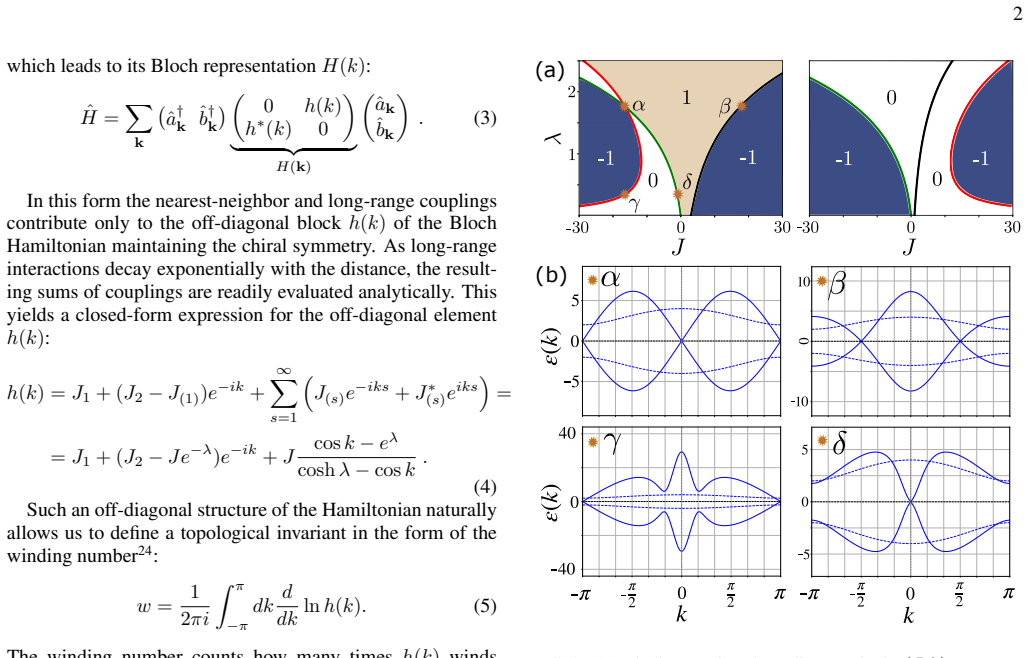
In the extended Su-Schrieffer-Heeger model with exponentially decaying long-range interactions, the topological transition is controlled by the interaction range such that even weak couplings suffice to change the topology when the range is sufficiently large.
What carries the argument
The spatial range of the exponentially decaying long-range interaction terms, which alters the effective band structure and drives the topological transition.
If this is right
- Topological phase transitions occur at lower coupling strengths once the interaction range is made larger.
- The phase boundary in the plane of coupling strength versus range moves to smaller strengths as range grows.
- Interaction range offers an independent control parameter for topological properties in one-dimensional chains.
Where Pith is reading between the lines
- Comparable range-dependent transitions may appear in two-dimensional systems with long-range hoppings.
- Platforms allowing tunable interaction decay, such as trapped ions or Rydberg arrays, could test the predicted range threshold.
- Models that ignore interaction range may underestimate the stability of topological phases in extended chains.
Load-bearing premise
The model uses a fixed nearest-neighbor Su-Schrieffer-Heeger coupling pattern combined with purely exponentially decaying longer-range terms in one dimension, without disorder or other interactions.
What would settle it
A calculation of the topological invariant such as the winding number that shows no transition when the interaction range is increased at fixed small coupling strength would falsify the claim.
Figures



read the original abstract
We study a one-dimensional topological model featuring a Su-Schrieffer-Heeger type pattern of nearest-neighbor couplings in combination with the longer-range interactions exponentially decaying with the distance. We demonstrate that even relatively weak long-range couplings can trigger the topological transition if their range is large enough. This provides an additional facet in the control of topological phases.
Editorial analysis
A structured set of objections, weighed in public.
Referee Report
Summary. The manuscript examines a one-dimensional topological insulator model consisting of a Su-Schrieffer-Heeger (SSH) nearest-neighbor hopping pattern supplemented by exponentially decaying longer-range couplings. The central claim is that even weak long-range terms can induce a topological phase transition provided their decay length is sufficiently large, thereby identifying interaction range as an additional control parameter for topological phases.
Significance. If substantiated, the result adds a concrete mechanism for tuning topological invariants via interaction range rather than strength alone, which may be relevant for platforms with tunable long-range couplings. The model itself is standard, but the emphasis on range as a tunable knob and the demonstration that weak but extended couplings suffice constitute a modest but useful extension of existing SSH literature.
major comments (2)
- [§3, Fig. 3] §3 (Numerical results), Fig. 3 and associated text: the phase diagrams and gap-closing points are shown for finite chains (L = 80–200). When the exponential decay length ξ approaches or exceeds L/2, the long-range terms effectively become uniform or periodic with the system size; the manuscript must demonstrate that the reported transitions survive for L ≫ ξ_max and include a finite-size scaling analysis or extrapolation of the topological invariant to the thermodynamic limit. Without this, the central claim that weak long-range couplings drive a bulk transition remains vulnerable to the finite-size artifact raised in the stress-test note.
- [§2, Eq. (2)] §2 (Model definition), Eq. (2): the longer-range term is written as J_r exp(−r/ξ) with r up to L−1. It is not stated whether open or periodic boundary conditions are used when ξ is large; periodic boundaries would introduce wrap-around contributions that alter the effective topology. Clarify the boundary conditions and show that the topological invariant (winding number or Zak phase) is computed consistently in the open-chain limit.
minor comments (3)
- [Abstract] The abstract states a 'demonstration'; the manuscript should replace this with 'numerical evidence' or 'observation in finite systems' until the thermodynamic-limit issue is resolved.
- [§2] Notation for the decay length is introduced as both 'range' and 'ξ' without a single consistent symbol; adopt one symbol throughout.
- [Introduction] Missing reference to prior works on long-range SSH models (e.g., papers on power-law or exponential tails in 1D topological chains) would help situate the novelty.
Simulated Author's Rebuttal
We thank the referee for the careful reading of our manuscript and for the constructive comments, which help strengthen the presentation of our results. We address each major comment below and have revised the manuscript to incorporate the requested clarifications and additional analyses.
read point-by-point responses
-
Referee: [§3, Fig. 3] §3 (Numerical results), Fig. 3 and associated text: the phase diagrams and gap-closing points are shown for finite chains (L = 80–200). When the exponential decay length ξ approaches or exceeds L/2, the long-range terms effectively become uniform or periodic with the system size; the manuscript must demonstrate that the reported transitions survive for L ≫ ξ_max and include a finite-size scaling analysis or extrapolation of the topological invariant to the thermodynamic limit. Without this, the central claim that weak long-range couplings drive a bulk transition remains vulnerable to the finite-size artifact raised in the stress-test note.
Authors: We agree that a careful treatment of finite-size effects is essential when ξ becomes comparable to the system size. In the revised manuscript we have added a finite-size scaling analysis of the winding number versus 1/L for several fixed values of ξ, together with data for chains up to L = 500. The extrapolated transition points remain finite and the phase boundaries converge to well-defined values in the thermodynamic limit. We have updated the text in §3 and the caption of Fig. 3 to present these extrapolations, confirming that the reported transitions are not finite-size artifacts and persist for L ≫ ξ. revision: yes
-
Referee: [§2, Eq. (2)] §2 (Model definition), Eq. (2): the longer-range term is written as J_r exp(−r/ξ) with r up to L−1. It is not stated whether open or periodic boundary conditions are used when ξ is large; periodic boundaries would introduce wrap-around contributions that alter the effective topology. Clarify the boundary conditions and show that the topological invariant (winding number or Zak phase) is computed consistently in the open-chain limit.
Authors: We thank the referee for noting this ambiguity. All results in the manuscript are obtained with open boundary conditions; the sum in Eq. (2) runs from r = 1 to L−1 with no periodic wrapping. The topological invariant is the winding number evaluated from the bulk Bloch Hamiltonian in the thermodynamic limit, cross-checked by the presence of zero-energy edge states in the open-chain spectra. We have inserted an explicit statement in §2 clarifying the use of open boundaries and the consistent computation of the invariant in the open-chain limit. revision: yes
Circularity Check
No circularity detected; derivation is self-contained
full rationale
The paper defines a standard one-dimensional SSH nearest-neighbor pattern augmented by exponentially decaying longer-range couplings and demonstrates that sufficiently long-ranged weak terms can induce topological transitions. This follows directly from the model Hamiltonian and its topological invariants or gap-closing conditions without any self-definitional loops, fitted inputs renamed as predictions, or load-bearing self-citations. The central claim is obtained by solving the specified equations rather than reducing to its own inputs by construction, making the analysis independent of the patterns that would indicate circularity.
Axiom & Free-Parameter Ledger
axioms (1)
- domain assumption The system is strictly one-dimensional with nearest-neighbor couplings following the Su-Schrieffer-Heeger pattern and additional exponentially decaying longer-range terms.
Lean theorems connected to this paper
-
IndisputableMonolith/Foundation/AlexanderDuality.leanalexander_duality_circle_linking unclear?
unclearRelation between the paper passage and the cited Recognition theorem.
We study a one-dimensional topological model featuring a Su-Schrieffer-Heeger type pattern of nearest-neighbor couplings in combination with the longer-range interactions exponentially decaying with the distance.
-
IndisputableMonolith/Cost/FunctionalEquation.leandAlembert_cosh_solution_aczel echoes?
echoesECHOES: this paper passage has the same mathematical shape or conceptual pattern as the Recognition theorem, but is not a direct formal dependency.
h(k) = J1 + (J2 - J e^{-λ})e^{-ik} + J (cosh λ - cos k)^{-1} ...
What do these tags mean?
- matches
- The paper's claim is directly supported by a theorem in the formal canon.
- supports
- The theorem supports part of the paper's argument, but the paper may add assumptions or extra steps.
- extends
- The paper goes beyond the formal theorem; the theorem is a base layer rather than the whole result.
- uses
- The paper appears to rely on the theorem as machinery.
- contradicts
- The paper's claim conflicts with a theorem or certificate in the canon.
- unclear
- Pith found a possible connection, but the passage is too broad, indirect, or ambiguous to say the theorem truly supports the claim.
Reference graph
Works this paper leans on
-
[1]
author author T. Ozawa , author H. M. \ Price , author A. Amo , author N. Goldman , author M. Hafezi , author L. Lu , author M. C. \ Rechtsman , author D. Schuster , author J. Simon , author O. Zilberberg ,\ and\ author I. Carusotto ,\ title title Topological photonics , \ https://doi.org/10.1103/RevModPhys.91.015006 journal journal Reviews of Modern Phys...
-
[2]
author author L. Lu , author J. D. \ Joannopoulos ,\ and\ author M. Soljačić ,\ title title Topological photonics , \ https://doi.org/10.1038/nphoton.2014.248 journal journal Nature Photonics \ volume 8 ,\ pages 821--829 ( year 2014 ) NoStop
-
[3]
author author A. B. \ Khanikaev \ and\ author G. Shvets ,\ title title Two-dimensional topological photonics , \ https://doi.org/10.1038/s41566-017-0048-5 journal journal Nature Photonics \ volume 11 ,\ pages 763--773 ( year 2017 ) NoStop
-
[4]
author author M. Z. \ Hasan \ and\ author C. L. \ Kane ,\ title title Colloquium: Topological insulators , \ https://doi.org/10.1103/revmodphys.82.3045 journal journal Reviews of Modern Physics \ volume 82 ,\ pages 3045--3067 ( year 2010 ) NoStop
-
[5]
author author D. Xiao , author M.-C. \ Chang ,\ and\ author Q. Niu ,\ title title Berry phase effects on electronic properties , \ https://doi.org/10.1103/revmodphys.82.1959 journal journal Reviews of Modern Physics \ volume 82 ,\ pages 1959--2007 ( year 2010 ) NoStop
-
[6]
author author T. Zhang , author Y. Jiang , author Z. Song , author H. Huang , author Y. He , author Z. Fang , author H. Weng ,\ and\ author C. Fang ,\ title title Catalogue of topological electronic materials , \ https://doi.org/https://doi.org/10.1038/s41586-019-0944-6 journal journal Nature \ volume 566 ,\ pages 475--479 ( year 2019 ) NoStop
-
[7]
author author M. C. \ Rechtsman , author J. M. \ Zeuner , author Y. Plotnik , author Y. Lumer , author D. Podolsky , author F. Dreisow , author S. Nolte , author M. Segev ,\ and\ author A. Szameit ,\ title title Photonic Floquet topological insulators , \ https://doi.org/10.1038/nature12066 journal journal Nature \ volume 496 ,\ pages 196--200 ( year 2013...
-
[8]
author author M. Hafezi , author S. Mittal , author J. Fan , author A. Migdall ,\ and\ author J. M. \ Taylor ,\ title title Imaging topological edge states in silicon photonics , \ https://doi.org/10.1038/nphoton.2013.274 journal journal Nature Photonics \ volume 7 ,\ pages 1001--1005 ( year 2013 ) NoStop
-
[9]
author author A. B. \ Khanikaev , author S. Hossein Mousavi , author W.-K. \ Tse , author M. Kargarian , author A. H. \ MacDonald ,\ and\ author G. Shvets ,\ title title Photonic topological insulators , \ https://doi.org/10.1038/nmat3520 journal journal Nature Materials \ volume 12 ,\ pages 233--239 ( year 2012 ) NoStop
-
[10]
author author T. Karzig , author C.-E. \ Bardyn , author N. H. \ Lindner ,\ and\ author G. Refael ,\ title title Topological Polaritons , \ https://doi.org/10.1103/physrevx.5.031001 journal journal Physical Review X \ volume 5 ,\ pages 031001 ( year 2015 ) NoStop
-
[11]
author author S. Klembt , author T. H. \ Harder , author O. A. \ Egorov , author K. Winkler , author R. Ge , author M. A. \ Bandres , author M. Emmerling , author L. Worschech , author T. C. H. \ Liew , author M. Segev , author C. Schneider ,\ and\ author S. Höfling ,\ title title Exciton-polariton topological insulator , \ https://doi.org/10.1038/s41586-...
-
[12]
author author N. Cooper , author J. Dalibard ,\ and\ author I. Spielman ,\ title title Topological bands for ultracold atoms , \ https://doi.org/10.1103/revmodphys.91.015005 journal journal Reviews of Modern Physics \ volume 91 ,\ pages 015005 ( year 2019 ) NoStop
-
[13]
author author D.-W. \ Zhang , author Y.-Q. \ Zhu , author Y. Zhao , author H. Yan ,\ and\ author S.-L. \ Zhu ,\ title title Topological quantum matter with cold atoms , \ https://doi.org/https://doi.org/10.1080/00018732.2019.1594094 journal journal Advances in Physics \ volume 67 ,\ pages 253--402 ( year 2018 ) NoStop
-
[14]
\ Shen ,\ @noop title Topological Insulators
author author S.-Q. \ Shen ,\ @noop title Topological Insulators. Dirac Equation in Condensed Matters \ ( publisher Springer, Heidelberg ,\ year 2012 ) NoStop
work page 2012
-
[15]
author author J. Asboth , author L. Oroszlany ,\ and\ author A. Palyi ,\ @noop title A Short Course on Topological Insulators \ ( publisher Springer, Heidelberg ,\ year 2016 ) NoStop
work page 2016
-
[16]
author author W. P. \ Su , author J. R. \ Schrieffer ,\ and\ author A. J. \ Heeger ,\ title title Solitons in Polyacetylene , \ https://doi.org/10.1103/physrevlett.42.1698 journal journal Physical Review Letters \ volume 42 ,\ pages 1698--1701 ( year 1979 ) NoStop
-
[17]
author author A. J. \ Heeger , author S. Kivelson , author J. R. \ Schrieffer ,\ and\ author W. P. \ Su ,\ title title Solitons in conducting polymers , \ https://doi.org/10.1103/revmodphys.60.781 journal journal Reviews of Modern Physics \ volume 60 ,\ pages 781--850 ( year 1988 ) NoStop
-
[18]
author author B. Perez-Gonzalez , author M. Bello , author A. Gomez-Leon ,\ and\ author G. Platero ,\ title title Interplay between long-range hopping and disorder in topological systems , \ https://doi.org/10.1103/physrevb.99.035146 journal journal Physical Review B \ volume 99 ,\ pages 035146 ( year 2019 ) NoStop
-
[19]
author author Z. He , author D. A. \ Bobylev , author D. A. \ Smirnova , author D. V. \ Zhirihin , author M. A. \ Gorlach ,\ and\ author V. R. \ Tuz ,\ title title Reconfigurable topological states in arrays of bianisotropic particles , \ https://doi.org/10.1021/acsphotonics.2c00309 journal journal ACS Photonics \ volume 9 ,\ pages 2322--2326 ( year 2022 ) NoStop
-
[20]
author author P. Nevado , author S. Fern \'a ndez-Lorenzo ,\ and\ author D. Porras ,\ title title Topological edge states in periodically driven trapped-ion chains , \ https://doi.org/https://doi.org/10.1103/PhysRevLett.119.210401 journal journal Physical Review Letters \ volume 119 ,\ pages 210401 ( year 2017 ) NoStop
-
[21]
author author J. Schulz , author C. J\" o rg ,\ and\ author G. von Freymann ,\ title title Geometric control of next-nearest-neighbor coupling in evanescently coupled dielectric waveguides , \ https://doi.org/10.1364/OE.447921 journal journal Opt. Express \ volume 30 ,\ pages 9869--9877 ( year 2022 ) NoStop
-
[22]
author author M. Li , author D. Zhirihin , author M. Gorlach , author X. Ni , author D. Filonov , author A. Slobozhanyuk , author A. Alù ,\ and\ author A. B. \ Khanikaev ,\ title title Higher-order topological states in photonic kagome crystals with long-range interactions , \ https://doi.org/10.1038/s41566-019-0561-9 journal journal Nature Photonics \ vo...
-
[23]
author author N. A. \ Olekhno , author A. D. \ Rozenblit , author V. I. \ Kachin , author A. A. \ Dmitriev , author O. I. \ Burmistrov , author P. S. \ Seregin , author D. V. \ Zhirihin ,\ and\ author M. A. \ Gorlach ,\ title title Experimental realization of topological corner states in long-range-coupled electrical circuits , \ https://doi.org/10.1103/p...
-
[24]
author author S. Ryu \ and\ author Y. Hatsugai ,\ title title Topological origin of zero-energy edge states in particle-hole symmetric systems. \ https://doi.org/10.1103/physrevlett.89.077002 journal journal Physical Review Letters \ volume 89 ,\ pages 077002 ( year 2002 ) NoStop
-
[25]
author author J. Zak ,\ title title Berry's phase for energy bands in solids , \ https://doi.org/10.1103/PhysRevLett.62.2747 journal journal Phys. Rev. Lett. \ volume 62 ,\ pages 2747--2750 ( year 1989 ) NoStop
-
[26]
author author D. Thouless ,\ title title Electrons in disordered systems and the theory of localization , \ https://doi.org/https://doi.org/10.1016/0370-1573(74)90029-5 journal journal Physics Reports \ volume 13 ,\ pages 93--142 ( year 1974 ) NoStop
-
[27]
author author P. T. \ Dumitrescu , author J. G. \ Bohnet , author J. P. \ Gaebler , author A. Hankin , author D. Hayes , author A. Kumar , author B. Neyenhuis , author R. Vasseur ,\ and\ author A. C. \ Potter ,\ title title Dynamical topological phase realized in a trapped-ion quantum simulator , \ https://doi.org/10.1038/s41586-022-04853-4 journal journa...
-
[28]
author author C. Edmunds , author E. Rico , author I. Arrazola , author G. Brennen , author M. Meth , author R. Blatt ,\ and\ author M. Ringbauer ,\ title title Symmetry-Protected Topological Haldane Phase on a Qudit Quantum Processor , \ https://doi.org/10.1103/prxquantum.6.020349 journal journal PRX Quantum \ volume 6 ,\ pages 020349 ( year 2025 ) NoStop
-
[29]
author author O. Katz , author L. Feng , author D. Porras ,\ and\ author C. Monroe ,\ title title Observing Topological Insulator Phases with a Programmable Quantum Simulator , \ https://doi.org/https://doi.org/10.48550/arXiv.2401.10362 journal journal arXiv:2401.10362 \ ( year 2024 ),\ https://doi.org/10.48550/arXiv.2401.10362 NoStop
-
[30]
author author W. D. \ Newman , author C. L. \ Cortes , author A. Afshar , author K. Cadien , author A. Meldrum , author R. Fedosejevs ,\ and\ author Z. Jacob ,\ title title Observation of long-range dipole-dipole interactions in hyperbolic metamaterials , \ https://doi.org/10.1126/sciadv.aar5278 journal journal Science Advances \ volume 4 ,\ pages eaar527...
discussion (0)
Sign in with ORCID, Apple, or X to comment. Anyone can read and Pith papers without signing in.