Krylov Winding and Emergent Coherence in Operator Growth Dynamics
Pith reviewed 2026-05-18 12:35 UTC · model grok-4.3
The pith
In quantum chaotic systems the operator wavefunction acquires a phase that winds linearly with the Krylov index, producing size winding when a low-rank basis mapping and growth-bound saturation are present.
A machine-rendered reading of the paper's core claim, the machinery that carries it, and where it could break.
Core claim
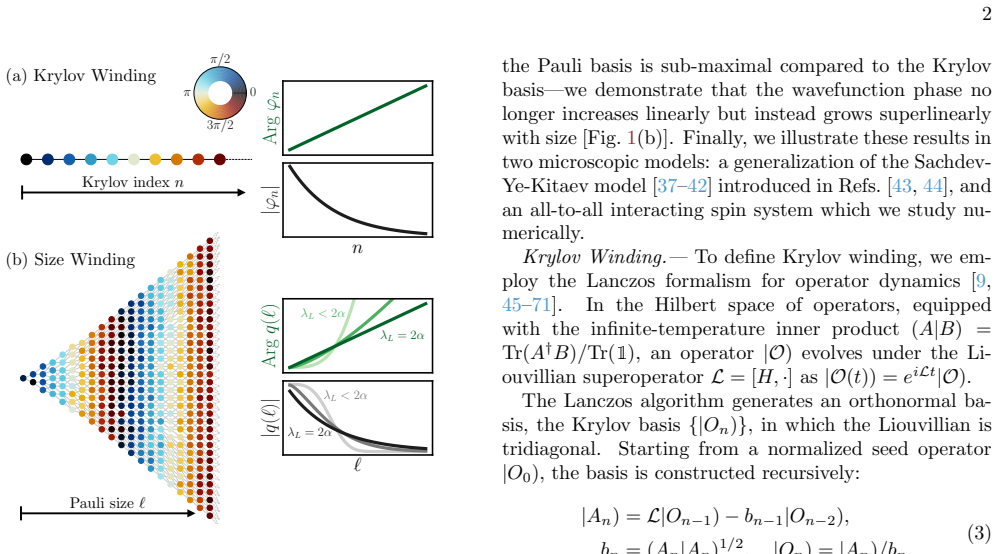
Krylov winding is a generic feature of quantum chaotic systems and is a direct consequence of the universal operator growth bound hypothesis. It gives rise to size winding under two additional conditions: a low-rank mapping between the Krylov and size bases, which ensures phase alignment among operators of the same size, and saturation of the chaos-operator growth bound λ_L ≤ 2α. For systems which do not saturate this bound, with h = λ_L / 2α < 1, the winding with Pauli size ℓ becomes superlinear, behaving as ℓ^{1/h}. These results are illustrated in the SYK model and its variants and in a disordered k-local spin model.
What carries the argument
Krylov winding: the linear increase of the phase of the operator wavefunction with the Krylov index, which follows from the universal operator growth bound and converts into size winding under a low-rank Krylov-to-size mapping plus bound saturation.
If this is right
- Size winding appears automatically once the low-rank mapping holds and the growth bound saturates.
- When saturation fails the phase grows as size to the power 1/h with h = λ_L / 2α.
- The same winding mechanism operates in both the SYK family and disordered k-local spin chains.
- Coherent phases in scrambled operators can arise without holography once the growth bound is respected.
Where Pith is reading between the lines
- The same winding structure could appear in other bases that are approximately low-rank related to the size basis, offering a route to detect chaos through phase measurements.
- Open-system extensions might show how dissipation modifies the superlinear regime when the bound is not saturated.
- Quantum simulators could test the predicted crossover from linear to superlinear winding by tuning the effective Lyapunov exponent.
Load-bearing premise
The low-rank mapping between the Krylov and size bases that produces phase alignment among all operators of the same size.
What would settle it
A measurement in a system known to saturate λ_L = 2α that finds the operator phase growing nonlinearly with size, or a chaotic system lacking the low-rank mapping that nevertheless shows size winding.
Figures


read the original abstract
The operator wavefunction provides a fine-grained description of quantum chaos and of the irreversible growth of simple operators into increasingly complex ones. Remarkably, at finite temperature this wavefunction can acquire a phase that increases linearly with the operator's size, a phenomenon called \emph{size winding}. Although size winding occurs naturally in a holographic setting, the emergence of a coherent phase in a scrambled operator remains mysterious from the standpoint of a thermalizing quantum many-body system. In this work, we elucidate this phenomenon by introducing the related concept of \textit{Krylov winding}, whereby the operator wavefunction acquires a phase which winds linearly with the Krylov index. We show that Krylov winding is a generic feature of quantum chaotic systems and is a direct consequence of the universal operator growth bound hypothesis. It gives rise to size winding under two additional conditions: (i) a low-rank mapping between the Krylov and size bases, which ensures phase alignment among operators of the same size, and (ii) the saturation of the ``chaos-operator growth'' bound $\lambda_L \leq 2 \alpha$ (with $\lambda_L$ the Lyapunov exponent and $\alpha$ the growth rate), which ensures a linear phase dependence on size. For systems which do not saturate this bound, with $h = \lambda_L / 2\alpha <1$, the winding with Pauli size $\ell$ becomes \emph{superlinear}, behaving as $\ell^{1/h}$. We illustrate these results with two classes of microscopic models: the Sachdev-Ye-Kitaev (SYK) model and its variants, and a disordered $k$-local spin model.
Editorial analysis
A structured set of objections, weighed in public.
Referee Report
Summary. The manuscript introduces Krylov winding, a linear phase accumulation with Krylov index in the operator wavefunction, as a generic feature of quantum chaotic systems that follows directly from the universal operator growth bound hypothesis. It further claims that, under two additional conditions—a low-rank mapping between the Krylov and size bases ensuring phase alignment for same-size operators, and saturation of the chaos bound λ_L ≤ 2α—this produces size winding with linear phase dependence on Pauli size ℓ; when the bound is not saturated (h = λ_L / 2α < 1), the dependence becomes superlinear as ℓ^{1/h}. Results are illustrated in the SYK model and a disordered k-local spin model.
Significance. If the claims hold, the work provides a valuable microscopic mechanism linking Krylov complexity to emergent size winding and coherence in thermalizing systems, extending beyond holographic settings. Explicit use of the universal growth bound, the derivation of superlinear scaling when h < 1, and concrete illustrations in SYK and spin models are positive features that support broader applicability in quantum chaos studies.
major comments (2)
- [Abstract] Abstract, paragraph on conditions for size winding: the low-rank mapping between Krylov and size bases (condition (i)) is presented as an independent additional requirement needed for phase alignment and linear size dependence, yet it is not derived from the universal operator growth bound hypothesis nor shown to be enforced by chaotic dynamics. This assumption is load-bearing for the central claim that Krylov winding generically produces size winding.
- [Model illustrations] Section on model illustrations: explicit checks confirming that the low-rank overlap matrix holds and that λ_L saturates 2α (or quantifying deviations via h) are not provided for the SYK and disordered spin examples, leaving the applicability of the size-winding conclusions dependent on unverified assumptions in the concrete cases.
minor comments (1)
- [Notation] The notation for the superlinear exponent 1/h and its relation to the phase dependence on ℓ should be tied to an explicit equation to improve clarity.
Simulated Author's Rebuttal
We thank the referee for the careful reading and constructive feedback on our manuscript. The comments help clarify the scope of our claims regarding Krylov winding and its relation to size winding. We respond to each major comment below and indicate where revisions will be made.
read point-by-point responses
-
Referee: [Abstract] Abstract, paragraph on conditions for size winding: the low-rank mapping between Krylov and size bases (condition (i)) is presented as an independent additional requirement needed for phase alignment and linear size dependence, yet it is not derived from the universal operator growth bound hypothesis nor shown to be enforced by chaotic dynamics. This assumption is load-bearing for the central claim that Krylov winding generically produces size winding.
Authors: We agree that the low-rank mapping is presented as an additional condition rather than a direct consequence of the universal operator growth bound. The manuscript derives Krylov winding (linear phase accumulation with Krylov index) strictly from the bound hypothesis, while size winding requires the two extra conditions to ensure phase alignment across same-size operators and linear (or superlinear) dependence on Pauli size. We do not claim that chaotic dynamics universally enforces the low-rank property; it is a physically motivated assumption that facilitates the mapping in the systems of interest. In the revised manuscript, we will update the abstract and relevant sections to emphasize this separation more explicitly and discuss the motivation for the low-rank condition without implying it follows automatically from chaos. revision: partial
-
Referee: [Model illustrations] Section on model illustrations: explicit checks confirming that the low-rank overlap matrix holds and that λ_L saturates 2α (or quantifying deviations via h) are not provided for the SYK and disordered spin examples, leaving the applicability of the size-winding conclusions dependent on unverified assumptions in the concrete cases.
Authors: We concur that adding explicit verifications would strengthen the link between the general framework and the model results. For the SYK model, the chaos bound saturation (h=1) is known from prior literature, but we will include a direct computation or reference to the overlap matrix rank. For the disordered k-local spin model, we will add numerical or analytical estimates of the Krylov-size overlap matrix and the value of h to confirm or quantify deviations from the assumptions. These additions will be placed in the main text or an appendix of the revised version. revision: yes
Circularity Check
No significant circularity; Krylov winding follows from external growth bound with explicit additional conditions stated
full rationale
The paper states that Krylov winding is a direct consequence of the external universal operator growth bound hypothesis. Size winding is derived only after introducing two additional conditions (low-rank mapping and saturation of λ_L ≤ 2α) that are presented as independent requirements rather than derived internally. The parameter h = λ_L / 2α is defined from these quantities to describe superlinear behavior when the bound is not saturated, but this is a straightforward re-expression, not a fit renamed as prediction. No self-citation forms a load-bearing chain, no ansatz is smuggled, and no quantity is defined in terms of itself. The derivation chain remains self-contained against the stated external hypothesis and explicit assumptions.
Axiom & Free-Parameter Ledger
axioms (1)
- domain assumption universal operator growth bound hypothesis
Lean theorems connected to this paper
-
IndisputableMonolith/Cost/FunctionalEquation.leanwashburn_uniqueness_aczel; dAlembert_cosh_solution_aczel echoes?
echoesECHOES: this paper passage has the same mathematical shape or conceptual pattern as the Recognition theorem, but is not a direct formal dependency.
Krylov wavefunction φ_n(t_β) = sqrt[...] tanh[α(t_β)]^n / cosh[α(t_β)]^{2Δ} with phase θ_K(t) = Arg[tanh(α t_β)] and exponential decay exp(−2 n e^{-2α t} cos(α β/2))
-
IndisputableMonolith/Foundation/AlphaCoordinateFixation.leanalpha_pin_under_high_calibration; J_uniquely_calibrated_via_higher_derivative refines?
refinesRelation between the paper passage and the cited Recognition theorem.
Operator growth hypothesis b_n ∼ α n; chaos-operator growth bound λ_L ≤ 2α with h = λ_L / 2α controlling linear vs superlinear winding ℓ^{1/h}
What do these tags mean?
- matches
- The paper's claim is directly supported by a theorem in the formal canon.
- supports
- The theorem supports part of the paper's argument, but the paper may add assumptions or extra steps.
- extends
- The paper goes beyond the formal theorem; the theorem is a base layer rather than the whole result.
- uses
- The paper appears to rely on the theorem as machinery.
- contradicts
- The paper's claim conflicts with a theorem or certificate in the canon.
- unclear
- Pith found a possible connection, but the passage is too broad, indirect, or ambiguous to say the theorem truly supports the claim.
Reference graph
Works this paper leans on
-
[1]
P. Hayden and J. Preskill, Black holes as mirrors: quan- tum information in random subsystems, Journal of High Energy Physics2007, 120–120 (2007)
work page 2007
-
[2]
Y. Sekino and L. Susskind, Fast scramblers, Journal of High Energy Physics2008, 065–065 (2008)
work page 2008
-
[3]
J. Maldacena, S. H. Shenker, and D. Stanford, A bound on chaos, Journal of High Energy Physics2016, 10.1007/jhep08(2016)106 (2016)
-
[4]
S. H. Shenker and D. Stanford, Black holes and the butterfly effect, Journal of High Energy Physics2014, 10.1007/jhep03(2014)067 (2014)
-
[5]
S. H. Shenker and D. Stanford, Stringy effects in scram- bling (2015), arXiv:1412.6087 [hep-th]
work page internal anchor Pith review Pith/arXiv arXiv 2015
-
[6]
P. Hosur, X.-L. Qi, D. A. Roberts, and B. Yoshida, Chaos in quantum channels, Journal of High Energy Physics 2016, 10.1007/jhep02(2016)004 (2016)
-
[7]
D. A. Roberts, D. Stanford, and L. Susskind, Local- ized shocks, Journal of High Energy Physics2015, 10.1007/jhep03(2015)051 (2015)
- [8]
-
[9]
D. E. Parker, X. Cao, A. Avdoshkin, T. Scaffidi, and E. Altman, A universal operator growth hypothesis, Phys. Rev. X9, 041017 (2019)
work page 2019
-
[10]
C. W. von Keyserlingk, T. Rakovszky, F. Pollmann, and S. L. Sondhi, Operator hydrodynamics, otocs, and en- tanglement growth in systems without conservation laws, Physical Review X8, 021013 (2018)
work page 2018
-
[11]
Swingle, Unscrambling the physics of out-of-time- order correlators, Nature Physics14, 988 (2018)
B. Swingle, Unscrambling the physics of out-of-time- order correlators, Nature Physics14, 988 (2018)
work page 2018
-
[12]
V. Khemani, A. Vishwanath, and D. A. Huse, Operator spreading and the emergence of dissipative hydrodynam- ics under unitary evolution with conservation laws, Phys. Rev. X8, 031057 (2018)
work page 2018
- [13]
-
[14]
J. Kim, E. Altman, and X. Cao, Dirac fast scramblers, Phys. Rev. B103, L081113 (2021)
work page 2021
-
[15]
D. A. Roberts and B. Yoshida, Chaos and complex- ity by design, Journal of High Energy Physics2017, 10.1007/jhep04(2017)121 (2017)
-
[16]
C. Von Keyserlingk, F. Pollmann, and T. Rakovszky, Op- erator backflow and the classical simulation of quantum transport, Physical Review B105, 245101 (2022)
work page 2022
-
[17]
X. Mi, P. Roushan, C. Quintana, S. Mandra, J. Mar- shall, C. Neill, F. Arute, K. Arya, J. Atalaya, R. Bab- bush,et al., Information scrambling in quantum circuits, Science374, 1479 (2021)
work page 2021
- [18]
-
[19]
M. G¨ arttner, J. G. Bohnet, A. Safavi-Naini, M. L. Wall, J. J. Bollinger, and A. M. Rey, Measuring out-of-time- order correlations and multiple quantum spectra in a trapped-ion quantum magnet, Nature Physics13, 781 (2017)
work page 2017
-
[20]
J. Li, R. Fan, H. Wang, B. Ye, B. Zeng, H. Zhai, X. Peng, and J. Du, Measuring out-of-time-order correlators on a nuclear magnetic resonance quantum simulator, Physical Review X7, 031011 (2017)
work page 2017
-
[21]
X.-L. Qi and A. Streicher, Quantum epidemiology: op- erator growth, thermal effects, and syk, Journal of High Energy Physics2019, 10.1007/jhep08(2019)012 (2019)
-
[22]
Here the inner product is defined as (A|B) = Tr[A †B]
-
[23]
A. R. Brown, H. Gharibyan, S. Leichenauer, H. W. Lin, S. Nezami, G. Salton, L. Susskind, B. Swingle, and M. Walter, Quantum gravity in the lab. i. teleporta- tion by size and traversable wormholes, PRX quantum 4, 010320 (2023)
work page 2023
- [24]
-
[25]
P. Gao, D. L. Jafferis, and A. C. Wall, Traversable worm- holes via a double trace deformation, Journal of High Energy Physics2017, 1 (2017)
work page 2017
-
[26]
J. Maldacena, D. Stanford, and Z. Yang, Diving into traversable wormholes, Fortschritte der Physik65, 1700034 (2017)
work page 2017
-
[27]
Efficient decoding for the Hayden-Preskill protocol
B. Yoshida and A. Kitaev, Efficient decoding for the hayden-preskill protocol, arXiv preprint arXiv:1710.03363 (2017)
work page internal anchor Pith review Pith/arXiv arXiv 2017
-
[28]
K. A. Landsman, C. Figgatt, T. Schuster, N. M. Linke, B. Yoshida, N. Y. Yao, and C. Monroe, Verified quantum information scrambling, Nature567, 61 (2019)
work page 2019
-
[29]
M. S. Blok, V. V. Ramasesh, T. Schuster, K. O’Brien, J.-M. Kreikebaum, D. Dahlen, A. Morvan, B. Yoshida, N. Y. Yao, and I. Siddiqi, Quantum information scram- bling on a superconducting qutrit processor, Physical Re- view X11, 021010 (2021)
work page 2021
-
[30]
T. Schuster, B. Kobrin, P. Gao, I. Cong, E. T. Khabi- boulline, N. M. Linke, M. D. Lukin, C. Monroe, B. Yoshida, and N. Y. Yao, Many-body quantum telepor- tation via operator spreading in the traversable wormhole protocol, Phys. Rev. X12, 031013 (2022)
work page 2022
-
[31]
F. M. Haehl, A. Streicher, and Y. Zhao, Six-point func- tions and collisions in the black hole interior, Journal of High Energy Physics2021, 1 (2021)
work page 2021
-
[32]
H. W. Lin, J. Maldacena, and Y. Zhao, Symmetries near the horizon, Journal of High Energy Physics2019(2019)
work page 2019
-
[33]
T.-G. Zhou, Y. Gu, and P. Zhang, Size winding mech- anism beyond maximal chaos, Journal of High Energy Physics2024, 10.1007/jhep11(2024)044 (2024)
-
[34]
Gao, Commuting syk: a pseudo-holographic model, Journal of High Energy Physics2024, 1 (2024)
P. Gao, Commuting syk: a pseudo-holographic model, Journal of High Energy Physics2024, 1 (2024)
work page 2024
-
[35]
D. Jafferis, A. Zlokapa, J. D. Lykken, D. K. Kolch- meyer, S. I. Davis, N. Lauk, H. Neven, and M. Spiropulu, Traversable wormhole dynamics on a quantum processor, Nature612, 51 (2022)
work page 2022
- [36]
-
[37]
S. Sachdev and J. Ye, Gapless spin-fluid ground state in a random quantum Heisenberg magnet, Phys. Rev. Lett. 70, 3339 (1993)
work page 1993
-
[38]
Sachdev, Bekenstein-Hawking Entropy and Strange Metals, Phys
S. Sachdev, Bekenstein-Hawking Entropy and Strange Metals, Phys. Rev. X5, 041025 (2015)
work page 2015
-
[39]
A. Kitaev, A simple model of quantum holography, http://online.kitp.ucsb.edu/online/entangled15/kitaev/ (2015)
work page 2015
-
[40]
J. Maldacena and D. Stanford, Remarks on the Sachdev- Ye-Kitaev model, Phys. Rev. D94, 106002 (2016)
work page 2016
-
[41]
A. Kitaev and S. J. Suh, The soft mode in the sachdev- ye-kitaev model and its gravity dual, Journal of High Energy Physics2018, 10.1007/jhep05(2018)183 (2018)
-
[42]
D. Chowdhury, A. Georges, O. Parcollet, and S. Sachdev, Sachdev-Ye-Kitaev models and beyond: Window into non-Fermi liquids, Rev. Mod. Phys.94, 035004 (2022)
work page 2022
-
[43]
Y. Chen, H. Zhai, and P. Zhang, Tunable quantum chaos in the sachdev-ye-kitaev model coupled to a thermal bath, Journal of High Energy Physics2017, 10.1007/jhep07(2017)150 (2017)
- [44]
-
[45]
V. Viswanath and G. Muller,The Recursion Method: Ap- plications to Many-body Dynamics(Springer, New York, 2008)
work page 2008
- [46]
-
[47]
D. E. Parker, X. Cao, and M. P. Zaletel, Local matrix product operators: Canonical form, compression, and control theory, Phys. Rev. B102, 035147 (2020)
work page 2020
-
[48]
X. Cao, A statistical mechanism for operator growth, 7 Journal of Physics A: Mathematical and Theoretical54, 144001 (2021)
work page 2021
- [49]
-
[50]
A. De, U. Borla, X. Cao, and S. Gazit, Stochastic sam- pling of operator growth dynamics, Phys. Rev. B110, 155135 (2024)
work page 2024
-
[51]
B. Bhattacharjee, X. Cao, P. Nandy, and T. Pathak, Krylov complexity in saddle-dominated scrambling, Journal of High Energy Physics2022, 174 (2022)
work page 2022
- [52]
-
[53]
E. Rabinovici, A. S´ anchez-Garrido, R. Shir, and J. Son- ner, Krylov complexity, arXiv preprint (2025), submitted on 8 July 2025, arXiv:2507.06286 [hep-th]
work page internal anchor Pith review Pith/arXiv arXiv 2025
-
[54]
B. Bhattacharjee, X. Cao, P. Nandy, and T. Pathak, Op- erator growth in open quantum systems: lessons from the dissipative SYK, arXiv e-prints , arXiv:2212.06180 (2022), arXiv:2212.06180 [quant-ph]
-
[55]
B. Bhattacharjee, S. Sur, and P. Nandy, Probing quan- tum scars and weak ergodicity-breaking through quan- tum complexity (2022)
work page 2022
- [56]
-
[57]
P. Caputa and S. Liu, Quantum complexity and topolog- ical phases of matter (2022)
work page 2022
-
[58]
E. Rabinovici, A. S´ anchez-Garrido, R. Shir, and J. Sonner, Krylov complexity from integrability to chaos, Journal of High Energy Physics2022, 10.1007/jhep07(2022)151 (2022)
-
[59]
F. B. Trigueros and C.-J. Lin, Krylov complexity of many-body localization: Operator localization in Krylov basis, SciPost Phys.13, 037 (2022)
work page 2022
- [60]
-
[61]
A. Dymarsky and M. Smolkin, Krylov complexity in con- formal field theory, Phys. Rev. D104, L081702 (2021)
work page 2021
-
[62]
B. Bhattacharjee, P. Nandy, and T. Pathak, Krylov com- plexity in large-qand double-scaled syk model (2022)
work page 2022
-
[63]
Baek, Krylov complexity in inverted harmonic oscilla- tor (2022)
S. Baek, Krylov complexity in inverted harmonic oscilla- tor (2022)
work page 2022
-
[64]
Fan, Universal relation for operator complexity, Phys
Z.-Y. Fan, Universal relation for operator complexity, Phys. Rev. A105, 062210 (2022)
work page 2022
-
[65]
Guo, Operator growth in su(2) yang-mills theory (2022)
S. Guo, Operator growth in su(2) yang-mills theory (2022)
work page 2022
-
[66]
E. Rabinovici, A. S´ anchez-Garrido, R. Shir, and J. Son- ner, Operator complexity: a journey to the edge of krylov space, Journal of High Energy Physics2021, 10.1007/jhep06(2021)062 (2021)
-
[67]
C. Liu, H. Tang, and H. Zhai, Krylov complexity in open quantum systems (2022)
work page 2022
-
[68]
E. Rabinovici, A. S´ anchez-Garrido, R. Shir, and J. Sonner, Krylov localization and suppression of complexity, Journal of High Energy Physics2022, 10.1007/jhep03(2022)211 (2022)
-
[69]
A. Bhattacharya, P. Nandy, P. P. Nath, and H. Sahu, Operator growth and krylov construction in dissipative open quantum systems (2022)
work page 2022
-
[70]
V. Balasubramanian, P. Caputa, J. M. Magan, and Q. Wu, Quantum chaos and the complexity of spread of states, Phys. Rev. D106, 046007 (2022)
work page 2022
-
[71]
W. M¨ uck and Y. Yang, Krylov complexity and orthogo- nal polynomials, Nuclear Physics B984, 115948 (2022)
work page 2022
-
[72]
We note that this interpretation is “dual” to the one in holography, where sizelis regarded as momentum andµ gives the position
-
[73]
C. Baldwin and B. Swingle, Quenched vs annealed: Glassiness from sk to syk, Physical Review X10, 10.1103/physrevx.10.031026 (2020)
-
[74]
This is easily shown using the interlacing theorem since Mnm is a submatrix of the matrix representation of a projector
-
[75]
B. Bhattacharjee, X. Cao, P. Nandy, and T. Pathak, Op- erator growth in open quantum systems: lessons from the dissipative syk, Journal of High Energy Physics2023, 54 (2023)
work page 2023
-
[76]
Y. Gu and A. Kitaev, On the relation between the mag- nitude and exponent of otocs, Journal of High Energy Physics2019, 10.1007/jhep02(2019)075 (2019)
-
[77]
Y. Gu, A. Kitaev, and P. Zhang, A two-way approach to out-of-time-order correlators, Journal of High Energy Physics2022, 10.1007/jhep03(2022)133 (2022)
-
[78]
P. Zhang and Y. Gu, Operator size distribution in large n quantum mechanics of majorana fermions, Journal of High Energy Physics2023, 10.1007/jhep10(2023)018 (2023)
-
[79]
P. Zhang, Y. Gu, and A. Kitaev, An obstacle to sub-ads holography for syk-like models, Journal of High Energy Physics2021, 10.1007/jhep03(2021)094 (2021)
-
[80]
P. Zhang, Information scrambling and entangle- ment dynamics of complex brownian sachdev-ye- kitaev models, Journal of High Energy Physics2023, 10.1007/jhep04(2023)105 (2023)
discussion (0)
Sign in with ORCID, Apple, or X to comment. Anyone can read and Pith papers without signing in.