Well quasi-order and atomicity for combinatorial structures under consecutive orders
Pith reviewed 2026-05-18 10:48 UTC · model grok-4.3
The pith
A general framework decides well quasi-order and atomicity for avoidance sets of combinatorial structures under consecutive orders.
A machine-rendered reading of the paper's core claim, the machinery that carries it, and where it could break.
Core claim
We establish a general framework which enables us to answer these problems for a wide class of combinatorial structures, including graphs, digraphs and collections of relations.
What carries the argument
The general framework that extends recent approaches to consecutive embedding orders, deciding well quasi-order and atomicity of avoidance sets.
If this is right
- The framework decides well quasi-order of avoidance sets for any finite forbidden collection in the poset of graphs under consecutive order.
- It decides atomicity of the same avoidance sets.
- Both decisions apply directly to digraphs under consecutive order.
- Both decisions apply directly to collections of relations under consecutive order.
Where Pith is reading between the lines
- The same framework could be tested on consecutive orders for other structures such as permutations or words to see whether the decidability carries over.
- It connects the two properties of well quasi-order and atomicity through a single set of reduction conditions that future work might simplify further.
- If the framework is algorithmic, it would yield effective procedures for checking these properties on small forbidden sets.
Load-bearing premise
The consecutive embedding order on the structures permits extending recent approaches into one general framework that covers graphs, digraphs and collections of relations without additional restrictions.
What would settle it
A concrete finite set of forbidden structures on graphs under consecutive order for which the framework fails to decide whether the avoidance set is well quasi-ordered or atomic.
Figures



read the original abstract
We consider partially ordered sets of combinatorial structures under consecutive orders, meaning that two structures are related when one embeds in the other such that `consecutive' elements remain consecutive in the image. Given such a partially ordered set, we may ask decidability questions about its avoidance sets: subsets defined by a finite number of forbidden substructures. Two such questions ask, given a finite set of structures, whether its avoidance set is well quasi-ordered (i.e. contains no infinite antichains) or atomic (i.e. cannot be expressed as the union of two proper subsets). Extending some recent new approaches, we will establish a general framework, which enables us to answer these problems for a wide class of combinatorial structures, including graphs, digraphs and collections of relations.
Editorial analysis
A structured set of objections, weighed in public.
Referee Report
Summary. The manuscript develops a general framework for analyzing decidability of well-quasi-ordering and atomicity for avoidance sets of combinatorial structures under consecutive embedding orders. It extends recent approaches to cover a wide class including graphs, digraphs, and collections of relations, providing uniform methods to determine these properties from finite sets of forbidden substructures.
Significance. If the central construction holds, the work supplies a unified, extensible tool for longstanding decidability questions in combinatorial order theory. The consistent inductive arguments on forbidden substructures and absence of hidden uniformity restrictions across the stated classes represent a clear strength, building directly on prior work while broadening its scope.
minor comments (2)
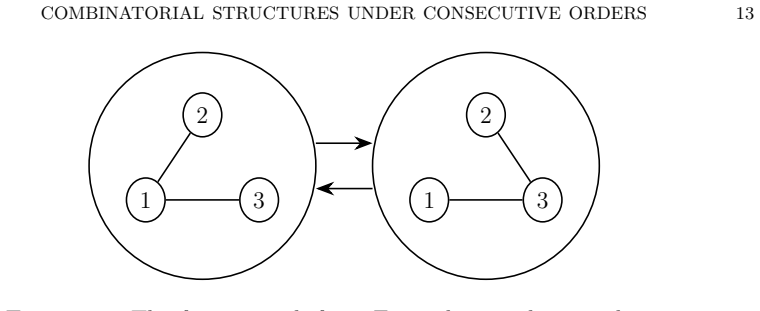
- The definition of consecutive embedding is introduced without an early illustrative example; adding a small diagram or concrete instance in the opening definitions section would improve accessibility for readers from adjacent areas of combinatorics.
- Notation for the poset of structures and the avoidance set operator is used consistently but could be summarized in a single table or notation box to reduce cross-referencing.
Simulated Author's Rebuttal
We thank the referee for the positive summary, the recognition of the framework's potential for unifying decidability results across graphs, digraphs and relations, and the recommendation of minor revision. The report raises no specific major comments, so we have no individual points to address.
Circularity Check
No significant circularity; framework extends prior approaches independently
full rationale
The derivation establishes a general framework for WQO and atomicity questions on avoidance sets under consecutive embeddings by extending recent approaches to a wide class of structures (graphs, digraphs, relation collections). Definitions of consecutive order and inductive arguments on forbidden substructures are developed directly from the poset setup without reducing to self-definitions, fitted parameters renamed as predictions, or load-bearing self-citations that force the central claims. The construction remains self-contained, with independent applicability to the stated class and no equations or steps that collapse by construction to the inputs.
discussion (0)
Sign in with ORCID, Apple, or X to comment. Anyone can read and Pith papers without signing in.