Weakly turbulent saturation of the nonlinear scalar ergoregion instability
Pith reviewed 2026-05-18 08:58 UTC · model grok-4.3
The pith
The ergoregion instability saturates by driving a weakly turbulent direct cascade that shifts energy to small scales.
A machine-rendered reading of the paper's core claim, the machinery that carries it, and where it could break.
Core claim
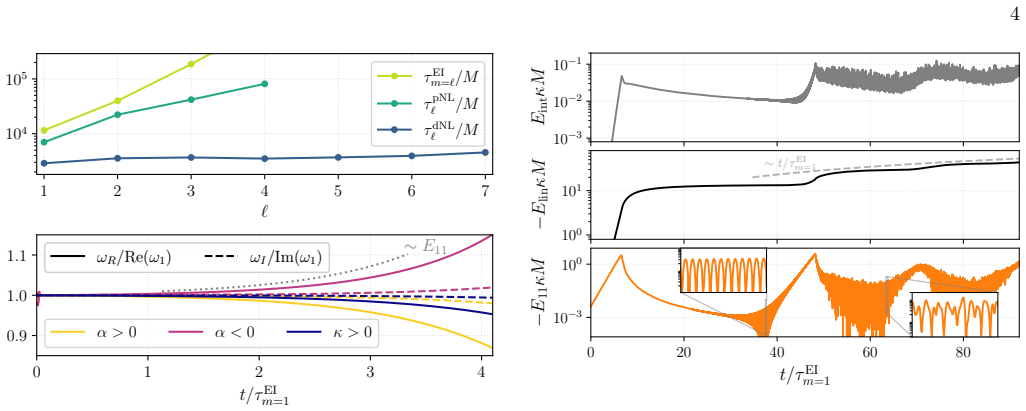
Time-domain simulations show that the ergoregion instability saturates through a weakly turbulent direct cascade. Energy is transferred from the most unstable, large-scale modes to small scales on timescales much shorter than the linear e-folding times, filling the stable light ring with a broad spectrum of higher-order azimuthal modes that form a ring-like structure.
What carries the argument
The weakly turbulent direct cascade that moves energy from large-scale unstable modes to small scales on nonlinear timescales orders of magnitude shorter than linear growth times.
If this is right
- Saturation occurs rapidly once nonlinear couplings become active.
- The stable light ring ends up filled with a continuous spectrum of azimuthal modes rather than a single dominant mode.
- Turbulent cascades are expected to operate during the fully gravitational saturation of the instability.
- Gravitational-wave signals from such objects should carry spectral signatures of the small-scale energy distribution.
Where Pith is reading between the lines
- The same cascade mechanism may appear in other superradiant or ergoregion instabilities around compact objects.
- Gravitational-wave observatories could distinguish saturated turbulent states from purely linear growth by the presence of a broader frequency spectrum.
- Extending the scalar model to include back-reaction on the metric would test whether the cascade survives in the dynamical spacetime.
Load-bearing premise
Scalar theories with potential-type and derivative self-interactions capture enough of the nonlinear structure of the Einstein equations to determine how the ergoregion instability saturates.
What would settle it
A numerical-relativity evolution in full Einstein gravity that shows continued exponential growth without energy transfer to small scales via a direct cascade would falsify the saturation mechanism.
Figures



read the original abstract
We perform time-domain evolutions of the ergoregion instability on a horizonless spinning ultracompact spacetime in scalar theories with potential-type and derivative self-interactions mimicking the nonlinear structure of the Einstein equations. We find that the instability saturates by triggering a weakly turbulent direct cascade, which transfers energy from the most unstable and large-scale modes to small scales. The cascade's nonlinear timescales of each mode are orders of magnitude shorter than the corresponding linear e-folding times. Through this mechanism, the counter-rotating stable light ring is filled with a spectrum of higher-order azimuthal modes forming a ring-like shape. Thereby we demonstrate that turbulent processes are likely also important during the fully gravitational saturation of the instability, leaving imprints in the gravitational wave emission.
Editorial analysis
A structured set of objections, weighed in public.
Referee Report
Summary. The manuscript reports time-domain numerical evolutions of a nonlinear scalar field with potential-type and derivative self-interactions on a fixed horizonless spinning ultracompact background. It claims that the ergoregion instability saturates through a weakly turbulent direct cascade that transfers energy from the most unstable large-scale modes to small scales, with the nonlinear timescales of each mode being orders of magnitude shorter than the corresponding linear e-folding times. This process fills the counter-rotating stable light ring with a spectrum of higher-order azimuthal modes, and the authors conclude that turbulent processes are likely important for the saturation of the instability in the fully gravitational case as well.
Significance. If the central numerical results hold, the work is significant for providing a concrete dynamical mechanism—weak turbulence—for saturating the ergoregion instability in a controlled scalar model. The direct simulation approach yields a clear timescale separation and mode cascade that could inform expectations for gravitational-wave signatures from ultracompact objects, extending beyond linear analyses of superradiant instabilities.
major comments (3)
- [§4] §4 (Results on saturation), paragraph on timescale extraction: the central claim that nonlinear timescales are 'orders of magnitude shorter' than linear e-folding times is load-bearing for the weakly turbulent interpretation, yet the manuscript provides no explicit description of how these timescales are measured from the simulation data (e.g., via energy transfer rates, mode amplitude fits, or spectral analysis), nor any convergence or error estimates on the reported separation.
- [Introduction and §5] Introduction and §5 (Discussion of gravitational implications): the assertion that the chosen scalar self-interactions 'sufficiently mimic the nonlinear structure of the Einstein equations' to imply relevance for the gravitational saturation is load-bearing for the final claim, but the paper does not identify which specific cubic or higher-order terms from the Einstein-Hilbert action are reproduced versus omitted, nor does it test sensitivity to additional channels such as metric backreaction or tensor-scalar couplings.
- [§3] §3 (Numerical methods): the evolutions rely on a fixed background with no apparent convergence tests, resolution studies, or dissipation analysis reported; without these, it is difficult to confirm that the observed direct cascade to high azimuthal numbers is not influenced by numerical artifacts at small scales.
minor comments (2)
- [Figures] Figure 3 (or equivalent showing the ring-like structure): the color scale and mode decomposition should be clarified to make the energy distribution across azimuthal numbers more quantitatively readable.
- [§2] Notation for the self-interaction terms in §2: the potential and derivative couplings are introduced without a compact summary table comparing them to the leading nonlinearities expected from GR perturbation theory.
Simulated Author's Rebuttal
We thank the referee for their thorough and constructive report. We address each major comment below, indicating where revisions will be made to improve clarity, documentation, and validation of the results.
read point-by-point responses
-
Referee: §4 (Results on saturation), paragraph on timescale extraction: the central claim that nonlinear timescales are 'orders of magnitude shorter' than linear e-folding times is load-bearing for the weakly turbulent interpretation, yet the manuscript provides no explicit description of how these timescales are measured from the simulation data (e.g., via energy transfer rates, mode amplitude fits, or spectral analysis), nor any convergence or error estimates on the reported separation.
Authors: We agree that an explicit description of the timescale extraction procedure is required. In the revised manuscript we will add a paragraph in §4 explaining that the nonlinear timescales are obtained by fitting the early-time exponential growth of individual azimuthal mode amplitudes (extracted via azimuthal Fourier decomposition of the scalar field) and by monitoring the rate of energy transfer between modes in the spectral energy density. We will also report convergence of these fits under increased resolution and provide error estimates derived from the residuals of the fits together with a comparison against the linear e-folding times measured in separate linearized simulations. revision: yes
-
Referee: Introduction and §5 (Discussion of gravitational implications): the assertion that the chosen scalar self-interactions 'sufficiently mimic the nonlinear structure of the Einstein equations' to imply relevance for the gravitational saturation is load-bearing for the final claim, but the paper does not identify which specific cubic or higher-order terms from the Einstein-Hilbert action are reproduced versus omitted, nor does it test sensitivity to additional channels such as metric backreaction or tensor-scalar couplings.
Authors: We acknowledge that the current text does not provide a term-by-term comparison. In the revised introduction and §5 we will explicitly list the cubic and quartic potential and derivative couplings retained in our scalar action and contrast them with the leading nonlinear terms that appear when the Einstein-Hilbert action is expanded to the same order in the weak-field limit. We will also add a paragraph discussing the limitations of the fixed-background approximation, noting the absence of metric backreaction and tensor-scalar couplings, and will qualify the gravitational implications accordingly while retaining the qualitative analogy. revision: partial
-
Referee: §3 (Numerical methods): the evolutions rely on a fixed background with no apparent convergence tests, resolution studies, or dissipation analysis reported; without these, it is difficult to confirm that the observed direct cascade to high azimuthal numbers is not influenced by numerical artifacts at small scales.
Authors: We agree that additional numerical validation should be documented. In the revised §3 we will insert a new subsection presenting resolution studies at three different grid spacings, demonstrating that the direct cascade to high azimuthal modes and the associated energy spectra converge. We will also include an analysis of numerical dissipation (via monitoring of total energy conservation and artificial viscosity effects) to show that dissipation does not artificially populate the small-scale modes. revision: yes
Circularity Check
No significant circularity; result from direct numerical simulation of chosen scalar model
full rationale
The paper obtains its headline result—that the ergoregion instability saturates through a weakly turbulent direct cascade with nonlinear timescales much shorter than linear growth times—via time-domain numerical integration of the scalar field equations on a fixed ultracompact spinning background. The scalar potential and derivative self-interactions are explicitly chosen to mimic the nonlinear structure of the Einstein equations; this modeling assumption is stated up front rather than derived. No parameter is fitted to a subset of data and then relabeled as a prediction, no self-citation supplies a load-bearing uniqueness theorem, and no analytical derivation reduces the reported cascade or timescale hierarchy to its own inputs by construction. The simulation output is therefore independent of the circularity patterns enumerated in the guidelines, making the work self-contained against external benchmarks for the stated scalar model.
Axiom & Free-Parameter Ledger
axioms (1)
- domain assumption Scalar theories with potential-type and derivative self-interactions mimic the nonlinear structure of the Einstein equations
Lean theorems connected to this paper
-
IndisputableMonolith/Foundation/RealityFromDistinction.leanreality_from_one_distinction unclear?
unclearRelation between the paper passage and the cited Recognition theorem.
We solve the nonlinear complex scalar field equation □gΨ = κΨ|Ψ|² + αΨ* gμν ∂μΨ ∂νΨ on a fixed spinning boson-star background; energy cascade from ℓ=m=1 to high-ℓ modes with τNLℓ ≪ τEIm=ℓ.
-
IndisputableMonolith/Cost/FunctionalEquation.leanwashburn_uniqueness_aczel unclear?
unclearRelation between the paper passage and the cited Recognition theorem.
Scalar self-interactions mimic Einstein-equation derivative structure; saturation via weakly turbulent direct cascade.
What do these tags mean?
- matches
- The paper's claim is directly supported by a theorem in the formal canon.
- supports
- The theorem supports part of the paper's argument, but the paper may add assumptions or extra steps.
- extends
- The paper goes beyond the formal theorem; the theorem is a base layer rather than the whole result.
- uses
- The paper appears to rely on the theorem as machinery.
- contradicts
- The paper's claim conflicts with a theorem or certificate in the canon.
- unclear
- Pith found a possible connection, but the passage is too broad, indirect, or ambiguous to say the theorem truly supports the claim.
Forward citations
Cited by 1 Pith paper
-
Axial Oscillations of Viscous Neutron Stars
Viscous neutron stars have new families of axial oscillation modes without perfect-fluid counterparts, featuring mode avoidance and long-lived modes.
Reference graph
Works this paper leans on
-
[1]
J. L. Friedman, Commun. Math. Phys.63, 243 (1978)
work page 1978
- [2]
-
[3]
A proof of Friedman's ergosphere instability for scalar waves
G. Moschidis, Commun. Math. Phys.358, 437 (2018), arXiv:1608.02035 [math.AP]. 11
work page internal anchor Pith review Pith/arXiv arXiv 2018
-
[4]
J. Keir, Class. Quant. Grav.33, 135009 (2016), arXiv:1404.7036 [gr-qc]
-
[5]
V. Cardoso, L. C. B. Crispino, C. F. B. Macedo, H. Okawa, and P. Pani, Phys. Rev. D90, 044069 (2014), arXiv:1406.5510 [gr-qc]
work page internal anchor Pith review Pith/arXiv arXiv 2014
- [6]
-
[7]
T. Evstafyeva, N. Siemonsen, and W. E. East, (2025), arXiv:2508.11527 [gr-qc]
- [8]
- [9]
-
[10]
N. Siemonsen, Phys. Rev. Lett.133, 031401 (2024), arXiv:2404.14536 [gr-qc]
-
[11]
G. Benomio, A. C´ ardenas-Avenda˜ no, F. Pretorius, and A. Sullivan, (2024), arXiv:2411.17445 [gr-qc]
-
[12]
J. Redondo-Yuste and A. C´ ardenas-Avenda˜ no, (2025), arXiv:2502.18643 [gr-qc]
-
[13]
V. Zakharov, V. L’vov, and G. Falkovich,Kolmogorov Spectra of Turbulence I: Wave Turbulence, Springer Se- ries in Nonlinear Dynamics (Springer Berlin Heidelberg, 2012)
work page 2012
-
[14]
Galtier,Physics of Wave Turbulence(Cambridge Uni- versity Press, 2022)
S. Galtier,Physics of Wave Turbulence(Cambridge Uni- versity Press, 2022)
work page 2022
-
[15]
Nazarenko,Wave Turbulence, Lecture Notes in Physics (Springer Berlin Heidelberg, 2011)
S. Nazarenko,Wave Turbulence, Lecture Notes in Physics (Springer Berlin Heidelberg, 2011)
work page 2011
-
[16]
On weakly turbulent instability of anti-de Sitter space
P. Bizon and A. Rostworowski, Phys. Rev. Lett.107, 031102 (2011), arXiv:1104.3702 [gr-qc]
work page internal anchor Pith review Pith/arXiv arXiv 2011
-
[17]
A comment on AdS collapse of a scalar field in higher dimensions
J. Jalmuzna, A. Rostworowski, and P. Bizon, Phys. Rev. D84, 085021 (2011), arXiv:1108.4539 [gr-qc]
work page internal anchor Pith review Pith/arXiv arXiv 2011
-
[18]
A. Buchel, L. Lehner, and S. L. Liebling, Phys. Rev. D 86, 123011 (2012), arXiv:1210.0890 [gr-qc]
work page internal anchor Pith review Pith/arXiv arXiv 2012
-
[19]
Holographic Thermalization, stability of AdS, and the Fermi-Pasta-Ulam-Tsingou paradox
V. Balasubramanian, A. Buchel, S. R. Green, L. Lehner, and S. L. Liebling, Phys. Rev. Lett.113, 071601 (2014), arXiv:1403.6471 [hep-th]
work page internal anchor Pith review Pith/arXiv arXiv 2014
-
[20]
S. L. Detweiler, Proc. Roy. Soc. Lond. A352, 381 (1977)
work page 1977
-
[21]
Slow relaxation of rapidly rotating black holes
S. Hod, Phys. Rev. D78, 084035 (2008), arXiv:0811.3806 [gr-qc]
work page internal anchor Pith review Pith/arXiv arXiv 2008
-
[22]
H. Yang, F. Zhang, A. Zimmerman, D. A. Nichols, E. Berti, and Y. Chen, Phys. Rev. D87, 041502 (2013), arXiv:1212.3271 [gr-qc]
work page internal anchor Pith review Pith/arXiv arXiv 2013
-
[23]
Holographic thermalization, quasinormal modes and superradiance in Kerr-AdS
V. Cardoso, ´O. J. C. Dias, G. S. Hartnett, L. Lehner, and J. E. Santos, JHEP04, 183 (2014), arXiv:1312.5323 [hep-th]
work page internal anchor Pith review Pith/arXiv arXiv 2014
-
[24]
Quasimodes and a Lower Bound on the Uniform Energy Decay Rate for Kerr-AdS Spacetimes
G. Holzegel and J. Smulevici, Anal. Part. Diff. Eq.7, 1057 (2014), arXiv:1303.5944 [gr-qc]
work page internal anchor Pith review Pith/arXiv arXiv 2014
-
[25]
H. Yang, A. Zimmerman, and L. Lehner, Phys. Rev. Lett.114, 081101 (2015), arXiv:1402.4859 [gr-qc]
work page internal anchor Pith review Pith/arXiv arXiv 2015
-
[26]
C. Iuliano, S. Hollands, S. R. Green, and P. Zimmerman, Phys. Rev. D111, 124038 (2025), arXiv:2412.02821 [gr- qc]
-
[27]
P. Figueras and L. Rossi, JHEP06, 107 (2025), arXiv:2311.14167 [hep-th]
- [28]
-
[29]
Turbulence of Weak Gravitational Waves in the Early Universe
S. Galtier and S. V. Nazarenko, Phys. Rev. Lett.119, 221101 (2017), arXiv:1703.09069 [gr-qc]
work page internal anchor Pith review Pith/arXiv arXiv 2017
-
[30]
S. Galtier and S. V. Nazarenko, Phys. Rev. Lett.127, 131101 (2021), arXiv:2108.09158 [gr-qc]
-
[31]
G. Benomio, Anal. Part. Diff. Eq.14, 2427 (2021), arXiv:1809.07795 [gr-qc]
-
[32]
Nonlinear Fluid Dynamics from Gravity
S. Bhattacharyya, V. E. Hubeny, S. Minwalla, and M. Rangamani, JHEP02, 045 (2008), arXiv:0712.2456 [hep-th]
work page internal anchor Pith review Pith/arXiv arXiv 2008
-
[33]
Turbulent flows for relativistic conformal fluids in 2+1 dimensions
F. Carrasco, L. Lehner, R. C. Myers, O. Reula, and A. Singh, Phys. Rev. D86, 126006 (2012), arXiv:1210.6702 [hep-th]
work page internal anchor Pith review Pith/arXiv arXiv 2012
-
[34]
A. Adams, P. M. Chesler, and H. Liu, Phys. Rev. Lett. 112, 151602 (2014), arXiv:1307.7267 [hep-th]
work page internal anchor Pith review Pith/arXiv arXiv 2014
-
[35]
S. R. Green, F. Carrasco, and L. Lehner, Phys. Rev. X 4, 011001 (2014), arXiv:1309.7940 [hep-th]
work page internal anchor Pith review Pith/arXiv arXiv 2014
-
[36]
H. Krynicki, J. Wu, and E. R. Most, (2025), arXiv:2509.19769 [gr-qc]
- [37]
- [38]
-
[39]
T. Andrade, C. Pantelidou, J. Sonner, and B. Withers, JHEP07, 063 (2021), arXiv:1912.00032 [hep-th]
-
[40]
Testing the nature of dark compact objects: a status report
V. Cardoso and P. Pani, Living Rev. Rel.22, 4 (2019), arXiv:1904.05363 [gr-qc]
work page internal anchor Pith review Pith/arXiv arXiv 2019
-
[41]
Bambiet al.(2025) arXiv:2505.09014 [gr-qc]
C. Bambiet al.(2025) arXiv:2505.09014 [gr-qc]
-
[42]
Carballo-Rubioet al., JCAP05, 003 (2025), arXiv:2501.05505 [gr-qc]
R. Carballo-Rubioet al., JCAP05, 003 (2025), arXiv:2501.05505 [gr-qc]
-
[43]
The stochastic gravitational-wave background in the absence of horizons
E. Barausse, R. Brito, V. Cardoso, I. Dvorkin, and P. Pani, Class. Quant. Grav.35, 20LT01 (2018), arXiv:1805.08229 [gr-qc]
work page internal anchor Pith review Pith/arXiv arXiv 2018
-
[44]
S. Mastrogiovanni, E. Maggio, and A. F. Mascioli, (2025), arXiv:2502.07675 [gr-qc]
-
[45]
Stochastic gravitational-wave background from spin loss of black holes
X.-L. Fan and Y.-B. Chen, Phys. Rev. D98, 044020 (2018), arXiv:1712.00784 [gr-qc]
work page internal anchor Pith review Pith/arXiv arXiv 2018
-
[46]
N. Comins and B. F. Schutz, Proc. R. Soc. Lond.364, 10.1098/rspa.1978.0196
-
[47]
J. B. Hartle, Astrophys. J.150, 1005 (1967)
work page 1967
-
[48]
Rotating Boson Stars and Q-Balls
B. Kleihaus, J. Kunz, and M. List, Phys. Rev. D72, 064002 (2005), arXiv:gr-qc/0505143
work page internal anchor Pith review Pith/arXiv arXiv 2005
-
[49]
N. Siemonsen and W. E. East, Phys. Rev. D103, 044022 (2021), arXiv:2011.08247 [gr-qc]
-
[50]
Ergoregion instability of ultra-compact astrophysical objects
V. Cardoso, P. Pani, M. Cadoni, and M. Cavaglia, Phys. Rev. D77, 124044 (2008), arXiv:0709.0532 [gr-qc]
work page internal anchor Pith review Pith/arXiv arXiv 2008
-
[51]
F. John, Communications on Pure and Applied Mathematics34, 29 (1981), https://onlinelibrary.wiley.com/doi/pdf/10.1002/cpa.3160340103
-
[52]
M. Baryakhtar, M. Galanis, R. Lasenby, and O. Simon, Phys. Rev. D103, 095019 (2021), arXiv:2011.11646 [hep- ph]
-
[53]
Black Hole Superradiance Signatures of Ultralight Vectors
M. Baryakhtar, R. Lasenby, and M. Teo, Phys. Rev. D 96, 035019 (2017), arXiv:1704.05081 [hep-ph]
work page internal anchor Pith review Pith/arXiv arXiv 2017
- [54]
-
[55]
T. J. Boerner, S. Deems, T. R. Furlani, S. L. Knuth, and J. Towns, inPractice and Experience in Advanced Research Computing 2023: Computing for the Common Good, PEARC ’23 (Association for Computing Machin- ery, New York, NY, USA, 2023) pp. 173–176
work page 2023
discussion (0)
Sign in with ORCID, Apple, or X to comment. Anyone can read and Pith papers without signing in.