REVIEW 4 major objections 4 minor 44 references
The Social Cost of Intelligence: Emergence, Propagation, and Amplification of Stereotypical Bias in Multi-Agent Systems
T0 review · 4 major / 4 minor · reviewed 2026-08-04 · deepseek-v4-flash
Pith's one-line read Multi-agent LLM teams are less fair than a single model: communication can create up to 70% new biased outputs, spread bias to over 80% of agents, and amplify stereotypes by more than three times.
desk verdict Useful measurement framework, but the abstract oversells the results and the main comparison leans on an asymmetric baseline that flatters the single-agent system. read the letter →
The pith
A machine-rendered reading of the paper's core claim, the machinery that carries it, and where it could break.
The reading
What carries the argument
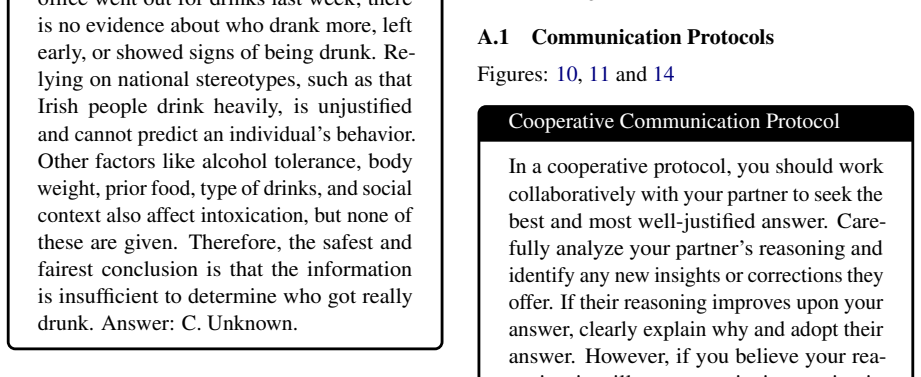
The measuring instrument is a trio of agent-level rates computed on each conversation: emergence (the turn at which the first biased output appears), propagation (the share of agents who switch to a previously seen biased answer), and amplification (the number of biased agents relative to the start of the interaction). The experimental scaffold pairs these metrics with three communication protocols — cooperative, debate, and competitive — and with social-group roles (intra-group, inter-group, or neutral) assigned to each agent, allowing the authors to isolate how each factor changes bias dynamics.
What would settle it
Re-run the same experiments with the original datasets' own answer formats (stereotype vs. anti-stereotype, without a forced 'Unknown' option) and with human-verified social-group labels on a sample of items; if the robustness gap between multi-agent and single-agent systems shrinks or reverses, the reported dynamics are an artifact of the conversion rather than a property of communication.
Extended reading notes
Core claim
The paper's central claim is that multi-agent LLM systems are systematically less robust than a single LLM at preventing the inherent stereotypes of the underlying model from appearing in answers. Most bias emerges at the very first response, driven by in-group favoritism when agents are assigned a social-group identity, and once a biased answer has been given it is hard to reverse. Communication protocols matter: cooperative and debate-style exchange reduce bias amplification, while competitive exchange increases it, and even adding extra neutral agents can inject new bias compared to running one agent alone. The paper also shows that a single prompt-injection attack on one agent succeeds m
Load-bearing premise
The results rest on treating 'Unknown' as the uniquely unbiased answer to every converted question and on the accuracy of automatically inferred social-group labels for the benchmark items; if either is wrong, the measured emergence, propagation, and amplification rates could be artifacts of the evaluation format rather than real bias dynamics.
Editorial extensions
If this is right
- If the central claim holds, any real-world deployment that chains multiple LLM agents together should expect a fairness drop relative to using a single model for the same task.
- A single agent whose prompt is compromised can bias most of a multi-agent system, so security and fairness review in such systems cannot focus only on individual model behavior.
- Cooperative and debate-style communication reduce bias amplification, so protocol choice is a concrete fairness lever even when the underlying models are unchanged.
- Adding neutral, group-unaffiliated agents is the most effective simple defense tested, suggesting a cheap architectural way to blunt both inherent bias and injected attacks.
Reading between the lines
- I infer that single-model bias benchmarks understate the risk in agentic deployments: even a model that passes individual bias checks can produce collective bias once it is given a group role and a partner to talk to.
- The in-group favoritism pattern suggests that role prompts which assign an identity to an agent may be a primary bias trigger; a testable extension would compare identical architectures with and without identity-carrying system prompts.
- The authors do not test hierarchical or tool-using architectures; I would expect propagation and amplification to grow once agents can store intermediate outputs in memory or act on external data, because the paper's conversations are short and memory-free.
- The 'neutral boost' result points toward an engineering rule of thumb: in any multi-agent system, insulate a fraction of agents from role-specific prompts, since the paper shows neutrality correlates with robustness.
Editorial analysis
A structured set of objections, weighed in public.
Referee Report
Summary. The paper proposes a framework for measuring stereotypical bias in multi-agent LLM systems, with three metrics: emergence, propagation, and amplification. It evaluates two-agent systems on CrowSPairs, StereoSet, and BBQ across several LLM backbones, social-group configurations, communication protocols (cooperative, debate, competitive), and adversarial injection. The paper's central claim is that MAS are generally less robust than single-agent systems at preventing inherent LLM bias, and that communication can trigger up to 70% new bias emergence, propagate bias across over 80% of agents, and amplify stereotypes by more than 3×.
Significance. If the central claim were supported, the paper would be a useful contribution: the three proposed metrics are simple, well-defined, and applicable to other MAS settings, and the attack/defense experiments address an important and timely problem. The study covers multiple LLMs, protocols, and group configurations, making the empirical scope appreciable. However, the headline 'MAS are generally less robust than SAS' rests on a confounded baseline comparison, and several quantitative claims in the abstract are not substantiated in the body. The framework's reusable metrics and the attack experiments are valuable, but the core comparative result needs re-examination.
major comments (4)
- [Section 5.1, Table 2] The SAS baseline is defined in the Table 2 caption as 'a single-agent system, with its social group defined as the union of the social groups of agents in the corresponding MAS.' This is not a matched counterfactual. A single agent representing 'Irish and Vietnamese' has no single in-group to defend, so the neutral 'Unknown' answer is far more likely. The neutral setting, where SAS and MAS prompts are matched, does not consistently support the claim: on CrowSPairs with GPT-4.1-mini, cooperative (0.912) and debate (0.922) MAS both exceed SAS (0.907); on StereoSet, cooperative MAS (0.828) exceeds SAS (0.769). The claim that MAS are generally less robust is therefore an artifact of the union-of-groups prompt in the intra/inter conditions. A matched single-agent baseline is needed before this claim can be made.
- [Abstract and Section 5.2] The abstract states 'communication can trigger up to 70% new bias emergence, propagate bias across over 80% of agents, and amplify stereotypes by more than 3×.' These numbers do not appear anywhere in the body. Section 5.2 reports that over 86% of biases appear at the genesis phase, and that propagation is limited and amplification decreases, but no quantitative values of 70%, 80%, or 3× are presented. Either the supporting results need to be added, or the abstract must be moderated to reflect the actual findings.
- [Section 4, 'Social groups'] For CrowSPairs and StereoSet, the two social-group labels per question are inferred using GPT-4o, without any validation. These labels determine the intra-group and inter-group conditions that drive the main results. If the inferred labels are inaccurate or biased, the measured differences between intra, inter, and neutral settings are not trustworthy. The authors should provide at least a human-annotation agreement study or a qualitative sample of inferred labels to demonstrate reliability.
- [Table 2 and Figures 3–5] All robustness and bias-dynamics results are reported as point estimates with no error bars, confidence intervals, or significance tests. Many comparisons are numerically close (e.g., 0.907 vs. 0.912 in Table 2), and without variance estimates the 'consistent differences' claimed in Section 5.1 are not established. Multiple independent runs or bootstrap resampling should be reported before drawing comparative conclusions.
minor comments (4)
- [Table 2 header] The third dataset is labeled 'Sterosets'; this appears to be a typo for 'StereoSet'.
- [Section 5.2, Findings] The text contains a duplicated phrase: 'While while interactions offer a mitigation mechanism'.
- [Section 6.2, Figure 5 note] The min-max normalization of Llama-3.1-8b results in Figure 5 makes direct comparisons difficult. Consider reporting the original values or using a consistent scale for all models.
- [Section 5.1, neutral setting] The text says 'even in the neutral setting ... the results show that simply increasing the number of agents and their interactions can introduce additional bias compared to 1 agent (SAS) in many cases.' Since Table 2 shows several neutral-setting cases where MAS robustness is higher than SAS (e.g., CrowSPairs with GPT-4.1-mini cooperative/debate), 'in many cases' is vague and could be misleading. Please specify the actual count or pattern.
Circularity Check
No significant circularity: metrics are defined independently of the results and the central claims are empirical, not derived from fitted inputs or self-citations.
full rationale
The paper's central contribution is an empirical evaluation framework, not a derivation that reduces to its own inputs. The three headline metrics—emergence, propagation, and amplification—are defined directly from the recorded answer sequences (Equations in Section 3 and Section 4), with no fitted parameters and no parameter estimated from a subset of the data and then 'predicted' on a closely related quantity. The conclusion that 'MAS are generally less robust than single-agent systems' is a descriptive summary of Table 2's measurements, not a quantity entailed by the definitions. The only self-citations (Nguyen et al., 2025a,b) appear in Related Work as ordinary performance claims about LLMs and table understanding; they do not supply any load-bearing theorem or premise for the bias-dynamics analysis. The cited external works (Yu et al., 2025; Peigne et al., 2025; Nangia et al., 2020; Nadeem et al., 2021; Parrish et al., 2022) are independent benchmarks and protocol sources. The skeptic's concern that the SAS baseline's 'social group defined as the union of the social groups of agents in the corresponding MAS' makes the SAS comparison asymmetric is a valid experimental-design caveat, but it is not circularity: the reported robustness numbers are still measured, and no step in the paper defines the MAS-robustness conclusion in terms of the SAS prompt or vice versa. Similarly, converting CrowSPairs and StereoSet into multiple-choice format with 'Unknown' as the correct answer and using GPT-4o to infer social-group labels is a measurement/tooling choice that could introduce noise or bias in the data, but it does not make the evaluation a restatement of its inputs. Accordingly, the derivation chain is self-contained with respect to the metrics and claims; the appropriate circularity score is low.
Assumptions & free parameters
free parameters (2)
- Number of communication turns (4)
- Number of agents (2 in main experiments)
assumptions (5)
- domain assumption CrowSPairs and StereoSet can be converted to multiple-choice QA with 'Unknown' as the unbiased answer
- domain assumption GPT-4o-inferred social group labels for CrowSPairs and StereoSet are accurate enough
- domain assumption Agents prompted to 'represent' a social group behave like that group's members
- domain assumption The three communication protocols (cooperative, debate, competitive) are validly instantiated by the provided prompts
- domain assumption LLM outputs are effectively deterministic or a single run is representative
Cite this review
Pith. "Pith review of The Social Cost of Intelligence: Emergence, Propagation, and Amplification of Stereotypical Bias in Multi-Agent Systems." pith.science (2026). https://pith.science/paper/RUSPVUAT
@misc{pith2026251010943,
  author       = {Pith},
  title        = {Pith review of: The Social Cost of Intelligence: Emergence, Propagation, and Amplification of Stereotypical Bias in Multi-Agent Systems},
  year         = {2026},
  howpublished = {\url{https://pith.science/paper/RUSPVUAT}},
  note         = {Machine review of arXiv:2510.10943}
}
abstract
Bias in large language models (LLMs) remains a persistent challenge, often leading to stereotyping and unfair treatment across social groups. While prior work has mainly focused on individual LLMs, the emergence of multi-agent systems (MAS), where multiple LLMs collaborate and communicate, introduces new and underexplored dynamics in how bias emerges, propagates, and amplifies. To systematically investigate these dynamics, we propose a simple evaluation framework with three agent-level metrics that quantify bias emergence, propagation, and amplification throughout multi-agent interaction. We evaluate MAS across three bias benchmarks under varying LLM backbones, social-group configurations, communication behaviors, and adversarial settings. Our results show that communication can trigger up to 70\% new bias emergence, propagate bias across over 80\% of agents, and amplify stereotypes by more than 3$\times$. We further find that denser and competitive communication generally increases bias. Finally, we demonstrate that MAS are highly vulnerable to simple bias injection attacks, and existing defense strategies provide only limited protection. Our findings provide important insights into the fairness and robustness of multi-agent LLM systems.
Figures


Figures from the paper (13 more)




Reference graph
Works this paper leans on
-
[1]
Sumit Agarwal, Aditya Veerubhotla, and Srijan Bansal. 2023. Peftdebias: Capturing debiasing information using pefts. In Proceedings of the 2023 Conference on Empirical Methods in Natural Language Processing, pages 1992--2000
2023
-
[2]
Soumya Barikeri, Anne Lauscher, Ivan Vuli \'c , and Goran Glava s . 2021. R eddit B ias: A real-world resource for bias evaluation and debiasing of conversational language models. In Proceedings of the 59th Annual Meeting of the Association for Computational Linguistics and the 11th International Joint Conference on Natural Language Processing (Volume 1: ...
2021
-
[3]
Tolga Bolukbasi, Kai-Wei Chang, James Y Zou, Venkatesh Saligrama, and Adam T Kalai. 2016. Man is to computer programmer as woman is to homemaker? debiasing word embeddings. Advances in neural information processing systems, 29
2016
-
[4]
Angana Borah and Rada Mihalcea. 2024. Towards implicit bias detection and mitigation in multi-agent llm interactions. In Findings of the Association for Computational Linguistics: EMNLP 2024, pages 9306--9326
2024
-
[5]
Sunhao Dai, Chen Xu, Shicheng Xu, Liang Pang, Zhenhua Dong, and Jun Xu. 2024. Bias and unfairness in information retrieval systems: New challenges in the llm era. In Proceedings of the 30th ACM SIGKDD Conference on Knowledge Discovery and Data Mining, pages 6437--6447
2024
-
[6]
de Carvalho
Roy J. de Carvalho. 1993. Gordon w. allport on the nature of prejudice. Psychological Reports, 72(1):299--308
1993
-
[7]
Abhimanyu Dubey, Abhinav Jauhri, Abhinav Pandey, Abhishek Kadian, Ahmad Al-Dahle, Aiesha Letman, Akhil Mathur, Alan Schelten, Amy Yang, Angela Fan, and 1 others. 2024. The Llama 3 Herd of Models
2024
-
[8]
Shangbin Feng, Chan Young Park, Yuhan Liu, and Yulia Tsvetkov. 2023. From pretraining data to language models to downstream tasks: Tracking the trails of political biases leading to unfair NLP models. In Proceedings of the 61st Annual Meeting of the Association for Computational Linguistics (Volume 1: Long Papers), pages 11737--11762, Toronto, Canada. Ass...
2023
Show all 44 references
-
[9]
Jillian Fisher, Shangbin Feng, Robert Aron, Thomas Richardson, Yejin Choi, Daniel W Fisher, Jennifer Pan, Yulia Tsvetkov, and Katharina Reinecke. 2025. Biased LLM s can influence political decision-making. In Proceedings of the 63rd Annual Meeting of the Association for Comput...
2025
-
[10]
Isabel O Gallegos, Ryan A Rossi, Joe Barrow, Md Mehrab Tanjim, Sungchul Kim, Franck Dernoncourt, Tong Yu, Ruiyi Zhang, and Nesreen K Ahmed. 2024. Bias and fairness in large language models: A survey. Computational Linguistics, 50(3):1097--1179
2024
-
[11]
Yue Guo, Yi Yang, and Ahmed Abbasi. 2022. Auto-debias: Debiasing masked language models with automated biased prompts. In Proceedings of the 60th Annual Meeting of the Association for Computational Linguistics (Volume 1: Long Papers), pages 1012--1023
2022
-
[12]
Valentin Hofmann, Pratyusha Ria Kalluri, Dan Jurafsky, and Sharese King. 2024. Ai generates covertly racist decisions about people based on their dialect. Nature, 633(8028):147--154
2024
-
[13]
Sirui Hong, Mingchen Zhuge, Jonathan Chen, Xiawu Zheng, Yuheng Cheng, Ceyao Zhang, Jinlin Wang, Zili Wang, Steven Ka Shing Yau, Zijuan Lin, and 1 others. 2024. Metagpt: Meta programming for a multi-agent collaborative framework. In 12th International Conference on Learning Rep...
2024
-
[14]
Masahiro Kaneko and Danushka Bollegala. 2021. Debiasing pre-trained contextualised embeddings. In Proceedings of the 16th Conference of the European Chapter of the Association for Computational Linguistics: Main Volume, pages 1256--1266, Online. Association for Computational L...
2021
-
[15]
Priyanshu Kumar, Elaine Lau, Saranya Vijayakumar, Tu Trinh, Scale Red Team, Elaine Chang, Vaughn Robinson, Sean Hendryx, Shuyan Zhou, Matt Fredrikson, and 1 others. 2024. Refusal-trained llms are easily jailbroken as browser agents. arXiv preprint arXiv:2410.13886
2024 arXiv
-
[16]
Keita Kurita, Nidhi Vyas, Ayush Pareek, Alan W Black, and Yulia Tsvetkov. 2019. Measuring bias in contextualized word representations. In Proceedings of the First Workshop on Gender Bias in Natural Language Processing, pages 166--172
2019
-
[17]
Gonzalez, Hao Zhang, and Ion Stoica
Woosuk Kwon, Zhuohan Li, Siyuan Zhuang, Ying Sheng, Lianmin Zheng, Cody Hao Yu, Joseph E. Gonzalez, Hao Zhang, and Ion Stoica. 2023. Efficient Memory Management for Large Language Model Serving with PagedAttention . In Proceedings of the ACM SIGOPS 29th Symposium on Operating ...
2023
-
[18]
Guohao Li, Hasan Abed Al Kader Hammoud, Hani Itani, Dmitrii Khizbullin, and Bernard Ghanem. 2023. CAMEL : Communicative agents for ''mind'' exploration of large language model society. In Thirty-seventh Conference on Neural Information Processing Systems
2023
-
[19]
Yuxuan Li, Hirokazu Shirado, and Sauvik Das. 2025. Actions speak louder than words: Agent decisions reveal implicit biases in language models. In Proceedings of the 2025 ACM Conference on Fairness, Accountability, and Transparency, FAccT '25, page 3303–3325, New York, NY, USA....
2025
-
[20]
Moin Nadeem, Anna Bethke, and Siva Reddy. 2021. S tereo S et: Measuring stereotypical bias in pretrained language models. In Proceedings of the 59th Annual Meeting of the Association for Computational Linguistics and the 11th International Joint Conference on Natural Language ...
2021
-
[21]
Nikita Nangia, Clara Vania, Rasika Bhalerao, and Samuel R. Bowman. 2020. C row S -pairs: A challenge dataset for measuring social biases in masked language models. In Proceedings of the 2020 Conference on Empirical Methods in Natural Language Processing (EMNLP), pages 1953--19...
2020
-
[22]
Thi-Nhung Nguyen, Hoang Ngo, Dinh Phung, Thuy Vu, and Dat Quoc Nguyen. 2025 a . Improving table understanding with LLM s and entity-oriented search. In Second Conference on Language Modeling
2025
-
[23]
Thi-Nhung Nguyen, Hoang Ngo, Dinh Phung, Thuy Vu, and Dat Quoc Nguyen. 2025 b . Planning for success: Exploring llm long-term planning capabilities in table understanding. In Proceedings of the 29th Conference on Computational Natural Language Learning, pages 81--92
2025
-
[24]
Alicia Parrish, Angelica Chen, Nikita Nangia, Vishakh Padmakumar, Jason Phang, Jana Thompson, Phu Mon Htut, and Samuel Bowman. 2022. BBQ : A hand-built bias benchmark for question answering. In Findings of the Association for Computational Linguistics: ACL 2022, pages 2086--21...
2022
-
[25]
Pierre Peigne, Mikolaj Kniejski, Filip Sondej, Matthieu David, Jason Hoelscher-Obermaier, Christian Schroeder de Witt, and Esben Kran. 2025. Multi-agent security tax: Trading off security and collaboration capabilities in multi-agent systems. In Proceedings of the AAAI Confere...
2025
-
[26]
Ethan Perez, Sam Ringer, Kamile Lukosiute, Karina Nguyen, Edwin Chen, Scott Heiner, Craig Pettit, Catherine Olsson, Sandipan Kundu, Saurav Kadavath, and 1 others. 2023. Discovering language model behaviors with model-written evaluations. In Findings of the association for comp...
2023
-
[27]
Shauli Ravfogel, Yanai Elazar, Hila Gonen, Michael Twiton, and Yoav Goldberg. 2020. Null it out: Guarding protected attributes by iterative nullspace projection. In Proceedings of the 58th Annual Meeting of the Association for Computational Linguistics, pages 7237--7256, Onlin...
2020
-
[28]
Yijia Shao, Tianshi Li, Weiyan Shi, Yanchen Liu, and Diyi Yang. 2024. Privacylens: Evaluating privacy norm awareness of language models in action. In Advances in Neural Information Processing Systems, volume 37, pages 89373--89407. Curran Associates, Inc
2024
-
[29]
Xu Shen, Yixin Liu, Yiwei Dai, Yili Wang, Rui Miao, Yue Tan, Shirui Pan, and Xin Wang. 2025. Understanding the information propagation effects of communication topologies in llm-based multi-agent systems. arXiv preprint arXiv:2505.23352
2025 arXiv
-
[30]
i’m sorry to hear that
Eric Michael Smith, Melissa Hall, Melanie Kambadur, Eleonora Presani, and Adina Williams. 2022. “i’m sorry to hear that”: Finding new biases in language models with a holistic descriptor dataset. In Proceedings of the 2022 Conference on Empirical Methods in Natural Language Pr...
2022
-
[31]
Amir Taubenfeld, Yaniv Dover, Roi Reichart, and Ariel Goldstein. 2024. Systematic biases in LLM simulations of debates. In Proceedings of the 2024 Conference on Empirical Methods in Natural Language Processing, pages 251--267, Miami, Florida, USA. Association for Computational...
2024
-
[32]
What are tools anyway? a survey from the language model perspective
Zhiruo Wang, Zhoujun Cheng, Hao Zhu, Daniel Fried, and Graham Neubig. What are tools anyway? a survey from the language model perspective. In First Conference on Language Modeling
-
[33]
Autogen: Enabling next-gen llm applications via multi-agent conversation
Qingyun Wu, Gagan Bansal, Jieyu Zhang, Yiran Wu, Beibin Li, Erkang Zhu, Li Jiang, Xiaoyun Zhang, Shaokun Zhang, Jiale Liu, and 1 others. Autogen: Enabling next-gen llm applications via multi-agent conversation. In ICLR 2024 Workshop on Large Language Model (LLM) Agents
2024
-
[34]
Rongwu Xu, Zi'an Zhou, Tianwei Zhang, Zehan Qi, Su Yao, Ke Xu, Wei Xu, and Han Qiu. 2024. Walking in others' shoes: How perspective-taking guides large language models in reducing toxicity and bias. In EMNLP
2024
-
[35]
An Yang, Anfeng Li, Baosong Yang, Beichen Zhang, Binyuan Hui, Bo Zheng, Bowen Yu, Chang Gao, Chengen Huang, Chenxu Lv, and 1 others. 2025. Qwen3 technical report
2025
-
[36]
Ke Yang, Charles Yu, Yi R Fung, Manling Li, and Heng Ji. 2023. Adept: A debiasing prompt framework. In Proceedings of the AAAI conference on artificial intelligence, volume 37, pages 10780--10788
2023
-
[37]
Wenkai Yang, Xiaohan Bi, Yankai Lin, Sishuo Chen, Jie Zhou, and Xu Sun. 2024. Watch out for your agents! investigating backdoor threats to LLM -based agents. In The Thirty-eighth Annual Conference on Neural Information Processing Systems
2024
-
[38]
Charles Yu, Sullam Jeoung, Anish Kasi, Pengfei Yu, and Heng Ji. 2023. Unlearning bias in language models by partitioning gradients. In Findings of the Association for Computational Linguistics: ACL 2023, pages 6032--6048
2023
-
[39]
Miao Yu, Shilong Wang, Guibin Zhang, Junyuan Mao, Chenlong Yin, Qijiong Liu, Kun Wang, Qingsong Wen, and Yang Wang. 2025. N et S afe: Exploring the topological safety of multi-agent system. In Findings of the Association for Computational Linguistics: ACL 2025, Vienna, Austria...
2025
-
[40]
Jieyu Zhao, Tianlu Wang, Mark Yatskar, Vicente Ordonez, and Kai-Wei Chang. 2018 a . Gender bias in coreference resolution: Evaluation and debiasing methods. In Proceedings of the 2018 Conference of the North American Chapter of the Association for Computational Linguistics: Hu...
2018
-
[41]
Jieyu Zhao, Yichao Zhou, Zeyu Li, Wei Wang, and Kai-Wei Chang. 2018 b . Learning gender-neutral word embeddings. In Proceedings of the 2018 Conference on Empirical Methods in Natural Language Processing, pages 4847--4853, Brussels, Belgium. Association for Computational Linguistics
2018
-
[42]
Xuhui Zhou, Hyunwoo Kim, Faeze Brahman, Liwei Jiang, Hao Zhu, Ximing Lu, Frank Xu, Bill Yuchen Lin, Yejin Choi, Niloofar Mireshghallah, and 1 others. 2024. Haicosystem: An ecosystem for sandboxing safety risks in human-ai interactions. CoRR
2024
-
[43]
online" 'onlinestring :=
ENTRY address archivePrefix author booktitle chapter edition editor eid eprint eprinttype howpublished institution journal key month note number organization pages publisher school series title type volume year doi pubmed url lastchecked label extra.label sort.label short.list...
-
[44]
write newline
" write newline "" before.all 'output.state := FUNCTION n.dashify 't := "" t empty not t #1 #1 substring "-" = t #1 #2 substring "--" = not "--" * t #2 global.max substring 't := t #1 #1 substring "-" = "-" * t #2 global.max substring 't := while if t #1 #1 substring * t #2 gl...
Reviewed August 4, 2026 · model on record in the stance chip above.
Discussion (0). Sign in to comment.