Symbolic Emulators for Cosmology: Accelerating Cosmological Analyses Without Sacrificing Precision
Pith reviewed 2026-05-18 04:36 UTC · model grok-4.3
The pith
Symbolic approximations to hypergeometric functions achieve 0.001 percent accuracy for cosmological distance and growth calculations.
A machine-rendered reading of the paper's core claim, the machinery that carries it, and where it could break.
Core claim
The central claim is that simple symbolic approximations to the hypergeometric functions for the Lambda CDM comoving distance and linear growth factor reach the accuracy levels needed for current surveys and, when inserted into a complete 3x2pt likelihood pipeline, leave the recovered cosmological parameters unchanged relative to exact numerical evaluation.
What carries the argument
Symbolic approximations to the hypergeometric functions that appear in the expressions for comoving distance and linear growth factor.
If this is right
- Cosmological parameter inference runs faster and uses substantially less memory than numerical integration.
- The approximations support efficient exploration of parameter spaces in large-scale structure analyses such as those from DES.
- The resulting constraints on cosmological parameters stay statistically consistent with those from full numerical methods.
- The stated accuracy holds for all redshifts and for matter densities between 0.1 and 0.5.
Where Pith is reading between the lines
- Similar symbolic approximations could be constructed for other cosmological observables or for models that allow dark energy or curvature to vary.
- Embedding these emulators in existing analysis pipelines would lower the runtime barrier for including more nuisance parameters or systematics.
- The approach might combine with other fast methods to enable broader scans over extended cosmological models.
Load-bearing premise
The symbolic approximations remain accurate enough when the model is extended beyond flat Lambda CDM to include varying dark energy, curvature, or neutrino mass and when the full likelihood incorporates all nuisance parameters and systematic effects.
What would settle it
A direct comparison of the posterior distributions for cosmological parameters from a complete DES-like 3x2pt analysis run once with the symbolic emulators and once with exact numerical integration of the hypergeometric functions.
Figures


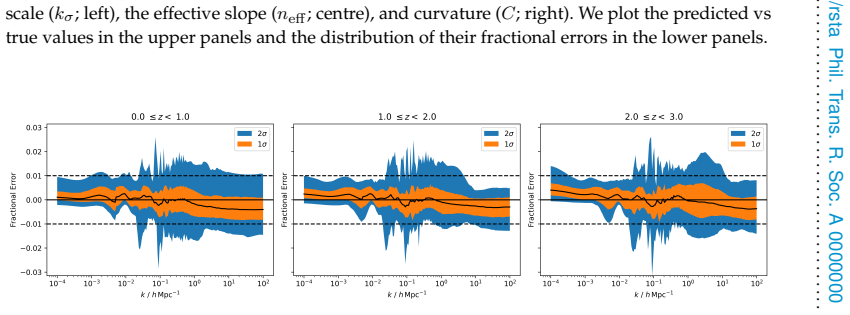


read the original abstract
In cosmology, emulators play a crucial role by providing fast and accurate predictions of complex physical models, enabling efficient exploration of high-dimensional parameter spaces that would be computationally prohibitive with direct numerical simulations. Symbolic emulators have emerged as promising alternatives to numerical approaches, delivering comparable accuracy with significantly faster evaluation times. While previous symbolic emulators were limited to relatively narrow prior ranges, we expand these to cover the parameter space relevant for current cosmological analyses. We introduce approximations to hypergeometric functions used for the $\Lambda$CDM comoving distance and linear growth factor which are accurate to better than 0.001% and 0.05%, respectively, for all redshifts and for $\Omega_{\rm m} \in [0.1, 0.5]$. We show that integrating symbolic emulators into a Dark Energy Survey-like $3\times2$pt analysis produces cosmological constraints consistent with those obtained using standard numerical methods. Our symbolic emulators offer substantial improvements in speed and memory usage, demonstrating their practical potential for scalable, likelihood-based inference.
Editorial analysis
A structured set of objections, weighed in public.
Referee Report
Summary. The paper introduces symbolic approximations to the hypergeometric functions that appear in the analytic expressions for the comoving distance and linear growth factor in flat ΛCDM. These approximations are reported to achieve relative accuracies better than 0.001% and 0.05%, respectively, for all redshifts and for Ω_m ∈ [0.1, 0.5]. The authors then embed the emulators in a DES-like 3×2pt likelihood analysis and state that the resulting cosmological constraints are statistically consistent with those obtained from standard numerical evaluations of the same quantities, while delivering substantial gains in evaluation speed and memory footprint.
Significance. If the claimed accuracies are robust and the consistency result generalizes, the work would supply a lightweight, interpretable alternative to numerical emulators for the background and linear perturbation quantities that dominate the computational cost of many current and near-future cosmological analyses. The explicit demonstration on a realistic 3×2pt pipeline is a positive step toward practical adoption.
major comments (2)
- [Results and validation] The accuracy statements are given only for the flat-ΛCDM hypergeometric forms (w = −1, Ω_k = 0, massless neutrinos). No re-derivation or error budget is supplied when the background expansion or growth equation changes, yet the central claim is that the emulators can be used inside a full likelihood pipeline. A concrete test (e.g., maximum fractional error on D(z) or fσ8 when w0, wa, or Σm_ν are varied within current priors) is required to support the claim that the quoted 0.001%/0.05% figures remain sufficient.
- [Application to 3×2pt analysis] The consistency between symbolic and numerical constraints is shown for a DES-like 3×2pt analysis, but the manuscript does not report the full error budget or the impact of all nuisance parameters and systematic effects on the posterior shift. It is therefore unclear whether the observed consistency would survive once the complete covariance and nuisance marginalization are included.
minor comments (2)
- [Methods] Clarify the precise definition of the relative error (maximum over z, or integrated, or at specific pivot points) and provide the explicit functional forms of the symbolic approximations (including the fitted coefficients) so that readers can reproduce the error curves.
- [Performance benchmarks] Add a short table comparing wall-clock time and memory usage of the symbolic emulators versus both direct numerical integration and existing neural-network emulators on the same hardware.
Simulated Author's Rebuttal
We thank the referee for the constructive and detailed comments. We address each major point below, clarifying the scope of the work and outlining specific revisions to improve the manuscript.
read point-by-point responses
-
Referee: [Results and validation] The accuracy statements are given only for the flat-ΛCDM hypergeometric forms (w = −1, Ω_k = 0, massless neutrinos). No re-derivation or error budget is supplied when the background expansion or growth equation changes, yet the central claim is that the emulators can be used inside a full likelihood pipeline. A concrete test (e.g., maximum fractional error on D(z) or fσ8 when w0, wa, or Σm_ν are varied within current priors) is required to support the claim that the quoted 0.001%/0.05% figures remain sufficient.
Authors: We appreciate the referee highlighting the need for clear scope. Our symbolic emulators approximate the specific hypergeometric functions that appear in the exact analytic expressions for comoving distance and linear growth factor in flat ΛCDM (w = −1, Ω_k = 0, massless neutrinos). These expressions do not hold when w0, wa or Σm_ν are varied, as the background expansion and growth equations change form. The manuscript therefore presents the emulators and the 3×2pt demonstration exclusively within the flat-ΛCDM framework, which remains the baseline for many current analyses. We do not claim the quoted accuracies apply unchanged to extended models. In the revised version we will add explicit statements in the abstract, Section 2, and the conclusions clarifying this scope and noting that extensions would require new symbolic derivations. We will also briefly discuss hybrid approaches (symbolic emulator plus numerical correction for small deviations from ΛCDM). revision: yes
-
Referee: [Application to 3×2pt analysis] The consistency between symbolic and numerical constraints is shown for a DES-like 3×2pt analysis, but the manuscript does not report the full error budget or the impact of all nuisance parameters and systematic effects on the posterior shift. It is therefore unclear whether the observed consistency would survive once the complete covariance and nuisance marginalization are included.
Authors: The 3×2pt pipeline in the manuscript already includes the standard DES-like nuisance parameters (galaxy bias, intrinsic alignments, photo-z shifts and widths, shear calibration) and the full covariance matrix. The reported consistency is for the cosmological parameters, with shifts well below statistical uncertainties. To address the concern about the complete error budget, we will expand the results section and add a supplementary table (or figure) that reports the posterior means and 68% intervals for all parameters—both cosmological and nuisance—for both the symbolic and numerical pipelines. We will also quantify the maximum shift in each parameter in units of the posterior standard deviation. This addition will make the full marginalization explicit and confirm that consistency is preserved. revision: yes
Circularity Check
No significant circularity; approximations validated externally against numerical benchmarks
full rationale
The paper constructs symbolic approximations to the hypergeometric expressions for flat-ΛCDM comoving distance and linear growth factor, then reports their maximum relative errors (better than 0.001% and 0.05%) over the stated Ω_m and redshift range by direct comparison to independent numerical evaluations of the same functions. These error figures are therefore measured quantities, not quantities defined by the approximation itself. The subsequent 3×2pt analysis simply substitutes the symbolic forms into an otherwise standard likelihood pipeline and shows posterior consistency with the numerical version; the consistency test is an external check rather than a self-referential definition. No step equates a fitted coefficient or ansatz to the reported accuracy or cosmological constraints by construction, and no load-bearing premise rests solely on a self-citation whose content is itself unverified. The derivation chain therefore remains self-contained against external numerical truth.
Axiom & Free-Parameter Ledger
free parameters (2)
- coefficients in symbolic distance approximation
- coefficients in symbolic growth-factor approximation
axioms (1)
- domain assumption flat Lambda CDM background evolution
Lean theorems connected to this paper
-
IndisputableMonolith/Cost/FunctionalEquation.leanwashburn_uniqueness_aczel unclear?
unclearRelation between the paper passage and the cited Recognition theorem.
We introduce approximations to hypergeometric functions used for the ΛCDM comoving distance and linear growth factor which are accurate to better than 0.001% and 0.05%, respectively, for all redshifts and for Ω_m ∈ [0.1, 0.5].
-
IndisputableMonolith/Foundation/AlexanderDuality.leanalexander_duality_circle_linking unclear?
unclearRelation between the paper passage and the cited Recognition theorem.
χ(a) = c/H0 ∫ da′/a′² √(Ω_m a′^{-3} + 1−Ω_m) expressed via 2F1(2/3,1,7/6;x′)
What do these tags mean?
- matches
- The paper's claim is directly supported by a theorem in the formal canon.
- supports
- The theorem supports part of the paper's argument, but the paper may add assumptions or extra steps.
- extends
- The paper goes beyond the formal theorem; the theorem is a base layer rather than the whole result.
- uses
- The paper appears to rely on the theorem as machinery.
- contradicts
- The paper's claim conflicts with a theorem or certificate in the canon.
- unclear
- Pith found a possible connection, but the passage is too broad, indirect, or ambiguous to say the theorem truly supports the claim.
Reference graph
Works this paper leans on
-
[1]
Zhai Z, Tinker JL, Becker MR, DeRose J, Mao YY, McClintock T, McLaughlin S, Rozo E, Wechsler RH. 2019 The Aemulus Project. III. Emulation of the Galaxy Correlation Function. ApJ874, 95. (10.3847/1538-4357/ab0d7b)
-
[2]
Angulo RE, Zennaro M, Contreras S, Aricò G, Pellejero-Ibañez M, Stücker J. 2021 The BACCO simulation project: exploiting the full power of large-scale structure for cosmology.MNRAS 507, 5869–5881. (10.1093/mnras/stab2018)
-
[3]
Aricò G, Angulo RE, Zennaro M. 2021 Accelerating Large-Scale-Structure data analyses by emulating Boltzmann solvers and Lagrangian Perturbation Theory. (10.12688/openreseurope.14310.2)
-
[4]
2023 The BACCO simulation project: biased tracers in real space.MNRAS524, 2407–2419
Zennaro M, Angulo RE, Pellejero-Ibáñez M, Stücker J, Contreras S, Aricò G. 2023 The BACCO simulation project: biased tracers in real space.MNRAS524, 2407–2419. (10.1093/mnras/stad2008)
-
[5]
2024 COBRA: Optimal Factorization of Cosmological Observables.arXiv e-printsp
Bakx T, Chisari NE, Vlah Z. 2024 COBRA: Optimal Factorization of Cosmological Observables.arXiv e-printsp. arXiv:2407.04660. (10.48550/arXiv.2407.04660)
-
[6]
Lawrence E, Heitmann K, Kwan J, Upadhye A, Bingham D, Habib S, Higdon D, Pope A, Finkel H, Frontiere N. 2017 The Mira-Titan Universe. II. Matter Power Spectrum Emulation. ApJ847, 50. (10.3847/1538-4357/aa86a9)
-
[7]
Spurio Mancini A, Piras D, Alsing J, Joachimi B, Hobson MP . 2022 COSMOPOWER: emulating cosmological power spectra for accelerated Bayesian inference from next-generation surveys. MNRAS511, 1771–1788. (10.1093/mnras/stac064)
-
[8]
Piras D, Spurio Mancini A. 2023 CosmoPower-JAX: high-dimensional Bayesian inference with differentiable cosmological emulators.The Open Journal of Astrophysics6, 20. (10.21105/astro.2305.06347)
-
[9]
Nishimichi T, Takada M, Takahashi R, Osato K, Shirasaki M, Oogi T, Miyatake H, Oguri M, Murata R, Kobayashi Y, Yoshida N. 2019 Dark Quest. I. Fast and Accurate Emulation of Halo Clustering Statistics and Its Application to Galaxy Clustering.ApJ884, 29. (10.3847/1538- 4357/ab3719)
-
[10]
Mootoovaloo A, Jaffe AH, Heavens AF, Leclercq F. 2022 Kernel-based emulator for the 3D matter power spectrum from CLASS.Astronomy and Computing38, 100508. (10.1016/j.ascom.2021.100508)
-
[11]
Euclid Collaboration, Knabenhans M, Stadel J, Marelli S, Potter D, Teyssier R, Legrand 20royalsocietypublishing.org/journal/rsta Phil. Trans. R. Soc. A 0000000. . . . . . . . . . . . . . . . . . . . . . . . . . . . . . . . . . . . . . . . . . . . . . . . . . . . . . . . . . . . . . . . . . . . . . . . . . L, Schneider A, Sudret B, Blot L, Awan S, Burigana...
-
[12]
Euclid Collaboration et al.. 2021 Euclid preparation: IX. EuclidEmulator2 - power spectrum emulation with massive neutrinos and self-consistent dark energy perturbations.MNRAS505, 2840–2869. (10.1093/mnras/stab1366)
-
[13]
2019 Emulators for the nonlinear matter power spectrum beyondΛCDM.Phys
Winther HA, Casas S, Baldi M, Koyama K, Li B, Lombriser L, Zhao GB. 2019 Emulators for the nonlinear matter power spectrum beyondΛCDM.Phys. Rev. D100, 123540. (10.1103/PhysRevD.100.123540)
-
[14]
Heitmann K, Higdon D, White M, Habib S, Williams BJ, Lawrence E, Wagner C. 2009 The Coyote Universe. II. Cosmological Models and Precision Emulation of the Nonlinear Matter Power Spectrum.ApJ705, 156–174. (10.1088/0004-637X/705/1/156)
-
[15]
2014 The Coyote Universe Extended: Precision Emulation of the Matter Power Spectrum.ApJ780, 111
Heitmann K, Lawrence E, Kwan J, Habib S, Higdon D. 2014 The Coyote Universe Extended: Precision Emulation of the Matter Power Spectrum.ApJ780, 111. (10.1088/0004- 637X/780/1/111)
-
[16]
2019 Precision modelling of the matter power spectrum in a Planck-like Universe.MNRAS486, 1448–1479
Smith RE, Angulo RE. 2019 Precision modelling of the matter power spectrum in a Planck-like Universe.MNRAS486, 1448–1479. (10.1093/mnras/stz890)
-
[17]
Computing High Accuracy Power Spectra with Pico
Fendt WA, Wandelt BD. 2007a Computing High Accuracy Power Spectra with Pico.arXiv e-printsp. arXiv:0712.0194. (10.48550/arXiv.0712.0194)
work page internal anchor Pith review Pith/arXiv arXiv doi:10.48550/arxiv.0712.0194
-
[18]
2007b Pico: Parameters for the Impatient Cosmologist.ApJ654, 2–11
Fendt WA, Wandelt BD. 2007b Pico: Parameters for the Impatient Cosmologist.ApJ654, 2–11. (10.1086/508342)
-
[19]
1986 The Statistics of Peaks of Gaussian Random Fields.ApJ304, 15
Bardeen JM, Bond JR, Kaiser N, Szalay AS. 1986 The Statistics of Peaks of Gaussian Random Fields.ApJ304, 15. (10.1086/164143)
-
[20]
1998 Baryonic Features in the Matter Transfer Function.ApJ496, 605–614
Eisenstein DJ, Hu W. 1998 Baryonic Features in the Matter Transfer Function.ApJ496, 605–614. (10.1086/305424)
-
[21]
1999 Power Spectra for Cold Dark Matter and Its Variants.ApJ511, 5–15
Eisenstein DJ, Hu W. 1999 Power Spectra for Cold Dark Matter and Its Variants.ApJ511, 5–15. (10.1086/306640)
-
[22]
Kronberger G, Burlacu B, Kommenda M, Winkler SM, Affenzeller M. 2024Symbolic Regression. Chapman & Hall / CRC Press
-
[23]
2024a A precise symbolic emulator of the linear matter power spectrum.A&A686, A209
Bartlett DJ, Kammerer L, Kronberger G, Desmond H, Ferreira PG, Wandelt BD, Burlacu B, Alonso D, Zennaro M. 2024a A precise symbolic emulator of the linear matter power spectrum.A&A686, A209. (10.1051/0004-6361/202348811)
-
[24]
Bartlett DJ, Wandelt BD, Zennaro M, Ferreira PG, Desmond H. 2024b SYREN-HALOFIT: A fast, interpretable, high-precision formula for theΛCDM nonlinear matter power spectrum. A&A686, A150. (10.1051/0004-6361/202449854)
-
[25]
Sui C, Bartlett DJ, Pandey S, Desmond H, Ferreira PG, Wandelt BD. 2025 SYREN-NEW: Precise formulae for the linear and nonlinear matter power spectra with massive neutrinos and dynamical dark energy.A&A698, A1. (10.1051/0004-6361/202452854)
-
[26]
2024 Machine learning unveils the linear matter power spectrum of modified gravity.Phys
Orjuela-Quintana JB, Nesseris S, Sapone D. 2024 Machine learning unveils the linear matter power spectrum of modified gravity.Phys. Rev. D109, 063511. (10.1103/PhysRevD.109.063511)
-
[27]
Bayron Orjuela-Quintana J, Sapone D, Nesseris S. 2024 Analytical Emulator for the Linear Matter Power Spectrum from Physics-Informed Machine Learning.arXiv e-printsp. arXiv:2407.16640
-
[28]
Kammerer L, Bartlett DJ, Kronberger G, Desmond H, Ferreira PG. 2025 syren-baryon: Analytic emulators for the impact of baryons on the matter power spectrum.A&A701, A284. (10.1051/0004-6361/202555887)
-
[29]
Taylor PL, Kitching TD, McEwen JD. 2018 Preparing for the cosmic shear data flood: Optimal data extraction and simulation requirements for stage IV dark energy experiments.Phys. Rev. D98, 043532. (10.1103/PhysRevD.98.043532)
-
[30]
2020 Operon C++: An Efficient Genetic Programming Framework for Symbolic Regression
Burlacu B, Kronberger G, Kommenda M. 2020 Operon C++: An Efficient Genetic Programming Framework for Symbolic Regression. InProceedings of the 2020 Genetic and Evolutionary Computation Conference CompanionGECCO ’20 p. 1562–1570 New York, NY, USA. Association for Computing Machinery. (10.1145/3377929.3398099)
-
[31]
Levenberg K. 1944 A METHOD FOR THE SOLUTION OF CERTAIN NON – LINEAR PROBLEMS IN LEAST SQUARES.Quarterly of Applied Mathematics2, 164–168
work page 1944
-
[32]
1963 An Algorithm for Least-Squares Estimation of Nonlinear Parameters
Marquardt DW. 1963 An Algorithm for Least-Squares Estimation of Nonlinear Parameters. Journal of the Society for Industrial and Applied Mathematics11, 431–441. (10.1137/0111030) 21royalsocietypublishing.org/journal/rsta Phil. Trans. R. Soc. A 0000000
-
[33]
Kommenda M, Burlacu B, Kronberger G, Affenzeller M. 2020 Parameter Identification for Symbolic Regression Using Nonlinear Least Squares.Genetic Programming and Evolvable Machines21, 471–501. (10.1007/s10710-019-09371-3)
-
[34]
2002 Combining Convergence and Diversity in Evolutionary Multiobjective Optimization.Evol
Laumanns M, Thiele L, Deb K, Zitzler E. 2002 Combining Convergence and Diversity in Evolutionary Multiobjective Optimization.Evol. Comput.10, 263–282. (10.1162/106365602760234108)
-
[35]
2023 Priors for symbolic regression
Bartlett DJ, Desmond H, Ferreira PG. 2023 Priors for symbolic regression. InThe Genetic and Evolutionary Computation Conference 2023. (10.1145/3583133.3596327)
-
[36]
Heath DJ. 1977 The growth of density perturbations in zero pressure Friedmann-Lemaître universes..MNRAS179, 351–358. (10.1093/mnras/179.3.351)
-
[37]
1980The large-scale structure of the universe
Peebles PJE. 1980The large-scale structure of the universe
-
[38]
Lewis A, Challinor A, Lasenby A. 2000 Efficient Computation of Cosmic Microwave Background Anisotropies in Closed Friedmann-Robertson-Walker Models.ApJ538, 473–476. (10.1086/309179)
-
[39]
2024 Exhaustive Symbolic Regression.IEEE T ransactions on Evolutionary Computation28, 950–964
Bartlett DJ, Desmond H, Ferreira PG. 2024 Exhaustive Symbolic Regression.IEEE T ransactions on Evolutionary Computation28, 950–964. (10.1109/TEVC.2023.3280250)
- [40]
-
[41]
Campagne JE, Lanusse F, Zuntz J, Boucaud A, Casas S, Karamanis M, Kirkby D, Lanzieri D, Peel A, Li Y. 2023 JAX-COSMO: An End-to-End Differentiable and GPU Accelerated Cosmology Library.The Open Journal of Astrophysics6, 15. (10.21105/astro.2302.05163)
-
[42]
Smith RE, Peacock JA, Jenkins A, White SDM, Frenk CS, Pearce FR, Thomas PA, Efstathiou G, Couchman HMP . 2003 Stable clustering, the halo model and non-linear cosmological power spectra.MNRAS341, 1311–1332. (10.1046/j.1365-8711.2003.06503.x)
-
[43]
Bird S, Viel M, Haehnelt MG. 2012 Massive neutrinos and the non-linear matter power spectrum.MNRAS420, 2551–2561. (10.1111/j.1365-2966.2011.20222.x)
-
[44]
2012 Revising the Halofit Model for the Nonlinear Matter Power Spectrum.ApJ761, 152
Takahashi R, Sato M, Nishimichi T, Taruya A, Oguri M. 2012 Revising the Halofit Model for the Nonlinear Matter Power Spectrum.ApJ761, 152. (10.1088/0004-637X/761/2/152)
-
[45]
N., et al., 2003, @doi [ApJS] 10.1086/377226 , 148, 175
Spergel DN, Verde L, Peiris HV , Komatsu E, Nolta MR, Bennett CL, Halpern M, Hinshaw G, Jarosik N, Kogut A, Limon M, Meyer SS, Page L, Tucker GS, Weiland JL, Wollack E, Wright EL. 2003 First-Year Wilkinson Microwave Anisotropy Probe (WMAP) Observations: Determination of Cosmological Parameters.ApJS148, 175–194. (10.1086/377226)
-
[46]
Abbott TMC, Abdalla FB, Alarcon A, Aleksi´ c J, Allam S, Allen S, Amara A, Annis J, Asorey J, Avila S, Bacon D, Balbinot E, Banerji M, Banik N, Barkhouse W, Baumer M, Baxter E, Bechtol K, Becker MR, Benoit-Lévy A, Benson BA, Bernstein GM, Bertin E, Blazek J, Bridle SL, Brooks D, Brout D, Buckley-Geer E, Burke DL, Busha MT, Campos A, Capozzi D, Carnero Ros...
-
[47]
Dark Energy Survey Year 1 Results: Multi-Probe Methodology and Simulated Likelihood Analyses
Krause E, Eifler TF, Zuntz J, Friedrich O, Troxel MA, Dodelson S, Blazek J, Secco LF, MacCrann N, Baxter E, Chang C, Chen N, Crocce M, DeRose J, Ferte A, Kokron N, Lacasa F, Miranda V , Omori Y, Porredon A, Rosenfeld R, Samuroff S, Wang M, Wechsler RH, Abbott TMC, Abdalla FB, Allam S, Annis J, Bechtol K, Benoit-Levy A, Bernstein GM, Brooks D, Burke DL, Ca...
work page internal anchor Pith review Pith/arXiv arXiv doi:10.48550/arxiv.1706.09359 2017
-
[48]
2008 Extended Limber approximation.Phys
LoVerde M, Afshordi N. 2008 Extended Limber approximation.Phys. Rev. D78, 123506. (10.1103/PhysRevD.78.123506)
-
[49]
Joachimi B, Mandelbaum R, Abdalla FB, Bridle SL. 2011 Constraints on intrinsic alignment contamination of weak lensing surveys using the MegaZ-LRG sample.A&A527, A26. (10.1051/0004-6361/201015621)
-
[50]
2015 CosmoSIS: Modular cosmological parameter estimation.Astronomy and Computing12, 45–59
Zuntz J, Paterno M, Jennings E, Rudd D, Manzotti A, Dodelson S, Bridle S, Sehrish S, Kowalkowski J. 2015 CosmoSIS: Modular cosmological parameter estimation.Astronomy and Computing12, 45–59. (10.1016/j.ascom.2015.05.005)
-
[51]
Feroz F, Hobson MP . 2008 Multimodal nested sampling: an efficient and robust alternative to Markov Chain Monte Carlo methods for astronomical data analyses.MNRAS384, 449–463. (10.1111/j.1365-2966.2007.12353.x)
-
[52]
Feroz F, Hobson MP , Bridges M. 2009 MULTINEST: an efficient and robust Bayesian inference tool for cosmology and particle physics.MNRAS398, 1601–1614. (10.1111/j.1365- 2966.2009.14548.x)
-
[53]
Importance Nested Sampling and the MultiNest Algorithm
Feroz F, Hobson MP , Cameron E, Pettitt AN. 2019 Importance Nested Sampling and the MultiNest Algorithm.The Open Journal of Astrophysics2, 10. (10.21105/astro.1306.2144)
work page internal anchor Pith review Pith/arXiv arXiv doi:10.21105/astro.1306.2144 2019
-
[54]
The No-U-Turn Sampler: Adaptively Setting Path Lengths in Hamiltonian Monte Carlo
Hoffman MD, Gelman A. 2011 The No-U-Turn Sampler: Adaptively Setting Path Lengths in Hamiltonian Monte Carlo.arXiv e-printsp. arXiv:1111.4246. (10.48550/arXiv.1111.4246)
work page internal anchor Pith review Pith/arXiv arXiv doi:10.48550/arxiv.1111.4246 2011
-
[55]
Pyro: Deep Universal Probabilistic Programming
Bingham E, Chen JP , Jankowiak M, Obermeyer F, Pradhan N, Karaletsos T, Singh R, Szerlip P , Horsfall P , Goodman ND. 2018 Pyro: Deep Universal Probabilistic Programming.arXiv e- printsp. arXiv:1810.09538. (10.48550/arXiv.1810.09538)
work page internal anchor Pith review Pith/arXiv arXiv doi:10.48550/arxiv.1810.09538 2018
-
[56]
Composable Effects for Flexible and Accelerated Probabilistic Programming in NumPyro
Phan D, Pradhan N, Jankowiak M. 2019 Composable Effects for Flexible and Accelerated Probabilistic Programming in NumPyro.arXiv e-printsp. arXiv:1912.11554. (10.48550/arXiv.1912.11554)
work page internal anchor Pith review Pith/arXiv arXiv doi:10.48550/arxiv.1912.11554 2019
-
[57]
GetDist: a Python package for analysing Monte Carlo samples
Lewis A. 2019 GetDist: a Python package for analysing Monte Carlo samples.arXiv e-printsp. arXiv:1910.13970. (10.48550/arXiv.1910.13970)
work page internal anchor Pith review Pith/arXiv arXiv doi:10.48550/arxiv.1910.13970 2019
discussion (0)
Sign in with ORCID, Apple, or X to comment. Anyone can read and Pith papers without signing in.