REVIEW 3 major objections 5 minor 1 cited by
CreativityPrism: A Cross-Domain Evaluation Framework for Large Language Model Creativity
T0 review · 3 major / 5 minor · reviewed 2026-08-04 · deepseek-v4-flash
Pith's one-line read This paper claims that LLM creativity is fragmented: a model's strong performance in one creative dimension or domain rarely predicts strong performance in another, so a single score cannot measure machine creativity.
desk verdict A useful benchmark assembly with a load-bearing fragmentation claim that the current numbers don't yet support. read the letter →
The pith
A machine-rendered reading of the paper's core claim, the machinery that carries it, and where it could break.
The reading
What carries the argument
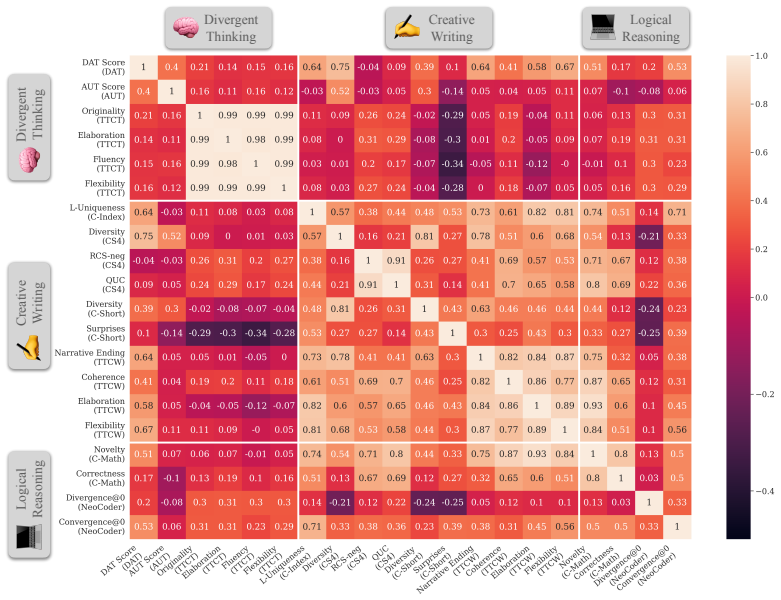
CreativityPrism, a benchmark and analysis suite. It organizes nine existing tasks (e.g., Alternative Uses Test, creative short-story generation, constrained code generation, creative math) into three domains and classifies twenty task-specific metrics into three dimensions: quality (does the output satisfy task requirements), novelty (is it rare compared to existing content), and diversity (how varied are multiple outputs). The analysis machinery is a correlation matrix over model performance vectors: for each metric, the normalized scores of all 17 models are stacked into a vector, and Pearson correlations between metric pairs reveal which dimensions travel together. That matrix is the load
What would settle it
Collect human creativity ratings on a sample of outputs from all nine tasks (especially the one with no human annotations at all), replace the AI-judge scores with human scores, and recompute the cross-metric correlation matrix; if the weak and negative novelty correlations disappear, the fragmentation claim would collapse.
Extended reading notes
Core claim
The central claim, stated on the paper's own terms, is that creativity in LLMs is multidimensional and fragmented. High performance in one creative dimension or domain rarely generalizes to others; in particular, novelty metrics often show weak or negative correlations with other metrics, because 'novelty' means different things in different tasks—being surprising in a short story is not the same as solving a coding problem in an unprecedented way. From this, the paper argues that a holistic benchmark spanning three domains and three creativity dimensions is necessary, and that an 'overall' creativity score should be treated only as a coarse comparison aid, not as a measure of a single under
Load-bearing premise
The rankings and the fragmentation conclusion rest on the assumption that the AI judge's creativity scores align with human judgments of creativity, an alignment that is only thinly validated for some of the nine tasks.
Editorial extensions
If this is right
- A single-task or single-domain evaluation of LLM creativity will misreport model capability, because strong performance in one domain does not predict performance in another.
- Novelty should be measured and reported per task, since novelty metrics across tasks share little variance and can even be negatively correlated.
- Models strong on quality tend to be strong on diversity, so diversity can serve as a rough proxy for quality, but neither predicts novelty.
- Frontier proprietary models lead in creative writing and logical reasoning by roughly 0.10–0.15 normalized points, yet show no clear advantage in divergent thinking, suggesting those domains are undertrained.
- The benchmark's three-dimension scores—quality, novelty, diversity—should be reported separately; the overall score is only a coarse summary.
Reading between the lines
- A testable extension: because the open–proprietary gap is smallest in divergent thinking, post-training with divergent-thinking tasks might be where open models can catch up most cheaply.
- The weak novelty dimension suggests that 'novelty' is not one capability but a family of task-specific behaviors; a model could be trained to inflate one novelty metric without gaining another.
- If human ratings later show the AI judges are biased, the specific rankings would shift, but the fragmentation structure might survive only if the bias is uniform across tasks; checking this with per-task human data is a natural next step.
Editorial analysis
A structured set of objections, weighed in public.
Referee Report
Summary. The paper introduces CreativityPrism, a benchmark and analysis framework for evaluating LLM creativity. It consolidates nine tasks in three domains (divergent thinking, creative writing, logical reasoning) and organizes twenty metrics into three dimensions (quality, novelty, diversity). The authors evaluate 17 proprietary and open-weight LLMs, aggregate scores by dimension and domain, and report a correlation analysis across metrics. The central claims are that proprietary models outperform open models in creative writing and logical reasoning but not in divergent thinking, and that creativity is fragmented: high performance on one dimension or domain does not reliably transfer, especially for novelty metrics, which show weak or negative correlations with other metrics. The paper also validates automatic LLM judges for six of the nine tasks, with varying levels of supporting evidence.
Significance. The benchmark addresses a real and timely gap: most LLM creativity evaluations are task-specific, single-domain, or rely on expensive human evaluation. CreativityPrism is useful as a structured consolidation of existing tasks and metrics, and the three-dimensional taxonomy is a sensible organizing principle. The paper also makes an explicit effort to check LLM-as-a-judge reliability, which is more than many benchmark papers do. If the results hold, the fragmentation claim would be an important caution against reporting a single creativity score. However, the two main supports for that claim — the LLM-judge validation and the cross-metric correlation analysis — are currently not strong enough to carry the conclusions, so the significance is conditional on the revisions described below.
major comments (3)
- [§5.3, Figures 3–4] The central fragmentation conclusion is a statistical claim about correlations among model performance vectors, but the paper provides no uncertainty quantification. For M=17 models, the standard error of a correlation under the null is about 1/sqrt(17−3) ≈ 0.27, so the headline example (Creative Short Story 'Surprise' vs NeoCoder 'Divergence@0', r=−0.25) has a 95% interval of roughly (−0.66, +0.26). That interval includes zero, and many other correlations in the 17×17 matrix are likely consistent with zero after accounting for multiple comparisons. In addition, several rows are from the same model family (Qwen, DeepSeek, Claude, GPT), so the effective independent sample size is smaller than 17. The paper should report confidence intervals or significance tests (ideally with a multiple-comparison adjustment) before claiming that novelty metrics are weakly or negatively correlated across
- [§4.2, Appendix D, Appendix E.2.5, E.8] The LLM-as-a-judge validation is too thin to support the ranking and correlation structure. For TTCT the paper states 'we have no human annotations at all' and instead reports Pearson correlations between Qwen2.5-72B and GPT-4.1 (0.50–0.69). That measures agreement between two LLM judges, not validity against human judgment, and the lower values are not obviously acceptable for a metric used to rank 17 models. For CS4, the human–LLM correlation is 0.55 on 15 stories; this is a small and modest alignment. For TTCW, the appendix (E.1.4) mentions a correlation threshold of 0.2 while the main text (D) reports accuracy values; the two descriptions are not consistent. These issues affect six of nine tasks, so they are load-bearing for the benchmark's conclusions; the manuscript's own acknowledgement that more human annotation is being collected confirms the validation is incomplete.
- [Abstract vs. §5.2 and Table 2] The abstract states that frontier LLMs 'offer no significant advantage in divergent thinking,' but §5.2 claims 'more than 10% in each domain' and Table 2 shows Claude3-Sonnet at 0.833 in divergent thinking versus the best open-weight model (Qwen2.5-72B) at 0.731, a gap of about 0.10 (roughly 14% relative). If 'no significant advantage' is meant statistically, no significance test is reported; if it is meant practically, the table does not support it. The claim should be reconciled with the reported numbers and, if retained, supported by an appropriate test.
minor comments (5)
- [Abstract] The phrase 'by a .10 (or 15%) lead' is unclear and appears garbled. Please use consistent absolute or relative numbers and specify which models are being compared.
- [Table 3 / Appendix E] Table 3 lists 19 models (including OLMo2-13B-SFT and OLMo2-13B-DPO), while Table 2 reports 17 models, and Appendix E.1.5/E.9.5 include Claude3-Opus, which does not appear in Table 2. The model inventory should be harmonized so that every reported result has a corresponding model entry.
- [Table 3] DeepSeek-R1 and DeepSeek-V3 are labeled as 'Gemini' in the Family column; this is a typo.
- [§5.2] The 'more than 20% in each dimension' and 'more than 10% in each domain' claims should state whether they are absolute or relative gaps and give the exact best-model comparisons from Table 2.
- [E.4.6] The table header in the Creative Short Story results uses 'Surprisal' and 'N-gram Diversity,' while the text refers to a 'novelty score'; please unify the metric names.
Circularity Check
No significant circularity: the paper's conclusions are empirical measurements from a constructed benchmark, not derivations that assume their own outcomes.
full rationale
The paper is an empirical benchmark construction, not a formal derivation. Its central claims—that proprietary models lead on writing/reasoning but not divergent thinking, and that novelty metrics correlate weakly across domains—are computed from measured model scores and correlation matrices, not entailed by any definition or fitted parameter. The taxonomy (quality/novelty/diversity) is a conceptual grouping of existing metrics; it does not by construction force low cross-metric correlations, and the empirical finding could in principle have been the opposite. The self-cited tasks (NeoCoder, Creativity Index) come from prior published work with independent human validation and code, so they serve as external evidence rather than a self-referential load-bearing chain. The TTCW metric-selection step (keeping only metrics with human–judge correlation > 0.2) is a post-hoc reliability filter, but it selects evaluation questions based on human agreement, not based on the paper's target conclusion, so it is not circular. The TTCT judge validation via correlation with another LLM judge, and the small human sample for CS4, raise validity and uncertainty concerns, but under-determination or statistical fragility is not circularity. The highlighted r=-0.25 lacks confidence intervals, but that is a robustness/statistical reporting issue, not a reduction of a prediction to an input. No equation or fitted parameter is renamed as a prediction, and no uniqueness claim is imported from the authors' prior work. The benchmark's conclusions are self-contained empirical measurements, so the circularity score is 0.
Assumptions & free parameters
free parameters (3)
- TTCW metric inclusion threshold =
correlation > 0.2
- LLM-judge agreement acceptance level =
lowered for story creativity
- Task selection criterion =
9 tasks with automatic metrics
assumptions (3)
- domain assumption Creativity decomposes into quality, novelty, and diversity
- domain assumption LLM-as-a-judge judgments are valid proxies for human creativity judgments
- standard math Known min/max bounds make min-max normalization across metrics meaningful
Cite this review
Pith. "Pith review of CreativityPrism: A Cross-Domain Evaluation Framework for Large Language Model Creativity." pith.science (2026). https://pith.science/paper/QNEF4GVH
@misc{pith2026251020091,
  author       = {Pith},
  title        = {Pith review of: CreativityPrism: A Cross-Domain Evaluation Framework for Large Language Model Creativity},
  year         = {2026},
  howpublished = {\url{https://pith.science/paper/QNEF4GVH}},
  note         = {Machine review of arXiv:2510.20091}
}
read the original abstract
Creativity is often seen as a hallmark of human intelligence. While large language models(LLMs) are increasingly perceived as generating creative text, there is still no cross-domain and scalable framework to evaluate their creativity across diverse scenarios. Existing methods of LLM creativity evaluation either heavily rely on humans, limiting speed and scalability, or are fragmented across different domains and different definitions of creativity. To address this gap, we propose CreativityPrism, an evaluation and analysis framework that consolidates eight tasks from three domains: divergent thinking, creative writing, and logical reasoning, into a taxonomy of creativity that emphasizes three dimensions: quality, novelty, and diversity of LLM generations. The framework is designed to be scalable with reliable automatic evaluation judges that have been validated against human annotations. We evaluate 17 state-of-the-art (SoTA) LLMs on CreativityPrism and find that while frontier-scale LLMs dominate creative writing and logical reasoning tasks by a .10 (or 15%) lead over locally-deployable open models, they offer no significant advantage in divergent thinking, a domain much less explored in existing post-training regimes. Our analysis also shows that high performance in one creative dimension or domain rarely generalizes to others; specifically, novelty metrics often show weak or negative correlations with other metrics. This fragmentation confirms that a cross-domain, multi-dimensional framework like CreativityPrism is essential for any meaningful assessment of LLM creativity.
Figures


Figures from the paper (9 more)


Forward citations
Cited by 1 Pith paper
-
Where Models Converge and Humans Diverge: A Coverage Framework for Distributional Pluralism in Open-Ended Generation
LLM outputs are usually plausible but cover far less of the human response space than matched human samples do, with the biggest gap at the periphery of the human distribution.
Reference graph
Works this paper leans on
-
[1]
What do educators need to know about the torrance tests of creative thinking: A comprehensive review
Ahmed M Abdulla Alabbasi, Sue Hyeon Paek, Daehyun Kim, and Bonnie Cramond. What do educators need to know about the torrance tests of creative thinking: A comprehensive review. Front. Psychol., 13:1000385, October 2022
2022
-
[2]
Claude 3 model family, 2024
Anthropic. Claude 3 model family, 2024. URL https://www.anthropic.com/news/ claude-3-family. Accessed: 2025-04-30. 10
2024
-
[3]
CS4: Measuring the creativity of large language models automatically by controlling the number of story-writing constraints.arXiv [cs.CL], October 2024
Anirudh Atmakuru, Jatin Nainani, Rohith Siddhartha Reddy Bheemreddy, Anirudh Lakkaraju, Zonghai Yao, Hamed Zamani, and Haw-Shiuan Chang. CS4: Measuring the creativity of large language models automatically by controlling the number of story-writing constraints.arXiv [cs.CL], October 2024
2024
-
[4]
Divergent creativity in humans and large language models.arXiv [cs.CL], May 2024
Antoine Bellemare-Pepin, François Lespinasse, Philipp Thölke, Yann Harel, Kory Mathewson, Jay A Olson, Yoshua Bengio, and Karim Jerbi. Divergent creativity in humans and large language models.arXiv [cs.CL], May 2024
2024
-
[5]
The MIT Press, June 1994
Margaret A Boden, editor.Dimensions of Creativity. The MIT Press, June 1994
1994
-
[6]
The crowdless future? generative ai and creative problem-solving.Organization Science, 35(5):1589–1607, 2024
Léonard Boussioux, Jacqueline N Lane, Miaomiao Zhang, Vladimir Jacimovic, and Karim R Lakhani. The crowdless future? generative ai and creative problem-solving.Organization Science, 35(5):1589–1607, 2024
2024
-
[7]
Evaluation of text generation: A survey
Asli Celikyilmaz, Elizabeth Clark, and Jianfeng Gao. Evaluation of text generation: A survey. arXiv [cs.CL], June 2020
2020
-
[8]
Art or artifice? large language models and the false promise of creativity
Tuhin Chakrabarty, Philippe Laban, Divyansh Agarwal, Smaranda Muresan, and Chien-Sheng Wu. Art or artifice? large language models and the false promise of creativity. InProceedings of the CHI Conference on Human Factors in Computing Systems, volume 70, pages 1–34, New York, NY , USA, May 2024. ACM
2024
Show all 124 references
-
[9]
Creativity support in the age of large language models: An empirical study involving professional writers
Tuhin Chakrabarty, Vishakh Padmakumar, Faeze Brahman, and Smaranda Muresan. Creativity support in the age of large language models: An empirical study involving professional writers. InCreativity and Cognition, New York, NY , USA, June 2024. ACM
2024
-
[10]
creativity
Honghua Chen and Nai Ding. Probing the “creativity” of large language models: Can models produce divergent semantic association? InThe 2023 Conference on Empirical Methods in Natural Language Processing, December 2023
2023
-
[11]
DeepSeek-V3 technical report
DeepSeek-AI, Aixin Liu, Bei Feng, Bing Xue, Bingxuan Wang, Bochao Wu, Chengda Lu, Chenggang Zhao, Chengqi Deng, Chenyu Zhang, Chong Ruan, Damai Dai, Daya Guo, Dejian Yang, Deli Chen, Dongjie Ji, Erhang Li, Fangyun Lin, Fucong Dai, Fuli Luo, Guangbo Hao, Guanting Chen, Guowei L...
2024
-
[12]
DeepSeek-R1: Incentivizing reasoning capability in LLMs via reinforcement learning.arXiv [cs.CL], January 2025
DeepSeek-AI, Daya Guo, Dejian Yang, Haowei Zhang, Junxiao Song, Ruoyu Zhang, Runxin Xu, Qihao Zhu, Shirong Ma, Peiyi Wang, Xiao Bi, Xiaokang Zhang, Xingkai Yu, Yu Wu, Z F Wu, Zhibin Gou, Zhihong Shao, Zhuoshu Li, Ziyi Gao, Aixin Liu, Bing Xue, Bingxuan Wang, Bochao Wu, Bei Fen...
2025
-
[13]
The definition and measurement of creativity: What do we know?J
Jaafar El-Murad and Douglas C West. The definition and measurement of creativity: What do we know?J. Advert. Res., 44(02):188–201, June 2004
2004
-
[14]
Creation-MMBench: Assessing context-aware creative intelligence in MLLM.arXiv [cs.CV], March 2025
Xinyu Fang, Zhijian Chen, Kai Lan, Lixin Ma, Shengyuan Ding, Yingji Liang, Xiangyu Zhao, Farong Wen, Zicheng Zhang, Guofeng Zhang, Haodong Duan, Kai Chen, and Dahua Lin. Creation-MMBench: Assessing context-aware creative intelligence in MLLM.arXiv [cs.CV], March 2025
2025
-
[15]
The MIT Press, October 1992
Ronald A Finke, Thomas B Ward, and Steven M Smith.Creative Cognition: Theory, research, and applications. The MIT Press, October 1992
1992
-
[16]
Creativity and machine learning: A survey.ACM Comput
Giorgio Franceschelli and Mirco Musolesi. Creativity and machine learning: A survey.ACM Comput. Surv., 56(11), June 2024. ISSN 0360-0300. doi: 10.1145/3664595. URL https: //doi.org/10.1145/3664595
2024 doi
-
[17]
Pushing GPT’s creativity to its limits: Alternative uses and torrance tests
Fabricio Goes, Marco V olpe, Piotr Sawicki, Marek Grzes, and Jacob Watson. Pushing GPT’s creativity to its limits: Alternative uses and torrance tests. In14th International Conference on Computational Creativity 2023, 2023
2023
-
[18]
Gemini 1.5 and 2.0: Next-gen multimodal models, 2024
Google DeepMind. Gemini 1.5 and 2.0: Next-gen multimodal models, 2024. URL https: //deepmind.google/technologies/gemini/. Accessed: 2025-04-30
2024
-
[19]
The llama 3 herd of models.arXiv [cs.AI], July 2024
Aaron Grattafiori, Abhimanyu Dubey, Abhinav Jauhri, Abhinav Pandey, Abhishek Kadian, Ah- mad Al-Dahle, Aiesha Letman, Akhil Mathur, Alan Schelten, Alex Vaughan, Amy Yang, Angela Fan, Anirudh Goyal, Anthony Hartshorn, Aobo Yang, Archi Mitra, Archie Sravankumar, Artem Korenev, A...
2024
-
[20]
OLMo: Accelerating the science of language models
Dirk Groeneveld, Iz Beltagy, Evan Walsh, Akshita Bhagia, Rodney Kinney, Oyvind Tafjord, Ananya Jha, Hamish Ivison, Ian Magnusson, Yizhong Wang, Shane Arora, David Atkinson, Russell Authur, Khyathi Chandu, Arman Cohan, Jennifer Dumas, Yanai Elazar, Yuling Gu, Jack Hessel, Tusha...
2024
-
[21]
Alternate uses, June 2012
J P Guilford, Paul R Christensen, Philip R Merrifield, and Robert C Wilson. Alternate uses, June 2012. Title of the publication associated with this dataset: PsycTESTS Dataset
2012
-
[22]
A confederacy of models: A comprehensive evaluation of LLMs on creative writing
Carlos Gómez-Rodríguez and Paul Williams. A confederacy of models: A comprehensive evaluation of LLMs on creative writing. InFindings of the Association for Computational Linguistics: EMNLP 2023, pages 14504–14528, Stroudsburg, PA, USA, December 2023. Association for Computati...
2023
-
[23]
Pun generation with surprise
He He, Nanyun Peng, and Percy Liang. Pun generation with surprise. In Jill Burstein, Christy Doran, and Thamar Solorio, editors,Proceedings of the 2019 Conference of the North American Chapter of the Association for Computational Linguistics: Human Language Technologies, Volum...
2019
-
[24]
What shapes a creative machine mind? comprehensively benchmarking creativity in foundation models.arXiv [cs.AI], October 2025
Zicong He, Boxuan Zhang, Weihao Liu, Ruixiang Tang, and Lu Cheng. What shapes a creative machine mind? comprehensively benchmarking creativity in foundation models.arXiv [cs.AI], October 2025
2025
-
[25]
Holyoak and R.G
K.J. Holyoak and R.G. Morrison.The Cambridge Handbook of Thinking and Reasoning. Cam- bridge Handbooks in Psychology. Cambridge University Press, 2005. ISBN 9780521824170. URLhttps://books.google.com/books?id=znbkHaC8QeMC. 14
2005
-
[26]
A scientific creativity test for secondary school students.Int
Weiping Hu and Philip Adey. A scientific creativity test for secondary school students.Int. J. Sci. Educ., 24(4):389–403, April 2002
2002
-
[27]
Qwen2.5-coder technical report.arXiv [cs.CL], September 2024
Binyuan Hui, Jian Yang, Zeyu Cui, Jiaxi Yang, Dayiheng Liu, Lei Zhang, Tianyu Liu, Jiajun Zhang, Bowen Yu, Keming Lu, Kai Dang, Yang Fan, Yichang Zhang, An Yang, Rui Men, Fei Huang, Bo Zheng, Yibo Miao, Shanghaoran Quan, Yunlong Feng, Xingzhang Ren, Xuancheng Ren, Jingren Zhou...
2024
-
[28]
Creativity in ai: Progresses and challenges, 2024
Mete Ismayilzada, Debjit Paul, Antoine Bosselut, and Lonneke van der Plas. Creativity in ai: Progresses and challenges, 2024. URLhttps://arxiv.org/abs/2410.17218
2024 arXiv
-
[29]
Evaluating creative short story generation in humans and large language models.arXiv [cs.CL], November 2024
Mete Ismayilzada, Claire Stevenson, and Lonneke van der Plas. Evaluating creative short story generation in humans and large language models.arXiv [cs.CL], November 2024
2024
-
[30]
Evaluating creative short story generation in humans and large language models.arXiv preprint arXiv:2411.02316, 2024
Mete Ismayilzada, Claire Stevenson, and Lonneke van der Plas. Evaluating creative short story generation in humans and large language models.arXiv preprint arXiv:2411.02316, 2024
2024 arXiv
-
[31]
LLM output homogenization is task dependent.arXiv [cs.CL], September 2025
Shomik Jain, Jack Lanchantin, Maximilian Nickel, Karen Ullrich, Ashia Wilson, and Jamelle Watson-Daniels. LLM output homogenization is task dependent.arXiv [cs.CL], September 2025
2025
-
[32]
Mistral 7B.arXiv [cs.CL], October 2023
Albert Q Jiang, Alexandre Sablayrolles, Arthur Mensch, Chris Bamford, Devendra Singh Chaplot, Diego de las Casas, Florian Bressand, Gianna Lengyel, Guillaume Lample, Lucile Saulnier, Lélio Renard Lavaud, Marie-Anne Lachaux, Pierre Stock, Teven Le Scao, Thibaut Lavril, Thomas W...
2023
-
[33]
Mixtral of experts.arXiv [cs.LG], January 2024
Albert Q Jiang, Alexandre Sablayrolles, Antoine Roux, Arthur Mensch, Blanche Savary, Chris Bamford, Devendra Singh Chaplot, Diego de las Casas, Emma Bou Hanna, Florian Bressand, Gianna Lengyel, Guillaume Bour, Guillaume Lample, Lélio Renard Lavaud, Lucile Saulnier, Marie-Anne ...
2024
-
[34]
Trust or escalate: LLM judges with provable guarantees for human agreement
Jaehun Jung, Faeze Brahman, and Yejin Choi. Trust or escalate: LLM judges with provable guarantees for human agreement. InThe Thirteenth International Conference on Learning Representations, October 2024
2024
-
[35]
Gemini 2.5: Our most intelligent AI model
Koray Kavukcuoglu. Gemini 2.5: Our most intelligent AI model. https://blog.google/ technology/google-deepmind/gemini-model-thinking-updates-march-2025/ , March 2025. Accessed: 2025-4-30
2025
-
[36]
Gonzalez, Hao Zhang, and Ion Stoica
Woosuk Kwon, Zhuohan Li, Siyuan Zhuang, Ying Sheng, Lianmin Zheng, Cody Hao Yu, Joseph E. Gonzalez, Hao Zhang, and Ion Stoica. Efficient memory management for large lan- guage model serving with pagedattention. InProceedings of the ACM SIGOPS 29th Symposium on Operating System...
2023
-
[37]
From generation to judgment: Opportunities and challenges of llm-as-a-judge, 2024
Dawei Li, Bohan Jiang, Liangjie Huang, Alimohammad Beigi, Chengshuai Zhao, Zhen Tan, Amrita Bhattacharjee, Yuxuan Jiang, Canyu Chen, Tianhao Wu, Kai Shu, Lu Cheng, and Huan Liu. From generation to judgment: Opportunities and challenges of llm-as-a-judge, 2024
2024
-
[38]
Llms-as-judges: A comprehensive survey on llm-based evaluation methods, 2024
Haitao Li, Qian Dong, Junjie Chen, Huixue Su, Yujia Zhou, Qingyao Ai, Ziyi Ye, and Yiqun Liu. Llms-as-judges: A comprehensive survey on llm-based evaluation methods, 2024. URL https://arxiv.org/abs/2412.05579
2024 arXiv
-
[39]
Rethinking creativity evaluation: A critical analysis of existing creativity evaluations.arXiv [cs.CL], August 2025
Li-Chun Lu, Miri Liu, Pin-Chun Lu, Yufei Tian, Shao-Hua Sun, and Nanyun Peng. Rethinking creativity evaluation: A critical analysis of existing creativity evaluations.arXiv [cs.CL], August 2025
2025
-
[40]
AI as humanity’s salieri: Quantifying linguistic creativity of language models via systematic attribution of machine text against web text
Ximing Lu, Melanie Sclar, Skyler Hallinan, Niloofar Mireshghallah, Jiacheng Liu, Seungju Han, Allyson Ettinger, Liwei Jiang, Khyathi Chandu, Nouha Dziri, and Yejin Choi. AI as humanity’s salieri: Quantifying linguistic creativity of language models via systematic attribution o...
2024
-
[41]
Ai as humanity’s salieri: Quantifying linguistic creativity of language models via systematic attribution of machine text against web text.CoRR, abs/2410.04265, 2024
Ximing Lu, Melanie Sclar, Skyler Hallinan, Niloofar Mireshghallah, Jiacheng Liu, Seungju Han, Allyson Ettinger, Liwei Jiang, Khyathi Raghavi Chandu, Nouha Dziri, and Yejin Choi. Ai as humanity’s salieri: Quantifying linguistic creativity of language models via systematic attri...
-
[42]
Benchmarking language model creativity: A case study on code generation
Yining Lu, Dixuan Wang, Tianjian Li, Dongwei Jiang, Sanjeev Khudanpur, Meng Jiang, and Daniel Khashabi. Benchmarking language model creativity: A case study on code generation. In Proceedings of the 2025 Conference of the Nations of the Americas Chapter of the Association for ...
2025
-
[43]
AidanBench: Evaluating novel idea generation on open-ended questions
Aidan McLaughlin, Anuja Uppuluri, and James Campbell. AidanBench: Evaluating novel idea generation on open-ended questions. InLanguage Gamification - NeurIPS 2024 Workshop, December 2024
2024
-
[44]
Obtaining reliable human ratings of valence, arousal, and dominance for 20,000 english words
Saif Mohammad. Obtaining reliable human ratings of valence, arousal, and dominance for 20,000 english words. InProceedings of the 56th Annual Meeting of the Association for Computational Linguistics (Volume 1: Long Papers), pages 174–184, Stroudsburg, PA, USA,
-
[45]
Lane, Leonard Boussioux, Charles Ayoubi, Ying Hao Chen, Camila Lin, Rebecca Spens, Pooja Wagh, and Pei-Hsin Wang
Jacqueline N. Lane, Leonard Boussioux, Charles Ayoubi, Ying Hao Chen, Camila Lin, Rebecca Spens, Pooja Wagh, and Pei-Hsin Wang. The narrative AI advantage? a field experiment on generative AI-augmented evaluations of early-stage innovations.Social Science Research Network, August 2024
2024
-
[46]
Nam- ing unrelated words predicts creativity.Proc
Jay A Olson, Johnny Nahas, Denis Chmoulevitch, Simon J Cropper, and Margaret E Webb. Nam- ing unrelated words predicts creativity.Proc. Natl. Acad. Sci. U. S. A., 118(25):e2022340118, June 2021
2021
-
[47]
Gpt-4 technical report, 2024
OpenAI. Gpt-4 technical report, 2024. URL https://openai.com/research/gpt-4. Ac- cessed: 2025-04-30
2024
-
[48]
Beyond semantic distance: Automated scoring of divergent thinking greatly improves with large language models.Think
Peter Organisciak, Selcuk Acar, Denis Dumas, and Kelly Berthiaume. Beyond semantic distance: Automated scoring of divergent thinking greatly improves with large language models.Think. Skills Creat., 49(101356):101356, September 2023
2023
-
[49]
Does writing with language models reduce content diversity? InThe Twelfth International Conference on Learning Representations, October 2023
Vishakh Padmakumar and He He. Does writing with language models reduce content diversity? InThe Twelfth International Conference on Learning Representations, October 2023
2023
-
[50]
GloVe: Global vectors for word representation
Jeffrey Pennington, Richard Socher, and Christopher Manning. GloVe: Global vectors for word representation. In Alessandro Moschitti, Bo Pang, and Walter Daelemans, editors,Proceedings of the 2014 Conference on Empirical Methods in Natural Language Processing (EMNLP), pages 153...
2014 doi
-
[51]
GloVe: Global vectors for word representation
Jeffrey Pennington, Richard Socher, and Christopher D Manning. GloVe: Global vectors for word representation. InProceedings of the 2014 Conference on Empirical Methods in Natural Language Processing (EMNLP), pages 1532–1543, October 2014
2014
-
[52]
Qwen2.5 technical report.arXiv [cs.CL], December 2024
Qwen, An Yang, Baosong Yang, Beichen Zhang, Binyuan Hui, Bo Zheng, Bowen Yu, Chengyuan Li, Dayiheng Liu, Fei Huang, Haoran Wei, Huan Lin, Jian Yang, Jianhong Tu, Jianwei Zhang, Jianxin Yang, Jiaxi Yang, Jingren Zhou, Junyang Lin, Kai Dang, Keming Lu, Keqin Bao, Kexin Yang, Le ...
2024
-
[53]
A meta-analysis of when and how advertising creativity works.J
Sara Rosengren, Martin Eisend, Scott Koslow, and Micael Dahlen. A meta-analysis of when and how advertising creativity works.J. Mark., 84(6):39–56, November 2020
2020
-
[54]
Approaches to measuring creativity: A systematic literature review.Creativity
Sameh Said-Metwaly, Wim Van den Noortgate, and Eva Kyndt. Approaches to measuring creativity: A systematic literature review.Creativity. Theories – Research - Applications, 4(2): 238–275, December 2017. 16
2017
-
[55]
Can LLMs generate novel research ideas? a large-scale human study with 100+ NLP researchers
Chenglei Si, Diyi Yang, and Tatsunori Hashimoto. Can LLMs generate novel research ideas? a large-scale human study with 100+ NLP researchers. InThe Thirteenth International Con- ference on Learning Representations, 2025. URL https://openreview.net/forum?id= M23dTGWCZy
2025
-
[56]
Modeling the determinants and effects of creativity in advertising.Mark
Robert E Smith, Scott B MacKenzie, Xiaojing Yang, Laura M Buchholz, and William K Darley. Modeling the determinants and effects of creativity in advertising.Mark. Sci., 26(6):819–833, November 2007
2007
-
[57]
An investment theory of creativity and its development.Human Development, 34(1):1–31, June 1991
R Sternberg and T Lubart. An investment theory of creativity and its development.Human Development, 34(1):1–31, June 1991
1991
-
[58]
Judgebench: A benchmark for evaluating LLM-based judges
Sijun Tan, Siyuan Zhuang, Kyle Montgomery, William Yuan Tang, Alejandro Cuadron, Chen- guang Wang, Raluca Popa, and Ion Stoica. Judgebench: A benchmark for evaluating LLM-based judges. InThe Thirteenth International Conference on Learning Representations, 2025. URL https://ope...
2025
-
[59]
Yufei Tian, Tenghao Huang, Miri Liu, Derek Jiang, Alexander Spangher, Muhao Chen, Jonathan May, and Nanyun Peng. Are large language models capable of generating human-level nar- ratives? InProceedings of the 2024 Conference on Empirical Methods in Natural Language Processing, ...
2024
-
[60]
Yufei Tian, Abhilasha Ravichander, Lianhui Qin, Ronan Le Bras, Raja Marjieh, Nanyun Peng, Yejin Choi, Thomas Griffiths, and Faeze Brahman. MacGyver: Are large language models creative problem solvers? InProceedings of the 2024 Conference of the North American Chapter of the As...
2024
-
[61]
Yufei Tian, Abhilasha Ravichander, Lianhui Qin, Ronan Le Bras, Raja Marjieh, Nanyun Peng, Yejin Choi, Thomas Griffiths, and Faeze Brahman. MacGyver: Are large language models creative problem solvers? In Kevin Duh, Helena Gomez, and Steven Bethard, editors, Proceedings of the ...
2024
-
[62]
Assessing the creativity of LLMs in proposing novel solutions to mathematical problems.arXiv [cs.CL], October 2024
Junyi Ye, Jingyi Gu, Xinyun Zhao, Wenpeng Yin, and Guiling Wang. Assessing the creativity of LLMs in proposing novel solutions to mathematical problems.arXiv [cs.CL], October 2024
2024
-
[63]
BERTScore: Evaluating text generation with BERT.arXiv [cs.CL], April 2019
Tianyi Zhang, Varsha Kishore, Felix Wu, Kilian Q Weinberger, and Yoav Artzi. BERTScore: Evaluating text generation with BERT.arXiv [cs.CL], April 2019
2019
-
[64]
NoveltyBench: Evaluating creativity and diversity in language models
Yiming Zhang, Harshita Diddee, Susan Holm, Hanchen Liu, Xinyue Liu, Vinay Samuel, Barry Wang, and Daphne Ippolito. NoveltyBench: Evaluating creativity and diversity in language models. InSecond Conference on Language Modeling, August 2025
2025
-
[65]
Assessing and understanding creativity in large language models.Mach
Yunpu Zhao, Rui Zhang, Wenyi Li, and Ling Li. Assessing and understanding creativity in large language models.Mach. Intell. Res., pages 1–20, April 2025
2025
-
[66]
Judging LLM-as-a-judge with MT-bench and chatbot arena.arXiv [cs.CL], June 2023
Lianmin Zheng, Wei-Lin Chiang, Ying Sheng, Siyuan Zhuang, Zhanghao Wu, Yonghao Zhuang, Zi Lin, Zhuohan Li, Dacheng Li, Eric P Xing, Hao Zhang, Joseph E Gonzalez, and Ion Stoica. Judging LLM-as-a-judge with MT-bench and chatbot arena.arXiv [cs.CL], June 2023
2023
-
[67]
non-novel
Shanshan Zhong, Zhongzhan Huang, Shanghua Gao, Wushao Wen, Liang Lin, Marinka Zitnik, and Pan Zhou. Let’s think outside the box: Exploring leap-of-thought in large language models with creative humor generation. In2024 IEEE/CVF Conference on Computer Vision and Pattern Recogni...
2024
-
[69]
The protagonist suffers physical discomfort when overwhelmed by emotions (nausea, shaking, etc.)
-
[70]
The protagonist is challenged by the need to engage in public spaces
-
[71]
The unknown man realizes that the protagonist can feel his emotions
-
[72]
The protagonist uses humor and sarcasm to cope with her situation
-
[73]
The protagonist is an introverted character
-
[74]
The story includes communication via text messages
-
[75]
The story is set in a Starbucks on Michigan in Chicago a week before Christmas
-
[76]
The protagonist is forced to leave the meeting early due to being overwhelmed
-
[77]
The protagonist desires to live a more normal life despite her unique condition
-
[78]
There exists a vaccine for controlling intuition
-
[79]
The protagonist devises coping strategies for managing her anxiety in public places. 12. Scientists are working to find a solution for people who can’t use the intuition vaccine
-
[80]
Tiffany threatens the protagonist to meet her
-
[81]
The protagonist struggles with accepting her condition
-
[82]
The protagonist must grapple with the thoughts and feelings of others in the Starbucks
-
[83]
The man looks at the protagonist with both desire and love
-
[84]
The protagonist is physically attractive
-
[85]
The protagonist encounters an unknown man who causes powerful and unique emotions
-
[86]
There is societal disapproval for people whose intuitions cannot be controlled by the vaccine
-
[87]
The protagonist has a heightened intuition
-
[88]
The setting should be during the holiday season
-
[89]
The protagonist feels other people’s emotions intensely
-
[90]
The protagonist struggles with disentangling their own feelings from others’
-
[91]
Tiffany is a strong-willed and passionate character
-
[92]
"crazy cat lady
The protagonist reluctantly acknowledges being a potential ""crazy cat lady""
-
[93]
Puberty is identified as a critical time for the progression of intuition powers
-
[94]
The protagonist and Tiffany were inseparable until puberty
-
[95]
The protagonist has personal hygiene items (travel mouthwash) handy
-
[96]
This vaccine doesn’t work for the protagonist due to a genetic mutation
-
[97]
Characters should express understanding of the protagonist’s predicament
-
[98]
The protagonist’s primary means of communication with the outside world is through the internet
-
[99]
The protagonist experiences other’s thoughts as if they were their own
-
[100]
The protagonist’s intuition is uncontrollable due to a genetic mutation
-
[101]
The protagonist’s coping mechanisms do not always successfully block out other people’s emotions
-
[102]
The protagonist uses strategies to block out the feelings of others, such as counting letters on the menu board
-
[103]
The protagonist finds solace in the idea of drinking coffee
-
[104]
Include a hint of romance in the story
-
[105]
There is societal pressure to control intuition with the vaccine
-
[106]
yes") only if it is being completely satisfied in the story. For no satisfaction/partial satisfaction, mark a
The protagonist prefers isolation to manage their heightened intuition." 28 E.2.3 Experiment Configurations • Temperature: 0.75 • Max Token: 4096 • Top-p: 1 E.2.4 Inference Prompt Inference Prompt User: Write a story in less than 500 words about {story theme} Base Story: {base...
-
[107]
Week 18 aboard the Depth Reaver, Circa 2023
Start the story with the sentence: "Week 18 aboard the Depth Reaver, Circa 2023"
2023
-
[108]
Yes - The story is 302 words long, meeting the constraint of being less than 377 words
Include a revelation of an unexpected large-scale phenomenon observed in space." Output 1. Yes - The story is 302 words long, meeting the constraint of being less than 377 words
-
[109]
Week 18 aboard the Depth Reaver, Circa 2023
Yes - The story starts with the exact sentence: "Week 18 aboard the Depth Reaver, Circa 2023"
2023
-
[110]
Yes - The revelation of the moon cracking open to reveal a colossal human face qualifies as an unexpected large-scale phenomenon observed in space. Number of constraints satisfied: 3 {other examples} Input Story: {story to be evaluated} Constraints: {constraints} Output 29 Eva...
-
[111]
Grammar: Which story has better writing and grammar comparitively?
-
[112]
Coherence: Which story has a better logical flow and the writing fits together with respect to the plot?
-
[113]
A" or "B
Likability: Which story do you find more enjoyable to read? You will be given two Stories - Story A and Story B. Add a rating out of 5 for each category, specify which story you prefer for each metric by responding with just the letter "A" or "B" followed by a hyphen and one l...
-
[117]
Then, please provide a very brief reason for your evaluation based on the criteria above
If the new solution is significantly simpler or more complex than the others, it can be regarded as essentially novel, even if they lead to the same result. Given the following mathematical problem: {problem} Reference solutions: {reference_solutions} New solution: {new_soluti...
-
[118]
Even if the final results are the same, if the intermediate steps or processes involved in reaching those solutions vary significantly, the new solution can be considered novel
-
[119]
If the new solution relies on different assumptions or conditions, it should be considered novel
-
[120]
In such cases, they are considered distinct
A solution might generalize to a broader class of problems, while another solution might be specific to certain conditions. In such cases, they are considered distinct
-
[121]
If the new solution is significantly simpler or more complex than the others, it can be regarded as essentially novel, even if they lead to the same result. Given the following mathematical problem: {problem} Reference solutions: {reference_solutions} New solution: {new_soluti...
-
[122]
**Galaxy** 10
**Sonnet** 9. **Galaxy** 10. **Bureaucracy** E.7.4 Model Performance Model DAT Score Mistral-7B 0.7908 Qwen2.5-7B 0.6907 OLMo2-7B 0.8058 Llama3.1-8B 0.8208 OLMo2-13B 0.8133 Mistral-24B 0.6004 Qwen2.5-32B 0.6919 Mixtral-8x7B 0.8298 Llama3.3-70B 0.6940 Qwen2.5-72B 0.7747 Claude3...
-
[123]
Fluency refers to the ability to generate a large quantity of ideas or solutions to a given problem
Fluency. Fluency refers to the ability to generate a large quantity of ideas or solutions to a given problem. This measure isn’t concerned with the quality or uniqueness of the ideas, but rather the sheer volume. The more ideas one can produce, the higher the fluency
-
[124]
Flexibility is the capacity to shift one’s thinking and to produce a wide range of ideas from different categories or perspectives
Flexibility. Flexibility is the capacity to shift one’s thinking and to produce a wide range of ideas from different categories or perspectives. It involves being able to think outside of the box and to switch from one type of idea to another
-
[125]
Originality refers to the ability to come up with unique or novel ideas that differ from the norm
Originality. Originality refers to the ability to come up with unique or novel ideas that differ from the norm. It’s not just about producing many ideas (fluency), but also about producing ideas that are different from what others might typically think of
-
[126]
Elaboration is the ability to expand upon or add detail to ideas
Elaboration. Elaboration is the ability to expand upon or add detail to ideas. It involves taking a simple idea and building upon it, adding complexity and depth. Elaboration isn’t just about creating more, but about deepening what is there
-
[127]
Finally, you will provide an overall score between 1 and 5, with 5 being the highest. You should only give the score, format like: Fluency: 3 Question: {Question} Answer: {Answer} Model Elaboration Flexibility Fluency Originality Mistral-7B 0.7861 0.7757 0.7660 0.7279 Qwen2.5-...
-
[2018]
Association for Computational Linguistics
Reviewed August 4, 2026 · model on record in the stance chip above.
Discussion (0). Continue with ORCID to comment.