Soft Phonon Charge-Density Wave Formation in the Kagome Metal KV₃Sb₅
Pith reviewed 2026-05-18 05:22 UTC · model grok-4.3
The pith
Phonons soften to zero energy at the L-point to form the charge-density wave in KV3Sb5 around 78 K.
A machine-rendered reading of the paper's core claim, the machinery that carries it, and where it could break.
Core claim
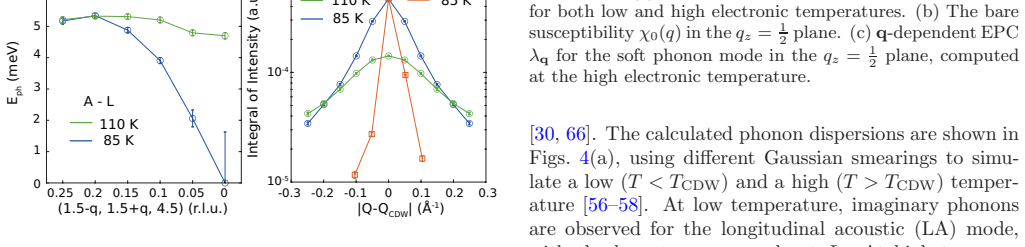
Inelastic x-ray scattering shows that phonons in KV3Sb5 soften to zero energy at the CDW ordering vector (L-point) at TCDW = 78 K. The soft-phonon intensity displays strong in-plane anisotropy, extending farther along L-A than along L-H and producing diffuse scattering. First-principles calculations find that the momentum-dependent electron-phonon coupling is peaked at L and reproduces the same anisotropy, whereas the electronic susceptibility is not peaked at L and exhibits the opposite anisotropy. These observations identify momentum-dependent EPC as the driving mechanism of the CDW.
What carries the argument
Momentum-dependent electron-phonon coupling peaked at the L-point, which produces the observed phonon softening and its in-plane anisotropy.
If this is right
- The CDW forms by a conventional soft-phonon mechanism rather than a purely electronic instability.
- The same in-plane anisotropy of diffuse scattering should appear in the related Rb and Cs compounds.
- Tuning the strength or momentum dependence of the electron-phonon coupling should directly control the CDW transition temperature.
- The unusual properties reported inside the CDW state can arise as consequences of this standard phonon-driven order.
Where Pith is reading between the lines
- Pressure or doping that alters the Fermi-surface nesting or EPC strength at L could be used to test whether the transition temperature tracks the calculated EPC peak.
- The finding suggests that the kagome lattice itself does not require a new CDW mechanism; the same EPC-driven softening seen in layered dichalcogenides suffices.
- If the anisotropy is intrinsic to the EPC, then single-domain samples or uniaxial strain should produce measurable differences in the diffuse scattering pattern along the two in-plane directions.
Load-bearing premise
The first-principles calculations reproduce the measured in-plane anisotropy of the electron-phonon coupling without being dominated by the specific choice of pseudopotentials, exchange-correlation functional, or k-point sampling.
What would settle it
Inelastic x-ray scattering data showing that the phonon branch at the L-point remains at finite energy (well above zero) immediately above 78 K would falsify the claim of complete softening.
Figures


read the original abstract
A range of of unusual emergent behaviors have been reported in the charge-density wave (CDW) state of the $A$V$_3$Sb$_5$ ($A=~$K, Rb, Cs) kagome metals, including a CDW formation process without soft phonons, which points to an unconventional CDW mechanism. Here, we use inelastic x-ray scattering to show that the CDW in KV$_3$Sb$_5$ forms via phonons that soften to zero energy at the CDW ordering vector ($L$-point) around $T_{\rm CDW}=78$~K. The intensity of soft phonons exhibit a remarkable in-plane anisotropy, extending over a much larger momentum range along $L$-$A$ relative to $L$-$H$, which leads to diffuse scattering common among $A$V$_3$Sb$_5$. Using first-principles calculations, we find that the momentum-dependent electron-phonon coupling (EPC) is peaked at $L$ and exhibits the same in-plane anisotropy as the phonon softening. Conversely, the electronic susceptibility is not peaked at $L$ and shows the opposite in-plane anisotropy. Our findings favor momentum-dependent EPC as the driving mechanism of the CDW in KV$_3$Sb$_5$, with a CDW formation process similar to that of transition metal dichalcogenides.
Editorial analysis
A structured set of objections, weighed in public.
Referee Report
Summary. The manuscript reports inelastic x-ray scattering measurements on KV3Sb5 showing that the CDW transition near 78 K is driven by phonons that soften to zero energy at the L-point. The soft-phonon intensity displays pronounced in-plane anisotropy, extending farther along L-A than L-H. First-principles calculations find that the electron-phonon coupling is peaked at L with the same anisotropy, while the electronic susceptibility is not peaked at L and exhibits the opposite anisotropy. The authors conclude that momentum-dependent EPC, rather than electronic susceptibility, drives the CDW, producing a formation process similar to that in transition-metal dichalcogenides.
Significance. If the central claims hold, the work supplies direct spectroscopic evidence that the CDW in KV3Sb5 proceeds via conventional phonon softening, resolving prior reports of CDW formation without soft modes in the AV3Sb5 family. The explicit comparison of computed EPC versus susceptibility, together with the reproduction of the observed experimental anisotropy, strengthens the case for momentum-dependent EPC as the dominant mechanism and offers a concrete link to the diffuse scattering seen across the series.
major comments (1)
- [Calculations section] Calculations section: The central distinction that EPC (peaked at L with matching L-A > L-H anisotropy) rather than electronic susceptibility drives the CDW rests on the first-principles results. No convergence tests with respect to pseudopotential choice, exchange-correlation functional, or k-point sampling are reported. If these technical choices shift the momentum dependence or reverse the anisotropy, the evidence favoring EPC over susceptibility would be substantially weakened. Please add such tests or alternative-functional results to establish robustness.
minor comments (2)
- [Experimental methods] Experimental methods: Background subtraction procedure, resolution convolution details, and the precise criteria used to identify zero-energy softening are described only at an abstract level. Adding these would allow full verification of the IXS data.
- [Results] Figure captions and text: The temperature dependence of the soft-mode intensity and the precise definition of the L-point anisotropy metric should be stated more quantitatively to facilitate direct comparison with the calculated EPC.
Simulated Author's Rebuttal
We thank the referee for the positive evaluation of our work and the constructive comment regarding the first-principles calculations. We address this point below and will incorporate the requested tests in the revised manuscript.
read point-by-point responses
-
Referee: [Calculations section] Calculations section: The central distinction that EPC (peaked at L with matching L-A > L-H anisotropy) rather than electronic susceptibility drives the CDW rests on the first-principles results. No convergence tests with respect to pseudopotential choice, exchange-correlation functional, or k-point sampling are reported. If these technical choices shift the momentum dependence or reverse the anisotropy, the evidence favoring EPC over susceptibility would be substantially weakened. Please add such tests or alternative-functional results to establish robustness.
Authors: We agree that explicit convergence tests strengthen the central claim. In the revised manuscript we will add a dedicated paragraph and supplementary figure reporting calculations with (i) the LDA functional, (ii) PBEsol, (iii) a 2× denser k-mesh, and (iv) an alternative norm-conserving pseudopotential set. These additional runs reproduce the L-point peak in the EPC and the L-A > L-H anisotropy to within a few percent, confirming that the momentum dependence is robust and not an artifact of the original PBE/ultrasoft settings. The electronic susceptibility remains non-peaked at L with opposite anisotropy under all tested conditions. revision: yes
Circularity Check
No significant circularity; independent experiment and first-principles computation
full rationale
The derivation rests on an experimental inelastic x-ray scattering measurement of phonon softening to zero energy at the L-point with observed in-plane anisotropy, performed independently of theory. First-principles calculations of momentum-dependent EPC (peaked at L with matching anisotropy) and electronic susceptibility (not peaked at L, opposite anisotropy) are then compared to the data. These calculations are not obtained by fitting to the measured dispersion or phonon intensities; they are computed separately and used for qualitative comparison. No self-definitional steps, fitted inputs renamed as predictions, or load-bearing self-citations appear in the chain. The central claim that EPC drives the CDW therefore does not reduce to its own inputs by construction.
Axiom & Free-Parameter Ledger
axioms (1)
- domain assumption Standard density-functional approximations suffice to compute momentum-dependent electron-phonon coupling and its anisotropy in KV3Sb5
Lean theorems connected to this paper
-
IndisputableMonolith/Cost/FunctionalEquation.leanwashburn_uniqueness_aczel unclear?
unclearRelation between the paper passage and the cited Recognition theorem.
the momentum-dependent electron-phonon coupling (EPC) is peaked at L and exhibits the same in-plane anisotropy as the phonon softening. Conversely, the electronic susceptibility is not peaked at L and shows the opposite in-plane anisotropy.
-
IndisputableMonolith/Foundation/AlphaCoordinateFixation.leanJ_uniquely_calibrated_via_higher_derivative unclear?
unclearRelation between the paper passage and the cited Recognition theorem.
IXS scans ... soft phonon mode ... power law Eph = [(T − T0)/T0]^δ ... mean-field softening ... similar to ... 2H-NbSe2
What do these tags mean?
- matches
- The paper's claim is directly supported by a theorem in the formal canon.
- supports
- The theorem supports part of the paper's argument, but the paper may add assumptions or extra steps.
- extends
- The paper goes beyond the formal theorem; the theorem is a base layer rather than the whole result.
- uses
- The paper appears to rely on the theorem as machinery.
- contradicts
- The paper's claim conflicts with a theorem or certificate in the canon.
- unclear
- Pith found a possible connection, but the passage is too broad, indirect, or ambiguous to say the theorem truly supports the claim.
Forward citations
Cited by 1 Pith paper
-
Antiferromagnetic Dimers in the Parent Phase of a Correlated Kagome Superconductor
CsCr3Sb5's 4x1 CDW state features antiferromagnetic Cr dimers whose fluctuations may mediate superconductivity.
Reference graph
Works this paper leans on
-
[1]
are similar to that in KV 3Sb5, the presence of soft phonons in these compounds cannot be excluded. As this study on KV 3Sb5 and previous IXS studies of (Cs,Rb)V3Sb5 are performed in different Brillouin zones, a comprehensive search of soft phonons across multi- ple zones in (Cs,Rb)V 3Sb5 will be helpful to elucidate whether phonon softening is common to t...
work page 2024
-
[2]
A. Mielke, Journal of Physics A: Mathematical and General 24, L73–L77 (1991), ISSN 1361-6447, URL http://dx.doi.org/10.1088/0305-4470/24/2/005
-
[3]
S.-L. Yu and J.-X. Li, Physical Re- view B 85 (2012), ISSN 1550-235X, URL http://dx.doi.org/10.1103/PhysRevB.85.144402
-
[4]
M. L. Kiesel and R. Thomale, Physical Re- view B 86 (2012), ISSN 1550-235X, URL http://dx.doi.org/10.1103/PhysRevB.86.121105
-
[5]
W.-S. Wang, Z.-Z. Li, Y.-Y. Xiang, and Q.-H. Wang, Physical Review B 87 (2013), ISSN 1550-235X, URL http://dx.doi.org/10.1103/PhysRevB.87.115135
-
[6]
M. L. Kiesel, C. Platt, and R. Thomale, Physi- cal Review Letters 110 (2013), ISSN 1079-7114, URL http://dx.doi.org/10.1103/PhysRevLett.110.126405
-
[7]
B. R. Ortiz, L. C. Gomes, J. R. Morey, M. Winiarski, M. Bordelon, J. S. Mangum, I. W. H. Os- wald, J. A. Rodriguez-Rivera, J. R. Neilson, S. D. Wilson, et al., Physical Review Mate- rials 3, 094407 (2019), ISSN 2475-9953, URL https://link.aps.org/doi/10.1103/PhysRevMaterials.3.094407
-
[8]
B. R. Ortiz, S. M. L. Teicher, Y. Hu, J. L. Zuo, P. M. Sarte, E. C. Schueller, A. M. M. 6 Abeykoon, M. J. Krogstad, S. Rosenkranz, R. Os- born, et al., Phys. Rev. Lett. 125, 247002 (2020), URL https://link.aps.org/doi/10.1103/PhysRevLett.125.247002
-
[9]
S. D. Wilson and B. R. Ortiz, Nature Reviews Materials 9, 420–432 (2024), ISSN 2058-8437, URL http://dx.doi.org/10.1038/s41578-024-00677-y
-
[10]
S.-Y. Yang, Y. Wang, B. R. Ortiz, D. Liu, J. Gayles, E. Derunova, R. Gonzalez-Hernandez, L. ˇSmejkal, Y. Chen, S. S. P. Parkin, et al., Science Advances 6 (2020), ISSN 2375-2548, URL http://dx.doi.org/10.1126/sciadv.abb6003
-
[11]
F. H. Yu, T. Wu, Z. Y. Wang, B. Lei, W. Z. Zhuo, J. J. Ying, and X. H. Chen, Physical Review B 104 (2021), ISSN 2469-9969, URL http://dx.doi.org/10.1103/PhysRevB.104.L041103
-
[12]
E. M. Kenney, B. R. Ortiz, C. Wang, S. D. Wil- son, and M. J. Graf, Journal of Physics: Condensed Matter 33, 235801 (2021), ISSN 1361-648X, URL http://dx.doi.org/10.1088/1361-648X/abe8f9
-
[13]
Y.-X. Jiang, J.-X. Yin, M. M. Denner, N. Shu- miya, B. R. Ortiz, G. Xu, Z. Guguchia, J. He, M. S. Hossain, X. Liu, et al., Nature Materi- als 20, 1353–1357 (2021), ISSN 1476-4660, URL http://dx.doi.org/10.1038/s41563-021-01034-y
-
[14]
X. Feng, K. Jiang, Z. Wang, and J. Hu, Science Bulletin 66, 1384–1388 (2021), ISSN 2095-9273, URL http://dx.doi.org/10.1016/j.scib.2021.04.043
-
[15]
C. Mielke, D. Das, J.-X. Yin, H. Liu, R. Gupta, Y.- X. Jiang, M. Medarde, X. Wu, H. C. Lei, J. Chang, et al., Nature 602, 245–250 (2022), ISSN 1476-4687, URL http://dx.doi.org/10.1038/s41586-021-04327-z
-
[16]
L. Nie, K. Sun, W. Ma, D. Song, L. Zheng, Z. Liang, P. Wu, F. Yu, J. Li, M. Shan, et al., Nature 604, 59–64 (2022), ISSN 1476-4687, URL http://dx.doi.org/10.1038/s41586-022-04493-8
-
[17]
F. Grandi, A. Consiglio, M. A. Sentef, R. Thomale, and D. M. Kennes, Physical Re- view B 107 (2023), ISSN 2469-9969, URL http://dx.doi.org/10.1103/PhysRevB.107.155131
-
[18]
C. Guo, C. Putzke, S. Konyzheva, X. Huang, M. Gutierrez-Amigo, I. Errea, D. Chen, M. G. Vergniory, C. Felser, M. H. Fischer, et al., Na- ture 611, 461–466 (2022), ISSN 1476-4687, URL http://dx.doi.org/10.1038/s41586-022-05127-9
-
[19]
Q. Yin, Z. Tu, C. Gong, Y. Fu, S. Yan, and H. Lei, Chinese Physics Letters 38, 037403 (2021), ISSN 1741-3540, URL http://dx.doi.org/10.1088/0256-307X/38/3/037403
-
[20]
B. R. Ortiz, P. M. Sarte, E. M. Kenney, M. J. Graf, S. M. L. Teicher, R. Seshadri, and S. D. Wilson, Physical Review Materi- als 5, 034801 (2021), ISSN 2475-9953, URL https://link.aps.org/doi/10.1103/PhysRevMaterials.5.034801
-
[21]
F. H. Yu, D. H. Ma, W. Z. Zhuo, S. Q. Liu, X. K. Wen, B. Lei, J. J. Ying, and X. H. Chen, Na- ture Communications 12 (2021), ISSN 2041-1723, URL http://dx.doi.org/10.1038/s41467-021-23928-w
-
[22]
K. Y. Chen, N. N. Wang, Q. W. Yin, Y. H. Gu, K. Jiang, Z. J. Tu, C. S. Gong, Y. Uwatoko, J. P. Sun, H. C. Lei, et al., Physical Review Letters 126, 247001 (2021), ISSN 0031-9007, 1079-7114, URL https://link.aps.org/doi/10.1103/PhysRevLett.126.247001
-
[23]
F. Du, S. Luo, B. R. Ortiz, Y. Chen, W. Duan, D. Zhang, X. Lu, S. D. Wilson, Y. Song, and H. Yuan, Phys. Rev. B 103, L220504 (2021), URL https://link.aps.org/doi/10.1103/PhysRevB.103.L220504
-
[24]
Y. Zhou, G. Ye, S. Luo, Y. Song, X. Lu, and H. Yuan, Superconductor Science and Tech- nology 37, 103001 (2024), ISSN 1361-6668, URL http://dx.doi.org/10.1088/1361-6668/ad7641
-
[25]
M. Kang, S. Fang, J.-K. Kim, B. R. Ortiz, S. H. Ryu, J. Kim, J. Yoo, G. Sangiovanni, D. Di Sante, B.-G. Park, et al., Nature Physics 18, 301 (2022), ISSN 1745-2473, 1745-2481, URL https://www.nature.com/articles/s41567-021-01451-5
work page 2022
-
[26]
Y. Hu, X. Wu, B. R. Ortiz, S. Ju, X. Han, J. Ma, N. C. Plumb, M. Radovic, R. Thomale, S. D. Wilson, et al., Na- ture Communications 13 (2022), ISSN 2041-1723, URL http://dx.doi.org/10.1038/s41467-022-29828-x
-
[27]
H. Tan, Y. Liu, Z. Wang, and B. Yan, Physical Review Letters 127, 046401 (2021), ISSN 0031-9007, 1079-7114, URL https://link.aps.org/doi/10.1103/PhysRevLett.127.046401
-
[28]
T. Park, M. Ye, and L. Balents, Physical Re- view B 104 (2021), ISSN 2469-9969, URL http://dx.doi.org/10.1103/PhysRevB.104.035142
-
[29]
Y.-P. Lin and R. M. Nandkishore, Physical Review B 104 (2021), ISSN 2469-9969, URL http://dx.doi.org/10.1103/PhysRevB.104.045122
-
[30]
M. M. Denner, R. Thomale, and T. Neupert, Physi- cal Review Letters 127 (2021), ISSN 1079-7114, URL http://dx.doi.org/10.1103/PhysRevLett.127.217601
-
[31]
H. Luo, Q. Gao, H. Liu, Y. Gu, D. Wu, C. Yi, J. Jia, S. Wu, X. Luo, Y. Xu, et al., Nature Communications 13 (2022), ISSN 2041-1723, URL http://dx.doi.org/10.1038/s41467-021-27946-6
-
[32]
Y. Xie, Y. Li, P. Bourges, A. Ivanov, Z. Ye, J.-X. Yin, M. Z. Hasan, A. Luo, Y. Yao, Z. Wang, et al., Physical Review B 105 (2022), ISSN 2469-9969, URL http://dx.doi.org/10.1103/PhysRevB.105.L140501
-
[33]
G. Liu, X. Ma, K. He, Q. Li, H. Tan, Y. Liu, J. Xu, W. Tang, K. Watanabe, T. Taniguchi, et al., Na- ture Communications 13 (2022), ISSN 2041-1723, URL http://dx.doi.org/10.1038/s41467-022-31162-1
-
[34]
G. He, L. Peis, E. F. Cuddy, Z. Zhao, D. Li, Y. Zhang, R. Stumberger, B. Moritz, H. Yang, H. Gao, et al., Na- ture Communications 15 (2024), ISSN 2041-1723, URL http://dx.doi.org/10.1038/s41467-024-45865-0
-
[35]
M. Gutierrez-Amigo, D. Dangic, C. Guo, C. Felser, P. J. W. Moll, M. G. Vergniory, and I. Errea, Com- munications Materials 5 (2024), ISSN 2662-4443, URL http://dx.doi.org/10.1038/s43246-024-00676-0
-
[36]
J.-Y. You, C.-E. Hsu, M. Del Ben, and Z. Li, Phys. Rev. Lett. 134, 106401 (2025), URL https://link.aps.org/doi/10.1103/PhysRevLett.134.106401
-
[37]
X. Zhu, Y. Cao, J. Zhang, E. W. Plummer, and J. Guo, Proceedings of the National Academy of Sci- ences 112, 2367–2371 (2015), ISSN 1091-6490, URL http://dx.doi.org/10.1073/pnas.1424791112
-
[38]
X. Zhu, J. Guo, J. Zhang, and E. W. Plummer, Advances in Physics: X 2, 622–640 (2017), ISSN 2374-6149, URL http://dx.doi.org/10.1080/23746149.2017.1343098
-
[39]
M. Le Tacon, A. Bosak, S. M. Souliou, G. Del- lea, T. Loew, R. Heid, K.-P. Bohnen, G. Ghir- inghelli, M. Krisch, and B. Keimer, Nature Physics 10, 52–58 (2013), ISSN 1745-2481, URL http://dx.doi.org/10.1038/nphys2805
-
[40]
Y. He, S. Wu, Y. Song, W.-S. Lee, A. H. Said, 7 A. Alatas, A. Bosak, A. Girard, S. M. Souliou, A. Ruiz, et al., Phys. Rev. B 98, 035102 (2018), URL https://link.aps.org/doi/10.1103/PhysRevB.98.035102
-
[41]
H. Li, T. T. Zhang, T. Yilmaz, Y. Y. Pai, C. E. Marvinney, A. Said, Q. W. Yin, C. S. Gong, Z. J. Tu, E. Vescovo, et al., Physical Re- view X 11, 031050 (2021), ISSN 2160-3308, URL https://link.aps.org/doi/10.1103/PhysRevX.11.031050
-
[42]
D. Subires, A. Korshunov, A. H. Said, L. S´ anchez, B. R. Ortiz, S. D. Wilson, A. Bosak, and S. Blanco-Canosa, Nature Communica- tions 14, 1015 (2023), ISSN 2041-1723, URL https://www.nature.com/articles/s41467-023-36668-w
work page 2023
-
[43]
X. Zhou, Y. Li, X. Fan, J. Hao, Y. Xiang, Z. Liu, Y. Dai, Z. Wang, Y. Yao, and H.-H. Wen, Phys- ical Review B 107 (2023), ISSN 2469-9969, URL http://dx.doi.org/10.1103/PhysRevB.107.165123
-
[44]
H. Miao, H. X. Li, W. R. Meier, A. Huon, H. N. Lee, A. Said, H. C. Lei, B. R. Ortiz, S. D. Wil- son, J. X. Yin, et al., Physical Review B 104, 195132 (2021), ISSN 2469-9950, 2469-9969, URL https://link.aps.org/doi/10.1103/PhysRevB.104.195132
-
[45]
C. Wang, S. Liu, H. Jeon, and J.-H. Cho, Physical Review B 105, 045135 (2022), ISSN 2469-9950, 2469-9969, URL https://link.aps.org/doi/10.1103/PhysRevB.105.045135
-
[46]
C. Park and Y.-W. Son, Nature Communica- tions 14, 7309 (2023), ISSN 2041-1723, URL https://www.nature.com/articles/s41467-023-43170-w
work page 2023
-
[47]
H. Liu, S. Duan, X. Liu, Z. Liu, S. Wang, L. Gu, J. Huang, W. Yang, J. Liu, D. Qian, et al., Science Bulletin 70, 1211–1214 (2025), ISSN 2095-9273, URL http://dx.doi.org/10.1016/j.scib.2025.02.018
- [48]
-
[49]
D. Song, L. Zheng, F. Yu, J. Li, L. Nie, M. Shan, D. Zhao, S. Li, B. Kang, Z. Wu, et al., Science China Physics, Me- chanics & Astronomy 65 (2022), ISSN 1869-1927, URL http://dx.doi.org/10.1007/s11433-021-1826-1
-
[50]
X. Zhang, Y. Li, J. Zheng, F. Zhou, Q. Wu, X. Xi, Y. Lau, Z. Wang, and W. Wang, Applied Physics Letters 124 (2024), ISSN 1077-3118, URL http://dx.doi.org/10.1063/5.0185873
-
[51]
V. Scagnoli, L. J. Riddiford, S. W. Huang, Y.-G. Shi, Z. Tu, H. Lei, A. Bombardi, G. Nisbet, and Z. Guguchia, Journal of Physics: Condensed Matter 36, 185604 (2024), ISSN 0953-8984, 1361-648X, URL https://iopscience.iop.org/article/10.1088/1361-648X/ad20a2
-
[52]
F. Weber, S. Rosenkranz, J.-P. Castellan, R. Os- born, R. Hott, R. Heid, K.-P. Bohnen, T. Egami, A. H. Said, and D. Reznik, Physical Review Letters 107 (2011), ISSN 1079-7114, URL http://dx.doi.org/10.1103/PhysRevLett.107.107403
-
[53]
A. H. Said, H. Sinn, T. S. Toellner, E. E. Alp, T. Gog, B. M. Leu, S. Bean, and A. Alatas, Jour- nal of Synchrotron Radiation 27, 827 (2020), URL https://doi.org/10.1107/S1600577520002854
-
[54]
T. S. Toellner, A. Alatas, and A. H. Said, Jour- nal of Synchrotron Radiation 18, 605 (2011), URL https://doi.org/10.1107/S0909049511017535
-
[55]
P. Giannozzi, O. Andreussi, T. Brumme, O. Bunau, M. Buongiorno Nardelli, M. Calandra, R. Car, C. Cavaz- zoni, D. Ceresoli, M. Cococcioni, et al., Journal of Physics: Condensed Matter 29, 465901 (2017), URL https://dx.doi.org/10.1088/1361-648X/aa8f79
-
[56]
J. P. Perdew, K. Burke, and M. Ernzer- hof, Phys. Rev. Lett. 77, 3865 (1996), URL https://link.aps.org/doi/10.1103/PhysRevLett.77.3865
-
[57]
S. M. Souliou, T. Lacmann, R. Heid, C. Mein- gast, M. Frachet, L. Paolasini, A.-A. Haghigh- irad, M. Merz, A. Bosak, and M. Le Tacon, Phys. Rev. Lett. 129, 247602 (2022), URL https://link.aps.org/doi/10.1103/PhysRevLett.129.247602
-
[58]
A. Korshunov, H. Hu, D. Subires, Y. Jiang, D. C˘ alug˘ aru, X. Feng, A. Rajapitamahuni, C. Yi, S. Roychowdhury, M. G. Vergniory, et al., Nature Communications 14 (2023), ISSN 2041-1723, URL http://dx.doi.org/10.1038/s41467-023-42186-6
-
[59]
S. Cao, C. Xu, H. Fukui, T. Manjo, Y. Dong, M. Shi, Y. Liu, C. Cao, and Y. Song, Nature Communications 14 (2023), ISSN 2041-1723, URL http://dx.doi.org/10.1038/s41467-023-43454-1
-
[60]
Giustino ,\ 10.1103/RevModPhys.89.015003 journal journal Rev
F. Giustino, Rev. Mod. Phys. 89, 015003 (2017), URL https://link.aps.org/doi/10.1103/RevModPhys.89.015003
-
[61]
J. Noffsinger, F. Giustino, B. D. Malone, C.-H. Park, S. G. Louie, and M. L. Cohen, Computer Physics Com- munications 181, 2140 (2010), ISSN 0010-4655, URL https://www.sciencedirect.com/science/article/pii/S0010465
work page 2010
-
[62]
A. Marrazzo, S. Beck, E. R. Margine, N. Marzari, A. A. Mostofi, J. Qiao, I. Souza, S. S. Tsirkin, J. R. Yates, and G. Pizzi, Rev. Mod. Phys. 96, 045008 (2024), URL https://link.aps.org/doi/10.1103/RevModPhys.96.045008
-
[63]
G.-X. Zhi, C. Xu, S.-Q. Wu, F. Ning, and C. Cao, Computer Physics Communications 271, 108196 (2022), ISSN 0010-4655, URL https://www.sciencedirect.com/science/article/pii/S0010465
work page 2022
-
[64]
See the Supplemental Material for details on experimen - tal methods and data analysis, computational methods, momentum dependence of phonon softening, and first- principles calculations under pressure
-
[65]
J. Lamsal and W. Montfrooij, Phys. Rev. B 93, 214513 (2016), URL https://link.aps.org/doi/10.1103/PhysRevB.93.214513
-
[66]
Y. Song, S. Wu, X. Chen, Y. He, H. Uchiyama, B. Li, S. Cao, J. Guo, G. Cao, and R. Birge- neau, Phys. Rev. B 107, L041113 (2023), URL https://link.aps.org/doi/10.1103/PhysRevB.107.L041113
-
[67]
T. Kato, Y. Li, T. Kawakami, M. Liu, K. Nakayama, Z. Wang, A. Moriya, K. Tanaka, T. Taka- hashi, Y. Yao, et al., Communications Ma- terials 3, 30 (2022), ISSN 2662-4443, URL https://www.nature.com/articles/s43246-022-00255-1
work page 2022
-
[68]
F. Kaboudvand, S. M. L. Teicher, S. D. Wil- son, R. Seshadri, and M. D. Johannes, Applied Physics Letters 120 (2022), ISSN 1077-3118, URL http://dx.doi.org/10.1063/5.0081081
-
[69]
L. Kautzsch, B. R. Ortiz, K. Mallayya, J. Plumb, G. Pokharel, J. P. C. Ruff, Z. Islam, E.-A. Kim, R. Seshadri, and S. D. Wilson, Physical Re- view Materials 7 (2023), ISSN 2475-9953, URL http://dx.doi.org/10.1103/PhysRevMaterials.7.024806
-
[70]
Y. Hu, X. Wu, B. R. Ortiz, X. Han, N. C. Plumb, S. D. Wilson, A. P. Schnyder, and M. Shi, Phys- ical Review B 106 (2022), ISSN 2469-9969, URL http://dx.doi.org/10.1103/PhysRevB.106.L241106
-
[71]
Q. Stahl, D. Chen, T. Ritschel, C. Shekhar, E. Sadrol- lahi, M. C. Rahn, O. Ivashko, M. V. Zimmermann, 8 C. Felser, and J. Geck, Physical Review B 105, 195136 (2022), ISSN 2469-9950, 2469-9969, URL https://link.aps.org/doi/10.1103/PhysRevB.105.195136
-
[72]
Q. Xiao, Y. Lin, Q. Li, X. Zheng, S. Francoual, C. Plueckthun, W. Xia, Q. Qiu, S. Zhang, Y. Guo, et al., Phys. Rev. Res. 5, L012032 (2023), URL https://link.aps.org/doi/10.1103/PhysRevResearch.5.L012032
- [73]
-
[74]
F. Stier, A.-A. Haghighirad, G. Garbarino, S. Mishra, N. Stilkerich, D. Chen, C. Shekhar, T. Lacmann, C. Felser, T. Ritschel, et al., Phys. Rev. Lett. 133, 236503 (2024), URL https://link.aps.org/doi/10.1103/PhysRevLett.133.236503
-
[75]
N. N. Wang, K. Y. Chen, Q. W. Yin, Y. N. N. Ma, B. Y. Pan, X. Yang, X. Y. Ji, S. L. Wu, P. F. Shan, S. X. Xu, et al., Phys. Rev. Res. 3, 043018 (2021), URL https://link.aps.org/doi/10.1103/PhysRevResearch.3.043018
-
[76]
F. Du, S. Luo, R. Li, B. R. Ortiz, Y. Chen, S. D. Wilson, Y. Song, and H. Yuan, Chinese Physics B 31, 017404 (2022), ISSN 1674-1056, URL http://dx.doi.org/10.1088/1674-1056/ac4232
-
[77]
W. Duan, Z. Nie, S. Luo, F. Yu, B. R. Ortiz, L. Yin, H. Su, F. Du, A. Wang, Y. Chen, et al., Science China Physics, Mechanics & Astronomy 64, 107462 (2021), ISSN 1674-7348, 1869-1927, URL https://link.springer.com/10.1007/s11433-021-1747-7
- [78]
-
[79]
A. Kaczmarek, A. Capa Salinas, S. D. Wilson, and K. C. Nowack, arXiv e-prints arXiv:2412.19919 (2024), 2412.19919
-
[80]
Z. Guguchia, C. Mielke, D. Das, R. Gupta, J.- X. Yin, H. Liu, Q. Yin, M. H. Christensen, Z. Tu, C. Gong, et al., Nature Communica- tions 14, 153 (2023), ISSN 2041-1723, URL https://www.nature.com/articles/s41467-022-35718-z
work page 2023
discussion (0)
Sign in with ORCID, Apple, or X to comment. Anyone can read and Pith papers without signing in.