Nucleon-nucleon scattering up to next-to-leading order in manifestly Lorentz-invariant chiral effective field theory: low phases and the deuteron
Pith reviewed 2026-05-18 04:38 UTC · model grok-4.3
The pith
The manifestly Lorentz-invariant chiral EFT nucleon-nucleon potential at NLO, derived via time-ordered perturbation theory and iterated non-perturbatively, gives a reasonable description of S- and P-wave phase shifts plus deuteron binding.
A machine-rendered reading of the paper's core claim, the machinery that carries it, and where it could break.
Core claim
The nucleon-nucleon potential derived in manifestly Lorentz-invariant chiral effective field theory using time-ordered perturbation theory at next-to-leading order yields a reasonable description of the phase shifts in the S and P waves as well as the deuteron properties when treated non-perturbatively in the scattering equation.
What carries the argument
The manifestly Lorentz-invariant chiral EFT potential obtained from time-ordered perturbation theory and iterated non-perturbatively in the scattering equation.
If this is right
- The same potential and formalism can be applied directly to few-nucleon systems.
- The approach provides a starting point for many-body calculations of nuclear matter and finite nuclei.
- Relativistic effects remain under explicit control while the interaction is solved non-perturbatively.
Where Pith is reading between the lines
- The method may allow consistent inclusion of relativistic corrections in three-nucleon forces without additional non-relativistic expansions.
- Extension to next-to-next-to-leading order would test whether the present level of agreement persists or improves systematically.
- The framework could be combined with existing relativistic few-body methods to study electromagnetic observables in the deuteron.
Load-bearing premise
The potential derived via time-ordered perturbation theory remains reliable when iterated non-perturbatively for low partial waves at NLO.
What would settle it
A clear mismatch between the calculated and experimental phase shifts in any S or P wave below roughly 100 MeV, or a failure to reproduce the deuteron binding energy and asymptotic normalization constant, would falsify the claim of reasonable description.
Figures


read the original abstract
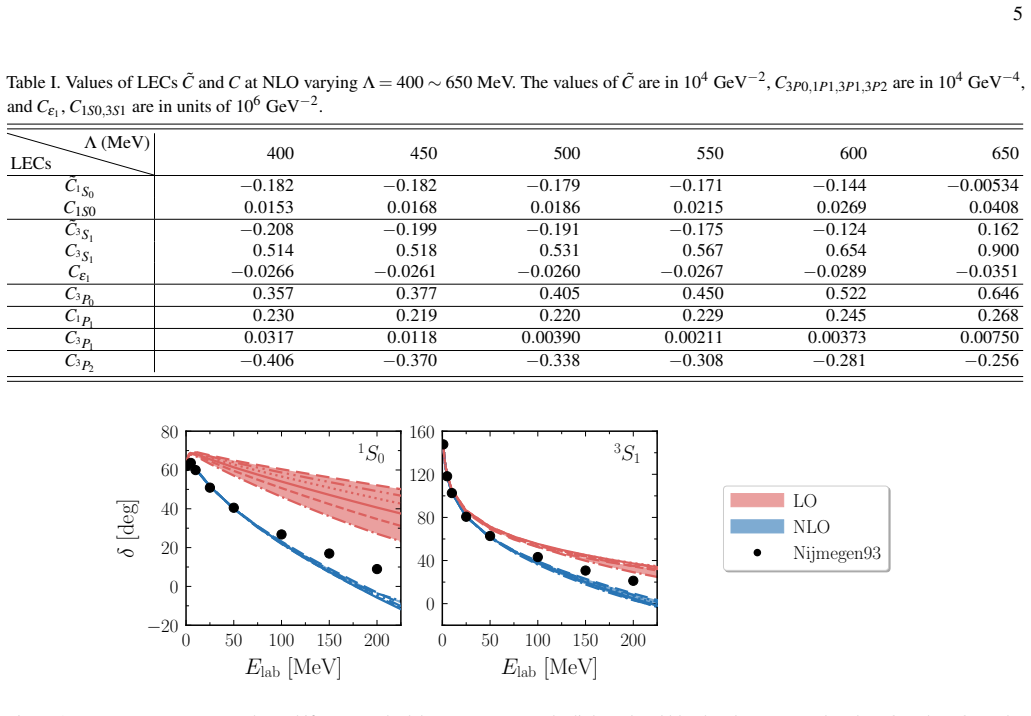
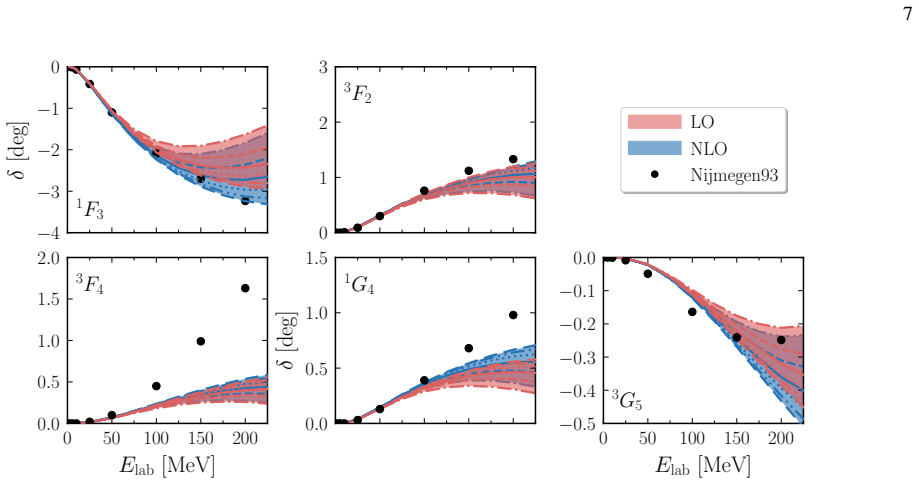
Recently the nucleon-nucleon interaction derived using time-ordered perturbation theory in manifestly Lorentz-invariant chiral effective field theory was shown to yield promising results for peripheral neutron-proton scattering. In this work we study low partial waves at next-to-leading order by treating the potential non-perturbatively in the scattering equation. Reasonable description of the phase shifts in the $S$ and $P$ waves as well as the deuteron properties is observed, which can be regarded as a feasibility study for the application of our formalism to the few- and many-body calculations.
Editorial analysis
A structured set of objections, weighed in public.
Referee Report
Summary. The manuscript investigates nucleon-nucleon scattering in low partial waves at next-to-leading order within manifestly Lorentz-invariant chiral effective field theory using a potential derived from time-ordered perturbation theory. The potential is iterated non-perturbatively to obtain phase shifts in S and P waves and properties of the deuteron, with the authors observing a reasonable description and framing the work as a feasibility study for few- and many-body calculations.
Significance. Should the central results hold upon closer quantitative scrutiny, this study would demonstrate the feasibility of applying the TOPT-derived manifestly Lorentz-invariant chiral EFT to low-energy NN interactions. This extends prior work on peripheral scattering and could provide a foundation for relativistic treatments in nuclear physics, particularly if the non-perturbative iteration is shown to be consistent with the chiral order.
major comments (2)
- The abstract states that a 'reasonable description' is observed, but no quantitative measures such as chi-squared values, average deviations, or error bands are supplied in the presented results. This makes it difficult to evaluate the quality of the agreement with data independently.
- The non-perturbative iteration of the NLO potential in the scattering equation (as done for low partial waves) may generate contributions beyond NLO. No explicit test, such as a comparison to perturbative NLO results or an estimate of higher-order effects, is reported to address this potential issue in the S and P waves and especially the deuteron bound state.
Simulated Author's Rebuttal
We thank the referee for the careful review and constructive comments on our manuscript. We address each major comment point by point below, indicating where revisions have been made to strengthen the presentation while maintaining the focus of this feasibility study.
read point-by-point responses
-
Referee: The abstract states that a 'reasonable description' is observed, but no quantitative measures such as chi-squared values, average deviations, or error bands are supplied in the presented results. This makes it difficult to evaluate the quality of the agreement with data independently.
Authors: We agree that quantitative measures would allow readers to assess the agreement more objectively. In the revised manuscript we have added chi-squared per degree of freedom for the S- and P-wave phase shifts (computed over the laboratory-energy range 0–100 MeV), together with the mean absolute deviation from the Nijmegen partial-wave analysis. We have also included cutoff-variation bands in the figures to represent the theoretical uncertainty at NLO. These additions are confined to the results section and do not alter the overall conclusions of the feasibility study. revision: yes
-
Referee: The non-perturbative iteration of the NLO potential in the scattering equation (as done for low partial waves) may generate contributions beyond NLO. No explicit test, such as a comparison to perturbative NLO results or an estimate of higher-order effects, is reported to address this potential issue in the S and P waves and especially the deuteron bound state.
Authors: The referee correctly notes that non-perturbative iteration can in principle promote higher-order contributions. In the manifestly Lorentz-invariant TOPT framework the potential is derived strictly at NLO; the Lippmann-Schwinger equation is solved to capture the non-perturbative dynamics required for the deuteron and low partial waves, which is standard practice in chiral EFT. To address the concern we have added a brief discussion (new paragraph in Sec. III) that (i) recalls the perturbative treatment used for peripheral waves in our earlier work and (ii) provides a rough estimate of the size of N2LO corrections by comparing the NLO deuteron binding energy and asymptotic normalization constant with the corresponding N2LO values available in the literature. A full perturbative-versus-non-perturbative comparison at NLO for the S waves lies outside the scope of the present feasibility study but will be pursued in follow-up work. revision: partial
Circularity Check
No significant circularity in derivation chain
full rationale
The paper constructs the NLO potential via time-ordered perturbation theory in manifestly Lorentz-invariant chiral EFT, then iterates it non-perturbatively in the scattering equation to obtain phase shifts and deuteron properties for low partial waves. This is presented explicitly as a feasibility study rather than a parameter-free prediction. No quoted step reduces a claimed result to its inputs by construction, no fitted parameter is relabeled as a prediction, and the cited prior peripheral-wave work supplies the potential definition without load-bearing self-citation that forces the low-wave outcomes. The comparison to data constitutes an external benchmark, rendering the central feasibility claim self-contained.
Axiom & Free-Parameter Ledger
axioms (1)
- domain assumption The nucleon-nucleon interaction can be derived using time-ordered perturbation theory in manifestly Lorentz-invariant chiral effective field theory.
Lean theorems connected to this paper
-
IndisputableMonolith/Cost/FunctionalEquationwashburn_uniqueness_aczel unclear?
unclearRelation between the paper passage and the cited Recognition theorem.
The effective potential, defined as a sum of two-nucleon-irreducible time-ordered diagrams... iterated non-perturbatively in the Kadyshevsky equation
-
IndisputableMonolith/Foundation/RealityFromDistinctionreality_from_one_distinction unclear?
unclearRelation between the paper passage and the cited Recognition theorem.
We have 9 parameters (as the combinations of LECs...) to be fixed
What do these tags mean?
- matches
- The paper's claim is directly supported by a theorem in the formal canon.
- supports
- The theorem supports part of the paper's argument, but the paper may add assumptions or extra steps.
- extends
- The paper goes beyond the formal theorem; the theorem is a base layer rather than the whole result.
- uses
- The paper appears to rely on the theorem as machinery.
- contradicts
- The paper's claim conflicts with a theorem or certificate in the canon.
- unclear
- Pith found a possible connection, but the passage is too broad, indirect, or ambiguous to say the theorem truly supports the claim.
Forward citations
Cited by 1 Pith paper
-
$S$-wave $KN$ scattering in a renormalizable chiral effective field theory
A renormalizable covariant chiral EFT calculation of s-wave KN scattering yields a good description of I=1 phase shifts with a negative effective range while the I=0 channel remains weakly constrained.
Reference graph
Works this paper leans on
- [1]
- [2]
-
[3]
D. R. Entem, R. Machleidt, and Y . Nosyk, Phys. Rev. C96, 024004 (2017), arXiv:1703.05454 [nucl-th]
work page internal anchor Pith review Pith/arXiv arXiv 2017
-
[4]
Semilocal momentum-space regularized chiral two-nucleon potentials up to fifth order
P. Reinert, H. Krebs, and E. Epelbaum, Eur. Phys. J. A54, 86 (2018), arXiv:1711.08821 [nucl-th]
work page internal anchor Pith review Pith/arXiv arXiv 2018
-
[5]
P. F. Bedaque and U. van Kolck, Ann. Rev. Nucl. Part. Sci.52, 339 (2002), arXiv:nucl-th/0203055
work page internal anchor Pith review Pith/arXiv arXiv 2002
-
[6]
Few-Nucleon Forces and Systems in Chiral Effective Field Theory
E. Epelbaum, Prog. Part. Nucl. Phys.57, 654 (2006), arXiv:nucl-th/0509032
work page internal anchor Pith review Pith/arXiv arXiv 2006
-
[7]
Modern Theory of Nuclear Forces
E. Epelbaum, H.-W. Hammer, and U.-G. Meißner, Rev. Mod. Phys.81, 1773 (2009), arXiv:0811.1338 [nucl-th]
work page internal anchor Pith review Pith/arXiv arXiv 2009
-
[8]
Chiral effective field theory and nuclear forces
R. Machleidt and D. Entem, Phys. Rept.503, 1 (2011), arXiv:1105.2919 [nucl-th]
work page internal anchor Pith review Pith/arXiv arXiv 2011
- [9]
-
[10]
E. Epelbaum, H. Krebs, and P. Reinert, Front. in Phys.8, 98 (2020), arXiv:1911.11875 [nucl-th]
-
[11]
L. E. Marcucci, ed.,The Long-Lasting Quest for Nuclear Interactions: The Past, the Present and the Future, Frontiers Research Topics (Frontiers Media SA, 2021)
work page 2021
-
[12]
A. Kievsky, ed.,Celebrating 30 Years of the Steven Weinberg’s Paper Nuclear F orces from Chiral Lagrangians, Collection of Few-body Systems (Few-body Systems, 2022)
work page 2022
-
[13]
Tewset al., Few Body Syst.63, 67 (2022), arXiv:2202.01105 [nucl-th]
I. Tewset al., Few Body Syst.63, 67 (2022), arXiv:2202.01105 [nucl-th]
-
[14]
Weinberg's approach to nucleon-nucleon scattering revisited
E. Epelbaum and J. Gegelia, Phys. Lett. B716, 338 (2012), arXiv:1207.2420 [nucl-th]
work page internal anchor Pith review Pith/arXiv arXiv 2012
- [15]
- [16]
- [17]
- [18]
-
[19]
Two-pion exchange nucleon-nucleon potential:O(q^4) relativistic chiral expansion
R. Higa and M. R. Robilotta, Phys. Rev. C68, 024004 (2003), arXiv:nucl-th/0304025
work page internal anchor Pith review Pith/arXiv arXiv 2003
-
[20]
R. Higa, M. R. Robilotta, and C. A. da Rocha, Phys. Rev. C69, 034009 (2004), arXiv:nucl-th/0310011
work page internal anchor Pith review Pith/arXiv arXiv 2004
-
[21]
Leading order relativistic chiral nucleon-nucleon interaction
X.-L. Ren, K.-W. Li, L.-S. Geng, B. Long, P. Ring, and J. Meng, Chin. Phys. C42, 014103 (2018), arXiv:1611.08475 [nucl-th]
work page internal anchor Pith review Pith/arXiv arXiv 2018
- [22]
-
[23]
The Two-Nucleon Potential from Chiral Lagrangians
C. Ordóñez, L. Ray, and U. van Kolck, Phys. Rev. C53, 2086 (1996), arXiv:hep-ph/9511380
work page internal anchor Pith review Pith/arXiv arXiv 2086
-
[24]
Relativity constraints on the two-nucleon contact interaction
L. Girlanda, S. Pastore, R. Schiavilla, and M. Viviani, Phys. Rev. C81, 034005 (2010), arXiv:1001.3676 [nucl-th]
work page internal anchor Pith review Pith/arXiv arXiv 2010
-
[25]
Covariant chiral nucleon-nucleon contact Lagrangian up to order $\mathcal{O}(q^4)$
Y . Xiao, L.-S. Geng, and X.-L. Ren, Phys. Rev. C99, 024004 (2019), arXiv:1812.03005 [nucl-th]
work page internal anchor Pith review Pith/arXiv arXiv 2019
-
[26]
E. Filandri and L. Girlanda, Phys. Lett. B841, 137957 (2023), arXiv:2303.10084 [nucl-th]
-
[27]
H. P. Stapp, T. J. Ypsilantis, and N. Metropolis, Phys. Rev.105, 302 (1957)
work page 1957
-
[28]
E. Epelbaum, W. Glockle, and U.-G. Meißner, Nucl. Phys. A671, 295 (2000), arXiv:nucl-th/9910064
work page internal anchor Pith review Pith/arXiv arXiv 2000
-
[29]
M. L. Goldberger and S. B. Treiman, Phys. Rev.110, 1178 (1958)
work page 1958
-
[30]
V . G. J. Stoks, R. A. M. Klomp, M. C. M. Rentmeester, and J. J. de Swart, Phys. Rev. C48, 792 (1993)
work page 1993
-
[31]
Improved chiral nucleon-nucleon potential up to next-to-next-to-next-to-leading order
E. Epelbaum, H. Krebs, and U.-G. Meißner, Eur. Phys. J. A51, 53 (2015), arXiv:1412.0142 [nucl-th]
work page internal anchor Pith review Pith/arXiv arXiv 2015
-
[32]
V . G. J. Stoks, R. A. M. Klomp, C. P. F. Terheggen, and J. J. de Swart, Phys. Rev. C49, 2950 (1994), arXiv:nucl-th/9406039
work page internal anchor Pith review Pith/arXiv arXiv 1994
-
[33]
J. J. de Swart, C. P. F. Terheggen, and V . G. J. Stoks, arXiv:nucl-th/9509032 (1995), arXiv:nucl-th/9509032
work page internal anchor Pith review Pith/arXiv arXiv 1995
discussion (0)
Sign in with ORCID, Apple, or X to comment. Anyone can read and Pith papers without signing in.