Recurrence Relations and Dispersive Techniques for Precision Multi-Loop Calculations
Pith reviewed 2026-05-18 03:46 UTC · model grok-4.3
The pith
Recurrence relations reduce multi-point Passarino-Veltman functions to two-point basis and cut the number of dispersive integrals needed.
A machine-rendered reading of the paper's core claim, the machinery that carries it, and where it could break.
Core claim
By expressing multi-point Passarino-Veltman functions in a two-point basis and using shifted space-time dimensions with recurrence relations, the number of required dispersive integrals is minimized. This reduces computation time and enables a precise and efficient analysis of one- and two-loop diagrams.
What carries the argument
Reduction of multi-point Passarino-Veltman functions to a two-point basis via recurrence relations in shifted dimensions, which lowers the count of dispersive integrals.
If this is right
- The number of dispersive integrals required for the diagrams is reduced.
- Computation time for two-loop electroweak corrections decreases.
- Precise analysis of one- and two-loop diagrams becomes feasible with less effort.
Where Pith is reading between the lines
- The same reduction steps could be tested on three-loop diagrams to check whether the basis change remains exact.
- Integration of the recurrence method into automated loop-calculation packages would allow direct checks on a wider set of observables.
- The approach may connect to existing dispersion-relation libraries for cross-validation on benchmark processes.
Load-bearing premise
The recurrence relations and dimension shifts allow exact reduction of the relevant multi-point Passarino-Veltman functions to two-point ones without loss of information or uncontrolled approximations for the electroweak diagrams.
What would settle it
Numerical evaluation of a specific two-loop electroweak integral using this reduction compared side-by-side with an independent exact result or high-precision Monte Carlo integration for the same diagram.
Figures
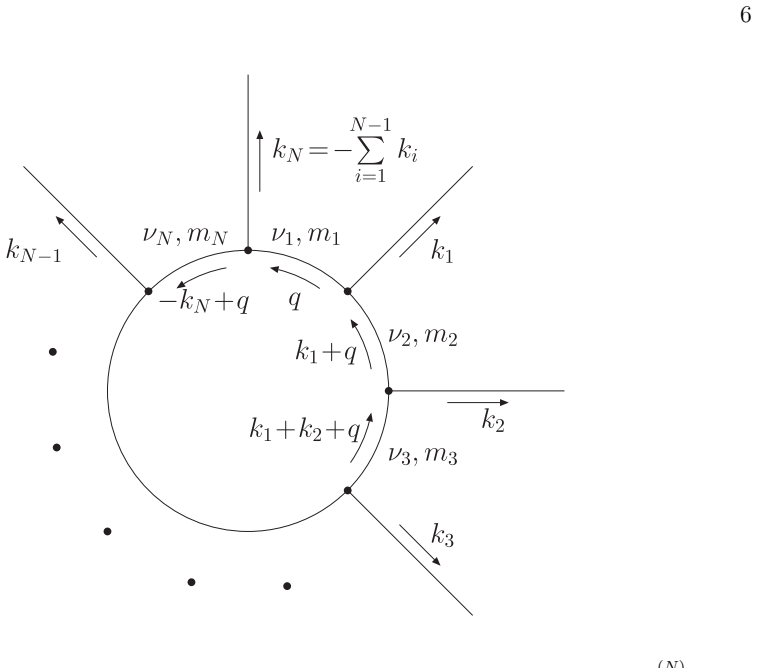
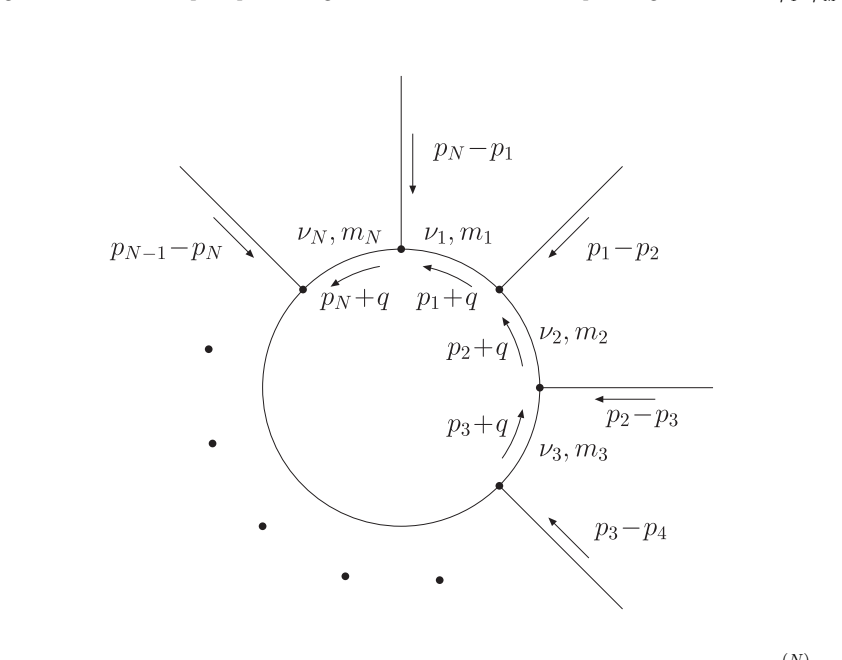

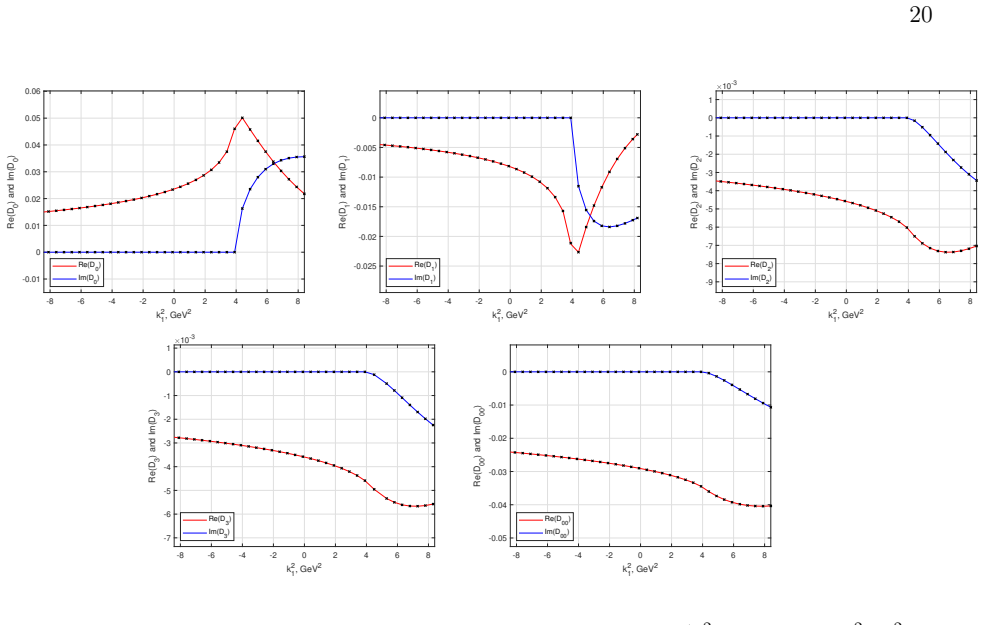
read the original abstract
Ab initio predictions of two-loop electroweak contributions to observables are increasingly essential for precision collider experiments, yet their evaluation remains very challenging. We connect recurrence techniques and dispersive method in order to evaluate complex multi-loop Feynman diagrams. By expressing multi-point Passarino-Veltman functions in a two-point basis and using shifted space-time dimensions with recurrence relations, we minimize the number of required dispersive integrals. This approach reduces computation time and enables a precise and efficient analysis of one- and two-loop diagrams.
Editorial analysis
A structured set of objections, weighed in public.
Referee Report
Summary. The paper claims that combining recurrence relations with shifted space-time dimensions allows multi-point Passarino-Veltman functions to be reduced exactly to a two-point basis, which in turn minimizes the number of dispersive integrals needed to evaluate one- and two-loop electroweak Feynman diagrams and thereby reduces computation time while maintaining precision.
Significance. If the reduction is exact and free of uncontrolled approximations for physical electroweak kinematics, the method could meaningfully accelerate precision two-loop calculations that are increasingly required for collider phenomenology. The explicit linkage of recurrence techniques to dispersive representations is a potentially useful technical step, but the manuscript supplies neither derivations, numerical benchmarks, nor verification against known results, leaving the practical significance unconfirmed.
major comments (2)
- [Abstract / method description] The central claim (abstract) that the recurrence-plus-dimension-shift procedure yields an exact reduction to a two-point basis without loss of information or introduction of uncontrolled approximations is load-bearing for the entire paper. Standard PV reduction identities divide by Gram determinants formed from external momenta; these determinants vanish or become numerically unstable for on-shell or forward-scattering electroweak diagrams (e.g., boxes or pentagons). The manuscript does not indicate whether singular cases are regularized, bypassed by alternative identities, or shown to cancel inside the final dispersive integral.
- [Abstract] No explicit derivation, numerical example, or error estimate is supplied to demonstrate that the claimed reduction actually works for a representative two-loop electroweak diagram. Without such verification the assertion that computation time is reduced while precision is preserved cannot be assessed.
minor comments (1)
- [Abstract] The abstract is the only concrete text provided; if the full manuscript contains derivations or examples, they should be highlighted in the introduction with explicit section references.
Simulated Author's Rebuttal
We thank the referee for the thoughtful and detailed report. The concerns raised about the exactness of the reduction and the lack of explicit examples are important for establishing the practical utility of the method. We address each point below and have made revisions to the manuscript to incorporate clarifications and additional verification.
read point-by-point responses
-
Referee: [Abstract / method description] The central claim (abstract) that the recurrence-plus-dimension-shift procedure yields an exact reduction to a two-point basis without loss of information or introduction of uncontrolled approximations is load-bearing for the entire paper. Standard PV reduction identities divide by Gram determinants formed from external momenta; these determinants vanish or become numerically unstable for on-shell or forward-scattering electroweak diagrams (e.g., boxes or pentagons). The manuscript does not indicate whether singular cases are regularized, bypassed by alternative identities, or shown to cancel inside the final dispersive integral.
Authors: We agree that standard Passarino-Veltman reductions can suffer from instabilities due to vanishing Gram determinants in certain physical kinematics relevant to electroweak processes. Our method employs recurrence relations in conjunction with shifts in the space-time dimension to express multi-point functions directly in terms of a two-point basis. This procedure is formulated analytically in shifted dimensions, where the relevant identities hold without explicit division by the Gram determinants at each step. Potential singularities are thus bypassed or cancel within the subsequent dispersive integrals. We have added a new subsection in the revised manuscript detailing the analytic continuation and regularization procedure for these cases, including a discussion of how the dimension shift regularizes the expressions. revision: yes
-
Referee: [Abstract] No explicit derivation, numerical example, or error estimate is supplied to demonstrate that the claimed reduction actually works for a representative two-loop electroweak diagram. Without such verification the assertion that computation time is reduced while precision is preserved cannot be assessed.
Authors: We acknowledge that the original submission focused on the formal connection between the techniques and did not include a concrete numerical demonstration. In the revised version, we have added an explicit derivation for the reduction of a two-loop electroweak box diagram to the two-point basis, along with a numerical benchmark comparing the computational time and precision against standard methods. Error estimates are provided based on the truncation of the dispersive integrals, confirming that precision is maintained while reducing the number of integrals required. revision: yes
Circularity Check
No circularity: method applies standard recurrence and dispersive tools to PV reduction
full rationale
The abstract and available text present the approach as combining established recurrence relations, dimension shifts, and dispersive integrals to express multi-point Passarino-Veltman functions in a two-point basis. No quoted equations or claims show the final result being fitted to itself, renamed by construction, or justified solely via a self-citation chain whose content reduces to the present work. The central claim concerns computational minimization rather than a closed derivation loop. Potential issues with vanishing Gram determinants (raised externally) concern numerical stability or completeness, not circularity in the derivation itself. The paper is treated as self-contained against external benchmarks for this analysis.
Axiom & Free-Parameter Ledger
Lean theorems connected to this paper
-
IndisputableMonolith/Cost/FunctionalEquation.leanwashburn_uniqueness_aczel unclear?
unclearRelation between the paper passage and the cited Recognition theorem.
By expressing multi-point Passarino-Veltman functions in a two-point basis and using shifted space-time dimensions with recurrence relations, we minimize the number of required dispersive integrals.
-
IndisputableMonolith/Foundation/RealityFromDistinction.leanreality_from_one_distinction unclear?
unclearRelation between the paper passage and the cited Recognition theorem.
Using the recurrence relation (80) for the case ν1=1 ... J(2)(D+2;1,ν2+1)=−π/(2ν2 k²) [...]
What do these tags mean?
- matches
- The paper's claim is directly supported by a theorem in the formal canon.
- supports
- The theorem supports part of the paper's argument, but the paper may add assumptions or extra steps.
- extends
- The paper goes beyond the formal theorem; the theorem is a base layer rather than the whole result.
- uses
- The paper appears to rely on the theorem as machinery.
- contradicts
- The paper's claim conflicts with a theorem or certificate in the canon.
- unclear
- Pith found a possible connection, but the passage is too broad, indirect, or ambiguous to say the theorem truly supports the claim.
Reference graph
Works this paper leans on
-
[1]
Recurrence Relations and Dispersive Techniques for Precision Multi-Loop Calculations
at BNL will further require comprehensive higher-order theory predictions across mul- tiple scattering channels. The accurate theoretical description of electroweak processes has long been a cornerstone of precision tests of the Standard Model (SM). Over the past four decades, the field has progressed from the first analytical one-loop formalisms to moder...
work page internal anchor Pith review Pith/arXiv arXiv 2025
-
[2]
=B 1−point {2l,n} (k2, m2 1, m2
-
[3]
+B 2−point {2l,n} (k2, m2 1, m2 2),(29) with B1−point {2l,n} (k2, m2 1, m2
-
[4]
= µ2εeγE εn! iπ1−ε −1 2 lh ¯R(1,0) 2,l,n(m1, m2, k2, ε)J(2) (2−2ε; 1,0) + ¯R(0,1) 2,l,n(m1, m2, k2, ε)J(2) (2−2ε; 0,1) i ,(30) B2−point {2l,n} (k2, m2 1, m2
-
[5]
For the four-point function the situation is a bit more complicated
= µ2εeγE εn! iπ1−ε −1 2 l R(1,1) 2,l,n(m1, m2, k2, ε) ¯J (2) n+l+1 (2−2ε; 1,1).(31) 13 Note that all UV-singularities are inB1−point {2l,n} (k2, m2 1, m2 2), namely in the tadpole integrals (19), whereas the termB2−point {2l,n} (k2, m2 1, m2 2)is UV-finite. For the four-point function the situation is a bit more complicated. Let us start from the integral...
-
[6]
Im i−1J (2) (2−2ε; 1,1) sδ + i π 1 sδ −k 2 −i0 ∞ˆ sδ dsIm i−1J (2) (2−2ε; 1,1) s s−ε ∂ ∂s sε(s+m 2 1 −m 2 2) sn+l+1(s−m 2 1 −m 2 2) .(51) We can see that in the limitδ→0the first (non-integral) term on the r.h.s. of Eq. (51) exactly cancels the non-integral term in Eq. (50). The remaining integrals contibuting to ¯J (2) n+l+1 (2−2ε; 1,2)are finite asδ→0. ...
-
[7]
+Cl 2 (2τ ′ 02)].(88) In other regions (where∆<0) one can use analytic continuation. This process was described in Ref. [64], at any order inε. Introducing variableszi =e iσθi, such thatθi = 2τ ′ 0i, 31 σ=±1, we get iσ[Ls 1 (π)−Ls 1 (θi)] = ln(−z i),(89) iσ[Ls 2 (π)−Ls 2 (θi)] =− 1 2 [Li2 (zi)−Li 2 (1/zi)].(90) In our case, the variablesz1 andz 2 can be p...
-
[8]
MOLLER Collaboration (J. Benesch (Jefferson Lab) et al.), JLAB-PHY-14-1986 (2014) [nucl- ex/1411.4088]
work page internal anchor Pith review Pith/arXiv arXiv 1986
-
[9]
D. Becker (U. Mainz, PRISMA & Mainz U., Inst. Kernphys.) et al., DOI: 10.1140/epja/i2018- 12611-6 (2018) [nucl-ex/1802.04759]
work page internal anchor Pith review Pith/arXiv arXiv doi:10.1140/epja/i2018- 2018
-
[10]
Arringtonet al.,[Jefferson Lab SoLID], J
J. Arringtonet al.,[Jefferson Lab SoLID], J. Phys.G50, 110501 (2023) [arXiv:2209.13357 [nucl-ex]]
-
[11]
V. Burkert et al., Prog. Part. Nucl. Phys.131, 104032 (2023) [arXiv:2211.15746 [nucl-ex]]
- [12]
-
[13]
W. F. L. Hollik, Fortsch. Phys.38, 165-260 (1990)
work page 1990
-
[14]
A. Denner, Fortsch. Phys.41, 307-420 (1993) [arXiv:0709.1075 [hep-ph]]
work page internal anchor Pith review Pith/arXiv arXiv 1993
-
[15]
O. V. Tarasov, Phys. Rev. D54, 6479-6490 (1996) [arXiv:hep-th/9606018 [hep-th]]
work page internal anchor Pith review Pith/arXiv arXiv 1996
-
[16]
O. V. Tarasov, Nucl. Phys.B502, 455–482 (1996) [hep-ph/9703319]
work page internal anchor Pith review Pith/arXiv arXiv 1996
-
[17]
A. I. Davydychev, Phys. Lett.B263, 107–111 (1991)
work page 1991
-
[18]
W. T. Giele and E. W. N. Glover, JHEP04, 029 (2004) [hep-ph/0402152]
work page internal anchor Pith review Pith/arXiv arXiv 2004
- [19]
-
[20]
R. K. Ellis, W. T. Giele and G. Zanderighi, Phys. Rev.D73, 014027 (2006) [hep-ph/0508308]
work page internal anchor Pith review Pith/arXiv arXiv 2006
-
[21]
R. N. Lee, JHEP04, 108 (2015) [arXiv:1411.0911 [hep-ph]]
work page internal anchor Pith review Pith/arXiv arXiv 2015
-
[22]
V. A. Smirnov, Evaluating Feynman integrals, Springer Tracts in Modern Physics,211, 1–244 (2004)
work page 2004
-
[23]
Anti-differentiation and the calculation of Feynman amplitudes
A. V. Kotikov, in "Anti-differentiation and the calculation of Feynman amplitudes" (2021), p. 235–259, [arXiv:2102.07424]
-
[24]
J. Blümlein and C. Schneider, J. Phys.A55, 443005 (2022), [arXiv:2203.13015]
-
[25]
J. Blümlein, M. Saragnese and C. Schneider, Ann. Math. Artif. Intell.91, 591–649 (2023) [arXiv:2111.15501]
-
[26]
Wasser, doi:10.25358/openscience-6801 (2025)
P. Wasser, doi:10.25358/openscience-6801 (2025)
- [27]
-
[28]
Quadratic electroweak corrections for polarized Moller scattering
A. Aleksejevs, S. Barkanova, Y. Kolomensky, E. Kuraev and V. Zykunov, Phys. Rev.D85, 37 013007 (2012) [arXiv:1110.1750 [hep-ph]]
work page internal anchor Pith review Pith/arXiv arXiv 2012
-
[29]
A. G. Aleksejevs, S. G. Barkanova, Y. M. Bystritskiy, A. N. Ilyichev, E. A. Kuraev and V. A. Zykunov, Eur. Phys. J.C72, 2249 (2012)
work page 2012
-
[30]
A. G. Aleksejevs, S. G. Barkanova, V. A. Zykunov and E. A. Kuraev, Phys. Atom. Nucl.76, 888–900 (2013)
work page 2013
-
[31]
A. G. Aleksejevs, S. G. Barkanova, Y. M. Bystritskiy, E. A. Kuraev and V. A. Zykunov, Phys. Part. Nucl. Lett.12, no.5, 645–656 (2015) [arXiv:1504.03560 [hep-ph]]
work page internal anchor Pith review Pith/arXiv arXiv 2015
-
[32]
A. G. Aleksejevs, S. G. Barkanova, Y. M. Bystritskiy, E. A. Kuraev and V. A. Zykunov, Phys. Part. Nucl. Lett.13, no.3, 310-317 (2016) [arXiv:1508.07853 [hep-ph]]
work page internal anchor Pith review Pith/arXiv arXiv 2016
-
[33]
Dispersion Approach in Two-Loop Calculations
A. Aleksejevs, Phys. Rev.D98, 036021 (2018) [hep-th/1804.08914]
work page internal anchor Pith review Pith/arXiv arXiv 2018
-
[35]
Dimensional Regularization and Dispersive Two-Loop Calculations
A. Aleksejevs and S. Barkanova, (2019) [arXiv:1905.07936 [hep-th]]
work page internal anchor Pith review Pith/arXiv arXiv 2019
-
[36]
A. Aleksejevs and S. Barkanova, PoS LeptonPhoton2019, 090 (2019) [arXiv:1912.04762 [hep- th]]
-
[37]
X.-L. Chen, P.-F. Yang and W. Chen, Chin. Phys. Lett.41, 111101 (2024) [arXiv:2405.19868]
-
[38]
Q. Song and A. Freitas, JHEP04, 179 (2021) [arXiv:2101.00308 [hep-ph]]
-
[39]
A. Freitas and Q. Song, Phys. Rev. Lett.130, 031801 (2023) [arXiv:2209.07612 [hep-ph]]
-
[40]
The two-loop electroweak bosonic corrections to $\sin^2\theta_{\rm eff}^{\rm b}$
I. Dubovyk, A. Freitas, J. Gluza, T. Riemann and J. Usovitsch, Phys. Lett.B 762, 184-189 (2016) [arXiv:1607.08375 [hep-ph]]
work page internal anchor Pith review Pith/arXiv arXiv 2016
-
[41]
I. Dubovyk, A. Freitas, J. Gluza, K. Grzanka, M. Hidding and J. Usovitsch, Phys. Rev.D106, L111301 (2022) [arXiv:2201.02576 [hep-ph]]
- [42]
-
[43]
N. Schwanemann and S. Weinzierl, SciPost Phys.18, no.6, 172 (2025) [arXiv:2412.07522 [hep- ph]]
- [44]
-
[45]
Navaset al.[Particle Data Group], Phys
S. Navaset al.[Particle Data Group], Phys. Rev.D110, 030001 (2024)
work page 2024
-
[46]
Numerical multi-loop integrals and applications
A. Freitas, Prog. Part. Nucl. Phys.90, 201–240 (2016) [arXiv:1604.00406 [hep-ph]]
work page internal anchor Pith review Pith/arXiv arXiv 2016
- [47]
-
[48]
New representation of two-loop propagator and vertex functions
A. Czarnecki, U. Kilian and D. Kreimer. Nucl. Phys.B433, 259–275 (1995) [hep-ph/9405423]
work page internal anchor Pith review Pith/arXiv arXiv 1995
-
[49]
New representation of the two-loop crossed vertex function
A. Frink, U. Kilian and D. Kreimer. Nucl. Phys.B488, 426–440 (1997) [hep-ph/9610285]
work page internal anchor Pith review Pith/arXiv arXiv 1997
-
[50]
The two-loop sunrise graph with arbitrary masses
L. Adams, C. Bogner and S. Weinzierl, J. Math. Phys.54, 052303 (2013) [arXiv:1302.7004 38 [hep-ph]]
work page internal anchor Pith review Pith/arXiv arXiv 2013
-
[51]
L. Adams, C. Bogner and S. Weinzierl, J. Math. Phys.56, 072303 (2015) [arXiv:1504.03255 [hep-ph]]
work page internal anchor Pith review Pith/arXiv arXiv 2015
-
[52]
The iterated structure of the all-order result for the two-loop sunrise integral
L. Adams, C. Bogner and S. Weinzierl, J. Math. Phys.57, 032304 (2016) [arXiv:1512.05630 [hep-ph]]
work page internal anchor Pith review Pith/arXiv arXiv 2016
-
[53]
E. Remiddi and L. Tancredi, Nucl. Phys.B907, 400–444 (2016) [arXiv:1602.01481 [hep-ph]]
work page internal anchor Pith review Pith/arXiv arXiv 2016
-
[54]
A Feynman integral via higher normal functions
S. Bloch, M. Kerr and P. Vanhove, Compos. Math.151, 2329–2375 (2015) [arXiv:1406.2664 [hep-th]]
work page internal anchor Pith review Pith/arXiv arXiv 2015
-
[55]
Local mirror symmetry and the sunset Feynman integral
S. Bloch, M. Kerr and P. Vanhove, Adv. Theor. Math. Phys.21, 1373–1453 (2017) [arXiv:1601.08181 [hep-th]]
work page internal anchor Pith review Pith/arXiv arXiv 2017
-
[56]
SecDec: A tool for numerical multi-loop calculations
S. Borowka, J. Carter and G. Heinrich, J. Phys. Conf. Ser.368, 012051 (2012) [arXiv:1206.4908 [hep-ph]]
work page internal anchor Pith review Pith/arXiv arXiv 2012
-
[57]
Numerical evaluation of multi-loop integrals for arbitrary kinematics with SecDec 2.0
S. Borowka, J. Carter and G. Heinrich, Comput. Phys. Commun.184, 396–408 (2013) [arXiv:1204.4152 [hep-ph]]
work page internal anchor Pith review Pith/arXiv arXiv 2013
-
[58]
Simple one-dimensional integral representations for two-loop self-energies: the master diagram
S. Bauberger, M. Böhm, Nucl. Phys.B445, 25–46 (1995) [hep-ph/9501201 [hep-ph]]
work page internal anchor Pith review Pith/arXiv arXiv 1995
-
[59]
The effective electroweak mixing angle $\sin^2\theta_{eff}$ with two-loop fermionic contributions
W. Hollik, U. Meier and S. Uccirati, Nucl. Phys.B731, 213–224 (2005) [hep-ph/0507158]
work page internal anchor Pith review Pith/arXiv arXiv 2005
-
[60]
A. Freitas, W. Hollik, W. Walter and G Weiglein, Nucl. Phys.B632, 189–218 (2002) [hep- ph/0202131]
-
[61]
Master integrals for massive two-loop Bhabha scattering in QED
M. Czakon, J. Gluza and T. Riemann, Phys. Rev.D71, 073009 (2005) [hep-ph/0412164]
work page internal anchor Pith review Pith/arXiv arXiv 2005
-
[62]
Virtual Hadronic and Leptonic Contributions to Bhabha Scattering
S. Actis, M. Czakon, J. Gluza and T. Riemann, Phys. Rev. Lett.100, 131602 (2008) [arXiv:0711.3847 [hep-ph]]
work page internal anchor Pith review Pith/arXiv arXiv 2008
-
[64]
F. V. Tkachov, Phys. Lett.B100, 65–68 (1981)
work page 1981
-
[65]
K. G. Chetyrkin and F. V. Tkachov, Nucl. Phys.B192, 159–204 (1981)
work page 1981
-
[66]
A. I. Davydychev and R. Delbourgo, J. Math. Phys.394299–4334 (1998) [hep-th/9709216]
work page internal anchor Pith review Pith/arXiv arXiv 1998
-
[67]
A. I. Davydychev, Nucl. Instr. Meth.A559, 293–297 (2006) [hep-th/0509233]
work page internal anchor Pith review Pith/arXiv arXiv 2006
- [68]
-
[69]
Geometrical approach to Feynman integrals and the epsilon-expansion
A. I. Davydychev, Proc. Workshop "AIHENP-99", Heraklion, Greece, April 1999 (Parisianou S.A., Athens, 2000), 219–225 [hep-th/9908032]. 39
work page internal anchor Pith review Pith/arXiv arXiv 1999
-
[70]
A. I. Davydychev, Phys. Rev.D61, 087701 (2000) [hep-ph/9910224]
work page internal anchor Pith review Pith/arXiv arXiv 2000
- [71]
-
[72]
Relativistic phase space: dimensional recurrences
R. Delbourgo and M. L. Roberts, J. Phys.A36, 1719–1728 (2003) [hep-th/0301004]
work page internal anchor Pith review Pith/arXiv arXiv 2003
-
[73]
A. I. Davydychev and R. Delbourgo, J. Phys.A37, 4871–4876 (2004) [hep-th/0311075]
work page internal anchor Pith review Pith/arXiv arXiv 2004
-
[74]
E. E. Boos and A. I. Davydychev, Teor. Mat. Fiz.8956, (1991) [Theor. Math. Phys.89, 1052 (1991)]
work page 1991
-
[75]
A. P. Prudnikov, Yu. A. Brychkov and O. I. Marichev, Integrals and series. Additional chapters (Nauka, Moscow, 1986)
work page 1986
-
[76]
Collier: a fortran-based Complex One-Loop LIbrary in Extended Regularizations
A. Denner, S. Dittmaier and L. Hofer, Comput. Phys. Commun.212, 220–238 (2017) [arXiv:1604.06792]
work page internal anchor Pith review Pith/arXiv arXiv 2017
-
[77]
Reduction of one-loop tensor 5-point integrals
A. Denner and S. Dittmaier, Nucl. Phys.B658, 175–202 (2003) [hep-ph/0212259]
work page internal anchor Pith review Pith/arXiv arXiv 2003
-
[78]
Reduction schemes for one-loop tensor integrals
A. Denner and S. Dittmaier, Nucl. Phys.B734, 62–115 (2006) [hep-ph/0509141]
work page internal anchor Pith review Pith/arXiv arXiv 2006
-
[79]
Scalar one-loop 4-point integrals
A. Denner and S. Dittmaier, Nucl. Phys.B844, 199–242 (2011) [arXiv:1005.2076 [hep-ph]]
work page internal anchor Pith review Pith/arXiv arXiv 2011
-
[80]
Crossed Topology in Two-Loop Dispersive Approach
A. Aleksejevs, (2018) [arXiv:1809.05592 [hep-th]]
work page internal anchor Pith review Pith/arXiv arXiv 2018
-
[81]
H. H. Patel, Comput. Phys. Commun.197, 276–290 (2015) [arXiv:1503.01469 [hep-ph]]
work page internal anchor Pith review Pith/arXiv arXiv 2015
-
[82]
H. H. Patel, Comput. Phys. Commun.218, 66–70 (2017) [arXiv:1612.00009 [hep-ph]]
work page internal anchor Pith review Pith/arXiv arXiv 2017
discussion (0)
Sign in with ORCID, Apple, or X to comment. Anyone can read and Pith papers without signing in.