Letter of Intent: The Forward Physics Facility
Pith reviewed 2026-05-21 20:55 UTC · model grok-4.3
The pith
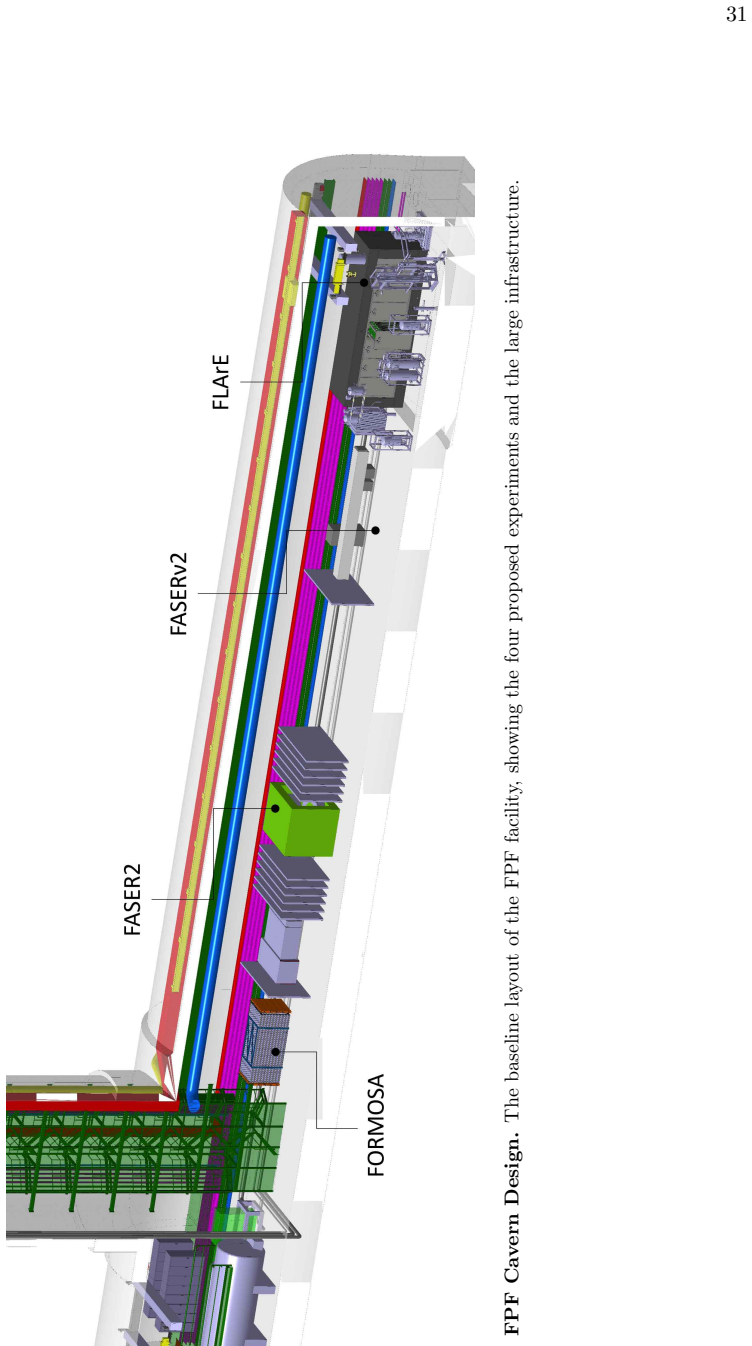
A proposed shielded cavern 627 meters downstream from an LHC collision point would host four detectors to study high-energy neutrinos and search for new particles.
A machine-rendered reading of the paper's core claim, the machinery that carries it, and where it could break.
Core claim
The Forward Physics Facility is a proposed extension of the HL-LHC program designed to exploit the unique scientific opportunities offered by the intense flux of high energy neutrinos, and possibly new particles, in the far-forward direction. Located in a well-shielded cavern 627 m downstream of one of the LHC interaction points, the facility will support a broad and ambitious physics program that significantly expands the discovery potential of the HL-LHC. Equipped with four complementary detectors—FLArE, FASERν2, FASER2, and FORMOSA—the FPF will enable breakthrough measurements that will advance our understanding of neutrino physics, quantum chromodynamics, and astroparticle physics, and搜索
What carries the argument
The Forward Physics Facility, a shielded cavern placed 627 m downstream of an LHC interaction point and instrumented with the four complementary detectors FLArE, FASERν2, FASER2, and FORMOSA.
If this is right
- The facility would deliver high-energy neutrino cross-section measurements that extend current data by orders of magnitude in energy.
- Forward particle production data would tighten constraints on parton distribution functions used in QCD calculations.
- Dedicated searches would set new limits on feebly interacting particles and dark-matter candidates that escape main LHC detectors.
- Combined detector data would improve models of high-energy neutrino production relevant to cosmic-ray and astrophysical observations.
- The program would increase the overall new-physics reach of the HL-LHC by accessing previously under-explored forward kinematics.
Where Pith is reading between the lines
- Successful operation could supply calibration data that benefits neutrino experiments at other facilities or in space by providing an independent high-energy benchmark.
- Long-term data taking might reveal whether forward neutrino fluxes deviate from standard model predictions in ways that affect interpretations of cosmic neutrino observations.
- The modular detector approach suggests that future upgrades could add specialized instruments without rebuilding the entire cavern.
Load-bearing premise
The far-forward neutrino flux and any new-particle flux at 627 m downstream will be both intense enough and sufficiently well shielded to allow the listed detectors to record statistically significant samples.
What would settle it
A detailed simulation or direct measurement that shows the expected number of neutrino interactions or new-particle events in any of the four detectors falls below the threshold needed for statistically significant results would undermine the central physics case.
Figures





















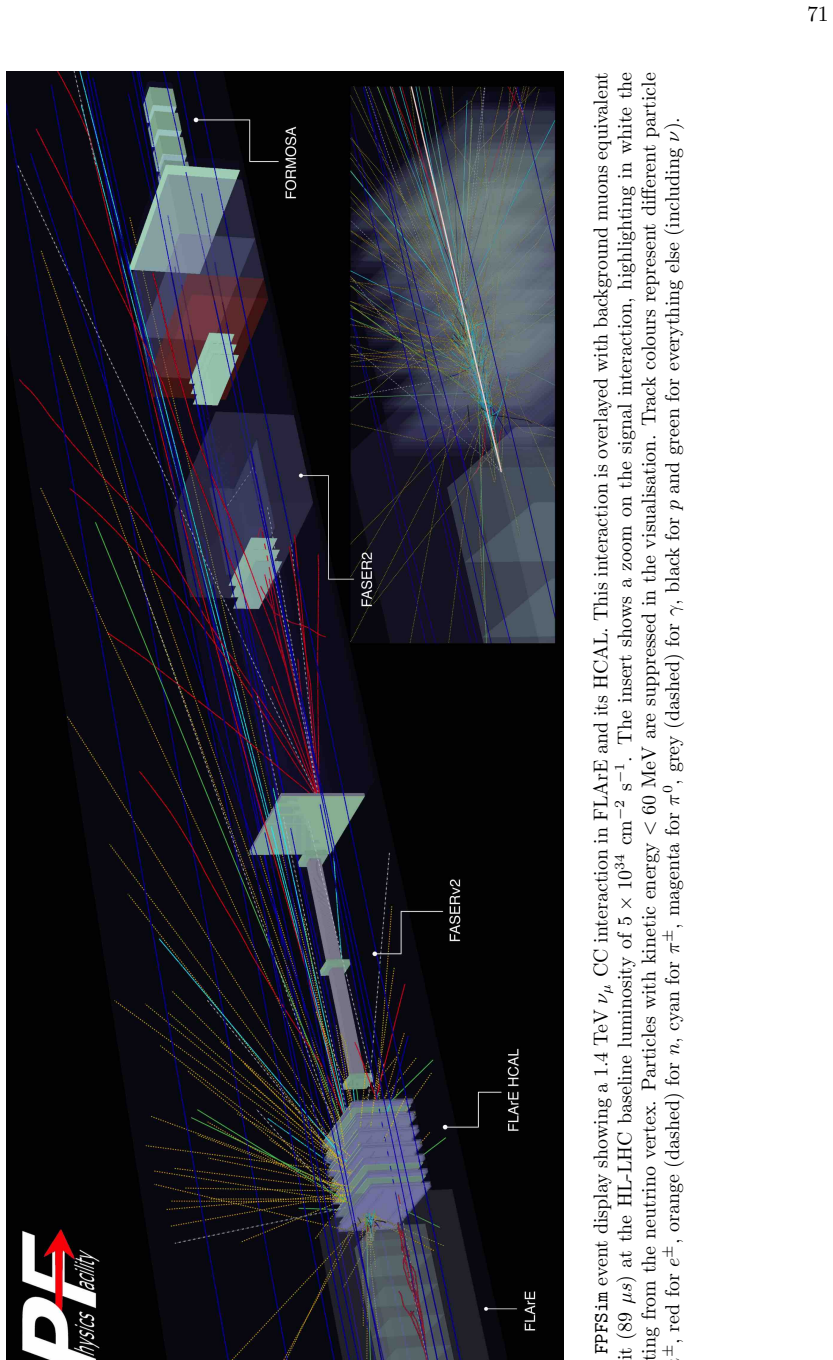


read the original abstract
The Forward Physics Facility (FPF) is a proposed extension of the HL-LHC program designed to exploit the unique scientific opportunities offered by the intense flux of high energy neutrinos, and possibly new particles, in the far-forward direction. Located in a well-shielded cavern 627 m downstream of one of the LHC interaction points, the facility will support a broad and ambitious physics program that significantly expands the discovery potential of the HL-LHC. Equipped with four complementary detectors -- FLArE, FASER$\nu$2, FASER2, and FORMOSA -- the FPF will enable breakthrough measurements that will advance our understanding of neutrino physics, quantum chromodynamics, and astroparticle physics, and will search for dark matter and other new particles. With this Letter of Intent, we propose the construction of the FPF cavern and the construction, integration, and installation of its experiments. We summarize the physics case, the facility design, the layout and components of the detectors, as well as the envisioned collaboration structure, cost estimate, and implementation timeline.
Editorial analysis
A structured set of objections, weighed in public.
Referee Report
Summary. The manuscript is a Letter of Intent proposing the Forward Physics Facility (FPF) as an extension to the HL-LHC program. Located in a well-shielded cavern 627 m downstream of an LHC interaction point, the FPF would host four complementary detectors (FLArE, FASERν2, FASER2, and FORMOSA) to exploit the intense far-forward flux of high-energy neutrinos and possible new particles. The document summarizes the physics case for advancing neutrino physics, QCD, astroparticle physics, and dark-matter searches, along with the facility design, detector layouts, collaboration structure, cost estimate, and implementation timeline.
Significance. If the far-forward fluxes prove sufficient after shielding, the FPF would open a new kinematic regime for high-statistics neutrino measurements and forward QCD studies that are inaccessible to the central LHC detectors, while also enabling searches for light dark matter and other new particles. The proposal builds directly on the operational experience of the existing FASER experiment and could meaningfully expand the overall discovery reach of the HL-LHC program.
major comments (1)
- [Abstract] Abstract: The central claim that the four detectors 'will enable breakthrough measurements' rests on the assumption that the far-forward neutrino and new-particle fluxes at 627 m will be intense enough, after shielding, to produce statistically significant event samples. The text asserts that the cavern is 'well-shielded' and the flux 'intense' but provides no new Monte Carlo results, luminosity-scaled interaction rates, or background-rejection factors, instead referencing prior FASER studies. This external assumption is load-bearing for the physics case and should be explicitly re-quantified or updated within the LoI.
minor comments (2)
- [Facility Design] The detector integration and cavern layout sections would benefit from a single schematic figure showing the relative positions and shielding layers of all four experiments.
- [Physics Case] Clarify the precise HL-LHC luminosity assumptions used for any projected event yields referenced from earlier work.
Simulated Author's Rebuttal
We thank the referee for their careful review and positive assessment of the FPF proposal's significance. We address the major comment below and will incorporate revisions to strengthen the manuscript.
read point-by-point responses
-
Referee: [Abstract] Abstract: The central claim that the four detectors 'will enable breakthrough measurements' rests on the assumption that the far-forward neutrino and new-particle fluxes at 627 m will be intense enough, after shielding, to produce statistically significant event samples. The text asserts that the cavern is 'well-shielded' and the flux 'intense' but provides no new Monte Carlo results, luminosity-scaled interaction rates, or background-rejection factors, instead referencing prior FASER studies. This external assumption is load-bearing for the physics case and should be explicitly re-quantified or updated within the LoI.
Authors: We agree that the abstract's claims depend on the far-forward fluxes and that a Letter of Intent should make the supporting quantitative basis more self-contained. The detailed Monte Carlo simulations, luminosity-scaled rates, and background estimates are documented in the referenced FASER and FPF studies that underpin this proposal. To address the concern directly, we will revise the abstract to include concise, luminosity-scaled estimates of expected neutrino interaction rates and new-particle search sensitivities drawn from those prior calculations. We will also add a short paragraph in the main text (near the facility description) that explicitly quotes the key flux numbers, shielding attenuation factors, and background-rejection performance at 627 m. This keeps the LoI concise while rendering the load-bearing assumptions explicit and traceable within the document itself. revision: partial
Circularity Check
No circularity: facility proposal contains no derivation chain
full rationale
This Letter of Intent is a high-level proposal document that summarizes the physics case, facility design, detector layouts, cost estimates, and timeline for the FPF. It contains no equations, fitted parameters, or predictive derivations that could reduce to their own inputs by construction. References to prior FASER flux studies are external citations rather than self-referential loops within a derivation; the central claims about future measurements are forward-looking assertions, not closed mathematical reductions. The document is therefore self-contained as a proposal and receives a circularity score of 0.
Axiom & Free-Parameter Ledger
Lean theorems connected to this paper
-
IndisputableMonolith/Foundation/RealityFromDistinction.leanreality_from_one_distinction unclear?
unclearRelation between the paper passage and the cited Recognition theorem.
The FPF will enable breakthrough measurements that will advance our understanding of neutrino physics, quantum chromodynamics, and astroparticle physics
What do these tags mean?
- matches
- The paper's claim is directly supported by a theorem in the formal canon.
- supports
- The theorem supports part of the paper's argument, but the paper may add assumptions or extra steps.
- extends
- The paper goes beyond the formal theorem; the theorem is a base layer rather than the whole result.
- uses
- The paper appears to rely on the theorem as machinery.
- contradicts
- The paper's claim conflicts with a theorem or certificate in the canon.
- unclear
- Pith found a possible connection, but the passage is too broad, indirect, or ambiguous to say the theorem truly supports the claim.
Forward citations
Cited by 2 Pith papers
-
A New Source of Millicharged Particles: Secondary Showers in the LHC Forward Absorber
Secondary cascades in the TAXN absorber produce a substantial millicharged particle flux that complements primary production and boosts FORMOSA signals by ~50% for m_χ below 0.1 GeV.
-
The FASER experiment at the Large Hadron Collider
FASER is now running at the LHC and has started delivering first collider-based neutrino data along with searches for new light particles.
Reference graph
Works this paper leans on
-
[1]
Forward Physics Facility Kickoff Meeting
“Forward Physics Facility Kickoff Meeting.”https://indico.cern.ch/event/955956, 9-10 November 2020
work page 2020
-
[2]
2nd Forward Physics Facility Meeting (FPF2)
“2nd Forward Physics Facility Meeting (FPF2).”https://indico.cern.ch/event/1022352, 27-28 May 2021
-
[3]
3rd Forward Physics Facility Meeting (FPF3)
“3rd Forward Physics Facility Meeting (FPF3).”https://indico.cern.ch/event/1076733, 25-26 October 2021
-
[4]
4th Forward Physics Facility Meeting (FPF4)
“4th Forward Physics Facility Meeting (FPF4).”https://indico.cern.ch/event/1110746, 31 January-1 February 2022
-
[5]
5th Forward Physics Facility Meeting (FPF5)
“5th Forward Physics Facility Meeting (FPF5).”https://indico.cern.ch/event/1196506, 15-16 November 2022
-
[6]
6th Forward Physics Facility Meeting (FPF6)
“6th Forward Physics Facility Meeting (FPF6).”https://indico.cern.ch/event/1275380, 8-9 June 2023
-
[7]
7th Forward Physics Facility Meeting (FPF7)
“7th Forward Physics Facility Meeting (FPF7).”https://indico.cern.ch/event/1358966, 29 February - 1 March 2024
-
[8]
8th Forward Physics Facility Meeting (FPF8)
“8th Forward Physics Facility Meeting (FPF8).”https://indico.cern.ch/event/1473651, 21–22 January 2025
-
[9]
Forward Physics Facility Theory Workshop
“Forward Physics Facility Theory Workshop.”https://indico.cern.ch/event/1296658, 18-19 September 2024
-
[10]
The Forward Physics Facility: Sites, experiments, and physics potential,
L. A. Anchordoquiet al., “The Forward Physics Facility: Sites, experiments, and physics potential,” Phys. Rept.968(2022) 1–50,arXiv:2109.10905 [hep-ph]
-
[11]
The Forward Physics Facility at the High-Luminosity LHC,
J. L. Fenget al., “The Forward Physics Facility at the High-Luminosity LHC,”J. Phys. G50(2023) no. 3, 030501,arXiv:2203.05090 [hep-ex]
-
[12]
Scientific program for the Forward Physics Facility,
J. Adhikaryet al., “Scientific program for the Forward Physics Facility,”Eur. Phys. J. C85(2025) no. 4, 430,arXiv:2411.04175 [hep-ex]. [13]FPF Working GroupsCollaboration, L. A. Anchordoquiet al., “The Forward Physics Facility at the Large Hadron Collider,” 3, 2025.arXiv:2503.19010 [hep-ex]. [14]FASERCollaboration, H. Abreuet al., “Search for dark photons...
-
[13]
Neutrino and muon physics in the collider mode of future accelerators,
A. De Rujula and R. Ruckl, “Neutrino and muon physics in the collider mode of future accelerators,” inSSC Workshop: Superconducting Super Collider Fixed Target Physics, pp. 571–596. 5, 1984. http://inspirehep.net/record/204753/files/p571.pdf. [16]FASERCollaboration, H. Abreuet al., “The FASER detector,”JINST19(2024) no. 05, P05066, arXiv:2207.11427 [physi...
-
[14]
The dawn of collider neutrino physics,
E. Worcester, “The dawn of collider neutrino physics,”APS Physics16(2023) 113. [21]FASERCollaboration, R. Mammen Abrahamet al., “First Measurement ofν e andν µ Interaction Cross Sections at the LHC with FASER’s Emulsion Detector,”Phys. Rev. Lett.133(2024) no. 2, 021802,arXiv:2403.12520 [hep-ex]. [22]FASERCollaboration, R. Mammen Abrahamet al., “First Meas...
-
[15]
Forward neutrino fluxes at the LHC,
F. Kling and L. J. Nevay, “Forward neutrino fluxes at the LHC,”Phys. Rev. D104(2021) no. 11, 113008,arXiv:2105.08270 [hep-ph]
-
[16]
EPOS LHC : test of collective hadronization with LHC data
T. Pierog, I. Karpenko, J. M. Katzy, E. Yatsenko, and K. Werner, “EPOS LHC: Test of collective hadronization with data measured at the CERN Large Hadron Collider,”Phys. Rev. C92(2015) no. 3, 034906,arXiv:1306.0121 [hep-ph]
work page internal anchor Pith review Pith/arXiv arXiv 2015
-
[17]
Predictions for neutrinos and new physics from forward heavy hadron production at the LHC,
L. Buonocore, F. Kling, L. Rottoli, and J. Sominka, “Predictions for neutrinos and new physics from forward heavy hadron production at the LHC,”Eur. Phys. J. C84(2024) no. 4, 363, arXiv:2309.12793 [hep-ph]. [26]FASERCollaboration, R. Mammen Abrahamet al., “Prospects and Opportunities with an upgraded FASER Neutrino Detector during the HL-LHC era: Input to...
-
[18]
Detecting 84 LHC neutrinos at surface level,
A. Ariga, S. Barwick, J. Boyd, M. Fieg, F. Kling, T. M¨ akel¨ a, C. Vendeuvre, and B. Weyer, “Detecting 84 LHC neutrinos at surface level,”JHEP07(2025) 270,arXiv:2501.06142 [hep-ex]
-
[19]
Lake- and Surface-Based Detectors for Forward Neutrino Physics,
N. W. Kamp, C. A. Arg¨ uelles, A. Karle, J. Thomas, and T. Yuan, “Lake- and Surface-Based Detectors for Forward Neutrino Physics,”arXiv:2501.08278 [hep-ex]. [29]Particle Data GroupCollaboration, P. A. Zylaet al., “Review of Particle Physics,”PTEP2020 (2020) no. 8, 083C01
-
[20]
Post-LS3 Experimental Options in ECN3,
C. Ahdidaet al., “Post-LS3 Experimental Options in ECN3,”arXiv:2310.17726 [hep-ex]. [31]SND@LHCCollaboration, D. Abbaneoet al., “Input from the SND@LHC collaboration to the 2026 Update to the European Strategy for Particle Physics,”arXiv:2503.24233 [hep-ex]
-
[21]
SND@HL-LHC, Scattering and Neutrino Detector in Run 4 of the LHC,
D. Abbaneoet al., “SND@HL-LHC, Scattering and Neutrino Detector in Run 4 of the LHC,” tech. rep., CERN, Geneva, 2025.https://cds.cern.ch/record/2926288. [33]FASERCollaboration, R. Mammen Abrahamet al., “Neutrino rate predictions for FASER,”Phys. Rev. D110(2024) no. 1, 012009,arXiv:2402.13318 [hep-ex]
-
[22]
F. Kling, T. M¨ akel¨ a, and J. McFayden, “Anti-Electron Neutrinos at High-Energy Neutrino Experiments: Identification Strategies and Physics Potential,”arXiv:2507.00262 [hep-ph]. [35]NOMADCollaboration, Q. Wuet al., “A Precise measurement of the muon neutrino-nucleon inclusive charged current cross-section off an isoscalar target in the energy range 2.5<...
-
[23]
J. P. Bergeet al., “Total Neutrino and Anti-neutrino Charged Current Cross-section Measurements in 100-GeV, 160-GeV and 200-GeV Narrow Band Beams,”Z. Phys. C35(1987) 443
work page 1987
-
[24]
Precise Measurement of Neutrino and Anti-neutrino Differential Cross Sections
W. G. Seligman,A Next-to-Leading Order QCD Analysis of Neutrino - Iron Structure Functions at the Tevatron. PhD thesis, Nevis Labs, Columbia U., 1997. [38]NuTeVCollaboration, M. Tzanovet al., “Precise measurement of neutrino and anti-neutrino differential cross sections,”Phys. Rev. D74(2006) 012008,arXiv:hep-ex/0509010
work page internal anchor Pith review Pith/arXiv arXiv 1997
-
[25]
A first measurement of the interaction cross section of the tau neutrino
C. Baltayet al., “ν µ −ν e Universality in Charged Current Neutrino Interactions,”Phys. Rev. D41 (1990) 2653. [40]DONuTCollaboration, K. Kodamaet al., “Final tau-neutrino results from the DONuT experiment,” Phys. Rev. D78(2008) 052002,arXiv:0711.0728 [hep-ex]. [41]IceCubeCollaboration, M. G. Aartsenet al., “The IceCube Neutrino Observatory: Instrumentatio...
work page internal anchor Pith review Pith/arXiv arXiv 1990
-
[26]
Extracting the Energy-Dependent Neutrino-Nucleon Cross Section Above 10 TeV Using IceCube Showers
M. Bustamante and A. Connolly, “Extracting the Energy-Dependent Neutrino-Nucleon Cross Section above 10 TeV Using IceCube Showers,”Phys. Rev. Lett.122(2019) no. 4, 041101,arXiv:1711.11043 [astro-ph.HE]. [44]IceCubeCollaboration, R. Abbasiet al., “Measurement of the high-energy all-flavor neutrino-nucleon cross section with IceCube,”arXiv:2011.03560 [hep-ex]
work page internal anchor Pith review Pith/arXiv arXiv 2019
-
[27]
S. A. Rabinowitzet al., “Measurement of the strange sea distribution using neutrino charm production,”Phys. Rev. Lett.70(1993) 134–137. [46]NuTeVCollaboration, M. Goncharovet al., “Precise Measurement of Dimuon Production Cross-Sections inν µ Fe and ¯νµ Fe Deep Inelastic Scattering at the Tevatron.,”Phys. Rev. D64(2001) 112006,arXiv:hep-ex/0102049
work page internal anchor Pith review Pith/arXiv arXiv 1993
-
[28]
Measurement of charm production in neutrino charged-current interactions
A. Kayis-Topaksuet al., “Measurement of charm production in neutrino charged-current interactions,” New J. Phys.13(2011) 093002,arXiv:1107.0613 [hep-ex]. [48]OPERACollaboration, N. Agafonovaet al., “Final Results of the OPERA Experiment onν τ Appearance in the CNGS Neutrino Beam,”Phys. Rev. Lett.120(2018) no. 21, 211801, arXiv:1804.04912 [hep-ex]. [Erratu...
work page internal anchor Pith review Pith/arXiv arXiv 2011
-
[29]
Investigating the fluxes and physics potential of LHC neutrino experiments,
F. Kling, T. M¨ akel¨ a, and S. Trojanowski, “Investigating the fluxes and physics potential of LHC neutrino experiments,”Phys. Rev. D108(2023) no. 9, 095020,arXiv:2309.10417 [hep-ph]. [53]NOMADCollaboration, P. Astieret al., “Final NOMAD results on muon-neutrino→tau-neutrino and electron-neutrino→tau-neutrino oscillations including a new search for tau-n...
-
[30]
General bounds on non-standard neutrino interactions
C. Biggio, M. Blennow, and E. Fernandez-Martinez, “General bounds on non-standard neutrino interactions,”JHEP08(2009) 090,arXiv:0907.0097 [hep-ph]. [56]Particle Data GroupCollaboration, S. Navaset al., “Review of particle physics,”Phys. Rev. D110 (2024) no. 3, 030001
work page internal anchor Pith review Pith/arXiv arXiv 2009
-
[31]
A. Falkowski, M. Gonz´ alez-Alonso, J. Kopp, Y. Soreq, and Z. Tabrizi, “EFT at FASERν,”JHEP10 (2021) 086,arXiv:2105.12136 [hep-ph]
-
[32]
Neutral current neutrino interactions at FASERν,
A. Ismail, R. Mammen Abraham, and F. Kling, “Neutral current neutrino interactions at FASERν,” Phys. Rev. D103(2021) no. 5, 056014,arXiv:2012.10500 [hep-ph]
-
[33]
Resonances in ¯νe −e − scattering below a TeV,
V. Brdar, A. de Gouvˆ ea, P. A. N. Machado, and R. Plestid, “Resonances in ¯νe −e − scattering below a TeV,”Phys. Rev. D105(2022) no. 9, 093004,arXiv:2112.03283 [hep-ph]
-
[34]
Modeling Deep Inelastic Cross Sections in the Few GeV Region
A. Bodek and U. K. Yang, “Modeling deep inelastic cross-sections in the few GeV region,”Nucl. Phys. B Proc. Suppl.112(2002) 70–76,arXiv:hep-ex/0203009
work page internal anchor Pith review Pith/arXiv arXiv 2002
-
[35]
Improved low Q2 model for neutrino and electron nucleon cross sections in few GeV region
A. Bodek, I. Park, and U.-k. Yang, “Improved lowQ 2 model for neutrino and electron nucleon cross sections in few GeV region,”Nucl. Phys. B Proc. Suppl.139(2005) 113–118,arXiv:hep-ph/0411202
work page internal anchor Pith review Pith/arXiv arXiv 2005
-
[36]
A. Bodek and U.-k. Yang, “Axial and Vector Structure Functions for Electron- and Neutrino- Nucleon Scattering Cross Sections at allQ 2 using Effective Leading order Parton Distribution Functions,” arXiv:1011.6592 [hep-ph]
work page internal anchor Pith review Pith/arXiv arXiv
-
[37]
Neutrino Structure Functions from GeV to EeV Energies,
A. Candido, A. Garcia, G. Magni, T. Rabemananjara, J. Rojo, and R. Stegeman, “Neutrino Structure Functions from GeV to EeV Energies,”arXiv:2302.08527 [hep-ph]
-
[38]
Neutrino cross sections: Interface of shallow- and deep-inelastic scattering for collider neutrinos,
Y. S. Jeong and M. H. Reno, “Neutrino cross sections: Interface of shallow- and deep-inelastic scattering for collider neutrinos,”Phys. Rev. D108(2023) no. 11, 113010,arXiv:2307.09241 [hep-ph]
-
[39]
Low-νmethod with LHC neutrinos,
C. Wilkinson and A. Garcia Soto, “Low-νmethod with LHC neutrinos,”Phys. Rev. D109(2024) no. 3, 033010,arXiv:2310.06520 [hep-ph]. [66]NuSTECCollaboration, L. Alvarez-Rusoet al., “NuSTEC White Paper: Status and challenges of neutrino–nucleus scattering,”Prog. Part. Nucl. Phys.100(2018) 1–68,arXiv:1706.03621 [hep-ph]. [67]CHARM-IICollaboration, D. Geiregatet...
-
[40]
Discovering neutrino tridents at the Large Hadron Collider,
W. Altmannshofer, T. M¨ akel¨ a, S. Sarkar, S. Trojanowski, K. Xie, and B. Zhou, “Discovering neutrino tridents at the Large Hadron Collider,”Phys. Rev. D110(2024) no. 7, 072018,arXiv:2406.16803 [hep-ph]
-
[41]
W. Altmannshofer, S. Gori, J. Mart´ ın-Albo, A. Sousa, and M. Wallbank, “Neutrino Tridents at DUNE,”Phys. Rev. D100(2019) no. 11, 115029,arXiv:1902.06765 [hep-ph]
-
[42]
Beyond the Standard Model Explanations of GW190521,
J. Sakstein, D. Croon, S. D. McDermott, M. C. Straight, and E. J. Baxter, “Beyond the Standard Model Explanations of GW190521,”Phys. Rev. Lett.125(2020) no. 26, 261105,arXiv:2009.01213 [gr-qc]. [73]MiniBooNECollaboration, A. A. Aguilar-Arevaloet al., “A Search for Electron Neutrino Appearance at the ∆m 2 ∼1eV 2 Scale,”Phys. Rev. Lett.98(2007) 231801,arXiv...
-
[43]
R. E. Shrock, “Electromagnetic Properties and Decays of Dirac and Majorana Neutrinos in a General Class of Gauge Theories,”Nucl. Phys. B206(1982) 359–379
work page 1982
-
[44]
Triangle Inequalities for Majorana-Neutrino Magnetic Moments
J.-M. Fr` ere, J. Heeck, and S. Mollet, “Triangle Inequalities for Majorana-Neutrino Magnetic Moments,”Phys. Rev. D92(2015) no. 5, 053002,arXiv:1506.02964 [hep-ph]
work page internal anchor Pith review Pith/arXiv arXiv 2015
-
[45]
Neutrino Electromagnetic Properties and the Weak Mixing Angle at the LHC Forward Physics Facility,
R. Mammen Abraham, S. Foroughi-Abari, F. Kling, and Y.-D. Tsai, “Neutrino Electromagnetic Properties and the Weak Mixing Angle at the LHC Forward Physics Facility,”arXiv:2301.10254 [hep-ph]. [77]NuTeVCollaboration, G. P. Zelleret al., “A Precise Determination of Electroweak Parameters in Neutrino Nucleon Scattering,”Phys. Rev. Lett.88(2002) 091802,arXiv:h...
-
[46]
The Structure of the Proton in the LHC Precision Era
J. Gao, L. Harland-Lang, and J. Rojo, “The Structure of the Proton in the LHC Precision Era,”Phys. Rept.742(2018) 1–121,arXiv:1709.04922 [hep-ph]
work page internal anchor Pith review Pith/arXiv arXiv 2018
-
[47]
Nuclear PDFs After the First Decade of LHC Data,
M. Klasen and H. Paukkunen, “Nuclear PDFs After the First Decade of LHC Data,”Ann. Rev. Nucl. Part. Sci.74(2024) 49–87,arXiv:2311.00450 [hep-ph]. [80]CHORUSCollaboration, G. Onengutet al., “Measurement of nucleon structure functions in neutrino 86 scattering,”Phys. Lett. B632(2006) 65–75
-
[48]
The LHC as a Neutrino-Ion Collider,
J. M. Cruz-Martinez, M. Fieg, T. Giani, P. Krack, T. M¨ akel¨ a, T. R. Rabemananjara, and J. Rojo, “The LHC as a Neutrino-Ion Collider,”Eur. Phys. J. C84(2024) no. 4, 369,arXiv:2309.09581 [hep-ph]
-
[49]
Electron Ion Collider: The Next QCD Frontier - Understanding the glue that binds us all
A. Accardiet al., “Electron Ion Collider: The Next QCD Frontier: Understanding the glue that binds us all,”Eur. Phys. J. A52(2016) no. 9, 268,arXiv:1212.1701 [nucl-ex]. [83]ALICECollaboration, “Physics of the ALICE Forward Calorimeter upgrade,”. https://cds.cern.ch/record/2858858. [84]PBCCollaboration, R. Alemany Fern´ andezet al., “Summary Report of the ...
work page internal anchor Pith review Pith/arXiv arXiv 2016
-
[50]
F. Faura, S. Iranipour, E. R. Nocera, J. Rojo, and M. Ubiali, “The Strangest Proton?,”Eur. Phys. J. C80(2020) no. 12, 1168,arXiv:2009.00014 [hep-ph]
-
[51]
Identified Hadron Production in Deeply Inelastic Neutrino-Nucleon Scattering,
L. Bonino, T. Gehrmann, M. L¨ ochner, K. Sch¨ onwald, and G. Stagnitto, “Identified Hadron Production in Deeply Inelastic Neutrino-Nucleon Scattering,”arXiv:2504.05376 [hep-ph]
-
[52]
Parton Fragmentation Functions
A. Metz and A. Vossen, “Parton Fragmentation Functions,”Prog. Part. Nucl. Phys.91(2016) 136–202,arXiv:1607.02521 [hep-ex]. [88]PDF4LHC Working GroupCollaboration, R. D. Ballet al., “The PDF4LHC21 combination of global PDF fits for the LHC Run III,”J. Phys. G49(2022) no. 8, 080501,arXiv:2203.05506 [hep-ph]
work page internal anchor Pith review Pith/arXiv arXiv 2016
-
[53]
PDF reweighting in the Hessian matrix approach
H. Paukkunen and P. Zurita, “PDF reweighting in the Hessian matrix approach,”JHEP12(2014) 100,arXiv:1402.6623 [hep-ph]
work page internal anchor Pith review Pith/arXiv arXiv 2014
-
[54]
Updating and Optimizing Error PDFs in the Hessian Approach
C. Schmidt, J. Pumplin, C. P. Yuan, and P. Yuan, “Updating and optimizing error parton distribution function sets in the Hessian approach,”Phys. Rev. D98(2018) no. 9, 094005,arXiv:1806.07950 [hep-ph]
work page internal anchor Pith review Pith/arXiv arXiv 2018
-
[55]
Towards Ultimate Parton Distributions at the High-Luminosity LHC
R. Abdul Khalek, S. Bailey, J. Gao, L. Harland-Lang, and J. Rojo, “Towards Ultimate Parton Distributions at the High-Luminosity LHC,”Eur. Phys. J. C78(2018) no. 11, 962, arXiv:1810.03639 [hep-ph]. [92]HERAFitter developers’ teamCollaboration, S. Camardaet al., “QCD analysis ofW- and Z-boson production at Tevatron,”Eur. Phys. J. C75(2015) no. 9, 458,arXiv:...
work page internal anchor Pith review Pith/arXiv arXiv 2018
-
[56]
HERAFitter, Open Source QCD Fit Project
S. Alekhinet al., “HERAFitter,”Eur. Phys. J. C75(2015) no. 7, 304,arXiv:1410.4412 [hep-ph]
work page internal anchor Pith review Pith/arXiv arXiv 2015
-
[57]
xFitter 2.0.0: An Open Source QCD Fit Framework
V. Bertone, M. Botje, D. Britzger,et al., “xFitter 2.0.0: An open source QCD fit framework,”PoS DIS2017(2018) 203,arXiv:1709.01151 [hep-ph]. [95]xFitterCollaboration, H. Abdolmalekiet al., “xFitter: An Open Source QCD Analysis Framework. A resource and reference document for the Snowmass study,” 6, 2022.arXiv:2206.12465 [hep-ph]
work page internal anchor Pith review Pith/arXiv arXiv 2018
-
[58]
xFitter Developers’ Team.https://www.xfitter.org/xFitter/
-
[59]
EPPS21: a global QCD analysis of nuclear PDFs,
K. J. Eskola, P. Paakkinen, H. Paukkunen, and C. A. Salgado, “EPPS21: a global QCD analysis of nuclear PDFs,”Eur. Phys. J. C82(2022) no. 5, 413,arXiv:2112.12462 [hep-ph]
-
[60]
Nuclear effects in structure functions,
M. Arneodo, “Nuclear effects in structure functions,”Phys. Rept.240(1994) 301–393
work page 1994
- [61]
-
[62]
PDF Nuclear Corrections for Charged Lepton and Neutrino Deep Inelastic Scattering Processes
I. Schienbein, J. Y. Yu, K. Kovarik, C. Keppel, J. G. Morfin, F. Olness, and J. F. Owens, “PDF Nuclear Corrections for Charged and Neutral Current Processes,”Phys. Rev. D80(2009) 094004, arXiv:0907.2357 [hep-ph]
work page internal anchor Pith review Pith/arXiv arXiv 2009
-
[63]
Nuclear corrections in neutrino-nucleus DIS and their compatibility with global NPDF analyses
K. Kovarik, I. Schienbein, F. I. Olness, J. Y. Yu, C. Keppel, J. G. Morfin, J. F. Owens, and T. Stavreva, “Nuclear Corrections in Neutrino-Nucleus DIS and Their Compatibility with Global NPDF Analyses,”Phys. Rev. Lett.106(2011) 122301,arXiv:1012.0286 [hep-ph]
work page internal anchor Pith review Pith/arXiv arXiv 2011
-
[64]
Compatibility of neutrino DIS data and its impact on nuclear parton distribution functions,
K. F. Muzakkaet al., “Compatibility of neutrino DIS data and its impact on nuclear parton distribution functions,”Phys. Rev. D106(2022) no. 7, 074004,arXiv:2204.13157 [hep-ph]
-
[65]
Neutrino(antineutrino)–nucleus interactions in the shallow- and deep-inelastic scattering regions,
M. Sajjad Athar and J. G. Morf´ ın, “Neutrino(antineutrino)–nucleus interactions in the shallow- and deep-inelastic scattering regions,”J. Phys. G48(2021) no. 3, 034001,arXiv:2006.08603 [hep-ph]
-
[66]
Heavy Quark mass effects in charged-current Deep-Inelastic Scattering at NNLO in the ACOT scheme,
P. Risse, V. Bertone, T. Jeˇ zo, K. Kovaˇ r´ ık, A. Kusina, F. Olness, and I. Schienbein, “Heavy Quark mass effects in charged-current Deep-Inelastic Scattering at NNLO in the ACOT scheme,” arXiv:2504.13317 [hep-ph]
-
[67]
Neutrino Production of m+ and e+ Heavy Leptons. 1.,
C. H. Albright and C. Jarlskog, “Neutrino Production of m+ and e+ Heavy Leptons. 1.,”Nucl. Phys. B84(1975) 467–492
work page 1975
-
[68]
Target Mass Corrections to Electro-Weak Structure Functions and Perturbative Neutrino Cross Sections
S. Kretzer and M. H. Reno, “Target mass corrections to electroweak structure functions and perturbative neutrino cross-sections,”Phys. Rev. D69(2004) 034002,arXiv:hep-ph/0307023
work page internal anchor Pith review Pith/arXiv arXiv 2004
-
[69]
Tau polarization effects inντ/ν¯τ-tungsten interactions at the LHC energies,
R. Francener, V. P. Goncalves, and D. R. Gratieri, “Tau polarization effects inντ/ν¯τ-tungsten interactions at the LHC energies,”Phys. Rev. D110(2024) no. 7, 073006,arXiv:2408.11736 [hep-ph]
-
[70]
Deep-Inelastic Scattering at TeV Energies with LHC Muons,
R. Francener, V. P. Goncalves, F. Kling, P. Krack, and J. Rojo, “Deep-Inelastic Scattering at TeV Energies with LHC Muons,”arXiv:2506.13889 [hep-ph]. 87
-
[71]
The Intrinsic Charm of the Proton,
S. J. Brodsky, P. Hoyer, C. Peterson, and N. Sakai, “The Intrinsic Charm of the Proton,”Phys. Lett. B 93(1980) 451–455. [110]NNPDFCollaboration, R. D. Ball, A. Candido, J. Cruz-Martinez, S. Forte, T. Giani, F. Hekhorn, K. Kudashkin, G. Magni, and J. Rojo, “Evidence for intrinsic charm quarks in the proton,”Nature 608(2022) no. 7923, 483–487,arXiv:2208.083...
-
[72]
The persistent nonperturbative charm enigma,
M. Guzzi, T. J. Hobbs, K. Xie, J. Huston, P. Nadolsky, and C. P. Yuan, “The persistent nonperturbative charm enigma,”Phys. Lett. B843(2023) 137975,arXiv:2211.01387 [hep-ph]. [112]European MuonCollaboration, J. J. Aubertet al., “Production of charmonium in 250-GeVµ + - iron interactions,”Nucl. Phys. B213(1983) 1–30
-
[73]
Hide and seek: how PDFs can conceal new physics,
E. Hammou, Z. Kassabov, M. Madigan, M. L. Mangano, L. Mantani, J. Moore, M. M. Alvarado, and M. Ubiali, “Hide and seek: how PDFs can conceal new physics,”JHEP11(2023) 090, arXiv:2307.10370 [hep-ph]. [114]LHC Higgs Cross Section Working GroupCollaboration, D. de Florianet al., “Handbook of LHC Higgs Cross Sections: 4. Deciphering the Nature of the Higgs Se...
-
[74]
Parton distributions in the SMEFT from high-energy Drell-Yan tails,
A. Greljo, S. Iranipour, Z. Kassabov, M. Madigan, J. Moore, J. Rojo, M. Ubiali, and C. Voisey, “Parton distributions in the SMEFT from high-energy Drell-Yan tails,”JHEP07(2021) 122, arXiv:2104.02723 [hep-ph]
-
[75]
Unravelling new physics signals at the HL-LHC with EIC and FPF constraints,
E. Hammou and M. Ubiali, “Unravelling new physics signals at the HL-LHC with EIC and FPF constraints,”Phys. Rev. D111(2025) no. 9, 095028,arXiv:2410.00963 [hep-ph]
-
[76]
Monte Carlo treatment of hadronic interactions in enhanced Pomeron scheme: I. QGSJET-II model
S. Ostapchenko, “Monte Carlo treatment of hadronic interactions in enhanced Pomeron scheme: I. QGSJET-II model,”Phys. Rev. D83(2011) 014018,arXiv:1010.1869 [hep-ph]
work page internal anchor Pith review Pith/arXiv arXiv 2011
-
[77]
Hadronic interaction model Sibyll 2.3d and extensive air showers,
F. Riehn, R. Engel, A. Fedynitch, T. K. Gaisser, and T. Stanev, “Hadronic interaction model Sibyll 2.3d and extensive air showers,”Phys. Rev. D102(2020) no. 6, 063002,arXiv:1912.03300 [hep-ph]
-
[78]
Tuning pythia for forward physics experiments,
M. Fieg, F. Kling, H. Schulz, and T. Sj¨ ostrand, “Tuning pythia for forward physics experiments,” Phys. Rev. D109(2024) no. 1, 016010,arXiv:2309.08604 [hep-ph]. [122]LHCfCollaboration, O. Adrianiet al., “Measurement of forward photon production cross-section in proton–proton collisions at √s= 13 TeV with the LHCf detector,”Phys. Lett. B780(2018) 233–239,...
-
[79]
G. Piparoet al., “Measurement of the forwardηmeson production rate in p-p collisions at √s = 13 TeV with the LHCf-Arm2 detector,”JHEP10(2023) 169,arXiv:2305.06633 [hep-ex]. [125]FASERCollaboration, A. Arigaet al., “Studying neutrinos at the LHC: FASER and its impact to the cosmic-ray physics,”PoSICRC2021(2021) 1025
-
[80]
Far-forward neutrinos at the Large Hadron Collider,
W. Bai, M. Diwan, M. V. Garzelli, Y. S. Jeong, and M. H. Reno, “Far-forward neutrinos at the Large Hadron Collider,”JHEP06(2020) 032,arXiv:2002.03012 [hep-ph]
discussion (0)
Sign in with ORCID, Apple, or X to comment. Anyone can read and Pith papers without signing in.