REVIEW 2 major objections 5 minor 2 cited by
This paper constructs the first complete Dirac tensor bases for J=4 and J=5 meson Bethe-Salpeter amplitudes and uses them to predict ground-state masses that lie on linear Regge trajectories across all flavor sectors.
Reviewed by Pith at T0; open to challenge. T0 means a machine referee read the full paper against a public rubric. the ladder, T0–T4 →
T0 review · deepseek-v4-flash
2026-08-04 06:57 UTC pith:7XG7O2YW
load-bearing objection Useful technical step for continuum QCD: first explicit J=4,5 tensor bases and exploratory rainbow-ladder spectra, but the heavy-quark masses rest on an extrapolation whose quoted error bars do not cover the systematic risk. the 2 major comments →
Spectra of light and heavy mesons with J le 5 in a relativistic Bethe-Salpeter approach
The pith
A machine-rendered reading of the paper's core claim, the machinery that carries it, and where it could break.
Core claim
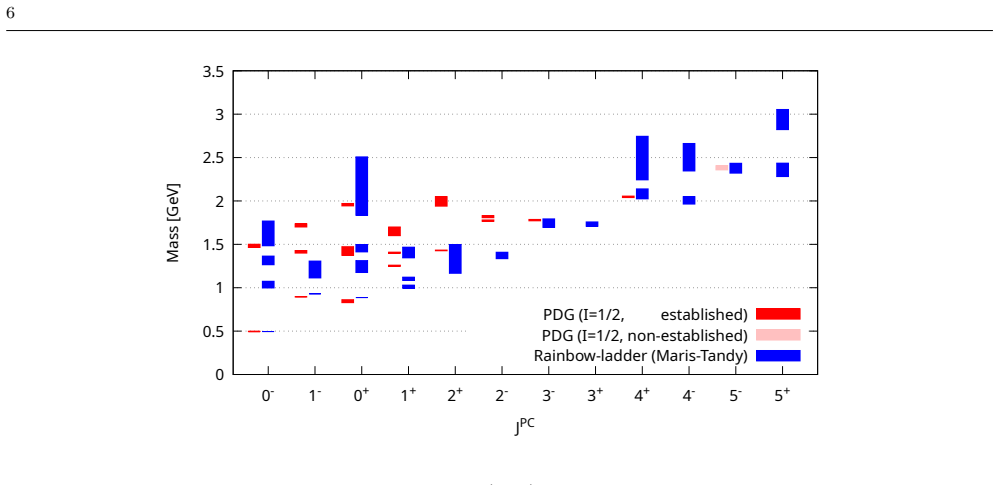
The paper provides, for the first time, complete orthonormal Dirac tensor bases for meson Bethe-Salpeter amplitudes with J=4 and J=5, and uses them in a rainbow-ladder truncation to compute an exploratory spectrum of ground states with J^PC=4++ and 5-- in light, strange, hidden-strange, charm and bottom sectors. The resulting masses fall on approximately linear Regge trajectories for the natural-parity sequence 1--, 2++, 3--, 4++, 5--, reproducing measured 4++ states where available and making new predictions such as a light isovector 5-- near 2.33 GeV and a bottomonium 5-- near 10.89 GeV. The authors also show that the rainbow-ladder description improves as quark mass increases, and that th
What carries the argument
The key machinery is a systematic construction of orthonormal tensor bases for the Bethe-Salpeter amplitude. The building blocks are a unit-normalized transverse vector built from the relative momentum, the transverse projector with respect to the total momentum, and transverse gamma matrices; symmetrizing over all Lorentz-index permutations and fixing coefficients so that the tensors are traceless yields orthonormal bases, with parity controlled by a gamma-five factor. These bases feed a Bethe-Salpeter eigenvalue equation whose eigenvalue equals one at the physical meson mass, with a continued-fraction extrapolation used to reach the mass shell when the kernel cannot be evaluated directly t
Load-bearing premise
The load-bearing assumption is that the continued-fraction extrapolation of the Bethe-Salpeter eigenvalue down to the mass-shell point stays unbiased for high-spin and heavy states, even though the safe evaluation region does not reach the physical mass for charmonium and bottomonium.
What would settle it
A measurement of the predicted 5-- ground state in the light isovector channel near 2.33 GeV, or of the charm 5-- near 4.75 GeV, would settle the matter: if the measured state lands far outside the quoted uncertainty, the rainbow-ladder kernel or the extrapolation is biased. An independent first-principles calculation of the same 5-- charmonium state would provide a direct cross-check of the 4.75 GeV prediction.
If this is right
- Ground-state masses for J^PC=4++ and 5-- mesons are predicted in all five flavor sectors, including a kaonic 5-- near 2.38 GeV, a charm 5-- near 4.75 GeV, and a bottom 5-- near 10.89 GeV, giving direct experimental targets.
- The natural-parity sequence 1--, 2++, 3--, 4++, 5-- is approximately linear in squared mass versus angular momentum for light, strange, hidden-strange, charm and bottom quarks, with slopes growing from about 1.2 GeV^2 in the light sector to about 7.2 GeV^2 for bottomonium.
- Where 4++ states are already measured, the calculation agrees, which strengthens the case that the predicted 5-- masses are credible predictions rather than mere extrapolation artifacts.
- The rainbow-ladder truncation is confirmed to be progressively more reliable for heavier quarks, while light scalar, axialvector and radially excited states remain poorly described and will require more complete interaction kernels.
- The interaction model's momentum-space coupling yields a nearly linear rising part in the extracted potential at intermediate distances, giving a concrete, though model-internal, explanation for why Regge trajectories appear despite no explicit confinement input.
Where Pith is reading between the lines
- Because the new tensor bases are purely kinematical, they can be reused as-is in beyond-rainbow-ladder calculations or in other bound-state frameworks; the hard part of deriving complete J=4 and J=5 amplitudes is done once.
- The heavy-state predictions offer a sharp test of the extrapolation procedure: if a measured charmonium or bottomonium 5-- disagrees with the quoted uncertainties, the most likely source of error is the analytic continuation of the eigenvalue curve, not the tensor basis itself.
- The near-linear Regge slope may be a more robust observable than individual masses: even if more complete kernels shift absolute values, the slope could survive, making it a useful benchmark for comparing interaction models.
- A testable extension would be to apply the same effective interaction in a beyond-rainbow-ladder truncation to just the natural-parity channel; if the linear trajectory persists, the physics behind it is tied to the shape of the effective coupling rather than to details of the truncation.
Editorial analysis
A structured set of objections, weighed in public.
Referee Report
Summary. The paper extends the rainbow-ladder Dyson-Schwinger/Bethe-Salpeter (DSE/BSE) framework to mesons with total angular momentum J=4 and J=5. Its main technical novelty is the construction of orthonormal Dirac tensor bases for these channels, presented in Tables 6 and 7, satisfying transversality, symmetry, tracelessness, and parity. Using the Maris-Tandy (MT) and Qin-Chang (QC) effective interactions, the authors compute ground-state masses for many J^PC channels in the light, strange, hidden-strange, charmonium, and bottomonium sectors. They identify a natural-parity Regge trajectory 1--, 2++, 3--, 4++, 5-- and give new predictions for 4++ and 5-- masses in all flavour sectors, comparing with available PDG data and discussing known limitations of rainbow-ladder truncation.
Significance. If the tensor-basis construction is complete, it is a useful technical step for continuum studies of high-spin mesons, and the J=4,5 mass predictions are the first of their kind from this framework. The paper is appropriately cautious: it labels the heavy-quark results as exploratory, acknowledges the known failures of rainbow-ladder in scalar and axial-vector channels, and does not fit the J=4,5 states. The explicit tensor tables, parameter values, and comparison with experiment are strengths that make the calculation reproducible and testable. However, the central quantitative claims in the heavy-quark sector rest on an extrapolation whose systematic uncertainty is not quantified, and the advertised new bases are not proven to be complete. These issues need to be addressed before the results can be fully relied upon.
major comments (2)
- [Appendix B, Tables 6-7] The paper asserts that the eight tensors listed for J=4 and J=5 form a basis for the Bethe-Salpeter amplitude satisfying transversality, symmetry, tracelessness, and parity. Orthonormality is checked, but completeness of the set is never proven. Since these tables are the paper's main technical novelty, a dimension count or a constructive spanning argument is needed: show that the space of Dirac-valued rank-J Lorentz tensors with the imposed constraints has the same dimension as the number of tensors listed, and that the listed tensors span that space. Without this, a missing tensor structure would change the BSE and the resulting masses.
- [Sec. 4.1, Appendix A, Figs. 5-6, Tab. 2] For charmonium and bottomonium, the safe evaluation region 'does not exceed the lightest ground states' and the eigenvalue lambda(P^2) is extrapolated 'further towards larger masses' via the Schlessinger continued fraction. All J=3,4,5 heavy-quark masses are obtained this way. The quoted errors, e.g. ±115 MeV for the c-cbar 5-- state and ±75 MeV for the b-bbar 5-- state, are resampling standard deviations over subsets of the sampled P^2 points; they do not include the systematic error of the continued-fraction ansatz through the complex quark-propagator singularities discussed in Appendix A. Because the Regge slopes in Fig. 7 and Table 2 are extracted from these same extrapolated masses, the central quantitative claim of linear heavy-quark Regge trajectories depends on this unquantified systematic. Please provide evidence that the extrapolation is unbiased, for example by comparing Schle
minor comments (5)
- [Fig. 5 caption] The state referred to as 'eta_c1(3872)' should presumably be X(3872)/chi_c1(3872), since the X(3872) has J^PC=1++.
- [Sec. 3, last paragraph] 'without recurse to any non-relativistic approximations' should read 'without recourse'.
- [Appendix B.2.6] The role of the conjugate tensors \bar{tau}_i and the signs in Tables 3-7 is not explained. If these signs encode charge-conjugation parity, this should be stated explicitly, since the spectra are labelled with J^PC rather than J^P alone.
- [Eq. (B.10)] The notation for the J=0 and J>0 basis sets is ambiguous: it looks like a Cartesian product of sets. Please clarify that for J=0 there are no Lorentz indices and the listed factors are the Dirac-space building blocks.
- [Sec. 4.1, QC paragraph] 'numerical problems with QC did prevent us from extracting a spectrum beyond J=2' should be 'prevented us'. Also, the statement that the QC potential is 'much broader' would benefit from a quantitative reference to Fig. 1.
Circularity Check
No significant circularity: J=4,5 predictions are genuine model outputs; only minor self-citation for parameter choices.
full rationale
The central new results (J=4,5 ground-state masses) are solutions of the rainbow-ladder Bethe-Salpeter equation with the tensor bases constructed in Appendix B, and are not identified with any fitted input. Quark masses are fixed to the pion, kaon, J/ψ and Υ masses (Sec. 2.1, Table 1), and the paper does not present those fitted masses as predictions; the new 3--, 4++, 5-- masses for each flavor are extrapolated/mass-shell evaluated outputs, not inputs. The heavy-quark parameter η is taken from the same authors' earlier Ref. [47] ('the model parameter η fixed in Ref. [47]'), which is a self-citation, but it is a parameter choice rather than a result being 'predicted' here, and the new higher-spin masses still carry independent content. The χ_c2/χ_b2 comparisons are validation checks, not fitted predictions in this paper, and even if η was adjusted in prior work any such fit does not directly determine the J=4,5 states. The Regge trajectories in Fig. 7 and Table 2 are linear fits to the computed masses, a quantitative check of the output rather than an input-to-output equivalence. The Schlessinger extrapolation (Appendix A) is a numerical continuation of λ(P^2); its systematic uncertainty for heavy high-spin states is a correctness/reliability concern, not a circular step, and the paper explicitly acknowledges the safe-region limitation ('the momentum region where we can evaluate the Bethe-Salpeter equation safely does not exceed the lightest ground states'). No equation reduces a prediction to an input by construction, and no load-bearing argument collapses to a self-citation chain. Hence no significant circularity; score 2 only for the minor self-citation in fixing η for the heavy-quark sector.
Axiom & Free-Parameter Ledger
free parameters (9)
- light quark mass m_u/d =
0.0037 GeV
- strange quark mass m_s =
0.085 GeV
- charm quark mass m_c =
0.830 GeV
- bottom quark mass m_b =
3.765 GeV
- MT width eta for light/strange =
1.8
- MT width eta_charm =
1.157
- MT width eta_bottom =
1.1
- MT scale Lambda =
0.72 GeV
- QC parameters eta_QC and Lambda_QC =
1.741, 0.696 GeV
axioms (5)
- domain assumption Rainbow-ladder truncation with one effective gluon exchange (Eq. 10) preserves chiral Ward-Takahashi identities and is quantitatively adequate for natural-parity high-J ground states.
- ad hoc to paper The eight tensors constructed per J^P channel in Appendix B form a complete basis for the Bethe-Salpeter amplitude satisfying the Fierz constraints.
- domain assumption The BSE eigenvalue lambda(P^2) can be continued by the Schlessinger rational function from safe P^2 values to the mass-shell pole lambda(-m^2)=1 even though the quark propagator has complex singularities in that region.
- domain assumption Quark masses and effective-coupling parameters fitted to pi, K, J/psi, and Upsilon remain valid for high-J states and other flavor sectors.
- domain assumption The Fourier transform of the rainbow-ladder kernel gives a meaningful static heavy-quark potential for illustration.
read the original abstract
We extend the range of application of the relativistic Dyson-Schwinger/Bethe-Salpeter approach from previously discussed mesons with total angular momentum $J \le 3$ to the ones with $J=4,5$. On a technical level, the new element is the general Dirac tensor representations for the latter which, to our knowledge, are presented here for the first time. As a first application, we provide an exploratory spectrum for these mesons in a rainbow-ladder truncation of Dyson-Schwinger and Bethe-Salpeter equations. We discuss the merits and limitations of this truncation and explore the shape of the heavy-quark potential corresponding to the underlying effective running coupling. With our predictions for the masses of ground state mesons with quantum numbers $J^{PC}=3^{--}, 4^{++}, 5^{--}$ we identify Regge trajectories in channels where the interaction model can be trusted on a semi-quantitative level. In other channels, discrepancies with experiments confirm the well-known need to go beyond rainbow-ladder in the Dyson-Schwinger/Bethe-Salpeter approach by using more sophisticated interactions.
Figures




Forward citations
Cited by 2 Pith papers
-
Real poles with opposite-sign residues in the non-perturbative quark propagator
Full quark-gluon vertex dynamics in the gap equation yields real poles with opposite-sign residues and a 350 MeV constituent mass, unlike prior approximations that produce complex poles.
-
Light mesons in the symmetric-vertex approximation
A dressed quark-gluon vertex computed in the symmetric approximation yields light-meson masses that match experiment more closely than rainbow-ladder results.
Reference graph
Works this paper leans on
-
[3]
Strange-Meson Spectroscopy – from COMPASS to AMBER
COMP ASS, AMBERCollaboration, S. Wallner, “Strange-Meson Spectroscopy – from COMPASS to AMBER”,EPJ Web Conf.274(2022) 03010, arXiv:2211.09499 [hep-ex]
Pith/arXiv arXiv 2022
-
[4]
QCD and Strongly Coupled Gauge Theories: Challenges and Perspectives
N. Brambillaet al., “QCD and Strongly Coupled Gauge Theories: Challenges and Perspectives”, Eur. Phys. J.C74no. 10, (2014) 2981, arXiv:1404.3723 [hep-ph]
Pith/arXiv arXiv 2014
-
[5]
On the Representation theory of inhomogeneous Lorentz groups as the foundation of quantum mechanical kinematics
H. Joos, “On the Representation theory of inhomogeneous Lorentz groups as the foundation of quantum mechanical kinematics”,Fortsch. Phys. 10(1962) 65–146
1962
-
[6]
Feynman Rules for Any Spin
S. Weinberg, “Feynman Rules for Any Spin”,Phys. Rev.133(1964) B1318–B1332
1964
-
[7]
Determination of the Spins and Parities of Resonances
C. Zemach, “Determination of the Spins and Parities of Resonances”,Phys. Rev.140(1965) B109–B124
1965
-
[8]
A covariant study of tensor mesons
A. Krassnigg and M. Blank, “A covariant study of tensor mesons”,Phys. Rev.D83(2011) 096006, arXiv:1011.6650 [hep-ph]
Pith/arXiv arXiv 2011
-
[9]
Mass spectra and Regge trajectories of light mesons in the Bethe-Salpeter approach
C. S. Fischer, S. Kubrak, and R. Williams, “Mass spectra and Regge trajectories of light mesons in the Bethe-Salpeter approach”,Eur. Phys. J.A50 (2014) 126,arXiv:1406.4370 [hep-ph]
Pith/arXiv arXiv 2014
-
[10]
Mesons in a Relativized Quark Model with Chromodynamics
S. Godfrey and N. Isgur, “Mesons in a Relativized Quark Model with Chromodynamics”,Phys. Rev. D32(1985) 189–231
1985
-
[11]
Mass spectra and Regge trajectories of light mesons in the relativistic quark model
D. Ebert, R. N. Faustov, and V. O. Galkin, “Mass spectra and Regge trajectories of light mesons in the relativistic quark model”,Phys. Rev. D79 (2009) 114029,arXiv:0903.5183 [hep-ph]
Pith/arXiv arXiv 2009
-
[12]
Investigation of rainbow-ladder truncation for excited and exotic mesons
S.-x. Qin, L. Chang, Y.-x. Liu, C. D. Roberts, and D. J. Wilson, “Investigation of rainbow-ladder truncation for excited and exotic mesons”,Phys. Rev.C85(2012) 035202,arXiv:1109.3459 [nucl-th]
Pith/arXiv arXiv 2012
-
[13]
Bottomonium in a Bethe-Salpeter-equation study
M. Blank and A. Krassnigg, “Bottomonium in a Bethe-Salpeter-equation study”,Phys. Rev.D84 (2011) 096014,arXiv:1109.6509 [hep-ph]
Pith/arXiv arXiv 2011
-
[14]
Light mesons in QCD and unquenching effects from the 3PI effective action
R. Williams, C. S. Fischer, and W. Heupel, “Light mesons in QCD and unquenching effects from the 3PI effective action”,Phys. Rev.D93no. 3, (2016) 034026,arXiv:1512.00455 [hep-ph]
Pith/arXiv arXiv 2016
-
[15]
Explanation and Prediction of Observables using Continuum Strong QCD
I. C. Cloet and C. D. Roberts, “Explanation and Prediction of Observables using Continuum Strong QCD”,Prog. Part. Nucl. Phys.77(2014) 1–69, arXiv:1310.2651 [nucl-th]
Pith/arXiv arXiv 2014
-
[16]
Baryons as relativistic three-quark bound states
G. Eichmann, H. Sanchis-Alepuz, R. Williams, R. Alkofer, and C. S. Fischer, “Baryons as relativistic three-quark bound states”,Prog. Part. Nucl. Phys.91(2016) 1–100,arXiv:1606.09602 [hep-ph]
Pith/arXiv arXiv 2016
-
[17]
Hadron physics with functional methods
G. Eichmann, “Hadron physics with functional methods”,arXiv:2503.10397 [hep-ph]
-
[18]
A beginner’s guide to functional methods in particle physics
M. Q. Huber, “A beginner’s guide to functional methods in particle physics”,arXiv:2510.18960 [hep-ph]
-
[19]
Correlation functions of Landau gauge Yang-Mills theory
M. Q. Huber, “Correlation functions of Landau gauge Yang-Mills theory”,Phys. Rev. D101no. 11, (2020) 114009,arXiv:2003.13703 [hep-ph]
Pith/arXiv arXiv 2020
-
[20]
Nonperturbative properties of Yang–Mills theories
M. Q. Huber, “Nonperturbative properties of Yang–Mills theories”,Phys. Rept.879(2020) 1–92, arXiv:1808.05227 [hep-ph]
Pith/arXiv arXiv 2020
-
[21]
Spectrum of scalar and pseudoscalar glueballs from functional methods
M. Q. Huber, C. S. Fischer, and H. Sanchis-Alepuz, “Spectrum of scalar and pseudoscalar glueballs from functional methods”,Eur. Phys. J. C80no. 11, (2020) 1077,arXiv:2004.00415 [hep-ph]
Pith/arXiv arXiv 2020
-
[22]
Higher spin glueballs from functional methods
M. Q. Huber, C. S. Fischer, and H. Sanchis-Alepuz, “Higher spin glueballs from functional methods”, Eur. Phys. J. C81no. 12, (2021) 1083, arXiv:2110.09180 [hep-ph]
Pith/arXiv arXiv 2021
-
[23]
Apparent convergence in functional glueball calculations
M. Q. Huber, C. S. Fischer, and H. Sanchis-Alepuz, “Apparent convergence in functional glueball calculations”,arXiv:2503.03821 [hep-ph]
-
[24]
Bethe-Salpeter study of vector meson masses and decay constants
P. Maris and P. C. Tandy, “Bethe-Salpeter study of vector meson masses and decay constants”,Phys. Rev.C60(1999) 055214, arXiv:nucl-th/9905056 [nucl-th]
Pith/arXiv arXiv 1999
-
[25]
Interaction model for the gap equation
S.-x. Qin, L. Chang, Y.-x. Liu, C. D. Roberts, and D. J. Wilson, “Interaction model for the gap equation”,Phys. Rev.C84(2011) 042202, arXiv:1108.0603 [nucl-th]
Pith/arXiv arXiv 2011
-
[26]
QCD forces and heavy quark bound states
G. S. Bali, “QCD forces and heavy quark bound states”,Phys. Rept.343(2001) 1–136, arXiv:hep-ph/0001312
Pith/arXiv arXiv 2001
-
[27]
Potential NRQCD: An Effective theory for heavy quarkonium
N. Brambilla, A. Pineda, J. Soto, and A. Vairo, “Potential NRQCD: An Effective theory for heavy quarkonium”,Nucl. Phys. B566(2000) 275, arXiv:hep-ph/9907240
Pith/arXiv arXiv 2000
-
[28]
N. Brambilla, A. Pineda, J. Soto, and A. Vairo, “The QCD potential at O(1/m)”,Phys. Rev. D63 (2001) 014023,arXiv:hep-ph/0002250
Pith/arXiv arXiv 2001
-
[29]
Nonperturbative determination of the QCD potential at O(1/m)
Y. Koma, M. Koma, and H. Wittig, “Nonperturbative determination of the QCD potential at O(1/m)”,Phys. Rev. Lett.97(2006) 122003,arXiv:hep-lat/0607009 [hep-lat]
Pith/arXiv arXiv 2006
-
[30]
Spin-dependent potentials from lattice QCD
Y. Koma and M. Koma, “Spin-dependent potentials from lattice QCD”,Nucl. Phys.B769 (2007) 79–107,arXiv:hep-lat/0609078 [hep-lat]
Pith/arXiv arXiv 2007
-
[31]
M. Eichberg and M. Wagner, “Computing 1/m Q and 1/m2 Q corrections to the static potential with lattice gauge theory using gradient flow”,PoS 16 LA TTICE2024(2025) 117,arXiv:2411.11640 [hep-lat]. 32.SESAMCollaboration, G. S. Bali, H. Neff, T. Duessel, T. Lippert, and K. Schilling, “Observation of string breaking in QCD”,Phys. Rev. D71(2005) 114513,arXiv:h...
Pith/arXiv arXiv 2025
-
[33]
Greensite,An introduction to the confinement problem, vol
J. Greensite,An introduction to the confinement problem, vol. 821. 2011
2011
-
[34]
Lattice Gluon Propagator and One-Gluon-Exchange Potential
A. Cucchieri, T. Mendes, and W. M. Serenone, “Lattice Gluon Propagator and One-Gluon-Exchange Potential”,Braz. J. Phys.49 no. 4, (2019) 548–563,arXiv:1704.08288 [hep-lat]. 35.Particle Data GroupCollaboration, S. Navas et al., “Review of particle physics”,Phys. Rev. D 110no. 3, (2024) 030001
Pith/arXiv arXiv 2019
-
[36]
Dynamically induced scalar quark confinement
R. Alkofer, C. S. Fischer, and F. J. Llanes-Estrada, “Dynamically induced scalar quark confinement”, Mod. Phys. Lett.A23(2008) 1105, arXiv:hep-ph/0607293
Pith/arXiv arXiv 2008
-
[37]
R. Alkofer, C. S. Fischer, F. J. Llanes-Estrada, and K. Schwenzer, “The Quark-gluon vertex in Landau gauge QCD: Its role in dynamical chiral symmetry breaking and quark confinement”,Annals Phys. 324(2009) 106–172,arXiv:0804.3042 [hep-ph]
Pith/arXiv arXiv 2009
-
[38]
Confinement, the Wilson Loop and the Gluon Propagator
G. B. West, “Confinement, the Wilson Loop and the Gluon Propagator”,Phys. Lett. B115(1982) 468–472
1982
-
[39]
Vector mesons as dynamical resonances in the Bethe–Salpeter framework
R. Williams, “Vector mesons as dynamical resonances in the Bethe–Salpeter framework”, Phys. Lett. B798(2019) 134943, arXiv:1804.11161 [hep-ph]
Pith/arXiv arXiv 2019
-
[40]
σ-meson: Four-quark versus two-quark components and decay width in a Bethe-Salpeter approach
N. Santowsky, G. Eichmann, C. S. Fischer, P. C. Wallbott, and R. Williams, “σ-meson: Four-quark versus two-quark components and decay width in a Bethe-Salpeter approach”,Phys. Rev. D102no. 5, (2020) 056014,arXiv:2007.06495 [hep-ph]
Pith/arXiv arXiv 2020
-
[41]
A. S. Miramontes, H. Sanchis Alepuz, and R. Alkofer, “Elucidating the effect of intermediate resonances in the quark interaction kernel on the timelike electromagnetic pion form factor”,Phys. Rev. D103no. 11, (2021) 116006, arXiv:2102.12541 [hep-ph]
Pith/arXiv arXiv 2021
-
[42]
J. R. Pelaez, “From controversy to precision on the sigma meson: a review on the status of the non-ordinaryf 0(500) resonance”, arXiv:1510.00653 [hep-ph]
-
[43]
Tetraquark Bound States in a Bethe-Salpeter Approach
W. Heupel, G. Eichmann, and C. S. Fischer, “Tetraquark Bound States in a Bethe-Salpeter Approach”,Phys. Lett.B718(2012) 545–549, arXiv:1206.5129 [hep-ph]
Pith/arXiv arXiv 2012
-
[44]
The light scalar mesons as tetraquarks
G. Eichmann, C. S. Fischer, and W. Heupel, “The light scalar mesons as tetraquarks”,Phys. Lett. B753(2016) 282–287,arXiv:1508.07178 [hep-ph]
Pith/arXiv arXiv 2016
-
[45]
Beyond Rainbow-Ladder in bound state equations
W. Heupel, T. Goecke, and C. S. Fischer, “Beyond Rainbow-Ladder in bound state equations”,Eur. Phys. J.A50(2014) 85,arXiv:1402.5042 [hep-ph]
Pith/arXiv arXiv 2014
-
[46]
U(A)(1) anomaly and eta-prime mass from an infrared singular quark-gluon vertex
R. Alkofer, C. S. Fischer, and R. Williams, “U(A)(1) anomaly and eta-prime mass from an infrared singular quark-gluon vertex”,Eur. Phys. J. A38(2008) 53–60,arXiv:0804.3478 [hep-ph]
Pith/arXiv arXiv 2008
-
[47]
Spectra of heavy mesons in the Bethe-Salpeter approach
C. S. Fischer, S. Kubrak, and R. Williams, “Spectra of heavy mesons in the Bethe-Salpeter approach”,Eur. Phys. J.A51(2015) 10, arXiv:1409.5076 [hep-ph]
Pith/arXiv arXiv 2015
-
[48]
Bethe-Salpeter equation at leading order in Coulomb gauge
P. Watson and H. Reinhardt, “Bethe-Salpeter equation at leading order in Coulomb gauge”,Phys. Rev.D86(2012) 125030,arXiv:1211.4507 [hep-ph]
Pith/arXiv arXiv 2012
-
[49]
Pi- and K meson Bethe-Salpeter amplitudes
P. Maris and C. D. Roberts, “Pi- and K meson Bethe-Salpeter amplitudes”,Phys. Rev.C56(1997) 3369–3383,arXiv:nucl-th/9708029 [nucl-th]
Pith/arXiv arXiv 1997
-
[50]
P. Maris, C. D. Roberts, and P. C. Tandy, “Pion mass and decay constant”,Phys. Lett.B420(1998) 267–273,arXiv:nucl-th/9707003 [nucl-th]
Pith/arXiv arXiv 1998
-
[51]
Dyson-Schwinger equations: A Tool for hadron physics
P. Maris and C. D. Roberts, “Dyson-Schwinger equations: A Tool for hadron physics”,Int. J. Mod. Phys.E12(2003) 297–365, arXiv:nucl-th/0301049 [nucl-th]
Pith/arXiv arXiv 2003
-
[52]
Analytic properties of the Landau gauge gluon and quark propagators
R. Alkofer, W. Detmold, C. S. Fischer, and P. Maris, “Analytic properties of the Landau gauge gluon and quark propagators”,Phys. Rev.D70 (2004) 014014,arXiv:hep-ph/0309077
Pith/arXiv arXiv 2004
-
[53]
S. M. Dorkin, L. P. Kaptari, T. Hilger, and B. Kampfer, “Analytical properties of the quark propagator from a truncated Dyson-Schwinger equation in complex Euclidean space”,Phys. Rev. C89(2014) 034005,arXiv:1312.2721 [hep-ph]
Pith/arXiv arXiv 2014
-
[54]
Analytic properties of the quark propagator from an effective infrared interaction model
A. Windisch, “Analytic properties of the quark propagator from an effective infrared interaction model”,Phys. Rev.C95no. 4, (2017) 045204, arXiv:1612.06002 [hep-ph]
Pith/arXiv arXiv 2017
-
[55]
Use of Analyticity in the Calculation of Nonrelativistic Scattering Amplitudes
L. Schlessinger, “Use of Analyticity in the Calculation of Nonrelativistic Scattering Amplitudes”,Phys. Rev.167no. 3, (1968) 1411
1968
-
[56]
Force-free particles with any spin
M. Fierz, “Force-free particles with any spin”,Helv. Phys. Acta12(1939) 3–37
1939
discussion (0)
Sign in with ORCID, Apple, or X to comment. Anyone can read and Pith papers without signing in.