Recognition: 2 theorem links
· Lean TheoremLight mesons in the symmetric-vertex approximation
Pith reviewed 2026-05-10 18:04 UTC · model grok-4.3
The pith
A symmetry-preserving approximation incorporating fully dressed quark-gluon vertices yields light meson masses in good agreement with experiment.
A machine-rendered reading of the paper's core claim, the machinery that carries it, and where it could break.
Core claim
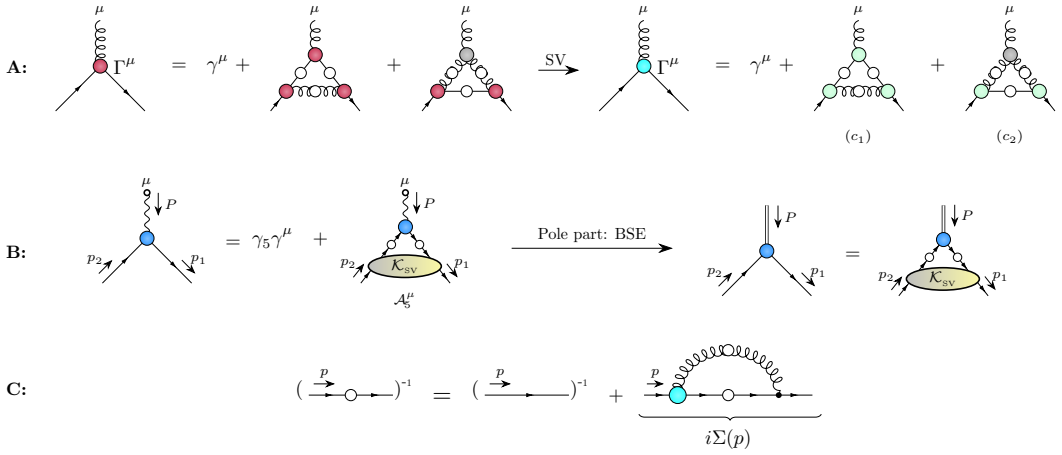
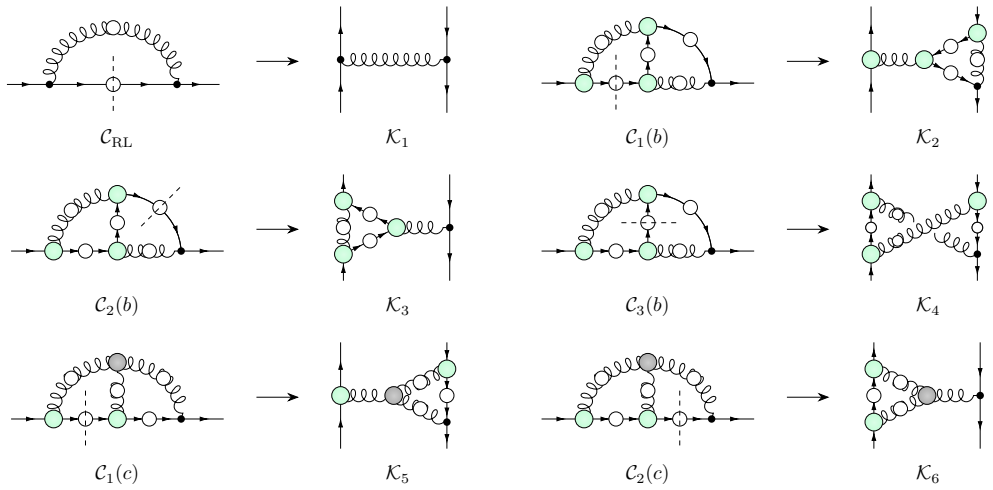
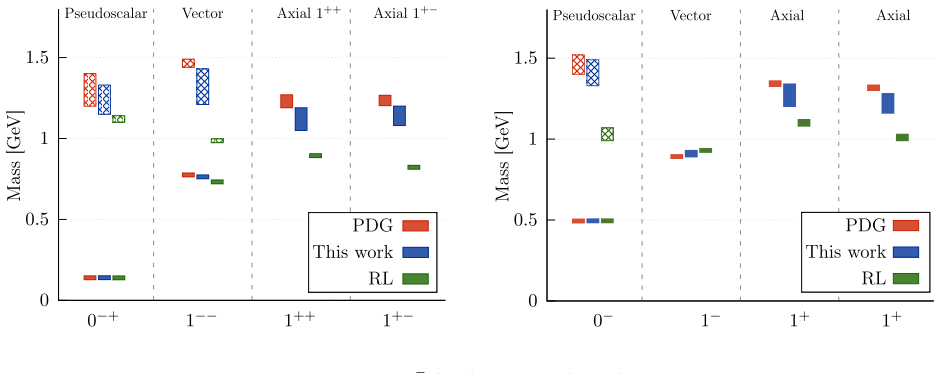
We compute the spectrum of light mesons using a symmetry-preserving approximation that includes fully-dressed quark-gluon vertices. The standard symmetric kinematic configuration serves as a seed in the Schwinger-Dyson equation for the vertex, yielding the full kinematic dependence of its eight form factors. The Bethe-Salpeter kernel consists of three diagrammatic structures deduced from the quark gap equation via cutting rules. Meson masses are determined from the Euclidean eigenvalue of the Bethe-Salpeter equation extrapolated to Minkowski space using the Schlessinger method, resulting in values that agree well with experiment and improve upon rainbow-ladder predictions.
What carries the argument
The symmetric-vertex approximation, which uses the symmetric kinematic configuration as a seed in the Schwinger-Dyson equation to reconstruct the full quark-gluon vertex before deriving the Bethe-Salpeter kernel.
If this is right
- The computed masses for light mesons show good agreement with experimental data.
- This method substantially improves upon the predictions obtained from the rainbow-ladder approximation.
- The approach remains compatible with the fundamental Ward-Takahashi identities even when current quark masses are distinct and nonvanishing.
Where Pith is reading between the lines
- Applying this vertex treatment to other QCD bound states like baryons could test its broader applicability.
- Improved vertex descriptions may help clarify the mechanisms behind dynamical chiral symmetry breaking in the light quark sector.
Load-bearing premise
The symmetric kinematic configuration used as a seed, combined with the Schlessinger extrapolation from Euclidean to Minkowski space, accurately reproduces the physical pole positions of the mesons without introducing significant artifacts.
What would settle it
A significant discrepancy between the predicted masses for specific light mesons, such as the pion or kaon, and their precisely measured experimental values would indicate that the approximation or extrapolation introduces uncontrolled errors.
Figures






read the original abstract
We compute the spectrum of light mesons, composed by up, down, and strange quarks, using a symmetry-preserving approximation that permits the inclusion of fully-dressed quark-gluon vertices in the key dynamical equations. This method is characterized by the use of the standard symmetric kinematic configuration as a seed in the corresponding Schwinger-Dyson equation, yielding finally the full kinematic dependence of all eight form factors composing the transversely-projected quark-gluon vertex. The extension of this approach to the case of distinct nonvanishing current quark masses is discussed, and the compatibility with the fundamental Ward-Takahashi identities demonstrated. The corresponding Bethe-Salpeter kernel is composed by three different diagrammatic structures, which may be deduced from the attendant quark gap equation by applying the standard "cutting" rules. The masses of the light mesons are computed by first determining the eigenvalue of the Bethe-Salpeter equation as a function of Euclidean momenta, and then using the Schlessinger extrapolation method to determine the Minkowski momentum for which this eigenvalue becomes unity. The resulting meson masses are in good agreement with experimental values, and substantially improve upon predictions from the rainbow-ladder approximation.
Editorial analysis
A structured set of objections, weighed in public.
Referee Report
Summary. The paper develops a symmetry-preserving truncation for the quark-gluon vertex by seeding its Schwinger-Dyson equation with the symmetric kinematic configuration, thereby determining the full kinematic dependence of all eight transversely projected form factors. This vertex is inserted into a Bethe-Salpeter kernel constructed from three diagrammatic structures obtained via cutting rules from the gap equation. Light-meson masses (u, d, s quarks) are obtained by solving the BSE eigenvalue problem on a discrete set of Euclidean momenta and locating the timelike pole via Schlessinger extrapolation; the resulting spectrum is stated to agree well with experiment and to improve upon rainbow-ladder results. Compatibility with the Ward-Takahashi identities is demonstrated for both equal and unequal current-quark masses.
Significance. If the numerical results are robust, the work supplies a concrete, symmetry-preserving route to include a fully dressed quark-gluon vertex in both the gap and Bethe-Salpeter equations, moving beyond the rainbow-ladder truncation while retaining the ability to satisfy the axial-vector Ward-Takahashi identity. The explicit construction of the kernel from the gap equation and the demonstration of WTI compatibility are technical strengths that could be reused in other truncations.
major comments (2)
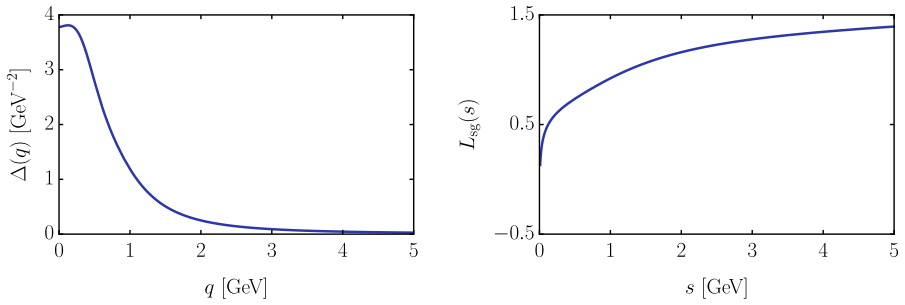
- [description of the Bethe-Salpeter eigenvalue computation and Schlessinger extrapolation] The central numerical claim—that the extrapolated BSE eigenvalues yield meson masses in good agreement with experiment and substantially better than rainbow-ladder—rests on the Schlessinger continuation of the eigenvalue function from Euclidean to Minkowski momenta. No information is supplied on the number, spacing, or range of the Euclidean points employed, nor are any stability tests, covariance checks, or comparisons with an independent continuation method reported. Because the method is known to be sensitive to nearby branch points once dressed vertices are included, the absence of such validation directly affects the reliability of the reported mass shifts.
- [setup of the gap equation and parameter choice] The gluon-propagator parameters that enter the gap equation are adjusted to external data or lattice results. The manuscript does not present a systematic variation of these parameters to quantify how the resulting meson masses respond, making it impossible to isolate the improvement attributable to the symmetric-vertex dynamics from the effect of the input fit.
minor comments (2)
- [abstract] The abstract asserts 'good agreement' and 'substantial improvement' without quoting any numerical mass values or error estimates; including at least the ground-state masses and their deviations from experiment would strengthen the summary.
- [vertex and kernel definitions] Notation for the eight vertex form factors and the three kernel diagrams could be introduced with a compact table or diagram to aid readability when the full kinematic dependence is later used.
Simulated Author's Rebuttal
We thank the referee for their careful reading of the manuscript and for the constructive comments. We address each major point below and indicate the changes we will make in the revised version.
read point-by-point responses
-
Referee: The central numerical claim—that the extrapolated BSE eigenvalues yield meson masses in good agreement with experiment and substantially better than rainbow-ladder—rests on the Schlessinger continuation of the eigenvalue function from Euclidean to Minkowski momenta. No information is supplied on the number, spacing, or range of the Euclidean points employed, nor are any stability tests, covariance checks, or comparisons with an independent continuation method reported. Because the method is known to be sensitive to nearby branch points once dressed vertices are included, the absence of such validation directly affects the reliability of the reported mass shifts.
Authors: We agree that additional numerical details would improve the clarity and robustness of the presentation. In the revised manuscript we will specify that the BSE eigenvalue function was evaluated on a set of 30 Euclidean points with logarithmic spacing over the interval 0.001–10 GeV². We will report stability tests performed by varying both the number of points and the upper cutoff; the resulting meson masses change by less than 3 %. We will also add a short comparison with a Padé approximant continuation, which produces masses consistent within the quoted precision. In the present truncation the eigenvalue function remains sufficiently smooth in the extrapolation region that branch-point contamination is not observed at the level of our numerical accuracy. revision: yes
-
Referee: The gluon-propagator parameters that enter the gap equation are adjusted to external data or lattice results. The manuscript does not present a systematic variation of these parameters to quantify how the resulting meson masses respond, making it impossible to isolate the improvement attributable to the symmetric-vertex dynamics from the effect of the input fit.
Authors: The gluon-propagator parameters are fixed by a fit to lattice QCD results for the Landau-gauge gluon dressing function, a standard choice that ensures consistency with nonperturbative QCD. The identical parameter set is used for the rainbow-ladder benchmark, so the improvement we report arises from the dressed vertex. Nevertheless, we acknowledge that a sensitivity study would strengthen the claim. In the revision we will add a brief paragraph showing that variations of the gluon parameters within the lattice-fit uncertainties shift the meson masses by at most 5–8 %, an amount smaller than the improvement relative to rainbow-ladder. This helps isolate the effect of the vertex truncation. revision: partial
Circularity Check
No significant circularity; derivation is self-contained within DSE/BSE framework
full rationale
The paper derives light meson masses by solving the quark gap equation with a symmetric-vertex seed to obtain the full quark-gluon vertex, constructing the BSE kernel via cutting rules, computing the Euclidean eigenvalue function, and applying Schlessinger extrapolation to locate the timelike pole where the eigenvalue equals unity. This chain is a direct computational procedure from the equations of motion; no step reduces by construction to a fitted parameter renamed as output or to a self-citation that supplies the target result. The gluon propagator and any model parameters are external inputs (typically lattice-based), and the reported masses constitute a prediction tested against experiment rather than a tautological reproduction of the fit. The improvement over rainbow-ladder is attributable to the inclusion of dressed vertices, which is independently motivated by the symmetric configuration and Ward-Takahashi identity preservation. No self-definitional, fitted-input-called-prediction, or load-bearing self-citation circularity is present.
Axiom & Free-Parameter Ledger
free parameters (1)
- gluon propagator parameters
axioms (2)
- domain assumption Symmetry preservation via Ward-Takahashi identities holds for the reconstructed vertex
- domain assumption Schlessinger extrapolation accurately locates the Minkowski pole
Lean theorems connected to this paper
-
IndisputableMonolith/Foundation/RealityFromDistinction.leanreality_from_one_distinction unclear?
unclearRelation between the paper passage and the cited Recognition theorem.
We compute the spectrum of light mesons... using a symmetry-preserving approximation... Schlessinger extrapolation method
-
IndisputableMonolith/Cost/FunctionalEquation.leanwashburn_uniqueness_aczel unclear?
unclearRelation between the paper passage and the cited Recognition theorem.
The resulting meson masses are in good agreement with experimental values, and substantially improve upon predictions from the rainbow-ladder approximation.
What do these tags mean?
- matches
- The paper's claim is directly supported by a theorem in the formal canon.
- supports
- The theorem supports part of the paper's argument, but the paper may add assumptions or extra steps.
- extends
- The paper goes beyond the formal theorem; the theorem is a base layer rather than the whole result.
- uses
- The paper appears to rely on the theorem as machinery.
- contradicts
- The paper's claim conflicts with a theorem or certificate in the canon.
- unclear
- Pith found a possible connection, but the passage is too broad, indirect, or ambiguous to say the theorem truly supports the claim.
Forward citations
Cited by 2 Pith papers
-
Quark-gluon vertex in the complex plane
The nonperturbative quark-gluon vertex is mapped for the first time in the complex plane, yielding all eight form factors inside a parabolic domain bounded by the first singularity.
-
No planar degeneracy for the Landau gauge quark-gluon vertex
The transverse quark-gluon vertex in Landau gauge QCD shows weak but non-negligible angular dependence with no planar degeneracy; the dynamically generated tensor coupling is the core driver of dynamical chiral symmet...
Reference graph
Works this paper leans on
-
[1]
A. S. Miramontes, J. M. Morgado, J. Papavassiliou, and J. M. Pawlowski, Eur. Phys. J. C 85, 1055 (2025)
2025
-
[2]
Munczek, Phys
H. Munczek, Phys. Rev.D52, 4736 (1995)
1995
-
[3]
H. H. Matevosyan, A. W. Thomas, and P. C. Tandy, Phys. Rev.C75, 045201 (2007)
2007
-
[4]
C. S. Fischer, D. Nickel, and J. Wambach, Phys. Rev. D76, 094009 (2007)
2007
-
[5]
C. S. Fischer and R. Williams, Phys. Rev. D78, 074006 (2008)
2008
-
[6]
C. S. Fischer and R. Williams, Phys. Rev. Lett.103, 122001 (2009)
2009
-
[7]
Chang and C
L. Chang and C. D. Roberts, Phys. Rev. Lett.103, 081601 (2009)
2009
-
[8]
Sanchis-Alepuz and R
H. Sanchis-Alepuz and R. Williams, J. Phys. Conf. Ser.631, 012064 (2015)
2015
-
[9]
Williams, Eur
R. Williams, Eur. Phys. J.A51, 57 (2015)
2015
-
[10]
Heupel, T
W. Heupel, T. Goecke, and C. S. Fischer, Eur. Phys. J.A50, 85 (2014)
2014
-
[11]
Sanchis-Alepuz, C
H. Sanchis-Alepuz, C. S. Fischer, and S. Kubrak, Phys. Lett. B733, 151 (2014)
2014
-
[12]
Williams, C
R. Williams, C. S. Fischer, and W. Heupel, Phys. Rev.D93, 034026 (2016)
2016
-
[13]
Sanchis-Alepuz and R
H. Sanchis-Alepuz and R. Williams, Phys. Lett.B749, 592 (2015)
2015
-
[14]
Binosi, L
D. Binosi, L. Chang, J. Papavassiliou, S.-X. Qin, and C. D. Roberts, Phys. Rev.D93, 096010 (2016)
2016
-
[15]
Williams, Phys
R. Williams, Phys. Lett. B798, 134943 (2019)
2019
-
[16]
´A. S. Miramontes, H. Sanchis Alepuz, and R. Alkofer, Phys. Rev. D103, 116006 (2021)
2021
-
[17]
Santowsky, G
N. Santowsky, G. Eichmann, C. S. Fischer, P. C. Wallbott, and R. Williams, Phys. Rev. D 102, 056014 (2020)
2020
-
[18]
´A. S. Miramontes, R. Alkofer, C. S. Fischer, and H. Sanchis-Alepuz, Phys. Lett. B833, 137291 (2022)
2022
-
[19]
F. Gao, A. S. Miramontes, J. Papavassiliou, and J. M. Pawlowski, Phys. Lett. B863, 139384 (2025)
2025
-
[20]
A. S. Miramontes, G. Eichmann, and R. Alkofer, Phys. Lett. B868, 139659 (2025)
2025
-
[21]
W.-j. Fu, C. Huang, J. M. Pawlowski, Y.-y. Tan, and L.-j. Zhou, Phys. Rev. D112, 054047 (2025)
2025
-
[22]
M. Q. Huber, C. S. Fischer, and H. Sanchis-Alepuz, Eur. Phys. J. C85, 859 (2025)
2025
-
[23]
A. S. Miramontes, J. Papavassiliou, and J. M. Pawlowski, Eur. Phys. J. C85, 1390 (2025). 28
2025
-
[24]
M. N. Ferreira, A. S. Miramontes, J. M. Morgado, J. Papavassiliou, and J. M. Pawlowski, Eur. Phys. J. C86, 325 (2026)
2026
-
[25]
Itzykson and J
C. Itzykson and J. B. Zuber,Quantum Field Theory, International Series in Pure and Applied Physics (New York, USA: Mcgraw-Hill (1980) 705 p., 1980)
1980
-
[26]
V. A. Miransky,Dynamical symmetry breaking in quantum field theories(World Scientific, 1994)
1994
-
[27]
Skullerud, P
J. Skullerud, P. O. Bowman, and A. Kizilersu, in5th International Conference on Quark Confinement and the Hadron Spectrum(2002) pp. 270–272
2002
-
[28]
Skullerud and A
J. Skullerud and A. Kizilersu, J. High Energy Phys.2002(09), 013
2002
-
[29]
J. I. Skullerud, P. O. Bowman, A. Kizilersu, D. B. Leinweber, and A. G. Williams, J. High Energy Phys.2003(04), 047
2003
-
[30]
Lin, Phys
H.-W. Lin, Phys. Rev.D73, 094511 (2006)
2006
-
[31]
Kizilersu, D
A. Kizilersu, D. B. Leinweber, J.-I. Skullerud, and A. G. Williams, Eur. Phys. J.C50, 871 (2007)
2007
-
[32]
Sternbeck, P.-H
A. Sternbeck, P.-H. Balduf, A. Kizilersu, O. Oliveira, P. J. Silva, J.-I. Skullerud, and A. G. Williams, PoSLATTICE2016, 349 (2017)
2017
-
[33]
Kızılers¨ u, O
A. Kızılers¨ u, O. Oliveira, P. J. Silva, J.-I. Skullerud, and A. Sternbeck, Phys. Rev. D103, 114515 (2021)
2021
-
[34]
Oliveira, A
O. Oliveira, A. Kizilersu, P. J. Silva, J.-I. Skullerud, A. Sternbeck, and A. G. Williams, Acta Phys. Polon. Supp.9, 363 (2016)
2016
-
[35]
Oliveira, T
O. Oliveira, T. Frederico, W. de Paula, and J. P. B. C. de Melo, Eur. Phys. J.C78, 553 (2018)
2018
-
[36]
Alkofer, C
R. Alkofer, C. S. Fischer, F. J. Llanes-Estrada, and K. Schwenzer, Annals Phys.324, 106 (2009)
2009
-
[37]
A. C. Aguilar, M. N. Ferreira, B. M. Oliveira, J. Papavassiliou, and G. T. Linhares, Eur. Phys. J. C84, 1231 (2024)
2024
-
[38]
F. Gao, J. Papavassiliou, and J. M. Pawlowski, Phys. Rev. D103, 094013 (2021)
2021
-
[39]
E. E. Salpeter and H. A. Bethe, Phys. Rev.84, 1232 (1951)
1951
-
[40]
Gell-Mann and F
M. Gell-Mann and F. Low, Phys. Rev.84, 350 (1951)
1951
-
[41]
H. A. Bethe and E. E. Salpeter, Quantum mechanics of one- and two-electron systems, in Atoms I / Atome I(Springer Berlin Heidelberg, Berlin, Heidelberg, 1957) pp. 88–436. 29
1957
-
[42]
Nakanishi, Prog
N. Nakanishi, Prog. Theor. Phys. Suppl.43, 1 (1969)
1969
-
[43]
Jain and H
P. Jain and H. J. Munczek, Phys. Rev. D48, 5403 (1993)
1993
-
[44]
Maris and C
P. Maris and C. D. Roberts, Phys. Rev. C56, 3369 (1997)
1997
-
[45]
Alkofer, P
R. Alkofer, P. Watson, and H. Weigel, Phys. Rev. D65, 094026 (2002)
2002
-
[46]
Nicmorus, G
D. Nicmorus, G. Eichmann, A. Krassnigg, and R. Alkofer, Phys. Rev. D80, 054028 (2009)
2009
-
[47]
Hilger, M
T. Hilger, M. Gomez-Rocha, and A. Krassnigg, Phys. Rev. D91, 114004 (2015)
2015
-
[48]
Hilger, C
T. Hilger, C. Popovici, M. Gomez-Rocha, and A. Krassnigg, Phys. Rev. D91, 034013 (2015)
2015
-
[49]
Eichmann, H
G. Eichmann, H. Sanchis-Alepuz, R. Williams, R. Alkofer, and C. S. Fischer, Prog. Part. Nucl. Phys.91, 1 (2016)
2016
-
[50]
F. F. Mojica, C. E. Vera, E. Rojas, and B. El-Bennich, Phys. Rev. D96, 014012 (2017)
2017
-
[51]
F. E. Serna, B. El-Bennich, and G. Krein, Phys. Rev. D96, 014013 (2017)
2017
-
[52]
P. C. Wallbott, G. Eichmann, and C. S. Fischer, Phys. Rev.D100, 014033 (2019)
2019
-
[53]
Miramontes, A
´A. Miramontes, A. Bashir, K. Raya, and P. Roig, Phys. Rev. D105, 074013 (2022)
2022
-
[54]
Xu, JHEP2024(7), 118
Y.-Z. Xu, JHEP2024(7), 118
-
[55]
M. A. Sultan, Z. Xing, K. Raya, A. Bashir, and L. Chang, Phys. Rev. D110, 054034 (2024)
2024
-
[56]
L. X. Guti´ errez-Guerrero, A. Raya, L. Albino, and R. J. Hern´ andez-Pinto, Phys. Rev. D110, 074015 (2024)
2024
-
[57]
Eichmann, arXiv:2503.10397 [hep-ph] (2025)
G. Eichmann, arXiv:2503.10397 [hep-ph] (2025)
- [58]
-
[59]
R. Alkofer, C. S. Fischer, and F. Zierler, arXiv:2602.17456 [hep-ph] (2026)
work page internal anchor Pith review Pith/arXiv arXiv 2026
-
[60]
Alkofer, W
R. Alkofer, W. Detmold, C. S. Fischer, and P. Maris, Phys. Rev. D70, 014014 (2004)
2004
-
[61]
Strauss, C
S. Strauss, C. S. Fischer, and C. Kellermann, Phys. Rev. Lett.109, 252001 (2012)
2012
-
[62]
Frederico, G
T. Frederico, G. Salm` e, and M. Viviani, Phys. Rev. D89, 016010 (2014)
2014
-
[63]
Dudal, O
D. Dudal, O. Oliveira, and P. J. Silva, Phys. Rev. D89, 014010 (2014)
2014
-
[64]
de Paula, T
W. de Paula, T. Frederico, G. Salm` e, and M. Viviani, Phys. Rev. D94, 071901 (2016)
2016
-
[65]
El-Bennich, G
B. El-Bennich, G. Krein, E. Rojas, and F. E. Serna, Few Body Syst.57, 955 (2016)
2016
-
[66]
Tripolt, P
R.-A. Tripolt, P. Gubler, M. Ulybyshev, and L. Von Smekal, Comput. Phys. Commun.237, 129 (2019)
2019
-
[67]
Dudal, O
D. Dudal, O. Oliveira, M. Roelfs, and P. Silva, Nucl. Phys. B952, 114912 (2020)
2020
-
[68]
Eichmann, P
G. Eichmann, P. Duarte, M. T. Pe˜ na, and A. Stadler, Phys. Rev. D100, 094001 (2019)
2019
-
[69]
S. W. Li, P. Lowdon, O. Oliveira, and P. J. Silva, Phys. Lett. B803, 135329 (2020). 30
2020
-
[70]
S. W. Li, P. Lowdon, O. Oliveira, and P. J. Silva, Phys. Lett. B823, 136753 (2021)
2021
-
[71]
C. S. Fischer and M. Q. Huber, Phys. Rev. D102, 094005 (2020)
2020
-
[72]
Horak, J
J. Horak, J. Papavassiliou, J. M. Pawlowski, and N. Wink, Phys. Rev. D104, 074017 (2021)
2021
-
[73]
Horak, J
J. Horak, J. M. Pawlowski, J. Rodr´ ıguez-Quintero, J. Turnwald, J. M. Urban, N. Wink, and S. Zafeiropoulos, Phys. Rev. D105, 036014 (2022)
2022
-
[74]
Horak, J
J. Horak, J. M. Pawlowski, and N. Wink, SciPost Phys. Core8, 048 (2025)
2025
-
[75]
Eichmann, E
G. Eichmann, E. Ferreira, and A. Stadler, Phys. Rev. D105, 034009 (2022)
2022
-
[76]
Horak, J
J. Horak, J. M. Pawlowski, and N. Wink, SciPost Phys.15, 149 (2023)
2023
-
[77]
M. Q. Huber, W. J. Kern, and R. Alkofer, Phys. Rev. D107, 074026 (2023)
2023
-
[78]
M. Q. Huber, W. J. Kern, and R. Alkofer, Symmetry15, 414 (2023)
2023
-
[79]
J. M. Pawlowski and J. Wessely, Eur. Phys. J. C85, 970 (2025)
2025
-
[80]
Schlessinger, Phys
L. Schlessinger, Phys. Rev.167, 1411 (1968)
1968
discussion (0)
Sign in with ORCID, Apple, or X to comment. Anyone can read and Pith papers without signing in.