Physics-informed neural network (PINN) modeling of charged particle multiplicity using the two-component framework in heavy-ion collisions: A comparison with data-driven neural networks
Pith reviewed 2026-05-18 00:10 UTC · model grok-4.3
The pith
Embedding the two-component model in a neural network loss function lets the model predict charged hadron multiplicity in unseen heavy-ion systems more accurately than standard networks.
A machine-rendered reading of the paper's core claim, the machinery that carries it, and where it could break.
Core claim
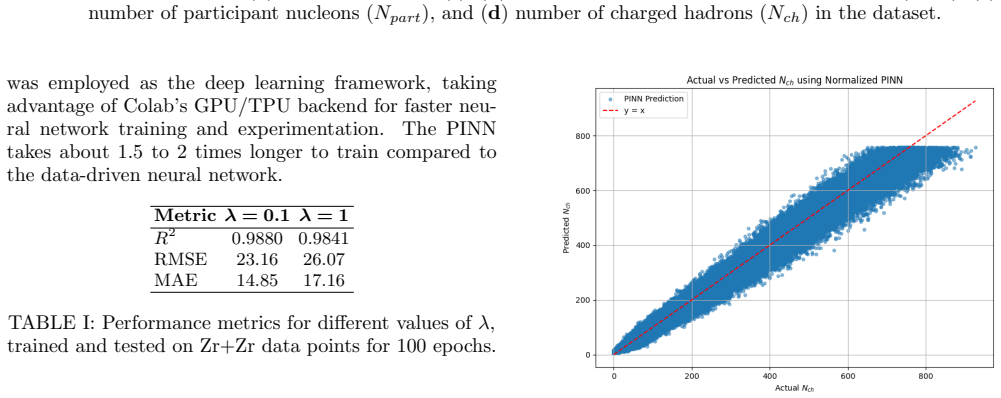
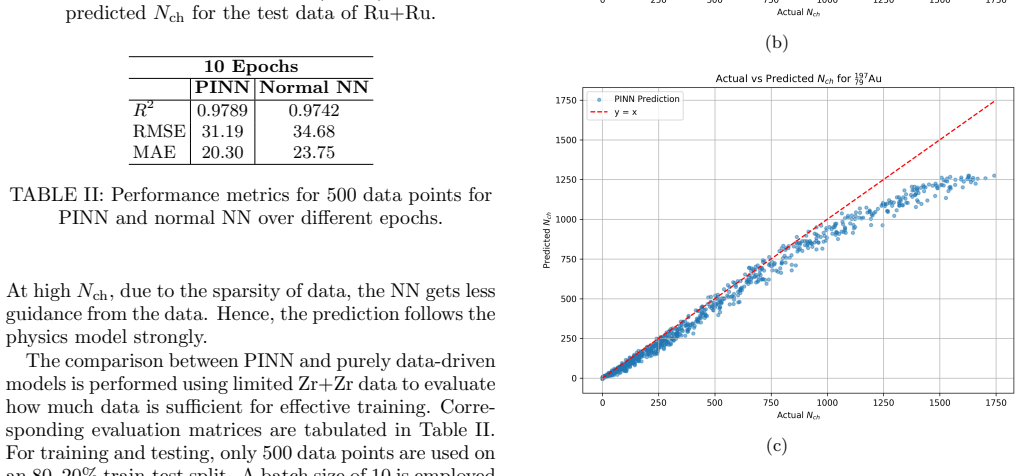
The authors show that a neural network whose loss function includes the two-component framework for multiplicity production extracts the hard-scattering fraction x from event data and yields more accurate predictions of charged particle multiplicity N_ch for collision systems not encountered in training, such as Au+Au, outperforming a purely data-driven neural network especially where data density is low at high N_ch.
What carries the argument
The physics-informed loss function that embeds the two-component framework relation between total multiplicity and the hard-scattering fraction x.
Load-bearing premise
The two-component framework embedded in the PINN loss function correctly captures the dominant physics of multiplicity production without introducing systematic bias for different nuclear species.
What would settle it
If the PINN predictions for multiplicity distributions in Au+Au collisions deviate more from HYDJET++ results than the standard NN predictions do in the high-N_ch tail, the claimed advantage would not hold.
Figures



read the original abstract
In this study, we employ a conventional deep neural network (NN) framework integrated with physics-based constraints to predict charged hadron multiplicity ($N_{\text{ch}}$) in heavy-ion collisions. The goal is to assess the performance of a purely data-driven deep neural network in comparison to a physics-informed neural network (PINN). To accomplish this, we have taken data generated from the HYDJET++ model for testing and training purposes. We train our neural network frameworks using the data of one million individual $^{96}_{40}\text{Zr}+^{96}_{40}\text{Zr}$ collision events. Our PINN model successfully extracts the hard-scattering fraction ($x$) by learning its underlying relation from the event data. For further testing and comparison with the conventional NN, we take data of $^{96}_{44}\text{Ru}+^{96}_{44}\text{Ru}$ (isobar of Zr) and $^{197}_{79}\text{Au}+^{197}_{79}\text{Au}$ collisions using the same simulation model. We found that the NN model needs more time to train with physics. However, once trained, the PINN model is capable of accurately predicting data that it has not encountered during training, such as Au+Au collision results. Especially in a region of sparse data corresponding to high $N_{\text{ch}}$ in our study, PINN has a clear advantage over a simple NN.
Editorial analysis
A structured set of objections, weighed in public.
Referee Report
Summary. The manuscript trains a physics-informed neural network (PINN) and a conventional deep neural network on one million HYDJET++ events for 96Zr+96Zr collisions. The PINN embeds the two-component (hard/soft) multiplicity framework in its loss function and is reported to extract the hard-scattering fraction x while outperforming the data-driven NN on held-out Ru+Ru and Au+Au events, with a claimed advantage in the high-N_ch tail.
Significance. If the central claim holds after verification, the work would illustrate how embedding a simple two-component ansatz can provide useful inductive bias for extrapolating multiplicity distributions across nuclear species in regions of sparse data. The use of the same event generator for training and testing on isobar and Au+Au systems is a positive feature for assessing generalization.
major comments (3)
- [Results] Results section: The abstract and text assert that the PINN 'successfully extracts' x and has a 'clear advantage' over the NN for high-N_ch Au+Au predictions, yet no quantitative metrics (MSE, MAE, R², or Kolmogorov-Smirnov distances), error bars, or training/validation curves are supplied for either model on the test systems. This leaves the performance comparison only qualitatively supported.
- [Methodology] Methodology / PINN loss definition: The two-component framework is embedded in the loss, but the manuscript does not report an explicit check that the learned x recovers the input hard-scattering fraction used to generate the HYDJET++ Zr+Zr events. Without this closure test, it is unclear whether the physics constraint is faithfully implemented or whether the network is learning an effective correction tuned to the training nucleus.
- [Results] Results / extrapolation test: The claim that the PINN generalizes to Au+Au rests on the assumption that the embedded two-component model reproduces the multiplicity distributions generated by HYDJET++ for systems of different size and isospin. No direct comparison of the two-component prediction versus HYDJET++ histograms for Au+Au (or even for Zr+Zr) is shown, raising the possibility that the reported high-N_ch advantage is an artifact of model mismatch rather than genuine physics guidance.
minor comments (2)
- [Abstract] The abstract states that the NN 'needs more time to train with physics,' but the comparison of training times and convergence behavior between the two architectures is not quantified or shown in a figure.
- [Introduction] Notation for the hard-scattering fraction x is introduced without an explicit equation linking it to the soft and hard components of N_ch; a short derivation or reference to the standard two-component formula would improve clarity.
Simulated Author's Rebuttal
We thank the referee for the careful and constructive review. The comments have helped us identify areas where the manuscript can be strengthened with additional quantitative evidence and validation. We have revised the paper accordingly to address each major point.
read point-by-point responses
-
Referee: [Results] Results section: The abstract and text assert that the PINN 'successfully extracts' x and has a 'clear advantage' over the NN for high-N_ch Au+Au predictions, yet no quantitative metrics (MSE, MAE, R², or Kolmogorov-Smirnov distances), error bars, or training/validation curves are supplied for either model on the test systems. This leaves the performance comparison only qualitatively supported.
Authors: We agree that quantitative metrics are necessary for a rigorous comparison. In the revised manuscript we have added a table reporting MSE, MAE, R², and Kolmogorov-Smirnov distances for both models on the held-out Ru+Ru and Au+Au sets. Error bars have been included on the predicted multiplicity distributions, and training/validation loss curves are now shown to document convergence for each network. revision: yes
-
Referee: [Methodology] Methodology / PINN loss definition: The two-component framework is embedded in the loss, but the manuscript does not report an explicit check that the learned x recovers the input hard-scattering fraction used to generate the HYDJET++ Zr+Zr events. Without this closure test, it is unclear whether the physics constraint is faithfully implemented or whether the network is learning an effective correction tuned to the training nucleus.
Authors: This is a fair criticism. We have performed the requested closure test on the Zr+Zr training events, comparing the x value extracted by the trained PINN against the known hard-scattering fraction parameter supplied to HYDJET++. The two values agree to within a few percent; the comparison and associated discussion have been added to the Methodology section of the revised manuscript. revision: yes
-
Referee: [Results] Results / extrapolation test: The claim that the PINN generalizes to Au+Au rests on the assumption that the embedded two-component model reproduces the multiplicity distributions generated by HYDJET++ for systems of different size and isospin. No direct comparison of the two-component prediction versus HYDJET++ histograms for Au+Au (or even for Zr+Zr) is shown, raising the possibility that the reported high-N_ch advantage is an artifact of model mismatch rather than genuine physics guidance.
Authors: We acknowledge the importance of this verification. New figures have been added to the Results section that overlay the two-component model predictions directly on the HYDJET++ multiplicity histograms for both Zr+Zr and Au+Au. These comparisons confirm that the embedded ansatz reproduces the generator distributions well across the full N_ch range, including the high-N_ch tail, thereby supporting that the observed advantage arises from the physics constraint rather than a mismatch artifact. revision: yes
Circularity Check
No significant circularity in PINN training or generalization claims
full rationale
The paper trains a PINN on one million Zr+Zr events generated by HYDJET++, embeds a two-component hard/soft multiplicity framework as a physics constraint inside the loss function, learns a hard-scattering fraction x from that training distribution, and then evaluates predictive accuracy on held-out Ru+Ru and Au+Au events. This workflow does not reduce any reported prediction or extracted parameter to the training inputs by algebraic construction; the network must still minimize a data-driven loss on unseen collision systems whose multiplicity distributions are generated independently by the same Monte Carlo model. No equations are shown that equate the learned x directly to a fitted parameter whose value is presupposed by the loss, and no self-citation chain is invoked to justify uniqueness of the two-component ansatz. The central comparison (PINN versus plain NN in the high-N_ch tail) therefore rests on an external benchmark—the HYDJET++ test sets—rather than on a tautological re-expression of the training data.
Axiom & Free-Parameter Ledger
free parameters (1)
- hard-scattering fraction x
axioms (1)
- domain assumption Charged particle multiplicity is the sum of a hard component proportional to the number of binary collisions and a soft component proportional to the number of participants.
Reference graph
Works this paper leans on
-
[1]
J. C. Collins and M. J. Perry, Phys. Rev. Lett.34(1975), 1353 doi:10.1103/PhysRevLett.34.1353
-
[2]
E. V. Shuryak, Phys. Lett. B78(1978), 150 doi:10.1016/0370-2693(78)90370-2
-
[3]
M. Abdallahet al.[STAR], Phys. Rev. C105 (2022) no.1, 014901 doi:10.1103/PhysRevC.105.014901 [arXiv:2109.00131 [nucl-ex]]
-
[4]
J. Adamet al.[STAR], Phys. Rev. C102(2020) no.5, 054913 doi:10.1103/PhysRevC.102.054913 [arXiv:2006.00582 [nucl-ex]]
-
[5]
K. Adcoxet al.[PHENIX], Phys. Rev. Lett.86(2001), 3500-3505 doi:10.1103/PhysRevLett.86.3500 [arXiv:nucl- ex/0012008 [nucl-ex]]
-
[6]
C. Adleret al.[STAR], Phys. Rev. Lett.87(2001), 112303 doi:10.1103/PhysRevLett.87.112303 [arXiv:nucl- ex/0106004 [nucl-ex]]
-
[7]
Deep Learning and its Application to LHC Physics
D. Guest, K. Cranmer and D. Whiteson, Ann. Rev. Nucl. Part. Sci.68(2018), 161-181 doi:10.1146/annurev-nucl- 101917-021019 [arXiv:1806.11484 [hep-ex]]
work page internal anchor Pith review Pith/arXiv arXiv doi:10.1146/annurev-nucl- 2018
-
[8]
J. Duarte and J. R. Vlimant, doi:10.1142/9789811234033 0012 [arXiv:2012.01249 [hep-ph]]
-
[9]
Journal of Computational Physics , keywords =
M. Raissi, P. Perdikaris and G. E. Karni- adakis, J. Comput. Phys.378, 686–707 (2019). doi:10.1016/j.jcp.2018.10.045
-
[10]
I. P. Lokhtin, L. V. Malinina, S. V. Petrushanko, A. M. Snigirev, I. Arsene and K. Tywoniuk, Comput. Phys. Commun.180(2009), 779-799 doi:10.1016/j.cpc.2008.11.015 [arXiv:0809.2708 [hep- ph]]
work page internal anchor Pith review Pith/arXiv arXiv doi:10.1016/j.cpc.2008.11.015 2009
-
[11]
I. P. Lokhtin, L. V. Malinina, S. V. Petrushanko and A. M. Snigirev, Phys. Atom. Nucl.73(2010), 2139–2147 doi:10.1134/S1063778810120203 [DOI] 7
-
[12]
T. Sjostrand, S. Mrenna and P. Z. Skands, JHEP 05(2006), 026 doi:10.1088/1126-6708/2006/05/026 [arXiv:hep-ph/0603175 [hep-ph]]
work page internal anchor Pith review Pith/arXiv arXiv doi:10.1088/1126-6708/2006/05/026 2006
-
[13]
N. S. Amelin, R. Lednicky, T. A. Pocheptsov, I. P. Lokhtin, L. V. Malinina, A. M. Snigirev, I. A. Karpenko and Y. M. Sinyukov, Phys. Rev. C74(2006), 064901 doi:10.1103/PhysRevC.74.064901 [arXiv:nucl-th/0608057 [nucl-th]]
work page internal anchor Pith review Pith/arXiv arXiv doi:10.1103/physrevc.74.064901 2006
-
[14]
N. S. Amelin, R. Lednicky, I. P. Lokhtin, L. V. Malinina, A. M. Snigirev, I. A. Karpenko, Y. M. Sinyukov, I. Ar- sene and L. Bravina, Phys. Rev. C77(2008), 014903 doi:10.1103/PhysRevC.77.014903 [arXiv:0711.0835 [hep- ph]]
work page internal anchor Pith review Pith/arXiv arXiv doi:10.1103/physrevc.77.014903 2008
-
[15]
B. Andersson, Camb. Monogr. Part. Phys. Nucl. Phys. Cosmol.7(1997), 1-471 Cambridge University Press, 1998, ISBN 978-1-009-40129-6, 978-1-009-40125-8, 978-1- 009-40128-9, 978-0-521-01734-3, 978-0-521-42094-5, 978- 0-511-88149-7 doi:10.1017/9781009401296
-
[16]
The Lund Fragmentation Process for a Multi-gluon String According to the Area Law
B. Andersson, S. Mohanty and F. Soderberg, Eur. Phys. J. C21(2001), 631-647 doi:10.1007/s100520100757 [arXiv:hep-ph/0106185 [hep-ph]]
work page internal anchor Pith review Pith/arXiv arXiv doi:10.1007/s100520100757 2001
-
[17]
The Angantyr model for Heavy-Ion Collisions in PYTHIA8
C. Bierlich, G. Gustafson, L. L¨ onnblad and H. Shah, JHEP10(2018), 134 doi:10.1007/JHEP10(2018)134 [arXiv:1806.10820 [hep-ph]]
work page internal anchor Pith review Pith/arXiv arXiv doi:10.1007/jhep10(2018)134 2018
-
[18]
C. Bierlich, S. Chakraborty, N. Desai, L. Gellersen, I. He- lenius, P. Ilten, L. L¨ onnblad, S. Mrenna, S. Prestel, C. T. Preusset al., SciPost Phys. Codeb.2022(2022), 8 doi:10.21468/SciPostPhysCodeb.8 [DOI]
-
[19]
I. Helenius and C. O. Rasmussen, Eur. Phys. J. C 79(2019) no. 5, 413 doi:10.1140/epjc/s10052-019-6914-1 [DOI]
-
[20]
T. Sjostrand and M. van Zijl, Phys. Rev. D36(1987), 2019 doi:10.1103/PhysRevD.36.2019
-
[21]
PyTorch: An Imperative Style, High-Performance Deep Learning Library
A. Paszke, S. Gross, F. Massa, A. Lerer, J. Bradbury, G. Chanan, T. Killeen, Z. Lin, N. Gimelshein, L. Antiga, A. Desmaison, A. K¨ opf, E. Yang, Z. DeVito, M. Raison, A. Tejani, S. Chilamkurthy, B. Steiner, L. Fang, J. Bai and S. Chintala, arXiv:1912.01703 [cs.LG] [arXiv]
work page internal anchor Pith review Pith/arXiv arXiv 1912
-
[22]
S. G. K. Patro and K. K. Sahu, arXiv:1503.06462 [cs.OH] [arXiv]
work page internal anchor Pith review Pith/arXiv arXiv
- [23]
-
[24]
H. j. Xu, H. Li, X. Wang, C. Shen and F. Wang, Phys. Lett. B819(2021), 136453 doi:10.1016/j.physletb.2021.136453 [arXiv:2103.05595 [nucl-th]]
-
[25]
A. Botchkarev, doi:10.48550/arXiv.1809.03006
work page internal anchor Pith review Pith/arXiv arXiv doi:10.48550/arxiv.1809.03006
discussion (0)
Sign in with ORCID, Apple, or X to comment. Anyone can read and Pith papers without signing in.