Probing Dark Energy Microphysics with kSZ Tomography
Pith reviewed 2026-05-21 19:25 UTC · model grok-4.3
The pith
Combining kinetic Sunyaev-Zel'dovich tomography with galaxy clustering improves dark energy equation-of-state constraints and probes perturbative effects.
A machine-rendered reading of the paper's core claim, the machinery that carries it, and where it could break.
Core claim
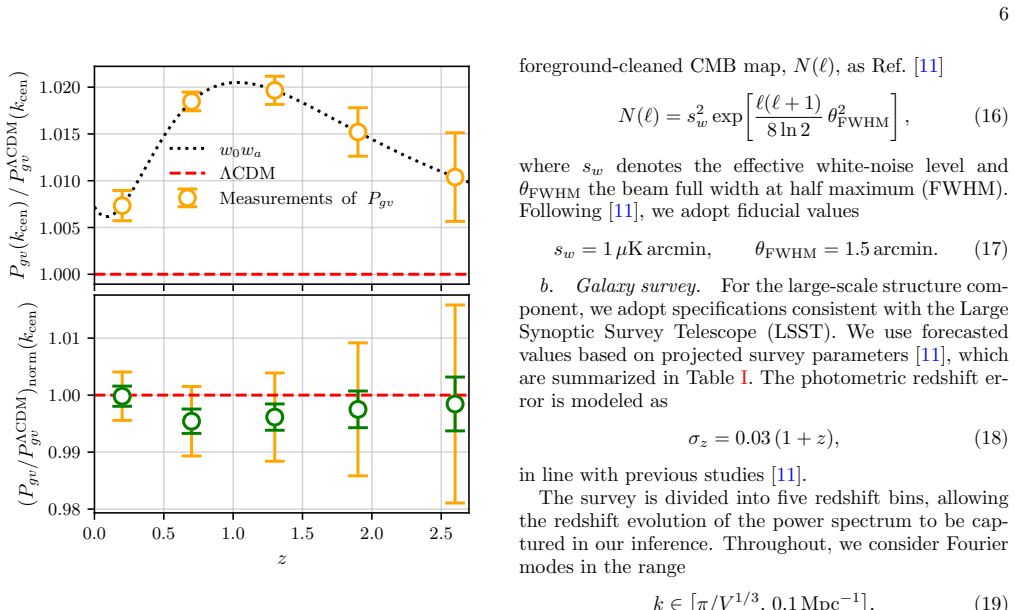
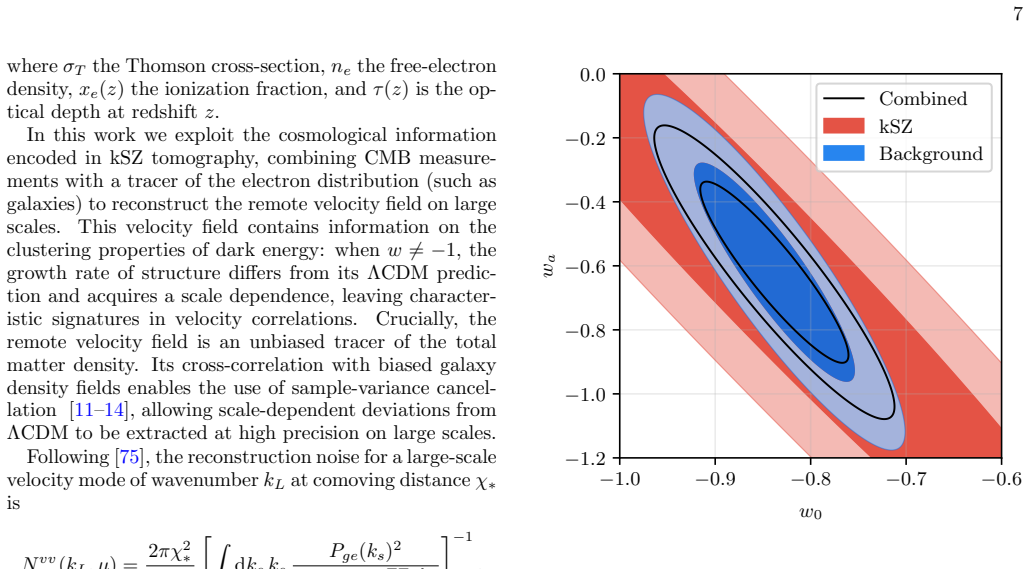
Including kSZ tomography data tightens constraints on w0 by 15% and on wa by 32%, with parameter degeneracies distinct from those of geometric probes. For canonical sound speed cs=1 the perturbation effects stay sub-percent and confined to horizon scales, whereas smaller sound speeds shift the signals into accessible k-ranges.
What carries the argument
Fisher-matrix analysis of the joint kinetic Sunyaev-Zel'dovich tomography and galaxy clustering power spectra.
If this is right
- Constraints on the dark energy equation-of-state parameters w0 and wa tighten by 15% and 32% respectively when kSZ tomography is added to galaxy clustering data.
- The resulting parameter degeneracies differ from those obtained with geometric probes alone.
- Dark energy perturbation signals remain sub-percent for sound speed cs=1 and limited to horizon scales.
- Lower sound speeds move the perturbation signatures into k-ranges reachable by near-future surveys.
- Near-term kSZ data primarily test consistency between background and perturbative signals while future low-noise surveys could constrain dark energy microphysics.
Where Pith is reading between the lines
- The method could be combined with weak-lensing or supernova data to further break degeneracies in multi-probe cosmological analyses.
- Survey strategies that optimize kSZ signal-to-noise may become a priority for next-generation dark energy studies.
- Detection of scale-dependent perturbations would favor dark energy models with non-canonical sound speeds over standard quintessence.
- The same framework might be applied to other velocity-field tracers to cross-check the perturbative signals.
Load-bearing premise
The Fisher matrix analysis accurately captures the full information content of the joint power spectra without significant biases from non-Gaussian statistics, survey systematics, or modeling inaccuracies in the dark energy perturbation sector.
What would settle it
Actual cross-correlation measurements between kSZ and galaxy surveys that fail to produce the forecasted 15% and 32% improvements in w0 and wa constraints would falsify the claimed information gain.
Figures




read the original abstract
The accelerated expansion of the Universe is well established by geometric probes, yet its physical origin remains poorly understood. Most constraints on dark energy arise from background observables -- supernovae, baryon acoustic oscillations, and the cosmic microwave background -- which mainly test the homogeneous expansion history. To move beyond this limitation, we examine how kinetic Sunyaev--Zel'dovich (kSZ) tomography, combined with galaxy clustering, can probe perturbative effects of dark energy and improve constraints on its background parameters. Using a Fisher-matrix analysis of the joint power spectra for LSST- and CMB-S4-like surveys, we quantify the additional information kSZ tomography contributes to dark-energy inference. Including kSZ data tightens constraints on $w_0$ by 15 % and on $w_a$ by 32 %, with parameter degeneracies distinct from those of geometric probes. We also assess the detectability of dark-energy perturbations through a two-parameter model, finding that for canonical sound speed ($c_s=1$) the effects are sub-percent and confined to horizon scales, while smaller sound speeds shift them to accessible $k$-ranges. Near-term kSZ measurements will primarily serve to test the consistency between background and perturbative signals, while future low-noise, high-resolution surveys may begin to uncover the microphysical properties of dark energy.
Editorial analysis
A structured set of objections, weighed in public.
Referee Report
Summary. The paper uses Fisher-matrix forecasts for LSST- and CMB-S4-like surveys to claim that adding kSZ tomography to galaxy clustering tightens constraints on dark-energy parameters w0 by 15% and wa by 32%, with distinct degeneracies from geometric probes, while also assessing detectability of dark-energy perturbations in a two-parameter model, finding sub-percent effects at horizon scales for cs=1 and more accessible signals for lower cs.
Significance. If the forecasts are robust, the work would be significant for showing how velocity-sensitive kSZ tomography can probe perturbative dark-energy effects beyond background expansion history, offering complementary information and motivating inclusion of such probes in next-generation survey planning.
major comments (2)
- [Fisher-matrix methodology] The Fisher-matrix analysis of the joint kSZ and galaxy-clustering power spectra (detailed in the methodology section) assumes Gaussian covariance. This omits non-Gaussian contributions such as the connected four-point function and super-sample covariance, which are expected to be relevant for growth-sensitive parameters at low redshift and for kSZ velocity fields; without quantification or mock validation, the reported 15% and 32% tightenings on w0 and wa cannot be taken as load-bearing results.
- [Dark-energy perturbation results] The detectability assessment for dark-energy perturbations (in the results section on the two-parameter model) rests on linear-theory assumptions and specific k-range shifts with cs. More explicit propagation of modeling uncertainties in the kSZ signal and comparison to the full error budget of the surveys is needed to support the claim that effects are sub-percent for cs=1 versus accessible for smaller cs.
minor comments (2)
- [Abstract] The abstract states the percentage improvements without referencing the exact survey specifications or section where they are derived; adding a brief pointer would improve readability.
- [Notation and figures] Notation for the sound speed (cs) and perturbation parameters should be checked for consistency between the text, equations, and figure captions.
Simulated Author's Rebuttal
We thank the referee for the constructive report and for highlighting important limitations in our forecasting approach. We address each major comment below, indicating where revisions have been made to the manuscript to improve clarity and acknowledge caveats without overstating the robustness of the numerical results.
read point-by-point responses
-
Referee: The Fisher-matrix analysis of the joint kSZ and galaxy-clustering power spectra (detailed in the methodology section) assumes Gaussian covariance. This omits non-Gaussian contributions such as the connected four-point function and super-sample covariance, which are expected to be relevant for growth-sensitive parameters at low redshift and for kSZ velocity fields; without quantification or mock validation, the reported 15% and 32% tightenings on w0 and wa cannot be taken as load-bearing results.
Authors: We agree that the Gaussian covariance assumption represents a limitation, as non-Gaussian contributions including super-sample covariance and the connected four-point function can affect growth-sensitive forecasts, particularly at low redshift. In the revised manuscript we have added an explicit discussion in Section 3 (Methodology) noting this approximation and its potential impact on the absolute error bars. We maintain that the reported relative improvements (15% on w0 and 32% on wa) remain indicative of the complementary information provided by kSZ tomography, because the same covariance approximation is applied consistently to both the galaxy-clustering-only and joint analyses; the differential gain should therefore be less sensitive to the omitted terms. Nevertheless, we have tempered the language in the abstract and conclusions to describe these percentages as forecast improvements under the Gaussian assumption rather than definitive constraints, and we flag full mock-based validation as an important direction for future work. revision: partial
-
Referee: The detectability assessment for dark-energy perturbations (in the results section on the two-parameter model) rests on linear-theory assumptions and specific k-range shifts with cs. More explicit propagation of modeling uncertainties in the kSZ signal and comparison to the full error budget of the surveys is needed to support the claim that effects are sub-percent for cs=1 versus accessible for smaller cs.
Authors: We acknowledge that the detectability statements rely on linear perturbation theory and idealized modeling of the kSZ signal. In the revised results section we have expanded the discussion to include a direct comparison of the predicted dark-energy perturbation amplitude to the survey error budget for each sound-speed case, and we have added a paragraph propagating a simple estimate of kSZ modeling uncertainty (arising from the optical-depth degeneracy and velocity reconstruction noise). We have also clarified how the k-range of the signal shifts with cs and emphasized that the sub-percent claim for cs=1 is within the linear regime only. Full end-to-end propagation of all systematics would require dedicated simulations beyond the scope of the present Fisher analysis; we now explicitly state this as a caveat and suggest it as follow-up work. revision: yes
Circularity Check
Fisher forecasts derive from forward modeling of survey specs and DE parameters with no reduction to fitted inputs
full rationale
The paper conducts a Fisher-matrix forecast for LSST- and CMB-S4-like surveys using a parameterized two-parameter model for dark-energy perturbations and standard power-spectrum expressions. The quoted 15% and 32% tightenings on w0 and wa, as well as the sub-percent detectability statements for cs=1 versus smaller sound speeds, follow directly from matrix inversion of the assumed Gaussian covariance of the joint kSZ-galaxy spectra; these quantities are not obtained by fitting any subset of existing data and then relabeling the fit as a prediction. No self-definitional steps, load-bearing self-citations, or ansatz smuggling appear in the derivation chain, so the results remain independent of the paper's own outputs.
Axiom & Free-Parameter Ledger
free parameters (2)
- w0
- wa
axioms (2)
- domain assumption Linear cosmological perturbation theory applies to dark energy with constant sound speed
- standard math Fisher matrix provides an accurate estimate of parameter uncertainties for the joint observables
Forward citations
Cited by 1 Pith paper
-
Measurement of the galaxy-velocity power spectrum of DESI tracers with the kinematic Sunyaev-Zeldovich effect using DESI DR2 and ACT DR6
DESI DR2 and ACT DR6 data yield 17σ LRG-velocity, 8.3σ ELG-velocity, and 6.8σ QSO-velocity detections plus a 3.1σ velocity-velocity signal, producing f_NL^loc = 15.9_{-34.4}^{+34.6} from the velocity field.
Reference graph
Works this paper leans on
-
[1]
Exploring the expansion history of the universe,
Eric V. Linder, “Exploring the expansion history of the universe,” Physical Review Letters90(2003), 10.1103/physrevlett.90.091301
-
[2]
The DESI Experiment Part I: Science,Targeting, and Survey Design
Amir Aghamousaet al.(DESI), “The DESI Experiment Part I: Science,Targeting, and Survey Design,” (2016), arXiv:1611.00036 [astro-ph.IM]
work page internal anchor Pith review Pith/arXiv arXiv 2016
-
[3]
Overview of the Instrumentation for the Dark Energy Spectroscopic Instrument
B. Abareshiet al.(DESI), “Overview of the Instrumenta- tion for the Dark Energy Spectroscopic Instrument,” As- tron. J.164, 207 (2022), arXiv:2205.10939 [astro-ph.IM]
work page internal anchor Pith review Pith/arXiv arXiv 2022
-
[4]
DESI DR2 Results II: Measurements of Baryon Acoustic Oscillations and Cosmological Constraints
DESI Collaboration, “DESI DR2 Results II: Measure- ments of Baryon Acoustic Oscillations and Cosmological Constraints,” (2025), arXiv:2503.14738 [astro-ph.CO]
work page internal anchor Pith review Pith/arXiv arXiv 2025
-
[5]
Parametrized post- friedmann framework for modified gravity,
Wayne Hu and Ignacy Sawicki, “Parametrized post- friedmann framework for modified gravity,” Physical Re- view D76(2007), 10.1103/physrevd.76.104043
-
[6]
R. A. Sunyaev and Ya. B. Zeldovich, “The Velocity of clusters of galaxies relative to the microwave background. The Possibility of its measurement,” Mon. Not. Roy. As- tron. Soc.190, 413–420 (1980)
work page 1980
-
[7]
Anne-Sylvie Deutsch, Emanuela Dimastrogiovanni, Matthew C. Johnson, Moritz M¨ unchmeyer, and Alexan- dra Terrana, “Reconstruction of the remote dipole and quadrupole fields from the kinetic Sunyaev Zel’dovich and polarized Sunyaev Zel’dovich effects,” (2017), arXiv:1707.08129 [astro-ph.CO]
work page internal anchor Pith review Pith/arXiv arXiv 2017
-
[9]
Exploring KSZ velocity reconstruction with N-body simulations and the halo model,
Utkarsh Giri and Kendrick M. Smith, “Exploring KSZ velocity reconstruction with N-body simulations and the halo model,” JCAP09, 028 (2022), arXiv:2010.07193 [astro-ph.CO]
-
[10]
Velocity re- construction with the cosmic microwave background and galaxy surveys,
Juan Cayuso, Richard Bloch, Selim C. Hotinli, Matthew C. Johnson, and Fiona McCarthy, “Velocity re- construction with the cosmic microwave background and galaxy surveys,” JCAP02, 051 (2023), arXiv:2111.11526 [astro-ph.CO]. 12
-
[11]
Constraining local non-gaussianities with kinetic sunyaev-zel’dovich tomography,
Moritz M¨ unchmeyer, Mathew S. Madhavacheril, Si- mone Ferraro, Matthew C. Johnson, and Kendrick M. Smith, “Constraining local non-gaussianities with kinetic sunyaev-zel’dovich tomography,” Physical Review D100 (2019), 10.1103/physrevd.100.083508
-
[12]
Probing cor- related compensated isocurvature perturbations using scale-dependent galaxy bias,
Selim C. Hotinli, James B. Mertens, Matthew C. Johnson, and Marc Kamionkowski, “Probing cor- related compensated isocurvature perturbations using scale-dependent galaxy bias,” Phys. Rev.D100, 103528 (2019), arXiv:1908.08953 [astro-ph.CO]
-
[13]
Primordial trispectrum from kinetic Sunyaev-Zel’dovich tomogra- phy,
Neha Anil Kumar, Gabriela Sato-Polito, Marc Kamionkowski, and Selim C. Hotinli, “Primordial trispectrum from kinetic Sunyaev-Zel’dovich tomogra- phy,” Phys. Rev. D106, 063533 (2022), arXiv:2205.03423 [astro-ph.CO]
-
[14]
Uncorrelated compensated isocurvature perturbations from kinetic Sunyaev-Zeldovich tomogra- phy,
Neha Anil Kumar, Selim C. Hotinli, and Marc Kamionkowski, “Uncorrelated compensated isocurvature perturbations from kinetic Sunyaev-Zeldovich tomogra- phy,” Phys. Rev. D107, 043504 (2023), arXiv:2208.02829 [astro-ph.CO]
-
[15]
Velocity Reconstruction from KSZ: Measuring fN L with ACT and DESILS,
Selim C. Hotinli, Kendrick M. Smith, and Simone Ferraro, “Velocity Reconstruction from KSZ: Measuring fN L with ACT and DESILS,” (2025), arXiv:2506.21657 [astro-ph.CO]
-
[16]
KSZ Velocity Reconstruction with ACT and DESI-LS using a Tomographic QML Power Spec- trum Estimator,
Anderson C. M. Lai, Yurii Kvasiuk, and Moritz M¨ unchmeyer, “KSZ Velocity Reconstruction with ACT and DESI-LS using a Tomographic QML Power Spec- trum Estimator,” (2025), arXiv:2506.21684 [astro- ph.CO]
-
[17]
Alex Lagu¨ e, Mathew S. Madhavacheril, Kendrick M. Smith, Simone Ferraro, and Emmanuel Schaan, “Con- straints on Local Primordial Non-Gaussianity with 3D Velocity Reconstruction from the Kinetic Sunyaev- Zeldovich Effect,” Phys. Rev. Lett.134, 151003 (2025), arXiv:2411.08240 [astro-ph.CO]
-
[18]
Fiona McCarthyet al., “The Atacama Cosmology Tele- scope: Large-scale velocity reconstruction with the kine- matic Sunyaev-Zel’dovich effect and DESI LRGs,” JCAP 05, 057 (2025), arXiv:2410.06229 [astro-ph.CO]
-
[19]
Constraints on cosmology beyond ΛCDM with kinetic Sunyaev Zel’dovich velocity reconstruction,
Jordan Krywonos, Selim C. Hotinli, and Matthew C. Johnson, “Constraints on cosmology beyond ΛCDM with kinetic Sunyaev Zel’dovich velocity reconstruction,” (2024), arXiv:2408.05264 [astro-ph.CO]
-
[20]
Kinetic Sunyaev Zel'dovich velocity reconstruction from Planck and unWISE
Richard Bloch and Matthew C. Johnson, “Kinetic Sun- yaev Zel’dovich velocity reconstruction from Planck and unWISE,” (2024), arXiv:2405.00809 [astro-ph.CO]
work page internal anchor Pith review Pith/arXiv arXiv 2024
-
[21]
Large Synoptic Survey Telescope: Dark Energy Science Collaboration
Alexandra Abateet al.(LSST Dark Energy Science), “Large Synoptic Survey Telescope: Dark Energy Science Collaboration,” (2012), arXiv:1211.0310 [astro-ph.CO]
work page internal anchor Pith review Pith/arXiv arXiv 2012
-
[22]
LSST: from Science Drivers to Reference Design and Anticipated Data Products
ˇZeljko Ivezi´ c, Steven M. Kahn, J. Anthony Tyson, et al., “LSST: From Science Drivers to Reference Design and Anticipated Data Products,” ApJ873, 111 (2019), arXiv:0805.2366 [astro-ph]
work page internal anchor Pith review Pith/arXiv arXiv 2019
-
[23]
CMB-S4 Science Book, First Edition
Kevork N. Abazajianet al.(CMB-S4),CMB-S4 Sci- ence Book, First Edition(2016) arXiv:1610.02743 [astro- ph.CO]
work page internal anchor Pith review Pith/arXiv arXiv 2016
-
[24]
CMB-S4 Science Case, Reference Design, and Project Plan
Kevork Abazajianet al., “CMB-S4 Science Case, Reference Design, and Project Plan,” (2019), arXiv:1907.04473 [astro-ph.IM]
work page internal anchor Pith review Pith/arXiv arXiv 2019
-
[25]
Elcio Abdallaet al., “Cosmology intertwined: A re- view of the particle physics, astrophysics, and cosmology associated with the cosmological tensions and anoma- lies,” JHEAp34, 49–211 (2022), arXiv:2203.06142 [astro- ph.CO]
work page internal anchor Pith review Pith/arXiv arXiv 2022
-
[26]
Thomas P. Sotiriou and Valerio Faraoni, “f(R) Theo- ries Of Gravity,” Rev. Mod. Phys.82, 451–497 (2010), arXiv:0805.1726 [gr-qc]
work page internal anchor Pith review Pith/arXiv arXiv 2010
-
[27]
Unified cosmic history in modified gravity: from F(R) theory to Lorentz non-invariant models
Shin’ichi Nojiri and Sergei D. Odintsov, “Unified cosmic history in modified gravity: from F(R) theory to Lorentz non-invariant models,” Phys. Rept.505, 59–144 (2011), arXiv:1011.0544 [gr-qc]
work page internal anchor Pith review Pith/arXiv arXiv 2011
-
[28]
Antonio De Felice and Shinji Tsujikawa, “f(R) theories,” Living Rev. Rel.13, 3 (2010), arXiv:1002.4928 [gr-qc]
work page internal anchor Pith review Pith/arXiv arXiv 2010
-
[29]
Salvatore Capozziello and Mariafelicia De Laurentis, “Extended Theories of Gravity,” Phys. Rept.509, 167– 321 (2011), arXiv:1108.6266 [gr-qc]
work page internal anchor Pith review Pith/arXiv arXiv 2011
-
[30]
Modified Gravity and Cosmology
Timothy Clifton, Pedro G. Ferreira, Antonio Padilla, and Constantinos Skordis, “Modified Gravity and Cos- mology,” Phys. Rept.513, 1–189 (2012), arXiv:1106.2476 [astro-ph.CO]
work page internal anchor Pith review Pith/arXiv arXiv 2012
-
[31]
Cosmological Con- sequences of a Rolling Homogeneous Scalar Field,
Bharat Ratra and P. J. E. Peebles, “Cosmological Con- sequences of a Rolling Homogeneous Scalar Field,” Phys. Rev. D37, 3406 (1988)
work page 1988
-
[32]
The cosmon model for an asymptotically vanishing time-dependent cosmological ``constant''
Christof Wetterich, “The Cosmon model for an asymp- totically vanishing time dependent cosmological ’con- stant’,” Astron. Astrophys.301, 321–328 (1995), arXiv:hep-th/9408025
work page internal anchor Pith review Pith/arXiv arXiv 1995
-
[33]
Cosmological Imprint of an Energy Component with General Equation of State
R. R. Caldwell, Rahul Dave, and Paul J. Steinhardt, “Cosmological imprint of an energy component with gen- eral equation of state,” Phys. Rev. Lett.80, 1582–1585 (1998), arXiv:astro-ph/9708069
work page internal anchor Pith review Pith/arXiv arXiv 1998
-
[34]
Quintessence, Cosmic Coincidence, and the Cosmological Constant
Ivaylo Zlatev, Li-Min Wang, and Paul J. Steinhardt, “Quintessence, cosmic coincidence, and the cosmolog- ical constant,” Phys. Rev. Lett.82, 896–899 (1999), arXiv:astro-ph/9807002
work page internal anchor Pith review Pith/arXiv arXiv 1999
-
[35]
The Cosmological Constant and Dark Energy
P. J. E. Peebles and Bharat Ratra, “The Cosmological Constant and Dark Energy,” Rev. Mod. Phys.75, 559– 606 (2003), arXiv:astro-ph/0207347
work page internal anchor Pith review Pith/arXiv arXiv 2003
-
[36]
Phantom energy and cosmic doomsday,
Robert R. Caldwell, Marc Kamionkowski, and Nevin N. Weinberg, “Phantom energy and cosmic doomsday,” Phys. Rev. Lett.91, 071301 (2003), arXiv:astro- ph/0302506
-
[37]
Is Cosmic Speed-Up Due to New Gravitational Physics?
Sean M. Carroll, Vikram Duvvuri, Mark Trodden, and Michael S. Turner, “Is Cosmic Speed-Up Due to New Gravitational Physics?” Phys. Rev. D70, 043528 (2004), arXiv:astro-ph/0306438
work page internal anchor Pith review Pith/arXiv arXiv 2004
-
[38]
Edmund J. Copeland, M. Sami, and Shinji Tsujikawa, “Dynamics of dark energy,” Int. J. Mod. Phys. D15, 1753–1936 (2006), arXiv:hep-th/0603057
work page internal anchor Pith review Pith/arXiv arXiv 1936
-
[39]
Assessing observational constraints on dark energy
David Shlivko and Paul J. Steinhardt, “Assessing obser- vational constraints on dark energy,” Phys. Lett. B855, 138826 (2024), arXiv:2405.03933 [astro-ph.CO]
work page internal anchor Pith review Pith/arXiv arXiv 2024
-
[40]
Scant evidence for thawing quintessence,
William J. Wolf, Carlos Garc´ ıa-Garc´ ıa, Deaglan J. Bartlett, and Pedro G. Ferreira, “Scant evidence for thawing quintessence,” Physical Review D110(2024), 10.1103/physrevd.110.083528
-
[41]
Mustapha Ishak, Amol Upadhye, and David N. Spergel, “Probing cosmic acceleration beyond the equation of state: Distinguishing between dark energy and mod- ified gravity models,” Physical Review D74(2006), 10.1103/physrevd.74.043513
-
[42]
Strange metal and superconductor in the two-dimensional yukawa-sachdev-ye-kitaev model,
Arthur Lue, Rom´ an Scoccimarro, and Glenn Stark- man, “Differentiating between modified gravity and dark energy,” Physical Review D69(2004), 10.1103/phys- revd.69.044005
-
[43]
Large-scale structure of the universe and cos- mological perturbation theory,
F. Bernardeau, S. Colombi, E. Gazta˜ naga, and R. Scoc- cimarro, “Large-scale structure of the universe and cos- mological perturbation theory,” Physics Reports367, 13 1–248 (2002)
work page 2002
-
[44]
Jaiyul Yoo, “General relativistic description of the ob- served galaxy power spectrum: Do we understand what we measure?” Physical Review D82(2010), 10.1103/physrevd.82.083508
-
[45]
Structure formation with generalized dark matter,
Wayne Hu, “Structure formation with generalized dark matter,” The Astrophysical Journal506, 485–494 (1998)
work page 1998
-
[46]
The mass power spectrum in quintessence cosmo- logical models,
Chung-Pei Ma, R. R. Caldwell, Paul Bode, and Limin Wang, “The mass power spectrum in quintessence cosmo- logical models,” The Astrophysical Journal521, L1–L4 (1999)
work page 1999
-
[47]
Daniel Baumann,Cosmology(Cambridge University Press, 2022)
work page 2022
-
[48]
Cosmological perturbation theory in the synchronous and conformal newtonian gauges,
Chung-Pei Ma and Edmund Bertschinger, “Cosmological perturbation theory in the synchronous and conformal newtonian gauges,” The Astrophysical Journal455, 7 (1995)
work page 1995
-
[49]
Theory of cosmological perturbations,
V.F. Mukhanov, H.A. Feldman, and R.H. Branden- berger, “Theory of cosmological perturbations,” Physics Reports215, 203–333 (1992)
work page 1992
-
[50]
The effective theory of quintessence: thew <−1 side unveiled,
Paolo Creminelli, Guido D’Amico, Jorge Nore˜ na, and Filippo Vernizzi, “The effective theory of quintessence: thew <−1 side unveiled,” Journal of Cosmology and Astroparticle Physics2009, 018–018 (2009)
work page 2009
-
[51]
Antony Lewis, Anthony Challinor, and Anthony Lasenby, “Efficient computation of cosmic microwave background anisotropies in closed friedmann-robertson- walker models,” The Astrophysical Journal538, 473–476 (2000)
work page 2000
-
[52]
Crossing the phantom divide with parametrized post- friedmann dark energy,
Wenjuan Fang, Wayne Hu, and Antony Lewis, “Crossing the phantom divide with parametrized post- friedmann dark energy,” Physical Review D78(2008), 10.1103/physrevd.78.087303
-
[53]
Cobaya: code for bayesian analysis of hierarchical physical models,
Jes´ us Torrado and Antony Lewis, “Cobaya: code for bayesian analysis of hierarchical physical models,” Jour- nal of Cosmology and Astroparticle Physics2021, 057 (2021)
work page 2021
-
[54]
Cobaya: Bayesian analysis in cosmology,
Jes´ us Torrado and Antony Lewis, “Cobaya: Bayesian analysis in cosmology,” Astrophysics Source Code Li- brary, record ascl:1910.019 (2019)
work page 1910
-
[55]
Cobaya: Code for Bayesian Analysis of hierarchical physical models
Jes´ us Torrado and Antony Lewis, “Cobaya: code for Bayesian analysis of hierarchical physical mod- els,” J. Cosmology Astropart. Phys.2021, 057 (2021), arXiv:2005.05290 [astro-ph.IM]
work page internal anchor Pith review Pith/arXiv arXiv 2021
-
[56]
Accelerating astro- nomical and cosmological inference with preconditioned monte carlo,
Minas Karamanis, Florian Beutler, John A Peacock, David Nabergoj, and Uroˇ s Seljak, “Accelerating astro- nomical and cosmological inference with preconditioned monte carlo,” Monthly Notices of the Royal Astronomical Society516, 1644–1653 (2022)
work page 2022
-
[57]
Minas Karamanis, David Nabergoj, Florian Beutler, John A Peacock, and Uros Seljak, “pocomc: A python package for accelerated bayesian inference in astron- omy and cosmology,” arXiv preprint arXiv:2207.05660 (2022)
-
[58]
Getdist: a python package for analysing monte carlo samples,
Antony Lewis, “Getdist: a python package for analysing monte carlo samples,” Journal of Cosmology and As- troparticle Physics2025, 025 (2025)
work page 2025
-
[59]
Measuring Dark Energy Clustering with CMB-Galaxy Correlations
Wayne Hu and Ryan Scranton, “Measuring dark energy clustering with CMB-galaxy correlations,” Phys. Rev. D 70, 123002 (2004), arXiv:astro-ph/0408456
work page internal anchor Pith review Pith/arXiv arXiv 2004
-
[60]
Arnab Rai Choudhuri,Astrophysics for Physicists(Cam- bridge University Press, 2010)
work page 2010
-
[61]
Observational evidence from super- novae for an accelerating universe and a cosmological constant,
Adam G. Riess, Alexei V. Filippenko, Peter Challis, Ale- jandro Clocchiatti, Alan Diercks, Peter M. Garnavich, Ron L. Gilliland, Craig J. Hogan, Saurabh Jha, Robert P. Kirshner, B. Leibundgut, M. M. Phillips, David Reiss, Brian P. Schmidt, Robert A. Schommer, R. Chris Smith, J. Spyromilio, Christopher Stubbs, Nicholas B. Suntzeff, and John Tonry, “Observa...
work page 1998
-
[62]
Measurements ofωandλfrom 42 high-redshift supernovae,
S. Perlmutter, G. Aldering, G. Goldhaber, R. A. Knop, P. Nugent, P. G. Castro, S. Deustua, S. Fabbro, A. Goo- bar, D. E. Groom, I. M. Hook, A. G. Kim, M. Y. Kim, J. C. Lee, N. J. Nunes, R. Pain, C. R. Penny- packer, R. Quimby, C. Lidman, R. S. Ellis, M. Irwin, R. G. McMahon, P. Ruiz-Lapuente, N. Walton, B. Schae- fer, B. J. Boyle, A. V. Filippenko, T. Mat...
work page 1999
-
[63]
Joseph W. Richards, Darren Homrighausen, Peter E. Freeman, Chad M. Schafer, and Dovi Poznanski, “Semi- supervised learning for photometric supernova classifi- cation: Semi-supervised sn classification,” Monthly No- tices of the Royal Astronomical Society419, 1121–1135 (2011)
work page 2011
-
[64]
Evolving dark energy or supernovae systematics?
George Efstathiou, “Evolving dark energy or supernovae systematics?” (2025), arXiv:2408.07175 [astro-ph.CO]
-
[65]
The pantheon+ analysis: Cosmological constraints,
Dillon Brout, Dan Scolnic, Brodie Popovic, Adam G. Riess, Anthony Carr, Joe Zuntz, Rick Kessler, Tamara M. Davis, Samuel Hinton, David Jones, W. D’Arcy Kenworthy, Erik R. Peterson, Khaled Said, Georgie Taylor, Noor Ali, Patrick Armstrong, Pranav Charvu, Arianna Dwomoh, Cole Meldorf, Antonella Palmese, Helen Qu, Benjamin M. Rose, Bruno Sanchez, Christopher...
work page 2022
-
[66]
Union Through UNITY: Cosmology with 2,000 SNe Using a Unified Bayesian Framework
David Rubin, Greg Aldering, Marc Betoule, Andy Fruchter, Xiaosheng Huang, Alex G. Kim, Chris Lid- man, Eric Linder, Saul Perlmutter, Pilar Ruiz-Lapuente, and Nao Suzuki, “Union through unity: Cosmology with 2,000 sne using a unified bayesian framework,” (2025), arXiv:2311.12098 [astro-ph.CO]
work page internal anchor Pith review Pith/arXiv arXiv 2025
-
[67]
The dark energy survey supernova pro- gram: Light curves and 5-year data release,
B. O. S´ anchez, D. Brout, M. Vincenzi, M. Sako, K. Herner, R. Kessler, T. M. Davis, D. Scolnic, M. Acevedo, J. Lee, A. M¨ oller, H. Qu, L. Kelsey, P. Wise- man, P. Armstrong, B. Rose, R. Camilleri, R. Chen, L. Galbany, E. Kovacs, C. Lidman, B. Popovic, M. Smith, M. Sullivan, M. Toy, D. Carollo, K. Glazebrook, G. F. Lewis, R. C. Nichol, B. E. Tucker, T. M...
-
[68]
Interpreting DESI 2024 BAO: Late-time dynamical dark energy or a local effect?
Gialamas et al., “Interpreting DESI 2024 BAO: Late-time dynamical dark energy or a local effect?” Physical Review D111(2025), 10.1103/physrevd.111.043540
-
[69]
Scott Dodelson,Modern Cosmology(Academic Press, Amsterdam, 2003)
work page 2003
-
[70]
Shaun Cole, Will J. Percival, John A. Peacock, Peder Norberg, Carlton M. Baugh, Carlos S. Frenk, Ivan Baldry, Joss Bland-Hawthorn, Terry Bridges, Russell Cannon, Matthew Colless, Chris Collins, Warrick Couch, Nicholas J. G. Cross, Gavin Dalton, Vincent R. Eke, Roberto De Propris, Simon P. Driver, George Efs- tathiou, Richard S. Ellis, Karl Glazebrook, Car...
work page internal anchor Pith review Pith/arXiv arXiv 2005
-
[71]
Daniel J. Eisensteinet al.(SDSS), “Detection of the Baryon Acoustic Peak in the Large-Scale Correlation Function of SDSS Luminous Red Galaxies,” Astrophys. J.633, 560–574 (2005), arXiv:astro-ph/0501171
work page internal anchor Pith review Pith/arXiv arXiv 2005
-
[72]
The 6dF Galaxy Survey: Baryon Acoustic Oscillations and the Local Hubble Constant
Florian Beutler, Chris Blake, Matthew Colless, D. Heath Jones, Lister Staveley-Smith, Lachlan Campbell, Quentin Parker, Will Saunders, and Fred Watson, “The 6dF Galaxy Survey: baryon acoustic oscillations and the local Hubble constant,” MNRAS416, 3017–3032 (2011), arXiv:1106.3366 [astro-ph.CO]
work page internal anchor Pith review Pith/arXiv arXiv 2011
-
[73]
Anton Chudaykin and Martin Kunz, “Modified gravity interpretation of the evolving dark energy in light of desi data,” (2024), arXiv:2407.02558 [astro-ph.CO]
-
[74]
Planck 2018 results. VI. Cosmological parameters
N. Aghanimet al.(Planck), “Planck 2018 results. VI. Cosmological parameters,” Astron. Astrophys.641, A6 (2020), [Erratum: Astron.Astrophys. 652, C4 (2021)], arXiv:1807.06209 [astro-ph.CO]
work page internal anchor Pith review Pith/arXiv arXiv 2018
-
[75]
KSZ tomography and the bispectrum
Kendrick M. Smith, Mathew S. Madhavacheril, Moritz M¨ unchmeyer, Simone Ferraro, Utkarsh Giri, and Matthew C. Johnson, “Ksz tomography and the bispec- trum,” (2018), arXiv:1810.13423 [astro-ph.CO]
work page internal anchor Pith review Pith/arXiv arXiv 2018
-
[76]
LSST Science Book, Version 2.0
LSST Science Collaboration, “Lsst science book, version 2.0,” (2009), arXiv:0912.0201 [astro-ph.IM]
work page internal anchor Pith review Pith/arXiv arXiv 2009
-
[77]
hmvec: Vectorized halo model code,
Mathew S. Madhavacheril, Simon Foreman, and William R. Coulton, “hmvec: Vectorized halo model code,” Astrophysics Source Code Library, record ascl:2502.030 (2025)
work page 2025
-
[78]
Resolving the cosmological missing energy problem,
Greg Huey, Limin Wang, R. Dave, R. R. Caldwell, and Paul J. Steinhardt, “Resolving the cosmological missing energy problem,” Phys. Rev. D59, 063005 (1999)
work page 1999
-
[79]
The effective field theory of dark energy,
Giulia Gubitosi, Federico Piazza, and Filippo Vernizzi, “The effective field theory of dark energy,” Journal of Cosmology and Astroparticle Physics2013, 032–032 (2013)
work page 2013
-
[80]
Maximal freedom at minimum cost: linear large-scale structure in general modifications of gravity,
Emilio Bellini and Ignacy Sawicki, “Maximal freedom at minimum cost: linear large-scale structure in general modifications of gravity,” Journal of Cosmology and As- troparticle Physics2014, 050–050 (2014)
work page 2014
-
[81]
Spherical col- lapse in quintessence models with zero speed of sound,
Paolo Creminelli, Guido D’Amico, Jorge Nore˜ na, Leonardo Senatore, and Filippo Vernizzi, “Spherical col- lapse in quintessence models with zero speed of sound,” Journal of Cosmology and Astroparticle Physics2010, 027–027 (2010). Appendix A: Analytic Fisher The Fisher matrix in a given redshift binzis Fab = V 2 Z kmax kmin Z 1 −1 k2 dkdµ (2π)2 Tr ∂C ∂θa C...
work page 2010
discussion (0)
Sign in with ORCID, Apple, or X to comment. Anyone can read and Pith papers without signing in.