Recognition: no theorem link
Measurement of the galaxy-velocity power spectrum of DESI tracers with the kinematic Sunyaev-Zeldovich effect using DESI DR2 and ACT DR6
Pith reviewed 2026-05-10 19:35 UTC · model grok-4.3
The pith
DESI and ACT data detect galaxy-velocity correlations via the kSZ effect at up to 17 sigma and set the tightest velocity-field limit on local primordial non-Gaussianity.
A machine-rendered reading of the paper's core claim, the machinery that carries it, and where it could break.
Core claim
Joint analysis of ACT DR6 CMB maps and DESI DR2 spectroscopic tracers reconstructs the radial velocity field via the kSZ effect. The velocity-galaxy cross-correlation is detected at 17.0 sigma for LRGs, 8.3 sigma for ELGs, and 6.8 sigma for QSOs, together with a 3.1 sigma velocity-velocity correlation for LRGs. The cumulative kSZ detection reaches 20.8 sigma. The observed signal amplitude lies below the prediction of the fiducial halo model and Battaglia electron profile. Combining the new observables gives f_NL^loc = 15.9 with errors -34.4 and +34.6 at 68 percent .
What carries the argument
The kinematic Sunyaev-Zeldovich effect, which shifts CMB temperature in proportion to the line-of-sight velocity of ionized gas, used to form cross-power spectra between reconstructed velocities and galaxy overdensities.
Load-bearing premise
Foreground contamination is modeled reliably with negligible impact on the measured correlations, and the Battaglia electron profile with the fiducial halo model correctly accounts for the lower observed kSZ amplitude.
What would settle it
A higher-precision measurement showing the kSZ amplitude matching the fiducial model prediction rather than remaining lower, or a value of f_NL^loc lying well outside the current error range around 15.9.
Figures


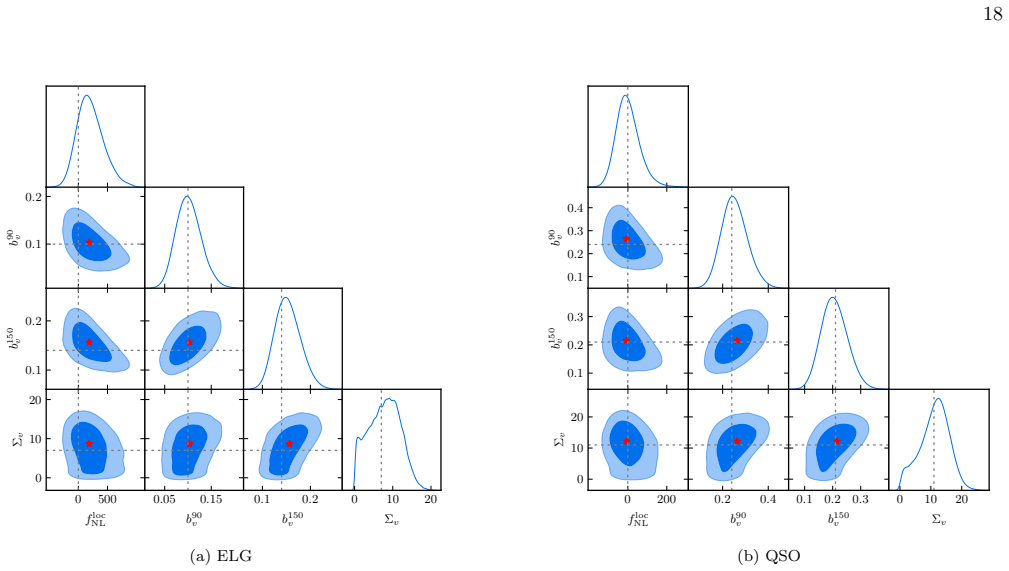
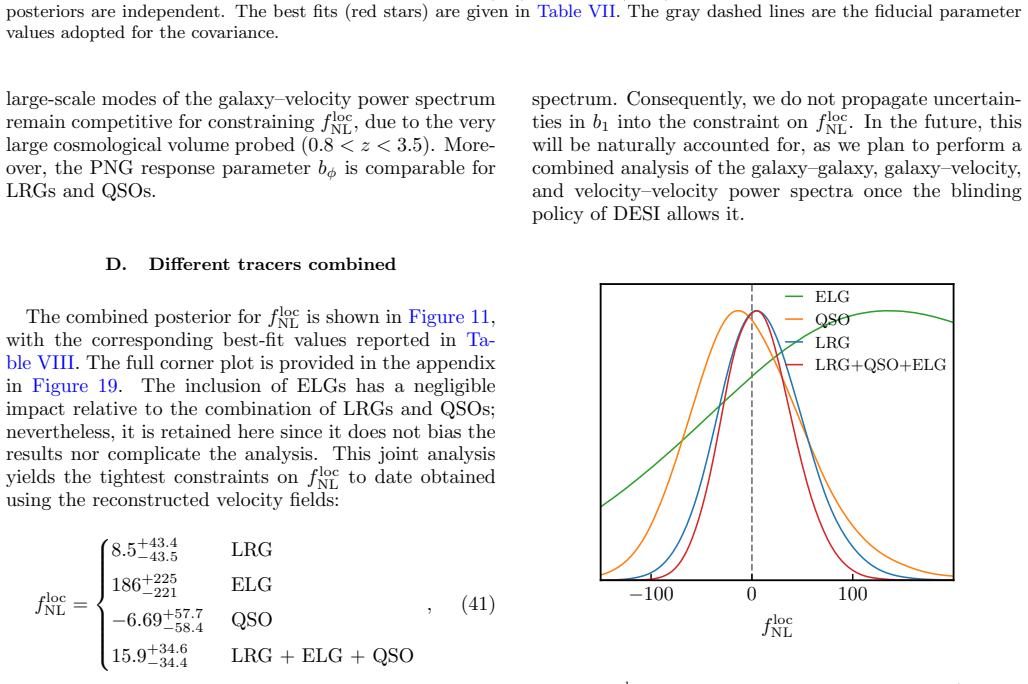
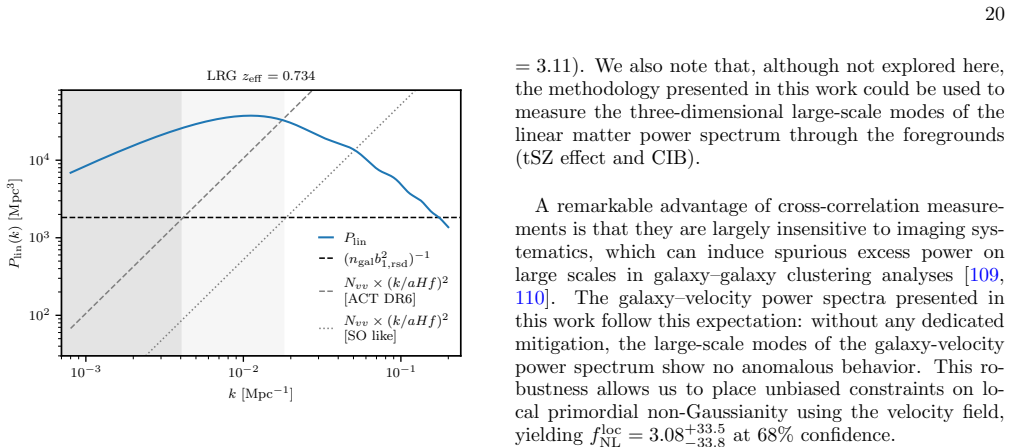
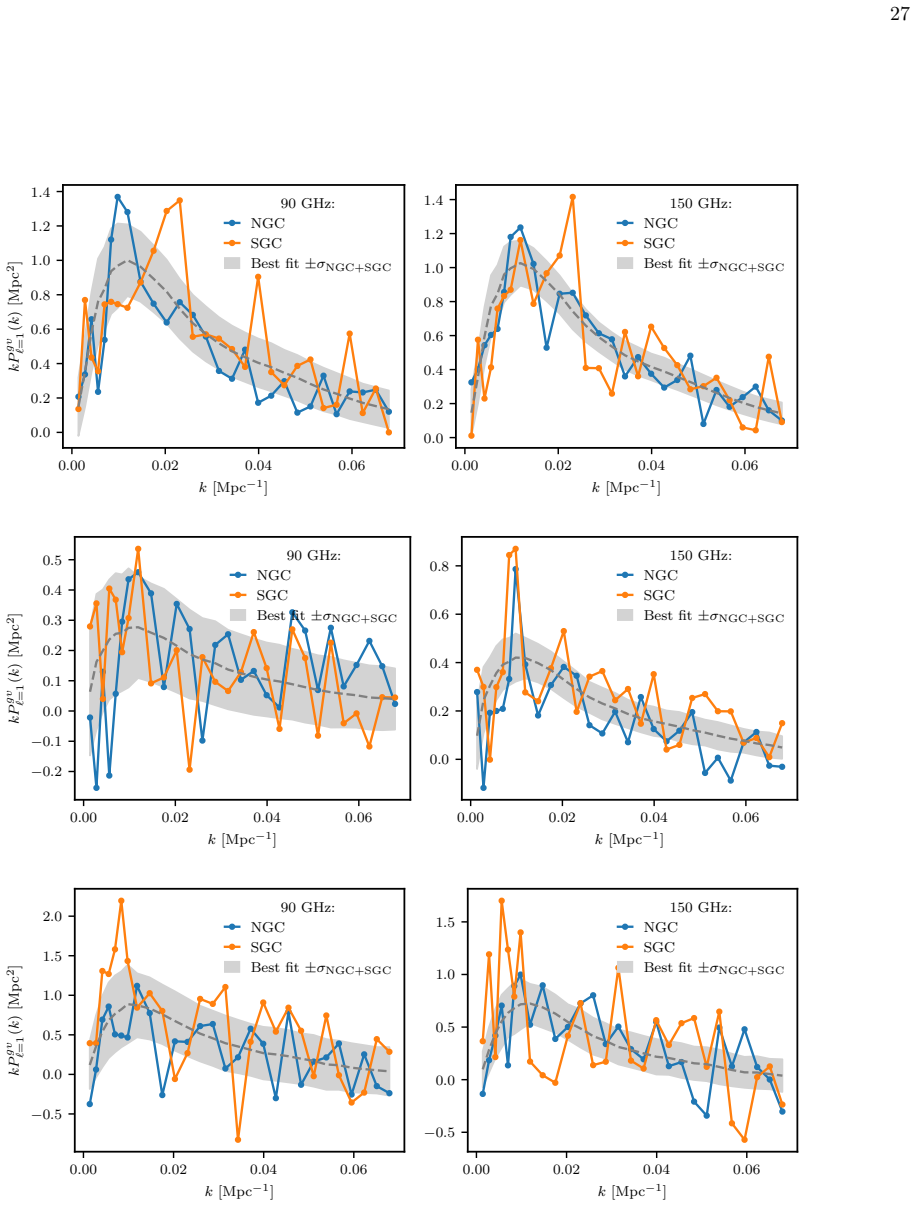


read the original abstract
Joint analyses of high-resolution CMB temperature maps with galaxy surveys provide a unique way to reconstruct the radial velocity field of the underlying matter distribution via the kinematic Sunyaev-Zeldovich (kSZ) effect. Using data from the Atacama Cosmology Telescope (ACT) DR6 and the Dark Energy Spectroscopic Instrument (DESI) DR2, we present radial velocity reconstructions for luminous red galaxies (LRGs), emission-line galaxies (ELGs), and quasars (QSOs). Leveraging the spectroscopic data, we are able to reliably model the foreground contamination and report a negligible impact on our main observables. We detect the velocity-galaxy cross-correlation at $17.0\sigma$ for LRGs, and for the first time, at $8.3\sigma$ for ELGs and $6.8\sigma$ for QSOs. We further report the first detection of the velocity-velocity correlation using LRGs at $3.1\sigma$, as well as the highest cumulative detection of the kSZ effect to date at $20.8 \sigma$. Similarly to previous results, we find a lower amplitude of the kSZ signal compared to our fiducial halo model prediction and electron profile assuming a Battaglia profile. Combining these new observables, we obtain constraints on local-type primordial non-Gaussianity (PNG): $f_{\rm NL}^{\rm loc} = 15.9_{-34.4}^{+34.6}$ at 68\% confidence, which represents the tightest constraint to date derived from the velocity field. The measurements presented here already exhibit lower noise on a per-mode basis than the galaxy auto-correlation on the largest scales, $k<0.004~\rm{Mpc^{-1}}$, highlighting the key role these observables will play in the context of future CMB experiments such as the Simons Observatory.
Editorial analysis
A structured set of objections, weighed in public.
Referee Report
Summary. The manuscript reports measurements of the galaxy-velocity cross-power spectrum via the kinematic Sunyaev-Zeldovich effect using ACT DR6 CMB maps and DESI DR2 spectroscopic tracers (LRGs, ELGs, QSOs). It claims detections at 17.0σ (LRG velocity-galaxy), 8.3σ (ELG), and 6.8σ (QSO), a 3.1σ velocity-velocity correlation with LRGs, and a cumulative 20.8σ kSZ detection—the highest to date. Foreground contamination is modeled as having negligible impact, a lower kSZ amplitude than the fiducial Battaglia electron profile plus halo model is noted (consistent with prior work), and these observables are combined to constrain local primordial non-Gaussianity at f_NL^loc = 15.9_{-34.4}^{+34.6} (68% CL), the tightest from the velocity field, while highlighting lower per-mode noise than galaxy auto-correlations at k < 0.004 Mpc^{-1}.
Significance. If the modeling holds, the result delivers the first ELG and QSO kSZ detections, the highest cumulative kSZ significance, and the tightest velocity-field f_NL^loc constraint to date. The explicit foreground assessment and high reported significances bolster the detections, while the per-mode noise comparison underscores the observables' future value for experiments such as Simons Observatory. Machine-checked elements are absent, but the multi-tracer approach and explicit negligible-foreground statement are strengths.
major comments (1)
- [Abstract and results discussion of amplitude] Abstract and results discussion of amplitude: the lower kSZ amplitude relative to the Battaglia profile plus fiducial halo model is noted without detailed resolution or quantitative propagation into the f_NL^loc posterior. Because the PNG constraint combines the cross-spectra (whose normalization enters the model), this mismatch risks mis-calibrating the scale-dependent signature; the manuscript should demonstrate robustness, e.g., by showing the f_NL posterior with and without amplitude rescaling or by marginalizing over profile parameters.
Simulated Author's Rebuttal
We thank the referee for their careful reading of the manuscript and for the positive assessment of the reported detections and their potential for future experiments. We address the single major comment below and will incorporate the requested robustness test in the revised version.
read point-by-point responses
-
Referee: Abstract and results discussion of amplitude: the lower kSZ amplitude relative to the Battaglia profile plus fiducial halo model is noted without detailed resolution or quantitative propagation into the f_NL^loc posterior. Because the PNG constraint combines the cross-spectra (whose normalization enters the model), this mismatch risks mis-calibrating the scale-dependent signature; the manuscript should demonstrate robustness, e.g., by showing the f_NL posterior with and without amplitude rescaling or by marginalizing over profile parameters.
Authors: We agree that explicitly demonstrating robustness of the f_NL^loc posterior to the overall kSZ amplitude is valuable. The lower amplitude relative to the fiducial Battaglia profile plus halo model is already noted in the manuscript and is consistent with previous kSZ measurements. In the model for the galaxy-velocity cross-spectra, an overall amplitude parameter is included that absorbs the normalization of the kSZ signal (including any profile mismatch). The f_NL^loc constraint is driven by the scale-dependent shape at the largest scales rather than the overall normalization. To directly address the concern, we have performed an additional test in which the model amplitude is rescaled to match the observed kSZ signal before refitting for f_NL^loc; the resulting posterior is statistically consistent with the fiducial result. We will add a description of this test, together with a comparison of the two posteriors, to the revised manuscript. revision: yes
Circularity Check
No circularity: measurements and f_NL constraint are independent of model inputs
full rationale
The paper reports direct detections of velocity-galaxy cross-spectra (17.0σ LRG, 8.3σ ELG, 6.8σ QSO) and velocity-velocity (3.1σ) from ACT+DESI data, then combines them to constrain f_NL^loc. No quoted step defines a prediction via a fit to the same data, renames a known result, or relies on a self-citation chain for the central claim. The noted lower amplitude vs. Battaglia+fiducial model is an external comparison, not a self-definitional input to the f_NL posterior. The derivation remains self-contained against external benchmarks.
Axiom & Free-Parameter Ledger
free parameters (1)
- f_NL^loc
axioms (2)
- domain assumption Foreground contamination can be reliably modeled from spectroscopic data with negligible residual impact on the kSZ observables.
- domain assumption The Battaglia electron pressure profile and fiducial halo model are appropriate benchmarks for the observed kSZ amplitude.
Forward citations
Cited by 2 Pith papers
-
Backlighting the Cosmic Web with Fast Radio Bursts: An Anthology of Dispersion Measure Cross-Correlations with Large-Scale Structure and Baryon Tracers
FRB DMs correlate at 2.6-5 sigma with galaxies, weak lensing, CIB, CMB lensing, tSZ, X-ray clusters, SXRB and radio continuum, consistent with moderate feedback models while ruling out weak feedback at 3.5 sigma via SXRB-DM.
-
New constraints on primordial non-Gaussianity from large-scale cross-correlations of CMB lensing and the cosmic infrared background
Dust-cleaned CIB and CMB lensing cross-correlations yield f_NL^local = 43 ± 23, tightening constraints on local primordial non-Gaussianity.
Reference graph
Works this paper leans on
-
[1]
As usual, the complexity and the cost of FFT scale with the mesh size
Computational Cost The surrogate methodology has a modest computa- tional cost. As usual, the complexity and the cost of FFT scale with the mesh size. In our case, we fix the cell size to 10 Mpc leading to a mesh size of 768 (resp
-
[2]
We note that such a resolution in the mesh is not needed for the study of the large scales, and the cell size will be increased in further work to reduce the computational time
for LRG (resp.QSO) such that a single surrogate takes 210s (resp.250s) using 25 (resp.64) threads and we have sufficient memory to run 10 (resp.4) in parallel in a single CPU node at NERSC. We note that such a resolution in the mesh is not needed for the study of the large scales, and the cell size will be increased in further work to reduce the computati...
2000
-
[3]
18 The frequency dependence of the tSZ effects isf tSZ(ν) = xcoth(x/2)−4 wherex=hν/k BTCMB [101]
because of the window function. 18 The frequency dependence of the tSZ effects isf tSZ(ν) = xcoth(x/2)−4 wherex=hν/k BTCMB [101]. leakage into the dipole remains subdominant to the sta- tistical errors and can be robustly controlled within our modeling framework. Once included, the rest of the anal- ysis is unbiased. A similar conclusion applies to the ve...
2024
-
[4]
or photometric LRGs from the DESI targeting cata- logs usingk max = 0.018 Mpc −1 [11] in combination with ACT DR5. The substantial improvement observed here demonstrates the enhanced constraining power provided by the DESI DR2 LRG spectroscopic samples. Finally, we attempt to detect the signal in the octopole (ℓ= 3), but find no significant detection (SNR...
-
[5]
Sunyaev and Y
R. Sunyaev and Y. B. Zeldovich,The Observations of Relic Radiation as a Test of the Nature of X-Ray Radiation from the Clusters of Galaxies,Comments on Astrophysics and Space Physics4(1972) 173
1972
-
[6]
R. A. Sunyaev and Y. B. Zeldovich,The velocity of clusters of galaxies relative to the microwave background. The possibility of its measurement, Monthly Notices of the Royal Astronomical Society 190(1980) 413
1980
-
[7]
Rephaeli and O
Y. Rephaeli and O. Lahav,Peculiar cluster velocities from measurements of the kinematic Sunyaev-Zeldovich effect,The Astrophysical Journal372(1991) 21
1991
-
[8]
Birkinshaw,The Sunyaev–Zel’dovich effect,Physics Reports310(1999) 97
M. Birkinshaw,The Sunyaev–Zel’dovich effect,Physics Reports310(1999) 97. 20 https://zenodo.org/records/19408668
-
[9]
A.-S. Deutsch, E. Dimastrogiovanni, M. C. Johnson, M. M¨ unchmeyer and A. Terrana,Reconstruction of the remote dipole and quadrupole fields from the kinetic Sunyaev Zel’dovich and polarized Sunyaev Zel’dovich effects,Physical Review D98(2018) 123501 [1707.08129]
- [10]
-
[11]
U. Giri and K. M. Smith,Exploring KSZ velocity reconstruction withN-body simulations and the halo model,Journal of Cosmology and Astroparticle Physics 2022(2020) 028 [2010.07193]
- [12]
- [13]
-
[14]
A. Dey, D. J. Schlegel, D. Lang, R. Blum, K. Burleigh, X. Fan et al.,Overview of the DESI Legacy Imaging Surveys,The Astronomical Journal157(2019) 168 [1804.08657]
work page Pith review arXiv 2019
- [15]
- [16]
-
[17]
F. McCarthy, B. Hadzhiyska, J. R. Bond, W. R. Coulton, J. Dunkley, C. E. Villagra et al.,The Atacama Cosmology Telescope: Cross-correlation of kSZ and continuity equation velocity reconstruction with photometric DESI LRGs,arXiv e-prints(2025) [2511.15701]
- [18]
-
[19]
B. Hadzhiyska, S. Ferraro, B. Ried Guachalla, E. Schaan, J. Aguilar, S. Ahlen et al.,Evidence for large baryonic feedback at low and intermediate redshifts from kinematic Sunyaev-Zel’dovich observations with ACT and DESI photometric galaxies, Physical Review D112(2025) 083509 [2407.07152]
-
[20]
S. Pandey, J. C. Hill, A. Alarcon, O. Alves, A. Amon, D. Anbajagane et al.,Constraints on cosmology and baryonic feedback with joint analysis of Dark Energy Survey Year 3 lensing data and ACT DR6 thermal Sunyaev-Zel’dovich effect observations,arXiv e-prints (2025) [2506.07432]
-
[21]
B. Hadzhiyska, S. Ferraro, G. S. Farren, N. Sailer and R. Zhou,Missing baryons recovered: A measurement of the gas fraction in galaxies and groups with the kinematic Sunyaev-Zel’dovich effect and CMB lensing, Physical Review D112(2025) 123507 [2507.14136]
-
[22]
M. M¨ unchmeyer, M. S. Madhavacheril, S. Ferraro, M. C. Johnson and K. M. Smith,Constraining local non-Gaussianities with kinetic Sunyaev-Zel’dovich tomography,Physical Review D100(2019) [1810.13424v1]
-
[23]
S. C. Hotinli, J. B. Mertens, M. C. Johnson and M. Kamionkowski,Probing correlated compensated isocurvature perturbations using scale-dependent galaxy bias,Physical Review D100(2019) 103528
2019
-
[24]
N. Anil Kumar, G. Sato-Polito, M. Kamionkowski and S. C. Hotinli,Primordial trispectrum from kinetic Sunyaev-Zel’dovich tomography,Physical Review D 106(2022) 063533 [2205.03423]
-
[25]
S. C. Hotinli and M. C. Johnson,Reconstructing large scales at cosmic dawn,Physical Review D105(2022) 063522
2022
- [26]
-
[27]
S. C. Hotinli, S. Ferraro, G. P. Holder, M. C. Johnson, M. Kamionkowski and P. La Plante,Probing helium reionization with kinetic Sunyaev-Zel’dovich tomography,Physical Review D107(2023) 103517
2023
-
[28]
P. Adshead and A. J. Tishue,Probing beyond local-type non-Gaussianity with kinematic Sunyaev-Zeldovich tomography,Physical Review D110(2024) 103549 [2407.21094]
-
[29]
A. J. Tishue, S. C. Hotinli, P. Adshead, E. D. Kovetz and M. S. Madhavacheril,Neutrino mass constraints from kinetic Sunyaev Zel’dovich tomography,Physical Review D111(2025) 123556
2025
- [30]
-
[31]
Verde, L
L. Verde, L. Wang, A. F. Heavens and M. Kamionkowski,Large-scale structure, the cosmic microwave background and primordial non-Gaussianity,Monthly Notices of the Royal Astronomical Society313(2000) 141
2000
-
[32]
Maldacena,Non-gaussian features of primordial fluctuations in single field inflationary models,Journal of High Energy Physics7(2003) 233 [0210603]
J. Maldacena,Non-gaussian features of primordial fluctuations in single field inflationary models,Journal of High Energy Physics7(2003) 233 [0210603]
2003
-
[33]
Bartolo, E
N. Bartolo, E. Komatsu, S. Matarrese and A. Riotto, Non-Gaussianity from inflation: theory and observations,Physics Reports402(2004) 103
2004
-
[34]
N. Dalal, O. Dor´ e, D. Huterer and A. Shirokov, Imprints of primordial non-Gaussianities on large-scale structure: Scale-dependent bias and abundance of virialized objects,Physical Review D - Particles, Fields, Gravitation and Cosmology77(2008) 1 [0710.4560]
- [35]
-
[36]
Kinetic Sunyaev Zel'dovich velocity reconstruction from Planck and unWISE
R. Bloch and M. C. Johnson,Kinetic Sunyaev Zel’dovich velocity reconstruction from Planck and unWISE,arXiv e-prints(2024) [2405.00809]
work page internal anchor Pith review arXiv 2024
-
[37]
McCarthy, N
F. McCarthy, N. Battaglia, R. Bean, J. Richard Bond, H. Cai, E. Calabrese et al.,The Atacama Cosmology Telescope: Large-scale velocity reconstruction with the kinematic Sunyaev-Zel’dovich effect and DESI LRGs, Journal of Cosmology and Astroparticle Physics2025 (2025) 057
2025
-
[38]
J. Krywonos, S. C. Hotinli and M. C. Johnson, Constraints on cosmology beyondΛCDM with kinetic Sunyaev Zel’dovich velocity reconstruction,arXiv e-prints(2024) [2408.05264]
-
[39]
A. Lagu¨ e, M. S. Madhavacheril, K. M. Smith, S. Ferraro and E. Schaan,Constraints on Local Primordial Non-Gaussianity with 3D Velocity Reconstruction from the Kinetic Sunyaev-Zeldovich Effect,Physical Review Letters134(2025) 151003 [2411.08240]
-
[40]
Komatsu and D
E. Komatsu and D. N. Spergel,Acoustic signatures in the primary microwave background bispectrum, Physical Review D - Particles, Fields, Gravitation and Cosmology63(2001) 13 [0005036]
2001
-
[41]
Planck 2018 results. IX. Constraints on primordial non-Gaussianity
Planck Collaboration, Y. Akrami, F. Arroja, M. Ashdown, J. Aumont, C. Baccigalupi et al.,Planck 2018 results: IX. Constraints on primordial non-Gaussianity,Astronomy and Astrophysics641 (2020) 24 [1905.05697]
work page Pith review arXiv 2018
- [42]
-
[43]
E. Chaussidon, C. Y` eche, A. de Mattia, C. Payerne, P. McDonald, A. Ross et al.,Constraining primordial non-Gaussianity with DESI 2024 LRG and QSO samples,Journal of Cosmology and Astroparticle Physics2025(2025) 029 [2411.17623]
-
[44]
Data Release 1 of the Dark Energy Spectroscopic Instrument
DESI Collaboration, M. Abdul-Karim, A. G. Adame, D. Aguado, J. Aguilar, S. Ahlen et al.,Data Release 1 of the Dark Energy Spectroscopic Instrument,arXiv e-prints(2025) [2503.14745]
work page internal anchor Pith review arXiv 2025
-
[45]
Kurita and M
T. Kurita and M. Takada,Constraints on anisotropic primordial non-Gaussianity from intrinsic alignments of SDSS-III BOSS galaxies,Physical Review D108 (2023) 083533
2023
- [46]
-
[47]
Constraining primordial non-Gaussianity from DESI DR1 quasars and Planck PR4 CMB Lensing
S. Chiarenza, A. Krolewski, M. Bonici, E. Chaussidon, R. de Belsunce, W. Percival et al.,Constraining primordial non-Gaussianity from DESI DR1 quasars and Planck PR4 CMB Lensing,arXiv e-prints23 (2025) 40 [2512.17865]
work page internal anchor Pith review Pith/arXiv arXiv 2025
-
[48]
A. Chudaykin, M. M. Ivanov and O. H. E. Philcox, Reanalyzing DESI DR1: 3. Constraints on Inflation from Galaxy Power Spectra and Bispectra,arXiv e-prints(2025) [2512.04266]
- [49]
- [50]
-
[51]
LSST Science Collaboration, P. A. Abell, J. Allison, S. F. Anderson, J. R. Andrew, J. R. P. Angel et al., LSST Science Book, Version 2.0,arXiv e-prints(2009) [0912.0201]
work page Pith review arXiv 2009
-
[52]
O. Dor´ e, J. Bock, M. Ashby, P. Capak, A. Cooray, R. de Putter et al.,Cosmology with the SPHEREX All-Sky Spectral Survey,arXiv e-prints(2014) [1412.4872]
-
[53]
R. De Putter, J. Gleyzes and O. Dor´ e,Next non-Gaussianity frontier: What can a measurement withσ(fNL) 1 tell us about multifield inflation?, Physical Review D95(2017) [1612.05248v1]
-
[54]
Creminelli and M
P. Creminelli and M. Zaldarriaga,A single-field consistency relation for the three-point function, Journal of Cosmology and Astroparticle Physics(2004) 101 [0407059]
2004
-
[55]
DESI Collaboration,DESI DR2: Data Release 2 of the Dark Energy Spectroscopic Instrument,in prep(2026)
2026
-
[56]
The DESI Experiment Part I: Science,Targeting, and Survey Design
DESI Collaboration, A. Aghamousa, J. Aguilar, S. Ahlen, S. Alam, L. E. Allen et al.,The DESI Experiment Part I: Science,Targeting, and Survey Design,arXiv e-prints(2016) [1611.00036]
work page internal anchor Pith review arXiv 2016
-
[57]
The DESI Experiment Part II: Instrument Design
DESI Collaboration, A. Aghamousa, J. Aguilar, S. Ahlen, S. Alam, L. E. Allen et al.,The DESI Experiment Part II: Instrument Design,arXiv e-prints (2016) [1611.00037]
work page Pith review arXiv 2016
-
[58]
S. C. Hotinli,Velocity Reconstruction with photometric error DESI LRG x ACT DR6,in prep(2026)
2026
-
[59]
Chen,Comparaison power spectrum and stacking method DESI x ACT,in prep(2026)
X. Chen,Comparaison power spectrum and stacking method DESI x ACT,in prep(2026)
2026
- [60]
-
[61]
Kaiser,Clustering in real space and in redshift space,Monthly Notices of the Royal Astronomical Society227(1987) 1
N. Kaiser,Clustering in real space and in redshift space,Monthly Notices of the Royal Astronomical Society227(1987) 1
1987
- [62]
-
[63]
Planck 2018 results. VI. Cosmological parameters
Planck Collaboration, N. Aghanim, Y. Akrami, M. Ashdown, J. Aumont, C. Baccigalupi et al.,Planck 2018 results: VI. Cosmological parameters,Astronomy and Astrophysics641(2020) [1807.06209]
work page internal anchor Pith review Pith/arXiv arXiv 2018
-
[64]
M. Biagetti, T. Lazeyras, T. Baldauf, V. Desjacques and F. Schmidt,Verifying the consistency relation for the scale-dependent bias from local primordial non-Gaussianity,Monthly Notices of the Royal Astronomical Society468(2017) 3277 [1611.04901]
-
[65]
A. Barreira, G. Cabass, F. Schmidt, A. Pillepich and D. Nelson,Galaxy bias and primordial non-Gaussianity: Insights from galaxy formation simulations with IllustrisTNG,Journal of Cosmology and Astroparticle Physics2020(2020) [2006.09368]
- [66]
- [67]
-
[68]
A. Guti´ errez Adame, S. Avila, V. Gonzalez-Perez, G. Yepes, M. Pellejero, M. S. Wang et al., PNG-UNITsims: Halo clustering response to primordial non-Gaussianities as a function of mass, Astronomy and Astrophysics689(2024) A69 [2312.12405]
-
[69]
N. Dalal and W. J. Percival,Estimating non-gaussian bias using counts of tracers,arXiv e-prints(2025) [2503.21024]
-
[70]
B. Hadzhiyska and S. Ferraro,Refining localtype primordial non-Gaussianity: Sharpened bϕconstraints through bias expansion,Physical Review D111(2025) [2501.14873]
- [71]
- [72]
-
[73]
J. Koda, C. Blake, T. Davis, C. Magoulas, C. M. Springob, M. Scrimgeour et al.,Are peculiar velocity 24 surveys competitive as a cosmological probe?,Monthly Notices of the Royal Astronomical Society445(2014) 4267
2014
- [74]
-
[75]
F. Beutler and P. McDonald,Unified galaxy power spectrum measurements from 6dFGS, BOSS, and eBOSS,Journal of Cosmology and Astroparticle Physics2021(2021) [2106.06324]
-
[76]
A. De Mattia and V. Ruhlmann-Kleider,Integral constraints in spectroscopic surveys,Journal of Cosmology and Astroparticle Physics2019(2019) [1904.08851]
-
[77]
N. Battaglia,The tau of galaxy clusters,Journal of Cosmology and Astroparticle Physics2016(2016) [1607.02442]
-
[78]
Y. B. Zeldovich and R. A. Sunyaev,The interaction of matter and radiation in a hot-model universe, Astrophysics and Space Science4(1969) 301
1969
-
[79]
M. G. Hauser and E. Dwek,The cosmic infrared background: Measurements and implications,Annual Review of Astronomy and Astrophysics39(2001) 249 [0105539]
2001
- [80]
discussion (0)
Sign in with ORCID, Apple, or X to comment. Anyone can read and Pith papers without signing in.