Seyfert Galaxies as Neutrino Sources: An Outflow-Cloud Interaction Perspective
Pith reviewed 2026-05-18 00:23 UTC · model grok-4.3
The pith
Seyfert galaxy nuclei produce TeV neutrinos when AGN winds collide with gas clouds and accelerate protons.
A machine-rendered reading of the paper's core claim, the machinery that carries it, and where it could break.
Core claim
In the outflow-cloud interaction scenario, AGN-driven winds collide with nuclear gas clouds to form bow shocks that efficiently accelerate cosmic-ray protons. These protons interact with cold protons via inelastic pp collisions to produce high-energy neutrinos, with a possible subdominant pγ contribution at the highest energies. The framework reproduces TeV neutrino fluxes for five neutrino-associated Seyfert galaxies without violating existing gamma-ray constraints and shows that the Seyfert population can account for a substantial fraction of the diffuse neutrino background in the 10^4-10^5 GeV range when integrated over X-ray luminosity functions.
What carries the argument
Bow shocks formed by collisions between AGN-driven outflows and clumpy nuclear gas clouds, which accelerate protons leading to neutrino production via pp interactions.
If this is right
- The pp process dominates neutrino production over pγ interactions across most of the energy range in this scenario.
- The same parameters that fit individual sources remain consistent with gamma-ray non-detections.
- Seyfert galaxies can supply a large share of the observed diffuse neutrino flux specifically in the 10-100 TeV window.
- The mechanism relies on the clumpy structure of nuclear gas to enable repeated shock acceleration.
Where Pith is reading between the lines
- Similar outflow-cloud interactions might operate in other types of active galaxies and contribute to the neutrino background at lower energies.
- Multi-messenger campaigns that jointly monitor X-ray variability and neutrino arrival times from individual Seyferts could test the timing predictions of the bow-shock model.
- If the contribution is confirmed, it would shift emphasis in neutrino source searches toward nearby AGN rather than distant blazars for the 10-100 TeV band.
Load-bearing premise
Bow shocks from outflow-cloud collisions accelerate cosmic-ray protons efficiently enough to match observed neutrino fluxes for the selected galaxies while staying below gamma-ray limits.
What would settle it
A future measurement showing gamma-ray emission from one of the five modeled Seyfert galaxies that exceeds the upper limits implied by the neutrino flux fit, or a population study finding far lower total neutrino output from the full Seyfert sample.
Figures


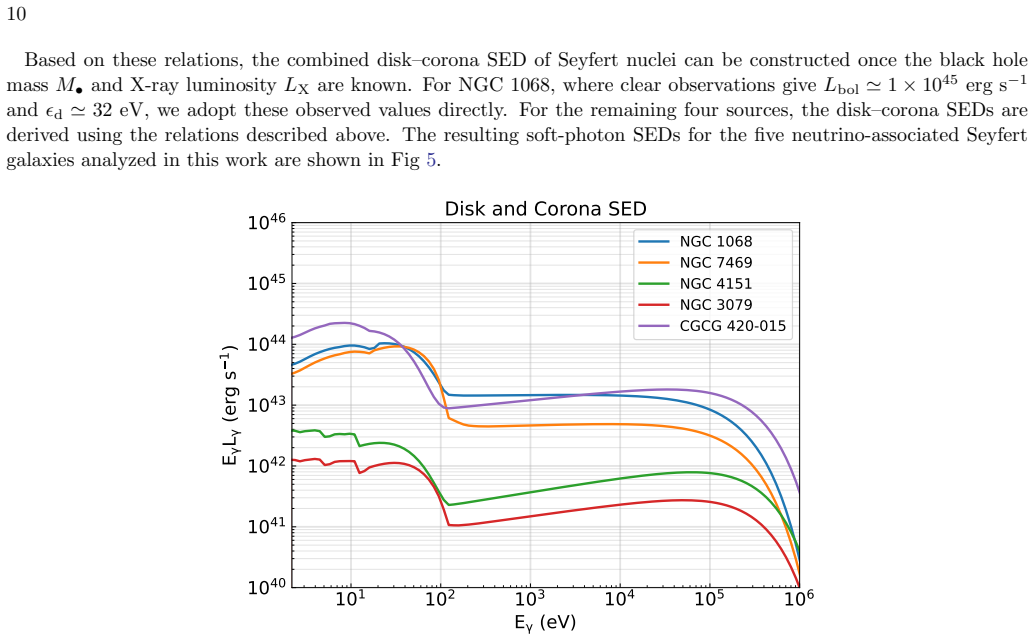
read the original abstract
Following the identification of the first confirmed individual neutrino source, Seyfert galaxies have emerged as the most prominent class of high-energy neutrino emitters. In this work, we perform a detailed investigation of the outflow--cloud interaction scenario for neutrino production in Seyfert nuclei. In this framework, fast AGN-driven winds collide with clumpy gas clouds in the nuclear region, forming bow shocks that efficiently accelerate cosmic-ray protons. The accelerated protons subsequently interact with cold protons from the outflows via inelastic proton--proton ($pp$) collisions, producing high-energy neutrinos, while the photomeson ($p\gamma$) process with disk photons may provide a subdominant contribution at the highest energies. Applying this model to five neutrino-associated Seyfert galaxies, we successfully reproduce the observed TeV neutrino fluxes without violating existing gamma-ray constraints. By integrating over the Seyfert population using X-ray luminosity functions, we further demonstrate that Seyfert galaxies can account for a substantial fraction of the diffuse astrophysical neutrino background in the $10^4-10^5~{\rm GeV}$ energy range.
Editorial analysis
A structured set of objections, weighed in public.
Referee Report
Summary. The manuscript proposes an outflow-cloud interaction model for neutrino production in Seyfert galaxy nuclei. Fast AGN-driven winds collide with clumpy gas clouds, forming bow shocks that accelerate cosmic-ray protons; these protons then produce high-energy neutrinos primarily via inelastic pp collisions (with a possible subdominant pγ contribution). The model is applied to five neutrino-associated Seyfert galaxies, where the authors claim to reproduce the observed TeV neutrino fluxes while remaining below existing gamma-ray upper limits. The work then integrates the model over the Seyfert population using X-ray luminosity functions to conclude that these galaxies can account for a substantial fraction of the diffuse astrophysical neutrino background in the 10^4–10^5 GeV energy range.
Significance. If the acceleration efficiency, cloud density, and covering factor can be shown to follow from a single set of physical priors rather than source-by-source adjustment, the model would provide a concrete mechanism linking observed Seyfert neutrino associations to the diffuse flux without gamma-ray violation. The population-level extrapolation using X-ray luminosity functions is a standard and potentially powerful step. The result would be of clear interest to the high-energy neutrino and AGN communities if the parameter choices are demonstrated to be robust and representative.
major comments (2)
- [Model application to individual sources] The reproduction of observed TeV neutrino fluxes for the five selected Seyfert galaxies is presented without quantitative values, ranges, or fitting procedure for the free parameters (proton acceleration efficiency, cloud column density, and covering factor). This is load-bearing for the central claim because the subsequent population integration inherits the same scalings; without explicit documentation that these parameters are fixed from independent observables or a single prior set rather than adjusted per source to match neutrino data while satisfying gamma-ray limits, the reproduction does not constitute a strong test of the mechanism.
- [Population synthesis and diffuse flux calculation] The integration over the X-ray luminosity function to estimate the diffuse neutrino background contribution assumes that the efficiencies and densities calibrated on the five sources are representative of the average Seyfert population. No sensitivity analysis or justification for this extrapolation is provided, which directly affects the robustness of the claim that Seyferts account for a substantial fraction in the 10^4–10^5 GeV range.
minor comments (2)
- [Abstract] The abstract would benefit from a brief statement of the specific energy range and flux normalization used for the five sources to allow readers to assess the reproduction claim at a glance.
- [Model description] Notation for the bow-shock acceleration efficiency and cloud covering factor should be defined consistently in the text and any equations to avoid ambiguity when comparing to other AGN neutrino models.
Simulated Author's Rebuttal
We thank the referee for their thorough and insightful comments on our manuscript. We have addressed each of the major comments in detail below and have made revisions to the manuscript to improve the clarity and robustness of our analysis.
read point-by-point responses
-
Referee: [Model application to individual sources] The reproduction of observed TeV neutrino fluxes for the five selected Seyfert galaxies is presented without quantitative values, ranges, or fitting procedure for the free parameters (proton acceleration efficiency, cloud column density, and covering factor). This is load-bearing for the central claim because the subsequent population integration inherits the same scalings; without explicit documentation that these parameters are fixed from independent observables or a single prior set rather than adjusted per source to match neutrino data while satisfying gamma-ray limits, the reproduction does not constitute a strong test of the mechanism.
Authors: We appreciate the referee highlighting the need for clearer documentation. The parameters in our model are not adjusted freely per source to fit the neutrino data. The proton acceleration efficiency is fixed at 10% for all sources, consistent with standard expectations from diffusive shock acceleration in strong shocks. Cloud column densities are taken directly from published X-ray absorption measurements for each individual galaxy, and the covering factor is estimated from the observed outflow covering fractions reported in multi-wavelength studies of Seyfert nuclei. In the revised manuscript we have added a new Table 2 that lists the exact numerical values adopted for each of the five sources together with the observational references used to constrain them. We have also added a short subsection explaining that these choices are made prior to computing the neutrino flux and are required to remain consistent with the gamma-ray upper limits; the neutrino flux is then a prediction rather than a fit. A brief sensitivity study showing the effect of varying each parameter within its observational uncertainty range is included as well. revision: yes
-
Referee: [Population synthesis and diffuse flux calculation] The integration over the X-ray luminosity function to estimate the diffuse neutrino background contribution assumes that the efficiencies and densities calibrated on the five sources are representative of the average Seyfert population. No sensitivity analysis or justification for this extrapolation is provided, which directly affects the robustness of the claim that Seyferts account for a substantial fraction in the 10^4–10^5 GeV range.
Authors: We agree that an explicit justification and sensitivity analysis strengthen the population synthesis step. In the revised Section 5 we now justify the extrapolation by noting that the five neutrino-associated sources span more than two orders of magnitude in X-ray luminosity and that their nuclear gas properties (column densities and outflow velocities) lie within the ranges measured for the broader Seyfert population in large X-ray surveys. We have performed a Monte-Carlo sensitivity analysis in which the acceleration efficiency, cloud density, and covering factor are each varied independently over the full range allowed by the observational constraints used for the individual sources. The resulting contribution to the diffuse neutrino background in the 10^4–10^5 GeV band remains between 15 % and 45 % of the IceCube flux even under the most conservative parameter combinations. These results are shown in a new figure with shaded uncertainty bands and are discussed in the text. revision: yes
Circularity Check
Fitted parameters to match neutrino fluxes for five galaxies then extrapolated to population-level diffuse background
specific steps
-
fitted input called prediction
[Abstract]
"Applying this model to five neutrino-associated Seyfert galaxies, we successfully reproduce the observed TeV neutrino fluxes without violating existing gamma-ray constraints. By integrating over the Seyfert population using X-ray luminosity functions, we further demonstrate that Seyfert galaxies can account for a substantial fraction of the diffuse astrophysical neutrino background in the 10^4-10^5 GeV energy range."
Reproduction for the five galaxies requires tuning acceleration efficiency, cloud column density, and interaction volume to match observed neutrino fluxes while staying below gamma-ray limits. The population integration then deploys these same tuned values across the luminosity function, so the diffuse-background fraction is statistically forced by the source-specific fits rather than predicted independently.
full rationale
The derivation applies a physical outflow-cloud bow-shock model but reproduces observed TeV neutrino fluxes for five specific sources by adjusting efficiencies and densities, then integrates the same scalings over the X-ray luminosity function. This makes the claimed substantial contribution to the 10^4-10^5 GeV background a direct consequence of the per-source fits rather than an independent first-principles result. No self-citation chains, uniqueness theorems, or ansatz smuggling are present; the circularity is limited to the fitted-input pattern on the central quantitative claims.
Axiom & Free-Parameter Ledger
free parameters (2)
- proton acceleration efficiency
- cloud density and covering factor
axioms (2)
- standard math Inelastic proton-proton collisions produce neutrinos through charged-pion decay chains.
- domain assumption Bow shocks formed by fast outflows colliding with clumpy clouds accelerate cosmic-ray protons efficiently.
Lean theorems connected to this paper
-
IndisputableMonolith/Cost/FunctionalEquation.leanwashburn_uniqueness_aczel unclear?
unclearRelation between the paper passage and the cited Recognition theorem.
fast AGN-driven winds collide with clumpy gas clouds... bow shocks that efficiently accelerate cosmic-ray protons... pp collisions... pγ process... parameters R, ε_B, η_k, v0
-
IndisputableMonolith/Foundation/AlexanderDuality.leanalexander_duality_circle_linking unclear?
unclearRelation between the paper passage and the cited Recognition theorem.
integrating over the Seyfert population using X-ray luminosity functions... 10^4-10^5 GeV energy range
What do these tags mean?
- matches
- The paper's claim is directly supported by a theorem in the formal canon.
- supports
- The theorem supports part of the paper's argument, but the paper may add assumptions or extra steps.
- extends
- The paper goes beyond the formal theorem; the theorem is a base layer rather than the whole result.
- uses
- The paper appears to rely on the theorem as machinery.
- contradicts
- The paper's claim conflicts with a theorem or certificate in the canon.
- unclear
- Pith found a possible connection, but the passage is too broad, indirect, or ambiguous to say the theorem truly supports the claim.
Reference graph
Works this paper leans on
-
[1]
G., Abbasi, R., Ackermann, M., et al
Aartsen, M. G., Abbasi, R., Ackermann, M., et al. 2021, Journal of Physics G: Nuclear and Particle Physics, 48, 060501
work page 2021
-
[2]
Abbasi, R., Ackermann, M., Adams, J., et al. 2022, Science, 378, 538
work page 2022
-
[3]
Abbasi, R., Ackermann, M., Adams, J., et al. 2025, arXiv preprint arXiv:2510.13403
-
[4]
2022, The Astrophysical Journal Supplement Series, 260, 53
Abdollahi, S., Acero, F., Baldini, L., et al. 2022, The Astrophysical Journal Supplement Series, 260, 53
work page 2022
-
[5]
A., Ansoldi, S., Antonelli, L., et al
Acciari, V. A., Ansoldi, S., Antonelli, L., et al. 2019, The Astrophysical Journal, 883, 135
work page 2019
-
[6]
2015, The Astrophysical Journal, 799, 86
Ackermann, M., Ajello, M., Albert, A., et al. 2015, The Astrophysical Journal, 799, 86
work page 2015
-
[7]
A., Aghanim, N., Arnaud, M., et al
Ade, P. A., Aghanim, N., Arnaud, M., et al. 2016, Astronomy & Astrophysics, 594, A13
work page 2016
-
[8]
Anchordoqui, L. A., Krizmanic, J. F., & Stecker, F. W. 2021, arXiv preprint arXiv:2102.12409
- [9]
-
[10]
Bentz, M. C., Williams, P. R., & Treu, T. 2022, The Astrophysical Journal, 934, 168
work page 2022
-
[11]
1987, Physics Reports, 154, 1 B¨ ottcher, M., Reimer, A., Sweeney, K., & Prakash, A
Blandford, R., & Eichler, D. 1987, Physics Reports, 154, 1 B¨ ottcher, M., Reimer, A., Sweeney, K., & Prakash, A. 2013, The Astrophysical Journal, 768, 54
work page 1987
-
[12]
Breit, G., & Wheeler, J. A. 1934, Physical Review, 46, 1087
work page 1934
-
[13]
Chodorowski, M. J., Zdziarski, A. A., & Sikora, M. 1992, Astrophysical Journal, Part 1 (ISSN 0004-637X), vol. 400, no. 1, p. 181-185., 400, 181 Collaboration*, I. 2013, Science, 342, 1242856
work page 1992
-
[14]
Collaboration, I., MAGIC, AGILE, et al. 2018, Science, 361, eaat1378
work page 2018
-
[15]
2011, Astronomy & Astrophysics, 525, L8
Czerny, B., & Hryniewicz, K. 2011, Astronomy & Astrophysics, 525, L8
work page 2011
-
[16]
Das, A., Zhang, B. T., & Murase, K. 2024, The Astrophysical Journal, 972, 44 De Angelis, A., Tatischeff, V., Grenier, I. A., et al. 2018, Journal of High Energy Astrophysics, 19, 1
work page 2024
-
[17]
Drury, L. O. 1983, Reports on Progress in Physics, 46, 973
work page 1983
-
[18]
Eichmann, B., Oikonomou, F., Salvatore, S., Dettmar, R.-J., & Tjus, J. B. 2022, The Astrophysical Journal, 939, 43
work page 2022
-
[19]
L., Halzen, F., & Gallagher, J
Fang, K., Rodriguez, E. L., Halzen, F., & Gallagher, J. S. 2023, The Astrophysical Journal, 956, 8
work page 2023
- [20]
-
[21]
2024, The Astrophysical Journal Letters, 961, L14
Sironi, L. 2024, The Astrophysical Journal Letters, 961, L14
work page 2024
-
[22]
2021, arXiv preprint arXiv:2108.02860 G´ amez Rosas, V., Isbell, J
Fleischhack, H. 2021, arXiv preprint arXiv:2108.02860 G´ amez Rosas, V., Isbell, J. W., Jaffe, W., et al. 2022, Nature, 602, 403 Garc´ ıa-Burillo, S., Combes, F., Almeida, C. R., et al. 2016, The Astrophysical Journal Letters, 823, L12
-
[23]
2018, Nature Astronomy, 2, 198
Harrison, C., Costa, T., Tadhunter, C., et al. 2018, Nature Astronomy, 2, 198
work page 2018
-
[24]
1954, The Quantum Theory of Radiation, 3rd edn, Clarendon, Oxford
Heitler, W. 1954, The Quantum Theory of Radiation, 3rd edn, Clarendon, Oxford
work page 1954
-
[25]
Ho, L. C. 2008, Annu. Rev. Astron. Astrophys., 46, 475
work page 2008
-
[26]
Hopkins, P. F., Richards, G. T., & Hernquist, L. 2007, The Astrophysical Journal, 654, 731
work page 2007
-
[27]
2024, arXiv preprint arXiv:2406.14001
Huang, Y.-H., Wang, K., & Ma, Z.-P. 2024, arXiv preprint arXiv:2406.14001
-
[28]
2022, arXiv preprint arXiv:2207.02097
Inoue, S., Cerruti, M., Murase, K., & Liu, R.-Y. 2022, arXiv preprint arXiv:2207.02097
-
[29]
2020, The Astrophysical Journal Letters, 891, L33
Inoue, Y., Khangulyan, D., & Doi, A. 2020, The Astrophysical Journal Letters, 891, L33
work page 2020
-
[30]
2019, The Astrophysical Journal, 880, 40
Inoue, Y., Khangulyan, D., Inoue, S., & Doi, A. 2019, The Astrophysical Journal, 880, 40
work page 2019
-
[31]
2001, The Astrophysical Journal, 561, L69
Iyomoto, N., Fukazawa, Y., Nakai, N., & Ishihara, Y. 2001, The Astrophysical Journal, 561, L69
work page 2001
-
[32]
2008, Black-Hole Accretion Disks—Towards a New Paradigm—
Kato, S., Fukue, J., & Mineshige, S. 2008, Black-Hole Accretion Disks—Towards a New Paradigm—
work page 2008
-
[33]
2008, Physical Review D, 78, 034013
Kelner, S., & Aharonian, F. 2008, Physical Review D, 78, 034013
work page 2008
-
[34]
Kelner, S. R., Aharonian, F. A., & Bugayov, V. V. 2006, Physical Review D, 74, 034018
work page 2006
-
[35]
Kheirandish, A., Murase, K., & Kimura, S. S. 2021, The Astrophysical Journal, 922, 45
work page 2021
-
[36]
2015, Annual Review of Astronomy and Astrophysics, 53, 115
King, A., & Pounds, K. 2015, Annual Review of Astronomy and Astrophysics, 53, 115
work page 2015
-
[37]
Klein, R. I., McKee, C. F., & Colella, P. 1994, Astrophysical Journal, Part 1 (ISSN 0004-637X), vol. 420, no. 1, p. 213-236, 420, 213
work page 1994
-
[38]
Kondratko, P. T., Greenhill, L. J., & Moran, J. M. 2005, The Astrophysical Journal, 618, 618 12
work page 2005
-
[39]
2017, The Astrophysical Journal, 850, 74
Koss, M., Trakhtenbrot, B., Ricci, C., et al. 2017, The Astrophysical Journal, 850, 74
work page 2017
-
[40]
J., Trakhtenbrot, B., Ricci, C., et al
Koss, M. J., Trakhtenbrot, B., Ricci, C., et al. 2022, The Astrophysical Journal Supplement Series, 261, 1
work page 2022
-
[41]
Laha, S., Reynolds, C. S., Reeves, J., et al. 2021, Nature Astronomy, 5, 13
work page 2021
-
[42]
2016, Astronomy & Astrophysics, 596, A68
Lamastra, A., Fiore, F., Guetta, D., et al. 2016, Astronomy & Astrophysics, 596, A68
work page 2016
-
[43]
2025, Astronomy & Astrophysics, 697, A124
Lemoine, M., & Rieger, F. 2025, Astronomy & Astrophysics, 697, A124
work page 2025
-
[44]
2018, The Astrophysical Journal, 858, 9
Liu, R.-Y., Murase, K., Inoue, S., Ge, C., & Wang, X.-Y. 2018, The Astrophysical Journal, 858, 9
work page 2018
-
[45]
2024, The Astrophysical Journal, 970, 127
Ma, Z.-P., & Wang, K. 2024, The Astrophysical Journal, 970, 127
work page 2024
-
[46]
Malkov, M., & Drury, L. O. 2001, Reports on Progress in Physics, 64, 429
work page 2001
-
[47]
2014, Nuclear Instruments and Methods in Physics Research Section A:
Margiotta, A., Collaboration, K., et al. 2014, Nuclear Instruments and Methods in Physics Research Section A:
work page 2014
-
[48]
2015, Monthly Notices of the Royal Astronomical Society: Letters, 456, L94
Marinucci, A., Bianchi, S., Matt, G., et al. 2015, Monthly Notices of the Royal Astronomical Society: Letters, 456, L94
work page 2015
-
[49]
Hard X--ray detection of NGC 1068 with BeppoSAX
Matt, G., Guainazzi, M., Frontera, F., et al. 1997, arXiv preprint astro-ph/9707065
work page internal anchor Pith review Pith/arXiv arXiv 1997
-
[50]
2024, Physical Review D, 109, L101306
Mbarek, R., Philippov, A., Chernoglazov, A., Levinson, A., & Mushotzky, R. 2024, Physical Review D, 109, L101306
work page 2024
-
[51]
McKee, C. F., & Cowie, L. L. 1975, Astrophysical Journal, vol. 195, Feb. 1, 1975, pt. 1, p. 715-725., 195, 715
work page 1975
-
[52]
2019, The Astrophysical Journal, 871, 156
Mizumoto, M., Izumi, T., & Kohno, K. 2019, The Astrophysical Journal, 871, 156
work page 2019
-
[53]
2021, Monthly Notices of the Royal Astronomical Society, 507, 1684
Mou, G., & Wang, W. 2021, Monthly Notices of the Royal Astronomical Society, 507, 1684
work page 2021
-
[54]
2022, The Astrophysical Journal Letters, 941, L17
Murase, K. 2022, The Astrophysical Journal Letters, 941, L17
work page 2022
-
[55]
2016, Physical Review Letters, 116, 071101
Murase, K., Guetta, D., & Ahlers, M. 2016, Physical Review Letters, 116, 071101
work page 2016
-
[56]
Murase, K., Inoue, Y., & Dermer, C. D. 2014, Physical Review D, 90, 023007
work page 2014
-
[57]
2008, Physical Review D—Particles, Fields, Gravitation, and Cosmology, 78, 023005
Murase, K., Ioka, K., Nagataki, S., & Nakamura, T. 2008, Physical Review D—Particles, Fields, Gravitation, and Cosmology, 78, 023005
work page 2008
-
[58]
2024, The Astrophysical Journal Letters, 961, L34
Buson, S. 2024, The Astrophysical Journal Letters, 961, L34
work page 2024
-
[59]
Murase, K., Kimura, S. S., & Meszaros, P. 2020, Physical review letters, 125, 011101
work page 2020
-
[60]
2023, arXiv preprint arXiv:2308.00191
Naab, R., Ganster, E., & Zhang, Z. 2023, arXiv preprint arXiv:2308.00191
-
[61]
Naddaf, M.-H., & Czerny, B. 2024, Universe, 10, 29, doi: 10.3390/universe10010029
-
[62]
2024, Physical Review Letters, 132, 101002
Neronov, A., Savchenko, D., & Semikoz, D. 2024, Physical Review Letters, 132, 101002
work page 2024
- [63]
-
[64]
2012, The Astrophysical Journal Letters, 759, L30
Passy, J.-C., Mac Low, M.-M., & De Marco, O. 2012, The Astrophysical Journal Letters, 759, L30
work page 2012
-
[65]
2016, Chinese Physics C, 40, 100001, doi: 10.1088/1674-1137/40/10/100001
Patrignani, C., Particle Data Group, Agashe, K., et al. 2016, Chinese Physics C, 40, 100001, doi: 10.1088/1674-1137/40/10/100001
-
[66]
2023, arXiv preprint arXiv:2303.03298
Peretti, E., Peron, G., Tombesi, F., et al. 2023, arXiv preprint arXiv:2303.03298
-
[67]
2014, The Astrophysical Journal, 795, 149
Peterson, B., Grier, C., Horne, K., et al. 2014, The Astrophysical Journal, 795, 149
work page 2014
-
[68]
Ricci, C., Ho, L. C., Fabian, A. C., et al. 2018, Monthly Notices of the Royal Astronomical Society, 480, 1819
work page 2018
-
[69]
2021, Monthly Notices of the Royal Astronomical Society, 506, 5935
Ricci, C., Privon, G., Pfeifle, R., et al. 2021, Monthly Notices of the Royal Astronomical Society, 506, 5935
work page 2021
-
[70]
Rossi, E. M., Stone, N. C., Law-Smith, J. A., et al. 2021, Space Science Reviews, 217, 1
work page 2021
- [71]
-
[72]
2025, The Astrophysical Journal, 981, 103
Sommani, G., Franckowiak, A., Lincetto, M., & Dettmar, R.-J. 2025, The Astrophysical Journal, 981, 103
work page 2025
-
[73]
1968, Physical Review Letters, 21, 1016
Stecker, F. 1968, Physical Review Letters, 21, 1016
work page 1968
-
[74]
Stepney, S., & Guilbert, P. W. 1983, Monthly Notices of the Royal Astronomical Society, 204, 1269
work page 1983
-
[75]
2018, The Astrophysical Journal, 853, 146
Tanimoto, A., Ueda, Y., Kawamuro, T., et al. 2018, The Astrophysical Journal, 853, 146
work page 2018
-
[76]
The Swift/BAT AGN Spectroscopic Survey (BASS) -- VI. The Gamma_X - L/L_Edd relation
Trakhtenbrot, B., Ricci, C., Koss, M. J., et al. 2017a, arXiv preprint arXiv:1705.01550
work page internal anchor Pith review Pith/arXiv arXiv
-
[77]
Watson, M. G. 2014, The Astrophysical Journal, 786, 104
work page 2014
-
[78]
Veilleux, S., Cecil, G., & Bland-Hawthorn, J. 2005, Annu. Rev. Astron. Astrophys., 43, 769
work page 2005
- [79]
-
[80]
2009, The Astrophysical Journal, 691, L67
Wang, X.-Y., & Dai, Z.-G. 2009, The Astrophysical Journal, 691, L67
work page 2009
discussion (0)
Sign in with ORCID, Apple, or X to comment. Anyone can read and Pith papers without signing in.