Kinematic scaling relations of disc galaxies from ionised gas at zsim1 and their connection with dark matter haloes
Pith reviewed 2026-05-17 23:22 UTC · model grok-4.3
The pith
Disc galaxies observed at z=0.9 follow stellar-to-halo mass relations that differ from those at z=0, implying they are not progenitor-descendant populations in Cold Dark Matter.
A machine-rendered reading of the paper's core claim, the machinery that carries it, and where it could break.
Core claim
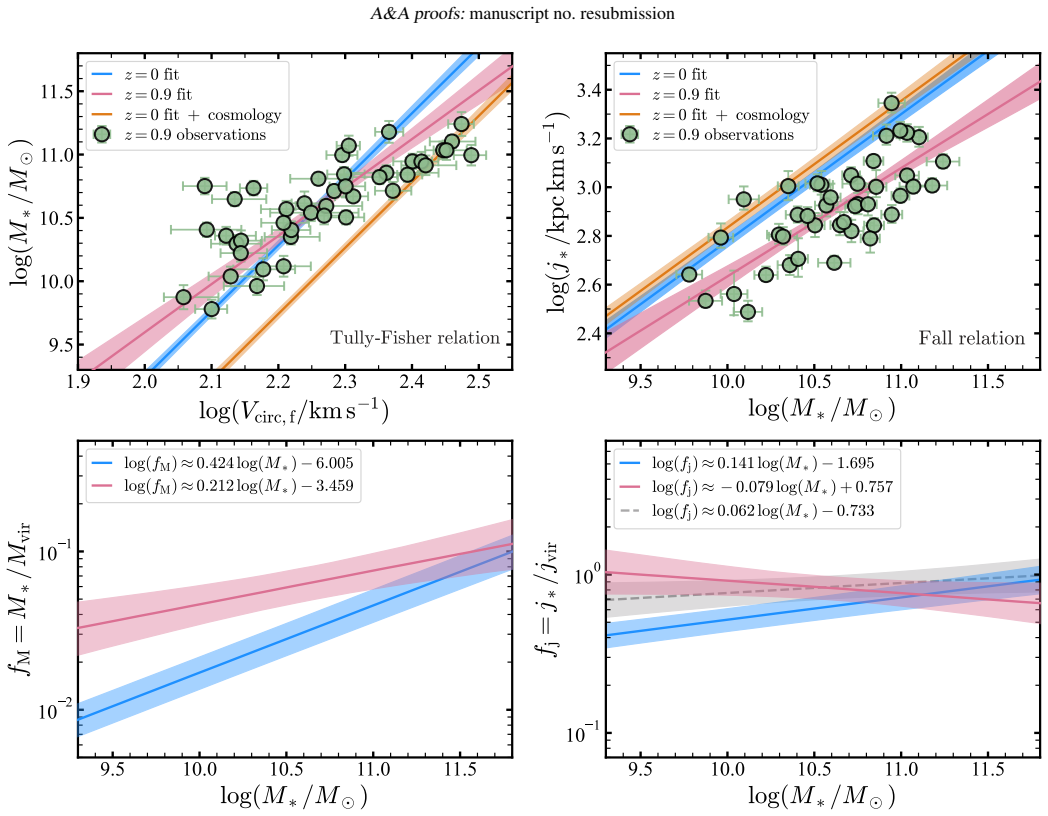
After fitting the Tully-Fisher and Fall relations to the sample and correcting velocities for asymmetric drift, the relations are interpreted through the lens of galaxy-to-halo scaling. This yields f_j values around 0.8 with little dependence on stellar mass or redshift, but f_M values that are both larger on average and show weaker mass dependence at z=0.9 than at the present day. The paper concludes that within the standard Cold Dark Matter model these differences mean the high-redshift and local disc populations cannot be linked as direct progenitors and descendants.
What carries the argument
The galaxy-to-halo scaling parameters f_M = M_star / M_vir and f_j = j_star / j_vir that connect observed stellar properties to dark matter halo properties.
If this is right
- The stellar mass fraction in dark matter halos was higher at z=0.9 and showed less variation with galaxy mass.
- Angular momentum retention factor has stayed close to 0.8 across the last 8 Gyr.
- The disc galaxy populations at these two epochs must have distinct assembly histories.
- Any systematic error in the high-redshift kinematic modeling would affect the inferred discontinuity.
Where Pith is reading between the lines
- High-redshift discs likely experienced significant merging or morphological changes to match today's population.
- Simulations of galaxy formation should be checked for reproducing the observed change in f_M-M_star relation.
- Extending kinematic studies to z between 0.5 and 0.9 could map the transition epoch.
Load-bearing premise
The H-alpha kinematics provide a reliable measure of the circular velocities and that the sample is not strongly biased by selection effects in representing the disc population at z=0.9.
What would settle it
An independent measurement of halo masses at z=0.9, for example through weak lensing, showing f_M values matching the local relation would falsify the need for a discontinuity between the populations.
Figures



read the original abstract
We derive the Tully-Fisher (TFR, $M_\ast-V_{\rm circ,f}$) and Fall (FR, $j_\ast-M_\ast$) relations at redshift $z = 0.9$ using a sample of 43 main-sequence disc galaxies with H$\alpha$ IFU data and JWST/HST imaging. The strength of our analysis lies in the use of state-of-the-art 3D kinematic models to infer galaxy rotation curves, the inclusion and morphological modelling of NIR bands, and the use of SED modelling applied to our photometry measurements to estimate stellar masses. After correcting the inferred H$\alpha$ velocities for asymmetric drift, we find a TFR of the form $\log(M_\ast / M_\odot) = a \log(V_{\rm circ,f} / 150~\mathrm{km\,s^{-1}}) + b$, with $a=3.82^{+0.55}_{-0.40}$ and $b=10.27^{+0.06}_{-0.07}$, as well as a FR of the form $\log(j_\ast / \mathrm{kpc\,km\,s^{-1}}) = a \log(M_\ast / 10^{10.5} M_\odot) + b$, with $a=0.44^{+0.06}_{-0.06}$ and $b=2.86^{+0.02}_{-0.02}$. Compared with their $z=0$ counterparts, we find moderate evolution in the TFR and strong evolution in the FR over the past 8 Gyr. We interpret our findings in the context of the galaxy-to-halo scaling parameters $f_{\rm M}=M_\ast/M_{\rm vir}$ and $f_{\rm j}=j_\ast/j_{\rm vir}$. We infer that $f_{\rm j}$ shows little redshift evolution and depends very weakly on $M_\ast$, with typical values around $f_{\rm j}\sim0.8$. As for $f_{\rm M}$, we find it to be higher and less dependent on $M_\ast$ at $z=0.9$ than at $z=0$. Interpreting our observed $f_{\rm M}-M_\ast$ relations within the Cold Dark Matter framework implies necessarily that the galaxy populations at $z=0.9$ and $z=0$ are not the progenitor/descendant of one another. The alternative scenario is that the $z=0.9$ relations are incorrect due to strong selection effects, unidentified systematics, or the possibility that H$\alpha$ kinematics may not be a reliable dynamical tracer. Such problems would also affect previous studies on the same subject.
Editorial analysis
A structured set of objections, weighed in public.
Referee Report
Summary. The manuscript derives the Tully-Fisher relation (TFR: log(M*/M⊙) = 3.82 log(Vcirc,f/150 km s⁻¹) + 10.27) and Fall relation (FR: log(j*/kpc km s⁻¹) = 0.44 log(M*/10^{10.5} M⊙) + 2.86) at z ≈ 0.9 from 43 main-sequence disc galaxies observed with Hα IFU spectroscopy and JWST/HST NIR imaging. After asymmetric-drift correction of the Hα velocities and SED-based stellar masses, the authors report moderate TFR evolution and strong FR evolution relative to z = 0. They extract galaxy-to-halo fractions f_M = M*/M_vir and f_j = j*/j_vir, finding f_j ≈ 0.8 with weak mass dependence and little redshift evolution, while f_M is higher and flatter at z = 0.9. Within a CDM framework this implies the z = 0.9 and z = 0 populations are not progenitor-descendant pairs; the paper explicitly lists selection effects, unidentified systematics, or unreliable Hα tracers as the main alternative.
Significance. If the kinematic and mass measurements hold, the work supplies new high-redshift anchors for the baryon retention and angular-momentum retention fractions that are central to galaxy-formation models. The use of full 3D kinematic modeling, NIR morphological decomposition, and multi-band SED fitting constitutes a clear methodological improvement over earlier z ∼ 1 studies and allows direct comparison of observed f_M–M* and f_j–M* trends with halo scaling relations.
major comments (2)
- [Kinematic modeling and asymmetric-drift correction] The asymmetric-drift correction that converts observed Hα rotation curves to V_circ,f is load-bearing for both the reported TFR slope and the f_M–M* offset. The manuscript does not detail whether the assumed vertical scale height or velocity-dispersion profile is held constant across the mass range or allowed to vary; a mass-dependent residual would systematically tilt the inferred f_M–M* relation at z = 0.9 and weaken the claimed difference from the z = 0 relation (see the alternative scenario stated in the abstract).
- [Interpretation of f_M and f_j] The conclusion that the z = 0.9 and z = 0 populations cannot be progenitor-descendant pairs rests on the observed f_M–M* difference being interpreted inside CDM halo scaling relations. Because M_vir is obtained from V_circ,f via abundance-matching or simulation-calibrated priors, the argument contains an element of circularity that is not quantified; an explicit test (e.g., varying the halo-mass assignment within published uncertainties) is needed to show that the non-progenitor inference survives.
minor comments (2)
- [Abstract] The abstract states the sample size and the two fitted slopes but does not quote the number of galaxies used for the final relations after quality cuts; adding this number would improve clarity.
- [Results section] Tables listing the individual galaxy properties (V_circ,f, j*, M*, uncertainties) would allow readers to reproduce the fits and assess the impact of any single object.
Simulated Author's Rebuttal
We thank the referee for their constructive and detailed comments, which have helped us strengthen the presentation and robustness of our analysis. We address each major comment below and have revised the manuscript to incorporate additional details and tests as appropriate.
read point-by-point responses
-
Referee: The asymmetric-drift correction that converts observed Hα rotation curves to V_circ,f is load-bearing for both the reported TFR slope and the f_M–M* offset. The manuscript does not detail whether the assumed vertical scale height or velocity-dispersion profile is held constant across the mass range or allowed to vary; a mass-dependent residual would systematically tilt the inferred f_M–M* relation at z = 0.9 and weaken the claimed difference from the z = 0 relation (see the alternative scenario stated in the abstract).
Authors: We thank the referee for this important observation. Our asymmetric-drift correction follows the standard thin-disc approximation with a fixed vertical scale height of 300 pc and a radially constant but galaxy-specific velocity dispersion derived from the observed Hα line widths. To directly address the possibility of mass-dependent residuals, we have added a new appendix containing sensitivity tests in which the scale height is allowed to vary from 200–400 pc and the dispersion profile is permitted a weak mass dependence following local galaxy relations. These tests shift the TFR slope by at most 0.15 (well within the quoted uncertainties) and leave the f_M–M* relation higher and flatter than the z = 0 comparison sample. The methods section has been expanded to state these assumptions explicitly and to report the outcome of the tests. revision: yes
-
Referee: The conclusion that the z = 0.9 and z = 0 populations cannot be progenitor-descendant pairs rests on the observed f_M–M* difference being interpreted inside CDM halo scaling relations. Because M_vir is obtained from V_circ,f via abundance-matching or simulation-calibrated priors, the argument contains an element of circularity that is not quantified; an explicit test (e.g., varying the halo-mass assignment within published uncertainties) is needed to show that the non-progenitor inference survives.
Authors: We agree that the progenitor-descendant interpretation depends on the adopted V_circ–M_vir mapping. While abundance-matching relations are calibrated independently of our kinematic data (using the stellar-mass function and simulation priors), we have now performed the explicit robustness test requested. In the revised manuscript we perturb each galaxy’s M_vir by ±0.3 dex (the typical published uncertainty) and recompute f_M. Across this range the z = 0.9 f_M–M* relation remains systematically higher and less mass-dependent than the z = 0 relation, preserving the conclusion that the two populations are not direct progenitors. This test is described in the discussion section together with a clearer statement of the assumptions underlying the halo-mass assignment. revision: yes
Circularity Check
No significant circularity in derivation chain
full rationale
The paper derives the TFR and FR directly from the 43-galaxy sample via 3D kinematic modeling of Hα IFU data, NIR morphological fits, SED-based stellar masses, and asymmetric-drift correction to obtain V_circ,f; these steps are data-driven and independent of the target conclusion. The subsequent mapping to f_M = M_*/M_vir and f_j = j_*/j_vir employs standard CDM halo scaling relations (virial quantities from cosmology and simulations) that are external to the present dataset and not fitted to it. The statement that the z=0.9 and z=0 populations are not progenitor/descendant is a logical implication within the adopted framework rather than a quantity forced by construction from the inputs. No self-definitional steps, fitted inputs renamed as predictions, or load-bearing self-citations appear in the chain. The analysis remains self-contained against external benchmarks.
Axiom & Free-Parameter Ledger
free parameters (2)
- TFR slope a =
3.82
- FR slope a =
0.44
axioms (2)
- domain assumption Hα kinematics after asymmetric-drift correction reliably trace the circular velocity of the stellar disk
- domain assumption The 43 main-sequence disk galaxies form a representative sample of the z~1 population
Lean theorems connected to this paper
-
IndisputableMonolith/Foundation/RealityFromDistinction.leanreality_from_one_distinction unclear?
unclearRelation between the paper passage and the cited Recognition theorem.
We interpret our observed f_M-M_* relations within the Cold Dark Matter framework implies necessarily that the galaxy populations at z=0.9 and z=0 are not the progenitor/descendant of one another.
-
IndisputableMonolith/Cost/FunctionalEquation.leanwashburn_uniqueness_aczel unclear?
unclearRelation between the paper passage and the cited Recognition theorem.
f_M = M_*/M_vir and f_j = j_*/j_vir … derived from the observed TFR and FR
What do these tags mean?
- matches
- The paper's claim is directly supported by a theorem in the formal canon.
- supports
- The theorem supports part of the paper's argument, but the paper may add assumptions or extra steps.
- extends
- The paper goes beyond the formal theorem; the theorem is a base layer rather than the whole result.
- uses
- The paper appears to rely on the theorem as machinery.
- contradicts
- The paper's claim conflicts with a theorem or certificate in the canon.
- unclear
- Pith found a possible connection, but the passage is too broad, indirect, or ambiguous to say the theorem truly supports the claim.
Reference graph
Works this paper leans on
-
[1]
, " * write output.state after.block = add.period write newline
ENTRY address archiveprefix author booktitle chapter edition editor howpublished institution eprint journal key month note number organization pages publisher school series title type volume year label extra.label sort.label short.list INTEGERS output.state before.all mid.sentence after.sentence after.block FUNCTION init.state.consts #0 'before.all := #1 ...
-
[2]
" write newline "" before.all 'output.state := FUNCTION n.dashify 't := "" t empty not t #1 #1 substring "-" = t #1 #2 substring "--" = not "--" * t #2 global.max substring 't := t #1 #1 substring "-" = "-" * t #2 global.max substring 't := while if t #1 #1 substring * t #2 global.max substring 't := if while FUNCTION word.in bbl.in " " * FUNCTION format....
-
[3]
Abril-Melgarejo , V., Epinat , B., Mercier , W., et al. 2021, , 647, A152
work page 2021
- [4]
-
[5]
Afruni , A., Pezzulli , G., Fraternali , F., & Gr nnow , A. 2023, , 524, 2351
work page 2023
-
[6]
Y., Tran , K.-V., Glazebrook , K., et al
Alcorn , L. Y., Tran , K.-V., Glazebrook , K., et al. 2018, , 858, 47
work page 2018
-
[7]
Araujo-Carvalho , A. E., Gon c alves , T. S., Krajnovi \'c , D., Men \'e ndez-Delmestre , K., & de Is \' dio , N. 2025, , 991, 3
work page 2025
-
[8]
Astropy Collaboration , Price-Whelan , A. M., Sip o cz , B. M., et al. 2018, , 156, 123
work page 2018
-
[9]
Bell , E. F. & de Jong , R. S. 2001, , 550, 212
work page 2001
- [10]
- [11]
- [12]
-
[13]
Blumenthal , G. R., Faber , S. M., Primack , J. R., & Rees , M. J. 1984, , 311, 517
work page 1984
-
[14]
F., Genel , S., Pellissier , A., et al
Bouch \'e , N. F., Genel , S., Pellissier , A., et al. 2021, , 654, A49
work page 2021
-
[15]
B., Governato , F., Ro s kar , R., et al
Brook , C. B., Governato , F., Ro s kar , R., et al. 2011, , 415, 1051
work page 2011
-
[16]
Brook , C. B., Stinson , G., Gibson , B. K., et al. 2012, , 419, 771
work page 2012
- [17]
-
[18]
Bryan , G. L. & Norman , M. L. 1998, , 495, 80
work page 1998
-
[19]
Bullock , J. S., Dekel , A., Kolatt , T. S., et al. 2001, , 555, 240
work page 2001
-
[20]
Burkert , A., F \"o rster Schreiber , N. M., Genzel , R., et al. 2016, , 826, 214
work page 2016
-
[21]
Carnall , A. C., McLure , R. J., Dunlop , J. S., & Dav \'e , R. 2018, , 480, 4379
work page 2018
-
[22]
Casey , C. M., Kartaltepe , J. S., Drakos , N. E., et al. 2023, , 954, 31
work page 2023
- [23]
-
[24]
Chaikin , E., Schaye , J., Schaller , M., et al. 2025, arXiv e-prints, arXiv:2509.07960
work page internal anchor Pith review Pith/arXiv arXiv 2025
- [25]
-
[26]
Cimatti , A., Fraternali , F., & Nipoti , C. 2019, Introduction to Galaxy Formation and Evolution: From Primordial Gas to Present-Day Galaxies ( Cambridge University Press )
work page 2019
-
[27]
Conselice , C. J., Bundy , K., Ellis , R. S., et al. 2005, , 628, 160
work page 2005
- [28]
-
[29]
Correa , C. A., Wyithe , J. S. B., Schaye , J., & Duffy , A. R. 2015, , 452, 1217
work page 2015
-
[30]
Cortese , L., Fogarty , L. M. R., Bekki , K., et al. 2016, , 463, 170
work page 2016
-
[31]
Courteau , S., Dutton , A. A., van den Bosch , F. C., et al. 2007, , 671, 203
work page 2007
-
[32]
Cresci , G., Hicks , E. K. S., Genzel , R., et al. 2009, , 697, 115
work page 2009
-
[33]
Dalcanton , J. J., Spergel , D. N., & Summers , F. J. 1997, , 482, 659
work page 1997
-
[34]
Di Teodoro , E. M. & Fraternali , F. 2015, , 451, 3021
work page 2015
-
[35]
M., Fraternali , F., & Miller , S
Di Teodoro , E. M., Fraternali , F., & Miller , S. H. 2016, , 594, A77
work page 2016
-
[36]
Di Teodoro , E. M. & Peek , J. E. G. 2021, , 923, 220
work page 2021
-
[37]
Di Teodoro , E. M., Posti , L., Fall , S. M., et al. 2023, , 518, 6340
work page 2023
-
[38]
Di Teodoro , E. M., Posti , L., Ogle , P. M., Fall , S. M., & Jarrett , T. 2021, , 507, 5820
work page 2021
-
[39]
Dunlop , J. S., Abraham , R. G., Ashby , M. L. N., et al. 2021, PRIMER: Public Release IMaging for Extragalactic Research , JWST Proposal. Cycle 1, ID. \#1837
work page 2021
-
[40]
A., Conroy , C., van den Bosch , F
Dutton , A. A., Conroy , C., van den Bosch , F. C., Prada , F., & More , S. 2010, , 407, 2
work page 2010
-
[41]
Dutton , A. A. & van den Bosch , F. C. 2012, , 421, 608
work page 2012
-
[42]
Dutton , A. A., van den Bosch , F. C., Faber , S. M., et al. 2011, , 410, 1660
work page 2011
-
[43]
Overview of the JWST Advanced Deep Extragalactic Survey (JADES)
Eisenstein , D. J., Willott , C., Alberts , S., et al. 2023, arXiv e-prints, arXiv:2306.02465
work page internal anchor Pith review Pith/arXiv arXiv 2023
-
[44]
Ejdetj \"a rn , T., Agertz , O., \"O stlin , G., Renaud , F., & Romeo , A. B. 2022, , 514, 480
work page 2022
-
[45]
El-Badry , K., Quataert , E., Wetzel , A., et al. 2018, , 473, 1930
work page 2018
-
[46]
Eldridge , J. J. & Stanway , E. R. 2009, , 400, 1019
work page 2009
-
[47]
M., Glazebrook , K., Fisher , D
Espejo Salcedo , J. M., Glazebrook , K., Fisher , D. B., et al. 2025, , 536, 1188
work page 2025
- [48]
-
[49]
Fall , S. M. 1979, , 281, 200
work page 1979
-
[50]
Fall , S. M. 1983, in IAU Symposium, Vol. 100, Internal Kinematics and Dynamics of Galaxies, ed. E. Athanassoula , 391--398
work page 1983
-
[51]
Fall , S. M. & Efstathiou , G. 1980, , 193, 189
work page 1980
-
[52]
Fall , S. M. & Romanowsky , A. J. 2013, , 769, L26
work page 2013
-
[53]
Fall , S. M. & Romanowsky , A. J. 2018, , 868, 133
work page 2018
-
[54]
Forbes , D. A. & Gannon , J. 2024, , 528, 608
work page 2024
-
[55]
Fouque , P., Bottinelli , L., Gouguenheim , L., & Paturel , G. 1990, , 349, 1
work page 1990
-
[56]
Fraternali , F., Karim , A., Magnelli , B., et al. 2021, , 647, A194
work page 2021
-
[57]
Geesink , N. N., Mancera Pi \ n a , P. E., Lagos , C. d. P., & Kriek , M. 2025, , 697, A87
work page 2025
-
[58]
Genel , S., Fall , S. M., Hernquist , L., et al. 2015, , 804, L40
work page 2015
- [59]
-
[60]
Gillman , S., Tiley , A. L., Swinbank , A. M., et al. 2020, , 492, 1492
work page 2020
- [61]
-
[62]
Grand , R. J. J., G \'o mez , F. A., Marinacci , F., et al. 2017, , 467, 179
work page 2017
-
[63]
Grogin , N. A., Kocevski , D. D., Faber , S. M., et al. 2011, , 197, 35
work page 2011
-
[64]
A., Cortese , L., Obreschkow , D., Catinella , B., & Cook , R
Hardwick , J. A., Cortese , L., Obreschkow , D., Catinella , B., & Cook , R. H. W. 2022, , 509, 3751
work page 2022
-
[65]
Harrison , C. M., Johnson , H. L., Swinbank , A. M., et al. 2017, , 467, 1965
work page 2017
-
[66]
Huang , K.-H., Fall , S. M., Ferguson , H. C., et al. 2017, , 838, 6
work page 2017
-
[67]
Hubble , E. P. 1926, , 64, 321
work page 1926
-
[68]
Hunter, J. D. 2007, Computing in Science & Engineering, 9, 90
work page 2007
-
[69]
Irodotou , D., Thomas , P. A., Henriques , B. M., Sargent , M. T., & Hislop , J. M. 2019, , 489, 3609
work page 2019
-
[70]
M., Aussel , H., Calzetti , D., et al
Koekemoer , A. M., Aussel , H., Calzetti , D., et al. 2007, , 172, 196
work page 2007
-
[71]
Koekemoer , A. M., Faber , S. M., Ferguson , H. C., et al. 2011, , 197, 36
work page 2011
- [72]
-
[73]
Lagos , C. d. P., Stevens , A. R. H., Bower , R. G., et al. 2018, , 473, 4956
work page 2018
-
[74]
Lagos , C. d. P., Theuns , T., Stevens , A. R. H., et al. 2017, , 464, 3850
work page 2017
-
[75]
Leja , J., Speagle , J. S., Ting , Y.-S., et al. 2022, , 936, 165
work page 2022
-
[76]
Lelli , F., McGaugh , S. S., & Schombert , J. M. 2016, , 152, 157
work page 2016
- [77]
- [78]
-
[79]
Mancera Pi \ n a , P. E., Fraternali , F., Oman , K. A., et al. 2020, , 495, 3636
work page 2020
-
[80]
E., Fraternali , F., Oosterloo , T., et al
Mancera Pi \ n a , P. E., Fraternali , F., Oosterloo , T., et al. 2022, , 514, 3329
work page 2022
discussion (0)
Sign in with ORCID, Apple, or X to comment. Anyone can read and Pith papers without signing in.