SpiralThinker: Latent Reasoning through an Iterative Process with Text-Latent Interleaving
Pith reviewed 2026-05-17 23:00 UTC · model grok-4.3
The pith
SpiralThinker stabilizes iterative latent reasoning by interleaving updates with textual steps and applying progressive alignment.
A machine-rendered reading of the paper's core claim, the machinery that carries it, and where it could break.
Core claim
SpiralThinker is a stabilized iterative latent reasoning framework that performs iterative updates over latent representations while interleaving latent and textual reasoning steps. At its core, it combines a progressive alignment objective that explicitly regulates latent representations across iterations with structured annotations for text-latent interleaving, thereby stabilizing latent updates and maintaining coherence with textual reasoning. Across mathematical, logical, and commonsense reasoning tasks, SpiralThinker achieves state-of-the-art performance among latent reasoning baselines.
What carries the argument
The progressive alignment objective together with structured text-latent interleaving annotations, which regulates latent representations iteration by iteration to keep updates stable and coherent with text.
If this is right
- Both the number of iterations and the presence of alignment are required for the observed gains.
- The best number of latent tokens and the best iteration count differ across mathematical, logical, and commonsense datasets.
- Without proper alignment, iterative latent reasoning loses coherence and underperforms.
- The interleaving schedule can be adjusted per task to balance latent efficiency against textual grounding.
Where Pith is reading between the lines
- The same alignment-plus-interleaving pattern might transfer to domains that already use latent planning, such as code generation or multi-step decision making.
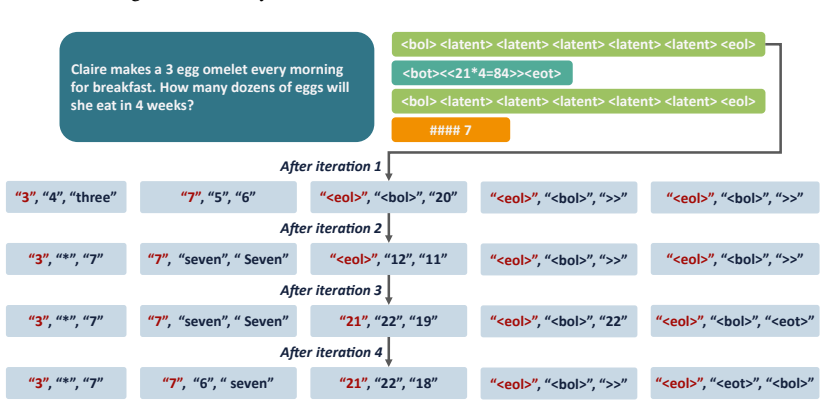
- Because the method separates latent computation from text output, it could be combined with existing test-time scaling techniques that allocate more compute to harder examples.
- If the alignment loss can be made dataset-agnostic, the framework might reduce the need for task-specific prompt engineering in reasoning pipelines.
Load-bearing premise
A progressive alignment objective combined with structured text-latent annotations can reliably stabilize iterative latent updates and maintain coherence with textual reasoning without introducing new instabilities or task-specific biases.
What would settle it
A controlled ablation that removes the progressive alignment objective and shows either divergence in successive latent states or loss of the reported performance gains on the same reasoning benchmarks would falsify the central claim.
Figures


read the original abstract
Recent advances in large reasoning models have been driven by reinforcement learning and test-time scaling, accompanied by growing interest in latent rather than purely textual reasoning. However, existing latent reasoning methods lack mechanisms to ensure stable reasoning dynamics in latent space and a systematic way to interleave implicit and explicit reasoning. We introduce SpiralThinker, a stabilized iterative latent reasoning framework that performs iterative updates over latent representations while interleaving latent and textual reasoning steps. At its core, it combines a progressive alignment objective that explicitly regulates latent representations across iterations with structured annotations for text-latent interleaving, thereby stabilizing latent updates and maintaining coherence with textual reasoning. Across mathematical, logical, and commonsense reasoning tasks, SpiralThinker achieves state-of-the-art performance among latent reasoning baselines. Further analysis shows that both iteration and alignment are essential, that the optimal numbers of latent tokens and iterations vary by dataset, and that proper alignment is crucial for effective iterative latent reasoning. Overall, SpiralThinker bridges iterative computation and latent reasoning, demonstrating that aligned iterative updates can reliably steer reasoning in the latent space.
Editorial analysis
A structured set of objections, weighed in public.
Referee Report
Summary. The manuscript introduces SpiralThinker, a framework for iterative latent reasoning that interleaves latent and textual steps. It uses a progressive alignment objective together with structured text-latent annotations to regulate latent representations across iterations, stabilize updates, and maintain coherence with explicit reasoning. The central empirical claim is that this combination yields state-of-the-art results among latent reasoning baselines on mathematical, logical, and commonsense tasks, with further analyses indicating that both iteration and alignment are essential and that optimal latent-token and iteration counts are dataset-dependent.
Significance. If the reported gains are reproducible and the alignment mechanism demonstrably stabilizes latent trajectories without introducing task-specific biases or new instabilities, the work would provide a concrete bridge between test-time iterative computation and latent-space reasoning. The explicit regulation of latent updates via progressive alignment addresses a recognized limitation in prior latent reasoning methods and supplies a falsifiable mechanism that could be tested on additional domains.
major comments (2)
- [§4.3, Table 4] §4.3 and Table 4: The ablation removing the progressive alignment objective shows performance degradation, yet the section reports no quantitative stability diagnostics (latent trajectory variance, cross-iteration coherence scores, or divergence rates). Without these metrics it is difficult to confirm that alignment regulates representations across iterations rather than merely compensating for other instabilities.
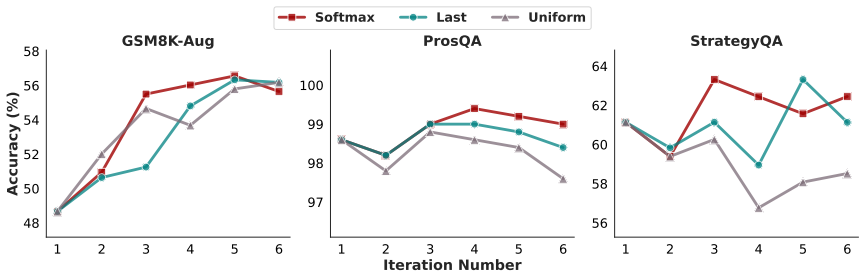
- [§5.1, Figure 3] §5.1, Figure 3: The claim that 'proper alignment is crucial for effective iterative latent reasoning' rests on the observed sensitivity to the alignment loss weight, but the figure does not include error bars or statistical significance tests across the five random seeds mentioned in the experimental setup; this weakens the load-bearing assertion that alignment reliably prevents incoherence.
minor comments (2)
- [§3.2] The notation for the number of latent tokens (k) and iterations (T) is introduced in §3.2 but used inconsistently in the experimental tables; a single consolidated definition table would improve clarity.
- [§2] The related-work section (§2) cites several latent reasoning baselines but omits recent test-time scaling papers that also interleave discrete and continuous steps; adding these would better situate the contribution.
Simulated Author's Rebuttal
We thank the referee for the constructive feedback on our manuscript. We address each major comment below and indicate the revisions we plan to make.
read point-by-point responses
-
Referee: [§4.3, Table 4] §4.3 and Table 4: The ablation removing the progressive alignment objective shows performance degradation, yet the section reports no quantitative stability diagnostics (latent trajectory variance, cross-iteration coherence scores, or divergence rates). Without these metrics it is difficult to confirm that alignment regulates representations across iterations rather than merely compensating for other instabilities.
Authors: We agree that explicit quantitative stability diagnostics would strengthen the interpretation of the ablation results. In the revised manuscript we will add measurements of latent trajectory variance, cross-iteration coherence scores, and divergence rates for both the full SpiralThinker model and the no-alignment ablation. These metrics will be reported in §4.3 alongside the existing performance numbers to show that progressive alignment reduces variance and improves coherence rather than simply offsetting unrelated instabilities. revision: yes
-
Referee: [§5.1, Figure 3] §5.1, Figure 3: The claim that 'proper alignment is crucial for effective iterative latent reasoning' rests on the observed sensitivity to the alignment loss weight, but the figure does not include error bars or statistical significance tests across the five random seeds mentioned in the experimental setup; this weakens the load-bearing assertion that alignment reliably prevents incoherence.
Authors: We acknowledge that the absence of error bars and significance tests in Figure 3 limits the strength of the claim. Although the experiments were conducted with five random seeds, these statistics were omitted for visual simplicity. In the revision we will update Figure 3 to display error bars (standard deviation across seeds) and include paired statistical significance tests between different alignment weights, thereby providing quantitative support for the assertion that proper alignment reliably prevents incoherence. revision: yes
Circularity Check
No circularity: empirical claims rest on task performance, not self-referential definitions or predictions
full rationale
The paper introduces SpiralThinker as an iterative latent reasoning framework that interleaves text and latent steps via a progressive alignment objective and structured annotations. Its strongest claims are empirical SOTA results on mathematical, logical, and commonsense reasoning benchmarks relative to other latent baselines, plus ablation evidence that iteration and alignment matter. No derivation chain, equations, or fitted-parameter predictions are described that reduce to the method's own inputs by construction. The abstract and available text contain no self-definitional loops, no renaming of known results as novel unification, and no load-bearing self-citations that substitute for independent verification. The method is therefore self-contained against external benchmarks.
Axiom & Free-Parameter Ledger
free parameters (2)
- number of latent tokens
- number of iterations
axioms (1)
- domain assumption Progressive alignment can regulate latent representations across iterations to stabilize reasoning dynamics.
Lean theorems connected to this paper
-
IndisputableMonolith/Cost/FunctionalEquation.leanwashburn_uniqueness_aczel unclear?
unclearRelation between the paper passage and the cited Recognition theorem.
progressive alignment objective that constrains latent representations to remain consistent with their explicit textual counterparts throughout the iterative process
-
IndisputableMonolith/Foundation/DimensionForcing.leanreality_from_one_distinction contradicts?
contradictsCONTRADICTS: the theorem conflicts with this paper passage, or marks a claim that would need revision before publication.
optimal numbers of latent tokens and iterations vary by dataset
What do these tags mean?
- matches
- The paper's claim is directly supported by a theorem in the formal canon.
- supports
- The theorem supports part of the paper's argument, but the paper may add assumptions or extra steps.
- extends
- The paper goes beyond the formal theorem; the theorem is a base layer rather than the whole result.
- uses
- The paper appears to rely on the theorem as machinery.
- contradicts
- The paper's claim conflicts with a theorem or certificate in the canon.
- unclear
- Pith found a possible connection, but the passage is too broad, indirect, or ambiguous to say the theorem truly supports the claim.
Reference graph
Works this paper leans on
-
[1]
Implicit chain of thought reasoning via knowledge distillation.arXiv preprint arXiv:2311.01460,
Implicit chain of thought reasoning via knowl- edge distillation.arXiv preprint arXiv:2311.01460. Jonas Geiping, Sean Michael McLeish, Neel Jain, John Kirchenbauer, Siddharth Singh, Brian R. Bartoldson, Bhavya Kailkhura, Abhinav Bhatele, and Tom Gold- stein. 2025. Scaling up test-time compute with latent reasoning: A recurrent depth approach. InES-FoMo II...
-
[2]
Thinking tokens for language modeling
Training large language model to reason in a continuous latent space. David Herel and Tomas Mikolov. 2024. Thinking tokens for language modeling.arXiv preprint arXiv:2405.08644. Edward J Hu, yelong shen, Phillip Wallis, Zeyuan Allen- Zhu, Yuanzhi Li, Shean Wang, Lu Wang, and Weizhu Chen. 2022. LoRA: Low-rank adaptation of large language models. InInternat...
-
[3]
Jacob Pfau, William Merrill, and Samuel R
Can language models learn to skip steps?Ad- vances in Neural Information Processing Systems, 37:45359–45385. Jacob Pfau, William Merrill, and Samuel R. Bowman
-
[4]
CODI: Compressing Chain-of-Thought into Continuous Space via Self-Distillation
Let’s think dot by dot: Hidden computation in transformer language models. InFirst Conference on Language Modeling. Nikunj Saunshi, Nishanth Dikkala, Zhiyuan Li, Sanjiv Kumar, and Sashank J. Reddi. 2025. Reasoning with latent thoughts: On the power of looped transform- ers. InThe Thirteenth International Conference on Learning Representations. Zhenyi Shen...
work page internal anchor Pith review arXiv 2025
-
[5]
SoftCoT: Soft chain-of-thought for efficient reasoning with LLMs. InProceedings of the 63rd Annual Meeting of the Association for Computational Linguistics (Volume 1: Long Papers), pages 23336– 23351, Vienna, Austria. Association for Computa- tional Linguistics. Qifan Yu, Zhenyu He, Sijie Li, Xun Zhou, Jun Zhang, Jingjing Xu, and Di He. 2025. Enhancing au...
-
[6]
A survey on latent reasoning.arXiv preprint arXiv:2507.06203. A Data Format DATAFORMAT Explicit Reasoning: Question <bot> Step 1 <eot> <bot> Step 2 <eot> <bot> Step 3 <eot> <bot> Step 4 <eot> #### Answer Implicit Reasoning: (1) Question <bol> N x <latent> <eol> <bot> Step 2 <eot> <bol> N x <latent> <eol> <bot> Step 4 <eot> #### Answer (2) Question <bot> S...
-
[7]
is an augmented version generated with GPT- 4 based on the original GSM8K training set. ProsQAProsQA (Hao et al., 2025) is a synthetic question–answering dataset designed to evaluate logical reasoning capability. It is constructed from randomly generated directed acyclic graphs that specify the known conditions and reasoning depen- dencies. Each instance ...
work page 2025
-
[8]
with a few-shot prompting setup (Table 6) following chain-of-thought (Wei et al., 2022) to generate them. And because the official test set is unavailable, we follow prior work by using the val- idation set for testing and sampling an equal-sized subset from the training data as the new validation set. The dataset statistics are summarized in Table 4. C B...
work page 2022
-
[9]
Do hamsters provide food for any animals? Hamsters are prey animals. Prey are food for predators. Thus, hamsters provide food for some animals. So the answer is yes
-
[10]
Princeton University is about as academically rigorous as the University of Pennsylvania
Could Brooke Shields succeed at University of Pennsylvania? Brooke Shields went to Princeton University. Princeton University is about as academically rigorous as the University of Pennsylvania. Thus, Brooke Shields could also succeed at the University of Pennsylvania. So the answer is yes
-
[11]
Hydrogen’s atomic number squared exceeds number of Spice Girls? Hydrogen has an atomic number of 1. 1 squared is 1. There are 5 Spice Girls. Thus, Hydrogen’s atomic number squared is less than 5. So the answer is no
-
[12]
December is in the winter, so there can be frost
Is it common to see frost during some college commencements? College commencement ceremonies can happen in December, May, and June. December is in the winter, so there can be frost. Thus, there could be frost at some commencements. So the answer is yes
-
[13]
The gestation period for a llama is 11 months, which is more than 6 months
Could a llama birth twice during War in Vietnam (1945-46)? The War in Vietnam was 6 months. The gestation period for a llama is 11 months, which is more than 6 months. Thus, a llama could not give birth twice during the War in Vietnam. So the answer is no
work page 1945
-
[14]
Objects less dense than water float
Would a pear sink in water? The density of a pear is about0.6g/cm 3, which is less than water. Objects less dense than water float. Thus, a pear would float. So the answer is no. Table 6: The prompt for StrategyQA dataset. RESULT OFGSM8K-AUG
-
[15]
Charleston has 4 times as many sheep as Seattle
Toulouse has twice as many sheep as Charleston. Charleston has 4 times as many sheep as Seattle. How many sheep do Toulouse, Charleston, and Seattle have together if Seattle has 20 sheep? SpiralThinker: <bol><latent><latent><latent><latent><latent><eol> <bot><<2*80=160>><eot> <bol><latent><latent><latent><latent><latent><eol> #### 260 Ground Truth: <<20*4...
-
[16]
Claire makes a 3 egg omelet every morning for breakfast. How many dozens of eggs will she eat in 4 weeks? SpiralThinker: <bol><latent><latent><latent><latent><latent><eol> <bot><<21*4=84>><eot> <bol><latent><latent><latent><latent><latent><eol> #### 7 Ground Truth: <<3*7=21>> <<4*21=84>> <<84/12=7>> #### 7 Table 7: Generated results of GSM8K-Aug. RESULT OFPROSQA
-
[17]
Every kerpus is a sterpus. Every vumpus is a gerpus. Rex is a impus. Rex is a vumpus. Every boompus is a terpus. Every shumpus is a zhorpus. Alex is a kerpus. Every terpus is a felpus. Bob is a zhorpus. Every fompus is a gerpus. Every yimpus is a jelpus. Every gwompus is a sterpus. Every gwompus is a zhorpus. Every yimpus is a kerpus. Alex is a gwompus. E...
-
[18]
Every impus is a lempus. Every timpus is a jompus. Every terpus is a shumpus. Every sterpus is a zhorpus. Every vumpus is a zhorpus. Eva is a timpus. Every rompus is a yumpus. Every yumpus is a lempus. Every yumpus is a impus. Every gorpus is a zhorpus. Every fompus is a quimpus. Rex is a vumpus. Every fompus is a zhorpus. Every zhorpus is a zumpus. Every...
-
[19]
Florida is on the East Coast of the United States
Is Miami a city on the American West Coast? SpiralThinker: <bol><latent><latent><latent><latent><latent><latent><eol> <bot>The American West Coast refers to the western coast of the United States, which includes states like California, Oregon, and Washington.<eot> <bol><latent><latent><latent><latent><latent><latent><eol> #### no Ground Truth: Miami is lo...
-
[20]
Amoebas are single-celled organisms, so they don’t have tissues or organs that cancer can affect
Can amoebas get cancer? SpiralThinker: <bol><latent><latent><latent><latent><latent><latent><eol> <bot>Cancer is a disease that arises from abnormal cell growth and division.<eot> <bol><latent><latent><latent><latent><latent><latent><eol> <bot>Thus, amoebas cannot get cancer.<eot> #### no Ground Truth: Cancer happens when cells in a multicellular organism...
discussion (0)
Sign in with ORCID, Apple, or X to comment. Anyone can read and Pith papers without signing in.