A Unified Dark-Matter--Driven Relativistic Bondi Route to Black-Hole Growth from Stellar to Supermassive Scales
Pith reviewed 2026-05-17 22:42 UTC · model grok-4.3
The pith
Self-interacting dark matter in a critical regime drives Bondi accretion that grows primordial black holes into supermassive ones by redshift seven, independent of local conditions.
A machine-rendered reading of the paper's core claim, the machinery that carries it, and where it could break.
Core claim
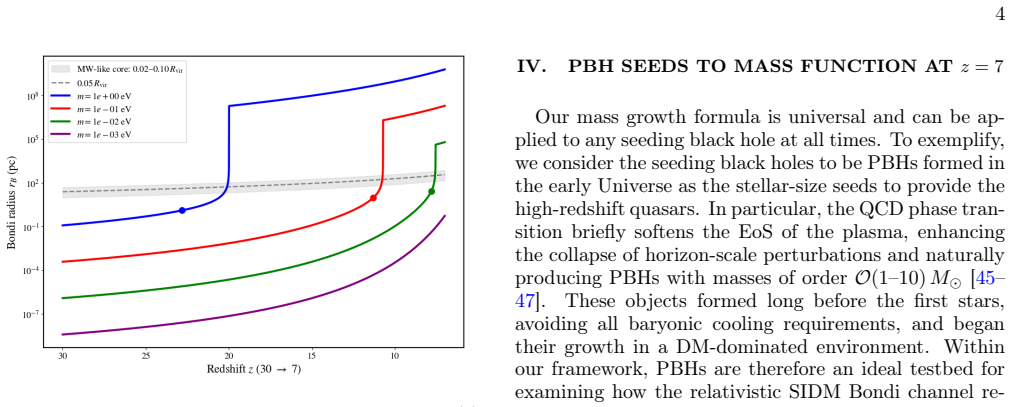
In the critical regime of near-relativistic sound speed the relativistic Bondi accretion rate onto a black hole is determined only by the self-interacting dark matter particle mass m. For m greater than or equal to 10^{-2} eV this rate is sufficient to grow a 10 solar-mass primordial black hole seed into a 10^9 to 10^{10} solar-mass supermassive black hole by redshift 7 regardless of the ambient medium. The final black-hole mass function at late times is then fixed once the initial primordial black-hole mass distribution and the value of m are given.
What carries the argument
The critical regime of self-interacting dark matter Bondi accretion, in which the sound speed approaches the speed of light and the accretion rate therefore depends only on the particle mass m.
If this is right
- Given any primordial black-hole mass distribution and a fixed particle mass m, the entire black-hole mass function from stellar to supermassive scales is completely determined at late times.
- Black-hole growth proceeds without fine-tuned gas densities or adherence to Eddington limits.
- Microscopic properties of dark matter particles become directly testable through the observed distribution of black-hole masses at high redshift.
Where Pith is reading between the lines
- If the mechanism operates, the rapid appearance of supermassive black holes no longer demands unusually dense or specially arranged gas reservoirs.
- Measurements of the high-redshift black-hole mass function could be inverted to place bounds on the allowed range of self-interacting dark matter particle masses.
- Numerical simulations that adopt this mass-dependent accretion rate could be compared directly with current quasar luminosity functions to test consistency.
Load-bearing premise
A critical regime exists in which the self-interacting dark matter sound speed is near-relativistic, rendering the Bondi accretion rate independent of ambient density and environment.
What would settle it
An observation that the masses of supermassive black holes at redshift 7 still require accretion rates that vary with local gas density, or that cannot be reached for any self-interacting dark matter mass above 0.01 electronvolts, would falsify the mechanism.
Figures


read the original abstract
Observations of luminous quasars at $z\gtrsim7$ reveal supermassive black holes (SMBHs) with inferred masses $M_{\rm BH}\sim10^9 \, M_\odot$ formed within the first $\sim700$~Myr of cosmic history. Standard growth channels \textrm{ -- } Eddington-limited gas accretion and hierarchical mergers \textrm{ -- } face severe timescale restrictions. We consider a super-Eddington accretion mechanism aided by the Bondi accretion of a minimal model of self-interacting dark matter (SIDM). We demonstrate that in a {\it critical regime} with a near-relativistic sound speed, the Bondi accretion yields an accretion rate that depends only on the mass $m$ of SIDM, thus it is universal to the ambient environment. This critical accretion mechanism for $m\gtrsim 10^{-2}\; {\rm eV}$ can grow seeds as small as $10\,M_\odot$ primordial black holes (PBH) in the early Universe into $10^9$ \textrm{--} $10^{10}\,M_\odot$ SMBHs by $z\sim7$ without fine-tuned environments. Therefore, given a mass distribution of PBHs and a value of $m$, the mass function of primary black holes at late time can be fully determined with masses ranging from stellar to SMBHs. This connects the microscopic physics of dark matter to astrophysical observations of black holes.
Editorial analysis
A structured set of objections, weighed in public.
Referee Report
Summary. The manuscript proposes that a minimal self-interacting dark matter (SIDM) fluid enables relativistic Bondi accretion onto primordial black holes (PBHs). In a 'critical regime' with near-relativistic sound speed, the accretion rate is claimed to depend only on the SIDM particle mass m (for m ≳ 10^{-2} eV), making it universal and independent of ambient density profiles or environment. This allows 10 M_⊙ PBH seeds to grow into 10^9–10^{10} M_⊙ supermassive black holes by z ∼ 7 without fine-tuned conditions, unifying stellar to supermassive black hole growth and determining the late-time black hole mass function from the PBH distribution and m.
Significance. If the central derivation holds, the result would provide a direct link between dark matter microphysics and the rapid formation of high-redshift SMBHs, offering a potential resolution to the timescale problem for z ≳ 7 quasars that avoids reliance on super-Eddington gas accretion or hierarchical mergers. It would imply that SIDM properties alone can dictate black hole demographics across scales.
major comments (2)
- [Critical regime and accretion rate derivation] The claim that the relativistic Bondi rate reduces to a function of m alone in the critical regime (with near-relativistic sound speed) is load-bearing for the environment-independence and the no-fine-tuning assertion. Standard form is Ṁ ∝ G² M_BH² ρ_∞ / c_s³ (or relativistic generalization); the manuscript must derive explicitly how the SIDM equation of state and self-interaction cross-section produce the required cancellation between ρ_∞ and c_s³ such that the ratio depends only on m across the range of early-Universe densities and velocity dispersions relevant for growth from 10 M_⊙ to 10^9–10^{10} M_⊙ by z ∼ 7. Without this derivation or numerical demonstration, the universality result remains unverified.
- [Growth from stellar to supermassive scales] The growth calculation from 10 M_⊙ seeds to 10^9–10^{10} M_⊙ by z ∼ 7 must include the integrated timescale, explicit dependence on initial PBH mass distribution, and checks against variations in ambient conditions to substantiate that the mechanism operates without fine-tuning. The abstract states the outcome but the supporting integration and sensitivity analysis are needed to make the claim quantitative.
minor comments (2)
- [Notation and definitions] Define the precise boundaries of the 'critical regime' (e.g., the range of sound speed relative to c and the corresponding self-interaction strength) with a dedicated equation or table.
- [Introduction and references] Add references to prior relativistic Bondi accretion literature and existing SIDM constraints to contextualize the minimal model.
Simulated Author's Rebuttal
We thank the referee for the careful and constructive report. The major comments identify key areas where additional explicit derivations and quantitative details will strengthen the presentation of the SIDM-driven relativistic Bondi accretion mechanism. We address each point below and have revised the manuscript to incorporate the requested clarifications and expansions.
read point-by-point responses
-
Referee: The claim that the relativistic Bondi rate reduces to a function of m alone in the critical regime (with near-relativistic sound speed) is load-bearing for the environment-independence and the no-fine-tuning assertion. Standard form is Ṁ ∝ G² M_BH² ρ_∞ / c_s³ (or relativistic generalization); the manuscript must derive explicitly how the SIDM equation of state and self-interaction cross-section produce the required cancellation between ρ_∞ and c_s³ such that the ratio depends only on m across the range of early-Universe densities and velocity dispersions relevant for growth from 10 M_⊙ to 10^9–10^{10} M_⊙ by z ∼ 7. Without this derivation or numerical demonstration, the universality result remains unverified.
Authors: We agree that an explicit, step-by-step derivation of the cancellation is essential for verifying the claimed universality. The original manuscript introduces the critical regime in Section 3, where the SIDM fluid reaches near-relativistic sound speeds set by the particle mass m and the self-interaction cross-section per unit mass. To address the referee's concern directly, we have added a dedicated subsection that starts from the relativistic Bondi accretion formula, substitutes the SIDM equation of state (derived from the self-interacting fluid dynamics), and shows analytically how ρ_∞ / c_s³ becomes independent of ambient density and velocity dispersion, depending only on m for m ≳ 10^{-2} eV. We further include a numerical scan over a range of early-universe densities and dispersions to confirm the cancellation holds across the relevant parameter space for growth from stellar-mass to supermassive scales. These additions make the environment-independence fully transparent. revision: yes
-
Referee: The growth calculation from 10 M_⊙ seeds to 10^9–10^{10} M_⊙ by z ∼ 7 must include the integrated timescale, explicit dependence on initial PBH mass distribution, and checks against variations in ambient conditions to substantiate that the mechanism operates without fine-tuning. The abstract states the outcome but the supporting integration and sensitivity analysis are needed to make the claim quantitative.
Authors: We concur that the growth results require more explicit quantitative support to demonstrate robustness without fine-tuning. In the revised manuscript we have expanded the growth section to present the full time-integrated accretion history from z ≈ 20 to z ≈ 7, using the universal rate derived in the critical regime. We now show results for both a monochromatic 10 M_⊙ seed population and an extended initial PBH mass function, with the final mass distribution at z ∼ 7 determined solely by the choice of m. We also add sensitivity tests that vary ambient density profiles and velocity dispersions over plausible early-universe ranges; these confirm that the final black-hole masses remain in the 10^9–10^{10} M_⊙ interval for m ≳ 0.01 eV, thereby substantiating the lack of fine-tuning. revision: yes
Circularity Check
Critical regime's claimed environment-independence of SIDM Bondi rate rests on unshown cancellation between ρ_∞ and c_s tied only to m
specific steps
-
self definitional
[Abstract]
"We demonstrate that in a critical regime with a near-relativistic sound speed, the Bondi accretion yields an accretion rate that depends only on the mass m of SIDM, thus it is universal to the ambient environment."
The critical regime is defined precisely to yield an accretion rate depending only on m (via near-relativistic c_s that cancels ambient ρ_∞ dependence in the Bondi expression). Without shown equations demonstrating enforcement by SIDM self-interactions, the universality is built into the regime choice rather than derived from first principles or the particle model.
full rationale
The paper's central result—that Bondi accretion in the critical regime depends only on SIDM particle mass m and is therefore universal—relies on positing a near-relativistic sound-speed regime that enforces the necessary cancellation in the relativistic Bondi formula. No explicit derivation from the SIDM equation of state or cross-section is quoted showing how this cancellation occurs across relevant early-Universe densities; the independence is therefore introduced by the regime definition rather than independently derived from the microscopic model. This produces partial circularity in the load-bearing step without reducing the entire derivation to a fit.
Axiom & Free-Parameter Ledger
free parameters (1)
- SIDM particle mass m
axioms (2)
- domain assumption Bondi accretion formula remains valid in the near-relativistic sound-speed regime for SIDM
- ad hoc to paper Existence of a critical regime with near-relativistic sound speed that erases environmental dependence
invented entities (1)
-
Minimal self-interacting dark matter (SIDM) fluid
no independent evidence
Lean theorems connected to this paper
-
IndisputableMonolith/Cost/FunctionalEquation.leanwashburn_uniqueness_aczel unclear?
unclearRelation between the paper passage and the cited Recognition theorem.
in a critical regime with a near-relativistic sound speed, the Bondi accretion yields an accretion rate that depends only on the mass m of SIDM... K=64π ρ_B ∝ m^{5/2}
-
IndisputableMonolith/Foundation/AlphaCoordinateFixation.leancostAlphaLog_high_calibrated_iff unclear?
unclearRelation between the paper passage and the cited Recognition theorem.
ϵ ≃ 2/9 ρ_DM/ρ_B ... ˙M_Bondi = 64π ρ_B M²
What do these tags mean?
- matches
- The paper's claim is directly supported by a theorem in the formal canon.
- supports
- The theorem supports part of the paper's argument, but the paper may add assumptions or extra steps.
- extends
- The paper goes beyond the formal theorem; the theorem is a base layer rather than the whole result.
- uses
- The paper appears to rely on the theorem as machinery.
- contradicts
- The paper's claim conflicts with a theorem or certificate in the canon.
- unclear
- Pith found a possible connection, but the passage is too broad, indirect, or ambiguous to say the theorem truly supports the claim.
Reference graph
Works this paper leans on
-
[1]
An 800-million-solar-mass black hole in a significantly neutral Universe at redshift 7.5
E. Banados et al., Nature553, 473 (2018), 1712.01860
work page internal anchor Pith review Pith/arXiv arXiv 2018
- [2]
-
[4]
R. L. Larson et al., Astrophys. J. Lett.953, L29 (2023)
work page 2023
- [5]
- [6]
-
[7]
L. J. Furtak et al., Mon. Not. R. Astron. Soc.526, 3382 (2023)
work page 2023
-
[8]
2023b, ApJ, 959, 39, doi: 10.3847/1538-4357/ad029e
Y. Harikane et al., The Astrophysical Journal959, 39 (2023), published December 2023, URLhttps://doi. org/10.3847/1538-4357/ad029e
-
[9]
D. e. a. Kocevski, Nature628, 57 (2024)
work page 2024
- [10]
-
[11]
Bogdan et al., Nature Astron.8, 126 (2024), 2305.15458
A. Bogdan et al., Nature Astron.8, 126 (2024), 2305.15458
-
[12]
Juodžbalis et al., Nature636, 594 (2024), 2403.03872
I. Juodžbalis et al., Nature636, 594 (2024), 2403.03872
- [13]
- [14]
-
[15]
J. H. Wise, J. A. Regan, B. W. O’Shea, M. L. Norman, T. P. Downes, and H. Xu, Nature566, 85 (2019), URL https://doi.org/10.1038/s41586-019-0873-4
-
[16]
The Formation of the First Stars. I. The Primordial Star Forming Cloud
V. Bromm, P. S. Coppi, and R. B. Larson, Astrophys. J. 564, 23 (2002), astro-ph/0102503
work page internal anchor Pith review Pith/arXiv arXiv 2002
-
[17]
S. P. Oh and Z. Haiman, Astrophys. J.569, 558 (2002), astro-ph/0108071
work page internal anchor Pith review Pith/arXiv arXiv 2002
-
[18]
M. C. Begelman, M. Volonteri, and M. J. Rees, Monthly Notices of the Royal Astronomical Society370, 289 (2006), URLhttps://doi.org/10.1111/j.1365-2966. 2006.10467.x
- [19]
-
[20]
K. Inayoshi, E. Visbal, and Z. Haiman, Annu. Rev. As- tron. Astrophys.58, 27 (2020)
work page 2020
-
[21]
A.SmithandV.Bromm, Contemp.Phys.60, 111(2019), 1904.12890
work page internal anchor Pith review Pith/arXiv arXiv 2019
-
[22]
J. E. Greene, J. Strader, and L. C. Ho, Annu. Rev. As- tron. Astrophys.58, 257 (2020)
work page 2020
- [23]
-
[24]
M. C. Begelman, R. D. Blandford, and M. J. Rees, Na- ture287, 307 (1980), URLhttps://doi.org/10.1038/ 287307a0
work page 1980
-
[25]
M. Volonteri, F. Haardt, and P. Madau, The Astrophys- ical Journal582, 559 (2003)
work page 2003
-
[26]
M. C. Miller and D. P. Hamilton, Monthly No- tices of the Royal Astronomical Society330, 232 (2002), URLhttps://doi.org/10.1046/j.1365-8711. 2002.05050.x
-
[27]
C. L. Rodriguez, M. Zevin, P. Amaro-Seoane, S. Chatter- jee, K. Kremer, F. A. Rasio, and C. S. Ye, Phys. Rev. D 100, 043027 (2019), URLhttps://link.aps.org/doi/ 10.1103/PhysRevD.100.043027
-
[28]
D. Gerosa and M. Fishbach, Nature Astronomy 5, 749 (2021), URLhttps://doi.org/10.1038/ s41550-021-01398-w
work page 2021
-
[29]
H.-H. S. Chiu, H.-Y. Schive, H.-Y. K. Yang, H. Huang, and M. Gaspari, Phys. Rev. Lett.134, 051402 (2025)
work page 2025
-
[30]
D. N. Spergel and P. J. Steinhardt, Phys. Rev. Lett.84, 3760 (2000)
work page 2000
- [31]
- [32]
-
[33]
Bradač, The Astrophysical Journal679, 1173 (2008)
S.W.Randall, M.Markevitch, D.Clowe, A.H.Gonzalez, and M. Bradač, The Astrophysical Journal679, 1173 (2008)
work page 2008
-
[34]
W.-X. Feng, H.-B. Yu, and Y.-M. Zhong, arXiv e-prints (2025), 2506.17641
- [35]
-
[36]
K. Zhang, L.-W. Luo, J.-S. Tsao, C.-S. Chen, and F.-L. Lin, Results Phys.53, 106967 (2023), 2303.03266
-
[37]
S. L. Shapiro and S. A. Teukolsky,Black holes, white dwarfs, and neutron stars: The physics of compact ob- jects(1983), ISBN 978-0-471-87316-7, 978-3-527-61766- 1
work page 1983
-
[38]
Planck 2018 results. VI. Cosmological parameters
Planck Collaboration, Astron. Astrophys.641, A6 (2020), 1807.06209
work page internal anchor Pith review Pith/arXiv arXiv 2020
-
[39]
G. L. Bryan and M. L. Norman, Astrophysical Journal 495, 80 (1998)
work page 1998
-
[40]
S. D. M. White and M. J. Rees, Monthly Notices of the Royal Astronomical Society183, 341 (1978)
work page 1978
-
[41]
G. R. Blumenthal, S. M. Faber, J. R. Primack, and M. J. Rees, Nature311, 517 (1984)
work page 1984
-
[42]
J. Schaye et al., Monthly Notices of the Royal Astronom- ical Society446, 521 (2015), URLhttps://doi.org/10. 1093/mnras/stu2058
work page 2015
- [43]
-
[44]
M. Kaplinghat, S. Tulin, and H.-B. Yu, Phys. Rev. Lett. 116, 041302 (2016)
work page 2016
-
[45]
B. J. Carr and S. W. Hawking, Mon. Not. R. Astron. Soc.168, 399 (1974)
work page 1974
- [46]
-
[47]
C. T. Byrnes, M. Hindmarsh, S. Young, and M. R. S. Hawkins, JCAP2018, 041 (2018)
work page 2018
-
[48]
M. Ricotti, J. P. Ostriker, and K. J. Mack, Astrophys. J. 680, 829 (2008), 0709.0524
work page internal anchor Pith review Pith/arXiv arXiv 2008
- [49]
-
[50]
CMB bounds on disk-accreting massive Primordial Black Holes
V. Poulin, P. D. Serpico, F. Calore, S. Clesse, and K. Kohri, Phys. Rev. D96, 083524 (2017), 1707.04206
work page internal anchor Pith review Pith/arXiv arXiv 2017
-
[51]
P. D. Serpico, V. Poulin, D. Inman, and K. Kohri, Phys. Rev. Res.2, 023204 (2020)
work page 2020
-
[52]
P.Tisserandandothers(EROS-2Collaboration), Astron. Astrophys.469, 387 (2007)
work page 2007
-
[53]
H. Niikura, M. Takada, N. Yasuda, R. H. Lupton, T. Sumi, S. More, T. Kurita, S. Sugiyama, A. More, M. Oguri, et al., Nature Astron.3, 524 (2019)
work page 2019
- [54]
- [55]
- [56]
-
[57]
G. R. Blumenthal, S. M. Faber, R. Flores, and J. R. Primack, Astrophysical Journal301, 27 (1986), URL https://doi.org/10.1086/163867
-
[58]
J. F. Navarro, C. S. Frenk, and S. D. M. White, As- trophysical Journal462, 563 (1996), URLhttps://doi. 7 org/10.1086/177173
-
[59]
H. J. Mo, F. C. van den Bosch, and S. D. M. White, Galaxy Formation and Evolution(Cambridge University Press, Cambridge, 2010)
work page 2010
-
[60]
W.-X. Feng, A. Parisi, C.-S. Chen, and F.-L. Lin, Journal of Cosmology and Astroparticle Physics p. 032 (2022), URLhttps://doi.org/10.1088/1475-7516/ 2022/08/032
- [61]
-
[62]
L. G. van den Aarssen, T. Bringmann, and C. Pfrommer, Phys. Rev. Lett.109, 231301 (2012), 1205.5809
work page internal anchor Pith review Pith/arXiv arXiv 2012
-
[63]
Resonant Dark Forces and Small Scale Structure
S. Tulin, H.-B. Yu, and K. M. Zurek, Phys. Rev. Lett. 110, 111301 (2013), 1210.0900
work page internal anchor Pith review Pith/arXiv arXiv 2013
-
[64]
J. Eby, C. Kouvaris, N. G. Nielsen, and L. C. R. Wijew- ardhana, JHEP02, 028 (2016), 1511.04474
work page internal anchor Pith review Pith/arXiv arXiv 2016
-
[65]
A. Maselli, P. Pnigouras, N. G. Nielsen, C. Kou- varis, and K. D. Kokkotas, Phys. Rev. D96, 023005 (2017), URLhttps://link.aps.org/doi/10. 1103/PhysRevD.96.023005. 1 Supplementary Material forA Unified Dark-Matter–Driven Relativistic Bondi Route to Black-Hole Growth from Stellar to Supermassive Scales In this supplementary material, we will first discuss ...
work page 2017
-
[66]
The Eddington accretion is due to the balance between the radiation pressure and gravity, and the heat due to the collision can be depleted by the radiation to prevent the heating-up feedback
-
[67]
Unlike the Eddington accretion rate with a universaltEdd, the Bondi one depends on energy densityρof the accreting fluid, which is usually insufficient to supply enough inflow of matter to form SMBHs. For examples, for a black hole ofM= 3M ⊙ yielding ˙MEdd ∼6×10 −8M⊙/yr, then (i) in the post-ionization intergalactic medium withn∼10 −6cm−3,a∼12km/s, ˙MBond...
-
[68]
This leads to a suppressed accretion rate compared to Bondi’s prediction
Moreover, considering the accretion of cold dark matter (CDM), the local density of CDM in the inner region is estimated to be far smaller than the baryonic matter in the halos with NFW structures [42, 57–59]. This leads to a suppressed accretion rate compared to Bondi’s prediction
-
[69]
On the other hand, considering the accretion of relativistic dark matter, the Bondi accretion rate is suppressed by largec s ∼ O(c). This can also be understood as resistance to collapse under high pressure, leading to slower accretion. 2 Therefore, in the usual consideration of forming SMBH by accretion mechanism, the Eddington is usually the dominant me...
-
[70]
The fact of zero sound speed,a= 0, implies no pressure support, thus no Bondi flow. Thus, thea→0is a critical limit, so that the Bondi accretion should be replaced by ballistic free fall of dust with the accretion rate ˙Mdust = 4πr2 capρ∞v∞ = 16πρ∞ (GM)2 v3∞ (S5) wherer cap = 2GM v2∞ is the gravitational capture radius, andv∞ is the asymptotic ballistic v...
-
[71]
Physically, the above failure of Bondi accretion in the critical limit can be understood as follows. The vanishing aimplies the CDM is almost collisionless, so that its capture by the central black hole simply relies on gravity. This needs a small impact parameter, resulting in a smaller effective accretion rate than predicted by Bondi accretion
-
[72]
Thus, it lacks a mechanism to realize huge
The tiny scattering cross-section of CDM also limits the increase of coarse-grained phase-space density to form ”Bondi radius". Thus, it lacks a mechanism to realize huge "Bondi focusing" even with a tiny sound speed. We now move the consider how to bypass the no-go of forming SMBH by Bondi accretion. From the above discussions, we cannot consider CDM, bu...
-
[73]
The prefactor of the Bondi accretion rate diverges asa→c/3
-
[74]
This ensures a dense profile to supply Bondi accretion
The Bondi accretion creates a spike profile around the center black hole as shown in [60]. This ensures a dense profile to supply Bondi accretion
-
[75]
This SIDM model can also resolve other astrophysical issues, such as the satellite problem, bullet cluster collision, and the too-big-to-fall problem, and satisfy the cosmological constraint by appropriately tuning the model parameters, e.g., see [30, 31, 33, 61–63]
-
[76]
The Bondi accretion rate should be self-regulated to avoid the over-production of SMBHs in the current era, which we do not observe
-
[77]
The total mass of the halos can also be estimated by treating the primordial halos as the Tolman-Oppenheimer- Volkoff (TOV) configurations. The key message from the above discussions is as follows: By assuming that SMBHs form through Bondi accretion of DM, the recently discovered SMBHs by JWST can place a very tight constraint on DM models. Once a viable ...
discussion (0)
Sign in with ORCID, Apple, or X to comment. Anyone can read and Pith papers without signing in.