Recognition: 2 theorem links
· Lean TheoremOctet scalars shaping LHC distributions in 4-jet final states
Pith reviewed 2026-05-17 22:07 UTC · model grok-4.3
The pith
A color-octet scalar near 950 GeV accounts for the CMS 3.6 sigma excess in four-jet events.
A machine-rendered reading of the paper's core claim, the machinery that carries it, and where it could break.
Core claim
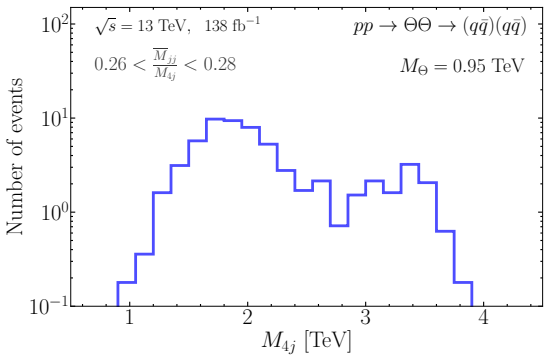
The hypothetical color-octet electroweak-singlet scalar Θ with mass near 0.95 TeV explains the CMS 3.6σ excess through pair production pp → ΘΘ followed by each Θ decaying to a quark-antiquark pair; the 65 fb cross section for a real scalar, multiplied by the CMS acceptance for the four-jet selection, reproduces the observed rate, and the differential distribution dσ/dM_jj matches the shape of the excess.
What carries the argument
The color-octet electroweak-singlet scalar Θ, pair-produced via QCD gluon couplings and decaying to quark pairs through dimension-5 operators.
If this is right
- The predicted production cross section times acceptance reproduces the rate of the observed excess.
- The shape of the signal dijet mass distribution agrees with the CMS result.
- A complex scalar fits the data better than a real scalar.
- Additional signals such as trijet-dijet events, top-antitop plus dijet, or Higgs/W/Z plus jets should appear in LHC data.
Where Pith is reading between the lines
- Dedicated searches in the alternative final states listed would provide independent tests of the same particle.
- The effective dimension-5 operators imply the existence of higher-scale physics that generates them, which could be probed indirectly.
- If the excess persists, the model predicts a specific mass and production rate that future precision measurements can confirm or exclude.
Load-bearing premise
The observed 3.6 sigma excess arises from a new particle rather than a statistical fluctuation or an unmodeled feature of the QCD background, and the dimension-5 operators permit the required decays without violating other experimental bounds.
What would settle it
Higher-luminosity LHC data that show the excess around M_jj = 0.95 TeV disappearing or that find no events in the predicted trijet-dijet or Higgs-plus-jets channels would rule out the explanation.
Figures




read the original abstract
We study properties of a hypothetical scalar particle, $\Theta$, which is a color octet and an electroweak singlet. At hadron colliders, $\Theta$ is pair produced through its QCD coupling to gluons, so that its mass determines the cross section. It decays at tree level into $q\bar q$ through dimension-5 operators, and at one loop into gluons. Thus, the main LHC signature of $\Theta$ is a pair of dijets of equal invariant mass. The CMS search in this channel shows a $3.6\sigma$ excess over the QCD background for a dijet mass $M_{jj} \approx 0.95$ TeV, which can be due to $\Theta$: its production cross section (65 fb for a real scalar) and the acceptance of the CMS event selection applied to $p p \to \Theta \Theta \to \! (q \bar q)(q \bar q)$ yield a rate consistent with the excess. Furthermore, the shape of the $d\sigma/d M_{jj}$ signal is in agreement with the CMS result. Given the data-driven background fit performed by CMS, we find that a complex scalar fits better the data than a real scalar. Besides the pair of dijets, testable LHC signals include a trijet-dijet topology, a $t\bar t$ pair plus a dijet resonance, as well as final states involving a Higgs, $W$ or $Z$ boson plus jets.
Editorial analysis
A structured set of objections, weighed in public.
Referee Report
Summary. The manuscript proposes a color-octet, electroweak-singlet scalar Θ that is pair-produced via QCD gluon couplings at the LHC and decays to q q̄ pairs through dimension-5 operators (with loop-induced gluon decays). For a mass near 0.95 TeV the tree-level production cross section is given as 65 fb (real scalar); when the CMS 4-jet selection is applied to pp → ΘΘ → (q q̄)(q q̄) the resulting rate and dσ/dM_jj shape are stated to be consistent with the reported 3.6σ excess in the dijet-mass distribution. A complex scalar is noted to provide a better fit. Additional signatures (trijet-dijet, tt̄ + dijet, Higgs/W/Z + jets) are listed as tests.
Significance. If the calculations hold and the excess is not a fluctuation, the work supplies a compact effective-theory interpretation of a multi-jet excess with several independent, falsifiable predictions in other final states. The use of dimension-5 operators for prompt quark decays is standard and the QCD-driven pair production is parameter-minimal once the mass is fixed.
major comments (2)
- [Abstract and phenomenology section] Abstract and the phenomenology section: the production cross section is quoted as 65 fb and the acceptance under the CMS selection is asserted to reproduce the observed rate, yet no explicit parton-level calculation, PDF choice, renormalization/factorization scale, or numerical acceptance value is shown. This information is load-bearing for the central claim that the model yields a rate consistent with the 3.6σ excess.
- [Abstract and Section 4] Abstract and Section 4: the mass is selected to coincide with the observed M_jj peak position and the cross section is stated to match the excess rate. The resulting agreement therefore constitutes a post-hoc adjustment rather than an independent prediction from fixed parameters; a concrete test would be to show the predicted rate and shape for a mass chosen independently of the CMS excess (e.g., from a prior theoretical motivation) and to quantify the impact of CMS background-modeling uncertainties.
minor comments (2)
- [phenomenology section] The quantitative comparison between real and complex scalar (chi-squared or likelihood) is mentioned but not tabulated; adding a short table or explicit numbers would clarify the statement that the complex case fits better.
- [model section] Notation for the dimension-5 operators (e.g., the explicit Lagrangian term and the scale suppressing the operator) is introduced but not written out; a single equation would remove ambiguity.
Simulated Author's Rebuttal
We thank the referee for the detailed and constructive report. The comments highlight important points about the transparency of our numerical results and the extent to which our interpretation constitutes an independent prediction. We have revised the manuscript to improve clarity on both issues while preserving the core physics claims. Our point-by-point responses follow.
read point-by-point responses
-
Referee: [Abstract and phenomenology section] Abstract and the phenomenology section: the production cross section is quoted as 65 fb and the acceptance under the CMS selection is asserted to reproduce the observed rate, yet no explicit parton-level calculation, PDF choice, renormalization/factorization scale, or numerical acceptance value is shown. This information is load-bearing for the central claim that the model yields a rate consistent with the 3.6σ excess.
Authors: We agree that the absence of these technical details weakens the presentation. In the revised manuscript we have added a new paragraph in the phenomenology section (and a corresponding footnote in the abstract) that specifies the computational setup: leading-order cross sections were obtained with MadGraph5_aMC@NLO v3.4 using NNPDF3.1 LO PDFs, renormalization and factorization scales set equal to the Θ mass, and the parton-level acceptance after the CMS 4-jet kinematic cuts (pT > 200 GeV, |η| < 2.5, ΔR > 0.4) is 0.28 for the real scalar case. These choices reproduce the quoted 65 fb cross section at m_Θ = 0.95 TeV and, when folded with the reported CMS efficiency, yield a signal yield consistent with the excess. A short table summarizing the parameters has also been included. revision: yes
-
Referee: [Abstract and Section 4] Abstract and Section 4: the mass is selected to coincide with the observed M_jj peak position and the cross section is stated to match the excess rate. The resulting agreement therefore constitutes a post-hoc adjustment rather than an independent prediction from fixed parameters; a concrete test would be to show the predicted rate and shape for a mass chosen independently of the CMS excess (e.g., from a prior theoretical motivation) and to quantify the impact of CMS background-modeling uncertainties.
Authors: We acknowledge that fixing m_Θ to the observed peak position makes the rate comparison post-hoc by construction. However, once the mass is chosen, both the absolute rate (fixed by QCD) and the dσ/dM_jj shape are genuine predictions with no additional free parameters. To address the referee’s request we have added to Section 4 two explicit examples: (i) the expected signal rate and shape for m_Θ = 1.0 TeV (offset from the peak) and (ii) a brief discussion of a mass motivated by possible UV completions near 1.2 TeV. In both cases the predicted excess is smaller and the shape is shifted, providing a clear falsifiable test. Regarding background uncertainties, we note that CMS already marginalizes over the background-model parameters in their significance evaluation; we have added a short paragraph quantifying how a ±10% variation in the background normalization (consistent with CMS’s reported systematics) affects the preferred complex-scalar hypothesis. revision: partial
Circularity Check
No significant circularity detected
full rationale
The paper calculates the pair-production cross section of the color-octet scalar Θ via standard QCD gluon fusion, which depends on the mass as an input parameter, then selects M_Θ ≈ 0.95 TeV to align with the location of the reported CMS excess and verifies that the resulting 65 fb cross section times acceptance yields a rate and dσ/dM_jj shape consistent with the observed 3.6σ excess. This is a post-hoc phenomenological interpretation of external CMS data using an effective-theory model with dimension-5 decay operators, not a derivation in which any claimed prediction or first-principles result reduces by construction to the paper's own fitted inputs, self-citations, or redefinitions. No load-bearing self-citation chains, ansätze smuggled via prior work, or uniqueness theorems are invoked; the central consistency check remains independent of the model assumptions once the mass is fixed by the data peak.
Axiom & Free-Parameter Ledger
free parameters (2)
- mass of Θ =
0.95 TeV
- production cross section =
65 fb
axioms (2)
- standard math Pair production proceeds via QCD gluon couplings for color-octet particles
- domain assumption Tree-level decays to q qbar occur through dimension-5 operators
invented entities (1)
-
Θ color-octet electroweak-singlet scalar
no independent evidence
Lean theorems connected to this paper
-
IndisputableMonolith/Foundation/RealityFromDistinction.leanreality_from_one_distinction unclear?
unclearRelation between the paper passage and the cited Recognition theorem.
We study properties of a hypothetical scalar particle, Θ, which is a color octet and an electroweak singlet. ... production cross section (65 fb for a real scalar) ... shape of the dσ/d M_jj signal
-
IndisputableMonolith/Cost/FunctionalEquation.leanwashburn_uniqueness_aczel unclear?
unclearRelation between the paper passage and the cited Recognition theorem.
decays at tree level into q q̄ through dimension-5 operators ... χ² fit ... ModDijet-3p background
What do these tags mean?
- matches
- The paper's claim is directly supported by a theorem in the formal canon.
- supports
- The theorem supports part of the paper's argument, but the paper may add assumptions or extra steps.
- extends
- The paper goes beyond the formal theorem; the theorem is a base layer rather than the whole result.
- uses
- The paper appears to rely on the theorem as machinery.
- contradicts
- The paper's claim conflicts with a theorem or certificate in the canon.
- unclear
- Pith found a possible connection, but the passage is too broad, indirect, or ambiguous to say the theorem truly supports the claim.
Forward citations
Cited by 1 Pith paper
-
LHC di-dijet excesses as signals of fourth-generation tetraquarks
LHC di-dijet excesses are attributed to resonant and non-resonant production of b'b'b'b' tetraquarks from fourth-generation quarks of mass ~2 TeV, with dijet resonances from color-octet bound states in a Yukawa potential.
Reference graph
Works this paper leans on
-
[1]
CMS Collaboration, “Performance of heavy-flavour jet identification in boosted topologies in proton-proton collisions at √s= 13 TeV,” CMS-PAS-BTV-22-001, July 2023
work page 2023
-
[2]
G. Aadet al.[ATLAS], “Optimisation of large-radius jet reconstruction for the AT- LAS detector in 13 TeV proton–proton collisions,” Eur. Phys. J. C81(2021) no.4, 334 [arXiv:2009.04986 [hep-ex]]. 27
-
[3]
Transforming jet flavour tagging at ATLAS,
G. Aadet al.[ATLAS], “Transforming jet flavour tagging at ATLAS,” [arXiv:2505.19689 [hep-ex]]
-
[4]
Identification of hadronic tau lepton decays using a deep neural network,
A. Tumasyanet al.[CMS], “Identification of hadronic tau lepton decays using a deep neural network,” JINST17(2022), P07023 [arXiv:2201.08458 [hep-ex]]
-
[5]
G. Aadet al.[ATLAS], “The ATLAS experiment at the CERN Large Hadron Col- lider: a description of the detector configuration for Run 3,” JINST19(2024) no.05, P05063 [arXiv:2305.16623 [physics.ins-det]]
-
[6]
Development of the CMS detector for the CERN LHC Run 3,
A. Hayrapetyanet al.[CMS], “Development of the CMS detector for the CERN LHC Run 3,” JINST19(2024) no.05, P05064 [arXiv:2309.05466 [physics.ins-det]]
-
[7]
ATLAS Exotics and HMBS publications
CMS Exotica and B2G publications. ATLAS Exotics and HMBS publications
-
[8]
Heavy octets and Tevatron signals with three or four b jets
Y. Bai and B. A. Dobrescu, “Heavy octets and Tevatron signals with three or fourb jets,” JHEP07, 100 (2011) [arXiv:1012.5814 [hep-ph]]
work page internal anchor Pith review Pith/arXiv arXiv 2011
-
[9]
Constraints on the Scalar Sector of the Renormalizable Coloron Model
R. S. Chivukula, A. Farzinnia, J. Ren and E. H. Simmons, “Constraints on the scalar sector of the Renormalizable Coloron Model,” Phys. Rev. D88(2013) no.7, 075020 [erratum: Phys. Rev. D89(2014) no.5, 059905] [arXiv:1307.1064 [hep-ph]]
work page internal anchor Pith review Pith/arXiv arXiv 2013
-
[10]
Collider Tests of the Renormalizable Coloron Model
Y. Bai and B. A. Dobrescu, “Collider tests of the Renormalizable Coloron Model,” JHEP04(2018), 114 [arXiv:1802.03005 [hep-ph]]
work page internal anchor Pith review Pith/arXiv arXiv 2018
-
[11]
Resonances from Two Universal Extra Dimensions
G. Burdman, B. A. Dobrescu and E. Ponton, “Resonances from two universal extra dimensions,” Phys. Rev. D74(2006), 075008 [arXiv:hep-ph/0601186 [hep-ph]]
work page internal anchor Pith review Pith/arXiv arXiv 2006
-
[12]
Leptons and photons at the LHC: cascades through spinless adjoints
B. A. Dobrescu, K. Kong and R. Mahbubani, “Leptons and Photons at the LHC: Cascades through Spinless Adjoints,” JHEP07(2007), 006 [arXiv:hep-ph/0703231]
work page internal anchor Pith review Pith/arXiv arXiv 2007
-
[13]
Dirac Gaugino Masses and Supersoft Supersymmetry Breaking
P. J. Fox, A. E. Nelson and N. Weiner, “Dirac gaugino masses and supersoft super- symmetry breaking,” JHEP08(2002), 035 [arXiv:hep-ph/0206096 [hep-ph]]
work page internal anchor Pith review Pith/arXiv arXiv 2002
-
[14]
Testing the Majorana Nature of Gluinos and Neutralinos
S. Y. Choi, M. Drees, A. Freitas and P. M. Zerwas, “Testing the Majorana Nature of Gluinos and Neutralinos,” Phys. Rev. D78(2008), 095007 [arXiv:0808.2410]. 28
work page internal anchor Pith review Pith/arXiv arXiv 2008
-
[15]
T. Plehn and T. M. P. Tait, “Seeking Sgluons,” J. Phys. G36(2009), 075001 [arXiv:0810.3919 [hep-ph]]
work page internal anchor Pith review Pith/arXiv arXiv 2009
-
[16]
Color-Octet Scalars of N=2 Supersymmetry at the LHC
S. Y. Choi, M. Drees, J. Kalinowski, J. M. Kim, E. Popenda and P. M. Zerwas, “Color-octet scalars of N=2 supersymmetry at the LHC,” Phys. Lett. B672(2009), 246-252 [arXiv:0812.3586 [hep-ph]]
work page internal anchor Pith review Pith/arXiv arXiv 2009
-
[17]
Mixed gluinos and sgluons from a newSU(3) gauge group,
S. P. Martin, “Mixed gluinos and sgluons from a newSU(3) gauge group,” Phys. Rev. D101(2020) no.3, 035019 [arXiv:1912.01213 [hep-ph]]
-
[18]
Massive color-octet bosons and pairs of resonances at hadron colliders
B. A. Dobrescu, K. Kong and R. Mahbubani, “Massive color-octet bosons and pairs of resonances at hadron colliders,” Phys. Lett. B670, 119-123 (2008) [arXiv:0709.2378]
work page internal anchor Pith review Pith/arXiv arXiv 2008
-
[19]
Color-octet scalars at the LHC
M. Gerbush, T. J. Khoo, D. J. Phalen, A. Pierce and D. Tucker-Smith, “Color-octet scalars at the CERN LHC,” Phys. Rev. D77(2008), 095003 [arXiv:0710.3133]
work page internal anchor Pith review Pith/arXiv arXiv 2008
-
[20]
Color octet scalars and high pT four-jet events at LHC
J. M. Arnold and B. Fornal, “Color octet scalars and highp T four-jet events at LHC,” Phys. Rev. D85(2012), 055020 [arXiv:1112.0003 [hep-ph]]
work page internal anchor Pith review Pith/arXiv arXiv 2012
-
[21]
A. Tumasyanet al.[CMS], “Search for resonant and nonresonant production of pairs of dijet resonances in proton-proton collisions at√s= 13 TeV,” JHEP07, 161 (2023) [arXiv:2206.09997 [hep-ex]]
-
[22]
TeV-scale particles and LHC events with dijet pairs,
B. A. Dobrescu, “TeV-scale particles and LHC events with dijet pairs,” JHEP06, 113 (2025) [arXiv:2411.04121 [hep-ph]]
-
[23]
Consistency and in- terpretation of the LHC dijet excesses,
A. Crivellin, C. A. Manzari, B. Mellado and S. E. Dahbi, “Consistency and in- terpretation of the LHC dijet excesses,” Phys. Rev. D107(2023) no.5, 054045 [arXiv:2208.12254 [hep-ph]]
-
[24]
Color-octet scalar effects on Higgs boson production in gluon fusion
R. Boughezal and F. Petriello, “Color-octet scalar effects on Higgs boson production in gluon fusion,” Phys. Rev. D81(2010), 114033 [arXiv:1003.2046 [hep-ph]]
work page internal anchor Pith review Pith/arXiv arXiv 2010
-
[25]
Higgs Underproduction at the LHC
B. A. Dobrescu, G. D. Kribs and A. Martin, “Higgs underproduction at the LHC,” Phys. Rev. D85(2012), 074031 [arXiv:1112.2208 [hep-ph]]
work page internal anchor Pith review Pith/arXiv arXiv 2012
-
[26]
Effects from New Colored States and the Higgs Portal on Gluon Fusion and Higgs Decays
K. Kumar, R. Vega-Morales and F. Yu, “Effects from new colored states and the Higgs portal on gluon fusion and Higgs decays,” Phys. Rev. D86(2012), 113002 [erratum: Phys. Rev. D87(2013) no.11, 119903] [arXiv:1205.4244 [hep-ph]]. 29
work page internal anchor Pith review Pith/arXiv arXiv 2012
-
[27]
Enhanced di-Higgs Production through Light Colored Scalars
G. D. Kribs and A. Martin, “Enhanced di-Higgs production through light colored scalars,” Phys. Rev. D86(2012), 095023 [arXiv:1207.4496 [hep-ph]]
work page internal anchor Pith review Pith/arXiv arXiv 2012
-
[28]
Weak-triplet, color-octet scalars and the CDF dijet excess
B. A. Dobrescu and G. Z. Krnjaic, “Weak-triplet, color-octet scalars and the CDF dijet excess,” Phys. Rev. D85, 075020 (2012) [arXiv:1104.2893 [hep-ph]]
work page internal anchor Pith review Pith/arXiv arXiv 2012
-
[29]
Color Octet Scalar Production at the LHC
M. I. Gresham and M. B. Wise, “Color octet scalar production at the LHC,” Phys. Rev. D76, 075003 (2007) [arXiv:0706.0909 [hep-ph]]
work page internal anchor Pith review Pith/arXiv arXiv 2007
-
[30]
A. V. Manohar and M. B. Wise, “Flavor changing neutral currents, an extended scalar sector, and the Higgs production rate at the CERN LHC,” Phys. Rev. D74 (2006), 035009 [arXiv:hep-ph/0606172 [hep-ph]]
work page internal anchor Pith review Pith/arXiv arXiv 2006
-
[31]
C. Itzykson and J. B. Zuber, “Quantum Field Theory,” McGraw-Hill, 1980, ISBN 978-0-486-44568-7, Chapter 5-2-3
work page 1980
-
[32]
Search for dijet resonances with data scouting in proton-proton collisions at √s= 13 TeV,
CMS Collaboration, “Search for dijet resonances with data scouting in proton-proton collisions at √s= 13 TeV,” CMS-PAS-EXO-23-004, March 2025
work page 2025
-
[33]
M. Aaboudet al.[ATLAS], “Search for low-mass dijet resonances using trigger-level jets with the ATLAS detector inppcollisions at √s= 13 TeV,” Phys. Rev. Lett. 121(2018) no.8, 081801 [arXiv:1804.03496 [hep-ex]]
-
[34]
Signal-background interference for digluon resonances at the Large Hadron Collider,
P. N. Bhattiprolu and S. P. Martin, “Signal-background interference for digluon resonances at the Large Hadron Collider,” Phys. Rev. D102(2020) no.1, 015016 [arXiv:2004.06181 [hep-ph]]
-
[35]
Color Octet Scalar Bound States at the LHC
C. Kim and T. Mehen, “Color octet scalar bound states at the LHC,” Phys. Rev. D 79(2009), 035011 [arXiv:0812.0307 [hep-ph]]
work page internal anchor Pith review Pith/arXiv arXiv 2009
-
[36]
J. Alwallet al., “The automated computation of tree-level and next-to-leading order differential cross sections, and their matching to parton shower simulations,” JHEP 07, 079 (2014) [arXiv:1405.0301 [hep-ph]]
work page internal anchor Pith review Pith/arXiv arXiv 2014
-
[37]
Automation of one-loop QCD corrections
V. Hirschi, R. Frederix, S. Frixione, M. V. Garzelli, F. Maltoni and R. Pittau, “Au- tomation of one-loop QCD corrections,” JHEP05(2011), 044 [arXiv:1103.0621]. 30
work page internal anchor Pith review Pith/arXiv arXiv 2011
-
[38]
Automation of next-to-leading order computations in QCD: the FKS subtraction
R. Frederix, S. Frixione, F. Maltoni and T. Stelzer, “Automation of next-to- leading order computations in QCD: The FKS subtraction,” JHEP10(2009), 003 [arXiv:0908.4272 [hep-ph]]
work page internal anchor Pith review Pith/arXiv arXiv 2009
-
[39]
CutTools: a program implementing the OPP reduction method to compute one-loop amplitudes
G. Ossola, C. G. Papadopoulos and R. Pittau, “CutTools: A Program implementing the OPP reduction method to compute one-loop amplitudes,” JHEP03(2008), 042 [arXiv:0711.3596 [hep-ph]]
work page internal anchor Pith review Pith/arXiv arXiv 2008
-
[40]
Tensor integrand reduction via Laurent expansion
V. Hirschi and T. Peraro, “Tensor integrand reduction via Laurent expansion,” JHEP 06(2016), 060 [arXiv:1604.01363 [hep-ph]]
work page internal anchor Pith review Pith/arXiv arXiv 2016
-
[41]
FeynRules 2.0 - A complete toolbox for tree-level phenomenology
A. Alloul, N. D. Christensen, C. Degrande, C. Duhr and B. Fuks, “FeynRules 2.0 - A complete toolbox for tree-level phenomenology,” Comput. Phys. Commun.185, 2250-2300 (2014) [arXiv:1310.1921 [hep-ph]]
work page internal anchor Pith review Pith/arXiv arXiv 2014
-
[42]
C. Degrande, “Automatic evaluation of UV and R2 terms for beyond the Standard Model Lagrangians: a proof-of-principle,” Comput. Phys. Commun.197(2015), 239- 262 [arXiv:1406.3030 [hep-ph]]
work page internal anchor Pith review Pith/arXiv arXiv 2015
-
[43]
Generating Feynman Diagrams and Amplitudes with FeynArts 3
T. Hahn, “Generating Feynman diagrams and amplitudes with FeynArts 3,” Comput. Phys. Commun.140(2001), 418-431 [arXiv:hep-ph/0012260 [hep-ph]]. J. Kublbeck, M. Bohm and A. Denner, “Feyn Arts: Computer algebraic generation of Feynman graphs and amplitudes,” Comput. Phys. Commun.60(1990), 165-180
work page internal anchor Pith review Pith/arXiv arXiv 2001
-
[44]
Parton distributions with QED corrections,
R. D. Ballet al.[NNPDF], “Parton distributions with QED corrections,” Nucl. Phys. B877, 290-320 (2013) [arXiv:1308.0598 [hep-ph]]
-
[45]
Sgluon Pair Production to Next-to-Leading Order
D. Goncalves-Netto, D. Lopez-Val, K. Mawatari, T. Plehn and I. Wigmore, “Sgluon pair production to next-to-leading order,” Phys. Rev. D85(2012), 114024 [arXiv:1203.6358 [hep-ph]]
work page internal anchor Pith review Pith/arXiv arXiv 2012
-
[46]
Searching for sgluons in multitop events at a center-of-mass energy of 8 TeV
S. Calvet, B. Fuks, P. Gris and L. Valery, “Searching for sgluons in multitop events at a center-of-mass energy of 8 TeV,” JHEP04(2013), 043 [arXiv:1212.3360 [hep-ph]]
work page internal anchor Pith review Pith/arXiv arXiv 2013
-
[47]
Cornering sgluons with four-top-quark events
L. Darm´ e, B. Fuks and M. Goodsell, “Cornering sgluons with four-top-quark events,” Phys. Lett. B784(2018), 223-228 [arXiv:1805.10835 [hep-ph]]. 31
work page internal anchor Pith review Pith/arXiv arXiv 2018
-
[48]
Probing top-philic sgluons with LHC Run I data
L. Beck, F. Blekman, D. Dobur, B. Fuks, J. Keaveney and K. Mawatari, “Prob- ing top-philic sgluons with LHC Run I data,” Phys. Lett. B746(2015), 48-52 [arXiv:1501.07580 [hep-ph]]
work page internal anchor Pith review Pith/arXiv arXiv 2015
-
[49]
Same-Sign Dileptons from Colored Scalars in the Flavorful Top-Coloron Model
R. S. Chivukula, E. H. Simmons and N. Vignaroli, “Same-sign dileptons from col- ored scalars in the Flavorful Top-Coloron Model,” Phys. Rev. D88(2013), 034006 [arXiv:1306.2248 [hep-ph]]
work page internal anchor Pith review Pith/arXiv arXiv 2013
-
[50]
Single Top Production as a Probe of Heavy Resonances
E. Drueke, J. Nutter, R. Schwienhorst, N. Vignaroli, D. G. E. Walker and J. H. Yu, “Single top production as a probe of heavy resonances,” Phys. Rev. D91(2015) no.5, 054020 [arXiv:1409.7607 [hep-ph]]
work page internal anchor Pith review Pith/arXiv arXiv 2015
-
[51]
Heavy Color-Octet Particles at the LHC
C. Y. Chen, A. Freitas, T. Han and K. S. M. Lee, “Heavy color-octet particles at the LHC,” JHEP05(2015), 135 [arXiv:1410.8113 [hep-ph]]
work page internal anchor Pith review Pith/arXiv arXiv 2015
-
[52]
Composite Octet Searches with Jet Substructure
Y. Bai and J. Shelton, “Composite octet searches with jet substructure,” JHEP07, 067 (2012) [arXiv:1107.3563 [hep-ph]]
work page internal anchor Pith review Pith/arXiv arXiv 2012
-
[53]
A. Hayrapetyanet al.[CMS], “Searches for pair-produced multijet resonances using data scouting in proton-proton collisions at √s= 13 TeV,” Phys. Rev. Lett.133 (2024) no.20, 201803 [arXiv:2404.02992 [hep-ex]]
-
[54]
M. Aaboudet al.[ATLAS], “A search for pair-produced resonances in four-jet final states at √s= 13 TeV,” Eur. Phys. J. C78, no.3, 250 (2018) [arXiv:1710.07171]
work page internal anchor Pith review Pith/arXiv arXiv 2018
-
[55]
A. M. Sirunyanet al.[CMS Collaboration], “Search for pair-produced resonances decaying to quark pairs in proton-proton collisions at √s= 13 TeV,” Phys. Rev. D 98, no. 11, 112014 (2018) [arXiv:1808.03124 [hep-ex]]
work page internal anchor Pith review Pith/arXiv arXiv 2018
-
[56]
UFO 2.0: the ‘Universal Feynman Output’ format,
L. Darm´ eet al, “UFO 2.0: the ‘Universal Feynman Output’ format,” Eur. Phys. J. C83(2023) no.7, 631 [arXiv:2304.09883 [hep-ph]]
-
[57]
A Brief Introduction to PYTHIA 8.1
T. Sjostrand, S. Mrenna and P. Z. Skands, “A Brief Introduction to PYTHIA 8.1,” Comput. Phys. Commun.178(2008), 852-867 [arXiv:0710.3820 [hep-ph]]
work page internal anchor Pith review Pith/arXiv arXiv 2008
-
[58]
DELPHES 3, A modular framework for fast simulation of a generic collider experiment
J. de Favereauet al.[DELPHES 3], “DELPHES 3, A modular framework for fast simulation of a generic collider experiment,” JHEP02(2014), 057 [arXiv:1307.6346]. 32
work page internal anchor Pith review Pith/arXiv arXiv 2014
-
[59]
The anti-k_t jet clustering algorithm
M. Cacciari, G. P. Salam and G. Soyez, “The anti-k t jet clustering algorithm,” JHEP 04(2008), 063 [arXiv:0802.1189 [hep-ph]]
work page internal anchor Pith review Pith/arXiv arXiv 2008
-
[60]
M. Cacciari, G. P. Salam and G. Soyez, “FastJet User Manual,” Eur. Phys. J. C72 (2012), 1896 [arXiv:1111.6097 [hep-ph]]
work page internal anchor Pith review Pith/arXiv arXiv 2012
-
[61]
A. Hayrapetyanet al.[CMS], “Search for resonant production of pairs of dijet res- onances through broad mediators in proton-proton collisions at √s= 13 TeV,” [arXiv:2507.17884 [hep-ex]]
-
[62]
Durham High-Energy Physics Database (HEPData), hepdata.net/record/130817, for the CMS searches in [21]
-
[63]
HEPData: a repository for high energy physics data
E. Maguire, L. Heinrich and G. Watt, “HEPData: a repository for high energy physics data,” J. Phys. Conf. Ser.898(2017) no.10, 102006 [arXiv:1704.05473 [hep-ex]]
work page internal anchor Pith review Pith/arXiv arXiv 2017
-
[64]
Ultraheavy resonances at the LHC: beyond the QCD background
B. A. Dobrescu, R. M. Harris and J. Isaacson, “Ultraheavy resonances at the LHC: beyond the QCD background,” [arXiv:1810.09429 [hep-ph]]
work page internal anchor Pith review Pith/arXiv arXiv
-
[65]
LHC probes of the 10 TeV scale,
B. A. Dobrescu, “LHC probes of the 10 TeV scale,” [arXiv:1912.13155 [hep-ph]]
-
[66]
R-parity violation and 8 TeV four-jet events at the LHC,
P. Bittar, S. Roy and C. E. M. Wagner, “R-parity violation and 8 TeV four-jet events at the LHC,” [arXiv:2509.09062 [hep-ph]]
-
[67]
V. Khachatryanet al.[CMS], “Search for neutral color-octet weak-triplet scalar particles in proton-proton collisions at √s= 8 TeV,” JHEP09(2015), 201 [arXiv:1505.08118 [hep-ex]]. 33
work page internal anchor Pith review Pith/arXiv arXiv 2015
discussion (0)
Sign in with ORCID, Apple, or X to comment. Anyone can read and Pith papers without signing in.