Co-evolution of baryons and dark matter halos of LYRA dwarf galaxies
Pith reviewed 2026-05-17 22:14 UTC · model grok-4.3
The pith
Dwarf galaxies that restart star formation after reionization develop rounder shapes and distinct metal distributions compared to those that remain quenched.
A machine-rendered reading of the paper's core claim, the machinery that carries it, and where it could break.
Core claim
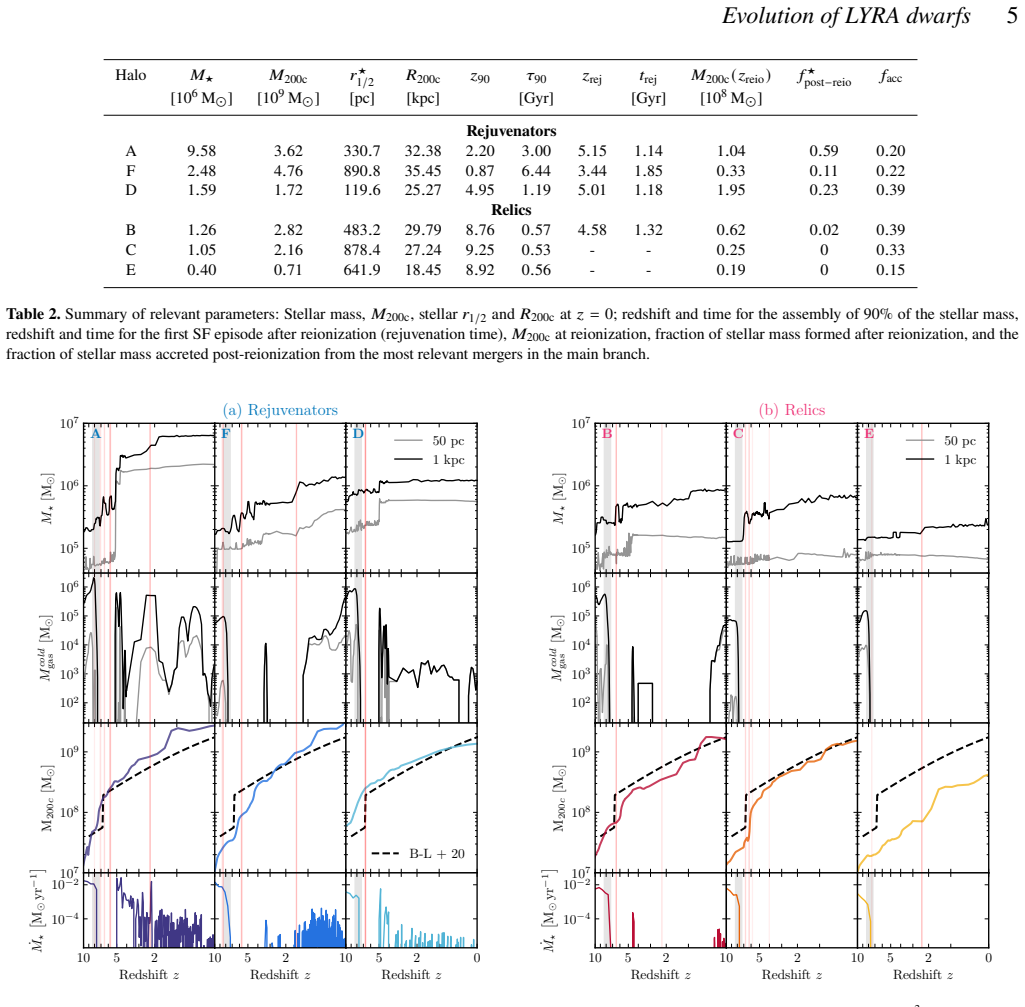
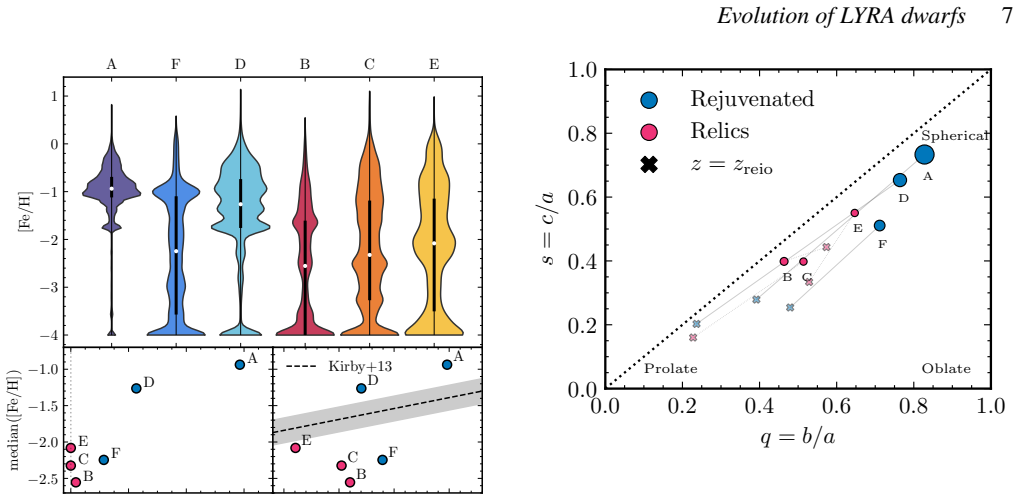
In the LYRA simulations, the fraction of stellar mass formed after reionization, denoted f_post-reio^star, correlates with the metallicity distribution such that reionization relics have lower median [Fe/H] and a more prominent low-metallicity tail. The shape of the stellar component at z=0 is more spherical for rejuvenators than for relics, with the difference emerging after reionization. Inner dark matter halos are also rounder in rejuvenators. All simulated halos become rounder than their dark-matter-only counterparts, with stronger evolution in rejuvenators. No correlation is found between star formation activity and the formation of shallow dark matter density cores.
What carries the argument
The fraction of stars formed post-reionization (f_post-reio^star), which distinguishes rejuvenators from reionization relics and drives correlations with metallicity distributions and galaxy shapes.
If this is right
- Reionization relics exhibit lower median iron abundances and more prominent low-metallicity tails than rejuvenators.
- Rejuvenators display more spherical stellar distributions at z=0 due to post-reionization star formation activity.
- Inner dark matter halos are rounder in rejuvenators than in relics, with all halos rounder than dark-matter-only counterparts.
- The scatter in the low-mass mass-metallicity relation correlates with star formation histories and galaxy shapes.
- These trends offer predictions testable with upcoming observational data on dwarf galaxies.
Where Pith is reading between the lines
- Observers could use measurements of galaxy sphericity and metallicity distributions in dwarfs to estimate the fraction of stars formed after reionization.
- Baryonic processes appear to influence dark matter halo shapes on small scales beyond core formation.
- The co-evolution pattern may help interpret shape variations in observed samples of low-mass galaxies.
Load-bearing premise
The six simulated galaxies and the subgrid physics prescriptions accurately represent the real population of dwarf galaxies and the effects of reionization, feedback, and mergers without major systematic biases.
What would settle it
Finding no difference in median [Fe/H], low-metallicity tail prominence, or shape between observed dwarf galaxies with and without post-reionization star formation in large samples.
Figures



read the original abstract
We use the extremely high-resolution ($m_{\rm bary}=4\rm{M}_\odot$) LYRA cosmological galaxy formation simulations of six dwarf galaxies with $M_{\rm 200c}\sim10^9\rm{M}_\odot$ at $z=0$ to investigate their stellar assembly histories. Based on the age of stars in these galaxies at $z=0$, $40-100\%$ of their stellar mass was formed by the time of reionization, when star formation (SF) abruptly shuts down. Depending on their halo mass evolution, some of the dwarfs reignite SF post-reionization (rejuvenators), while others remain quenched for the rest of cosmic time (reionization relics). However, the stellar mass of relics can still grow by more than $50\%$ through mergers post-reionisation. We find clear correlations between metallicity distributions of the galaxies and the fraction of stars formed post-reionization ($f_{\rm post-reio}^\star$) such that relics have lower median $\rm [Fe/H]$ with a more prominent low metallicity tail. Moreover, the shape of the galaxies at $z=0$ correlates with their $f_{\rm post-reio}^\star$, with rejuvenators showing more spherical stellar distribution than relics. This difference arises only post-reionization when rejuvenators become rounder with more SF activity. Similarly, the shape of dark matter (DM) halos in the inner regions display more spherical distributions in rejuvenators than in relics. The shape evolution shows that DM haloes in all galaxy formation simulations become rounder in comparison to their collision-less, DM-only counterparts. However, DM haloes of rejuvenators evolve more significantly. We do not find any correlation between SF activity and formation of shallow DM density cores in these galaxies. These predictions can be tested using upcoming observational data. In particular, our results indicate that the scatter in the mass-metallicity relation in the low mass regime is correlated with SF histories and the shape of galaxies.
Editorial analysis
A structured set of objections, weighed in public.
Referee Report
Summary. The manuscript analyzes six high-resolution (m_bary = 4 M_⊙) LYRA zoom-in simulations of dwarf galaxies with M_200c ≈ 10^9 M_⊙ at z=0. Galaxies are classified as reionization relics (quenched after reionization) or rejuvenators (resuming star formation post-reionization) based on halo mass evolution and stellar assembly. The central results are empirical correlations: relics exhibit lower median [Fe/H] and a more prominent low-metallicity tail as a function of f_post-reio^star; rejuvenators display more spherical stellar and inner-DM distributions at z=0; DM halos in all hydro runs become rounder than their DM-only counterparts, with stronger evolution in rejuvenators. No correlation is reported between star-formation activity and shallow DM density cores. These trends are offered as testable predictions for the scatter in the low-mass mass-metallicity relation.
Significance. If the reported trends prove robust, the work would link post-reionization baryonic processes directly to observable chemo-morphological properties and to the shape evolution of inner dark-matter halos in the dwarf regime. The extreme mass resolution permits detailed tracking of individual stellar populations and merger-driven growth, which is a clear technical strength. The explicit, falsifiable predictions for metallicity-shape correlations provide a concrete bridge to upcoming resolved-star observations.
major comments (1)
- [§4 and §5] §4 (metallicity results) and §5 (shape results): All reported correlations (median [Fe/H], low-metallicity tail, stellar and inner-DM sphericity) are derived from trends across exactly six galaxies. The manuscript presents these as clear correlations without quantified statistical measures (e.g., Spearman coefficients with bootstrap uncertainties) or tests against modest variations in subgrid feedback efficiency or different zoom-in initial conditions. Because the relic/rejuvenator classification itself depends on the fixed reionization and feedback prescriptions, the load-bearing claim that these differences constitute general predictions for the dwarf population requires either larger statistics or explicit robustness checks.
minor comments (2)
- [§5] The definition of 'inner regions' for DM shape measurements and the precise algorithm used to compute axis ratios (inertia tensor, radial weighting, etc.) should be stated explicitly so that the reported rounding relative to DM-only runs can be reproduced or compared to other suites.
- [Abstract and §6] The abstract and conclusion state that the results 'can be tested using upcoming observational data' but do not name specific observables (e.g., metallicity distribution functions from resolved stars in Local Group dwarfs or shape measurements from IFU surveys) that would directly confront the predicted f_post-reio^star correlations.
Simulated Author's Rebuttal
We thank the referee for their constructive comments and for recommending minor revision. We address the single major comment below, incorporating quantitative measures where feasible while being transparent about the inherent limitations of the current simulation suite.
read point-by-point responses
-
Referee: [§4 and §5] §4 (metallicity results) and §5 (shape results): All reported correlations (median [Fe/H], low-metallicity tail, stellar and inner-DM sphericity) are derived from trends across exactly six galaxies. The manuscript presents these as clear correlations without quantified statistical measures (e.g., Spearman coefficients with bootstrap uncertainties) or tests against modest variations in subgrid feedback efficiency or different zoom-in initial conditions. Because the relic/rejuvenator classification itself depends on the fixed reionization and feedback prescriptions, the load-bearing claim that these differences constitute general predictions for the dwarf population requires either larger statistics or explicit robustness checks.
Authors: We agree that the sample of six galaxies limits the statistical robustness of the reported trends and that the relic/rejuvenator classification is tied to the specific reionization and feedback implementation used. The small sample size is a direct consequence of the extreme baryonic mass resolution (4 M_⊙) required to track individual stellar populations and merger histories in cosmological zoom-ins. In the revised manuscript we have added Spearman rank correlation coefficients together with bootstrap uncertainties for the relations between f_post-reio^star and both the metallicity diagnostics (median [Fe/H] and low-metallicity tail) and the shape parameters (stellar and inner-DM sphericity). These quantitative measures are now reported in §§4 and 5. We have also clarified in the text that the trends are presented as testable predictions from this particular high-resolution suite rather than as statistically general results for the full dwarf population. Explicit robustness checks against changes in subgrid feedback efficiency or different zoom-in initial conditions would require a new set of simulations that lies outside the scope of the present study. revision: partial
- We cannot expand the sample size or perform robustness tests against variations in feedback prescriptions and initial conditions within the current work owing to the prohibitive computational cost of the 4 M_⊙ resolution.
Circularity Check
No significant circularity; results are direct simulation outputs
full rationale
The paper reports empirical correlations and trends extracted from the outputs of the LYRA cosmological simulations run on six specific dwarf galaxies. The relic/rejuvenator classification follows directly from the simulated star-formation histories and halo-mass evolution; the reported differences in metallicity distributions, stellar shapes, and inner DM halo shapes are measured quantities from those runs rather than quantities derived via equations that reduce to the inputs by construction. No fitted parameters are renamed as predictions, no self-citation chains supply the central claims, and no ansatz or uniqueness theorem is invoked to force the results. The analysis is therefore self-contained against the simulation data themselves.
Axiom & Free-Parameter Ledger
free parameters (1)
- subgrid star formation and feedback parameters
axioms (1)
- standard math Lambda-CDM cosmology and a specific reionization model
Lean theorems connected to this paper
-
IndisputableMonolith/Cost/FunctionalEquation.leanwashburn_uniqueness_aczel unclear?
unclearRelation between the paper passage and the cited Recognition theorem.
We use the extremely high-resolution (m_bary=4 M_⊙) LYRA cosmological galaxy formation simulations of six dwarf galaxies... correlations between metallicity distributions... and the fraction of stars formed post-reionization (f_post-reio^★)... shape of the galaxies at z=0 correlates with their f_post-reio^★... DM haloes become rounder...
-
IndisputableMonolith/Foundation/AlexanderDuality.leanalexander_duality_circle_linking unclear?
unclearRelation between the paper passage and the cited Recognition theorem.
We use the method described in Allgood et al. (2006) to quantify the ellipsoidal shape... reduced inertia tensor
What do these tags mean?
- matches
- The paper's claim is directly supported by a theorem in the formal canon.
- supports
- The theorem supports part of the paper's argument, but the paper may add assumptions or extra steps.
- extends
- The paper goes beyond the formal theorem; the theorem is a base layer rather than the whole result.
- uses
- The paper appears to rely on the theorem as machinery.
- contradicts
- The paper's claim conflicts with a theorem or certificate in the canon.
- unclear
- Pith found a possible connection, but the passage is too broad, indirect, or ambiguous to say the theorem truly supports the claim.
Reference graph
Works this paper leans on
-
[1]
V., 2015, ApJ, 804, 18 Agertz O., et al., 2020, MNRAS, 491, 1656 Allgood B., Flores R
Agertz O., Kravtsov A. V., 2015, ApJ, 804, 18 Agertz O., et al., 2020, MNRAS, 491, 1656 Allgood B., Flores R. A., Primack J. R., Kravtsov A. V., Wechsler R. H., Faltenbacher A., Bullock J. S., 2006, MNRAS, 367, 1781 Andersson E. P., Rey M. P., Pontzen A., Cadiou C., Agertz O., Read J. I., Martin N. F., 2025, ApJ, 978, 129 Behroozi P. S., Wechsler R. H., C...
discussion (0)
Sign in with ORCID, Apple, or X to comment. Anyone can read and Pith papers without signing in.