Detecting LLM-Assisted Academic Dishonesty using Keystroke Dynamics
Pith reviewed 2026-05-17 22:37 UTC · model grok-4.3
The pith
Keystroke dynamics distinguish genuine student writing from AI-assisted or paraphrased submissions more reliably than text analysis alone.
A machine-rendered reading of the paper's core claim, the machinery that carries it, and where it could break.
Core claim
By collecting keystroke data from participants completing writing tasks under genuine, AI-assisted, and paraphrased conditions, models using timing and editing features achieve higher detection accuracy for LLM-assisted academic dishonesty than state-of-the-art text-only detectors, although accuracy declines in adversarial scenarios where participants attempt to mask their behavior.
What carries the argument
Keystroke dynamics, which record inter-key intervals, pauses, and revision patterns as the text is produced, provide behavioral signals that reflect differences between human cognitive processes and AI generation.
If this is right
- Keystroke-based models outperform text-only detectors in identifying assisted writing during typical academic submissions.
- Explicit paraphrasing conditions reduce but do not eliminate the advantage of keystroke features over content analysis.
- Adversarial testing reveals clear performance drops when users are aware of monitoring and attempt to deceive the system.
- Comparison with human evaluators shows keystroke approaches maintain an edge in practical, non-adversarial deployment.
Where Pith is reading between the lines
- Real-time keystroke monitoring could be embedded in writing software to flag potential assistance during the composition process rather than after submission.
- The same behavioral signals might apply to detecting AI use in professional reports or creative writing outside academic settings.
- Future work could test whether combining keystroke data with other input signals, such as cursor movements, improves robustness against evasion attempts.
Load-bearing premise
Keystroke timing and editing patterns remain reliably distinguishable between genuine writing and AI-assisted or paraphrased text even when participants are aware of the detection method and attempt to mask their behavior.
What would settle it
An experiment in which participants are instructed to deliberately alter typing speed, pause lengths, and editing habits to imitate either fully human or fully AI-assisted writing, and the keystroke model's accuracy falls to near-chance levels, would falsify the claim of reliable detection.
Figures



read the original abstract
The rapid adoption of generative AI tools has heightened concerns regarding academic integrity, as students increasingly engage in dishonest practices by copying or paraphrasing AI-generated content. Existing plagiarism detection systems, which rely primarily on text-intrinsic features, are ineffective at identifying AI-assisted or paraphrased submissions. Our prior conference work introduced a behavioral detection approach that leverages how text is produced, captured through keystroke dynamics, in addition to what is written, enabling discrimination between genuine and assisted writing. That study, conducted on keystroke data from 40 participants, demonstrated promising performance. This paper substantially extends and systemizes the prior work by: (1) expanding the dataset with 90 additional participants and introducing an explicit paraphrasing condition to model realistic plagiarism strategies; (2) formalizing a threat model and evaluating detection under adversarial and deception-oriented scenarios; and (3) performing a comprehensive empirical comparison against state-of-the-art text-only detectors and human evaluators. Experimental results demonstrate that keystroke-based models significantly outperform text-based approaches in practical deployment settings, while revealing limitations under more challenging adversarial conditions.
Editorial analysis
A structured set of objections, weighed in public.
Referee Report
Summary. The manuscript extends the authors' prior conference work on keystroke dynamics for detecting LLM-assisted academic dishonesty. It adds data from 90 new participants, introduces an explicit paraphrasing condition to model realistic plagiarism, formalizes a threat model that includes adversarial and deception-oriented scenarios, and performs an empirical comparison of keystroke-based models against state-of-the-art text-only detectors and human evaluators. The central claim is that keystroke models significantly outperform text-based approaches in practical deployment settings while exhibiting limitations under more challenging adversarial conditions.
Significance. If the empirical results hold, the work provides a timely behavioral complement to text-intrinsic plagiarism detectors, which are known to struggle with AI-generated or paraphrased content. The dataset expansion, explicit threat-model formalization, and inclusion of adversarial testing represent clear improvements over the prior 40-participant study. The explicit acknowledgment of performance degradation under adversarial conditions strengthens the paper's credibility by avoiding over-claiming robustness.
major comments (2)
- [Abstract] Abstract: the claim that 'keystroke-based models significantly outperform text-based approaches' is presented without any quantitative metrics (accuracy, F1, AUC), error bars, dataset statistics, or model specifications. Because this outperformance is the central empirical result, the absence of these details in the summary statement makes it impossible to assess whether the data actually support the stated conclusion.
- [Threat Model / Adversarial Scenarios] Threat model and adversarial scenarios: the description of deception-oriented conditions with the 90 new participants does not specify whether participants received training or instructions on realistic evasion tactics (e.g., forced pauses, simulated natural burst patterns, or external typing aids) while still using AI content. If the scenarios are limited to basic paraphrasing without such training, the reported limitations may understate real-world failure modes and thereby weaken the practical-deployment outperformance claim.
minor comments (2)
- [Methods / Dataset] Provide participant demographics, typing-task instructions, and exact keystroke feature definitions (timing, editing patterns) in the methods section so that the experimental protocol is fully reproducible.
- [Results] All performance tables and figures should include confidence intervals or standard errors and should explicitly label the baseline text-only detectors (e.g., which SOTA models were used).
Simulated Author's Rebuttal
We thank the referee for the constructive and detailed feedback. We address each major comment point by point below, providing clarifications and indicating revisions to the manuscript where they strengthen the presentation without altering the core findings.
read point-by-point responses
-
Referee: [Abstract] Abstract: the claim that 'keystroke-based models significantly outperform text-based approaches' is presented without any quantitative metrics (accuracy, F1, AUC), error bars, dataset statistics, or model specifications. Because this outperformance is the central empirical result, the absence of these details in the summary statement makes it impossible to assess whether the data actually support the stated conclusion.
Authors: We agree that the abstract would benefit from key quantitative details to support the central claim. While abstracts are constrained by length, we have revised it to include specific metrics such as accuracy, F1-score, and AUC (with standard deviations) from the keystroke-based models versus text-only baselines on the expanded 130-participant dataset, along with a brief note on the experimental setup. revision: yes
-
Referee: [Threat Model / Adversarial Scenarios] Threat model and adversarial scenarios: the description of deception-oriented conditions with the 90 new participants does not specify whether participants received training or instructions on realistic evasion tactics (e.g., forced pauses, simulated natural burst patterns, or external typing aids) while still using AI content. If the scenarios are limited to basic paraphrasing without such training, the reported limitations may understate real-world failure modes and thereby weaken the practical-deployment outperformance claim.
Authors: Participants in the deception-oriented conditions were given instructions to paraphrase AI-generated text to simulate realistic student plagiarism but received no training or guidance on advanced evasion tactics such as forced pauses, burst pattern simulation, or typing aids. This reflects typical non-expert user behavior. We have revised the threat model section to explicitly describe the participant instructions and expanded the limitations discussion to note that more sophisticated adversarial training could further degrade performance, thereby providing a more balanced view of the practical outperformance results. revision: yes
Circularity Check
Minor self-citation of prior conference work that is not load-bearing for central empirical claims
full rationale
The paper frames itself as an empirical extension that collects fresh keystroke data from 90 new participants, adds an explicit paraphrasing condition, formalizes a threat model, and runs comparisons against text-only detectors and human evaluators. The abstract explicitly positions the prior conference work only as the source of the initial behavioral approach, with all performance claims and limitations derived from the new dataset and experiments rather than from any fitted parameters or equations carried over by construction. No self-definitional reductions, fitted-input predictions, or uniqueness theorems appear in the provided text, so the single self-citation remains non-load-bearing and the overall derivation chain stays self-contained against external benchmarks.
Axiom & Free-Parameter Ledger
axioms (1)
- domain assumption Keystroke dynamics contain stable behavioral signatures that differ between original human writing and AI-assisted or paraphrased text.
Lean theorems connected to this paper
-
IndisputableMonolith/Cost/FunctionalEquation.leanwashburn_uniqueness_aczel unclear?
unclearRelation between the paper passage and the cited Recognition theorem.
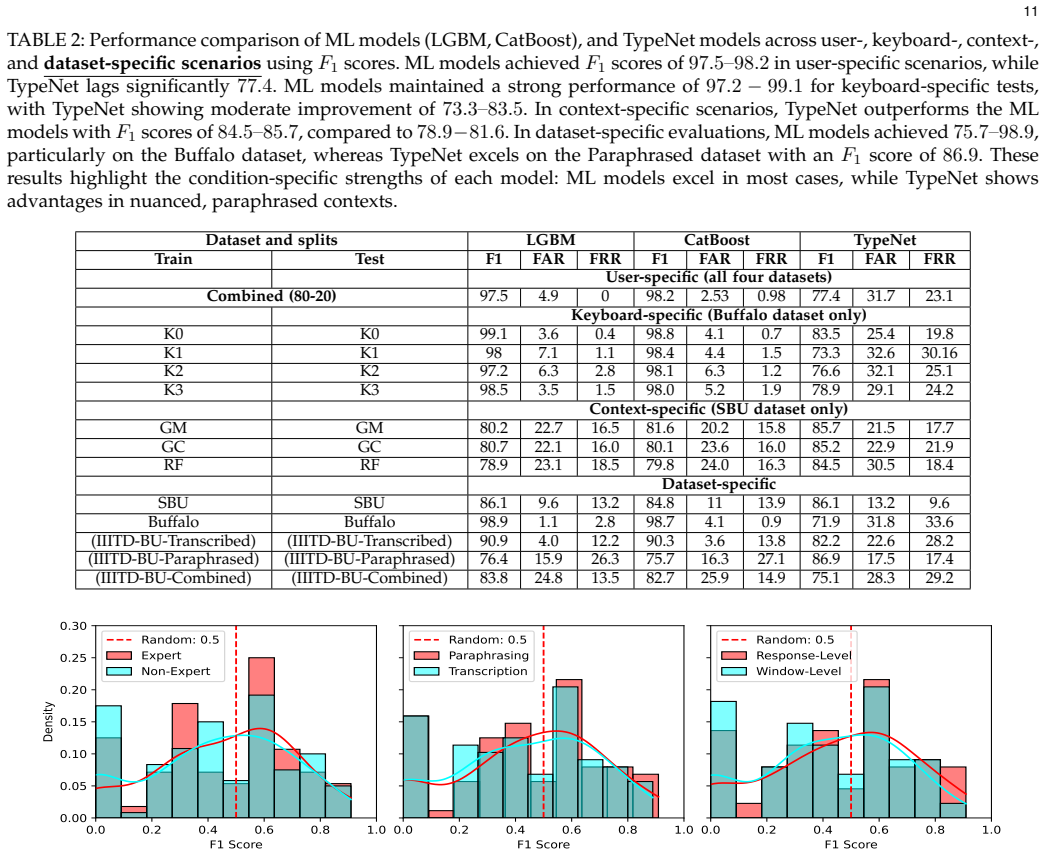
We employed a sliding window approach to divide keystroke sequences into fixed-length segments of 1000 keystrokes... extracted... dwell time... flight time... LGBM and CatBoost... TypeNet... deception-based threat model... adversarial training
-
IndisputableMonolith/Foundation/AlexanderDuality.leanalexander_duality_circle_linking unclear?
unclearRelation between the paper passage and the cited Recognition theorem.
IIITD-BU-Paraphrased dataset... paraphrasing... cognitive load... Bloom’s revised taxonomy
What do these tags mean?
- matches
- The paper's claim is directly supported by a theorem in the formal canon.
- supports
- The theorem supports part of the paper's argument, but the paper may add assumptions or extra steps.
- extends
- The paper goes beyond the formal theorem; the theorem is a base layer rather than the whole result.
- uses
- The paper appears to rely on the theorem as machinery.
- contradicts
- The paper's claim conflicts with a theorem or certificate in the canon.
- unclear
- Pith found a possible connection, but the passage is too broad, indirect, or ambiguous to say the theorem truly supports the claim.
Forward citations
Cited by 1 Pith paper
-
Detecting Cognitive Signatures in Typing Behavior for Non-Intrusive Authorship Verification
Cognitive Load Correlation from keystroke timings distinguishes genuine human composition from mechanical transcription with estimated 85-95% accuracy in a non-intrusive framework.
Reference graph
Works this paper leans on
-
[1]
The impact of chatgpt on higher education.Frontiers in Education, 2023
Juan Dempere, Kennedy Modugu, Allam Hesham, and Lakshmana Kumar Ramasamy. The impact of chatgpt on higher education.Frontiers in Education, 2023
work page 2023
-
[2]
Elizabeth Clark, Tal August, Sofia Serrano, Nikita Haduong, Suchin Gururangan, and Noah A Smith. All that’s’ human’is not gold: Evaluating human evaluation of generated text.arXiv preprint arXiv:2107.00061, 2021
-
[3]
Automatic detection of generated text is easiest when humans are fooled
Daphne Ippolito, Daniel Duckworth, Chris Callison-Burch, and Douglas Eck. Automatic detection of generated text is easiest when humans are fooled. arXiv preprint arXiv:1911.00650, 2019
-
[4]
D. Roh, R. Kumar, and A. Ngo. Llm-assisted cheating detection in korean language via keystrokes. InIEEE IJCB, 2025. Paper, acceptance rate∼39%
work page 2025
-
[5]
Liam Dugan, Daphne Ippolito, Arun Kirubarajan, Sherry Shi, and Chris Callison-Burch. Real or fake text?: Investigating human ability to detect boundaries between human-written and machine-generated text. InAAAI, 2023
work page 2023
-
[6]
Duanli Yan, Michael Fauss, Jiangang Hao, and Wenju Cui. Detection of ai-generated essays in writing assessments.Psychological Test and Assessment Modeling, 2023
work page 2023
-
[7]
Rebira Jemma and Rajesh Kumar. How well do llms imitate human writing style? InProceedings of the IEEE UEMCON, New York, NY, United States, 2025
work page 2025
-
[8]
Tweepfake: About detecting deepfake tweets.Plos one, 2021
Tiziano Fagni, Fabrizio Falchi, Margherita Gambini, Antonio Martella, and Maurizio Tesconi. Tweepfake: About detecting deepfake tweets.Plos one, 2021
work page 2021
-
[9]
Release Strategies and the Social Impacts of Language Models
Irene Solaiman, Miles Brundage, Jack Clark, Amanda Askell, Ariel Herbert-Voss, Jeff Wu, Alec Radford, Gretchen Krueger, Jong Wook Kim, Sarah Kreps, et al. Release strategies and the social impacts of language models.arXiv preprint arXiv:1908.09203, 2019
work page internal anchor Pith review Pith/arXiv arXiv 1908
-
[10]
Authorship attribution for neural text generation
Adaku Uchendu, Thai Le, Kai Shu, and Dongwon Lee. Authorship attribution for neural text generation. In Proceedings of the 2020 conference on empirical methods in natural language processing (EMNLP), 2020
work page 2020
-
[11]
Defending against neural fake news.Advances in neural information processing systems, 2019
Rowan Zellers, Ari Holtzman, Hannah Rashkin, Yonatan Bisk, Ali Farhadi, Franziska Roesner, and Yejin Choi. Defending against neural fake news.Advances in neural information processing systems, 2019
work page 2019
-
[12]
Leon Fr ¨ohling and Arkaitz Zubiaga. Feature-based detection of automated language models: tackling gpt-2, gpt-3 and grover.PeerJ Computer Science, 2021
work page 2021
-
[13]
GLTR: Statistical Detection and Visualization of Generated Text
Sebastian Gehrmann, Hendrik Strobelt, and Alexander M Rush. Gltr: Statistical detection and visualization of generated text.arXiv preprint arXiv:1906.04043, 2019
work page internal anchor Pith review Pith/arXiv arXiv 1906
-
[14]
Yaman Kumar, Swapnil Parekh, Somesh Singh, Junyi Jessy Li, Rajiv Ratn Shah, and Changyou Chen. Automatic essay scoring systems are both overstable and oversensitive: explaining why and proposing defenses.Dialogue & Discourse, 2023
work page 2023
-
[15]
Minimal: Mining models for universal adversarial triggers
Yaman Kumar Singla, Swapnil Parekh, Somesh Singh, Changyou Chen, Balaji Krishnamurthy, and Rajiv Ratn Shah. Minimal: Mining models for universal adversarial triggers. InProceedings of the AAAI Conference on Artificial Intelligence, 2022. 15
work page 2022
-
[16]
Detecting fake content with relative entropy scoring
Thomas Lavergne, Tanguy Urvoy, and Franc ¸ois Yvon. Detecting fake content with relative entropy scoring. Pan, 2008
work page 2008
-
[17]
Zerogpt, Quillbot, GPTZero, and Writefull
Zerogpt and Quillbot and GPTZero and Writefull. Zerogpt, Quillbot, GPTZero, and Writefull. Accessed via web, 2024. Zerogpt: https://www.zerogpt.com/, Quillbot: https://quillbot.com/, GPTZero: https:// gptzero.me/, Writefull: https://www.writefull.com/
work page 2024
-
[18]
Llm student sues jindal global law school over ai use in examination, 2024
The Hindu Bureau. Llm student sues jindal global law school over ai use in examination, 2024
work page 2024
-
[19]
Professors cautious of tools to detect ai-generated writing, February 2024
Lauren Coffey. Professors cautious of tools to detect ai-generated writing, February 2024
work page 2024
-
[20]
Turnitin admits there are some cases of higher false positives in ai writing detection tool, 2023
Anna Merod. Turnitin admits there are some cases of higher false positives in ai writing detection tool, 2023
work page 2023
-
[21]
Jeffrey R. Young. What happened after this college student’s paper was falsely flagged for ai use after using grammarly, February 2024
work page 2024
-
[22]
Guidance on ai detection and why we’re disabling turnitin’s ai detector, August 2023
Michael Coley. Guidance on ai detection and why we’re disabling turnitin’s ai detector, August 2023
work page 2023
-
[23]
Parents sue son’s high school history teacher over ai ‘cheating’ punishment, October 2024
Kat Tenbarge. Parents sue son’s high school history teacher over ai ‘cheating’ punishment, October 2024
work page 2024
-
[24]
Keystroke Dynamics - Plurilock — plurilock.com
Plurilock. Keystroke Dynamics - Plurilock — plurilock.com. https://plurilock.com/deep-dive/ keystroke-dynamics/, 2024. [Accessed 31-12-2024]
work page 2024
-
[25]
Augmented reality-based mimicry attacks on behaviour-based smartphone authentication
Hassan Khan, Urs Hengartner, and Daniel Vogel. Augmented reality-based mimicry attacks on behaviour-based smartphone authentication. In Proceedings of the 16th Annual International Conference on Mobile Systems, Applications, and Services, 2018
work page 2018
-
[26]
Hassan Khan, Urs Hengartner, and Daniel Vogel. Mimicry attacks on smartphone keystroke authentication.ACM Transactions on Privacy and Security, 2020
work page 2020
-
[27]
Monaco, Ruben Vera-Rodriguez, and Julian Fierrez
Alejandro Acien, Aythami Morales, John V . Monaco, Ruben Vera-Rodriguez, and Julian Fierrez. Typenet: Deep learning keystroke biometrics.IEEE TBIOM, 2022
work page 2022
-
[28]
John R. Hayes and Linda Flower. Uncovering Cognitive Processes in Writing: An Introduction to protocol analysis.ERIC Clearinghouse, 1981
work page 1981
-
[29]
Ann Matsuhashi. Pausing and planning: The tempo of written discourse production.Research in the Teaching of English, 1981
work page 1981
-
[30]
Pause time patterns in writing narrative and expository texts by children and adults
Janet G Van Hell, Ludo Verhoeven, and Liesbeth M Van Beijsterveldt. Pause time patterns in writing narrative and expository texts by children and adults. Discourse Processes, 2008
work page 2008
-
[31]
Keystroke dynamics against academic dishonesty in the age of llms.IEEE IJCB, 2024
Debnath Kundu, Atharva Mehta, Rajesh Kumar, Naman Lal, Avinash Anand, Apoorv Singh, and Rajiv Ratn Shah. Keystroke dynamics against academic dishonesty in the age of llms.IEEE IJCB, 2024
work page 2024
-
[32]
Keystroke patterns as prosody in digital writings: A case study with deceptive reviews and essays
Ritwik Banerjee, Song Feng, Jun Seok Kang, and Yejin Choi. Keystroke patterns as prosody in digital writings: A case study with deceptive reviews and essays. In EMNLP, Doha, Qatar, 2014
work page 2014
-
[33]
Shared keystroke dataset for continuous authentication
Yan Sun, Hayreddin Ceker, and Shambhu Upadhyaya. Shared keystroke dataset for continuous authentication. InWIFS, 2016
work page 2016
-
[34]
Detectgpt: Zero-shot machine-generated text detection using probability curvature
Eric Mitchell, Yoonho Lee, Alexander Khazatsky, Christopher D Manning, and Chelsea Finn. Detectgpt: Zero-shot machine-generated text detection using probability curvature. InICML, 2023
work page 2023
-
[35]
Academic plagiarism detection: a systematic literature review.ACM Computing Surveys (CSUR), 2019
Tom ´aˇs Folt `ynek, Norman Meuschke, and Bela Gipp. Academic plagiarism detection: a systematic literature review.ACM Computing Surveys (CSUR), 2019
work page 2019
-
[36]
A comprehensive review on fake news detection with deep learning.IEEE Access, 2021
Muhammad Firoz Mridha, Ashfia Jannat Keya, Md Abdul Hamid, Muhammad Mostafa Monowar, and Md Saifur Rahman. A comprehensive review on fake news detection with deep learning.IEEE Access, 2021
work page 2021
-
[37]
Finding Deceptive Opinion Spam by Any Stretch of the Imagination
Myle Ott, Yejin Choi, Claire Cardie, and Jeffrey T Hancock. Finding deceptive opinion spam by any stretch of the imagination.arXiv preprint arXiv:1107.4557, 2011
work page internal anchor Pith review Pith/arXiv arXiv 2011
-
[38]
Survey of review spam detection using machine learning techniques.Journal of Big Data, 2015
Michael Crawford, Taghi M Khoshgoftaar, Joseph D Prusa, Aaron N Richter, and Hamzah Al Najada. Survey of review spam detection using machine learning techniques.Journal of Big Data, 2015
work page 2015
-
[39]
Nguyen, Junichi Yamagishi, and Isao Echizen
David Ifeoluwa Adelani, Haotian Mai, Fuming Fang, Huy H. Nguyen, Junichi Yamagishi, and Isao Echizen. Generating Sentiment-Preserving fake online reviews using neural language models and their human- and Machine-Based detection. 2020
work page 2020
-
[40]
Max Weiss. Deepfake bot submissions to federal public comment websites cannot be distinguished from human submissions.Technology Science, 2019
work page 2019
-
[41]
Chenhao Tan, Lillian Lee, and Bo Pang. The effect of wording on message propagation: Topic- and author-controlled natural experiments on Twitter. Baltimore, Maryland, June 2014. ACL
work page 2014
-
[42]
What makes a photograph memorable?IEEE TP AMI, 2013
Phillip Isola, Jianxiong Xiao, Devi Parikh, Antonio Torralba, and Aude Oliva. What makes a photograph memorable?IEEE TP AMI, 2013
work page 2013
-
[43]
Long-term ad memorability: Understanding & generating memorable ads.arXiv e-prints, 2023
Harini SI, Somesh Singh, Yaman K Singla, Aanisha Bhattacharyya, Veeky Baths, Changyou Chen, Rajiv Ratn Shah, and Balaji Krishnamurthy. Long-term ad memorability: Understanding & generating memorable ads.arXiv e-prints, 2023
work page 2023
-
[44]
Somesh Singh, Yaman K Singla, Harini SI, and Balaji Krishnamurthy. Measuring and improving persuasiveness of large language models.arXiv preprint arXiv:2410.02653, 2024
-
[45]
Philip E Tetlock. Expert political judgment. InExpert Political Judgment. Princeton University Press, 2017
work page 2017
-
[46]
Natural language watermarking: Design, analysis, and a proof-of-concept implementation
Mikhail J Atallah, Victor Raskin, Michael Crogan, Christian Hempelmann, Florian Kerschbaum, Dina Mohamed, and Sanket Naik. Natural language watermarking: Design, analysis, and a proof-of-concept implementation. InInformation Hiding: 4th International Workshop. Springer, 2001
work page 2001
-
[47]
A watermark for large language models
John Kirchenbauer, Jonas Geiping, Yuxin Wen, Jonathan Katz, Ian Miers, and Tom Goldstein. A watermark for large language models. InICML, 2023
work page 2023
-
[48]
Detecting contract cheating using learning analytics.Journal of Learning Analytics, 2019
Kelly Trezise, Tracii Ryan, Paula de Barba, and Gregor Kennedy. Detecting contract cheating using learning analytics.Journal of Learning Analytics, 2019
work page 2019
-
[49]
Contract cheat detection using biometric keystroke dynamics
Nancy Agarwal, Nils Folvik Danielsen, Per Kristian Gravdal, and Patrick Bours. Contract cheat detection using biometric keystroke dynamics. In2022 20th International Conference on Emerging eLearning Technologies and Applications (ICETA), 2022
work page 2022
-
[50]
Steven A McCornack. The generation of deceptive messages: Laying the groundwork for a viable theory 16 of interpersonal deception. InMessage production. Routledge, 2013
work page 2013
-
[51]
Detecting deception by manipulating cognitive load.Trends in cognitive sciences, 2006
Aldert Vrij, Ronald Fisher, Samantha Mann, and Sharon Leal. Detecting deception by manipulating cognitive load.Trends in cognitive sciences, 2006
work page 2006
-
[52]
Darwin, deception, and facial expression
Paul Ekman. Darwin, deception, and facial expression. Annals of the new York Academy of sciences, 2003
work page 2003
-
[53]
Lisa M Vizer, Lina Zhou, and Andrew Sears. Automated stress detection using keystroke and linguistic features: An exploratory study.International Journal of Human-Computer Studies, 2009
work page 2009
-
[54]
Keystroke dynamics as signal for shallow syntactic parsing
Barbara Plank. Keystroke dynamics as signal for shallow syntactic parsing.arXiv preprint arXiv:1610.03321, 2016
work page internal anchor Pith review Pith/arXiv arXiv 2016
-
[55]
Teaching human behavior improves content understanding abilities of llms, 2024
Somesh Singh, Harini S I, Yaman K Singla, Veeky Baths, Rajiv Ratn Shah, Changyou Chen, and Balaji Krishnamurthy. Teaching human behavior improves content understanding abilities of llms, 2024
work page 2024
-
[56]
Synthesizing human gaze feedback for improved nlp performance.arXiv preprint arXiv:2302.05721, 2023
Varun Khurana, Yaman Kumar Singla, Nora Hollenstein, Rajesh Kumar, and Balaji Krishnamurthy. Synthesizing human gaze feedback for improved nlp performance.arXiv preprint arXiv:2302.05721, 2023
-
[57]
Improving natural language processing tasks with human gaze-guided neural attention.NIPS’20
Ekta Sood, Simon Tannert, Philipp M ¨uller, and Andreas Bulling. Improving natural language processing tasks with human gaze-guided neural attention.NIPS’20
-
[58]
Behavior optimized image generation.arXiv preprint arXiv:2311.10995, 2023
Varun Khurana, Yaman K Singla, Jayakumar Subramanian, Rajiv Ratn Shah, Changyou Chen, Zhiqiang Xu, and Balaji Krishnamurthy. Behavior optimized image generation.arXiv preprint arXiv:2311.10995, 2023
-
[59]
Learning to summarize with human feedback.NeurIPS, 2020
Nisan Stiennon, Long Ouyang, Jeffrey Wu, Daniel Ziegler, Ryan Lowe, Chelsea Voss, Alec Radford, Dario Amodei, and Paul F Christiano. Learning to summarize with human feedback.NeurIPS, 2020
work page 2020
-
[60]
Human preference score: Better aligning text-to-image models with human preference
Xiaoshi Wu, Keqiang Sun, Feng Zhu, Rui Zhao, and Hongsheng Li. Human preference score: Better aligning text-to-image models with human preference. InIEEE ICCV, 2023
work page 2023
-
[61]
Training a Helpful and Harmless Assistant with Reinforcement Learning from Human Feedback
Yuntao Bai, Andy Jones, Kamal Ndousse, Amanda Askell, Anna Chen, Nova DasSarma, Dawn Drain, Stanislav Fort, Deep Ganguli, Tom Henighan, et al. Training a helpful and harmless assistant with reinforcement learning from human feedback.arXiv preprint arXiv:2204.05862, 2022
work page internal anchor Pith review Pith/arXiv arXiv 2022
-
[62]
Training language models to follow instructions with human feedback.Neurips, 2022
Long Ouyang, Jeffrey Wu, Xu Jiang, Diogo Almeida, Carroll Wainwright, Pamela Mishkin, Chong Zhang, Sandhini Agarwal, Katarina Slama, Alex Ray, et al. Training language models to follow instructions with human feedback.Neurips, 2022
work page 2022
-
[63]
Ashmit Khandelwal, Aditya Agrawal, Aanisha Bhattacharyya, Yaman K Singla, Somesh Singh, Uttaran Bhattacharya, Ishita Dasgupta, Stefano Petrangeli, Rajiv Ratn Shah, Changyou Chen, et al. Large content and behavior models to understand, simulate, and optimize content and behavior.arXiv preprint arXiv:2309.00359, 2023
-
[64]
Socia: Training large language models to simulate social constructs and interventions
Aanisha Bhattacharyya, Susmit Agrawal, Yaman Kumar Singla, SR Nikitha, Tarun Ram Menta, and Balaji Krishnamurthy. Socia: Training large language models to simulate social constructs and interventions
-
[65]
Luuk Van Waes, Mari ¨elle Leijten, and Daphne Van Weijen. Keystroke logging in writing research: Observing writing processes with inputlog.German as a foreign language, 2009
work page 2009
-
[66]
Examining pauses in writing: Theory, methods and empirical data
˚Asa Wengelin. Examining pauses in writing: Theory, methods and empirical data. InComputer key-stroke logging and writing. Brill, 2006
work page 2006
-
[67]
Keystroke analysis: Reflections on procedures and measures.Written Communication, 2012
Veerle M Baaijen, David Galbraith, and Kees De Glopper. Keystroke analysis: Reflections on procedures and measures.Written Communication, 2012
work page 2012
-
[68]
Pattern Analysis and Recognition Corporation, 1977
George E Forsen, Mark R Nelson, and Raymond J Staron.Personal attributes authentication techniques. Pattern Analysis and Recognition Corporation, 1977
work page 1977
-
[69]
Verifying identity via keystroke characterstics.International Journal of Man-Machine Studies, 1988
John Leggett and Glen Williams. Verifying identity via keystroke characterstics.International Journal of Man-Machine Studies, 1988
work page 1988
-
[70]
D. H. Roh and R. Kumar. Active authentication via korean keystrokes under varying llm assistance and cognitive contexts. InICMLA, 2025
work page 2025
-
[71]
Lorin W. Anderson, David R. Krathwohl, Peter W. Airasian, Kathleen A. Cruikshank, Richard E. Mayer, Paul R. Pintrich, James Raths, and Merlin C. Wittrock. A Taxonomy for Learning, Teaching, and Assessing: A Revision of Bloom’s Taxonomy of Educational Objectives. Addison Wesley Longman, Inc., New York, 2001
work page 2001
- [72]
-
[73]
Authentication by keystroke timing: Some preliminary results.Rand Report, 1980
S Press. Authentication by keystroke timing: Some preliminary results.Rand Report, 1980
work page 1980
-
[74]
Keystroke dynamics: Concepts, techniques, and applications.arXiv preprint arXiv:2303.04605, 2023
Rashik Shadman, Ahmed Anu Wahab, Michael Manno, Matthew Lukaszewski, Daqing Hou, and Faraz Hussain. Keystroke dynamics: Concepts, techniques, and applications.arXiv preprint arXiv:2303.04605, 2023
-
[75]
Keystroke analysis of free text.ACM Trans
Daniele Gunetti and Claudia Picardi. Keystroke analysis of free text.ACM Trans. Inf. Syst. Secur., 2005
work page 2005
-
[76]
Methods of identifying users based on text entered on keyboard.Patent Pending’ 10
V Phoha and S Joshi. Methods of identifying users based on text entered on keyboard.Patent Pending’ 10
-
[77]
Banavar, Daqing Hou, and Stephanie Schuckers
Blaine Ayotte, Mahesh K. Banavar, Daqing Hou, and Stephanie Schuckers. Fast and accurate continuous user authentication by fusion of instance-based, free-text keystroke dynamics. In A. Br ¨omme, C. Busch, A. Dantcheva, C. Rathgeb, and A. Uhl, editors,Proc. BIOSIG 2019 – Int. Conf. Biometrics Special Interest Group, Lecture Notes in Informatics (LNI), Bonn...
work page 2019
-
[78]
Fast free-text authentication via instance-based keystroke dynamics.IEEE TBIOM, 2020
Blaine Ayotte, Mahesh Banavar, Daqing Hou, and Stephanie Schuckers. Fast free-text authentication via instance-based keystroke dynamics.IEEE TBIOM, 2020
work page 2020
-
[79]
When simple statistical algorithms outperform deep learning: A case of keystroke dynamics
Ahmed Wahab and Daqing Hou. When simple statistical algorithms outperform deep learning: A case of keystroke dynamics. InICPRAM, 2023
work page 2023
-
[80]
Spotting fake profiles in social networks via keystroke dynamics
Alvin Kuruvilla, Rojanaye Daley, and Rajesh Kumar. Spotting fake profiles in social networks via keystroke dynamics. InIEEE-CCNC, 2024
work page 2024
discussion (0)
Sign in with ORCID, Apple, or X to comment. Anyone can read and Pith papers without signing in.