Self-Organization and Spectral Mechanism of Attractor Landscapes in High-Capacity Kernel Hopfield Networks
Pith reviewed 2026-05-17 22:12 UTC · model grok-4.3
The pith
Kernel Hopfield networks self-organize a spectral ridge where the leading eigenvalue boosts global stability while trailing eigenvalues preserve high memory capacity.
A machine-rendered reading of the paper's core claim, the machinery that carries it, and where it could break.
Core claim
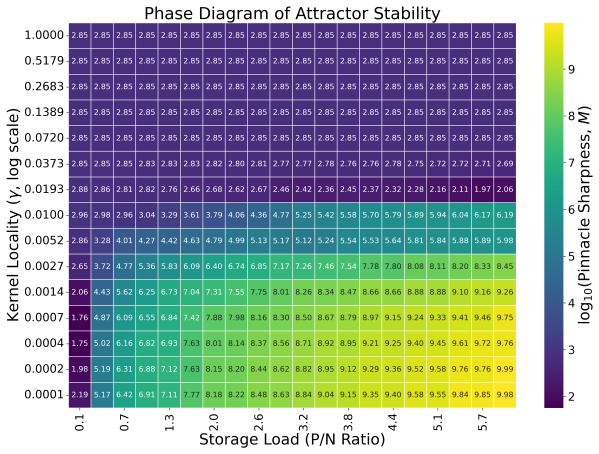
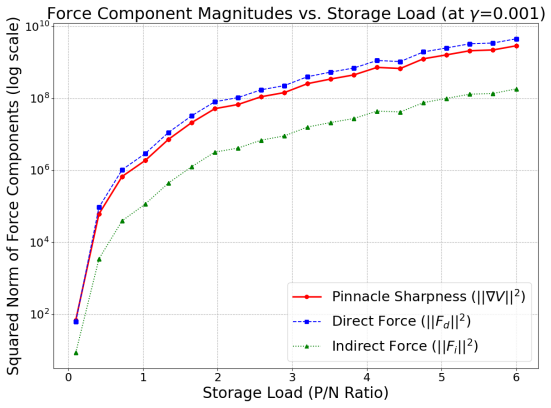
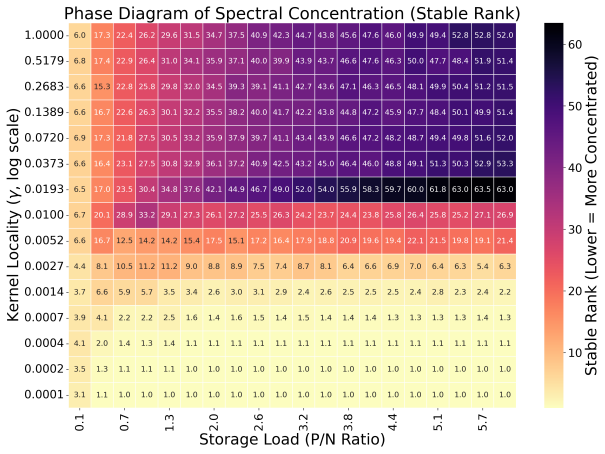
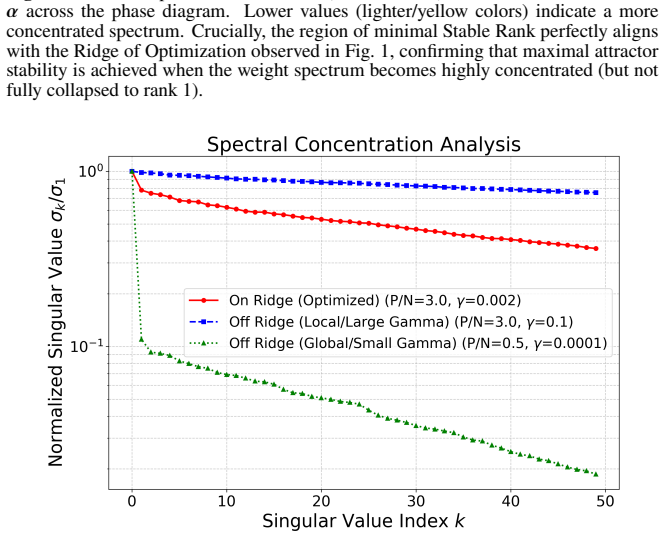
High-capacity kernel Hopfield networks self-organize into a critical regime on the Ridge of Optimization. There the weight spectrum reorganizes through Spectral Concentration: the leading eigenvalue is amplified to produce a Direct Force that enhances global stability, while the trailing eigenvalues remain finite to generate an Indirect Force that sustains high memory capacity. This antagonism between forces arises naturally from the learning dynamics rather than from an imposed rank-1 collapse.
What carries the argument
Spectral Concentration, the reorganization of the eigenvalue spectrum in which the dominant eigenvalue grows to strengthen global stability while the bulk of eigenvalues stays finite to maintain capacity.
If this is right
- Maximal robustness appears under high-load conditions precisely on the identified ridge.
- Learning reconciles stability and capacity through the described balance of direct and indirect forces.
- The attractor landscape exhibits a rich phase diagram with a distinct region of optimization.
- Force Antagonism emerges as the phenomenological signature of the underlying spectral change.
Where Pith is reading between the lines
- The same spectral balance could be engineered deliberately in other associative-memory architectures to improve capacity without sacrificing stability.
- Biological networks that store many memories may operate near an analogous critical spectral regime.
- The Pinnacle Sharpness metric offers a practical diagnostic for locating high-performance operating points in trained recurrent networks.
Load-bearing premise
The phase diagram and spectral reorganization are produced by self-organization inside the attractor landscape rather than by the specific kernel, simulation parameters, or post-hoc choice of the ridge region.
What would settle it
Run the same learning protocol on a different kernel or with altered regularization and check whether the ridge, the amplification of the leading eigenvalue, and the plateau of trailing eigenvalues all disappear.
Figures

read the original abstract
Kernel-based learning methods can dramatically increase the storage capacity of Hopfield networks, yet the dynamical mechanisms behind this enhancement remain poorly understood. We address this gap by combining a geometric characterization of the attractor landscape with the spectral theory of kernel machines. Using a novel metric, Pinnacle Sharpness, we empirically uncover a rich phase diagram of attractor stability, identifying a Ridge of Optimization where the network achieves maximal robustness under high-load conditions. Phenomenologically, this ridge is characterized by a Force Antagonism, in which a strong driving force is counterbalanced by a collective feedback force. We theoretically interpret this behavior as a consequence of a specific reorganization of the weight spectrum, which we term Spectral Concentration. Unlike a simple rank-1 collapse, our analysis shows that the network on the ridge self-organizes into a critical regime: the leading eigenvalue is amplified to enhance global stability (Direct Force), while the trailing eigenvalues remain finite to sustain high memory capacity (Indirect Force). Together, these results suggest a spectral mechanism by which learning reconciles stability and capacity in high-dimensional associative memory models.
Editorial analysis
A structured set of objections, weighed in public.
Referee Report
Summary. The manuscript claims that kernel-based Hopfield networks self-organize their attractor landscapes under high load, as revealed by a new metric (Pinnacle Sharpness) that uncovers a phase diagram containing a Ridge of Optimization. This ridge exhibits Force Antagonism (strong driving force balanced by collective feedback) and is theoretically interpreted via Spectral Concentration: the leading eigenvalue is amplified to enhance global stability (Direct Force) while trailing eigenvalues remain finite to preserve high memory capacity (Indirect Force).
Significance. If the central claims hold, the work supplies a concrete spectral mechanism explaining how learning reconciles stability and capacity in high-dimensional associative memories, extending geometric and spectral analyses of kernel machines. The empirical phase diagram and the distinction between Direct and Indirect Forces constitute the main contributions; the introduction of Pinnacle Sharpness as a diagnostic tool is a useful methodological addition.
major comments (2)
- [§4] §4 (phase-diagram construction): the Ridge of Optimization is identified post hoc as the region of peak Pinnacle Sharpness; because the subsequent spectral analysis is performed precisely on this selected region, the reported Spectral Concentration risks being a direct algebraic consequence of the selection criterion and the fixed kernel rather than an emergent dynamical property.
- [§5.2] §5.2 (spectral interpretation): the claim that the network self-organizes into a critical regime with amplified leading eigenvalue (Direct Force) and finite trailing eigenvalues (Indirect Force) is presented without a derivation from the underlying learning dynamics or network equations that would hold independently of kernel choice and load parameter; the observed antagonism may reduce to a property of the Gram matrix at high load.
minor comments (3)
- Clarify the precise mathematical definition of Pinnacle Sharpness and its relation to existing stability measures (e.g., basin volume or Lyapunov exponents) in a dedicated subsection.
- Add statistical error bars or multiple random seeds to the phase-diagram plots to quantify variability across realizations.
- Expand the discussion of related work on spectral properties of kernel matrices in associative memories to better situate the novelty of Spectral Concentration.
Simulated Author's Rebuttal
We thank the referee for the constructive comments, which help clarify the distinction between empirical observation and theoretical mechanism. We address each major comment below and indicate the revisions we will make.
read point-by-point responses
-
Referee: [§4] §4 (phase-diagram construction): the Ridge of Optimization is identified post hoc as the region of peak Pinnacle Sharpness; because the subsequent spectral analysis is performed precisely on this selected region, the reported Spectral Concentration risks being a direct algebraic consequence of the selection criterion and the fixed kernel rather than an emergent dynamical property.
Authors: We agree that the Ridge is located by maximizing Pinnacle Sharpness and that subsequent spectral analysis is performed on this region. Pinnacle Sharpness is defined from the geometry of the energy landscape (local curvature at fixed points) and is independent of the eigenvalue decomposition. Nevertheless, to rule out selection artifacts we will add control analyses in the revised §4: (i) spectra computed along trajectories during learning before the ridge is reached, and (ii) spectra at parameter points of comparable load but lower Pinnacle Sharpness. These controls will demonstrate that the reported antagonism between leading and trailing eigenvalues appears specifically when Pinnacle Sharpness is maximal, supporting an emergent rather than purely algebraic origin. revision: partial
-
Referee: [§5.2] §5.2 (spectral interpretation): the claim that the network self-organizes into a critical regime with amplified leading eigenvalue (Direct Force) and finite trailing eigenvalues (Indirect Force) is presented without a derivation from the underlying learning dynamics or network equations that would hold independently of kernel choice and load parameter; the observed antagonism may reduce to a property of the Gram matrix at high load.
Authors: We acknowledge that the current interpretation applies spectral theory to the observed weight matrices without a self-contained derivation from the learning rule. In the revision we will insert a short derivation in §5.2 that starts from the kernel Hopfield fixed-point equations and the online learning update, shows how the leading eigenmode is preferentially reinforced under high load while the bulk spectrum is constrained by the kernel’s reproducing property, and indicates the regime in which this holds for a broad class of positive-definite kernels. This will make explicit that the antagonism is a dynamical consequence rather than a static Gram-matrix feature. revision: yes
Circularity Check
No significant circularity detected in derivation chain
full rationale
The paper introduces Pinnacle Sharpness as a novel empirical metric to characterize attractor stability and identify the Ridge of Optimization in simulations. It then offers a phenomenological description of Force Antagonism and a theoretical interpretation via Spectral Concentration, linking leading/trailing eigenvalue behavior to stability-capacity tradeoffs. These steps rely on geometric and spectral analysis of the kernel Hopfield model without reducing the central claims to definitions or fits by construction; the phase diagram and interpretations are presented as emergent from the dynamics rather than tautological with the selection criteria. No load-bearing self-citation chains or ansatz smuggling are evident in the abstract or described structure. The derivation remains self-contained against external benchmarks of kernel spectral theory.
Axiom & Free-Parameter Ledger
axioms (1)
- domain assumption Spectral theory of kernel machines applies to the weight matrix of Hopfield networks
invented entities (4)
-
Pinnacle Sharpness
no independent evidence
-
Ridge of Optimization
no independent evidence
-
Force Antagonism
no independent evidence
-
Spectral Concentration
no independent evidence
Lean theorems connected to this paper
-
IndisputableMonolith/Cost/FunctionalEquation.leanwashburn_uniqueness_aczel unclear?
unclearRelation between the paper passage and the cited Recognition theorem.
the network on the ridge self-organizes into a critical regime: the leading eigenvalue is amplified to enhance global stability (Direct Force), while the trailing eigenvalues remain finite to sustain high memory capacity (Indirect Force)
What do these tags mean?
- matches
- The paper's claim is directly supported by a theorem in the formal canon.
- supports
- The theorem supports part of the paper's argument, but the paper may add assumptions or extra steps.
- extends
- The paper goes beyond the formal theorem; the theorem is a base layer rather than the whole result.
- uses
- The paper appears to rely on the theorem as machinery.
- contradicts
- The paper's claim conflicts with a theorem or certificate in the canon.
- unclear
- Pith found a possible connection, but the passage is too broad, indirect, or ambiguous to say the theorem truly supports the claim.
Reference graph
Works this paper leans on
-
[1]
Neural networks and physical systems with emergent collective computational abilities.,
J.J. Hopfield, “Neural networks and physical systems with emergent collective computational abilities.,” Proceedings of the National Academy of Sciences, vol.79, no.8, pp.2554–2558, 1982. 1114 Figure B-3.Geodesic Deviation of Learning Trajectories. The Ridge trajectory (𝛾=0.02, red solid line) exhibits a distinct parabolic arc, demonstrating that it is gu...
work page 1982
-
[2]
Storing infinite numbers of patterns in a spin-glass model of neural networks,
D.J. Amit, H. Gutfreund, and H. Sompolinsky, “Storing infinite numbers of patterns in a spin-glass model of neural networks,”Phys. Rev. Lett., vol.55, pp.1530–1533, 1985
work page 1985
-
[3]
Dense associative memory for pattern recognition,
D. Krotov and J.J. Hopfield, “Dense associative memory for pattern recognition,”Proceedings of the 30th International Conference on Neural Information Processing Systems, NIPS’16, Red Hook, NY, USA, pp.1180–1188, Curran Associates Inc., 2016
work page 2016
-
[4]
Hopfield Networks is All You Need
H. Ramsauer, B. Sch¨afl, J. Lehner, P. Seidl, M. Widrich, T. Adler, L. Gruber, M. Holzleitner, M. Pavlovi´c, G.K. Sandve, V. Greiff, D. Kreil, M. Kopp, G. Klambauer, J. Brandstetter, and S. Hochreiter, “Hopfield networks is all you need,”arXiv preprint arXiv:2008.02217, 2021
work page internal anchor Pith review Pith/arXiv arXiv 2008
-
[5]
Quantitative Attractor Analysis of High-Capacity Kernel Hopfield Networks
A. Tamamori, “Quantitative attractor analysis of high-capacity kernel hopfield networks,”arXiv preprint arXiv:2505.01218, 2025
work page internal anchor Pith review Pith/arXiv arXiv 2025
-
[6]
The space of interactions in neural network models,
E. Gardner, “The space of interactions in neural network models,”Journal of Physics A: Mathematical and General, vol.21, no.1, p.257, 1988
work page 1988
-
[7]
High order correlation model for associative memory,
H.H. Chen, Y.C. Lee, G.Z. Sun, H.Y. Lee, T. Maxwell, and C.L. Giles, “High order correlation model for associative memory,”AIP Conference Proceedings, vol.151, no.1, pp.86–99, 1986
work page 1986
-
[8]
Nonlinear discriminant functions and associative memories,
D. Psaltis, and C.H. Park, “Nonlinear discriminant functions and associative memories,”AIP Conference Proceedings,vol.151, no.1, pp.370–375, 1986
work page 1986
-
[9]
On a model of associative memory with huge storage capacity,
M. Demircigil, J. Heusel, M. L ¨owe, S. Upgang, and F. Vermet, “On a model of associative memory with huge storage capacity,”Journal of Statistical Physics, vol.168, pp.288–299, 2017
work page 2017
-
[10]
Collective computational properties of neural networks: New learning mechanisms,
L. Personnaz, I. Guyon, and G. Dreyfus, “Collective computational properties of neural networks: New learning mechanisms,”Phys. Rev. A, vol.34, pp.4217–4228, 1986
work page 1986
-
[11]
Storage capacity of kernel associative memories,
B. Caputo and H. Niemann, “Storage capacity of kernel associative memories,”Proceedings of the International Conference on Artificial Neural Networks, ICANN ’02, Berlin, Heidelberg, p.51–56, Springer-Verlag, 2002
work page 2002
-
[12]
D. Nowicki and H. Siegelmann, “Flexible kernel memory,”PLOS ONE, vol.5, no.6, pp.1–18, 2010
work page 2010
-
[13]
Kernel logistic regression learning for high-capacity hopfield networks,
A. Tamamori, “Kernel logistic regression learning for high-capacity hopfield networks,”IEICE Trans- actions on Information and Systems, vol.E109-E, no.2, 2026 (in press)
work page 2026
-
[14]
The mathematical theory of minority games: statistical mechanics of interacting agents,
A.C. Coolen, “The mathematical theory of minority games: statistical mechanics of interacting agents,” Oxford University Press, 2005
work page 2005
-
[15]
Improving support vector machine classifiers by modifying kernel functions,
S. Amari and S. Wu, “Improving support vector machine classifiers by modifying kernel functions,” Neural Networks, vol.12, no.6, pp.783–789, 1999
work page 1999
-
[16]
Sampling from Large Matrices: An Approach Through Geometric Functional Analysis,
M. Rudelson, and R. Vershynin, “Sampling from Large Matrices: An Approach Through Geometric Functional Analysis,”Journal of the ACM, vol.54, no.4, pp.21-es, 2007. 1115
work page 2007
-
[17]
Neuronal avalanches in neocortical circuits,
J.M. Beggs and P. Dietmar, “Neuronal avalanches in neocortical circuits,”Journal of Neuroscience, vol.23, no.35, pp.11167–11177, Society for Neuroscience, 2003
work page 2003
-
[18]
Using the nystr ¨om method to speed up kernel machines,
C.K.I. Williams and M. Seeger, “Using the nystr ¨om method to speed up kernel machines,”Advances in Neural Information Processing Systems, 2000
work page 2000
-
[19]
Random features for large-scale kernel machines,
A. Rahimi and B. Recht, “Random features for large-scale kernel machines,”Advances in Neural Information Processing Systems, ed. J. Platt, D. Koller, Y. Singer, and S. Roweis, Curran Associates, Inc., 2007
work page 2007
-
[20]
Amari,Information Geometry and its Applications, vol.194, Springer, 2016
S. Amari,Information Geometry and its Applications, vol.194, Springer, 2016
work page 2016
-
[21]
Natural gradient works efficiently in learning,
S. Amari, “Natural gradient works efficiently in learning,”Neural Computation, vol.10, no.2, pp.251– 276, 1998. 1116
work page 1998
discussion (0)
Sign in with ORCID, Apple, or X to comment. Anyone can read and Pith papers without signing in.