Effects of short-range correlations at high densities on neutron stars with and without DM content: role of the repulsive self-interaction
Pith reviewed 2026-05-17 20:12 UTC · model grok-4.3
The pith
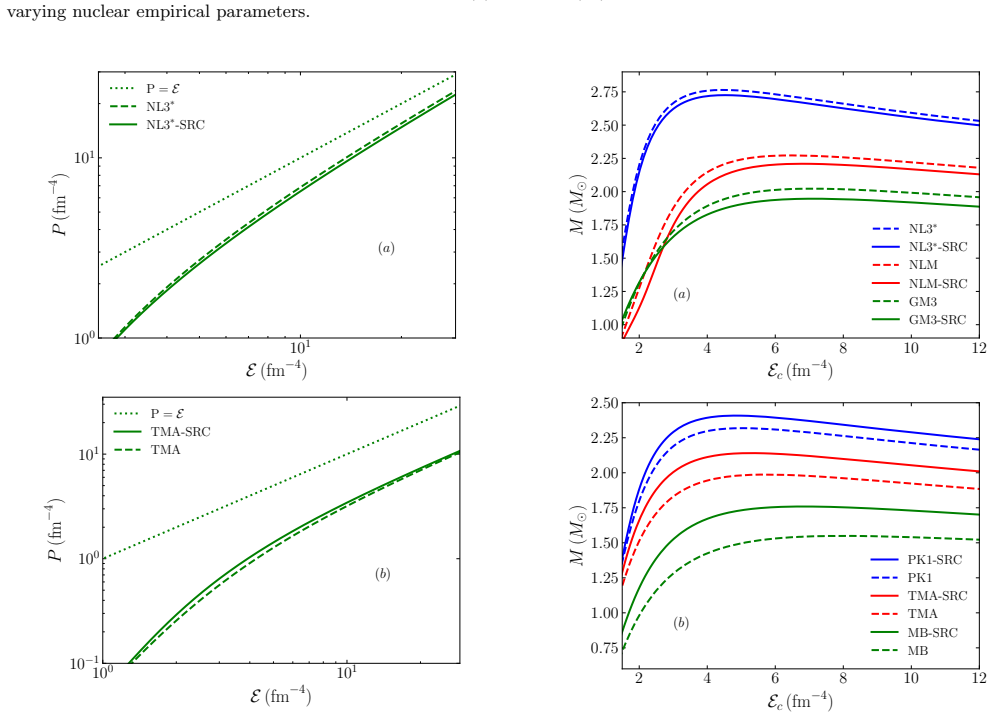
Short-range correlations soften the equation of state with quadratic vector self-interactions but stiffen it with the addition of a fourth-order term, raising neutron star maximum masses in both cases with and without dark matter.
A machine-rendered reading of the paper's core claim, the machinery that carries it, and where it could break.
Core claim
In relativistic mean-field models of dense matter, short-range correlations are incorporated through adjustments to the effective interactions. When the vector self-interaction includes only up to the quadratic term in the omega field, SRC soften the EOS at high densities, reducing the maximum neutron star mass. Inclusion of the quartic term reverses this, stiffening the EOS and increasing the maximum mass. These trends persist in two-fluid models that include a fermionic dark matter component, where SRC effects help mitigate the reduction in maximum mass caused by increasing DM fractions. All resulting stellar configurations satisfy current astrophysical bounds from NICER and GW events.
What carries the argument
Relativistic mean-field hadronic models modified by short-range correlations, with vector self-interactions limited to quadratic order or extended to quartic order in the omega field, whose equations of state are integrated via the Tolman-Oppenheimer-Volkoff equations for stellar structure.
If this is right
- Short-range correlations reduce the maximum mass of pure neutron stars in models limited to quadratic omega self-interactions.
- Short-range correlations increase the maximum mass of pure neutron stars in models that include the quartic omega self-interaction term.
- In stars containing a fermionic dark matter component, short-range correlations in the quartic model partly offset the drop in maximum mass caused by larger dark matter fractions.
- All examined parametrizations remain consistent with joint NICER-XMM-Newton constraints on PSR J0030+0451 and PSR J0740+6620 as well as the GW190425 event.
Where Pith is reading between the lines
- If the stiffening persists, short-range correlations could allow neutron star models to accommodate larger dark matter fractions while still reaching observed maximum masses.
- Models may need to retain higher-order interaction terms to reconcile short-range correlations with the existence of massive neutron stars.
- Future radius or tidal deformability measurements from mergers could indirectly probe short-range correlations through shifts in the mass-radius relation.
Load-bearing premise
The two-fluid formalism assumes that dark matter interacts with ordinary matter only through gravity and that the chosen parametrizations of the hadronic sector remain valid at the densities reached inside the star.
What would settle it
A precise mass and radius measurement of a neutron star with a substantial dark matter fraction that falls below the maximum mass predicted by the SRC-stiffened quartic-interaction model would falsify the compensation effect.
Figures




read the original abstract
In this work, we investigate how short-range correlations affect relativistic hadronic models at high densities, with direct consequences for the structure of neutron stars, both with and without dark matter content. Two versions of the model are examined: one with vector self-interactions up to second order ($\omega_0^2$) and another including a fourth-order term ($\omega_0^4$). We show that SRC tend to soften the equation of state when only the quadratic term is present, but produce a noticeable stiffening once the $\omega_0^4$ term is included. The corresponding Tolman-Oppenheimer-Volkoff solutions for pure neutron stars indicate that short-range correlations reduce the maximum mass in the first case but increase it in the second. Extending the analysis to stars containing a fermionic dark matter component, within the two-fluid formalism, we verify that the same features appear in the respective mass-radius diagrams. In particular, the decrease of the maximum mass with increasing dark matter fraction is partly compensated by the SRC effects in the hadronic sector for the model with the fourth-order term. In all cases, the resulting parametrizations are consistent with recent astrophysical constraints, including the joint NICER-XMM-Newton analyses of the pulsars PSR J0030+0451 and PSR J0740+6620, as well as the gravitational-wave event GW190425.
Editorial analysis
A structured set of objections, weighed in public.
Referee Report
Summary. The paper investigates how short-range correlations (SRC) modify the equation of state in relativistic mean-field hadronic models at high densities, comparing a version limited to quadratic vector self-interactions (ω₀²) with one that includes a quartic term (ω₀⁴). It reports that SRC soften the EOS and reduce maximum neutron-star mass in the quadratic case but stiffen the EOS and increase maximum mass once the quartic term is added. The same qualitative pattern is found for two-fluid neutron stars containing fermionic dark matter, with the SRC-induced compensation partially offsetting the mass reduction from increasing DM fraction. All resulting mass-radius relations are stated to be consistent with NICER-XMM-Newton data on PSR J0030+0451 and PSR J0740+6620 as well as the GW190425 event.
Significance. If the reported differential behavior of SRC survives scrutiny, the work illustrates a non-trivial dependence of high-density corrections on the truncation order of the vector self-interaction, which could affect both pure hadronic and DM-admixed neutron-star models. The explicit two-fluid treatment and direct comparison to recent astrophysical constraints add value, but the overall significance is limited by the absence of quantitative uncertainty quantification and by the reliance on parametrizations whose validity at the central densities of maximum-mass configurations (≳3–6 ρ₀) is not demonstrated.
major comments (3)
- [Formalism / EOS construction] The central claim that SRC produce stiffening (and higher maximum mass) only when the ω₀⁴ term is present rests on the assumption that the RMF parameters, fixed by saturation properties and finite nuclei, remain reliable once SRC are active at supranuclear densities. No explicit test or consistency check of this extrapolation is provided; without it the reported reversal of the SRC effect could be a parametrization artifact rather than a physical feature.
- [Neutron-star structure / Results] In the TOV integration and mass-radius results, the qualitative trends (mass decrease for quadratic case, mass increase for quartic case) are presented without error bands, sensitivity studies to the SRC strength parameter, or variation of the quartic coupling. This makes it difficult to assess whether the stiffening survives reasonable changes in the hadronic sector.
- [Dark-matter admixture] For the two-fluid DM extension, the assumption that the chosen hadronic parametrizations remain valid inside the star when a DM component is present is not re-examined; the same high-density extrapolation issue therefore propagates directly to the DM-admixed mass-radius curves.
minor comments (2)
- [Abstract / Introduction] The abstract and introduction would benefit from a brief statement of the numerical values adopted for the SRC strength and the quartic coupling so that readers can immediately gauge the magnitude of the reported effects.
- [Figures] Figure captions for the mass-radius diagrams should explicitly state the DM fraction range and the hadronic model variant (quadratic vs. quartic) shown in each panel.
Simulated Author's Rebuttal
We thank the referee for the careful and constructive review of our manuscript. We provide point-by-point responses to the major comments below, along with our plans for revisions.
read point-by-point responses
-
Referee: [Formalism / EOS construction] The central claim that SRC produce stiffening (and higher maximum mass) only when the ω₀⁴ term is present rests on the assumption that the RMF parameters, fixed by saturation properties and finite nuclei, remain reliable once SRC are active at supranuclear densities. No explicit test or consistency check of this extrapolation is provided; without it the reported reversal of the SRC effect could be a parametrization artifact rather than a physical feature.
Authors: We agree that the reliability of RMF parameters at supranuclear densities is an important consideration. Our approach follows the standard practice in RMF modeling where couplings are fixed at saturation density and the SRC are added as a high-density correction. The reversal of the SRC effect upon including the quartic term arises from the interplay between the SRC-induced modifications and the higher-order self-interaction in the vector channel. To address the referee's concern, we will expand the discussion in the formalism section to include references to the validity range of such models and note potential limitations of the extrapolation. A complete re-calibration of parameters including SRC effects at high density is beyond the scope of this work but could be pursued in future studies. revision: partial
-
Referee: [Neutron-star structure / Results] In the TOV integration and mass-radius results, the qualitative trends (mass decrease for quadratic case, mass increase for quartic case) are presented without error bands, sensitivity studies to the SRC strength parameter, or variation of the quartic coupling. This makes it difficult to assess whether the stiffening survives reasonable changes in the hadronic sector.
Authors: We appreciate this suggestion for improving the robustness of our results. We will include sensitivity studies by varying the SRC strength parameter over a range consistent with nuclear physics constraints and show that the qualitative behavior (softening vs. stiffening) remains unchanged. We will also briefly explore variations in the quartic coupling constant to confirm the persistence of the mass increase. Where feasible, we will add shaded regions or error bands to the mass-radius plots reflecting these variations. revision: yes
-
Referee: [Dark-matter admixture] For the two-fluid DM extension, the assumption that the chosen hadronic parametrizations remain valid inside the star when a DM component is present is not re-examined; the same high-density extrapolation issue therefore propagates directly to the DM-admixed mass-radius curves.
Authors: In the two-fluid formalism, the hadronic and DM sectors are coupled only through gravity, with no direct interaction. Therefore, the validity of the hadronic EOS is independent of the DM fraction. We will add a statement in the relevant section clarifying this and cross-referencing the expanded discussion on parameter validity added in response to the first comment. This ensures the propagation of the extrapolation issue is explicitly acknowledged. revision: partial
Circularity Check
No circularity: results follow from explicit model calculations
full rationale
The paper computes SRC-modified equations of state for two relativistic mean-field variants (quadratic vs. quartic vector self-interaction) and obtains the corresponding TOV mass-radius relations by direct numerical integration. No quoted step equates a reported prediction to a previously fitted parameter, redefines an input via self-citation, or imports a uniqueness theorem from the authors' prior work; the stiffening/softening behaviors and mass shifts are presented as outcomes of the Lagrangian modifications rather than tautological re-expressions of the same quantities. Consistency with NICER and GW190425 data is stated as a verification step after the calculations, not as a load-bearing constraint that defines the result.
Axiom & Free-Parameter Ledger
free parameters (1)
- vector self-interaction couplings
axioms (2)
- domain assumption Relativistic mean-field treatment of nucleon-meson interactions remains valid at supranuclear densities.
- domain assumption Short-range correlations can be incorporated via density-dependent modifications without altering the underlying meson-exchange structure.
Reference graph
Works this paper leans on
-
[1]
and another including a fourth-order term (ω 4 0). We show that SRC tend to soften the equation of state when only the quadratic term is present, but produce a noticeable stiffening once theω 4 0 term is included. The corresponding Tolman–Oppenheimer–Volkoff solutions for pure neutron stars indicate that short-range correlations reduce the maximum mass in...
work page internal anchor Pith review Pith/arXiv arXiv 2025
-
[2]
As a consequence, the inclusion of SRC softens the model at the high-density regime
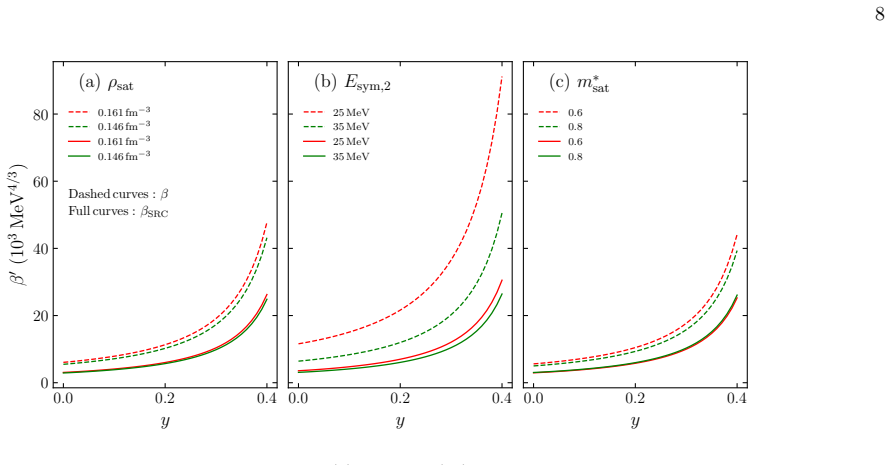
Consequently, the coefficientα SRC(y) is always larger than its counterpart without SRC, namely,α(y)≡ α′(y,A SRC,p = 1,A SRC,n = 1). As a consequence, the inclusion of SRC softens the model at the high-density regime. However, this may no longer be true if one con- siders a refitting of the model’s free coupling constants when SRC are taken into account. ...
-
[3]
and fourth order (ω4
-
[4]
(k2 Fn +M ∗2)1/2 − ϕ2 n(y)k2 Fn +M ∗2 1/2 ϕn(y) # + 4Cn(y)kFnln
in the repulsive vec- tor field. In the latter case, the self-interaction strength is governed by the constantC. We have also investi- gated the impact of incorporating SRC effects on the structure of these models. This phenomenology alters the kinetic contributions to the energy density, with di- rect consequences for the thermodynamical EoSs derived fro...
work page 2024
-
[5]
et al., The Astrophysical Journal Letters848, L13 (2017)
A. et al., The Astrophysical Journal Letters848, L13 (2017)
work page 2017
-
[6]
B. P. Abbott, R. Abbott, T. D. Abbott, S. Abraham, F. Acernese, et al., The Astrophysical Journal Letters 892, L3 (2020)
work page 2020
-
[7]
T. E. Riley, A. L. Watts, S. Bogdanov, P. S. Ray, R. M. Ludlam, S. Guillot, Z. Arzoumanian, C. L. Baker, A. V. Bilous, D. Chakrabarty, K. C. Gendreau, A. K. Hard- ing, W. C. G. Ho, J. M. Lattimer, S. M. Morsink, and T. E. Strohmayer, The Astrophysical Journal Letters 887, L21 (2019)
work page 2019
-
[8]
M. C. Miller, F. K. Lamb, A. J. Dittmann, S. Bog- danov, Z. Arzoumanian, K. C. Gendreau, S. Guillot, A. K. Harding, W. C. G. Ho, J. M. Lattimer, R. M. Ludlam, S. Mahmoodifar, S. M. Morsink, P. S. Ray, T. E. Strohmayer, K. S. Wood, T. Enoto, R. Foster, T. Okajima, G. Prigozhin, and Y. Soong, The Astro- physical Journal Letters887, L24 (2019)
work page 2019
-
[9]
T. Salmi, S. Vinciguerra, D. Choudhury, T. E. Ri- ley, A. L. Watts, R. A. Remillard, P. S. Ray, S. Bog- danov, S. Guillot, Z. Arzoumanian, C. Chirenti, A. J. Dittmann, K. C. Gendreau, W. C. G. Ho, M. C. Miller, S. M. Morsink, Z. Wadiasingh, and M. T. Wolff, The Astrophysical Journal941, 150 (2022)
work page 2022
-
[10]
M. C. Miller, F. K. Lamb, A. J. Dittmann, S. Bogdanov, Z. Arzoumanian, K. C. Gendreau, S. Guillot, W. C. G. Ho, J. M. Lattimer, M. Loewenstein, S. M. Morsink, P. S. Ray, M. T. Wolff, C. L. Baker, T. Cazeau, S. Man- thripragada, C. B. Markwardt, T. Okajima, S. Pollard, I. Cognard, H. T. Cromartie, E. Fonseca, L. Guillemot, M. Kerr, A. Parthasarathy, T. T. ...
work page 2021
-
[11]
S. Vinciguerra, T. Salmi, A. L. Watts, D. Choudhury, T. E. Riley, P. S. Ray, S. Bogdanov, Y. Kini, S. Guil- lot, D. Chakrabarty, W. C. G. Ho, D. Huppenkothen, S. M. Morsink, Z. Wadiasingh, and M. T. Wolff, The Astrophysical Journal961, 62 (2024)
work page 2024
- [12]
-
[13]
CLAS Collaboration, Nature560, 617 (2018)
work page 2018
-
[14]
CLAS Collaboration, Nature566, 354 (2019)
work page 2019
- [15]
-
[16]
O. Hen, G. A. Miller, E. Piasetzky, and L. B. Weinstein, Rev. Mod. Phys.89, 045002 (2017)
work page 2017
-
[17]
Duer et al., Physics Letters B797, 134792 (2019)
M. Duer et al., Physics Letters B797, 134792 (2019)
work page 2019
- [18]
- [19]
- [20]
- [21]
-
[22]
A. Carbone, A. Polls, and A. Rios, Europhysics Letters 97, 22001 (2012). 17
work page 2012
-
[23]
A. Rios, A. Polls, and W. H. Dickhoff, Phys. Rev. C89, 044303 (2014)
work page 2014
- [24]
- [25]
- [26]
- [27]
- [28]
-
[29]
A. E. Nelson, S. Reddy, and D. Zhou, Journal of Cos- mology and Astroparticle Physics2019(07), 012
-
[30]
M. Mariani, C. Albertus, M. d. R. Alessandroni, M. G. Orsaria, M. A. P´ erez-Garc´ ıa, and I. F. Ranea-Sandoval, Monthly Notices of the Royal Astronomical Society527, 6795 (2024)
work page 2024
- [31]
- [32]
- [33]
-
[34]
Y. Dengler, J. Schaffner-Bielich, and L. Tolos, Phys. Rev. D103, 109901 (2021)
work page 2021
-
[35]
Y. Dengler, J. Schaffner-Bielich, and L. Tolos, Phys. Rev. D105, 043013 (2022)
work page 2022
-
[36]
C. Biesdorf, J. Schaffner-Bielich, and L. Tolos, Phys. Rev. D111, 083038 (2025)
work page 2025
- [37]
- [38]
-
[39]
B. Sun, S. Bhattiprolu, and J. M. Lattimer, Phys. Rev. C109, 055801 (2024)
work page 2024
-
[40]
A. Rios, A. Polls, and W. H. Dickhoff, Phys. Rev. C79, 064308 (2009)
work page 2009
- [41]
-
[42]
O. Louren¸ co, M. Dutra, and J. Margueron, Phys. Rev. C109, 055202 (2024)
work page 2024
-
[43]
L. A. Souza, M. Dutra, C. H. Lenzi, and O. Louren¸ co, Phys. Rev. C101, 065202 (2020)
work page 2020
- [44]
-
[45]
O. Louren¸ co, T. Frederico, and M. Dutra, Phys. Rev. D 105, 023008 (2022)
work page 2022
-
[46]
O. Louren¸ co, C. H. Lenzi, T. Frederico, and M. Dutra, Phys. Rev. D106, 043010 (2022)
work page 2022
-
[47]
M. R. Pelicer, D. P. Menezes, M. Dutra, and O. Louren¸ co, The European Physical Journal A59, 10.1140/epja/s10050-023-01122-4 (2023)
-
[48]
G. Lalazissis, S. Karatzikos, R. Fossion, D. P. Arteaga, A. Afanasjev, and P. Ring, Physics Letters B671, 36 (2009)
work page 2009
-
[49]
B. V. Carlson, M. Dutra, O. Louren¸ co, and J. Mar- gueron, Phys. Rev. C107, 035805 (2023)
work page 2023
-
[50]
M. Centelles, M. Del Estal, and X. Vi˜ nas, Nuclear Physics A635, 193 (1998)
work page 1998
-
[51]
N. K. Glendenning and S. A. Moszkowski, Phys. Rev. Lett.67, 2414 (1991)
work page 1991
-
[52]
W. Long, J. Meng, N. V. Giai, and S.-G. Zhou, Phys. Rev. C69, 034319 (2004)
work page 2004
-
[53]
H. Toki, D. Hirata, Y. Sugahara, K. Sumiyoshi, and I. Tanihata, Nuclear Physics A588, c357 (1995), proceedings of the Fifth International Symposium on Physics of Unstable Nuclei
work page 1995
-
[54]
J. K. c. v. Bunta and i. c. v. Gmuca, Phys. Rev. C68, 054318 (2003)
work page 2003
-
[55]
R. C. Tolman, Phys. Rev.55, 364 (1939)
work page 1939
-
[56]
J. R. Oppenheimer and G. M. Volkoff, Phys. Rev.55, 374 (1939)
work page 1939
-
[57]
L. Lopez-Honorez, T. Schwetz, and J. Zupan, Physics Letters B716, 179 (2012)
work page 2012
- [58]
-
[59]
H. C. Das, A. Kumar, B. Kumar, and S. K. Patra, Galaxies10, 14 (2022)
work page 2022
- [60]
-
[61]
A. Das, T. Malik, and A. C. Nayak, Phys. Rev. D99, 043016 (2019)
work page 2019
- [62]
-
[63]
H. C. Das, A. Kumar, B. Kumar, S. K. Biswal, T. Nakatsukasa, A. Li, and S. K. Patra, Monthly Notices of the Royal Astronomical Society495, 4893 (2020)
work page 2020
-
[64]
H. C. Das, A. Kumar, and S. K. Patra, Phys. Rev. D 104, 063028 (2021)
work page 2021
-
[65]
H. C. Das, A. Kumar, S. K. Biswal, and S. K. Patra, Phys. Rev. D104, 123006 (2021)
work page 2021
-
[66]
H. C. Das, A. Kumar, and S. K. Patra, Monthly Notices of the Royal Astronomical Society507, 4053 (2021)
work page 2021
-
[67]
H. Das, A. Kumar, B. Kumar, S. Biswal, and S. Patra, Journal of Cosmology and Astroparticle Physics2021 (01), 007
- [68]
-
[69]
P. Routaray, S. R. Mohanty, H. Das, S. Ghosh, P. Kalita, V. Parmar, and B. Kumar, Journal of Cos- mology and Astroparticle Physics2023(10), 073
-
[70]
D. S. Akerib et al. (LUX), Phys. Rev. Lett.118, 251302 (2017)
work page 2017
- [71]
- [72]
- [73]
- [74]
-
[75]
Q.-F. Xiang, W.-Z. Jiang, D.-R. Zhang, and R.-Y. Yang, Phys. Rev. C89, 025803 (2014)
work page 2014
- [76]
- [77]
-
[78]
Z. Miao, Y. Zhu, A. Li, and F. Huang, Astrophys. J. 936, 69 (2022)
work page 2022
-
[79]
M. Emma, F. Schianchi, F. Pannarale, V. Sagun, and T. Dietrich, Particles5, 273 (2022)
work page 2022
- [80]
discussion (0)
Sign in with ORCID, Apple, or X to comment. Anyone can read and Pith papers without signing in.