High-Fidelity Raman Spin-Dependent Kicks in the Presence of Micromotion
Pith reviewed 2026-05-17 21:23 UTC · model grok-4.3
The pith
Trapped ions achieve high-fidelity spin-dependent kicks with micromotion present by selecting optimal RF phase and frequency to cancel backward kicks.
A machine-rendered reading of the paper's core claim, the machinery that carries it, and where it could break.
Core claim
By using amplitude modulation of a continuous-wave laser to generate nanosecond Raman pulses with a tunable beat frequency, the scheme produces spin-dependent kicks that maintain high fidelity. When micromotion occurs, optimal choices of RF phase and frequency suppress the unwanted backward kicks that would otherwise reduce performance, allowing the infidelities to remain below 10^{-5}.
What carries the argument
Optimal RF phase and frequency selection that suppresses unwanted backward kicks during micromotion-affected Raman SDK operations.
If this is right
- SDK infidelities reach 10^{-9} in the absence of micromotion.
- Infidelities remain below 10^{-5} when micromotion is present.
- The method supports realization of sub-trap-period high-fidelity two-qubit gates based on SDKs.
Where Pith is reading between the lines
- The tuning approach may reduce the engineering burden of eliminating micromotion through trap design alone.
- Similar phase and frequency optimization could apply to other timed laser operations in ion traps.
- Testing in chains of multiple ions would show whether the fidelity holds for entangling gates.
Load-bearing premise
Suitable RF phase and frequency values exist and can be set with enough precision to suppress backward kicks without adding decoherence or control errors from the amplitude modulation or laser sources.
What would settle it
Measure the infidelity of an SDK performed on a trapped ion under micromotion conditions while using the identified optimal RF phase and frequency, and check whether the error rate stays below 10^{-5}.
Figures



read the original abstract
We propose high-fidelity single-qubit spin-dependent kicks (SDKs) for trapped ions using nanosecond Raman pulses via amplitude modulation of a continuous-wave laser with a tunable beat frequency. We develop a general method for maintaining SDK performance in the presence of micromotion by identifying optimal choices of the RF phase and frequency that suppress unwanted backward kicks. The proposed scheme enables SDK infidelities as low as $10^{-9}$ in the absence of micromotion, and below $10^{-5}$ with micromotion. This study lays the foundation for the realization of sub-trap-period and high-fidelity two-qubit gates based on SDKs.
Editorial analysis
A structured set of objections, weighed in public.
Referee Report
Summary. The manuscript proposes high-fidelity single-qubit spin-dependent kicks (SDKs) for trapped ions via nanosecond Raman pulses generated by amplitude modulation of a continuous-wave laser with tunable beat frequency. It develops a general method to preserve SDK performance under micromotion by selecting optimal RF phase and frequency values that suppress unwanted backward kicks. The authors claim this yields infidelities as low as 10^{-9} in the absence of micromotion and below 10^{-5} when micromotion is present, establishing a basis for sub-trap-period high-fidelity two-qubit gates based on SDKs.
Significance. If the analytic and numerical results hold under realistic experimental conditions, the work would constitute a useful contribution to trapped-ion quantum information processing by providing a concrete route to fast, high-fidelity operations that mitigate a common source of error. The general optimization procedure for RF parameters could be applicable to other micromotion-sensitive protocols in ion traps.
major comments (2)
- [Results / optimization section (near the derivation of optimal RF parameters)] The central optimization of RF phase and frequency for canceling the micromotion-induced backward kick is performed under the assumption of ideal, noise-free amplitude modulation. The manuscript does not appear to incorporate first-order error channels arising from realistic intensity or timing fluctuations (∼0.1–1 %) in the modulator; such imperfections would generate residual sidebands that re-couple to the micromotion and produce a backward-kick infidelity that scales linearly with the modulation error, undermining the quoted 10^{-5} bound.
- [Abstract and concluding claims] The abstract and main claims assert specific infidelity targets (10^{-9} without micromotion, <10^{-5} with micromotion) without an accompanying error budget or explicit propagation of control imperfections through the derived kick amplitudes. A quantitative sensitivity analysis to amplitude-modulation noise is required to substantiate these numbers.
minor comments (2)
- [Theory / pulse description] Clarify the precise definition of the tunable beat frequency and its relation to the Raman detuning in the amplitude-modulation scheme.
- [Discussion] Include a brief discussion of how the chosen RF frequency avoids introducing additional decoherence channels from laser amplitude noise.
Simulated Author's Rebuttal
We thank the referee for the careful reading of the manuscript and the constructive comments. We address each major point below and describe the revisions that will be made to strengthen the presentation of robustness under realistic conditions.
read point-by-point responses
-
Referee: [Results / optimization section (near the derivation of optimal RF parameters)] The central optimization of RF phase and frequency for canceling the micromotion-induced backward kick is performed under the assumption of ideal, noise-free amplitude modulation. The manuscript does not appear to incorporate first-order error channels arising from realistic intensity or timing fluctuations (∼0.1–1 %) in the modulator; such imperfections would generate residual sidebands that re-couple to the micromotion and produce a backward-kick infidelity that scales linearly with the modulation error, undermining the quoted 10^{-5} bound.
Authors: We agree that the optimization and quoted infidelities are derived under the assumption of ideal amplitude modulation. The manuscript's primary contribution is the analytic identification of RF parameters that cancel the leading micromotion-induced backward kick. To address the referee's valid concern regarding experimental realism, the revised manuscript will include a first-order sensitivity analysis of amplitude and timing fluctuations. This analysis will explicitly show the linear scaling of residual infidelity with modulation error and confirm that the <10^{-5} target remains achievable for fluctuations at the 0.1% level typical of current modulators. revision: yes
-
Referee: [Abstract and concluding claims] The abstract and main claims assert specific infidelity targets (10^{-9} without micromotion, <10^{-5} with micromotion) without an accompanying error budget or explicit propagation of control imperfections through the derived kick amplitudes. A quantitative sensitivity analysis to amplitude-modulation noise is required to substantiate these numbers.
Authors: The stated infidelity values are obtained from the analytic and numerical results under ideal modulation, as detailed in the results section. We acknowledge that an explicit error budget and propagation of control imperfections would better support the claims for practical use. In the revision we will add a dedicated sensitivity analysis (in the main text or an appendix) that propagates first-order amplitude-modulation noise through the kick amplitudes, thereby providing the requested quantitative assessment and clarifying the conditions under which the quoted targets hold. revision: yes
Circularity Check
No circularity: derivation grounded in standard ion-trap model
full rationale
The paper derives optimal RF phase and frequency choices analytically or numerically from the standard micromotion Hamiltonian for trapped ions, then computes infidelities from the resulting time-dependent Schrödinger evolution. No load-bearing step reduces by construction to a fitted parameter renamed as prediction, a self-definition, or a self-citation chain. The quoted 10^{-9} and 10^{-5} bounds follow directly from the physical model under stated assumptions; the central claim remains independent of the present paper's own inputs.
Axiom & Free-Parameter Ledger
Lean theorems connected to this paper
-
IndisputableMonolith/Cost/FunctionalEquation.leanwashburn_uniqueness_aczel unclear?
unclearRelation between the paper passage and the cited Recognition theorem.
We develop a general method for maintaining SDK performance in the presence of micromotion by identifying optimal choices of the RF phase and frequency that suppress unwanted backward kicks.
-
IndisputableMonolith/Foundation/DimensionForcing.leanreality_from_one_distinction unclear?
unclearRelation between the paper passage and the cited Recognition theorem.
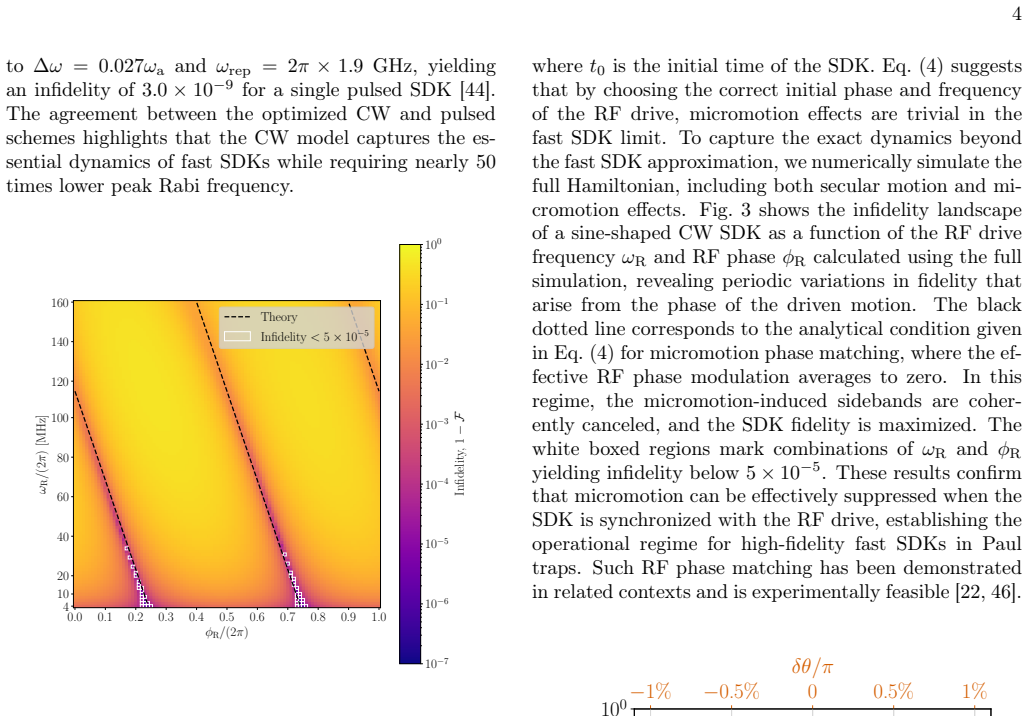
ω_R (t0 + τ/2) + ϕ_R = (2n + 1) π/2
What do these tags mean?
- matches
- The paper's claim is directly supported by a theorem in the formal canon.
- supports
- The theorem supports part of the paper's argument, but the paper may add assumptions or extra steps.
- extends
- The paper goes beyond the formal theorem; the theorem is a base layer rather than the whole result.
- uses
- The paper appears to rely on the theorem as machinery.
- contradicts
- The paper's claim conflicts with a theorem or certificate in the canon.
- unclear
- Pith found a possible connection, but the passage is too broad, indirect, or ambiguous to say the theorem truly supports the claim.
Reference graph
Works this paper leans on
- [1]
-
[2]
C. D. Bruzewicz, J. Chiaverini, R. McConnell, and J. M. Sage, Applied Physics Reviews 6, 021314 (2019)
work page 2019
- [3]
-
[4]
J. M. Pino, J. M. Dreiling, C. Figgatt, J. P. Gaebler, S. A. Moses, M. S. Allman, C. H. Baldwin, M. Foss-Feig, D. Hayes, K. Mayer, C. Ryan-Anderson, and B. Neyen- huis, Nature 592, 209 (2021)
work page 2021
- [5]
-
[6]
Demonstration of logical qubits and repeated error correction with better-than-physical error rates
A. Paetznick, M. P. d. Silva, C. Ryan-Anderson, J. M. Bello-Rivas, J. P. C. III, A. Chernoguzov, J. M. Dreil- ing, C. Foltz, F. Frachon, J. P. Gaebler, T. M. Gatter- man, L. Grans-Samuelsson, D. Gresh, D. Hayes, N. He- witt, C. Holliman, C. V. Horst, J. Johansen, D. Luc- chetti, Y. Matsuoka, M. Mills, S. A. Moses, B. Neyen- huis, A. Paz, J. Pino, P. Siegf...
work page internal anchor Pith review Pith/arXiv arXiv 2024
-
[7]
C. Mordini, A. Ricci Vasquez, Y. Motohashi, M. Müller, M. Malinowski, C. Zhang, K. K. Mehta, D. Kienzler, and J. P. Home, Physical Review X 15, 011040 (2025)
work page 2025
-
[8]
Architecting Scalable Trapped Ion Quantum Computers using Surface Codes
S. Jones and P. Murali, Architecting Scalable Trapped Ion Quantum Computers using Surface Codes (2025), arXiv:2510.23519 [quant-ph]
work page internal anchor Pith review Pith/arXiv arXiv 2025
-
[9]
S. Moses, C. Baldwin, M. Allman, R. Ancona, L. Ascar- runz, C. Barnes, J. Bartolotta, B. Bjork, P. Blanchard, M. Bohn, J. Bohnet, N. Brown, N. Burdick, W. Bur- ton, S. Campbell, J. Campora, C. Carron, J. Chambers, J. Chan, Y. Chen, A. Chernoguzov, E. Chertkov, J. Col- ina, J. Curtis, R. Daniel, M. DeCross, D. Deen, C. De- laney, J. Dreiling, C. Ertsgaard,...
work page 2023
-
[10]
S. Debnath, N. M. Linke, C. Figgatt, K. A. Landsman, K. Wright, and C. Monroe, Nature 536, 63 (2016)
work page 2016
-
[11]
C. Figgatt, A. Ostrander, N. M. Linke, K. A. Landsman, D. Zhu, D. Maslov, and C. Monroe, Nature 572, 368 (2019)
work page 2019
-
[12]
K. Wright, K. M. Beck, S. Debnath, J. M. Amini, Y. Nam, N. Grzesiak, J.-S. Chen, N. C. Pisenti, M. Chmielewski, C. Collins, K. M. Hudek, J. Mizrahi, J. D. Wong-Campos, S. Allen, J. Apisdorf, P. Solomon, M. Williams, A. M. Ducore, A. Blinov, S. M. Kreike- meier, V. Chaplin, M. Keesan, C. Monroe, and J. Kim, Nature Communications 10, 5464 (2019)
work page 2019
-
[13]
N. Grzesiak, R. Blümel, K. Wright, K. M. Beck, N. C. Pisenti, M. Li, V. Chaplin, J. M. Amini, S. Debnath, J.- S. Chen, and Y. Nam, Nature Communications 11, 2963 (2020)
work page 2020
- [14]
-
[15]
J.-S. Chen, E. Nielsen, M. Ebert, V. Inlek, K. Wright, V. Chaplin, A. Maksymov, E. Páez, A. Poudel, P. Maunz, and J. Gamble, Quantum 8, 1516 (2024). 6
work page 2024
-
[16]
D. Schwerdt, L. Peleg, Y. Shapira, N. Priel, Y. Florshaim, A. Gross, A. Zalic, G. Afek, N. Akerman, A. Stern, A. B. Kish, and R. Ozeri, Physical Review X 14, 041017 (2024)
work page 2024
-
[17]
J. J. García-Ripoll, P. Zoller, and J. I. Cirac, Physical Review Letters 91, 157901 (2003)
work page 2003
-
[18]
Duan, Physical Review Letters 93, 100502 (2004)
L.-M. Duan, Physical Review Letters 93, 100502 (2004)
work page 2004
-
[19]
W. C. Campbell, J. Mizrahi, Q. Quraishi, C. Senko, D. Hayes, D. Hucul, D. N. Matsukevich, P. Maunz, and C. Monroe, Physical Review Letters 105, 090502 (2010)
work page 2010
-
[20]
C. D. B. Bentley, A. R. R. Carvalho, D. Kielpinski, and J. J. Hope, New Journal of Physics 15, 043006 (2013)
work page 2013
-
[21]
E. P. G. Gale, Z. Mehdi, L. M. Oberg, A. K. Ratcliffe, S. A. Haine, and J. J. Hope, Physical Review A 101, 052328 (2020)
work page 2020
-
[22]
A. K. Ratcliffe, L. M. Oberg, and J. J. Hope, Physical Review A 101, 052332 (2020)
work page 2020
- [23]
- [24]
- [25]
-
[26]
I. Savill-Brown, Z. Mehdi, A. K. Ratcliffe, V. D. Vaidya, H. Liu, S. A. Haine, C. R. Viteri, and J. J. Hope, Error- Resilient Fast Entangling Gates for Scalable Ion-Trap Quantum Processors (2025), arXiv:2508.07593 [quant- ph]
-
[27]
I. Savill-Brown, J. J. Hope, A. K. Ratcliffe, V. D. Vaidya, H. Liu, S. A. Haine, C. R. Viteri, and Z. Mehdi, High-speed and high-connectivity two-qubit gates in long chains of trapped ions (2025), arXiv:2506.11385 [quant- ph]
-
[28]
A. K. Ratcliffe, R. L. Taylor, J. J. Hope, and A. R. Car- valho, Physical Review Letters 120, 220501 (2018)
work page 2018
- [29]
-
[30]
J. Wong-Campos, S. Moses, K. Johnson, and C. Monroe, Physical Review Letters 119, 230501 (2017)
work page 2017
-
[31]
K. Johnson, B. Neyenhuis, J. Mizrahi, J. Wong-Campos, and C. Monroe, Physical Review Letters 115, 213001 (2015)
work page 2015
-
[32]
K. G. Johnson, J. D. Wong-Campos, B. Neyenhuis, J. Mizrahi, and C. Monroe, Nature Communications 8, 697 (2017)
work page 2017
-
[33]
J. Mizrahi, C. Senko, B. Neyenhuis, K. G. Johnson, W. C. Campbell, C. W. S. Conover, and C. Monroe, Physical Review Letters 110, 203001 (2013)
work page 2013
-
[34]
For more details on this choice of configuration, see [19]
-
[37]
R. J. Cook, D. G. Shankland, and A. L. Wells, Physical Review A 31, 564 (1985)
work page 1985
-
[38]
L. H. Nguyên, A. Kalev, M. D. Barrett, and B.-G. En- glert, Physical Review A 85, 052718 (2012)
work page 2012
-
[39]
Technically, the distinction between the “forward” and “backward” components is arbitrary; the essential re- quirement is to maximize one while suppressing the other
-
[42]
This simulation is conducted using the momentum eigen- basis and the fast SDK limit where secular motion is frozen
-
[43]
M. J. Boguslawski, Z. J. Wall, S. R. Vizvary, I. D. Moore, M. Bareian, D. T. Allcock, D. J. Wineland, E. R. Hud- son, and W. C. Campbell, Physical Review Letters 131, 063001 (2023)
work page 2023
-
[44]
These are recorded as 10− 9 in Fig
The final populations of the |0, 0⟩, |1, − 2iη ⟩, and |0, 4iη ⟩ states are below 10− 9. These are recorded as 10− 9 in Fig. 2 for illustration purposes
-
[45]
See Supplemental Material for details
-
[46]
K. G. Johnson, J. D. Wong-Campos, A. Restelli, K. A. Landsman, B. Neyenhuis, J. Mizrahi, and C. Monroe, Review of Scientific Instruments 87, 053110 (2016)
work page 2016
-
[48]
H. Müller, S.-w. Chiow, Q. Long, S. Herrmann, and S. Chu, Physical Review Letters 100, 180405 (2008)
work page 2008
-
[49]
T. Mazzoni, X. Zhang, R. Del Aguila, L. Salvi, N. Poli, and G. M. Tino, Physical Review A 92, 053619 (2015)
work page 2015
-
[50]
D. M. Giltner, R. W. McGowan, and S. A. Lee, Physical Review Letters 75, 2638 (1995)
work page 1995
-
[51]
M. Kasevich and S. Chu, Physical Review Letters 67, 181 (1991). Supplemental Material: High-Fidelity Raman Spin-Dependent Kicks in the Presence of Micromotion Haonan Liu, 1, ∗ Varun D. Vaidya, 1 Monica Gutierrez Galan, 1 Alexander K. Ratcliffe, 1 Amrit Poudel, 1 and C. Ricardo Viteri 1 1IonQ, Inc., College Park, MD, USA (Dated: November 21, 2025) I. HAMIL ...
work page 1991
-
[52]
Three-level Hamiltonian Consider a three-level system with levels {|0⟩, |1⟩, |2⟩}. Without loss of generality, we refer to |0⟩ as the ground state, |1⟩ as the metastable state, and |2⟩ as the excited state. Here, {|0⟩, |1⟩} are the qubit states. The Hamiltonian of such a system is given by Ha = 2∑ j=0 ωj |j⟩ ⟨j|= ω 2 ω 1 ω 0 , ...
-
[53]
The su(3) Lie algebra Equations (1) and (10) strongly suggest symmetry. Indeed the total Hamiltonian can be expressed by the su(3) generators in their defining representation. By convention, the su(3) generators are usually given by the Gell-Mann matrices, i.e., λ 1 = 0 1 1 0 0 , λ 2 = 0 −i i 0 0 , λ ...
-
[54]
This conjugation on HI can be analytically solved
Interaction picture It is convenient to study the total Hamiltonian in the interaction picture (IP) defined by Ha, where the new Hamiltonian is given by H = U †HIU , where U = exp ( −iHat). This conjugation on HI can be analytically solved. Specifically, we use the following result [2]. Theorem 1: ForA,B in some Lie algebra, if [A,B ] = xB, then eABe− A =ex...
-
[55]
(22) is composed of terms oscillating with multiple frequencies
Rotating wave approximation The Hamiltonian in Eq. (22) is composed of terms oscillating with multiple frequencies. For convenience, we define two useful frequencies:
-
[56]
The qubit transition frequency between levels |1⟩ ↔ | 0⟩ ω a =ω 1 − ω 0. (24)
-
[57]
(25) 4 These frequencies have been introduced in Fig
The laser detuning from the |2⟩ ↔ | 0⟩ transition ∆ = ω − (ω 2 − ω 0). (25) 4 These frequencies have been introduced in Fig. 1(b) of the main text. Then naturally the laser detuning from the |2⟩ ↔ | 1⟩ transition is given by ∆ + ω a. In a Raman system, we expect the following hierarchy of frequencies: Approximation 1 [Rotating wave approximation] : ω a ≲ ...
-
[58]
Adiabatic elimination The Hamiltonian in Eq. (27) can be further reduced. Remember our ultimate goal is to use levels 0 and 1 as qubit levels. Therefore it would be nice to have an effective Hamiltonian that acts only on the {|0⟩, |1⟩} submanifold. This entails a twofold interpretation:
-
[59]
We are going from su(3) to one of its su(2) subalgebra
Mathematically this means the effective Hamiltonian should be block diagonal and in the subalgebra spanned by {U±,U 3}. We are going from su(3) to one of its su(2) subalgebra
-
[60]
Luckily, this is indeed the case as we will see
Physically this means that the excited state |2⟩ has a far detuned transition to the qubit states from the field and therefore is weakly populated. Luckily, this is indeed the case as we will see. Consider the Schrödinger equation [3] i ˙|ψ ⟩ =H |ψ ⟩, (28) where |ψ ⟩ = ∑ jcj |j⟩. Left multiplication by ⟨j| yields i ˙c0 = g∗ 02 2 ei∆ tc2, (29) i ˙c1 = g∗ 12...
-
[61]
(36)–(37), correspond to a non-Hermitian Hamiltonian
Effective two-level Hamiltonian The results from the adiabatic elimination, given in Eqs. (36)–(37), correspond to a non-Hermitian Hamiltonian. Although we now have an effective two-level system, the probability for an atom to leak from the qubit manifold into the excited state |2⟩ still scales with 1/ ∆ and is thus nonzero. In order to work in the two-leve...
-
[62]
Rabi frequency Following Sec. I A, a field (labeled by m) has the general form Em(r,t ) = Re [ Em(t)ei[km·r− ωt − ϕ m(t)]ϵm ] , (46) where Em(t) is the real amplitude envelope, ω is the characteristic frequency of the fields, km is the wavevector, ϕm(t) is a time-dependent phase factor, and ϵm is the normalized polarization vector. Notice that here the freq...
-
[63]
Rabi frequency For each beam, the polarization vector is ϵm = cosβmeσ + +eiψ m sinβmeσ − , (55) whereβm’s are used to parametrize left and right polarizations, and ψm’s are the relative phases. Notice that a global phase can be manipulated as its counterpart can be absorbed into the initial phase in Eq. (46). Due to geometry, neither beam has π polarizati...
-
[64]
Beam configuration Following discussions in [4] and for simplicity, we adopt the following beam configuration
-
[65]
The two beams share the same real temporal intensity envelope, so that Ω 0(t) ≡ Ω 1(t) = Ω 2(t). (71)
-
[66]
We take the beams to be counterpropagating along the quantization axis, with (k1)z = − (k2)z =k and ∆ k = 2k
-
[67]
We assume a “linear ⊥ linear” polarization scheme (lin ⊥ lin), i.e., β1 = −β2 = ± π 4, (72) and set the relative polarization phase to ∆ ψ = 0
-
[68]
The beams share the same initial optical phase and have a Raman beat frequency ∆ ω , so that ∆ ϕ(t) = ∆ ωt. (73) By Approxs. 4, this requires ∆ ω ≪ ∆ , (74) ensuring that the two-photon detuning is small compared to the single-photon detuning. Under these assumptions, the effective two-photon Rabi frequency becomes Ω(t) = 2Ω 0(t) cos (2kz − ∆ ωt ). (75) 9 ...
-
[69]
Schrödinger Picture We now write down the full Hamiltonian of the the system. For a single trapped ion ( 133Ba+, e.g.) of mass m interacting with two counterpropagating Raman laser beams configured in Sec. I C 2, the total Hamiltonian in the SP has the form H(t) = p2 2m external + ω a 2 σz internal + Ω 0(t) cos (2kz − ∆ ωt )σx interaction ...
-
[70]
Interaction Picture Equation (81) can be rewritten in a form that makes the spin-motion coupling more explicit. Using the stability condition of an ion trap [6], az + q2 z 2 ≥ 0, (82) 10 we can rewrite the Hamiltonian by H(t) = p2 z 2m + 1 8mω 2 Rz2 [ az + q2 z 2 − q2 z 2 + 2qz cos (ω Rt +ϕ R) ] + ω a 2 σz + Ω 0(t) cos (2kz − ∆ ωt )σx (83) = p2 z 2m + 1 2...
-
[71]
In the three-dimensional manifold, the state vector is expressed as |ψ (t)⟩ =c0(t) |0, 0⟩ +c+ 1 (t) |1, 2iη⟩ +c− 1 (t) |1, − 2iη⟩. (109) and the Hamiltonian is given by ˜H(t) = g0 0 e− iω − t e− iω +t eiω − t 0 0 eiω +t 0 0 . (110) The Schrödinger equation is thus id |ψ (t)⟩ dt = ˜H(t) |ψ (t)⟩, (111) or idc0 dt =g0 ( e− iω − tc...
-
[72]
(124) We still want to find a gauge transformation to make ˜H(t) time independent
In the five-dimensional manifold, the state vector is expressed as |ψ (t)⟩ =c0(t) |0, 0⟩ +c+ 1 (t) |1, 2iη⟩ +c− 1 (t) |1, − 2iη⟩ +c+ 2 (t) |0, 4iη⟩ +c− 2 (t) |0, − 4iη⟩, (123) and the Hamiltonian is given by ˜H(t) = g0 0 e− iω − t e− iω +t 0 0 eiω − t 0 0 eiω +t 0 eiω +t 0 0 0 eiω − t 0 e− iω +t 0 0 0 0 0 e− iω − t 0 0 ...
-
[73]
(5), the dot product is not defined by the Hermitian form u ·v = ∑ ujv∗ j
We note that in Eq. (5), the dot product is not defined by the Hermitian form u ·v = ∑ ujv∗ j . Rather, it follows the definition of the dot product of two real vectors since the field E is real anyway
-
[74]
This can be seen from several viewpoints. One may evaluate it directly using the Baker–Campbell–Hausdorff expansion. A more systematic perspective is to note that, in the adjoint representation, x is the eigenvalue of A acting on the eigenvector B; consequently, eA acts with eigenvalue ex. In many physics texts, the map [A,·] is introduced as a “superopera...
-
[75]
One can also use the Schrieffer–Wolff Transformation for this purpose. Here we show one approach
-
[76]
J. A. Mizrahi, Ultrafast Control of Spin and Motion in Trapped Ions , Ph.D. thesis, University of Maryland (2013)
work page 2013
-
[77]
D. Leibfried, R. Blatt, C. Monroe, and D. Wineland, Reviews of Modern Physics 75, 281 (2003)
work page 2003
-
[78]
L. H. Nguyên, A. Kalev, M. D. Barrett, and B.-G. Englert, Physical Review A 85, 052718 (2012)
work page 2012
discussion (0)
Sign in with ORCID, Apple, or X to comment. Anyone can read and Pith papers without signing in.