Architecting Scalable Trapped Ion Quantum Computers using Surface Codes
Pith reviewed 2026-05-18 04:13 UTC · model grok-4.3
The pith
Two-ion traps prove optimal for implementing surface codes on scalable trapped-ion quantum hardware.
A machine-rendered reading of the paper's core claim, the machinery that carries it, and where it could break.
Core claim
By building a topology-aware compiler that maps surface-code stabilizer measurements onto QCCD shuttling constraints, the authors show that two-ion traps simultaneously maximize logical clock rate and minimize electrode wiring complexity. This configuration outperforms both larger ion chains and alternative connectivity patterns under realistic near-term error rates of 10^{-3} to 10^{-4}.
What carries the argument
A near-optimal topology-aware compiler that schedules surface-code operations while accounting for ion shuttling times and trap connectivity constraints.
If this is right
- Future QCCD hardware can use simpler electrode wiring focused on two-ion units rather than complex multi-ion chains.
- Logical qubits can reach target speeds without requiring large ion numbers per trap.
- Connectivity graphs can be optimized around nearest-neighbor shuttling between two-ion modules.
- Overall device scaling becomes feasible at lower fabrication cost and complexity.
Where Pith is reading between the lines
- The same compiler-driven approach could be applied to other error-correcting codes to test whether two-ion optimality is surface-code specific.
- Modular designs built from many independent two-ion traps may reduce crosstalk and heating effects that grow with trap size.
Load-bearing premise
The performance comparisons assume specific ion movement times and gate error rates that will be realized in future fabricated QCCD devices.
What would settle it
Fabricate and benchmark a small QCCD array containing both two-ion and twenty-ion traps, then measure whether the two-ion layout actually produces higher logical operation rates under the same gate and shuttling error rates.
Figures



read the original abstract
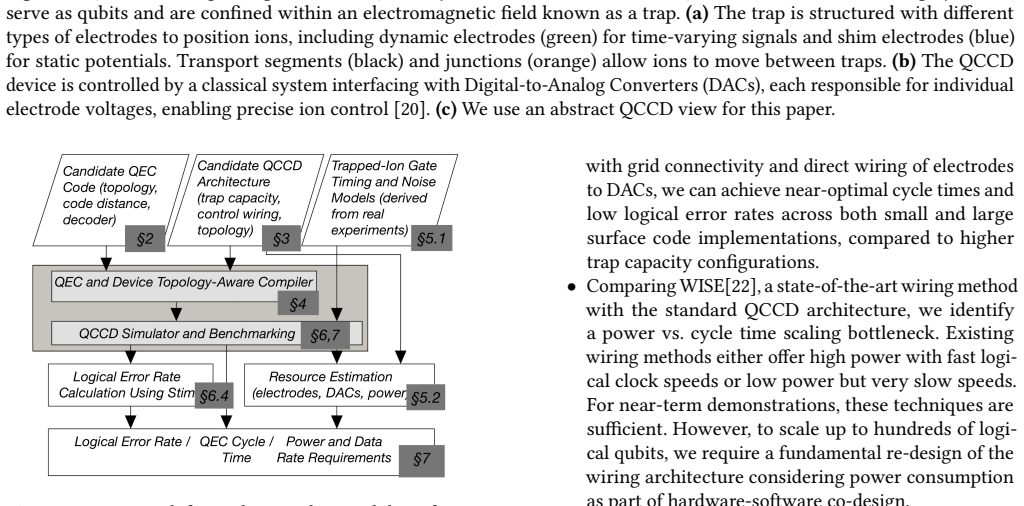
Trapped ion (TI) qubits are a leading quantum computing platform. Current TI systems have less than 60 qubits, but a modular architecture known as the Quantum Charge-Coupled Device (QCCD) is a promising path to scale up devices. There is a large gap between the error rates of near-term systems ($10^{-3}$ to $10^{-4}$) and the requirements of practical applications (below $10^{-9}$). To bridge this gap, we require Quantum Error Correction (QEC) to build logical qubits that are composed of multiple physical qubits. While logical qubits have been demonstrated on TI qubits, these demonstrations are restricted to small codes and systems. There is no clarity on how QCCD systems should be designed to implement practical-scale QEC. This paper studies how surface codes, a standard QEC scheme, can be implemented efficiently on QCCD-based systems. To examine how architectural parameters of a QCCD system can be tuned for surface codes, we develop a near-optimal topology-aware compilation method that outperforms existing QCCD compilers by an average of 3.8X in terms of logical clock speed. We use this compiler to examine how hardware trap capacity, connectivity and electrode wiring choices can be optimised for surface code implementation. In particular, we demonstrate that small traps of two ions are surprisingly ideal from both a performance-optimal and hardware-efficiency standpoint. This result runs counter to prior intuition that larger traps (20-30 ions) would be preferable, and has the potential to inform design choices for upcoming systems.
Editorial analysis
A structured set of objections, weighed in public.
Referee Report
Summary. The paper presents a near-optimal topology-aware compiler for implementing surface codes on QCCD trapped-ion architectures, claiming an average 3.8X improvement in logical clock speed over prior QCCD compilers. Using this compiler, the authors systematically vary hardware parameters including trap capacity, connectivity, and electrode wiring, and conclude that two-ion traps are optimal from both performance and hardware-efficiency perspectives, contrary to prior intuition favoring 20-30 ion traps.
Significance. If the modeling assumptions hold and the compiler results are robust, the work could meaningfully inform design choices for scalable trapped-ion systems by suggesting simpler small-trap architectures that still support efficient surface-code QEC. The compiler improvement and the counter-intuitive trap-size finding are the primary contributions; the paper also provides a concrete study of architectural trade-offs for near-term error rates.
major comments (2)
- [Abstract] Abstract: the central claim that two-ion traps are both performance-optimal and hardware-efficient rests on specific modeled costs for ion shuttling times, gate error rates in the 10^{-3}–10^{-4} range, and QCCD connectivity constraints. No sensitivity analysis or calibration against existing QCCD prototypes is indicated, yet deviations in real shuttling latencies or wiring overheads could reverse the optimality conclusion and favor larger traps.
- [Results/Methods] The performance numbers and trap-size optimality conclusion are outputs of the authors' compiler simulations. Without detailed methods, validation data, or error-bar reporting, it remains unclear whether post-hoc tuning or unstated modeling choices affect the 3.8X speedup and the trap-capacity result; this is load-bearing for the main architectural recommendation.
minor comments (2)
- Clarify the precise definition and measurement of 'logical clock speed' early in the text, including how shuttling and gate operations are aggregated.
- The abstract states the compiler 'outperforms existing QCCD compilers by an average of 3.8X'; provide the baseline compilers and workload details in a dedicated comparison section or table.
Simulated Author's Rebuttal
We thank the referee for their constructive comments on our manuscript. We address each major comment point by point below, providing the strongest honest defense of our work while agreeing to revisions that improve clarity and robustness without misrepresenting the results.
read point-by-point responses
-
Referee: [Abstract] Abstract: the central claim that two-ion traps are both performance-optimal and hardware-efficient rests on specific modeled costs for ion shuttling times, gate error rates in the 10^{-3}–10^{-4} range, and QCCD connectivity constraints. No sensitivity analysis or calibration against existing QCCD prototypes is indicated, yet deviations in real shuttling latencies or wiring overheads could reverse the optimality conclusion and favor larger traps.
Authors: The modeled parameters are drawn directly from published QCCD experimental results on shuttling latencies and gate fidelities in the cited range. We agree that explicit sensitivity analysis would strengthen the claim. In revision we will add a dedicated subsection varying shuttling time and wiring overhead across plausible experimental ranges and confirm that the two-ion optimality conclusion is robust within those bounds. Full experimental calibration of the model against a specific prototype lies outside the scope of this simulation study, but we will expand the text to cite the exact experimental sources and note this limitation. revision: yes
-
Referee: [Results/Methods] The performance numbers and trap-size optimality conclusion are outputs of the authors' compiler simulations. Without detailed methods, validation data, or error-bar reporting, it remains unclear whether post-hoc tuning or unstated modeling choices affect the 3.8X speedup and the trap-capacity result; this is load-bearing for the main architectural recommendation.
Authors: Section 3 presents the topology-aware compiler algorithm, cost model, and scheduling procedure in detail, with the 3.8X figure obtained from head-to-head comparison against the strongest prior QCCD compiler on the same surface-code benchmarks. To increase transparency we will expand the Methods section with additional pseudocode, an explicit table of all parameter values, and verification on small hand-solved instances. Because the simulations are deterministic given fixed hardware parameters, statistical error bars are not applicable; we will instead report results across multiple code distances and trap configurations to demonstrate consistency of the trap-size finding. revision: yes
Circularity Check
No significant circularity; results are simulation outputs under explicit assumptions
full rationale
The paper develops an independent topology-aware compiler, measures its 3.8X logical-clock-speed improvement over prior compilers, and then applies the compiler to evaluate architectural parameters including trap size. The conclusion favoring 2-ion traps emerges from these simulations under stated modeling assumptions for shuttling times, gate errors, and connectivity; it is not equivalent to any input by definition or construction. No self-definitional steps, fitted inputs renamed as predictions, or load-bearing self-citation chains appear in the derivation. The work remains self-contained as a modeling study whose central claims retain independent content from the chosen parameters.
Axiom & Free-Parameter Ledger
free parameters (1)
- trap capacity parameter
axioms (1)
- domain assumption Surface-code logical operations can be scheduled using the QCCD ion shuttling primitives without additional unmodeled overheads
Forward citations
Cited by 1 Pith paper
-
High-Fidelity Raman Spin-Dependent Kicks in the Presence of Micromotion
A scheme using modulated Raman pulses achieves spin-dependent kick infidelities below 10^{-5} in trapped ions despite micromotion by optimizing RF parameters to cancel backward kicks.
Reference graph
Works this paper leans on
-
[1]
Rajeev Acharya, Igor Aleiner, Richard Allen, Trond I. Andersen, Markus Ansmann, Frank Arute, Kunal Arya, Abraham Asfaw, Juan Atalaya, Ryan Babbush, Dave Bacon, Joseph C. Bardin, Joao Basso, Andreas Bengtsson, Sergio Boixo, Gina Bortoli, Alexandre Bourassa, Jenna Bovaird, Leon Brill, Michael Broughton, Bob B. Buckley, David A. Buell, Tim Burger, Brian Burk...
work page 2023
-
[2]
Google Quantum AI. 2025. Google Quantum AI Roadmap.https: //quantumai.google/roadmap
work page 2025
-
[3]
Konstantin Andreev and Harald Räcke. 2006. Balanced graph par- titioning.Theory of Computing Systems39, 6 (Nov. 2006), 929–939. doi:10.1007/s00224-006-1350-7Funding Information: This work was supported by the NSF under Grants CCR-0085982 and CCR-0122581∗
-
[4]
Barnes, Tomasz Bialas, Okan Buğdaycı, Earl T
Ben Barber, Kenton M. Barnes, Tomasz Bialas, Okan Buğdaycı, Earl T. Campbell, Neil I. Gillespie, Kauser Johar, Ram Rajan, Adam W. Richard- son, Luka Skoric, Canberk Topal, Mark L. Turner, and Abbas B. Ziad
-
[5]
A real-time, scalable, fast and resource-efficient decoder for a quantum computer.Nature Electronics8, 1 (Jan. 2025), 84–91. doi:10.1038/s41928-024-01319-5
-
[6]
R. Bowler, J. Gaebler, Y. Lin, T. R. Tan, D. Hanneke, J. D. Jost, J. P. Home, D. Leibfried, and D. J. Wineland. 2012. Coherent Diabatic Ion Transport and Separation in a Multizone Trap Array.Phys. Rev. Lett. 109 (Aug 2012), 080502. Issue 8. doi:10.1103/PhysRevLett.109.080502
-
[7]
William Cody Burton, Brian Estey, Ian M. Hoffman, Abigail R. Perry, Curtis Volin, and Gabriel Price. 2023. Transport of Multispecies Ion Crystals through a Junction in a Radio-Frequency Paul Trap.Physical Review Letters130, 17 (April 2023). doi:10.1103/physrevlett.130.173202
-
[8]
Jwo-Sy Chen, Erik Nielsen, Matthew Ebert, Volkan Inlek, Kenneth Wright, Vandiver Chaplin, Andrii Maksymov, Eduardo Páez, Amrit Poudel, Peter Maunz, and John Gamble. 2024. Benchmarking a trapped- ion quantum computer with 30 qubits.Quantum8 (Nov. 2024), 1516. doi:10.22331/q-2024-11-07-1516
-
[9]
Caroline Figgatt. 2018. Building and Programming a Universal Ion Trap Quantum Computer. (2018)
work page 2018
-
[10]
C. Figgatt, A. Ostrander, N. M. Linke, K. A. Landsman, D. Zhu, D. Maslov, and C. Monroe. 2019. Parallel entangling operations on a universal ion-trap quantum computer.Nature572, 7769 (July 2019), 368–372. doi:10.1038/s41586-019-1427-5
-
[11]
Austin G. Fowler and Craig Gidney. 2018. Low overhead quantum computation using lattice surgery.arXiv: Quantum Physics(2018). https://api.semanticscholar.org/CorpusID:119447706
work page 2018
-
[12]
Michael R. Garey and David S. Johnson. 1979.Computers and In- tractability: A Guide to the Theory of NP-Completeness. W.H. Freeman and Co., San Francisco, CA
work page 1979
-
[13]
Craig Gidney. 2021. Stim: a fast stabilizer circuit simulator.Quantum 5 (July 2021), 497. doi:10.22331/q-2021-07-06-497
-
[14]
M. Gutiérrez, M. Müller, and A. Bermúdez. 2019. Transversality and lattice surgery: Exploring realistic routes toward coupled logical qubits with trapped-ion quantum processors.Phys. Rev. A99 (Feb 2019), 022330. Issue 2. doi:10.1103/PhysRevA.99.022330
-
[15]
IBM. 2025. IBM Quantum Roadmap.https://www.ibm.com/roadmaps/ quantum/
work page 2025
-
[16]
Oxford Ionics. 2025. Oxford Ionics | High Performance Quantum Computing.https://www.oxionics.com/
work page 2025
-
[17]
IonQ. 2025. IonQ | Trapped Ion Quantum Computing.https://ionq. com/
work page 2025
-
[18]
D. Kielpinski, C. Monroe, and D. J. Wineland. 2002. Architecture for a large-scale ion-trap quantum computer.Nature417, 6890 (01 Jun 2002), 709–711. doi:10.1038/nature00784 14 Architecting Scalable Trapped Ion Quantum Computers using Surface Codes
-
[19]
Harold W. Kuhn. 1955. The Hungarian Method for the Assignment Problem.Naval Research Logistics Quarterly2, 1–2 (March 1955), 83–97. doi:10.1002/nav.3800020109
-
[20]
Tyler Leblond, Ryan S. Bennink, Justin G. Lietz, and Christopher M. Seck. 2023. TISCC: A Surface Code Compiler and Resource Estimator for Trapped-Ion Processors. InProceedings of the SC ’23 Workshops of the International Conference on High Performance Computing, Network, Storage, and Analysis (SC-W 2023). ACM, 1426–1435. doi:10.1145/ 3624062.3624214
-
[21]
Bjoern Lekitsch, Sebastian Weidt, Austin G. Fowler, Klaus Mølmer, Simon J. Devitt, Christof Wunderlich, and Winfried K. Hensinger. 2017. Blueprint for a microwave trapped ion quantum computer.Science Advances3, 2 (Feb. 2017). doi:10.1126/sciadv.1601540
-
[22]
Pak Hong Leung and Kenneth R. Brown. 2018. Entangling an arbitrary pair of qubits in a long ion crystal.Phys. Rev. A98 (Sep 2018), 032318. Issue 3. doi:10.1103/PhysRevA.98.032318
-
[23]
M. Malinowski, D.T.C. Allcock, and C.J. Ballance. 2023. How to Wire a1000-Qubit Trapped-Ion Quantum Computer.PRX Quantum4 (Oct 2023), 040313. Issue 4. doi:10.1103/PRXQuantum.4.040313
-
[24]
C. Monroe, R. Raussendorf, A. Ruthven, K. R. Brown, P. Maunz, L.- M. Duan, and J. Kim. 2014. Large-scale modular quantum-computer architecture with atomic memory and photonic interconnects.Phys. Rev. A89 (Feb 2014), 022317. Issue 2. doi:10.1103/PhysRevA.89.022317
-
[25]
S. A. Moses, C. H. Baldwin, M. S. Allman, R. Ancona, L. Ascarrunz, C. Barnes, J. Bartolotta, B. Bjork, P. Blanchard, M. Bohn, J. G. Bohnet, N. C. Brown, N. Q. Burdick, W. C. Burton, S. L. Campbell, J. P. Campora, C. Carron, J. Chambers, J. W. Chan, Y. H. Chen, A. Chernoguzov, E. Chertkov, J. Colina, J. P. Curtis, R. Daniel, M. DeCross, D. Deen, C. Delaney...
-
[26]
S. A. Moses, C. H. Baldwin, M. S. Allman, R. Ancona, L. Ascarrunz, C. Barnes, J. Bartolotta, B. Bjork, P. Blanchard, M. Bohn, J. G. Bohnet, N. C. Brown, N. Q. Burdick, W. C. Burton, S. L. Campbell, J. P. Campora, C. Carron, J. Chambers, J. W. Chan, Y. H. Chen, A. Chernoguzov, E. Chertkov, J. Colina, J. P. Curtis, R. Daniel, M. DeCross, D. Deen, C. Delaney...
work page 2023
-
[27]
Prakash Murali, Dripto M. Debroy, Kenneth R. Brown, and Margaret Martonosi. 2020. Architecting Noisy Intermediate-Scale Trapped Ion Quantum Computers. arXiv:2004.04706 [quant-ph]https://arxiv.org/ abs/2004.04706
-
[28]
Quantum Optics and Spectroscopy Institut für Experimentalphysik Universität Innsbruck. 2023. World list of QIP ion trapping groups.https://www.quantumoptics.at/images/miscellaneous/ IonTrappers.pdf
work page 2023
-
[29]
J. M. Pino, J. M. Dreiling, C. Figgatt, J. P. Gaebler, S. A. Moses, M. S. Allman, C. H. Baldwin, M. Foss-Feig, D. Hayes, K. Mayer, C. Ryan- Anderson, and B. Neyenhuis. 2021. Demonstration of the trapped-ion quantum CCD computer architecture.Nature592, 7853 (April 2021), 209–213. doi:10.1038/s41586-021-03318-4
-
[30]
Quantinuum. 2025. Quantinuum.https://www.quantinuum.com/
work page 2025
-
[31]
Abdullah Ash Saki, Rasit Onur Topaloglu, and Swaroop Ghosh. 2022. Muzzle the Shuttle: Efficient Compilation for Multi-Trap Trapped-Ion Quantum Computers. In2022 Design, Automation & Test in Europe Conference & Exhibition (DATE). 322–327. doi:10.23919/DATE54114. 2022.9774619
- [32]
-
[33]
Seyon Sivarajah, Silas Dilkes, Alexander Cowtan, Will Simmons, Alec Edgington, and Ross Duncan. 2020. t|ket 〉: a retargetable compiler for NISQ devices.Quantum Science and Technology6, 1 (Nov. 2020), 014003. doi:10.1088/2058-9565/ab8e92
-
[34]
Marco Valentini, Martin W. van Mourik, Friederike Butt, Jakob Wahl, Matthias Dietl, Michael Pfeifer, Fabian Anmasser, Yves Colombe, Clemens Rössler, Philip Holz, Rainer Blatt, Markus Müller, Thomas Monz, and Philipp Schindler. 2024. Demonstration of two-dimensional connectivity for a scalable error-corrected ion-trap quantum processor architecture. arXiv:...
- [35]
-
[36]
A. Walther, F. Ziesel, T. Ruster, S. T. Dawkins, K. Ott, M. Hettrich, K. Singer, F. Schmidt-Kaler, and U. Poschinger. 2012. Controlling Fast Transport of Cold Trapped Ions.Phys. Rev. Lett.109 (Aug 2012), 080501. Issue 8. doi:10.1103/PhysRevLett.109.080501
-
[37]
Anbang Wu, Gushu Li, Hezi Zhang, Gian Giacomo Guerreschi, Yufei Ding, and Yuan Xie. 2022. A synthesis framework for stitching surface code with superconducting quantum devices. InProceedings of the 49th Annual International Symposium on Computer Architecture(New York, New York)(ISCA ’22). Association for Computing Machinery, New York, NY, USA, 337–350. do...
discussion (0)
Sign in with ORCID, Apple, or X to comment. Anyone can read and Pith papers without signing in.