Recognition: 2 theorem links
· Lean TheoremAql X-1 from dawn 'til dusk: the early rise, fast state transition and decay of its 2024 outburst
Pith reviewed 2026-05-17 20:46 UTC · model grok-4.3
The pith
The neutron star LMXB Aql X-1 displayed a rapid 12-hour hard-to-soft state transition two weeks after the optical start of its 2024 outburst.
A machine-rendered reading of the paper's core claim, the machinery that carries it, and where it could break.
Core claim
The source underwent a very rapid, about 12-h long, transition from the hard to the soft state about two weeks after the optical onset of the outburst. The evolution of the temperature and physical sizes of both the inner region of the disk and a black body near the NS surface suggest that at the state transition, a boundary and spreading layer likely formed.
What carries the argument
Comparison of optical and X-ray light curves combined with time-resolved X-ray spectroscopy of the evolving accretion flow during the early rise and state transitions.
If this is right
- The rapid transition constrains the timescales for changes in the inner accretion disk and corona in neutron star LMXBs.
- Early low-luminosity detection highlights the role of sensitive X-ray monitors in capturing outburst onsets.
- Data on component sizes and temperatures offer tests for models of disk truncation and boundary layer formation.
Where Pith is reading between the lines
- This timing suggests that optical emission may arise from outer disk regions before the inner flow brightens in X-rays.
- Similar campaigns on other sources could reveal if such fast transitions are common or depend on specific conditions.
- Connecting to black hole systems, the 12-hour switch might indicate universal mechanisms for state changes independent of the compact object type.
Load-bearing premise
The optical and X-ray observations capture the same single outburst event with accurate alignment of timings across different instruments.
What would settle it
Detection of an X-ray rise that coincides with or precedes the optical rise, or a hard-to-soft transition lasting significantly longer than 12 hours in a comparable outburst.
Figures




read the original abstract
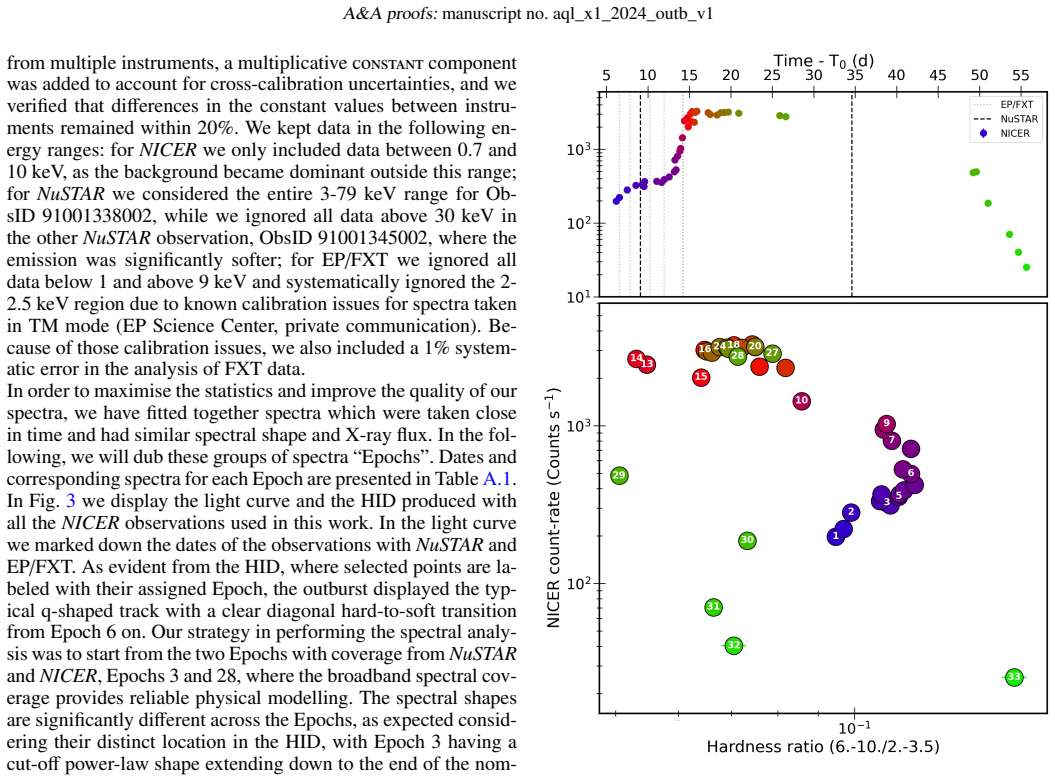
Transient Low-Mass X-ray Binaries (LMXBs) are usually first detected by all-sky X-ray monitors when they enter new outbursts, typically at X-ray luminosities above $\sim$10$^{36}$ erg/s. Observations of these sources during the early rise of the outbursts have so far been very limited. However, the launch of the Einstein Probe (EP) has greatly improved our ability to detect fainter X-ray activity, unlocking access to the outburst early rise. In September 2024, EP detected the early onset of a new outburst from the neutron star LMXB Aql X-1, catching the source at a luminosity below 10$^{35}$ erg/s. In this paper we present results from a comprehensive, multi-wavelength campaign of this event, combining data from EP, NICER, NuSTAR, Swift and Las Cumbres Observatory covering the full outburst from its early rise through its decay. By comparing X-ray and optical light curves obtained with Las Cumbres Observatory during the initial rise, we show that the start of the X-ray emission lagged the optical rise by, at most, 13 days. Time-resolved X-ray spectroscopy revealed how the geometry and the physical properties of the accretion flow evolve during this early stage of the outburst, as well as at higher luminosities as the source transitioned through the canonical X-ray spectral states - hard, intermediate and soft. These data show that the source underwent a very rapid, about 12-h long, transition from the hard to the soft state about two weeks after the optical onset of the outburst. The evolution of the temperature and physical sizes of both the inner region of the disk and a black body near the NS surface suggest that at the state transition, a boundary and spreading layer likely formed. We discuss these results in the context of time-scales for outburst evolution and state transitions in accreting neutron stars and black holes.
Editorial analysis
A structured set of objections, weighed in public.
Referee Report
Summary. The paper reports multi-wavelength observations of the 2024 outburst of the neutron star LMXB Aql X-1 using Einstein Probe (EP), NICER, NuSTAR, Swift, and Las Cumbres Observatory data. It claims X-ray emission lagged the optical rise by at most 13 days, with time-resolved spectroscopy showing evolution of the accretion flow through hard, intermediate, and soft states. A key result is a rapid ~12-hour hard-to-soft transition occurring about two weeks after the optical onset, interpreted as evidence for boundary and spreading layer formation, discussed in the context of outburst timescales.
Significance. If the cross-instrument timing holds, this provides rare access to the early rise of an LMXB outburst below 10^35 erg/s, enabled by EP, and documents an unusually fast state transition with detailed tracking of disk and neutron-star surface components. The complete rise-to-decay coverage with multiple facilities offers a valuable dataset for comparing accretion physics in neutron-star versus black-hole systems and constraining outburst evolution models.
major comments (2)
- §3 (light-curve comparison): The central claim that the hard-to-soft transition occurs about two weeks after optical onset with a 12-hour duration, and that X-rays lagged by at most 13 days, rests on precise alignment of Las Cumbres optical data with EP/NICER X-ray observations. The manuscript must detail MJD zero-point calibration, sampling gaps, and any checks for undetected earlier activity, as unaccounted systematics would directly undermine the reported delay and rapidity of the transition.
- §5.2 (time-resolved spectroscopy): The inference of boundary and spreading layer formation at the state transition is based on the evolution of inner-disk temperature and blackbody component sizes. This interpretation would be strengthened by explicit reporting of fit parameters, uncertainties, and a quantitative criterion distinguishing layer formation from other geometric changes.
minor comments (3)
- The observation log table should include exact start MJDs, exposure times, and instrument modes to facilitate reproducibility of the timing analysis.
- Figure 3 (spectral evolution): Adding vertical markers for the reported 12-hour transition window would improve clarity when linking spectral changes to the state transition epoch.
- A short methods subsection on EP data reduction and background subtraction would address the limited visibility of these details in the current presentation.
Simulated Author's Rebuttal
We thank the referee for their thorough and constructive review of our manuscript on the 2024 outburst of Aql X-1. The comments raise valid points regarding the robustness of the timing analysis and the quantitative support for our spectral interpretation. We address each major comment below and will incorporate revisions to strengthen the paper.
read point-by-point responses
-
Referee: §3 (light-curve comparison): The central claim that the hard-to-soft transition occurs about two weeks after optical onset with a 12-hour duration, and that X-rays lagged by at most 13 days, rests on precise alignment of Las Cumbres optical data with EP/NICER X-ray observations. The manuscript must detail MJD zero-point calibration, sampling gaps, and any checks for undetected earlier activity, as unaccounted systematics would directly undermine the reported delay and rapidity of the transition.
Authors: We agree that explicit documentation of the timing alignment is essential to support the reported lag and transition duration. In the revised manuscript we will add a new subsection in §3 that details the MJD zero-point calibration procedures for the Las Cumbres, EP, NICER, and Swift data, including cross-references to standard ephemerides and any applied offsets. We will also tabulate the sampling cadence and gaps for each instrument during the rise and explicitly discuss the non-detections in preceding monitoring campaigns that constrain the possibility of undetected earlier activity. These additions will quantify the systematic uncertainties and reinforce the reliability of the 13-day upper limit on the X-ray lag and the 12-hour transition timescale. revision: yes
-
Referee: §5.2 (time-resolved spectroscopy): The inference of boundary and spreading layer formation at the state transition is based on the evolution of inner-disk temperature and blackbody component sizes. This interpretation would be strengthened by explicit reporting of fit parameters, uncertainties, and a quantitative criterion distinguishing layer formation from other geometric changes.
Authors: We appreciate this suggestion to make the spectral interpretation more rigorous. In the revised §5.2 we will include a table (or expanded text) listing the best-fit parameters for each time-resolved spectrum, specifically the inner-disk temperature, blackbody temperature, and blackbody normalization (converted to emitting radius), together with their 1σ uncertainties. We will also define and apply a quantitative criterion, such as a factor-of-two increase in the blackbody emitting area coinciding with a temperature jump above a stated threshold, to distinguish boundary/spreading-layer formation from alternative geometric explanations. These changes will provide a clearer, reproducible basis for the layer-formation claim. revision: yes
Circularity Check
No circularity: purely observational data analysis
full rationale
The paper reports multi-instrument observations of an LMXB outburst, including light-curve comparisons between optical (Las Cumbres) and X-ray (EP, NICER, NuSTAR, Swift) data plus time-resolved spectroscopy. The central timing claim (X-ray lag at most 13 days, hard-to-soft transition ~2 weeks after optical onset, 12-hour duration) is extracted directly from the observed flux evolution and spectral state changes. No equations, model fits, or predictions are presented that reduce by construction to the input data or to self-citations. No self-definitional loops, fitted inputs relabeled as predictions, or ansatzes imported via author citations appear in the derivation chain. The analysis is self-contained against external benchmarks (instrument light curves and standard spectral states).
Axiom & Free-Parameter Ledger
Lean theorems connected to this paper
-
IndisputableMonolith/Cost/FunctionalEquation.leanwashburn_uniqueness_aczel unclear?
unclearRelation between the paper passage and the cited Recognition theorem.
Time-resolved X-ray spectroscopy revealed how the geometry and the physical properties of the accretion flow evolve... rapid, about 12-h long, transition from the hard to the soft state
-
IndisputableMonolith/Foundation/AlphaDerivationExplicit.leanalphaProvenanceCert unclear?
unclearRelation between the paper passage and the cited Recognition theorem.
optical-to-X-ray delay of ≲3 days... X-ray luminosity... 10^35 erg/s
What do these tags mean?
- matches
- The paper's claim is directly supported by a theorem in the formal canon.
- supports
- The theorem supports part of the paper's argument, but the paper may add assumptions or extra steps.
- extends
- The paper goes beyond the formal theorem; the theorem is a base layer rather than the whole result.
- uses
- The paper appears to rely on the theorem as machinery.
- contradicts
- The paper's claim conflicts with a theorem or certificate in the canon.
- unclear
- Pith found a possible connection, but the passage is too broad, indirect, or ambiguous to say the theorem truly supports the claim.
Forward citations
Cited by 1 Pith paper
-
Einstein Probe discovery of EP J171159.4-333253: an eclipsing neutron star low-mass X-ray binary with clocked bursts
Discovery of an eclipsing neutron star LMXB with clocked bursts, orbital period 6.483 hr, companion mass 0.6-0.8 Msun, and helium burst indications from energy ratio 120-130.
Reference graph
Works this paper leans on
-
[1]
, " * write output.state after.block = add.period write newline
ENTRY address archiveprefix author booktitle chapter edition editor howpublished institution eprint journal key month note number organization pages publisher school series title type volume year label extra.label sort.label short.list INTEGERS output.state before.all mid.sentence after.sentence after.block FUNCTION init.state.consts #0 'before.all := #1 ...
-
[2]
" write newline "" before.all 'output.state := FUNCTION n.dashify 't := "" t empty not t #1 #1 substring "-" = t #1 #2 substring "--" = not "--" * t #2 global.max substring 't := t #1 #1 substring "-" = "-" * t #2 global.max substring 't := while if t #1 #1 substring * t #2 global.max substring 't := if while FUNCTION word.in bbl.in " " * FUNCTION format....
-
[3]
1966, in Stellar Evolution, ed.\ R
Baker, N. 1966, in Stellar Evolution, ed.\ R. F. Stein,& A. G. W. Cameron (Plenum, New York) 333
work page 1966
- [4]
-
[5]
Cox, J. P. 1980, Theory of Stellar Pulsation (Princeton University Press, Princeton) 165
work page 1980
-
[6]
Cox, A. N.,& Stewart, J. N. 1969, Academia Nauk, Scientific Information 15, 1
work page 1969
- [7]
-
[8]
Tscharnuter W. M. 1987, A&A, 188, 55
work page 1987
-
[9]
Terlevich, R. 1992, in ASP Conf. Ser. 31, Relationships between Active Galactic Nuclei and Starburst Galaxies, ed. A. V. Filippenko, 13
work page 1992
-
[10]
Yorke, H. W. 1980a, A&A, 86, 286
- [11]
discussion (0)
Sign in with ORCID, Apple, or X to comment. Anyone can read and Pith papers without signing in.