Comparing galaxy merger orbits in hydrodynamical simulation and in dark-matter-only simulation
Pith reviewed 2026-05-17 20:58 UTC · model grok-4.3
The pith
Baryons cause galaxy mergers to complete earlier and follow more spiral-in orbits than in dark-matter-only simulations.
A machine-rendered reading of the paper's core claim, the machinery that carries it, and where it could break.
Core claim
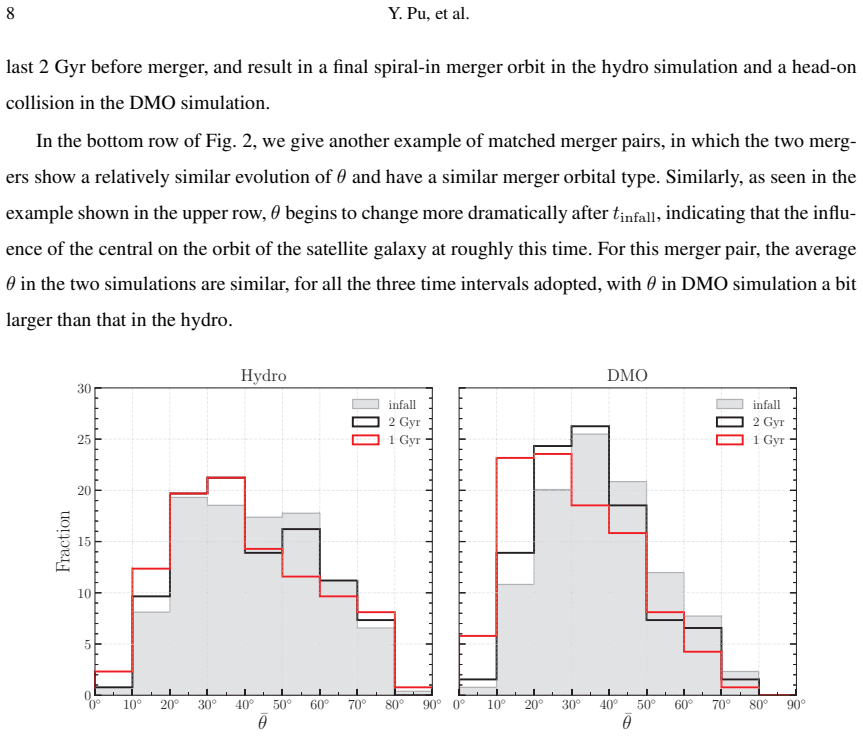
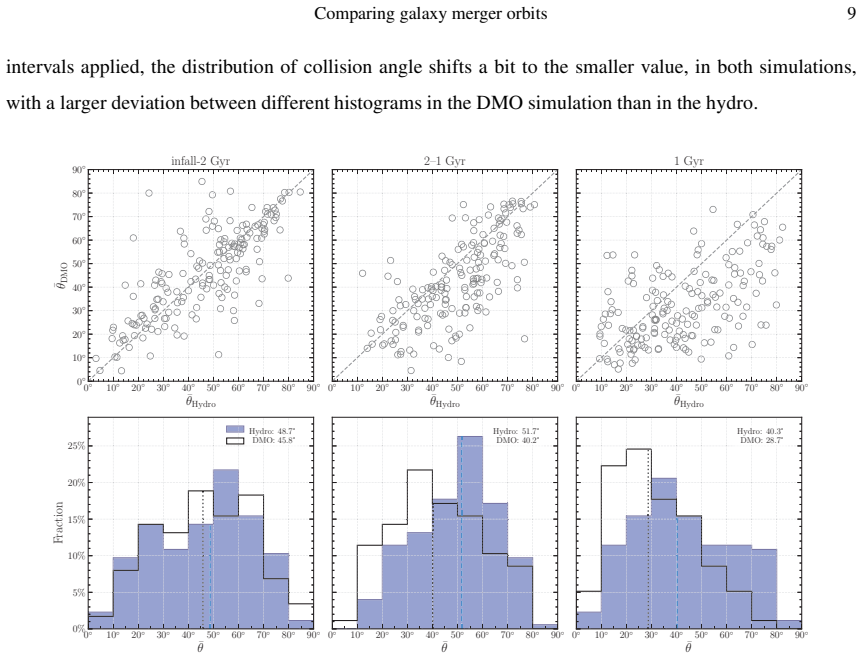
Compared with the mergers in the dark-matter-only simulation without baryons, the matched mergers in the hydrodynamical simulation have similar infall time, but have statistically earlier merger times and therefore shorter merger timescales. The merger orbits for the matched pairs are similar right after infall, and both evolve to more head-on orbits at final stages, with smaller changes in the hydrodynamical simulation. In the final 2 Gyr before merger, the collision angles are smaller in the hydro run by around 6 to 10 degrees, depending on mass ratios and galaxy masses.
What carries the argument
Comparison of matched merger pairs tracked across hydrodynamical and dark-matter-only versions of the same simulation volume, measuring differences in infall times, merger times, and collision angles.
Load-bearing premise
The matched merger pairs identified across the two simulation types are comparable enough that differences arise mainly from baryonic physics rather than from matching methods or resolution effects.
What would settle it
Finding no systematic difference in merger times or final collision angles between hydrodynamical and dark-matter-only runs in an independent simulation suite with similar matching would challenge the central claim.
Figures




read the original abstract
To investigate how the presence of baryons in simulations affects galaxy merger orbits, we compare in detail the merger timescales and orbits of the matched merger pairs in TNG100 hydrodynamical simulations and their corresponding dark-matter-only simulations, for different resolution levels. Compared with the mergers in the TNG100-1-Dark simulation without baryons, the matched mergers in the TNG100-1 simulation have similar infall time, but have statistically earlier merger times and therefore shorter merger timescales. The merger orbits for the matched pairs in the TNG100-1 and the TNG100-1-Dark simulations are similar right after infall, and both evolve to more head-on orbits at final stages, with smaller changes in the hydrodynamical simulation. In the final 2 Gyr before merger, the collision angles that represent merger orbits quantitatively are smaller in TNG100-1 than those in TNG100-1-Dark, by around 6$^\circ$ to 10$^\circ$, depending on the mass ratios and galaxy masses investigated. Our results demonstrate that the presence of baryons accelerates a bit the merger processes, and results in more spiral-in orbits for both major and minor mergers in galaxies with various stellar masses. These effects are less obvious in simulations with lower resolutions.
Editorial analysis
A structured set of objections, weighed in public.
Referee Report
Summary. The manuscript compares merger timescales and orbits of matched galaxy pairs in the TNG100-1 hydrodynamical simulation versus the TNG100-1-Dark dark-matter-only run at multiple resolutions. It reports similar infall times but statistically earlier merger times (hence shorter timescales) in the hydro run; orbits are similar post-infall but evolve to more head-on configurations with smaller changes in the hydro case. In the final 2 Gyr before merger, collision angles are smaller by 6–10° in TNG100-1 (depending on mass ratio and stellar mass), leading to the conclusion that baryons slightly accelerate mergers and produce more spiral-in orbits for major and minor mergers, with weaker effects at lower resolution.
Significance. If the differences are shown to arise from baryonic physics acting on equivalent initial conditions rather than from matching or numerical artifacts, the result would be useful for calibrating merger timescales in semi-analytic models and for interpreting observed merger fractions. The multi-resolution comparison is a positive feature that allows direct assessment of numerical sensitivity.
major comments (3)
- [Methods (pair identification and matching)] The pair-matching procedure between TNG100-1 and TNG100-1-Dark is described too briefly to evaluate selection bias. Baryons alter halo masses, concentrations, and subhalo tracking from early times, so pairs that survive matching may preferentially have more radial orbits or less perturbed histories; this directly affects whether the reported 6–10° difference and shorter timescales can be attributed to baryonic effects during the merger itself rather than to the matching criteria.
- [Results (collision-angle evolution)] The quantitative claim of a 6°–10° smaller collision angle in the final 2 Gyr (depending on mass ratio and galaxy mass) is presented without error bars, bootstrap uncertainties, or a statement of the number of matched pairs per bin. This information is load-bearing for the central statistical claim and for assessing whether the difference exceeds resolution-dependent scatter.
- [Discussion (resolution dependence)] The manuscript notes that effects are weaker at lower resolution but does not test whether this trend supports a physical baryonic interpretation or instead reflects resolution-dependent differences in halo finding and orbit integration that could also bias the matched sample.
minor comments (2)
- [Methods (orbit quantification)] Clarify the exact definition of the collision angle used to quantify merger orbits and confirm it is computed identically in both simulation suites.
- [Results] Add a table or explicit statement of the final sample sizes after matching for each mass-ratio and stellar-mass bin.
Simulated Author's Rebuttal
We thank the referee for their constructive and detailed comments, which have helped clarify several aspects of our analysis. We address each major comment below and have revised the manuscript accordingly to improve methodological transparency, statistical rigor, and interpretive discussion.
read point-by-point responses
-
Referee: The pair-matching procedure between TNG100-1 and TNG100-1-Dark is described too briefly to evaluate selection bias. Baryons alter halo masses, concentrations, and subhalo tracking from early times, so pairs that survive matching may preferentially have more radial orbits or less perturbed histories; this directly affects whether the reported 6–10° difference and shorter timescales can be attributed to baryonic effects during the merger itself rather than to the matching criteria.
Authors: We appreciate this concern regarding potential selection effects. Our matching identifies corresponding galaxies using shared dark-matter particle IDs at the infall epoch, which is intended to select pairs with equivalent initial conditions. We will expand the Methods section with a fuller description of the algorithm, including tolerances on position, velocity, and mass matching. We have also added checks showing that the distributions of orbital eccentricity and specific angular momentum at infall for the matched sample are statistically consistent with the full population, with no evident bias toward radial orbits. While early baryonic effects on halo properties are unavoidable, these post-infall comparisons support our attribution of the observed differences to baryonic physics acting during the merger phase. revision: partial
-
Referee: The quantitative claim of a 6°–10° smaller collision angle in the final 2 Gyr (depending on mass ratio and galaxy mass) is presented without error bars, bootstrap uncertainties, or a statement of the number of matched pairs per bin. This information is load-bearing for the central statistical claim and for assessing whether the difference exceeds resolution-dependent scatter.
Authors: We agree that quantitative uncertainties are necessary. In the revised manuscript we will add bootstrap-derived error bars (1000 resamples) to the collision-angle measurements and explicitly report the number of matched pairs in each mass-ratio and stellar-mass bin. These additions show that the 6°–10° offsets remain significant (typically 2–3σ) relative to the uncertainties and to the resolution-dependent scatter present in our multi-resolution comparisons. revision: yes
-
Referee: The manuscript notes that effects are weaker at lower resolution but does not test whether this trend supports a physical baryonic interpretation or instead reflects resolution-dependent differences in halo finding and orbit integration that could also bias the matched sample.
Authors: We will strengthen the Discussion by adding explicit comparisons of halo-finder and orbit-integrator performance across resolutions in both runs, quantifying the numerical scatter in merger timescales and angles. The observed weakening of baryonic effects at lower resolution is consistent with reduced resolution of gas dynamics and stellar components, but we will also include caveats on possible contributions from resolution-dependent numerical artifacts in the matching process. revision: partial
Circularity Check
Direct simulation comparison exhibits no circularity
full rationale
The paper conducts an empirical comparison of merger timescales and orbits between the TNG100 hydrodynamical run and its dark-matter-only counterpart using matched pairs identified across the two suites. No mathematical derivations, parameter fits presented as predictions, or self-referential definitions appear in the analysis. Central claims rest on statistical differences measured directly from the simulation outputs at multiple resolutions, with the matching procedure serving as a methodological choice rather than a load-bearing self-definition or fitted input. The work is self-contained against the external benchmark of the two simulation suites themselves.
Axiom & Free-Parameter Ledger
axioms (2)
- domain assumption Merger pairs can be accurately matched between hydrodynamical and dark-matter-only runs using shared initial conditions or halo properties without introducing systematic bias.
- domain assumption Differences in merger time and orbit are attributable to baryonic physics rather than numerical resolution or subgrid model choices.
Lean theorems connected to this paper
-
IndisputableMonolith/Foundation/RealityFromDistinction.leanreality_from_one_distinction unclear?
unclearRelation between the paper passage and the cited Recognition theorem.
Our results demonstrate that the presence of baryons accelerates a bit the merger processes, and results in more spiral-in orbits for both major and minor mergers in galaxies with various stellar masses.
What do these tags mean?
- matches
- The paper's claim is directly supported by a theorem in the formal canon.
- supports
- The theorem supports part of the paper's argument, but the paper may add assumptions or extra steps.
- extends
- The paper goes beyond the formal theorem; the theorem is a base layer rather than the whole result.
- uses
- The paper appears to rely on the theorem as machinery.
- contradicts
- The paper's claim conflicts with a theorem or certificate in the canon.
- unclear
- Pith found a possible connection, but the passage is too broad, indirect, or ambiguous to say the theorem truly supports the claim.
Reference graph
Works this paper leans on
-
[1]
Behroozi, P . S., Wechsler, R. H., & Wu, H.-Y . 2012, The Astrophysical Journal, 762, 109 3
work page 2012
-
[2]
2005, Astronomy & Astroph ysics, 437, 69 2
Bournaud, F., Jog, C., & Combes, F. 2005, Astronomy & Astroph ysics, 437, 69 2
work page 2005
-
[3]
Bournaud, F., Jog, C. J., & Combes, F. 2007, Astronomy & Astro physics, 476, 1179 2
work page 2007
- [4]
-
[5]
Conselice, C. J. 2014, Annual Review of Astronomy and Astrop hysics, 52, 291 2
work page 2014
-
[6]
Conselice, C. J., Bershady, M. A., Dickinson, M., & Papovich , C. 2003, The Astronomical Journal, 126, 1183 1 16 Y . Pu, et al. Dav´ e, R., Angl´ es-Alc´ azar, D., Narayanan, D., et al. 2019, Monthly Notices of the Royal Astronomical Society, 486, 2827 2
work page 2003
-
[7]
Dolag, K., Borgani, S., Murante, G., & Springel, V . 2009, MNR AS, 399, 497 4
work page 2009
-
[8]
2016, Monthly Not ices of the Royal Astronomical Society, 463, 3948 2
Dubois, Y ., Peirani, S., Pichon, C., et al. 2016, Monthly Not ices of the Royal Astronomical Society, 463, 3948 2
work page 2016
-
[9]
2023, Monthly N otices of the Royal Astronomical Society, 519, 2199 4
Eisert, L., Pillepich, A., Nelson, D., et al. 2023, Monthly N otices of the Royal Astronomical Society, 519, 2199 4
work page 2023
-
[10]
Fuentealba-Fuentes, M. F., Davies, L. J., Robotham, A. S., e t al. 2025, Monthly Notices of the Royal Astronomical Society, 539, 1651 2 Gonz´ alez-Garc´ ıa, A. C., & Balcells, M. 2005, Monthly Notices of the Royal Astronomical Society, 357, 753 2
work page 2025
-
[11]
Guo, Q., White, S., Boylan-Kolchin, M., et al. 2011, MNRAS, 4 13, 101 3
work page 2011
-
[12]
Holland, P . W ., & Welsch, R. E. 1977, Communications in Statistics-theory and Methods, 6, 813 6
work page 1977
-
[13]
Hopkins, P . F., Cox, T. J., Y ounger, J. D., & Hernquist, L. 2009, ApJ, 691, 1168 2
work page 2009
-
[14]
Hopkins, P . F., Hernquist, L., Cox, T. J., et al. 2006, The Astrophysical Journal Supplement Series, 163, 1 1
work page 2006
-
[15]
F., Croton, D., Bundy, K., et al
Hopkins, P . F., Croton, D., Bundy, K., et al. 2010, The Astrop hysical Journal, 724, 915 2
work page 2010
-
[16]
2024, Research in Astronomy and Astrop hysics, 24, 075019 2
Hu, J., Xu, D., & Li, C. 2024, Research in Astronomy and Astrop hysics, 24, 075019 2
work page 2024
-
[17]
A., Martin, G., Kaviraj, S., et al
Jackson, R. A., Martin, G., Kaviraj, S., et al. 2020, MNRAS, 4 94, 5568 2
work page 2020
-
[18]
Kitzbichler, M. G., & White, S. D. 2008, Monthly Notices of th e Royal Astronomical Society, 391, 1489 1
work page 2008
-
[19]
Knebe, A., Knollmann, S. R., Muldrew, S. I., et al. 2011, Mont hly Notices of the Royal Astronomical Society, 415, 2293 3
work page 2011
-
[20]
Kormendy, J., Fisher, D. B., Cornell, M. E., & Bender, R. 2009 , The Astrophysical Journal Supplement Series, 182, 216 2
work page 2009
-
[21]
Lacey, C. G., Baugh, C. M., Frenk, C. S., et al. 2016, MNRAS, 46 2, 3854 3 Łokas, E. L. 2020, Astronomy & Astrophysics, 642, L12 4 L´ opez-Sanjuan, C., Le F` evre, O., Tasca, L., et al. 2013, Astronomy & Astrophysics, 553, A78 2
work page 2016
-
[22]
M., Jonsson, P ., Cox, T., et al
Lotz, J. M., Jonsson, P ., Cox, T., et al. 2011, The Astrophysi cal Journal, 742, 103 2
work page 2011
-
[23]
M., Jonsson, P ., Cox, T., & Primack, J
Lotz, J. M., Jonsson, P ., Cox, T., & Primack, J. R. 2008, Monthly Notices of the Royal Astronomical Society, 391, 1137 1
work page 2008
- [24]
-
[25]
2018, Mo nthly Notices of the Royal Astronomical Society, 480, 5113 3
Marinacci, F., V ogelsberger, M., Pakmor, R., et al. 2018, Mo nthly Notices of the Royal Astronomical Society, 480, 5113 3
work page 2018
-
[26]
Martin, G., Kaviraj, S., Devriendt, J. E. G., Dubois, Y ., & Pi chon, C. 2018, MNRAS, 480, 2266 2
work page 2018
- [27]
-
[28]
P ., Pillepich, A., Springel, V ., et al
Naiman, J. P ., Pillepich, A., Springel, V ., et al. 2018, Mont hly Notices of the Royal Astronomical Society, 477, 1206 3
work page 2018
-
[29]
Nelder, J. A., & Wedderburn, R. W . 1972, Journal of the Royal S tatistical Society Series A: Statistics in Society, 135, 370 6
work page 1972
-
[30]
2015, Astronomy and Computing, 13, 12 4 Comparing galaxy merger orbits 17
Nelson, D., Pillepich, A., Genel, S., et al. 2015, Astronomy and Computing, 13, 12 4 Comparing galaxy merger orbits 17
work page 2015
-
[31]
2018, Monthl y Notices of the Royal Astronomical Society, 475, 624 3
Nelson, D., Pillepich, A., Springel, V ., et al. 2018, Monthl y Notices of the Royal Astronomical Society, 475, 624 3
work page 2018
- [32]
-
[33]
Peschken, N., Łokas, E. L., & Athanassoula, E. 2020, Monthly Notices of the Royal Astronomical Society, 493, 1375 2
work page 2020
-
[34]
2010, Astron omy & Astrophysics, 511, A50 2
Retzlaff, J., Rosati, P ., Dickinson, M., et al. 2010, Astron omy & Astrophysics, 511, A50 2
work page 2010
-
[35]
2015, Monthly Notices of the Royal Astronomical Society, 449, 49 4
Rodriguez-Gomez, V ., Genel, S., V ogelsberger, M., et al. 2015, Monthly Notices of the Royal Astronomical Society, 449, 49 4
work page 2015
-
[36]
Rodriguez-Gomez, V ., Sales, L. V ., Genel, S., et al. 2017, Mo nthly Notices of the Royal Astronomical Society, 467, 3083 2, 4 Ryan Jr, R., Cohen, S., Windhorst, R., & Silk, J. 2008, The Ast rophysical Journal, 678, 751 1
work page 2017
-
[37]
2007, Monthly Notices of the R oyal Astronomical Society, 383 2
Schaye, J., & Dalla V ecchia, C. 2007, Monthly Notices of the R oyal Astronomical Society, 383 2
work page 2007
-
[38]
Schaye, J., Crain, R. A., Bower, R. G., et al. 2015, Monthly No tices of the Royal Astronomical Society, 446, 521 2
work page 2015
-
[39]
2017, Monthly Notices of the Royal Astronomical Society, 470, 3946 2
Sparre, M., & Springel, V . 2017, Monthly Notices of the Royal Astronomical Society, 470, 3946 2
work page 2017
-
[40]
2010, Monthly Notices of the Royal Astronomical Society, 401, 791 3
Springel, V . 2010, Monthly Notices of the Royal Astronomical Society, 401, 791 3
work page 2010
-
[41]
2005, The Astrophysical Journal, 622, L9 2
Springel, V ., & Hernquist, L. 2005, The Astrophysical Journal, 622, L9 2
work page 2005
-
[42]
2018, Monthl y Notices of the Royal Astronomical Society, 475, 676 3
Springel, V ., Pakmor, R., Pillepich, A., et al. 2018, Monthl y Notices of the Royal Astronomical Society, 475, 676 3
work page 2018
-
[43]
Stevens, A. R. H., Sinha, M., Rohl, A., et al. 2024, P ASA, 41, e 053 3
work page 2024
-
[44]
2019, Month ly Notices of the Royal Astronomical Society, 487, 5416 3
Tacchella, S., Diemer, B., Hernquist, L., et al. 2019, Month ly Notices of the Royal Astronomical Society, 487, 5416 3
work page 2019
-
[45]
1977, In: Annual review of astronomy and astrophy sics
Toomre, A. 1977, In: Annual review of astronomy and astrophy sics. V olume 15.(A78-16576 04-90) Palo
work page 1977
-
[46]
Alto, Calif., Annual Reviews, Inc., 1977, p. 437-478. NSF-s upported research., 15, 437 2
work page 1977
-
[47]
1972, Astrophysical Journal, V ol
Toomre, A., & Toomre, J. 1972, Astrophysical Journal, V ol. 178, pp. 623-666 (1972), 178, 623 1 van der Wel, A., Franx, M., V an Dokkum, P ., et al. 2014, The Astrophysical Journal, 788, 28 2
work page 1972
- [48]
-
[49]
2019, Monthly Notices of the R oyal Astronomical Society, 485, 2083 3, 4, 5
Wang, L., Xu, D., Gao, L., et al. 2019, Monthly Notices of the R oyal Astronomical Society, 485, 2083 3, 4, 5
work page 2019
-
[50]
White, S. D., & Rees, M. J. 1978, Monthly Notices of the Royal A stronomical Society, 183, 341 2
work page 1978
-
[51]
Xie, L., De Lucia, G., Hirschmann, M., Fontanot, F., & Zoldan , A. 2017, MNRAS, 469, 968 3
work page 2017
-
[52]
2025, The Astrophysical Journal, 986, 201 2 , 6 18 Y
Xu, K., & Jing, Y . 2025, The Astrophysical Journal, 986, 201 2 , 6 18 Y . Pu, et al
work page 2025
-
[53]
2021, Monthly Notices of the Roya l Astronomical Society, 507, 3301 2, 4, 8, 14, 15
Zeng, G., Wang, L., & Gao, L. 2021, Monthly Notices of the Roya l Astronomical Society, 507, 3301 2, 4, 8, 14, 15
work page 2021
discussion (0)
Sign in with ORCID, Apple, or X to comment. Anyone can read and Pith papers without signing in.