Contact-Rich Robotic Assembly in Construction via Diffusion Policy Learning
Pith reviewed 2026-05-17 20:01 UTC · model grok-4.3
The pith
Diffusion policies trained on force-sensing demonstrations let industrial robots assemble tight-fitting timber joints despite positional errors up to 10 mm.
A machine-rendered reading of the paper's core claim, the machinery that carries it, and where it could break.
Core claim
Sensory-motor diffusion policies trained from teleoperated demonstrations in a force/torque-equipped industrial workcell achieve 100 percent success on nominal mortise-and-tenon timber assemblies and maintain an average 75 percent success rate when randomized positional perturbations of up to 10 mm are introduced, supplying initial evidence that the learned policies compensate for large misalignments through contact-rich control rather than open-loop positioning.
What carries the argument
Sensory-motor diffusion policies that generate action sequences conditioned on current force and position observations to produce contact-aware assembly motions.
Load-bearing premise
That teleoperated demonstrations collected inside a controlled workcell with force sensing will transfer to the wider range of material imperfections, tolerance stack-ups, and dynamic disturbances present on real construction sites.
What would settle it
A field trial on an actual construction site in which success rates fall below 50 percent when the same policy encounters accumulated tolerances from multiple prefabricated members and typical site vibrations would falsify the claim of practical robustness.
Figures


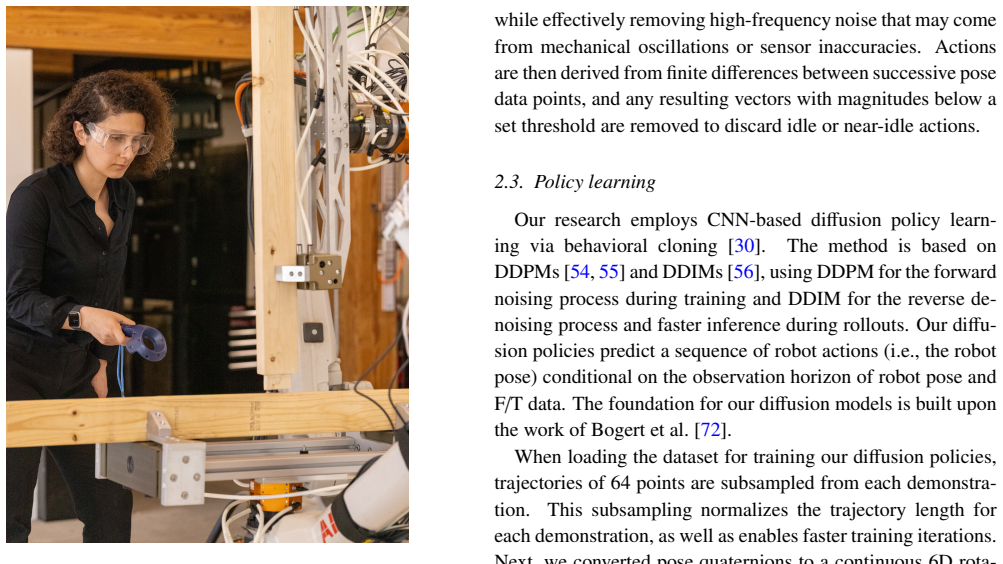


read the original abstract
Fabrication uncertainty arising from tolerance accumulation, material imperfection, and positioning errors remains a critical barrier to automated robotic assembly in construction, particularly for contact-rich manipulation tasks governed by friction and geometric constraints. This paper investigates the deployment of diffusion policy learning on construction-scale industrial robots to enable robust, high-precision assembly under such uncertainty, using tight-fitting mortise and tenon timber joinery as a representative case study. Sensory-motor diffusion policies are trained using teleoperated demonstrations collected from an industrial robotic workcell equipped with force/torque sensing. A two-phase experimental study evaluates baseline performance and robustness under randomized positional perturbations up to 10 mm, far exceeding the sub-millimeter joint clearance. The best-performing policy achieved 100% success under nominal conditions and 75% average success under uncertainty. These results provide initial evidence that diffusion policies compensate for misalignments through contact-aware control, representing a step toward robust robotic assembly in construction under tight tolerances.
Editorial analysis
A structured set of objections, weighed in public.
Referee Report
Summary. The manuscript investigates the application of sensory-motor diffusion policies, trained via teleoperated demonstrations in a force/torque-equipped industrial robotic workcell, to contact-rich assembly of tight-fitting mortise and tenon timber joints. A two-phase experimental study evaluates nominal performance and robustness to randomized positional perturbations of up to 10 mm. The best policy achieves 100% success under nominal conditions and 75% average success under uncertainty, offering initial evidence that diffusion policies enable contact-aware compensation for misalignments in construction-scale assembly tasks.
Significance. If the empirical results hold under broader conditions, the work provides concrete physical-robot evidence that diffusion-based imitation learning can address tolerance accumulation and positioning errors in contact-rich construction tasks, a domain where traditional control often fails. The use of force/torque sensing during demonstration collection and hardware validation on industrial robots strengthens the practical relevance, though the limited perturbation types leave open questions about transfer to full site variability.
major comments (2)
- [Abstract] Abstract: success rates of 100% nominal and 75% under perturbation are reported without any information on the number of teleoperated demonstrations, diffusion model hyperparameters, number of evaluation trials, statistical variance, or precise definition of assembly success (e.g., insertion depth threshold or force limits). These omissions directly affect assessment of the central claim that the policy compensates for misalignments.
- [Experimental Study] Two-phase experimental study: only randomized positional offsets (up to 10 mm) are applied to demonstrations collected in a controlled workcell. This does not test material imperfections, variable friction, or dynamic disturbances that would change contact dynamics outside the training distribution, weakening the generalization implied by the claim of contact-aware control for construction uncertainty.
minor comments (2)
- Clarify whether any baseline policies (e.g., standard behavior cloning or force-based controllers) were evaluated alongside the diffusion policy to contextualize the reported success rates.
- Ensure that any tables or figures presenting success rates include error bars or trial counts for transparency.
Simulated Author's Rebuttal
We thank the referee for their constructive feedback. Below we provide point-by-point responses to the major comments and indicate the revisions we plan to make.
read point-by-point responses
-
Referee: [Abstract] Abstract: success rates of 100% nominal and 75% under perturbation are reported without any information on the number of teleoperated demonstrations, diffusion model hyperparameters, number of evaluation trials, statistical variance, or precise definition of assembly success (e.g., insertion depth threshold or force limits). These omissions directly affect assessment of the central claim that the policy compensates for misalignments.
Authors: The abstract is intended as a concise summary, while the full manuscript details the experimental protocol, including the number of teleoperated demonstrations, model hyperparameters, evaluation trials, and the definition of assembly success (full insertion within force limits). To directly address the concern and strengthen the presentation of the central claim, we will revise the abstract to incorporate a brief statement on the number of trials and success criteria. revision: yes
-
Referee: [Experimental Study] Two-phase experimental study: only randomized positional offsets (up to 10 mm) are applied to demonstrations collected in a controlled workcell. This does not test material imperfections, variable friction, or dynamic disturbances that would change contact dynamics outside the training distribution, weakening the generalization implied by the claim of contact-aware control for construction uncertainty.
Authors: The study focuses on positional perturbations up to 10 mm as a representative and quantifiable source of uncertainty in construction assembly, with force/torque sensing enabling contact-aware adaptation as shown by the reported success rates. We agree that material imperfections, variable friction, and dynamic disturbances are not tested here and represent additional challenges. In revision we will add an explicit limitations discussion clarifying the current scope and suggesting future extensions to broader site variability. revision: partial
Circularity Check
No circularity: empirical hardware results independent of derivations
full rationale
The paper reports experimental outcomes from training sensory-motor diffusion policies on teleoperated demonstrations collected in a force/torque-equipped workcell, followed by direct physical testing of success rates under nominal conditions and randomized positional perturbations up to 10 mm. No mathematical derivation chain, first-principles predictions, or equations are presented that reduce by construction to fitted parameters, self-citations, or ansatzes; the 100% nominal and 75% perturbed success rates are measured performance metrics on hardware rather than outputs forced by the training data or prior author work. The central claim of contact-aware compensation is supported by these empirical benchmarks, which remain falsifiable outside any internal fitting process.
Axiom & Free-Parameter Ledger
axioms (1)
- domain assumption Teleoperated demonstrations provide sufficient coverage of contact-rich behaviors for policy generalization
Lean theorems connected to this paper
-
IndisputableMonolith/Cost/FunctionalEquation.leanwashburn_uniqueness_aczel unclear?
unclearRelation between the paper passage and the cited Recognition theorem.
sensory–motor diffusion policies... trained using teleoperated demonstrations... randomized positional perturbations up to 10 mm... 100% success under nominal conditions and 75% average success under uncertainty
What do these tags mean?
- matches
- The paper's claim is directly supported by a theorem in the formal canon.
- supports
- The theorem supports part of the paper's argument, but the paper may add assumptions or extra steps.
- extends
- The paper goes beyond the formal theorem; the theorem is a base layer rather than the whole result.
- uses
- The paper appears to rely on the theorem as machinery.
- contradicts
- The paper's claim conflicts with a theorem or certificate in the canon.
- unclear
- Pith found a possible connection, but the passage is too broad, indirect, or ambiguous to say the theorem truly supports the claim.
Forward citations
Cited by 1 Pith paper
-
From Reach to Insert: Tactile-Augmented Precision Assembly under Sub-Millimeter Tolerances
A two-stage IL-RL method with tactile group sampling and a tactile critic achieves 67% success at 0.05 mm clearance while cutting max force by 60% and torque by 44%.
Reference graph
Works this paper leans on
-
[1]
Delgado JMD, Oyedele L, Ajayi A, Akanbi L, Akinade O, Bilal M, Owolabi H. Robotics and automated systems in construction: Under- standing industry-specific challenges for adoption.Journal of Building Engineering, 26, pp. 100868, 2019,https://doi.org/10.1016/j.jo be.2019.100868
-
[2]
Wei HH, Zhang Y , Sun X, Chen J, Li S. Intelligent robots and human- robot collaboration in the construction industry: a review.Journal of Intelligent Construction, 1(1), pp. 1–12, 2023,https://doi.org/10.2 6599/JIC.2023.9180002
-
[3]
Laukkanen T. Construction work and education: occupational health and safety reviewed.Construction Management and Economics, 17, pp. 53– 62, 1999,https://doi.org/10.1080/014461999371826
-
[4]
Arndt V , Rothenbacher D, Daniel U, Zschenderlein B, Schuberth S, Bren- ner H. Construction work and risk of occupational disability: a ten year follow up of 14 474 male workers.Occupational and Environmental Medicine, 62, pp. 559–566, 2005,https://doi.org/10.1136/oe m.2004.018135
work page doi:10.1136/oe 2005
-
[5]
Bock T. The future of construction automation: Technological disrup- tion and the upcoming ubiquity of robotics.Automation in Construction, 59, pp. 113–121, 2015,https://doi.org/10.1016/j.autcon.201 5.07.022
-
[6]
Musarat MA, Alaloul WS, Rostam NAQA, Khan AM. Substitution of workforce with robotics in the construction industry: A wise or witless approach.Journal of Open Innovation: Technology, Market, and Com- plexity, 10(4), pp. 100420, 2024,https://doi.org/10.1016/j.joit mc.2024.100420
-
[7]
Chen Z, Adel A. Advancing robotic assembly in construction: Innova- tions, challenges, and opportunities.Automation in Construction, 178, pp. 106370, 2025,https://doi.org/10.1016/j.autcon.2025.1063 70
-
[8]
Parallel paths of inquiry: Detailing for DFAB HOUSE.Technology|Architecture+Design, 5, pp
Graser K, Adel A, Baur M, Pont DS, Thoma A. Parallel paths of inquiry: Detailing for DFAB HOUSE.Technology|Architecture+Design, 5, pp. 38–43, 2021,https://doi.org/10.1080/24751448.2021.186366 8
-
[9]
Feedback-driven adaptive multi- robot timber construction.Automation in Construction, 164, pp
Adel A, Ruan D, McGee W, Mozaffari S. Feedback-driven adaptive multi- robot timber construction.Automation in Construction, 164, pp. 105444, 2024,https://doi.org/10.1016/j.autcon.2024.105444
-
[10]
New paradigms of the automatic robotic timber construction in architecture
Willmann J, Gramazio F, Kohler M. New paradigms of the automatic robotic timber construction in architecture. InAdvancing Wood Ar- chitecture: a Computational Approach, pp. 13–27. Routledge, 2017, https://doi.org/10.4324/9781315678825-2
-
[11]
PhD thesis, ETH Zurich, 2018,https://doi.org/10.3929/ ethz-b-000266723
Apolinarska AA.Complex timber structures from simple elements: com- putational design of novel bar structures for robotic fabrication and as- sembly. PhD thesis, ETH Zurich, 2018,https://doi.org/10.3929/ ethz-b-000266723
work page 2018
-
[13]
PhD thesis, ETH Zurich, 2020, https://doi.org/10.3929/ethz-b-000439443
Adel A.Computational Design for Cooperative Robotic Assembly of Nonstandard Timber Frame Buildings. PhD thesis, ETH Zurich, 2020, https://doi.org/10.3929/ethz-b-000439443
-
[14]
Co-robotic assembly of nonstandard timber structures
Adel A. Co-robotic assembly of nonstandard timber structures. InHy- brids&Haecceities, Proceedings of the 42nd Annual Conference of the Association for Computer Aided Design in Architecture (ACADIA), pp. 604–613. CumInCAD, 2022,https://doi.org/10.7302/8675
-
[15]
Chai H, Wagner HJ, Guo Z, Qi Y , Menges A, Yuan PF. Computational design and on-site mobile robotic construction of an adaptive reinforce- ment beam network for cross-laminated timber slab panels.Automation in Construction, 142, pp. 104536, 2022,https://doi.org/10.1016/ j.autcon.2022.104536
-
[16]
Lauer APR, Benner E, Stark T, Klassen S, Abolhasani S, Schroth L, Gien- ger A, Wagner HJ, Schwieger V , Menges A et al. Automated on-site assembly of timber buildings on the example of a biomimetic shell.Au- tomation in Construction, 156, pp. 105118, 2023,https://doi.org/ 10.1016/j.autcon.2023.105118
-
[17]
Au- tomatic assembly of jointed timber structure using distributed robotic clamps
Leung PY , Apolinarska AA, Tanadini D, Gramazio F, Kohler M. Au- tomatic assembly of jointed timber structure using distributed robotic clamps. InPROJECTIONS, Proceedings of the 26th International Con- ference of the Association for Computer-Aided Architectural Design (CAADRIA), volume 1, pp. 583–592. CumInCAD, 2021,https://do i.org/10.52842/conf.caadria....
-
[18]
A survey of robot manipu- lation in contact.Robotics and Autonomous Systems, 156, pp
Suomalainen M, Karayiannidis Y , Kyrki V . A survey of robot manipu- lation in contact.Robotics and Autonomous Systems, 156, pp. 104224, 2022,https://doi.org/10.1016/j.robot.2022.104224
-
[19]
Robotic assembly of timber joints using reinforcement learning.Au- tomation in Construction, 125, pp
Apolinarska AA, Pacher M, Li H, Cote N, Pastrana R, Gramazio F, Kohler M. Robotic assembly of timber joints using reinforcement learning.Au- tomation in Construction, 125, pp. 103569, 2021,https://doi.org/ 10.1016/j.autcon.2021.103569
-
[20]
Kramberger A, Kunic A, Iturrate I, Sloth C, Naboni R, Schlette C. Robotic assembly of timber structures in a human-robot collaboration setup.Frontiers in Robotics and AI, 8, pp. 768038, 2022,https: //doi.org/10.3389/frobt.2021.768038
-
[21]
Automatic reconstruction of parametric building models from indoor point clouds
Yang X, Amtsberg F, Sedlmair M, Menges A. Challenges and potential for human–robot collaboration in timber prefabrication.Automation in Construction, 160, pp. 105333, 2024,https://doi.org/10.1016/j. autcon.2024.105333
work page doi:10.1016/j 2024
-
[22]
Benson T.Building the timber frame house: The revival of a forgotten craft. Simon and Schuster, 1981
work page 1981
-
[23]
Fang D, Mueller C. Mortise-and-tenon joinery for modern timber con- struction: Quantifying the embodied carbon of an alternative structural connection.Architecture, Structures and Construction, 3(1), pp. 11–24, 2023,https://doi.org/10.1007/s44150-021-00018-5
-
[24]
Fang D. Mortise-and-tenon joinery for modern timber construction: Quantifying the embodied carbon of an alternative structural connection. Master’s thesis, Massachusetts Institute of Technology, 2021,https: //hdl.handle.net/1721.1/145614
work page 2021
-
[25]
End-to-end training of deep visuo- motor policies.Journal of Machine Learning Research, 17(39), pp
Levine S, Finn C, Darrell T, Abbeel P. End-to-end training of deep visuo- motor policies.Journal of Machine Learning Research, 17(39), pp. 1–40, 2016,http://jmlr.org/papers/v17/15-522.html
work page 2016
-
[26]
One-shot visual imitation learning via meta-learning
Finn C, Yu T, Zhang T, Abbeel P, Levine S. One-shot visual imitation learning via meta-learning. InProceedings of the Conference on Robot Learning CoRL, pp. 357–368. PMLR, 2017,https://proceedings. mlr.press/v78/finn17a.html
work page 2017
-
[27]
Levine S, Pastor P, Krizhevsky A, Ibarz J, Quillen D. Learning hand-eye coordination for robotic grasping with deep learning and large-scale data collection.The International journal of robotics research, 37(4-5), pp. 421–436, 2018,https://doi.org/10.1177/0278364917710318
-
[28]
Scalable deep reinforce- ment learning for vision-based robotic manipulation
Kalashnikov D, Irpan A, Pastor P, Ibarz J, Herzog A, Jang E, Quillen D, Holly E, Kalakrishnan M, Vanhoucke V et al. Scalable deep reinforce- ment learning for vision-based robotic manipulation. InProccedings of Conference on robot learning (CoRL), volume 87, pp. 651–673. PMLR, 2018,https://proceedings.mlr.press/v87/kalashnikov18a.h tml
work page 2018
-
[29]
RT-1: Robotics Transformer for Real-World Control at Scale
Brohan A, Brown N, Carbajal J, Chebotar Y , Dabis J, Finn C, Gopalakr- ishnan K, Hausman K, Herzog A, Hsu J, Ibarz J, Ichter B, Irpan A, Jack- son T, Jesmonth S, Joshi NJ, Julian R, Kalashnikov D, Kuang Y , Leal I, Lee KH, Levine S, Lu Y , Malla U, Manjunath D, Mordatch I, Nachum O, Parada C, Peralta J, Perez E, Pertsch K, Quiambao J, Rao K, Ryoo M, Salaz...
work page internal anchor Pith review Pith/arXiv arXiv 2023
-
[30]
Diffusion policy: Visuomotor policy learning via action diffusion
Chi C, Xu Z, Feng S, Cousineau E, Du Y , Burchfiel B, Tedrake R, Song S. Diffusion policy: Visuomotor policy learning via action diffusion.The International Journal of Robotics Research, pp. 02783649241273668, 2024,https://doi.org/10.1177/02783649241273668
-
[31]
Universal Manipulation Interface: In-The-Wild Robot Teaching Without In-The-Wild Robots
Chi C, Xu Z, Pan C, Cousineau E, Burchfiel B, Feng S, Tedrake R, Song S. Universal manipulation interface: In-the-wild robot teaching without in-the-wild robots, 2024,https://arxiv.org/abs/2402.10329
work page internal anchor Pith review Pith/arXiv arXiv 2024
-
[32]
Hou Y , Liu Z, Chi C, Cousineau E, Kuppuswamy N, Feng S, Burchfiel B, Song S. Adaptive compliance policy: Learning approximate compliance for diffusion guided control, 2025,https://arxiv.org/abs/2410.0 9309
work page 2025
-
[33]
Yang L, Suh HJT, Zhao T, Graesdal BP, Kelestemur T, Wang J, Pang T, Tedrake R. Physics-driven data generation for contact-rich manipulation via trajectory optimization, 2025,https://arxiv.org/abs/2502.2 0382
work page 2025
-
[34]
Zhu H, Zhao T, Ni X, Wang J, Fang K, Righetti L, Pang T. Should we learn contact-rich manipulation policies from sampling-based planners? IEEE Robotics and Automation Letters, 10(6), pp. 6248–6255, 2025,ht tps://doi.org/10.1109/LRA.2025.3564701
-
[35]
Stadelmann L, Sandy T, Thoma A, Buchli J. End-effector pose correc- tion for versatile large-scale multi-robotic systems.IEEE Robotics and Automation Letters, 4, pp. 546–553, 2019,https://doi.org/10.110 9/LRA.2019.2891499
-
[36]
Tolerance-aware design of robotically assembled spatial structures
Gandia A, Gramazio F, Kohler M. Tolerance-aware design of robotically assembled spatial structures. InHybrids&Haecceities, Proceedings of the 42nd Annual Conference of the Association for Computer Aided De- sign in Architecture (ACADIA), pp. 4–23. CumInCAD, 2022,https: //papers.cumincad.org/cgi-bin/works/Show?acadia22_4
work page 2022
-
[37]
Additive robotic fabrication of complex timber structures
Helm V , Knauss M, Kohlhammer T, Gramazio F, Kohler M. Additive robotic fabrication of complex timber structures. InAdvancing Wood Architecture: A Computational Approach, pp. 29–44. Routledge, 2016, https://doi.org/10.4324/9781315678825-3
-
[38]
Ruan D, McGee W, Adel A. Reducing uncertainty in multi-robot con- struction through perception modelling and adaptive fabrication. InPro- ceedings of 40th International Symposium on Automation and Robotics in Construction (ISARC), pp. 25–31. IAARC Publications, 2023,https: //doi.org/10.22260/ISARC2023/0006
-
[39]
Adaptive robotic con- struction of wood frames.Construction Robotics, 8(1), pp
Cote N, Tish D, Koehle M, Koga Y , Chitta S. Adaptive robotic con- struction of wood frames.Construction Robotics, 8(1), pp. 8, 2024, https://doi.org/10.1007/s41693-024-00122-0
-
[40]
Helmreich M, Mayer H, Pacher M, Nakajima T, Kuroki M, Tsubata S, Gramazio F, Kohler M. Robotic assembly of modular multi-storey timber- only frame structures using traditional wood joinery. InProceedings of the 27th International Conference for the Association for Computer- Aided Architectural Design Research in Asia (CAADRIA), pp. 111–120. CumInCAD, 2022...
-
[41]
Albu-Schäffer A, Ott C, Hirzinger G. A unified passivity-based control framework for position, torque and impedance control of flexible joint robots.The international journal of robotics research, 26(1), pp. 23–39, 2007,https://doi.org/10.1177/0278364907073776
-
[42]
Can robots assemble an ikea chair? Science Robotics, 3(17), pp
Suárez-Ruiz F, Zhou X, Pham QC. Can robots assemble an ikea chair? Science Robotics, 3(17), pp. eaat6385, 2018,https://doi.org/10.1 126/scirobotics.aat6385
work page 2018
-
[43]
Vecerik M, Sushkov O, Barker D, Rothörl T, Hester T, Scholz J. A prac- tical approach to insertion with variable socket position using deep re- inforcement learning. In2019 international conference on robotics and automation (ICRA), pp. 754–760. IEEE, 2019,https://doi.org/10 .1109/ICRA.2019.8794074
-
[44]
TartanAir: A dataset to push the limits of visual SLAM,
Schoettler G, Nair A, Luo J, Bahl S, Ojea JA, Solowjow E, Levine S. Deep reinforcement learning for industrial insertion tasks with visual inputs and natural rewards. InProceedingd of 2020 IEEE/RSJ International Confer- ence on Intelligent Robots and Systems (IROS), pp. 5548–5555. IEEE, 2020,https://doi.org/10.1109/IROS45743.2020.9341714
-
[45]
A framework for robot manip- ulation: Skill formalism, meta learning and adaptive control
Johannsmeier L, Gerchow M, Haddadin S. A framework for robot manip- ulation: Skill formalism, meta learning and adaptive control. InInterna- tional Conference on Robotics and Automation (ICRA), pp. 5844–5850. IEEE, 2019,https://doi.org/10.1109/ICRA.2019.8793542
-
[46]
Robeller C, Weinand Y , Helm V , Thoma A, Gramazio F, Kohler M. Robotic integral attachment. InProceedings of Fabricate 2017: Rethink- ing Design and Construction, volume 3, pp. 92–97. UCL Press, 2017, https://doi.org/10.2307/j.ctt1n7qkg7.16
-
[47]
Rogeau NHPL.Robotic Assembly of Integrally-Attached Timber Plate Structures: From Computational Design to Automated Construction. PhD thesis, EPFL, 2023,https://infoscience.epfl.ch/entities/p ublication/6fd77403-f912-4f03-a68c-18a3bac91960
work page 2023
-
[48]
Deep imi- tation learning for humanoid loco-manipulation through human teleoper- ation
Seo M, Han S, Sim K, Bang SH, Gonzalez C, Sentis L, Zhu Y . Deep imi- tation learning for humanoid loco-manipulation through human teleoper- ation. In2023 IEEE-RAS 22nd International Conference on Humanoid Robots (Humanoids), pp. 1–8, 2023,https://doi.org/10.1109/Hu manoids57100.2023.10375203
work page doi:10.1109/hu 2023
-
[49]
Wang C, Fan L, Sun J, Zhang R, Fei-Fei L, Xu D, Zhu Y , Anandkumar A. Mimicplay: Long-horizon imitation learning by watching human play. In Proceedings of The 7th Conference on Robot Learning (CoRL), volume 229, pp. 201–221, 2023,https://doi.org/10.48550/arXiv.2302. 12422
work page internal anchor Pith review doi:10.48550/arxiv.2302 2023
-
[50]
Videodex: Learning dexterity from internet videos
Shaw K, Bahl S, Pathak D. Videodex: Learning dexterity from internet videos. In Liu K, Kulic D, Ichnowski J, editors,Proceedings of The 6th Conference on Robot Learning, volume 205 ofProceedings of Machine Learning Research, pp. 654–665. PMLR, 14–18 Dec 2023,https://pr oceedings.mlr.press/v205/shaw23a.html
work page 2023
-
[51]
Learning fine-grained bimanual manipulation with low-cost hardware
Zhao TZ, Kumar V , Levine S, Finn C. Learning fine-grained bimanual manipulation with low-cost hardware. InProceedings of Robotics: Sci- ence and Systems XIX. Robotics: Science and Systems Foundation, 2023, https://www.roboticsproceedings.org/rss19/p016.pdf
work page 2023
-
[52]
ALOHA unleashed: A simple recipe for robot dexter- ity
Zhao TZ, Tompson J, Driess D, Florence P, Ghasemipour SKS, Finn C, Wahid A. ALOHA unleashed: A simple recipe for robot dexter- ity. In Agrawal P, Kroemer O, Burgard W, editors,Proceedings of The 8th Conference on Robot Learning, volume 270 ofProceedings of Machine Learning Research, pp. 1910–1924. PMLR, 06–09 Nov 2025, https://proceedings.mlr.press/v270/z...
work page 1910
-
[53]
3d diffusion policy: Generalizable visuomotor policy learning via simple 3d representations
Ze Y , Zhang G, Zhang K, Hu C, Wang M, Xu H. 3d diffusion policy: Generalizable visuomotor policy learning via simple 3d representations. InICRA 2024 Workshop on 3D Visual Representations for Robot Manip- ulation, 2024,https://www.roboticsproceedings.org/rss20/p0 67.pdf
work page 2024
-
[54]
Denoising Diffusion Probabilistic Models
Ho J, Jain A, Abbeel P. Denoising diffusion probabilistic models. In Proceedings of the 34th International Conference on Neural Information Processing Systems (NeurIPS), volume 33, pp. 6840–6851, 2020,https: //doi.org/10.48550/arXiv.2006.11239
work page internal anchor Pith review Pith/arXiv arXiv doi:10.48550/arxiv.2006.11239 2020
-
[55]
Deep unsu- pervised learning using nonequilibrium thermodynamics
Sohl-Dickstein J, Weiss E, Maheswaranathan N, Ganguli S. Deep unsu- pervised learning using nonequilibrium thermodynamics. InProceedings of the 32nd International Conference on Machine Learning, volume 37 ofProceedings of Machine Learning Research, pp. 2256–2265. PMLR, 07–09 Jul 2015,https://proceedings.mlr.press/v37/sohl-dic kstein15.html
work page 2015
-
[56]
Denoising Diffusion Implicit Models
Song J, Meng C, Ermon S. Denoising diffusion implicit models, 2022, https://doi.org/10.48550/arXiv.2010.02502
work page internal anchor Pith review Pith/arXiv arXiv doi:10.48550/arxiv.2010.02502 2022
-
[57]
Florence P, Manuelli L, Tedrake R. Self-supervised correspondence in visuomotor policy learning.IEEE Robotics and Automation Letters, 5 (2), pp. 492–499, 2020,https://doi.org/10.1109/LRA.2019.295 6365
-
[58]
Behavior transformers: Cloning k modes with one stone
Shafiullah NM, Cui Z, Altanzaya AA, Pinto L. Behavior transformers: Cloning k modes with one stone. In Koyejo S, Mohamed S, Agarwal A, Belgrave D, Cho K, Oh A, editors,Proceedings of Advances in Neural In- formation Processing Systems (NeurIPS), volume 35, pp. 22955–22968. Curran Associates, Inc., 2022,https://proceedings.neurips.cc /paper_files/paper/202...
work page 2022
-
[59]
Florence P, Lynch C, Zeng A, Ramirez OA, Wahid A, Downs L, Wong A, Lee J, Mordatch I, Tompson J. Implicit behavioral cloning. InProceed- ings of the Conference on Robot Learning (CoRL), pp. 158–168. PMLR, 2022,https://proceedings.mlr.press/v164/florence22a.htm l
work page 2022
-
[60]
Strictly batch imitation learning by energy-based distribution matching
Jarrett D, Bica I, van der Schaar M. Strictly batch imitation learning by energy-based distribution matching. InProceedings of Advances in Neural Information Processing Systems (NeurIPS), volume 33, pp. 7354– 7365, 2020,https://proceedings.neurips.cc/paper_files/p aper/2020/hash/524f141e189d2a00968c3d48cadd4159-Abstr act.html
work page 2020
-
[61]
Kang JH, Joshi S, Huang R, Gupta SK. Robotic compliant object prying using diffusion policy guided by vision and force observations.IEEE Robotics and Automation Letters, 10(6), pp. 5505–5512, 2025,https: //doi.org/10.1109/LRA.2025.3553689
-
[62]
Tacdiffusion: Force-domain diffusion policy for precise tactile manipulation,
Wu Y , Chen Z, Wu F, Chen L, Zhang L, Bing Z, Swikir A, Haddadin S, Knoll A. Tacdiffusion: Force-domain diffusion policy for precise tactile manipulation, 2025,https://arxiv.org/abs/2409.11047
-
[63]
IRB 4600 40kg/2,55m,https://new.abb.com/produc ts/robotics/robots/articulated-robots/irb-4600
ABB Group. IRB 4600 40kg/2,55m,https://new.abb.com/produc ts/robotics/robots/articulated-robots/irb-4600. Accessed October 21, 2024
work page 2024
-
[64]
F/T Sensor: Delta IP60,https://www
ATI Industrial Automation. F/T Sensor: Delta IP60,https://www. ati- ia.com/products/ft/ft_models.aspx?id=delta+ip60. Accessed October 21, 2024
work page 2024
-
[65]
Schunk. OPR 081-P00 Anti-collision and overload protection sensor,ht tps://schunk.com/us/en/automation-technology/anti-col lision-unit/opr/c/PGR_1105. Accessed October 21, 2024
work page 2024
-
[66]
ABB AB, Robotics and Motion, Västerås, Sweden,
ABB Robotics.Technical Reference Manual - RAPID Instructions, Func- tions and Data Types. ABB AB, Robotics and Motion, Västerås, Sweden,
-
[67]
CX2062|Embedded PC with Intel ® Xeon® D-1548
Beckoff. CX2062|Embedded PC with Intel ® Xeon® D-1548. https://www.beckhoff.com/en-us/products/ipc/embedded-pcs/cx20x2- intel-r-xeon-r-d/cx2062.html. Accessed: 2025-05-08
work page 2025
-
[68]
ROS 2 Jazzy Jalisco, 2023,https://docs.ros.org/e n/jazzy/
Open Robotics. ROS 2 Jazzy Jalisco, 2023,https://docs.ros.org/e n/jazzy/. Accessed: 2025-05-08
work page 2023
-
[69]
HTC VIVE Pro 2,https://www.vive.com/us/pr oduct/vive-pro2/overview/
HTC Corporation. HTC VIVE Pro 2,https://www.vive.com/us/pr oduct/vive-pro2/overview/. Accessed October 21, 2024
work page 2024
-
[70]
OpenVR SDK, 2024,https://github.com/Val veSoftware/openvr
Valve Corporation. OpenVR SDK, 2024,https://github.com/Val veSoftware/openvr. Accessed: 2025-05-12
work page 2024
-
[71]
On the theory of filter amplifiers.Wireless Engineer, 7 (6), pp
Butterworth S. On the theory of filter amplifiers.Wireless Engineer, 7 (6), pp. 536–541, 1930
work page 1930
-
[72]
van den Bogert W, Iyengar M, Fazeli N. Built different: Tactile percep- tion to overcome cross-embodiment capability differences in collabora- tive manipulation, 2024,https://arxiv.org/abs/2409.14896
-
[73]
On the continuity of rotation rep- resentations in neural networks
Zhou Y , Barnes C, Lu J, Yang J, Li H. On the continuity of rotation rep- resentations in neural networks. InProceedings of the IEEE/CVF confer- ence on computer vision and pattern recognition, pp. 5745–5753, 2019, https://openaccess.thecvf.com/content_CVPR_2019/papers /Zhou_On_the_Continuity_of_Rotation_Representations_in _Neural_Networks_CVPR_2019_paper.pdf
work page 2019
-
[74]
Improved denoising diffusion probabilistic mod- els
Nichol AQ, Dhariwal P. Improved denoising diffusion probabilistic mod- els. InProceedings of the 38th International Conference on Machine Learning, volume 139 ofProceedings of Machine Learning Research, pp. 8162–8171. PMLR, 18–24 Jul 2021,https://proceedings.mlr. press/v139/nichol21a.html
work page 2021
-
[75]
Lee MA, Zhu Y , Zachares P, Tan M, Srinivasan K, Savarese S, Fei-Fei L, Garg A, Bohg J. Making sense of vision and touch: Learning multimodal representations for contact-rich tasks.IEEE Transactions on Robotics, 36 (3), pp. 582–596, 2020,https://doi.org/10.1109/TRO.2019.295 9445
-
[76]
Octo: An Open-Source Generalist Robot Policy
Octo Model Team, Ghosh D, Walke H, Pertsch K, Black K, Mees O, Dasari S, Hejna J, Kreiman T, Xu C, Luo J, Tan YL, Chen LY , Sanketi P, Vuong Q, Xiao T, Sadigh D, Finn C, Levine S. Octo: An open-source generalist robot policy, 2024,https://arxiv.org/abs/2405.12213
work page internal anchor Pith review Pith/arXiv arXiv 2024
-
[77]
OpenVLA: An Open-Source Vision-Language-Action Model
Kim MJ, Pertsch K, Karamcheti S, Xiao T, Balakrishna A, Nair S, Rafailov R, Foster E, Lam G, Sanketi P, Vuong Q, Kollar T, Burchfiel B, Tedrake R, Sadigh D, Levine S, Liang P, Finn C. OpenVLA: An open- source vision-language-action model, 2024,https://arxiv.org/ab s/2406.09246
work page internal anchor Pith review Pith/arXiv arXiv 2024
-
[78]
Craney R, Adel A. Engrained performance: Performance-driven com- putational design of a robotically assembled shingle facade system. In Distributed Proximities, Proceedings of the 40th Annual Conference of the Association of Computer Aided Design in Architecture (ACADIA), pp. 604–613. CumInCAD, 2020,https://doi.org/10.52842/conf.ac adia.2020.1.604
-
[79]
A Careful Examination of Large Behavior Models for Multitask Dexterous Manipulation
TRI LBM Team, Barreiros J, Beaulieu A, Bhat A, Cory R, Cousineau E, Dai H, Fang CH, Hashimoto K, Irshad MZ, Itkina M, Kuppuswamy N, Lee KH, Liu K, McConachie D, McMahon I, Nishimura H, Phillips- Grafflin C, Richter C, Shah P, Srinivasan K, Wulfe B, Xu C, Zhang M, Alspach A, Angeles M, Arora K, Guizilini VC, Castro A, Chen D, Chu TS, Creasey S, Curtis S, D...
work page internal anchor Pith review arXiv 2025
discussion (0)
Sign in with ORCID, Apple, or X to comment. Anyone can read and Pith papers without signing in.