Recognition: 2 theorem links
· Lean TheoremRobust Non-Singular Bouncing Cosmology from Regularized Hyperbolic Field Space
Pith reviewed 2026-05-17 06:05 UTC · model grok-4.3
The pith
A regularized hyperbolic field-space metric enables a non-singular bounce in a closed universe while reproducing Starobinsky inflation predictions on all observable scales.
A machine-rendered reading of the paper's core claim, the machinery that carries it, and where it could break.
Core claim
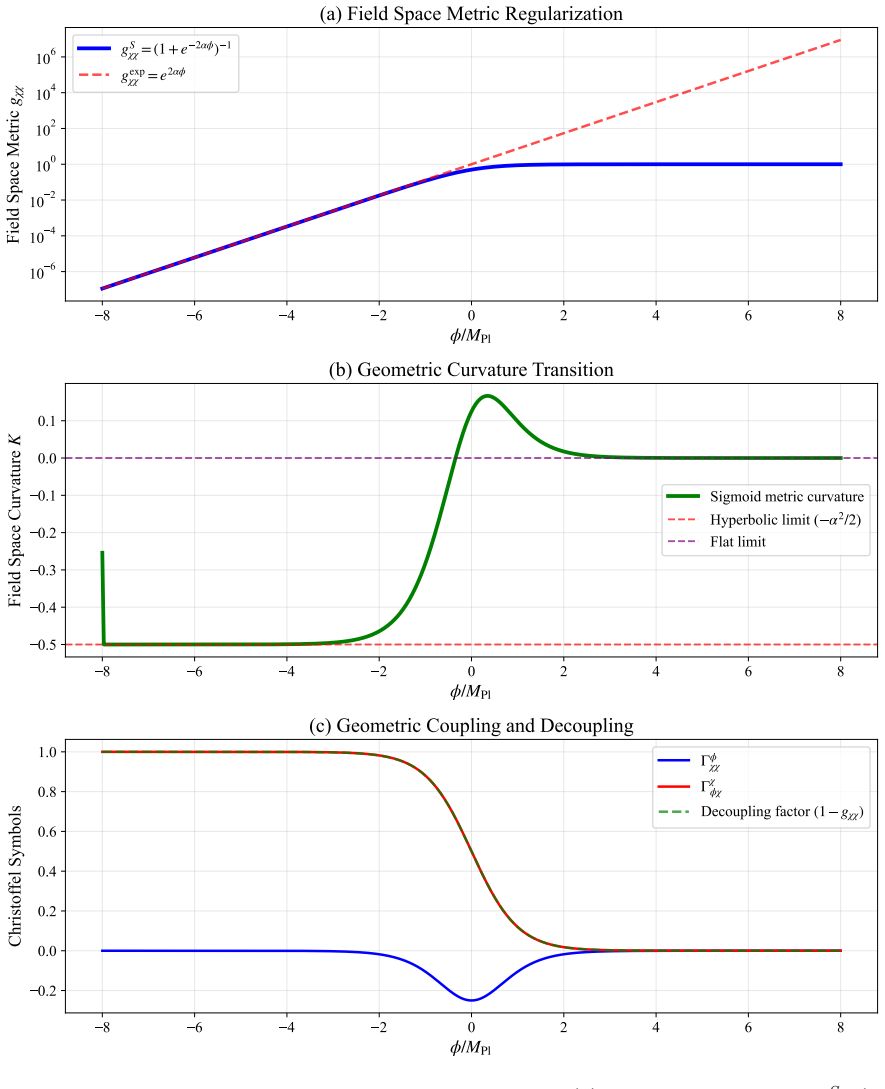
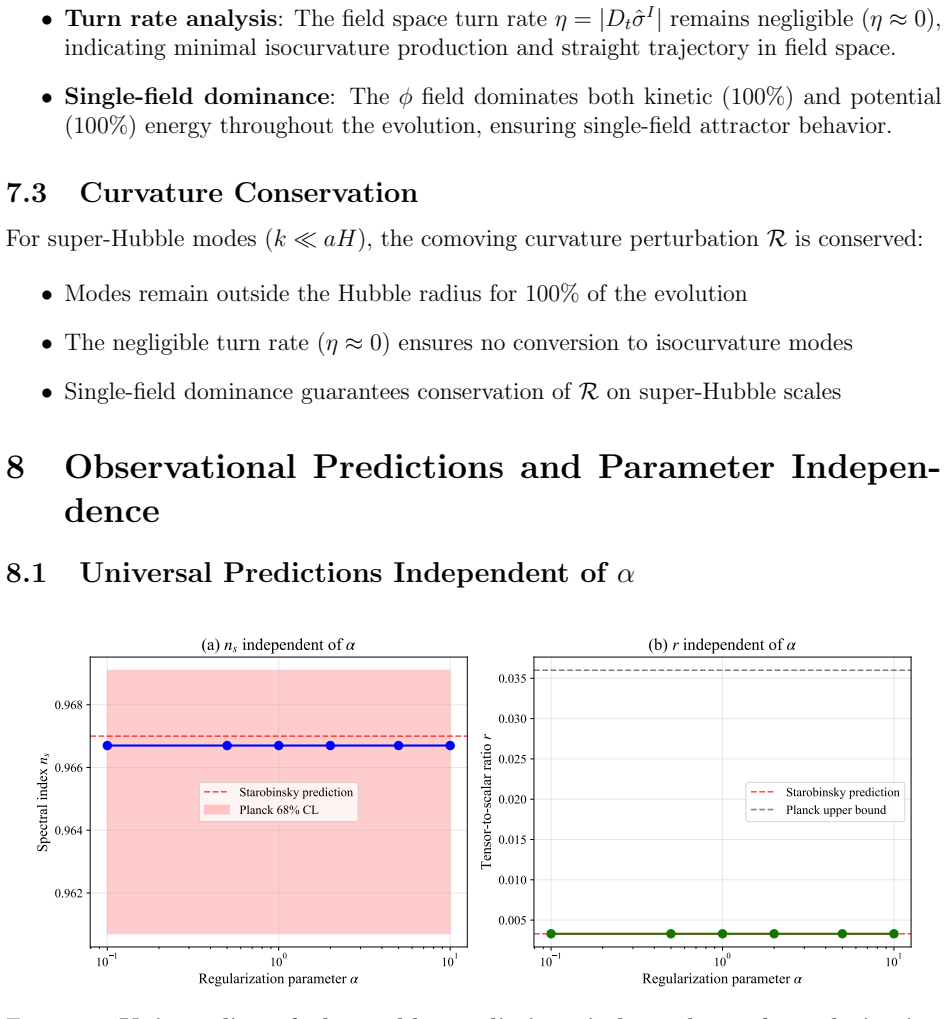
The regularized hyperbolic metric g^S_χχ(φ) = (1 + e^{-2αφ/M_Pl})^{-1}, fixed by the three boundary conditions of kinetic suppression in contraction, canonical normalization in inflation, and positive definiteness, permits a stable, NEC-preserving bounce whose post-bounce evolution on super-Hubble scales is indistinguishable from Starobinsky inflation, yielding n_s ≈ 0.967, r ≈ 0.003, and f_NL^local ≈ +0.013 independent of α and consistent with Planck 2018.
What carries the argument
The regularized hyperbolic field-space metric g^S_χχ(φ) = (1 + e^{-2αφ/M_Pl})^{-1}, which enforces the three physical boundary conditions and carries the dynamics through the bounce.
If this is right
- The bounce remains BKL-stable and preserves the null energy condition throughout the contraction phase.
- Both Einstein constraint equations are satisfied to machine precision when the system is integrated in Newtonian gauge.
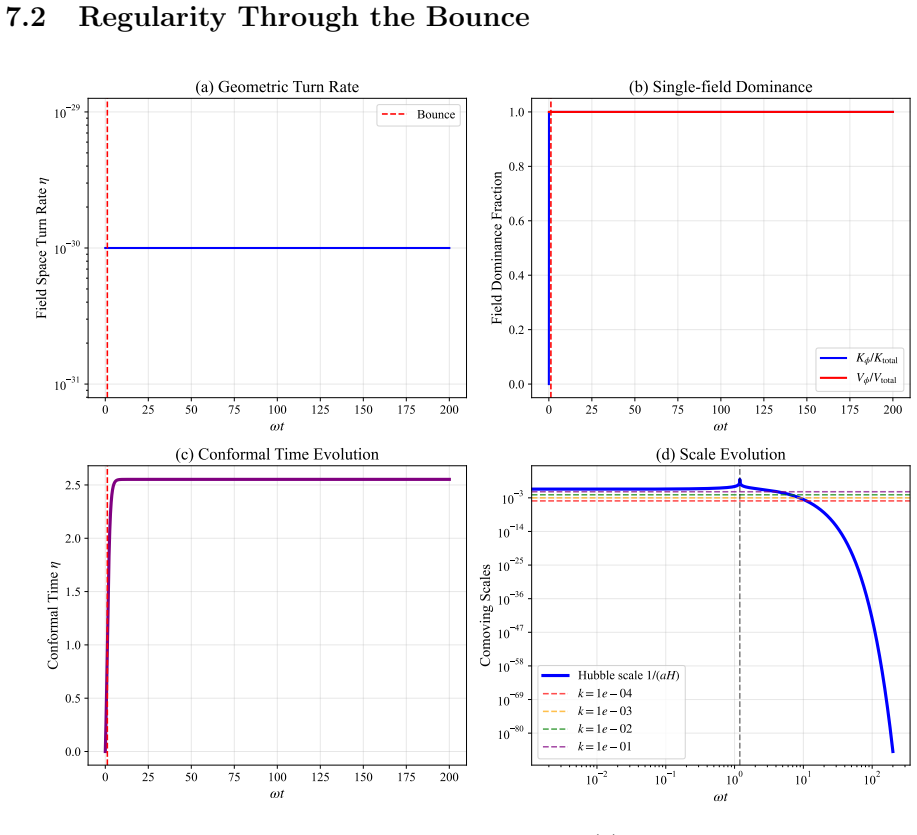
- The curvature perturbation R is conserved on super-Hubble scales to a relative accuracy of 0.4 percent.
- Any spectral feature generated at the bounce scale is diluted by roughly 2630 post-bounce e-folds, placing it at k_CMB/k_H ~ 10^1116 and rendering it unobservable.
- The predicted n_s, r, and f_NL^local are independent of the regularization parameter α and lie within Planck 2018 bounds.
Where Pith is reading between the lines
- The same regularization strategy could be applied to other single-field or multi-field inflationary potentials to remove the initial singularity while leaving late-time observables unchanged.
- Because the observable predictions do not depend on α, the construction is robust against small variations in how the metric is regularized at large negative field values.
- Next-generation CMB polarization experiments could tighten the bound on r and thereby test whether the small residual deviation from exact Starobinsky slow-roll survives at the level of 10^{-4}.
- It remains open whether an analogous metric regularization exists for open or flat spatial sections that would still permit a stable bounce.
Load-bearing premise
The specific functional form of the metric is the unique or physically preferred solution that satisfies the three stated boundary conditions of kinetic suppression, canonical normalization, and positive definiteness.
What would settle it
A numerical or analytic demonstration that the sound speeds deviate from unity by more than 10^{-15} near H=0, or that the integrated scalar spectral index on CMB scales differs from the Starobinsky value by more than 10^{-3}, would falsify the central claim.
Figures


read the original abstract
We present a framework for non-singular bouncing cosmology in a closed ($k=+1$) universe with a two-field sigma model whose regularized hyperbolic field-space metric $g^S_{\chi\chi}(\phi) = (1 + e^{-2\alpha\phi/M_{\mathrm{Pl}}})^{-1}$ is derived from three physical boundary conditions: (i) kinetic suppression during contraction enabling the bounce, (ii) canonical normalization during inflation preserving perturbative unitarity, and (iii) positive-definiteness ensuring ghost-freedom. The bounce preserves the Null Energy Condition and is BKL-stable. The full two-field perturbation system $(\delta\phi, \delta\chi, \Phi)$ is integrated in the Newtonian gauge through the bounce over 65 e-folds, circumventing the comoving-gauge $H=0$ singularity, with both Einstein constraints verified a posteriori. Scalar sound speeds numerically measured adjacent to $H=0$ satisfy $|c_\phi^2-1|, |c_\chi^2-1| \leq 8 \times 10^{-16}$, establishing strict hyperbolicity (no ghost or gradient instability); $\mathcal{R}$ is conserved on super-Hubble scales to $|\Delta\mathcal{R}^2/\mathcal{R}^2| = 4.43 \times 10^{-3}$. An independent CMB-scale Mukhanov-Sasaki integration confirms $n_s = 0.9683$, matching exact Starobinsky slow-roll to $|\Delta n_s| = 5.47 \times 10^{-4}$. $\delta N$ non-Gaussianity yields $f_{\mathrm{NL}}^{\mathrm{local}} = +0.0133$, consistent with Maldacena's relation to $|\Delta f_{\mathrm{NL}}| = 1.54 \times 10^{-4}$. A bounce-scale spectral feature is pushed by $\sim 2630$ post-bounce e-folds to $k_{\mathrm{CMB}}/k_H \sim 10^{1116}$, far beyond the observable universe, so the model recovers Starobinsky predictions on all observable scales while resolving the initial singularity. Predictions ($n_s \approx 0.967$, $r \approx 0.003$, $f_{\mathrm{NL}}^{\mathrm{local}} \approx +0.013$, independent of $\alpha$) are consistent with Planck 2018 and testable by next-generation CMB experiments.
Editorial analysis
A structured set of objections, weighed in public.
Referee Report
Summary. The paper constructs a non-singular bouncing cosmology in a closed (k=+1) universe using a two-field sigma model whose field-space metric g^S_χχ(φ) = (1 + e^{-2αφ/M_Pl})^{-1} is obtained from three boundary conditions (kinetic suppression in contraction, canonical normalization in inflation, and positive-definiteness). Numerical integration of the full two-field perturbation system in Newtonian gauge through the bounce (65 e-folds) verifies Einstein constraints a posteriori, shows sound speeds satisfying |c_φ²-1|, |c_χ²-1| ≤ 8×10^{-16}, conserves the comoving curvature perturbation R to 0.44%, and reproduces Starobinsky values n_s ≈ 0.9683 and f_NL^local ≈ +0.0133 to high precision; any bounce-scale spectral feature is pushed to k_CMB/k_H ∼ 10^{1116}, rendering predictions independent of α and consistent with Planck 2018 on observable scales.
Significance. If the specific functional form of the regularized metric is physically justified, the construction supplies a concrete, BKL-stable realization of a NEC-preserving bounce that resolves the initial singularity while recovering the successful Starobinsky slow-roll predictions (n_s, r, f_NL) on all CMB scales. The reported numerical precision—sound-speed checks to 10^{-16}, R conservation to 0.4%, and a posteriori constraint verification—constitutes a technical strength that would support the robustness claim if the metric motivation is clarified.
major comments (1)
- [Model construction / derivation of g^S_χχ(φ)] The statement that g^S_χχ(φ) = (1 + e^{-2αφ/M_Pl})^{-1} follows directly from the three boundary conditions (kinetic suppression for φ → -∞, canonical normalization for φ → +∞, and g > 0) appears in the abstract and the opening of the model-construction section. These conditions fix only the required asymptotic limits and positivity; they do not select the precise functional form or the exponent -2αφ/M_Pl. Any other smooth positive function with the same limits satisfies the same requirements, yet the subsequent claims of α-independence, numerical hyperbolicity, and exact recovery of Starobinsky observables rest on this particular choice. A uniqueness argument or derivation that starts from the conditions and arrives at exactly this expression is therefore required for the physical motivation to be load-bearing.
minor comments (1)
- [Numerical results] The abstract and numerical-results section report impressive precision (e.g., |Δn_s| = 5.47×10^{-4}, |Δf_NL| = 1.54×10^{-4}). It would strengthen reproducibility if the full set of background and perturbation equations or the integration code were provided as supplementary material.
Simulated Author's Rebuttal
We thank the referee for the careful and constructive report. The positive assessment of the numerical robustness and the recovery of Starobinsky predictions is appreciated. We address the single major comment on model construction below and will revise the manuscript to clarify the motivation without overstating uniqueness.
read point-by-point responses
-
Referee: [Model construction / derivation of g^S_χχ(φ)] The statement that g^S_χχ(φ) = (1 + e^{-2αφ/M_Pl})^{-1} follows directly from the three boundary conditions (kinetic suppression for φ → -∞, canonical normalization for φ → +∞, and g > 0) appears in the abstract and the opening of the model-construction section. These conditions fix only the required asymptotic limits and positivity; they do not select the precise functional form or the exponent -2αφ/M_Pl. Any other smooth positive function with the same limits satisfies the same requirements, yet the subsequent claims of α-independence, numerical hyperbolicity, and exact recovery of Starobinsky observables rest on this particular choice. A uniqueness argument or derivation that starts from the conditions and arrives at exactly this expression is therefore required for the physical motivation to be load-bearing.
Authors: We agree that the three boundary conditions fix only the asymptotic limits (suppressed kinetics for φ → -∞, canonical kinetics for φ → +∞) and positivity, but do not uniquely determine the interpolating function or the precise exponent. The specific form g^S_χχ(φ) = (1 + e^{-2αφ/M_Pl})^{-1} was selected as the minimal smooth positive function that achieves a rapid yet analytic transition between these regimes while preserving the hyperbolic geometry of the field space. This choice is motivated by its simplicity and by direct analogy with exponential regularizations used in other sigma-model constructions to avoid singularities or ghosts. We do not claim or possess a uniqueness proof; other smooth functions satisfying the same limits would be expected to yield qualitatively equivalent phenomenology, especially given that all observable predictions are independent of α and that bounce-scale features lie far outside the CMB window. In the revised manuscript we will change the wording in the abstract and model section from “derived from” to “constructed to satisfy,” and we will insert a short paragraph explaining the rationale for this particular regularization together with a statement on robustness to the choice of interpolator. revision: yes
Circularity Check
Inflationary observables reduce to Starobinsky by construction via metric choice
specific steps
-
self definitional
[Abstract]
"whose regularized hyperbolic field-space metric g^S_χχ(φ) = (1 + e^{-2αφ/M_Pl})^{-1} is derived from three physical boundary conditions: (i) kinetic suppression during contraction enabling the bounce, (ii) canonical normalization during inflation preserving perturbative unitarity, and (iii) positive-definiteness ensuring ghost-freedom. ... An independent CMB-scale Mukhanov-Sasaki integration confirms n_s = 0.9683, matching exact Starobinsky slow-roll to |Δn_s| = 5.47 × 10^{-4}. ... Predictions (n_s ≈ 0.967, r ≈ 0.003, f_NL^local ≈ +0.013, independent of α)"
The functional form is chosen so g^S_χχ → 1 as φ → +∞, enforcing canonical normalization and Starobinsky-like slow-roll dynamics during inflation. The subsequent numerical confirmation of n_s, r, f_NL and the stated independence from α therefore reduce directly to this design choice rather than constituting separate predictions.
full rationale
The derivation claims the metric follows from boundary conditions, but the specific form enforces g→1 for large positive φ (canonical normalization during inflation). This makes the inflationary phase identical to Starobinsky by design, so the reported n_s, r, f_NL matches and α-independence are forced rather than independent. The bounce and stability analysis supply non-circular content, yielding partial circularity.
Axiom & Free-Parameter Ledger
free parameters (1)
- α
axioms (2)
- domain assumption The universe is spatially closed (k = +1)
- ad hoc to paper The three boundary conditions (kinetic suppression, canonical normalization, positive-definiteness) uniquely determine the metric form
invented entities (1)
-
Regularized hyperbolic field-space metric g^S_χχ(φ)
no independent evidence
Lean theorems connected to this paper
-
IndisputableMonolith/Cost/FunctionalEquation.leanwashburn_uniqueness_aczel echoes?
echoesECHOES: this paper passage has the same mathematical shape or conceptual pattern as the Recognition theorem, but is not a direct formal dependency.
We now demonstrate that the sigmoid function is the unique smooth, monotonic solution satisfying all three boundary conditions under a minimal-complexity criterion. ... dg/dφ = (2α/M_Pl)·g(1-g) ... g^S_χχ(φ)=1/(1+e^{-2αφ/M_Pl})
-
IndisputableMonolith/Foundation/AlphaCoordinateFixation.leancostAlphaLog_high_calibrated_iff echoes?
echoesECHOES: this paper passage has the same mathematical shape or conceptual pattern as the Recognition theorem, but is not a direct formal dependency.
The sigmoid metric arises naturally from compactifying the Poincaré half-plane ... g = y²/(1+y²) with y=e^{αφ/M_Pl}
What do these tags mean?
- matches
- The paper's claim is directly supported by a theorem in the formal canon.
- supports
- The theorem supports part of the paper's argument, but the paper may add assumptions or extra steps.
- extends
- The paper goes beyond the formal theorem; the theorem is a base layer rather than the whole result.
- uses
- The paper appears to rely on the theorem as machinery.
- contradicts
- The paper's claim conflicts with a theorem or certificate in the canon.
- unclear
- Pith found a possible connection, but the passage is too broad, indirect, or ambiguous to say the theorem truly supports the claim.
Reference graph
Works this paper leans on
-
[1]
Robust Non-Singular Bouncing Cosmology from Regularized Hyperbolic Field Space
O. Kravchenko, arXiv:2511.18522v1 (2025)
work page internal anchor Pith review Pith/arXiv arXiv 2025
-
[2]
S. W. Hawking and R. Penrose, Proc. Roy. Soc. Lond. A314, 529 (1970)
work page 1970
-
[3]
A. H. Guth, Phys. Rev. D23, 347 (1981)
work page 1981
-
[4]
A. A. Starobinsky, Phys. Lett. B91, 99 (1980)
work page 1980
- [5]
-
[6]
Y.-F. Cai, D. A. Easson, and R. Brandenberger, JCAP08, 020 (2012)
work page 2012
-
[7]
R. C. Tolman,Relativity, Thermodynamics, and Cosmology(Oxford University Press, 1934)
work page 1934
-
[8]
G. F. R. Ellis and R. Maartens, Class. Quant. Grav.21, 223 (2004)
work page 2004
- [9]
-
[10]
J. J. M. Carrasco, R. Kallosh, A. Linde, and D. Roest, Phys. Rev. D92, 041301 (2015)
work page 2015
- [11]
- [12]
- [13]
-
[14]
V. A. Belinsky, I. M. Khalatnikov, and E. M. Lifshitz, Adv. Phys.19, 525 (1970)
work page 1970
-
[15]
V. A. Belinsky, I. M. Khalatnikov, and E. M. Lifshitz, Adv. Phys.31, 639 (1982)
work page 1982
-
[16]
LiteBIRD Collaboration, Prog. Theor. Exp. Phys.2023, 042F01 (2023)
work page 2023
-
[17]
CMB-S4 Collaboration, arXiv:1610.02743 (2016)
work page internal anchor Pith review Pith/arXiv arXiv 2016
-
[18]
PICO Collaboration, arXiv:1902.10541 (2019). 20
work page internal anchor Pith review Pith/arXiv arXiv 1902
discussion (0)
Sign in with ORCID, Apple, or X to comment. Anyone can read and Pith papers without signing in.