Recognition: 2 theorem links
· Lean TheoremTracing the Trace Anomaly of Dense Matter inside Neutron Stars
Pith reviewed 2026-05-17 06:17 UTC · model grok-4.3
The pith
Quasi-universal relations connect the trace anomaly profile of neutron stars to their compactness, moment of inertia, and tidal deformability.
A machine-rendered reading of the paper's core claim, the machinery that carries it, and where it could break.
Core claim
The authors present quasi-universal relations that connect the stellar profile of the trace anomaly Δ to the compactness, moment of inertia, and tidal deformability of neutron stars. Applying these relations to mass-radius measurements of PSR J0030+0451 and PSR J0740+6620, moment of inertia for PSR J0737-3039A, and a multimessenger constraint on tidal deformability yields an estimate of Δ_c = 0.1770 with uncertainties at the center of a 1.4 solar mass neutron star.
What carries the argument
Quasi-universal relations that link the trace anomaly Δ profile throughout the star to its compactness, moment of inertia, and tidal deformability.
If this is right
- The trace anomaly profile can be determined for observed neutron stars like PSR J0030+0451 using their mass and radius data.
- The central trace anomaly for a canonical 1.4 solar mass neutron star is estimated as 0.1770 with lower and upper bounds of 0.0432 and 0.0365 respectively.
- More precise future observations from electromagnetic and gravitational-wave sources will tighten constraints on the trace anomaly behavior inside neutron stars.
Where Pith is reading between the lines
- These relations may allow indirect probes of the phase structure of quantum chromodynamics at high densities by revealing the extent of conformal symmetry breaking.
- Applying the same approach to upcoming radius measurements could provide cross-checks on the trace anomaly estimates from different observables.
- Systematic application across a range of neutron star masses could reveal how the trace anomaly evolves with density in a model-independent way.
Load-bearing premise
The relations remain valid for the true equation of state of neutron star matter even though they were derived from a finite selection of model equations of state.
What would settle it
Discovery of a neutron star whose measured properties lead to a trace anomaly profile that deviates significantly from the prediction of these quasi-universal relations for its compactness and tidal deformability.
Figures




read the original abstract
The trace anomaly $\Delta$ is an important quantity that measures the broken conformal symmetry in neutron star matter. In this work, we present quasi-universal relations that connect the stellar profile of $\Delta$ to the compactness, moment of inertia, and tidal deformability of neutron stars. We apply the quasi-universal relations to determine the trace anomaly profiles for PSR J0030+0451 and PSR J0740+6620 based on their mass-radius measurements. We also analyze PSR J0737-3039A according to its moment of inertia inferred from Bayesian modeling of nuclear equation of state. A recent multimessenger constraint on the tidal deformability is also studied, resulting in an estimate value of the trace anomaly $\Delta_c = 0.1770^{+0.0365}_{-0.0432}$ at the center of a $1.4M_\odot$ canonical neutron star. It is expected that more precise observations from both electromagnetic and gravitational-wave channels in the future will provide tighter constraints on the behavior of $\Delta$ inside neutron stars.
Editorial analysis
A structured set of objections, weighed in public.
Referee Report
Summary. The manuscript presents quasi-universal relations that connect the radial profile of the trace anomaly Δ in neutron star interiors to global stellar properties including compactness, moment of inertia, and tidal deformability. These relations are derived from an ensemble of equations of state and subsequently applied to observational constraints from pulsars PSR J0030+0451, PSR J0740+6620, and PSR J0737-3039A, as well as multimessenger tidal deformability data, to infer Δ profiles and a central value for a canonical 1.4 solar mass neutron star.
Significance. If the quasi-universal relations are robust, the work provides a valuable tool for translating astrophysical observations into constraints on the trace anomaly, offering insights into the degree of conformal symmetry breaking in supranuclear matter. This could complement traditional EOS inference methods and highlight the potential of using existing and future data from electromagnetic and gravitational wave observations to probe dense matter properties.
major comments (3)
- [Derivation of quasi-universal relations] The relations are obtained by fitting or averaging over a finite collection of EOS models. The manuscript must explicitly list the EOS models employed, detail the fitting procedure (e.g., functional form and regression method), and provide validation tests such as leave-one-out cross-validation or application to EOS with first-order phase transitions to confirm the claimed quasi-universality holds beyond the sample.
- [Application to observational data] When applying the relations to data from PSR J0030+0451 and PSR J0740+6620, the analysis should address potential circularity arising from the fact that the relations were calibrated on similar EOS families; include a discussion or quantitative estimate of systematic uncertainties due to the choice of EOS ensemble.
- [Uncertainties in Δ_c estimate] The reported value Δ_c = 0.1770^{+0.0365}_{-0.0432} for the 1.4 M⊙ star appears to propagate only observational uncertainties. The total error budget should incorporate the intrinsic scatter or systematic error from the quasi-universal approximation itself, as quantified by the dispersion in the underlying EOS sample.
minor comments (2)
- [Notation and definitions] Ensure that the definition of the trace anomaly Δ and its radial profile are clearly stated early in the manuscript, including any normalization or dimensionless form used.
- [Figure clarity] Figures showing the Δ profiles for the observed stars should include error bands that reflect both observational and relation uncertainties for better interpretation.
Simulated Author's Rebuttal
We thank the referee for the detailed and constructive report. We address each of the major comments below and have made revisions to the manuscript to incorporate the suggested improvements.
read point-by-point responses
-
Referee: [Derivation of quasi-universal relations] The relations are obtained by fitting or averaging over a finite collection of EOS models. The manuscript must explicitly list the EOS models employed, detail the fitting procedure (e.g., functional form and regression method), and provide validation tests such as leave-one-out cross-validation or application to EOS with first-order phase transitions to confirm the claimed quasi-universality holds beyond the sample.
Authors: We agree that explicit documentation of the EOS ensemble, fitting details, and validation is essential for reproducibility. The original manuscript summarized the ensemble but did not include the complete list or procedural specifics. In the revised manuscript we have added an appendix that enumerates every EOS model in the sample, specifies the functional forms employed for the fits (polynomial and power-law regressions), and describes the least-squares regression procedure. We have also added leave-one-out cross-validation results together with explicit tests on EOS models that incorporate first-order phase transitions; these confirm that the quasi-universal relations retain comparable accuracy outside the original calibration set. revision: yes
-
Referee: [Application to observational data] When applying the relations to data from PSR J0030+0451 and PSR J0740+6620, the analysis should address potential circularity arising from the fact that the relations were calibrated on similar EOS families; include a discussion or quantitative estimate of systematic uncertainties due to the choice of EOS ensemble.
Authors: We acknowledge the risk of circularity when the calibration and application samples share similar EOS families. In the revised manuscript we have added a dedicated subsection that quantifies this systematic uncertainty. We report the variation in inferred Δ profiles obtained when the relations are recalibrated on random subsets of the ensemble and when they are applied to independent EOS models withheld from the original fit. These differences are presented as an explicit systematic error component that is now combined with the observational uncertainties. revision: yes
-
Referee: [Uncertainties in Δ_c estimate] The reported value Δ_c = 0.1770^{+0.0365}_{-0.0432} for the 1.4 M⊙ star appears to propagate only observational uncertainties. The total error budget should incorporate the intrinsic scatter or systematic error from the quasi-universal approximation itself, as quantified by the dispersion in the underlying EOS sample.
Authors: We thank the referee for highlighting this omission. The quoted uncertainties were derived solely from the observational constraints. In the revised manuscript we have augmented the error budget with the intrinsic scatter of the quasi-universal relations, defined as the standard deviation of the predicted central Δ values across the full EOS ensemble at fixed compactness. The updated Δ_c value and its asymmetric uncertainties now reflect the quadrature sum of observational and systematic contributions; the abstract and the relevant results section have been revised accordingly. revision: yes
Circularity Check
No significant circularity; relations derived from EOS sample and applied to external observations
full rationale
The paper computes the trace anomaly profile Δ(r) for a collection of equations of state, identifies empirical correlations between the profile and global stellar quantities (compactness, moment of inertia, tidal deformability), and then uses those correlations to infer Δ for observed pulsars whose mass-radius or tidal data come from NICER and gravitational-wave measurements. This workflow does not reduce any claimed prediction to its own fitted inputs by construction: the relations are extracted once from the model ensemble and subsequently applied to independent observational constraints. No self-definitional loop, load-bearing self-citation chain, or renaming of a known result is required for the central claim. The representativeness of the EOS sample affects external validity but does not create an internal circularity in the derivation itself.
Axiom & Free-Parameter Ledger
free parameters (1)
- EOS ensemble used to establish quasi-universality
axioms (1)
- domain assumption Quasi-universal relations for the trace anomaly hold to sufficient accuracy across the relevant range of neutron-star masses and equations of state
Lean theorems connected to this paper
-
IndisputableMonolith/Cost/FunctionalEquation.leanwashburn_uniqueness_aczel unclear?
unclearRelation between the paper passage and the cited Recognition theorem.
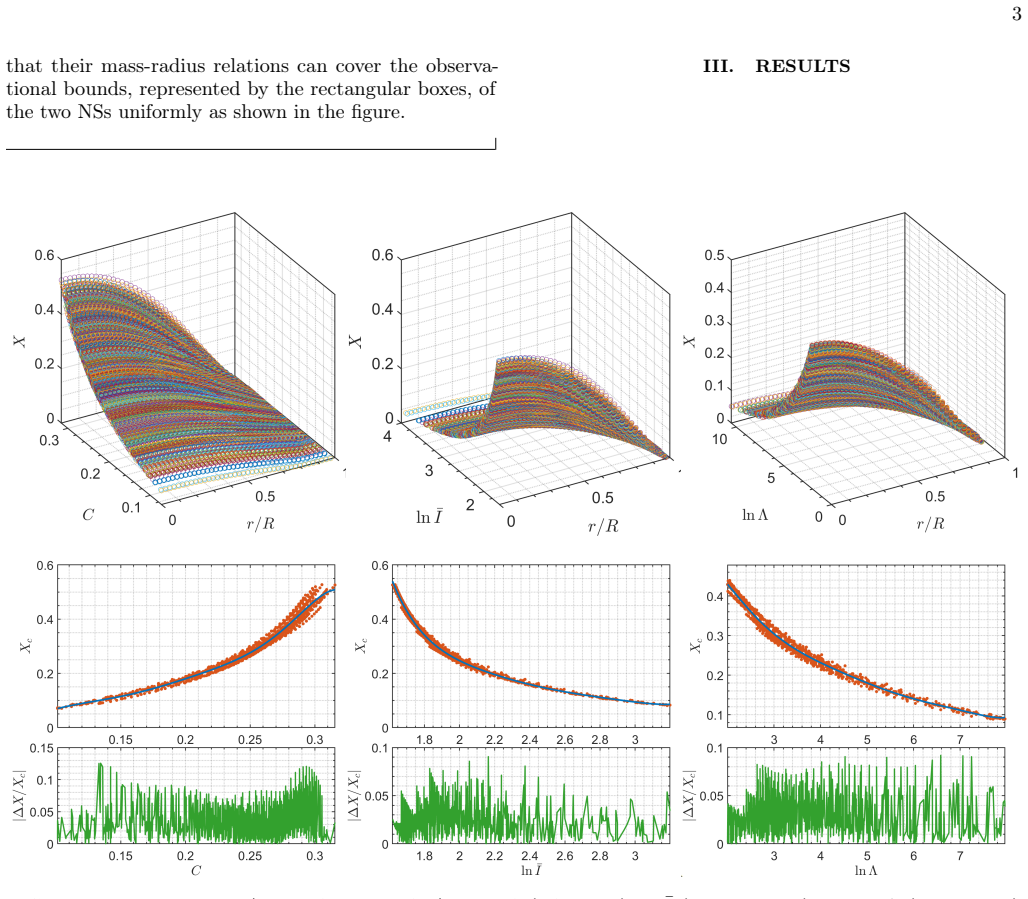
We implement a parametric representation through high-order polynomial fitting... X(u, ξ) = Σ ck,m u^k ξ^m (eighth-order bivariate polynomial)
-
IndisputableMonolith/Foundation/RealityFromDistinction.leanreality_from_one_distinction unclear?
unclearRelation between the paper passage and the cited Recognition theorem.
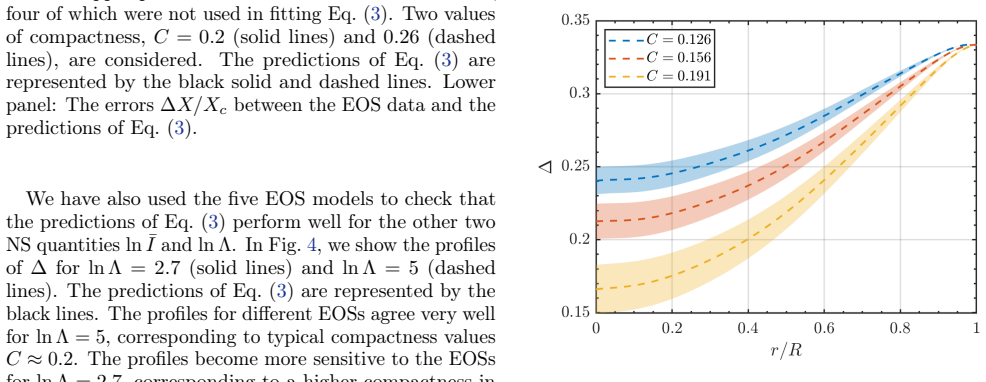
The profile of X(z) is weakly dependent on the EOS models for a given NS quantity C, Ī or Λ
What do these tags mean?
- matches
- The paper's claim is directly supported by a theorem in the formal canon.
- supports
- The theorem supports part of the paper's argument, but the paper may add assumptions or extra steps.
- extends
- The paper goes beyond the formal theorem; the theorem is a base layer rather than the whole result.
- uses
- The paper appears to rely on the theorem as machinery.
- contradicts
- The paper's claim conflicts with a theorem or certificate in the canon.
- unclear
- Pith found a possible connection, but the passage is too broad, indirect, or ambiguous to say the theorem truly supports the claim.
Reference graph
Works this paper leans on
-
[1]
S. L. Shapiro and S. A. Teukolsky,Black Holes, White Dwarfs, and Neutron Stars: The Physics of Compact Objects(Wiley, New York, 2004)
work page 2004
-
[2]
J. M. Lattimer and M. Prakash, Neutron star observa- tions: Prognosis for equation of state constraints, Physics Reports442, 109 (2007)
work page 2007
-
[3]
P. B. Demorest, T. Pennucci, S. M. Ransom, M. S. E. Roberts, and J. W. T. Hessels, A two-solar-mass neutron star measured using Shapiro delay, Nature467, 1081 (2010)
work page 2010
-
[4]
A Massive Pulsar in a Compact Relativistic Binary
J. Antoniadis, P. C. C. Freire, N. Wex, T. M. Tauris, R. S. Lynch, M. H. van Kerkwijk, M. Kramer, C. Bassa, V. S. Dhillon, T. Driebe, J. W. T. Hessels, V. M. Kaspi, V. I. Kondratiev, N. Langer, T. R. Marsh, M. A. McLaugh- lin, T. T. Pennucci, S. M. Ransom, I. H. Stairs, J. van Leeuwen, J. P. W. Verbiest, and D. G. Whelan, A Massive Pulsar in a Compact Rel...
work page internal anchor Pith review Pith/arXiv arXiv 2013
-
[5]
M. C. Miller, F. K. Lamb, A. J. Dittmann, S. Bog- danov, Z. Arzoumanian, K. C. Gendreau, S. Guillot, A. K. Harding, W. C. G. Ho, J. M. Lattimer, R. M. Ludlam, S. Mahmoodifar, S. M. Morsink, P. S. Ray, T. E. Strohmayer, K. S. Wood, T. Enoto, R. Foster, T. Oka- jima, G. Prigozhin, and Y. Soong, PSR J0030+0451 Mass and Radius from NICER Data and Implications...
work page 2019
-
[6]
T. E. Riley, A. L. Watts, S. Bogdanov, P. S. Ray, R. M. Ludlam, S. Guillot, Z. Arzoumanian, C. L. Baker, A. V. Bilous, D. Chakrabarty, K. C. Gendreau, A. K. Harding, W. C. G. Ho, J. M. Lattimer, S. M. Morsink, and T. E. Strohmayer, A nicer view of PSR J0030+0451: Millisec- ond pulsar parameter estimation, Astrophys. J. Lett.887, L21 (2019)
work page 2019
-
[7]
M. C. Miller, F. K. Lamb, A. J. Dittmann, S. Bogdanov, Z. Arzoumanian, K. C. Gendreau, S. Guillot, W. C. G. Ho, J. M. Lattimer, M. Loewenstein, S. M. Morsink, P. S. Ray, M. T. Wolff, C. L. Baker, T. Cazeau, S. Man- thripragada, C. B. Markwardt, T. Okajima, S. Pollard, I. Cognard, H. T. Cromartie, E. Fonseca, L. Guillemot, M. Kerr, A. Parthasarathy, T. T. ...
work page internal anchor Pith review arXiv 2021
-
[8]
T. E. Riley, A. L. Watts, P. S. Ray, S. Bogdanov, S. Guillot, S. M. Morsink, A. V. Bilous, Z. Arzouma- nian, D. Choudhury, J. S. Deneva, K. C. Gendreau, A. K. Harding, W. C. G. Ho, J. M. Lattimer, M. Loewenstein, R. M. Ludlam, C. B. Markwardt, T. Okajima, C. Prescod- Weinstein, R. A. Remillard, M. T. Wolff, E. Fonseca, H. T. Cromartie, M. Kerr, T. T. Penn...
work page 2021
-
[9]
P. Bedaque and A. W. Steiner, Sound Velocity Bound and Neutron Stars, Phys. Rev. Lett.114, 031103 (2015)
work page 2015
-
[10]
L. McLerran and S. Reddy, Quarkyonic matter and neu- tron stars, Phys. Rev. Lett.122, 122701 (2019)
work page 2019
-
[11]
S. Altiparmak, C. Ecker, and L. Rezzolla, On the Sound Speed in Neutron Stars, Astrophys. J. Lett.939, L34 (2022), arXiv:2203.14974 [astro-ph.HE]
- [12]
-
[13]
Y. Fujimoto, K. Fukushima, L. D. McLerran, and M. Praszałowicz, Trace Anomaly as Signature of Con- formality in Neutron Stars, Phys. Rev. Lett.129, 252702 (2022)
work page 2022
-
[14]
M. Marczenko, L. McLerran, K. Redlich, and C. Sasaki, Reaching percolation and conformal limits in neutron stars, Phys. Rev. C107, 025802 (2023)
work page 2023
-
[15]
J. C. Jiménez, L. Lazzari, and V. P. Gonçalves, How the qcd trace anomaly behaves at the core of twin stars?, Phys. Rev. D110, 114014 (2024)
work page 2024
-
[16]
B.-J. Cai and B.-A. Li, Unraveling trace anomaly of supradense matter via neutron star compactness scaling, Phys. Rev. D112, 10.1103/3p2p-p3d4 (2025)
- [17]
-
[18]
M. Kramer and N. Wex, The double pulsar system: A unique laboratory for gravity, Classical and Quantum Gravity26, 073001 (2009)
work page 2009
-
[19]
J. M. Lattimer and B. F. Schutz, Constraining the Equa- tion of State with Moment of Inertia Measurements, As- trophys. J.629, 979 (2005)
work page 2005
- [20]
-
[21]
É. É. Flanagan, Constraining neutron-star tidal Love numbers with gravitational-wave detectors, Phys. Rev. D 77, 10.1103/PhysRevD.77.021502 (2008)
-
[22]
LIGO Scientific Collaboration and Virgo Collaboration, GW170817: Observation of Gravitational Waves from a Binary Neutron Star Inspiral, Phys. Rev. Lett.119, 161101 (2017)
work page 2017
-
[23]
K. Chatziioannou, Neutron-star tidal deformability and equation-of-state constraints, General Relativity and Gravitation52, 109 (2020), arXiv:2006.03168 [gr-qc]
-
[24]
K. Yagi and N. Yunes, I-Love-Q relations in neutron stars and their applications to astrophysics, gravitational waves, and fundamental physics, Phys. Rev. D88, 023009 (2013)
work page 2013
-
[25]
N. Jiang and K. Yagi, Analytic i-love-c relations for real- istic neutron stars, Phys. Rev. D101, 124006 (2020)
work page 2020
-
[26]
R. C. Tolman, Static Solutions of Einstein’s Field Equa- tions for Spheres of Fluid, Physical Review55, 364 (1939)
work page 1939
-
[27]
J. B. Hartle, Slowly Rotating Relativistic Stars. I. Equa- tions of Structure, Astrophys. J.150, 1005 (1967)
work page 1967
-
[28]
Hinderer, Tidal Love Numbers of Neutron Stars, As- trophys
T. Hinderer, Tidal Love Numbers of Neutron Stars, As- trophys. J.677, 1216 (2008)
work page 2008
-
[29]
CompOSE - CompStar Online Supernovae Equations of State
S. Typel, M. Oertel, and T. Klaehn, CompOSE - Comp- Star Online Supernovae Equations of State (2013), arXiv:1307.5715 [astro-ph]
work page internal anchor Pith review Pith/arXiv arXiv 2013
-
[30]
L. Bennour, P.-H. Heenen, P. Bonche, J. Dobaczewski, and H. Flocard, Charge distributions of208Pb, 206Pb, and 205Tl and the mean-field approximation, Phys. Rev. C 40, 2834 (1989). 12
work page 1989
-
[31]
F. Gulminelli and A. R. Raduta, Unified treatment of sub- saturation stellar matter at zero and finite temperature, Phys. Rev. C92, 055803 (2015)
work page 2015
-
[32]
V. Dexheimer and S. Schramm, Proto-neutron and neu- tron stars in a chiral SU(3) model, Astrophys. J.683, 943 (2008)
work page 2008
-
[33]
V. Dexheimer, Tabulated neutron star equations of state modelled within the chiral mean field model, Publications of the Astronomical Society of Australia34, e066 (2017)
work page 2017
-
[34]
V. A. Dexheimer and S. Schramm, Novel approach to modeling hybrid stars, Phys. Rev. C81, 045201 (2010)
work page 2010
-
[35]
V. Dexheimer, R. O. Gomes, T. Klähn, S. Han, and M. Salinas, GW190814 as a massive rapidly rotating neu- tron star with exotic degrees of freedom, Phys. Rev. C 103, 025808 (2021)
work page 2021
-
[36]
H. Togashi, K. Nakazato, Y. Takehara, S. Yamamuro, H. Suzuki, and M. Takano, Nuclear equation of state for core-collapse supernova simulations with realistic nuclear forces, Nucl. Phys. A961, 78 (2017)
work page 2017
-
[37]
T. Kojo, G. Baym, and T. Hatsuda, Implications of nicer for neutron star matter: The QHC21 equation of state, Astrophys. J.934, 46 (2022)
work page 2022
-
[38]
G. Audi, F. G. Kondev, M. Wang, W. J. Huang, and S. Naimi, The NUBASE2016 evaluation of nuclear prop- erties, Chinese Physics C41, 030001 (2017)
work page 2017
-
[39]
V. Allard and N. Chamel, 1S0 pairing gaps, chemical potentials and entrainment matrix in superfluid neutron- star cores for the brussels–montreal functionals, Universe 7, 10.3390/universe7120470 (2021)
-
[40]
J. M. Pearson and N. Chamel, Unified equations of state for cold nonaccreting neutron stars with brussels-montreal functionals. iii. inclusion of microscopic corrections to pasta phases, Phys. Rev. C105, 015803 (2022)
work page 2022
-
[41]
J. M. Pearson, N. Chamel, and A. Y. Potekhin, Unified equations of state for cold nonaccreting neutron stars with brussels-montreal functionals. ii. pasta phases in semiclassical approximation, Phys. Rev. C101, 015802 (2020)
work page 2020
-
[42]
J. M. Pearson, N. Chamel, A. Y. Potekhin, A. F. Fantina, C. Ducoin, A. K. Dutta, and S. Goriely, Erratum: Unified equations of state for cold non-accreting neutron stars with brussels-montreal functionals. i. role of symmetry energy, Mon. Not. R. Astron. Soc.486, 768 (2019)
work page 2019
-
[43]
S. Goriely, N. Chamel, and J. M. Pearson, Hartree-fock- bogoliubov nuclear mass model with 0.50 MeV accuracy basedonstandardformsofskyrmeandpairingfunctionals, Phys. Rev. C88, 061302 (2013)
work page 2013
- [44]
-
[45]
Xu, Y., Goriely, S., Jorissen, A., Chen, G. L., and Arnould, M., Databases and tools for nuclear astrophysics applica- tions - BRUSsels Nuclear LIBrary (BRUSLIB), Nuclear Astrophysics Compilation of REactions II (NACRE II) and Nuclear NETwork GENerator (NETGEN), A&A549, A106 (2013)
work page 2013
-
[46]
A. Welker, N. A. S. Althubiti, D. Atanasov, K. Blaum, T. E. Cocolios, F. Herfurth, S. Kreim, D. Lunney, V. Manea, M. Mougeot, D. Neidherr, F. Nowacki, A. Poves, M. Rosenbusch, L. Schweikhard, F. Wienholtz, R. N. Wolf, and K. Zuber, Binding energy of79Cu: Prob- ing the structure of the doubly magic78Ni from only one proton away, Phys. Rev. Lett.119, 192502 (2017)
work page 2017
- [47]
-
[48]
P. J. Davis, H. Dinh Thi, A. F. Fantina, F. Gulminelli, M. Oertel, and L. Suleiman, Inference of neutron-star properties with unified crust-core equations of state for pa- rameter estimation, Astron. Astrophys.687, A44 (2024)
work page 2024
-
[49]
Envelopes with Strong Magnetic Fields, inNeutron Stars 1, edited by P. Haensel, A. Y. Potekhin, and D. G. Yakovlev (Springer, New York, NY, 2007) pp. 167–205
work page 2007
-
[50]
W. Long, J. Meng, N. V. Giai, and S.-G. Zhou, New effective interactions in relativistic mean field theory with nonlinear terms and density-dependent meson-nucleon coupling, Phys. Rev. C69, 034319 (2004)
work page 2004
-
[51]
C.-J. Xia, T. Maruyama, A. Li, B. Yuan Sun, W.-H. Long, and Y.-X. Zhang, Unified neutron star EOSs and neutron star structures in RMF models, Communications in Theoretical Physics74, 095303 (2022)
work page 2022
- [52]
-
[53]
A. Li, A. L. Watts, G. Zhang, S. Guillot, Y. Xu, A. San- tangelo, S. Zane, H. Feng, S.-N. Zhang, M. Ge, L. Qi, T. Salmi, B. Dorsman, Z. Miao, Z. Tu, Y. Cavecchi, X. Zhou, X. Zheng, W. Wang, Q. Cheng, X. Liu, Y. Wei, W. Wang, Y. Xu, S. Weng, W. Zhu, Z. Li, L. Shao, Y. Tuo, A. Dohi, M. Lyu, P. Liu, J. Yuan, M. Wang, W. Zhang, Z. Li, L. Tao, L. Zhang, H. She...
-
[54]
Y. Lim, J. W. Holt, and R. J. Stahulak, Predicting the moment of inertia of pulsar J0737-3039A from Bayesian modeling of the nuclear equation of state, Phys. Rev. C 100, 035802 (2019)
work page 2019
-
[55]
M. Kramer, I. H. Stairs, R. N. Manchester, N. Wex, A. T. Deller, W. A. Coles, M. Ali, M. Burgay, F. Camilo, I. Cognard, T. Damour, G. Desvignes, R. D. Ferdman, P. C. C. Freire, S. Grondin, L. Guillemot, G. B. Hobbs, G. Janssen, R. Karuppusamy, D. R. Lorimer, A. G. Lyne, J. W. McKee, M. McLaughlin, L. E. Münch, B. B. P. Perera, N. Pol, A. Possenti, J. Sark...
work page 2021
-
[56]
H. O. Silva, A. M. Holgado, A. Cárdenas-Avendaño, and N. Yunes, Astrophysical and theoretical physics impli- cations from multimessenger neutron star observations, Phys. Rev. Lett.126, 181101 (2021)
work page 2021
- [57]
-
[58]
LIGO Scientific Collaboration and Virgo Collaboration, Gw170817: Measurements of neutron star radii and equa- tion of state, Phys. Rev. Lett.121, 161101 (2018). 13
work page 2018
- [59]
- [60]
- [61]
-
[62]
C. Huang, Model-independent Determination of the Tidal Deformability of a 1.4 M ⊙ Neutron Star from Gravitational-wave Measurements, Astrophys. J.985, 216 (2025)
work page 2025
-
[63]
D. Choudhury, T. Salmi, S. Vinciguerra, T. E. Riley, Y. Kini, A. L. Watts, B. Dorsman, S. Bogdanov, S. Guil- lot, P. S. Ray, D. J. Reardon, R. A. Remillard, A. V. Bilous, D. Huppenkothen, J. M. Lattimer, N. Rutherford, Z. Arzoumanian, K. C. Gendreau, S. M. Morsink, and W. C. G. Ho, A NICER View of the Nearest and Brightest Millisecond Pulsar: PSR J0437-47...
-
[64]
C. Ecker and L. Rezzolla, Impact of large-mass constraints on the properties of neutron stars, Mon. Not. R. Astron. Soc.519, 2615 (2023), arXiv:2209.08101 [astro-ph.HE]
-
[65]
T. Carreau, F. Gulminelli, and J. Margueron, Bayesian analysis of the crust-core transition with a compressible liquid-drop model, Eur. Phys. J. A55, 188 (2019)
work page 2019
-
[66]
P. Char, C. Mondal, F. Gulminelli, and M. Oertel, Gener- alized description of neutron star matter with a nucleonic relativistic density functional, Phys. Rev. D108, 103045 (2023)
work page 2023
-
[67]
P. Gögelein, E. N. E. v. Dalen, C. Fuchs, and H. Müther, Nuclear matter in the crust of neutron stars derived from realistic NN interactions, Phys. Rev. C77, 025802 (2008)
work page 2008
-
[68]
T. Schürhoff, S. Schramm, and V. Dexheimer, Neutron stars with small radii—the role ofδ resonances, Astrophys. J. Lett.724, L74 (2010)
work page 2010
-
[69]
V. Dexheimer, R. Negreiros, and S. Schramm, Reconciling nuclear and astrophysical constraints, Phys. Rev. C92, 012801 (2015)
work page 2015
-
[70]
T. Gaitanos, M. Di Toro, S. Typel, V. Baran, C. Fuchs, V. Greco, and H. Wolter, On the lorentz structure of the symmetry energy, Nucl. Phys. A732, 24 (2004)
work page 2004
- [71]
-
[72]
Douchin, F. and Haensel, P., A unified equation of state of dense matter and neutron star structure, A&A380, 151 (2001)
work page 2001
- [73]
-
[74]
C. Providência, M. Fortin, H. Pais, and A. Rabhi, Hy- peronic Stars and the Nuclear Symmetry Energy, Fron- tiers in Astronomy and Space Sciences6, 10.3389/fs- pas.2019.00013 (2019)
work page doi:10.3389/fs- 2019
-
[75]
W.-C. Chen and J. Piekarewicz, Building relativistic mean field models for finite nuclei and neutron stars, Phys. Rev. C90, 044305 (2014)
work page 2014
-
[76]
R. Negreiros, L. Tolos, M. Centelles, A. Ramos, and V. Dexheimer, Cooling of small and massive hyperonic stars, Astrophys. J.863, 104 (2018)
work page 2018
- [77]
-
[78]
N. K. Glendenning and S. A. Moszkowski, Reconciliation of neutron-star masses and binding of theΛin hypernuclei, Phys. Rev. Lett.67, 2414 (1991)
work page 1991
-
[79]
M. Hempel and J. Schaffner-Bielich, A statistical model for a complete supernova equation of state, Nucl. Phys. A837, 210 (2010)
work page 2010
-
[80]
N. Hornick, L. Tolos, A. Zacchi, J.-E. Christian, and J. Schaffner-Bielich, Relativistic parameterizations of neu- tron matter and implications for neutron stars, Phys. Rev. C98, 065804 (2018)
work page 2018
discussion (0)
Sign in with ORCID, Apple, or X to comment. Anyone can read and Pith papers without signing in.