Recognition: 2 theorem links
· Lean TheoremExperimental Demonstration of an On-Axis Laser Ranging Interferometer for Future Gravity Missions
Pith reviewed 2026-05-17 05:52 UTC · model grok-4.3
The pith
An on-axis laser ranging interferometer achieves nanometer accuracy for inter-spacecraft distance measurements.
A machine-rendered reading of the paper's core claim, the machinery that carries it, and where it could break.
Core claim
The authors demonstrate that an on-axis laser ranging interferometer with a 7.3 MHz heterodyne frequency and active beam steering via differential wavefront sensing enables inter-spacecraft ranging measurements with nanometer accuracy. In tests that use hexapod rotations to replicate spacecraft jitter, the system delivers pointing stability below 10 urad per square root hertz between 0.2 mHz and 0.5 Hz, polarization-induced carrier-to-noise reductions of only 0.14 percent over 15 hours, and measurable tilt-to-length coupling through periodic scanning.
What carries the argument
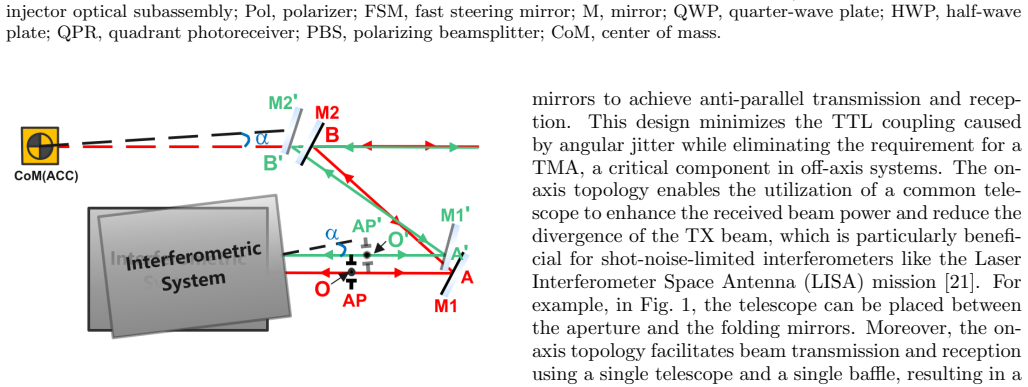
On-axis LRI architecture that permits monoaxial transmission and reception of laser beams together with active beam-steering loops driven by differential wavefront sensing signals to maintain co-alignment between receiving and transmitting beams.
If this is right
- The interferometric link maintains pointing stability below 10 urad per square root hertz in the 0.2 mHz to 0.5 Hz range under simulated attitude jitter.
- Polarization fluctuations in the transmitting beam reduce the carrier-to-noise-density ratio by only 0.14 percent over a continuous 15-hour measurement.
- Tilt-to-length coupling can be quantified by periodic hexapod scanning of the optical benches.
- The measured performance supports the on-axis LRI as a candidate for future GRACE-like gravity missions.
Where Pith is reading between the lines
- The single-path design could reduce the mass and alignment complexity of optical benches relative to separate transmit and receive paths.
- Active steering might permit looser initial satellite pointing requirements, enabling more flexible formation geometries in future missions.
- Extended vacuum and thermal-cycling tests would be the next logical step to confirm that lab results hold under orbital conditions.
Load-bearing premise
The hexapod-driven rotations and laboratory environment sufficiently replicate the full range of spacecraft attitude jitter, thermal drifts, and vacuum conditions that will occur in actual orbit.
What would settle it
An orbital test that records ranging fluctuations significantly larger than a few nanometers under real attitude jitter and thermal variations would show that the demonstrated performance does not translate to space.
Figures



read the original abstract
We experimentally demonstrate a novel interferometric architecture for next-generation gravity missions, featuring a laser ranging interferometer (LRI) that enables monoaxial transmission and reception of laser beams between two optical benches with a heterodyne frequency of 7.3 MHz. Active beam steering loops, utilizing differential wavefront sensing (DWS) signals, ensure co-alignment between the receiving (RX) beam and the transmitting (TX) beam. With spacecraft attitude jitter simulated by hexapod-driven rotations, the interferometric link achieves a pointing stability below 10 urad/$\mathrm{\sqrt{Hz}}$ in the frequency range between 0.2 mHz and 0.5 Hz, and the fluctuation of the TX beam's polarization state results in a reduction of 0.14\% in the carrier-to-noise-density ratio over a 15-hour continuous measurement. Additionally, tilt-to-length (TTL) coupling is experimentally investigated using the periodic scanning of the hexapod. Experimental results show that the on-axis LRI enables the inter-spacecraft ranging measurements with nanometer accuracy, making it a potential candidate for future GRACE-like missions.
Editorial analysis
A structured set of objections, weighed in public.
Referee Report
Summary. The manuscript experimentally demonstrates a novel on-axis laser ranging interferometer (LRI) for future gravity missions such as GRACE. It uses monoaxial transmission/reception at a 7.3 MHz heterodyne frequency with active beam steering via differential wavefront sensing (DWS) to maintain co-alignment. Spacecraft attitude jitter is simulated via hexapod rotations, yielding pointing stability below 10 μrad/√Hz (0.2 mHz–0.5 Hz), 0.14% CNR reduction over 15 hours, and TTL coupling characterization; the authors conclude this enables nanometer-accuracy inter-spacecraft ranging suitable for GRACE-like missions.
Significance. If the laboratory results translate to orbital conditions, the on-axis architecture with integrated TX/RX and DWS steering could simplify optical bench designs for next-generation gravity missions by eliminating separate beam paths. The work supplies direct experimental metrics on pointing stability and polarization effects without reliance on fitted models, which strengthens its contribution to the field of space-based laser interferometry.
major comments (3)
- [Section 3] Section 3 (Experimental Setup): The hexapod-driven rotations are used to simulate spacecraft attitude jitter for the pointing stability and TTL measurements, but the laboratory environment does not incorporate or bound the effects of orbital thermal cycling, radiation, or vacuum levels on thermal expansion and length noise; this directly limits support for the nanometer-ranging claim under flight conditions.
- [Section 4] Section 4 (Results): The reported values for pointing stability (<10 μrad/√Hz) and CNR fluctuation (0.14% over 15 h) are presented without an accompanying error budget, uncertainty analysis, or comparison to off-axis LRI baselines, which is load-bearing for assessing whether the demonstrated performance meets GRACE-like mission requirements.
- [Conclusion] Conclusion: The statement that the on-axis LRI is a 'potential candidate for future GRACE-like missions' lacks a quantitative mapping from the lab metrics to the specific noise budgets (e.g., ranging accuracy targets) required for such missions, weakening the central applicability claim.
minor comments (2)
- [Abstract] The abstract uses 'urad' instead of the standard 'μrad'; this notation should be corrected for consistency with optics literature.
- A brief table or plot comparing the achieved stability to published GRACE-FO LRI performance would improve context without altering the core results.
Simulated Author's Rebuttal
We thank the referee for the constructive comments on our manuscript. We respond to each major comment below and indicate the revisions we will make to address them.
read point-by-point responses
-
Referee: [Section 3] Section 3 (Experimental Setup): The hexapod-driven rotations are used to simulate spacecraft attitude jitter for the pointing stability and TTL measurements, but the laboratory environment does not incorporate or bound the effects of orbital thermal cycling, radiation, or vacuum levels on thermal expansion and length noise; this directly limits support for the nanometer-ranging claim under flight conditions.
Authors: We agree that the current laboratory setup does not simulate or bound the effects of orbital thermal cycling, radiation, or vacuum on thermal expansion and length noise. Our demonstration focuses on the core functionality of the on-axis LRI with active DWS-based beam steering under hexapod-simulated attitude jitter. The nanometer-ranging performance is shown through the achieved pointing stability and TTL characterization in this environment. In the revised version, we will add a paragraph in Section 3 discussing these limitations and their implications for flight conditions, along with references to how such effects are typically mitigated in space hardware. revision: yes
-
Referee: [Section 4] Section 4 (Results): The reported values for pointing stability (<10 μrad/√Hz) and CNR fluctuation (0.14% over 15 h) are presented without an accompanying error budget, uncertainty analysis, or comparison to off-axis LRI baselines, which is load-bearing for assessing whether the demonstrated performance meets GRACE-like mission requirements.
Authors: We will incorporate an error budget and uncertainty analysis into Section 4 of the revised manuscript. This will include estimates of uncertainties in the pointing stability measurements and CNR fluctuations, as well as a comparison to off-axis LRI systems based on published data from missions like GRACE-FO. These additions will provide a clearer assessment against GRACE-like requirements. revision: yes
-
Referee: [Conclusion] Conclusion: The statement that the on-axis LRI is a 'potential candidate for future GRACE-like missions' lacks a quantitative mapping from the lab metrics to the specific noise budgets (e.g., ranging accuracy targets) required for such missions, weakening the central applicability claim.
Authors: We will revise the conclusion to include a quantitative mapping of our laboratory metrics to GRACE-like mission noise budgets. For example, we will link the sub-10 μrad/√Hz pointing stability and the low TTL coupling to the nanometer ranging accuracy targets typically required (e.g., 1 nm/√Hz or better for inter-satellite ranging in next-generation gravity missions), supported by the experimental results and relevant mission specifications. revision: yes
- Full replication of orbital environmental conditions (thermal cycling, radiation, vacuum) and their impact on system performance cannot be achieved in the laboratory and requires dedicated space qualification or in-flight testing.
Circularity Check
No circularity: all results are direct experimental measurements
full rationale
The paper reports laboratory measurements of pointing stability, CNR fluctuation, and TTL coupling using hexapod rotations to simulate attitude jitter. These quantities are obtained from direct interferometric readouts and scans rather than from any fitted model, self-referential definition, or derivation that reduces to its own inputs. No equations or predictions are presented that could exhibit self-definition, fitted-input renaming, or load-bearing self-citation chains. The central claim of nanometer ranging accuracy follows from the reported experimental data without intermediate theoretical steps that loop back to the same data.
Axiom & Free-Parameter Ledger
axioms (1)
- standard math Standard heterodyne interferometry and differential wavefront sensing principles govern the optical link and alignment loops.
Lean theorems connected to this paper
-
IndisputableMonolith/Foundation/AlexanderDuality.leanalexander_duality_circle_linking unclear?
unclearRelation between the paper passage and the cited Recognition theorem.
Experimental results show that the on-axis LRI enables the inter-spacecraft ranging measurements with nanometer accuracy, making it a potential candidate for future GRACE-like missions.
-
IndisputableMonolith/Foundation/ArithmeticFromLogic.leanembed_strictMono_of_one_lt unclear?
unclearRelation between the paper passage and the cited Recognition theorem.
the interferometric link achieves a pointing stability below 10 µrad/√Hz ... TTL coupling ...
What do these tags mean?
- matches
- The paper's claim is directly supported by a theorem in the formal canon.
- supports
- The theorem supports part of the paper's argument, but the paper may add assumptions or extra steps.
- extends
- The paper goes beyond the formal theorem; the theorem is a base layer rather than the whole result.
- uses
- The paper appears to rely on the theorem as machinery.
- contradicts
- The paper's claim conflicts with a theorem or certificate in the canon.
- unclear
- Pith found a possible connection, but the passage is too broad, indirect, or ambiguous to say the theorem truly supports the claim.
Reference graph
Works this paper leans on
-
[1]
and thus do not affect our analysis here. To evaluate the co-alignment between the RX beam and the TX beam, the DWS signals from QPR1 and 9 200 120 40 40 120 200 Angle [µrad] (a) Pitch Yaw (b) 2.0 1.2 0.4 0.4 1.2 2.0 DWS signal [rad] (c) DWS1h DWS1v DWS2h DWS2v (d) 0 40 80 120 160 200 Scanning time in yaw [s] 0.30 0.19 0.08 0.03 0.14 0.25 DPS signal [W/W]...
work page 2019
-
[2]
B. D. Tapley, S. Bettadpur, M. Watkins, and C. Reigber, The gravity recovery and climate experiment: Mission overview and early results, Geophysical research letters 31(2004)
work page 2004
- [3]
-
[4]
B. D. Tapley, S. Bettadpur, J. C. Ries, P. F. Thomp- son, and M. M. Watkins, GRACE measurements of mass variability in the Earth system, science305, 503 (2004)
work page 2004
-
[5]
R. P. Kornfeld, B. W. Arnold, M. A. Gross, N. T. Dahya, W. M. Klipstein, P. F. Gath, and S. Bettadpur, GRACE- FO: The gravity recovery and climate experiment follow- on mission, Journal of Spacecraft and Rockets56, 931 (2019)
work page 2019
- [6]
-
[7]
R. Haagmans, C. Siemes, L. Massotti, O. Carraz, and P. Silvestrin, ESA’s next-generation gravity mission con- cepts, Rendiconti Lincei. Scienze Fisiche e Naturali31, 15 (2020)
work page 2020
-
[8]
K. Ghobadi-Far, S.-C. Han, C. M. McCullough, D. N. Wiese, D.-N. Yuan, F. W. Landerer, J. Sauber, and M. M. Watkins, GRACE Follow-On laser ranging in- terferometer measurements uniquely distinguish short- wavelength gravitational perturbations, Geophysical Re- search Letters47, e2020GL089445 (2020)
work page 2020
-
[9]
K. Abich, A. Abramovici, B. Amparan, A. Baatzsch, B. B. Okihiro, D. C. Barr, M. P. Bize, C. Bogan, C. Braxmaier, M. J. Burke, K. C. Clark, C. Dahl, K. Dahl, K. Danzmann, M. A. Davis, G. De Vine, J. A. Dickson, S. Dubovitsky, A. Eckardt, T. Ester, G. F. Barranco, R. Flatscher, F. Flechtner, W. M. Folkner, S. Francis, M. S. Gilbert, F. Gilles, M. Gohlke, N....
work page 2019
- [10]
-
[11]
G. Heinzel, C. Braxmaier, K. Danzmann, P. Gath, J. Hough, O. Jennrich, U. Johann, A. R¨ udiger, M. Sal- lusti, and H. Schulte, Lisa interferometry: recent develop- ments, Classical and Quantum Gravity23, S119 (2006)
work page 2006
-
[12]
D. Sch¨ utze, G. Stede, V. M¨ uller, O. Gerberding, T. Bandikova, B. S. Sheard, G. Heinzel, and K. Danz- mann, Laser beam steering for grace follow-on intersatel- lite interferometry, Optics express22, 24117 (2014)
work page 2014
-
[13]
F. W. Landerer, D. N. Wiese, M. Gross, F. M. Flecht- ner, H. Save, S. Fischer, C. M. McCullough, C. Dahle, S. V. Bettadpur, R. Gaston, and K. Snopek, Towards 30- years of mass change observations: GRACE Follow-On extended mission phase and GRACE-Continuity develop- ments, inAGU Fall Meeting Abstracts, Vol. 2024 (2024) pp. G21A–01
work page 2024
-
[14]
K. Nicklaus, K. Voss, A. Feiri, M. Kaufer, C. Dahl, M. Herding, B. A. Curzadd, A. Baatzsch, J. Flock, M. Weller, V. M¨ uller, G. Heinzel, M. Misfeldt, and J. J. E. Delgado, Towards NGGM: Laser Tracking In- strument for the Next Generation of Gravity Missions, Remote Sensing14, 4089 (2022)
work page 2022
-
[15]
K. Nicklaus, S. Cesare, L. Massotti, L. Bonino, S. Mot- tini, M. Pisani, and P. Silvestrin, Laser metrology con- cept consolidation for NGGM, CEAS Space Journal12, 313 (2020)
work page 2020
-
[16]
D. Sch¨ utze, V. M¨ uller, G. Stede, B. S. Sheard, G. Heinzel, K. Danzmann, A. J. Sutton, and D. A. Shaddock, Retroreflector for GRACE follow-on: Vertex vs point of minimal coupling, Optics Express22, 9324 (2014)
work page 2014
-
[17]
R. L. Ward, R. Fleddermann, S. Francis, C. Mow- Lowry, D. Wuchenich, M. Elliot, F. Gilles, M. Herding, K. Nicklaus, J. Brown, J. Burke, S. Dligatch, D. Far- rant, K. Green, J. Seckold, M. Blundell, R. Brister, C. Smith, K. Danzmann, G. Heinzel, D. Sch¨ utze, B. S. Sheard, W. Klipstein, D. E. McClelland, and D. A. Shad- dock, The design and construction of...
work page 2014
- [18]
-
[19]
Y. Yang, K. Yamamoto, M. Dovale ´Alvarez, D. Wei, J. J. Esteban Delgado, V. M¨ uller, J. Jia, and G. Heinzel, On- axis optical bench for laser ranging instruments in future gravity missions, Sensors22, 2070 (2022)
work page 2070
-
[20]
R. W. P. Drever, J. L. Hall, F. V. Kowalski, J. Hough, G. M. Ford, A. J. Munley, and H. Ward, Laser phase and frequency stabilization using an optical resonator, Applied Physics B31, 97 (1983)
work page 1983
-
[21]
V. M¨ uller,Design considerations for future geodesy mis- sions and for space laser interferometry, Ph.D. thesis, Hannover: Gottfried Wilhelm Leibniz Universit¨ at Han- nover (2017)
work page 2017
-
[22]
Laser Interferometer Space Antenna
P. Amaro-Seoane, H. Audley, S. Babak, J. Baker, E. Ba- rausse, P. Bender, E. Berti, P. Binetruy, M. Born, D. Bor- toluzzi, J. Camp, C. Caprini, V. Cardoso, M. Colpi, J. Conklin, N. Cornish, C. Cutler, K. Danzmann, R. Dolesi, L. Ferraioli, V. Ferroni, E. Fitzsimons, J. Gair, L. G. Bote, D. Giardini, F. Gibert, C. Grimani, H. Hal- loin, G. Heinzel, T. Herto...
work page internal anchor Pith review Pith/arXiv arXiv 2017
-
[23]
R. P. Kornfeld, B. W. Arnold, M. A. Gross, N. T. Dahya, W. M. Klipstein, P. F. Gath, and S. Bettadpur, GRACE- 16 FO: the gravity recovery and climate experiment follow- on mission, Journal of spacecraft and rockets56, 931 (2019)
work page 2019
-
[24]
H. Gu, X. Chen, C. Zhang, H. Jiang, and S. Liu, Study of the retardance of a birefringent waveplate at tilt inci- dence by mueller matrix ellipsometer, Journal of Optics 20, 015401 (2017)
work page 2017
-
[25]
O. Gerberding, B. Sheard, I. Bykov, J. Kullmann, J. J. E. Delgado, K. Danzmann, and G. Heinzel, Phasemeter core for intersatellite laser heterodyne interferometry: mod- elling, simulations and experiments, Classical and Quan- tum Gravity30, 235029 (2013)
work page 2013
-
[26]
D. Shaddock, B. Ware, P. Halverson, R. Spero, and B. Klipstein, Overview of the LISA Phasemeter, inAIP conference proceedings, Vol. 873 (American Institute of Physics, 2006) pp. 654–660
work page 2006
-
[27]
T. S. Schwarze,Phase extraction for laser interferome- try in space: phase readout schemes and optical testing, Ph.D. thesis, Hannover: Gottfried Wilhelm Leibniz Uni- versit¨ at Hannover (2018)
work page 2018
-
[28]
G. Heinzel, M. D. ´Alvarez, A. Pizzella, N. Brause, and J. J. E. Delgado, Tracking length and differential- wavefront-sensing signals from quadrant photodiodes in heterodyne interferometers with digital phase-locked- loop readout, Physical Review Applied14, 054013 (2020)
work page 2020
- [29]
-
[30]
E. Morrison, B. J. Meers, D. I. Robertson, and H. Ward, Automatic alignment of optical interferometers, Applied Optics33, 5041 (1994)
work page 1994
-
[31]
Daniel,Intersatellite laser interferometry Test envi- ronments for GRACE Follow-On, Ph.D
S. Daniel,Intersatellite laser interferometry Test envi- ronments for GRACE Follow-On, Ph.D. thesis, Leibniz University Hannover, Hannover (2015)
work page 2015
-
[32]
Newport Corporation,HXP Controller User’s Man- ual: Hexapod Motion Controller, Newport Corporation, Irvine, CA, USA (2015)
work page 2015
-
[33]
S. Goswami, S. P. Francis, T. Bandikova, and R. E. Spero, Analysis of grace follow-on laser ranging interfer- ometer derived inter-satellite pointing angles, IEEE Sen- sors Journal21, 19209 (2021)
work page 2021
-
[34]
H. Wegener, V. M¨ uller, G. Heinzel, and M. Misfeldt, Tilt- to-length coupling in the grace follow-on laser ranging in- terferometer, Journal of Spacecraft and Rockets57, 1362 (2020)
work page 2020
-
[35]
H. P. Wegener,Analysis of tilt-to-length coupling in the GRACE follow-on laser ranging interferometer, Ph.D. thesis, Hannover: Gottfried Wilhelm Leibniz Universit¨ at Hannover (2022)
work page 2022
-
[36]
M. Tr¨ obs and G. Heinzel, Improved spectrum estimation from digitized time series on a logarithmic frequency axis, Measurement39, 120 (2006)
work page 2006
discussion (0)
Sign in with ORCID, Apple, or X to comment. Anyone can read and Pith papers without signing in.