Recognition: 2 theorem links
· Lean TheoremRotational effects in quark stars: comparing different models
Pith reviewed 2026-05-17 04:20 UTC · model grok-4.3
The pith
Rotation amplifies differences between two models of strange quark stars by separating their energy budgets into gravitational, internal, rotational, and binding parts.
A machine-rendered reading of the paper's core claim, the machinery that carries it, and where it could break.
Core claim
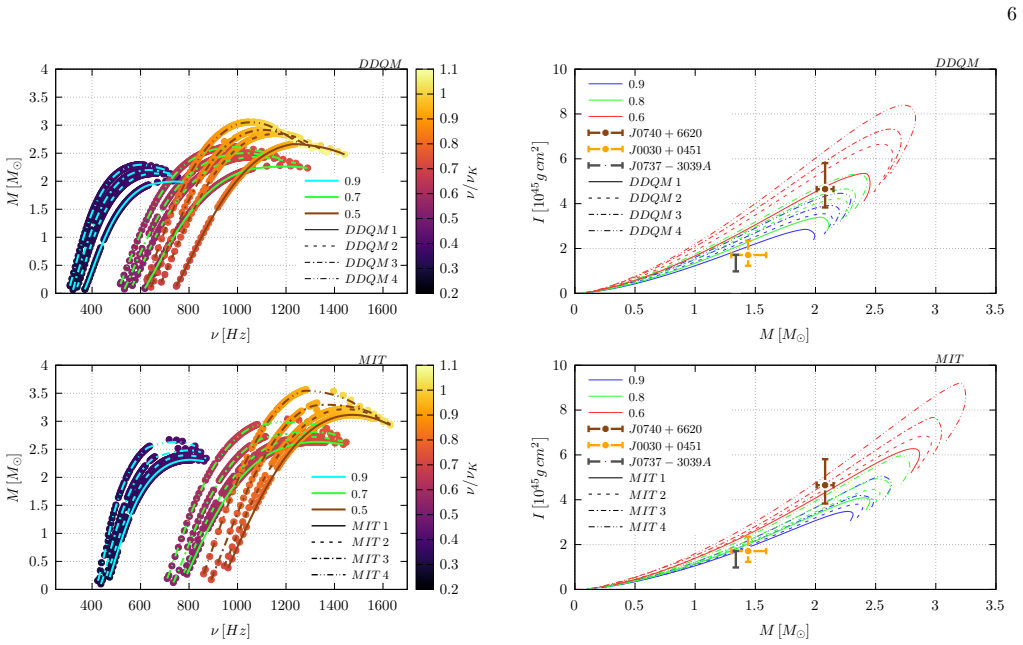
By performing general-relativistic calculations of uniformly rotating sequences for the vector MIT bag model and the density-dependent quark mass model, we find that rotation amplifies intrinsic EOS differences, with the MIT model supporting more massive compact stars with larger moments of inertia and greater resistance to deformation, while the DDQM model produces larger radii and less massive stars limited by mass-shedding at lower frequencies. A central result of this work is the full decomposition of the stellar energy budget in rotating strange stars, separating gravitational, internal, rotational, and binding energy contributions.
What carries the argument
The full decomposition of the stellar energy budget into gravitational, internal, rotational, and binding components, applied to uniformly rotating sequences for each equation of state.
If this is right
- Massive, rapidly rotating pulsars favor the MIT-like equation of state.
- Larger radii in slower, canonical-mass stars point to the DDQM-like model.
- Combined mass, radius, and frequency data break the degeneracy between the two equations of state.
- Rotational observables soon constrained by NICER and gravitational-wave detectors offer a test for self-bound quark matter.
Where Pith is reading between the lines
- The energy decomposition could be checked against future high-precision radius measurements of known fast pulsars to see if the separated contributions add up correctly.
- Extending the same sequences to include small differential rotation might reveal whether the amplification of EOS differences persists beyond uniform spin.
- If one model is favored by data, it would narrow the range of possible quark-matter parameters used in merger simulations.
Load-bearing premise
The two chosen equations of state represent the main possibilities for self-bound strange quark matter and the numerical methods for rotating stars introduce no large systematic errors from grid choice or boundaries.
What would settle it
A measured pulsar with mass above 3.3 solar masses, spin frequency above 600 Hz, and equatorial radius inconsistent with the compact MIT sequence but also outside the DDQM mass-shedding limit would show that the amplified differences and energy decomposition do not match real stars.
Figures



read the original abstract
We investigate the rotational properties of self-bound strange quark stars using two representative quark matter equations of state (EOS): the vector MIT bag model and the density-dependent quark mass (DDQM) model. Through general-relativistic calculations of uniformly rotating sequences, we analyze their mass--radius relations, moments of inertia, quadrupole moments, surface redshifts, Keplerian frequencies, and energy components. A central result of this work is the full decomposition of the stellar energy budget in rotating strange stars, separating gravitational, internal, rotational, and binding energy contributions. Rotation amplifies the intrinsic EOS differences: the MIT model supports more massive ($M_{\max} \gtrsim 3.3\,M_\odot$) compact stars with larger moments of inertia and greater resistance to deformation, while the DDQM model produces larger radii, less massive stars limited by mass-shedding at lower frequencies. Combined measurements of mass, radius, and frequency can thus break the EOS degeneracy; massive, rapidly rotating pulsars favors MIT-like EOS, whereas larger radii in canonical stars point to a DDQM-like model. These rotational observables, soon to be tightly constrained by NICER and next-generation gravitational-wave detectors, offer a means to test the existence and composition of self-bound quark matter in compact stars.
Editorial analysis
A structured set of objections, weighed in public.
Referee Report
Summary. The paper investigates rotational properties of self-bound strange quark stars using two EOS: the vector MIT bag model and the density-dependent quark mass (DDQM) model. It performs general-relativistic calculations for uniformly rotating sequences to analyze mass-radius relations, moments of inertia, quadrupole moments, surface redshifts, Keplerian frequencies, and a full decomposition of the stellar energy budget into gravitational, internal, rotational, and binding contributions. The central claim is that rotation amplifies intrinsic EOS differences, with MIT supporting more massive compact stars (M_max ≳ 3.3 M_⊙) with larger moments of inertia and greater resistance to deformation, while DDQM yields larger radii and lower mass-shedding frequencies; combined mass-radius-frequency measurements can break the degeneracy and test for quark matter.
Significance. If the numerical results are robust, the work provides a detailed comparison of how rotation affects observables and energy budgets in two representative strange quark matter models, offering a potential way to distinguish EOS using NICER and next-generation GW data. The energy decomposition for rotating configurations is a useful addition to the literature on compact star structure.
major comments (2)
- [Numerical methods and results sections] The manuscript reports no convergence tests, error estimates, grid resolution studies, or boundary condition checks for the numerical solutions of the Einstein equations in axisymmetric stationary spacetimes or for the subsequent energy decomposition. This is load-bearing for the central claim because the reported quantitative contrasts (e.g., M_max ≳ 3.3 M_⊙ for MIT versus mass-shedding limits for DDQM) could be affected by systematic numerical offsets that differ between the more compact MIT sequences and the larger-radius DDQM sequences.
- [Energy budget decomposition] No cross-validation of the energy decomposition against the slow-rotation limit or known analytic expansions (e.g., Hartle-Thorne) is provided. Without such checks, it is unclear whether the separated gravitational, internal, rotational, and binding energy contributions accurately reflect physical differences or contain scheme-dependent artifacts.
minor comments (1)
- [Abstract] The abstract states that GR calculations were performed but supplies no information on the numerical code, coordinate system, or outer boundary placement; adding a brief sentence on these would improve clarity for readers.
Simulated Author's Rebuttal
We thank the referee for the constructive and detailed report. The comments on numerical validation are well taken and highlight areas where the manuscript can be strengthened. We address each major comment below and have revised the manuscript to incorporate the requested checks and comparisons.
read point-by-point responses
-
Referee: [Numerical methods and results sections] The manuscript reports no convergence tests, error estimates, grid resolution studies, or boundary condition checks for the numerical solutions of the Einstein equations in axisymmetric stationary spacetimes or for the subsequent energy decomposition. This is load-bearing for the central claim because the reported quantitative contrasts (e.g., M_max ≳ 3.3 M_⊙ for MIT versus mass-shedding limits for DDQM) could be affected by systematic numerical offsets that differ between the more compact MIT sequences and the larger-radius DDQM sequences.
Authors: We agree that explicit documentation of convergence and error control was missing from the original submission. The calculations were performed with a standard axisymmetric GR code for stationary rotating configurations. In the revised manuscript we have added a new subsection (2.3) that specifies the grid resolutions employed (typically 300 radial by 150 angular zones), the boundary conditions at the stellar surface and at spatial infinity, and the results of resolution studies. Doubling the grid density changes the reported maximum masses by less than 0.4 % and the mass-shedding frequencies by less than 0.6 % for both EOS families. These numerical uncertainties are substantially smaller than the EOS-driven differences highlighted in the paper (e.g., the >0.5 M_⊙ gap in M_max and the distinct mass-shedding limits). We have also added representative error bars to the key figures. revision: yes
-
Referee: [Energy budget decomposition] No cross-validation of the energy decomposition against the slow-rotation limit or known analytic expansions (e.g., Hartle-Thorne) is provided. Without such checks, it is unclear whether the separated gravitational, internal, rotational, and binding energy contributions accurately reflect physical differences or contain scheme-dependent artifacts.
Authors: We concur that an explicit cross-check against the slow-rotation limit strengthens the energy decomposition. We have performed additional calculations in the revised manuscript comparing our full numerical decomposition with the Hartle-Thorne perturbative expansion for rotation frequencies up to ~400 Hz. The gravitational and rotational energy terms agree to within 1.5 % at low spin, with the expected growth of higher-order discrepancies at faster rotation. These comparisons are now shown in a new figure and discussed in Section 4. The agreement confirms that the reported separation of energy components is physically meaningful and not dominated by numerical scheme artifacts. revision: yes
Circularity Check
No significant circularity detected
full rationale
The paper computes rotational sequences for strange quark stars by numerically solving the Einstein equations for axisymmetric stationary spacetimes using two independent equations of state (vector MIT bag model and density-dependent quark mass model). The reported energy decomposition into gravitational, internal, rotational, and binding contributions, along with mass-radius relations, moments of inertia, and Kepler frequencies, are direct outputs of these integrations rather than quantities fitted to themselves or derived via self-referential definitions. No load-bearing step reduces by construction to the target observables, and the central claims rest on standard GR numerical methods applied to distinct EOS parametrizations without reliance on self-citation chains for uniqueness or ansatz smuggling.
Axiom & Free-Parameter Ledger
free parameters (2)
- Vector coupling and bag constant in MIT model
- Density-dependent mass parameters in DDQM model
axioms (2)
- domain assumption General relativity in the form of the Einstein equations for stationary axisymmetric spacetimes accurately describes the exterior and interior of uniformly rotating compact stars.
- domain assumption The vector MIT bag and DDQM parametrizations correctly represent the equation of state of self-bound strange quark matter at the densities and temperatures relevant to compact stars.
Lean theorems connected to this paper
-
IndisputableMonolith/Foundationreality_from_one_distinction unclear?
unclearRelation between the paper passage and the cited Recognition theorem.
We use the rns code to model the rigidly rotating strange stars. The code solves the Einstein’s field equations for a stationary, and axisymmetric space-time
What do these tags mean?
- matches
- The paper's claim is directly supported by a theorem in the formal canon.
- supports
- The theorem supports part of the paper's argument, but the paper may add assumptions or extra steps.
- extends
- The paper goes beyond the formal theorem; the theorem is a base layer rather than the whole result.
- uses
- The paper appears to rely on the theorem as machinery.
- contradicts
- The paper's claim conflicts with a theorem or certificate in the canon.
- unclear
- Pith found a possible connection, but the passage is too broad, indirect, or ambiguous to say the theorem truly supports the claim.
Reference graph
Works this paper leans on
-
[1]
The three-dimensional structure of the nucleon from lattice QCD
and surface redshift [ 77, 85] measurements. DDQM stars, being more deformable, predict larger quadrupole moments at fixed spin. Meanwhile, detecting a surface redshift Zp ≳ 0.7 in a massive, rotating pulsar would 9 strongly support the vector MIT description. In summary, a coordinated analysis of data from NICER (mass-radius), binary pulsar timing (momen...
work page 2023
- [2]
- [3]
- [4]
- [5]
-
[6]
J. M. Lattimer, M. Prakash, D. Masak, and A. Yahil, Astrophys. J.355, 241 (1990)
work page 1990
-
[7]
Keplerian frequencies and innermost stable circular orbits of rapidly rotating strange stars
N. Stergioulas, W. Klu´ zniak, and T. Bulik, Astronomy and Astrophysics352, L116 (1999), arXiv:astro-ph/9909152 [astro-ph]
work page internal anchor Pith review Pith/arXiv arXiv 1999
-
[8]
J. L. Zdunik, T. Bulik, W. Klu´ zniak, P. Haensel, and D. Gondek-Rosi´ nska, Astronomy and Astrophysics359, 143 (2000), arXiv:astro-ph/0004278 [astro-ph]
work page internal anchor Pith review Pith/arXiv arXiv 2000
-
[9]
I. Bombaci, A. V. Thampan, and B. Datta, The Astro- physical Journal Letters541, L71 (2000), arXiv:astro- ph/0008062 [astro-ph]. 10
-
[10]
Rotating compact strange stars
D. Gondek-Rosi´ nska, T. Bulik, J. L. Zdunik, E. Gour- goulhon, S. Ray, J. Dey, and M. Dey, Astronomy and Astrophysics363, 1005 (2000), arXiv:astro-ph/0007004 [astro-ph]
work page internal anchor Pith review Pith/arXiv arXiv 2000
-
[11]
J. L. Zdunik and P. Haensel, Phys. Rev. D42, 710 (1990)
work page 1990
- [12]
-
[13]
Fast spinning strange stars: possible ways to constrain interacting quark matter parameters
S. Bhattacharyya, I. Bombaci, D. Logoteta, and A. V. Thampan, Mon. Not. Roy. Astron. Soc.457, 3101 (2016), arXiv:1601.06120 [astro-ph.HE]
work page internal anchor Pith review Pith/arXiv arXiv 2016
-
[14]
E. Gourgoulhon, P. Haensel, R. Livine, E. Paluch, S. Bonazzola, and J. A. Marck, A&A349, 851 (1999)
work page 1999
-
[15]
E. Zhou, A. Tsokaros, L. Rezzolla, and R. Xu, Astron. Nachrichten338, 1044 (2017)
work page 2017
-
[16]
M. Szkudlarek, D. Gondek-Rosi´ nska, L. Villain, and M. Ansorg, inElectromagnetic Radiation from Pulsars and Magnetars, Astronomical Society of the Pacific Conference Series, Vol. 466, edited by W. Lewandowski, O. Maron, and J. Kijak (2012) p. 231
work page 2012
-
[17]
M. Szkudlarek, D. Gondek-Rosi´ nska, L. Villain, and M. Ansorg, Astrophys. J.879, 44 (2019)
work page 2019
-
[18]
E. Zhou, A. Tsokaros, K. Ury¯ u, R. Xu, and M. Shibata, Phys. Rev. D100, 043015 (2019)
work page 2019
-
[19]
Zhou, inJournal of Physics Conference Series, Journal of Physics Conference Series, Vol
E. Zhou, inJournal of Physics Conference Series, Journal of Physics Conference Series, Vol. 861 (2017) p. 012007
work page 2017
-
[20]
E. Zhou, A. Tsokaros, L. Rezzolla, R. Xu, and K. Ury¯ u, Phys. Rev. D97, 023013 (2018)
work page 2018
-
[21]
D. Gondek-Rosi´ nska, N. Stergioulas, T. Bulik, W. Klu´ zniak, and E. Gourgoulhon, Astronomy and Astrophysics380, 190 (2001)
work page 2001
-
[22]
D. Gondek-Rosi´ nska and T. Bulik, inAstrophysical Sources of High Energy Particles and Radiation, American Institute of Physics Conference Series, Vol. 801, edited by T. Bulik, B. Rudak, and G. Madejski (2005) pp. 227–228
work page 2005
-
[23]
D. Gondek-Rosi´ nska, W. Klu´ zniak, N. Stergioulas, and M. Wi´ sniewicz, Phys. Rev. D89, 104001 (2014)
work page 2014
-
[24]
J. L. Zdunik, P. Haensel, and E. Gourgoulhon, Astronomy and Astrophysics372, 535 (2001)
work page 2001
-
[25]
S. Bhattacharyya, A. V. Thampan, and I. Bombaci, As- tronomy and Astrophysics372, 925 (2001)
work page 2001
-
[26]
K. S. Cheng and T. Harko, Phys. Rev. D62, 083001 (2000)
work page 2000
-
[27]
D. D. Doneva, S. S. Yazadjiev, K. V. Staykov, and K. D. Kokkotas, Phys. Rev. D90, 104021 (2014)
work page 2014
- [28]
- [29]
-
[30]
J. Madsen, Phys. Rev. Lett.85, 10 (2000), arXiv:astro- ph/9912418 [astro-ph]
-
[31]
N. Andersson, D. I. Jones, and K. D. Kokkotas, Mon. Not. Roy. Astron. Soc.337, 1224 (2002), arXiv:astro- ph/0111582 [astro-ph]
-
[32]
D. Gondek-Rosi´ nska, E. Gourgoulhon, and P. Haensel, Astron. Astrophys.412, 777 (2003)
work page 2003
-
[33]
E. Zhou, K. Kiuchi, M. Shibata, A. Tsokaros, and K. Ury¯ u, Phys. Rev. D103, 123011 (2021)
work page 2021
-
[34]
D. B. Melrose, R. Fok, and D. P. Menezes, Mon. Not. Roy. Astron. Soc.371, 204 (2006), arXiv:astro-ph/0607553
work page internal anchor Pith review Pith/arXiv arXiv 2006
-
[35]
C. Kettner, F. Weber, M. K. Weigel, and N. K. Glenden- ning, Phys. Rev. D51, 1440 (1995)
work page 1995
-
[36]
N. K. Glendenning and F. Weber, Astrophys. J.400, 647 (1992)
work page 1992
-
[37]
P. Haensel, J. L. Zdunik, M. Bejger, and J. M. Lattimer, A&A502, 605 (2009)
work page 2009
-
[38]
C. J. Xia, G. X. Peng, S. W. Chen, Z. Y. Lu, and J. F. Xu, Phys. Rev. D89, 105027 (2014), arXiv:1405.3037 [hep-ph]
work page internal anchor Pith review Pith/arXiv arXiv 2014
- [39]
- [40]
- [41]
-
[42]
B. D. Serot and J. D. Walecka, Int. J. Mod. Phys. E6, 515 (1997)
work page 1997
-
[43]
R. J. Furnstahl, B. D. Serot, and H.-B. Tang, Nucl. Phys. A618, 446 (1997), arXiv:nucl-th/9611046
work page internal anchor Pith review Pith/arXiv arXiv 1997
- [44]
- [45]
-
[46]
D. P. Menezes, Universe7, 267 (2021)
work page 2021
- [47]
-
[48]
G. B. Cook, S. L. Shapiro, and S. A. Teukolsky, Astrophys. J.424, 823 (1994)
work page 1994
-
[49]
H. Komatsu, Y. Eriguchi, and I. Hachisu, Mon. Not. R. Astron. Soc.237, 355 (1989)
work page 1989
-
[50]
W. G. Laarakkers and E. Poisson, The Astrophysical Journal512, 282–287 (1999)
work page 1999
-
[51]
Multipole Moments of numerical spacetimes
G. Pappas and T. A. Apostolatos, Multipole moments of numerical spacetimes (2012), arXiv:1211.6299 [gr-qc]
work page internal anchor Pith review Pith/arXiv arXiv 2012
-
[53]
M. C. Milleret al., Astrophys. J. Lett.918, L28 (2021), arXiv:2105.06979 [astro-ph.HE]
work page internal anchor Pith review arXiv 2021
-
[55]
M. C. Miller, F. K. Lamb, A. J. Dittmann, et al., Astrophysical Journal Letters887, L24 (2019), arXiv:1912.05705 [astro-ph.HE]
work page internal anchor Pith review arXiv 2019
-
[56]
B. P. Abbott, R. Abbott, T. D. Abbott,et al., Phys. Rev. Lett.121, 161101 (2018)
work page 2018
-
[57]
B. P. Abbottet al., Phys. Rev. Lett.119, 161101 (2017)
work page 2017
- [58]
-
[59]
J. B. Hartle, Astrophys. J.150, 1005 (1967)
work page 1967
-
[60]
Strange Quark Matter and Compact Stars
F. Weber, Prog. Part. Nucl. Phys.54, 193 (2005), arXiv:astro-ph/0407155
work page internal anchor Pith review Pith/arXiv arXiv 2005
- [61]
-
[62]
J. W. T. Hessels, S. M. Ransom, I. H. Stairs, P. C. C. Freire, V. M. Kaspi, and F. Camilo, Sci311, 1901 (2006)
work page 1901
-
[63]
H. T. Cromartie, E. Fonseca, S. M. Ransom,et al., Nature Astronomy4, 72 (2020)
work page 2020
-
[64]
J. M. Lattimer and B. F. Schutz, Astrophys. J.629, 979 (2005)
work page 2005
-
[65]
F. M. da Silva, A. Issifu, L. C. N. Santos, T. Frederico, and D. P. Menezes, Phys. Rev. D112, 023007 (2025)
work page 2025
- [66]
-
[67]
Masses, Radii, and Equation of State of Neutron Stars
F. ¨Ozel and P. Freire, Annu. Rev. Astron. Astrophys.54, 401 (2016), arXiv:1603.02698 [astro-ph.HE]
work page internal anchor Pith review Pith/arXiv arXiv 2016
-
[68]
M. Krameret al., Phys. Rev. X11, 041050 (2021), arXiv:2112.06795 [astro-ph.HE]. 11
-
[69]
H. O. Silva, A. M. Holgado, A. C´ ardenas-Avenda˜ no, and N. Yunes, Phys. Rev. Lett.126, 181101 (2021)
work page 2021
-
[70]
Y. Li, J. Wang, Z. Wu, and D. Wen, Classical Quant. Grav.39, 035014 (2022)
work page 2022
- [71]
-
[72]
Quadrupole moments of rotating neutron stars and strange stars
M. Urbanec, J. C. Miller, and Z. Stuchlik, Mon. Not. Roy. Astron. Soc.433, 1903 (2013), arXiv:1301.5925 [astro- ph.SR]
work page internal anchor Pith review Pith/arXiv arXiv 1903
-
[73]
N. K. Glendenning,Compact Stars: Nuclear Physics, Par- ticle Physics, and General Relativity, 2nd ed., Astronomy and Astrophysics Library (Springer-Verlag, New York, 2000)
work page 2000
-
[74]
W. G. Laarakkers and E. Poisson, Astrophys. J.512, 282 (1999), arXiv:gr-qc/9709033
work page internal anchor Pith review Pith/arXiv arXiv 1999
-
[75]
F. Weber, M. Orsaria, H. Rodrigues, and S.-H. Yang, IAU Symp.291, 61 (2013), arXiv:1210.1910 [astro-ph.SR]
work page internal anchor Pith review Pith/arXiv arXiv 2013
-
[76]
Dynamics of Extended Spinning Masses in a Gravitational Field
B. Mashhoon and D. Singh, Phys. Rev. D74, 124006 (2006), arXiv:astro-ph/0608278
work page internal anchor Pith review Pith/arXiv arXiv 2006
-
[77]
J. M. Lattimer and M. Prakash, Astrophys. J.550, 426 (2001)
work page 2001
-
[78]
Gravitationally redshifted absorption lines in the X-ray burst spectra of a neutron star
J. Cottam, F. Paerels, and M. Mendez, Nature420, 51 (2002), arXiv:astro-ph/0211126
work page internal anchor Pith review Pith/arXiv arXiv 2002
-
[79]
The Burst Spectra of EXO 0748-676 during a Long 2003 XMM-Newton Observation
J. Cottam, F. Paerels, M. Mendez, L. Boirin, W. H. G. Lewin, E. Kuulkers, and J. M. Miller, Astrophys. J.672, 504 (2008), arXiv:0709.4062 [astro-ph]
work page internal anchor Pith review Pith/arXiv arXiv 2008
- [80]
-
[81]
Y. L. Vartanyan, A. K. Grigoryan, and G. A. Khachatryan, Astrophysics38, 152 (1995)
work page 1995
-
[82]
The evolution of rotating stars
A. Maeder and G. Meynet, Annu. Rev. Astron. Astrophys. 38, 143 (2000), arXiv:astro-ph/0004204 [astro-ph]
work page internal anchor Pith review Pith/arXiv arXiv 2000
discussion (0)
Sign in with ORCID, Apple, or X to comment. Anyone can read and Pith papers without signing in.