Recognition: no theorem link
A Comprehensive Study of WIMP Models Explaining the Fermi-LAT Galactic Center Excess
Pith reviewed 2026-05-17 04:23 UTC · model grok-4.3
The pith
WIMP models explain the Galactic Center Excess only in narrow resonant annihilation regimes, favoring leptophilic vectors and pseudoscalar portals.
A machine-rendered reading of the paper's core claim, the machinery that carries it, and where it could break.
Core claim
After examining Higgs portals, simplified scalar/vector mediators, U(1)_{L_i-L_j} leptonic models, U(1)_{B-L}, and Z portals, viable WIMP explanations of the Galactic Center Excess are restricted to finely tuned resonant regimes with m_DM approximately equal to m_med/2 and portal couplings much less than one; leptophilic vectors and pseudoscalar portals emerge as the most robust options that simultaneously satisfy relic density, direct detection, and indirect detection constraints.
What carries the argument
The resonant annihilation funnel where m_DM equals m_med over 2, which boosts the annihilation rate enough to match the thermal relic density at small couplings, together with the portal-specific coupling structures that control evasion of direct and indirect bounds.
If this is right
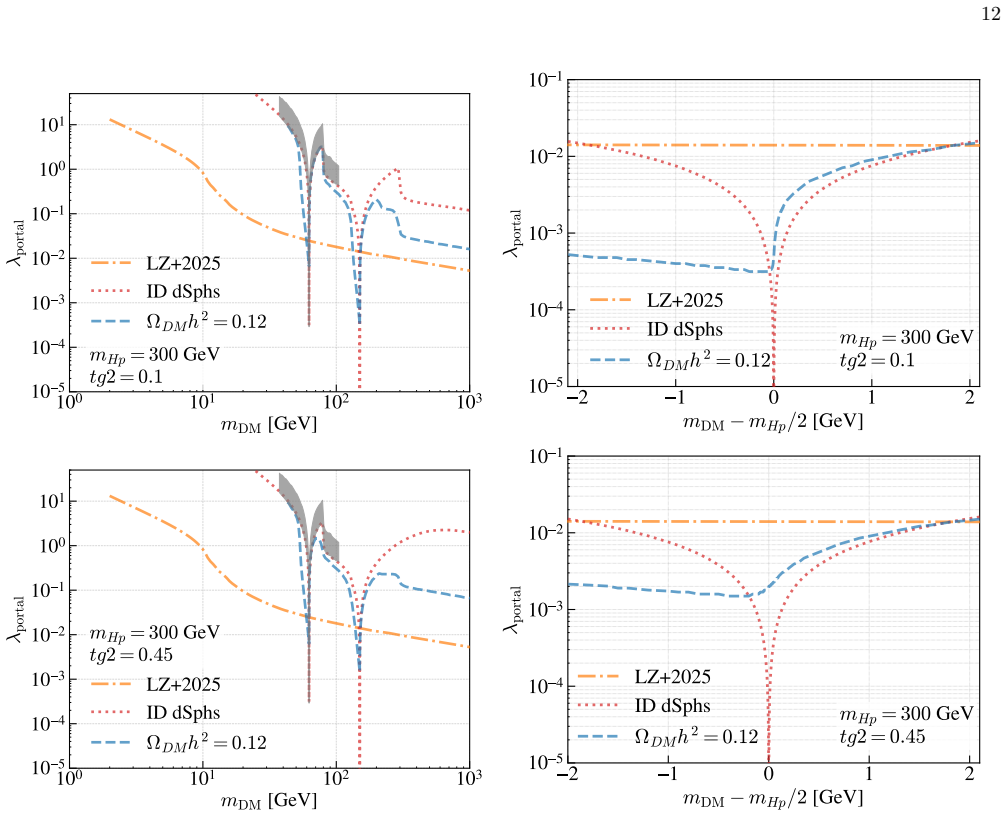
- Scalar Higgs portals survive only in a narrow band near 62.5 GeV with portal couplings around 10 to the minus 4.
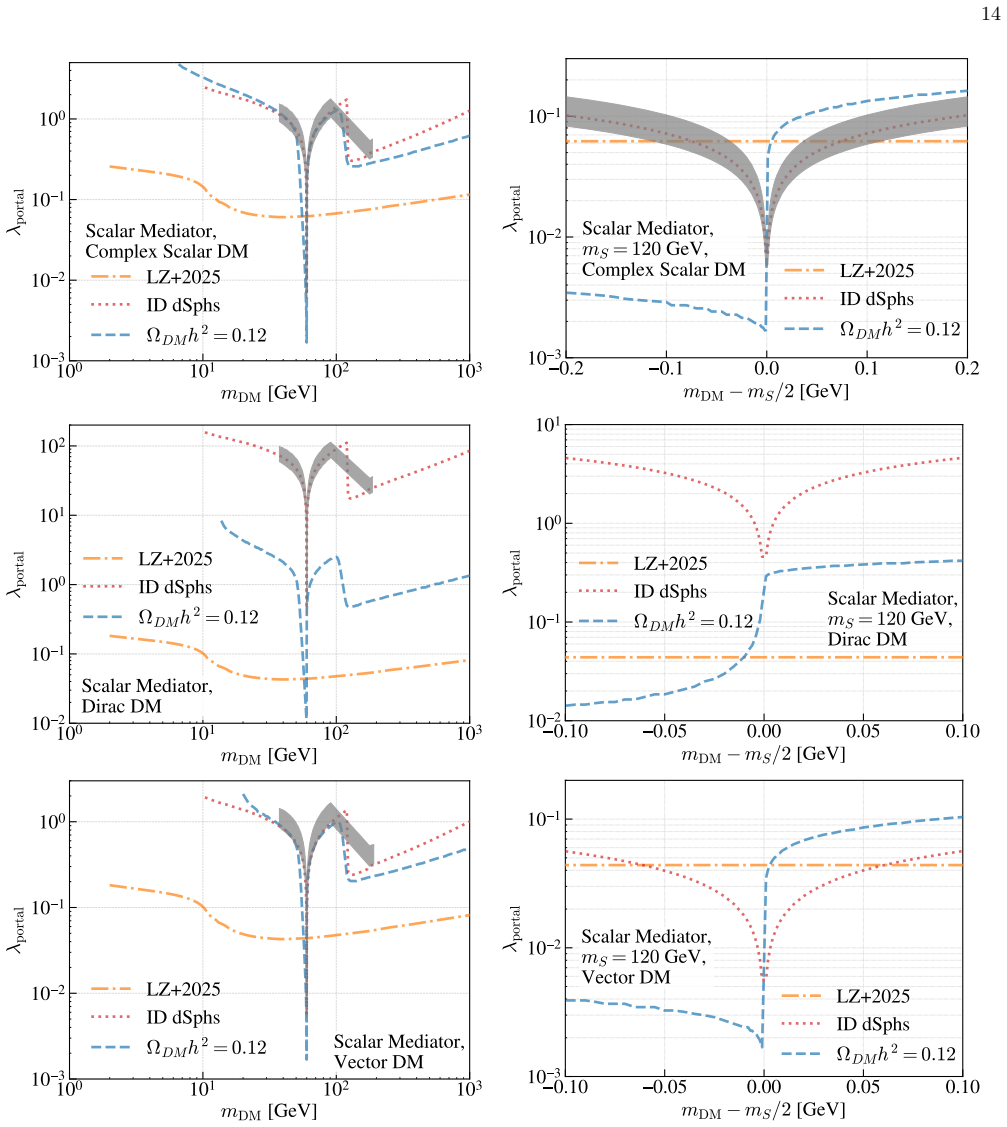
- Dirac dark matter is strongly disfavored in most Higgs and Z setups, while a pseudoscalar mediator with Dirac dark matter remains viable over a wider range.
- L_mu minus L_e leptophilic models fit the excess with near-thermal cross sections when inverse-Compton emission is included.
- Pure axial-vector couplings for simplified Z-prime mediators are excluded by the combined direct and indirect limits.
Where Pith is reading between the lines
- Upcoming direct detection runs with higher sensitivity could close the remaining resonant windows or provide a positive signal within them.
- If the excess is later shown to be astrophysical, the paper's results would eliminate these WIMP candidates across all portal classes.
- Collider searches for light leptophilic mediators could offer an independent test of the models that still fit the gamma-ray data.
Load-bearing premise
The Galactic Center Excess arises from dark matter annihilation rather than astrophysical sources and the applied direct and indirect detection limits are sufficiently model-independent to exclude broad non-resonant regions.
What would settle it
A direct detection signal at dark matter masses far from half the mediator mass, or a high-resolution spectrum of the Galactic Center Excess that deviates from the shape predicted by resonant WIMP annihilation in the surviving leptophilic and pseudoscalar models.
Figures





read the original abstract
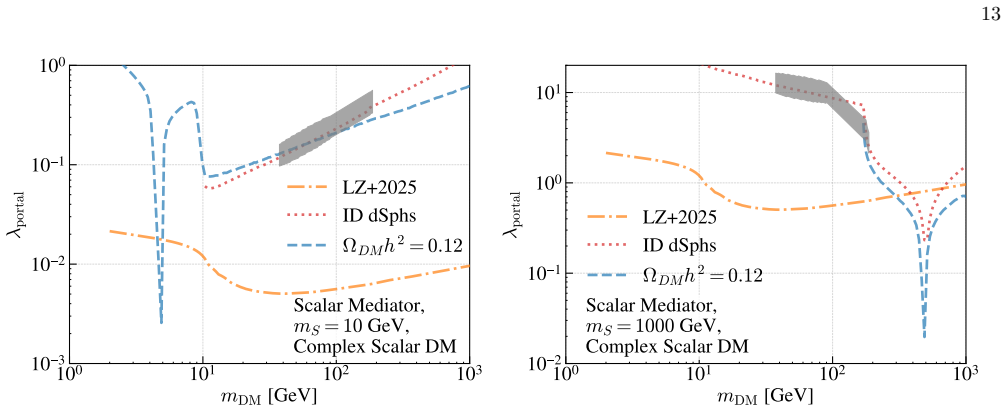
The Galactic Center excess (GCE) of GeV $\gamma$ rays may hint at dark matter (DM), yet its origin remains debated. Motivated by this, we survey weakly interacting massive particle (WIMP) models that can fit the GCE while satisfying relic-density, direct-detection (DD), and indirect-detection (ID) bounds. We group candidates into hadronic (Higgs portals; simplified scalar/vector mediators), leptonic ($U(1)_{L_i-L_j}$), and mixed ($U(1)_{B-L}$, $Z$-portal) classes. Across all cases, present DD and dwarf-spheroidal $\gamma$-ray limits exclude wide regions, leaving mainly narrow resonant funnels with $m_{\rm DM}\!\simeq\! m_{\rm med}/2$ and portal couplings $\ll 1$. In hadronic setups, scalar and vector Higgs portals survive only in a thin strip near $m_h/2\simeq62.5$ GeV with portal couplings $\sim 10^{-4}$, while the Dirac Higgs and $Z$ portals are essentially excluded. The UV-complete vector Higgs portal retains resonant bands whose viable portal strength depends on the mixing angle. Simplified scalars allow small windows for complex-scalar or vector DM; Dirac DM is strongly disfavored, whereas a pseudoscalar with Dirac DM remains viable over a broader parameter range. For a simplified $Z'$ mediator, a pure vector coupling leaves only a marginal region, while pure axial is excluded by DD/ID bounds. In leptonic scenarios, inverse-Compton emission is essential: $L_\mu-L_e$ (and, to a lesser extent, $B\!-\!L$) fits the GCE with near-thermal cross sections, while $L_\mu-L_\tau$ is disfavored. Overall, viable WIMP explanations are constrained to finely tuned resonant regime, with leptophilic vectors and pseudoscalar portals emerging as the most robust options.
Editorial analysis
A structured set of objections, weighed in public.
Referee Report
Summary. The manuscript surveys WIMP models grouped into hadronic (Higgs portals and simplified scalar/vector mediators), leptonic (U(1)_{L_i-L_j}), and mixed (U(1)_{B-L}, Z-portal) classes that can fit the Fermi-LAT Galactic Center Excess while satisfying relic-density, direct-detection, and indirect-detection bounds. It concludes that present constraints exclude wide regions, leaving mainly narrow resonant funnels with m_DM ≃ m_med/2 and portal couplings ≪ 1, with leptophilic vectors and pseudoscalar portals emerging as the most robust options.
Significance. If the central results hold, this comprehensive survey is significant for mapping viable WIMP parameter space for the GCE and identifying which model classes survive current limits. It employs standard relic-density formulas and experimental constraints across multiple mediator types, providing a useful reference that highlights the necessity of resonant annihilation and the relative robustness of leptophilic scenarios.
major comments (2)
- [Abstract and Introduction] Abstract and Introduction: The claim that viable WIMP explanations are constrained to finely tuned resonant regimes with leptophilic vectors and pseudoscalar portals as most robust rests on attributing the full GCE spectrum to DM annihilation in the chosen halo profile. The manuscript notes the ongoing debate but does not perform a sensitivity test with a reduced DM flux fraction (e.g., 50% astrophysical contribution from millisecond pulsars); repeating the scans under this variation would directly test whether the resonant funnels and model rankings persist.
- [Leptonic scenarios] Leptonic scenarios section: The assertion that L_μ-L_e (and to a lesser extent B-L) fits the GCE with near-thermal cross sections relies on inverse-Compton emission and fixed propagation parameters. Without exploring variations in these parameters, the robustness ranking relative to other classes is not fully established and could shift under reasonable changes in the propagation model.
minor comments (2)
- [Notation] The notation for portal couplings is generally consistent but would benefit from an explicit table comparing definitions across hadronic, leptonic, and mixed classes to aid cross-comparison.
- [Results figures] Exclusion plots in the results sections would be clearer with shaded bands explicitly marking the resonant m_DM ≈ m_med/2 regions and the surviving windows for each model class.
Simulated Author's Rebuttal
We thank the referee for the careful and constructive comments. Below we respond point by point to the major remarks, indicating where revisions will be made and where we maintain our original approach on substantive grounds.
read point-by-point responses
-
Referee: [Abstract and Introduction] Abstract and Introduction: The claim that viable WIMP explanations are constrained to finely tuned resonant regimes with leptophilic vectors and pseudoscalar portals as most robust rests on attributing the full GCE spectrum to DM annihilation in the chosen halo profile. The manuscript notes the ongoing debate but does not perform a sensitivity test with a reduced DM flux fraction (e.g., 50% astrophysical contribution from millisecond pulsars); repeating the scans under this variation would directly test whether the resonant funnels and model rankings persist.
Authors: We agree that the primary results assume the GCE is entirely due to DM annihilation, which is the conventional assumption in comprehensive WIMP surveys of this type. The introduction already references the astrophysical debate, including millisecond-pulsar contributions. A complete re-scan assuming only 50% DM flux would require repeating the full set of parameter explorations for every mediator class and is computationally intensive. We will add an explicit discussion in the revised abstract and introduction clarifying that a reduced DM contribution would only tighten the constraints further, reinforcing the necessity of resonant annihilation and the relative robustness of leptophilic and pseudoscalar portals. Because the ranking among model classes is driven primarily by direct-detection and relic-density considerations rather than the absolute normalization, we do not anticipate a qualitative shift in the conclusions. revision: partial
-
Referee: [Leptonic scenarios] Leptonic scenarios section: The assertion that L_μ-L_e (and to a lesser extent B-L) fits the GCE with near-thermal cross sections relies on inverse-Compton emission and fixed propagation parameters. Without exploring variations in these parameters, the robustness ranking relative to other classes is not fully established and could shift under reasonable changes in the propagation model.
Authors: The leptonic fits employ the standard propagation parameters and inverse-Compton modeling used in the Fermi-LAT GCE analyses to permit direct comparison with prior literature. While propagation uncertainties exist and could affect the precise spectral shape, the central advantage of leptophilic vectors—near-thermal annihilation cross sections that evade direct-detection bounds—remains independent of propagation details. We will insert a short paragraph in the leptonic section acknowledging the dependence on propagation assumptions, citing representative studies of cosmic-ray propagation variations, and noting that the model-class ranking is stable under these uncertainties. revision: partial
Circularity Check
No circularity: standard parameter scans against external constraints
full rationale
The paper surveys WIMP models by fitting annihilation spectra to the observed GCE and applying relic-density formulas plus external DD and ID limits from experiments. Viable regions emerge from these independent inputs rather than any quantity defined in terms of itself or a fitted parameter renamed as a prediction. No self-citations serve as load-bearing uniqueness theorems, and no ansatz is smuggled via prior work. The chain remains self-contained against external benchmarks.
Axiom & Free-Parameter Ledger
free parameters (2)
- portal coupling
- DM mass relative to mediator mass
axioms (2)
- domain assumption Standard thermal freeze-out relic density formula applies to all surveyed models
- domain assumption Dwarf spheroidal gamma-ray limits can be applied model-independently to exclude parameter space
Reference graph
Works this paper leans on
-
[1]
Silket al.,Particle Dark Matter: Observations, Models and Searches, edited by G
J. Silket al.,Particle Dark Matter: Observations, Models and Searches, edited by G. Bertone (Cambridge Univ. Press, Cambridge, 2010)
work page 2010
-
[2]
G. Bertone and D. Hooper, Rev. Mod. Phys.90, 045002 (2018), arXiv:1605.04909 [astro-ph.CO]
work page internal anchor Pith review Pith/arXiv arXiv 2018
-
[3]
M. Cirelli, A. Strumia, and J. Zupan, (2024), arXiv:2406.01705 [hep-ph]
work page internal anchor Pith review Pith/arXiv arXiv 2024
-
[5]
M. Schumann, J. Phys. G46, 103003 (2019), arXiv:1903.03026 [astro-ph.CO]
-
[6]
Dark Matter Searches at Colliders
A. Boveia and C. Doglioni, Ann. Rev. Nucl. Part. Sci. 68, 429 (2018), arXiv:1810.12238 [hep-ex]
work page internal anchor Pith review Pith/arXiv arXiv 2018
-
[7]
J. M. Gaskins, Contemp. Phys.57, 496 (2016), arXiv:1604.00014 [astro-ph.HE]
work page internal anchor Pith review Pith/arXiv arXiv 2016
-
[8]
Implications of High-Resolution Simulations on Indirect Dark Matter Searches
L. Pieri, J. Lavalle, G. Bertone, and E. Branchini, Phys. Rev. D83, 023518 (2011), arXiv:0908.0195 [astro- ph.HE]
work page internal anchor Pith review Pith/arXiv arXiv 2011
-
[9]
L. Goodenough and D. Hooper, (2009), arXiv:0910.2998 [hep-ph]
work page internal anchor Pith review Pith/arXiv arXiv 2009
-
[10]
Dark Matter Annihilation in The Galactic Center As Seen by the Fermi Gamma Ray Space Telescope
D. Hooper and L. Goodenough, Phys. Lett.B697, 412 (2011), arXiv:1010.2752 [hep-ph]
work page internal anchor Pith review Pith/arXiv arXiv 2011
-
[11]
A comment on the emission from the Galactic Center as seen by the Fermi telescope
A. Boyarsky, D. Malyshev, and O. Ruchayskiy, Phys. Lett.B705, 165 (2011), arXiv:1012.5839 [hep-ph]
work page internal anchor Pith review Pith/arXiv arXiv 2011
-
[12]
On The Origin Of The Gamma Rays From The Galactic Center
D. Hooper and T. Linden, Phys. Rev.D84, 123005 (2011), arXiv:1110.0006 [astro-ph.HE]
work page internal anchor Pith review Pith/arXiv arXiv 2011
-
[13]
K. N. Abazajian and M. Kaplinghat, Phys. Rev.D86, 083511 (2012), [Erratum: Phys. Rev.D87,129902(2013)], arXiv:1207.6047 [astro-ph.HE]
work page internal anchor Pith review Pith/arXiv arXiv 2012
-
[14]
Dark Matter and Pulsar Model Constraints from Galactic Center Fermi-LAT Gamma Ray Observations
C. Gordon and O. Macias, Phys. Rev.D88, 083521 (2013), [Erratum: Phys. Rev.D89,no.4,049901(2014)], arXiv:1306.5725 [astro-ph.HE]
work page internal anchor Pith review Pith/arXiv arXiv 2013
-
[15]
K. N. Abazajian, N. Canac, S. Horiuchi, and M. Kapling- hat, Phys. Rev.D90, 023526 (2014), arXiv:1402.4090 [astro-ph.HE]
work page internal anchor Pith review Pith/arXiv arXiv 2014
-
[16]
T. Daylan, D. P. Finkbeiner, D. Hooper, T. Linden, S. K. N. Portillo, N. L. Rodd, and T. R. Slatyer, Phys. Dark Univ.12, 1 (2016), arXiv:1402.6703 [astro-ph.HE]
work page internal anchor Pith review Pith/arXiv arXiv 2016
-
[17]
F. Calore, I. Cholis, C. McCabe, and C. Weniger, Phys. Rev. D91, 063003 (2015), arXiv:1411.4647 [hep-ph]
work page internal anchor Pith review Pith/arXiv arXiv 2015
-
[18]
Background model systematics for the Fermi GeV excess
F. Calore, I. Cholis, and C. Weniger, JCAP1503, 038 (2015), arXiv:1409.0042 [astro-ph.CO]
work page internal anchor Pith review Pith/arXiv arXiv 2015
-
[19]
Fermi-LAT Observations of High-Energy Gamma-Ray Emission Toward the Galactic Center
M. Ajelloet al.(Fermi-LAT), Astrophys. J.819, 44 (2016), arXiv:1511.02938 [astro-ph.HE]
work page internal anchor Pith review Pith/arXiv arXiv 2016
-
[20]
The Fermi Galactic Center GeV Excess and Implications for Dark Matter
M. Ackermannet al.(Fermi-LAT), Astrophys. J.840, 43 (2017), arXiv:1704.03910 [astro-ph.HE]
work page internal anchor Pith review Pith/arXiv arXiv 2017
-
[21]
M. Di Mauro, X. Hou, C. Eckner, G. Zaharijas, and E. Charles, Phys. Rev. D99, 123027 (2019), arXiv:1904.10977 [astro-ph.HE]
work page internal anchor Pith review Pith/arXiv arXiv 2019
-
[22]
M. Di Mauro, Phys. Rev. D103, 063029 (2021), arXiv:2101.04694 [astro-ph.HE]
-
[23]
I. Cholis, Y.-M. Zhong, S. D. McDermott, and J. P. Surdutovich, Phys. Rev. D105, 103023 (2022), arXiv:2112.09706 [astro-ph.HE]
-
[24]
M. Di Mauro and M. W. Winkler, Phys. Rev. D103, 123005 (2021), arXiv:2101.11027 [astro-ph.HE]
- [25]
-
[26]
Strong support for the millisecond pulsar origin of the Galactic center GeV excess
R. Bartels, S. Krishnamurthy, and C. Weniger, Phys. Rev. Lett.116, 051102 (2016), arXiv:1506.05104 [astro- ph.HE]
work page internal anchor Pith review Pith/arXiv arXiv 2016
-
[27]
S. K. Lee, M. Lisanti, B. R. Safdi, T. R. Slatyer, 18 and W. Xue, Phys. Rev. Lett.116, 051103 (2016), arXiv:1506.05124 [astro-ph.HE]
work page internal anchor Pith review Pith/arXiv arXiv 2016
- [28]
-
[29]
The Fermi-LAT GeV Excess Traces Stellar Mass in the Galactic Bulge
R. Bartels, E. Storm, C. Weniger, and F. Calore, Nat. Astron.2, 819 (2018), arXiv:1711.04778 [astro-ph.HE]
work page internal anchor Pith review Pith/arXiv arXiv 2018
-
[30]
S. Manconi, F. Calore, and F. Donato, Phys. Rev. D 109, 123042 (2024), arXiv:2402.04733 [astro-ph.HE]
- [31]
- [32]
- [33]
- [34]
- [35]
-
[36]
J. Aalberset al., Phys. Rev. Lett.131, 041002 (2023), arXiv:2207.03764 [hep-ex]
- [37]
-
[38]
J. Aalberset al.(LZ), Phys. Rev. Lett.135, 011802 (2025), arXiv:2410.17036 [hep-ex]
-
[39]
The Waning of the WIMP? A Review of Models, Searches, and Constraints
G. Arcadi, M. Dutra, P. Ghosh, M. Lindner, Y. Mam- brini, M. Pierre, S. Profumo, and F. S. Queiroz, Eur. Phys. J. C78, 203 (2018), arXiv:1703.07364 [hep-ph]
work page internal anchor Pith review Pith/arXiv arXiv 2018
- [40]
-
[41]
M. Di Mauro, C. Arina, N. Fornengo, J. Heisig, and D. Massaro, Phys. Rev. D108, 095008 (2023), arXiv:2305.11937 [hep-ph]
- [42]
- [43]
-
[44]
M. Pospelov, A. Ritz, and M. B. Voloshin, Phys. Lett. B662, 53 (2008), arXiv:0711.4866 [hep-ph]
work page internal anchor Pith review Pith/arXiv arXiv 2008
-
[45]
Astrophysical Signatures of Secluded Dark Matter
M. Pospelov and A. Ritz, Phys. Lett. B671, 391 (2009), arXiv:0810.1502 [hep-ph]
work page internal anchor Pith review Pith/arXiv arXiv 2009
- [46]
-
[47]
Di Mauro, (2025), arXiv:2511.19622 [hep-ph]
M. Di Mauro, (2025), arXiv:2511.19622 [hep-ph]
-
[48]
A. McDaniel, M. Ajello, C. M. Karwin, M. Di Mauro, A. Drlica-Wagner, and M. A. S´ anchez-Conde, Phys. Rev. D109, 063024 (2024), arXiv:2311.04982 [astro-ph.HE]
-
[49]
J. Abdallah, H. Araujo, A. Arbey, A. Ashkenazi, A. Belyaev, J. Berger, C. Boehm, A. Boveia, A. Bren- nan, J. Brooke, O. Buchmueller, M. Buckley, G. Bu- soni, L. Calibbi, S. Chauhan, N. Daci, G. Davies, I. De Bruyn, P. De Jong, A. De Roeck, K. de Vries, D. Del Re, A. De Simone, A. Di Simone, C. Doglioni, M. Dolan, H. K. Dreiner, J. Ellis, S. Eno, E. Etzion...
work page 2015
-
[50]
Impact of cosmological and astrophysical constraints on dark matter simplified models
C. Arina, Front. Astron. Space Sci.5, 30 (2018), arXiv:1805.04290 [hep-ph]
work page internal anchor Pith review Pith/arXiv arXiv 2018
- [51]
- [52]
-
[53]
J. M. Cline, K. Kainulainen, P. Scott, and C. Weniger, Phys. Rev. D88, 055025 (2013), [Erratum: Phys.Rev.D 92, 039906 (2015)], arXiv:1306.4710 [hep-ph]
work page internal anchor Pith review Pith/arXiv arXiv 2013
-
[54]
Combined analysis of effective Higgs portal dark matter models
A. Beniwal, F. Rajec, C. Savage, P. Scott, C. Weniger, M. White, and A. G. Williams, Phys. Rev. D93, 115016 (2016), arXiv:1512.06458 [hep-ph]
work page internal anchor Pith review Pith/arXiv arXiv 2016
-
[55]
VDM: A model for Vector Dark Matter
Y. Farzan and A. R. Akbarieh, JCAP10, 026 (2012), arXiv:1207.4272 [hep-ph]
work page internal anchor Pith review Pith/arXiv arXiv 2012
-
[56]
P. Ko, W.-I. Park, and Y. Tang, JCAP09, 013 (2014), arXiv:1404.5257 [hep-ph]
work page internal anchor Pith review Pith/arXiv arXiv 2014
-
[57]
S. Baek, P. Ko, W.-I. Park, and Y. Tang, JCAP06, 046 (2014), arXiv:1402.2115 [hep-ph]
work page internal anchor Pith review Pith/arXiv arXiv 2014
-
[58]
M. Duch, B. Grzadkowski, and M. McGarrie, JHEP09, 162 (2015), arXiv:1506.08805 [hep-ph]
work page internal anchor Pith review Pith/arXiv arXiv 2015
- [59]
-
[60]
G. Arcadi, Y. Mambrini, and F. Richard, JCAP03, 018 (2015), arXiv:1411.2985 [hep-ph]
work page internal anchor Pith review Pith/arXiv arXiv 2015
- [61]
-
[62]
X. G. He, G. C. Joshi, H. Lew, and R. R. Volkas, Phy. Rev. D43, R22 (1991)
work page 1991
-
[63]
Gauged L_mu - L_tau Symmetry at the Electroweak Scale
J. Heeck and W. Rodejohann, Phys. Rev. D84, 075007 (2011), arXiv:1107.5238 [hep-ph]
work page internal anchor Pith review Pith/arXiv arXiv 2011
- [64]
-
[65]
FeynRules 2.0 - A complete toolbox for tree-level phenomenology
A. Alloul, N. D. Christensen, C. Degrande, C. Duhr, and B. Fuks, Comput. Phys. Commun.185, 2250 (2014), arXiv:1310.1921 [hep-ph]
work page internal anchor Pith review Pith/arXiv arXiv 2014
-
[66]
UFO - The Universal FeynRules Output
C. Degrande, C. Duhr, B. Fuks, D. Grellscheid, O. Mat- telaer, and T. Reiter, Comput. Phys. Commun.183, 1201 (2012), arXiv:1108.2040 [hep-ph]
work page internal anchor Pith review Pith/arXiv arXiv 2012
-
[67]
CalcHEP 3.4 for collider physics within and beyond the Standard Model
A. Belyaev, N. D. Christensen, and A. Pukhov, Comput. Phys. Commun.184, 1729 (2013), arXiv:1207.6082 [hep- ph]
work page internal anchor Pith review Pith/arXiv arXiv 2013
-
[68]
MadDM v.1.0: Computation of Dark Matter Relic Abundance Using MadGraph5
M. Backovic, K. Kong, and M. McCaskey, Physics of the Dark Universe5-6, 18 (2014), arXiv:1308.4955 [hep-ph]
work page internal anchor Pith review Pith/arXiv arXiv 2014
-
[69]
MadDM v.3.0: a Comprehensive Tool for Dark Matter Studies
F. Ambrogi, C. Arina, M. Backovic, J. Heisig, F. Maltoni, L. Mantani, O. Mattelaer, and G. Mohlabeng, Phys. Dark Univ.24, 100249 (2019), arXiv:1804.00044 [hep- ph]
work page internal anchor Pith review Pith/arXiv arXiv 2019
- [70]
-
[71]
G. Belanger, F. Boudjema, A. Pukhov, and A. Semenov, Comput. Phys. Commun.176, 367 (2007), arXiv:hep- ph/0607059
-
[72]
micrOMEGAs3.1 : a program for calculating dark matter observables
G. Belanger, F. Boudjema, A. Pukhov, and A. Se- menov, Comput. Phys. Commun.185, 960 (2014), arXiv:1305.0237 [hep-ph]. 19
work page internal anchor Pith review Pith/arXiv arXiv 2014
-
[73]
G. B´ elanger, F. Boudjema, A. Goudelis, A. Pukhov, and B. Zaldivar, Comput. Phys. Commun.231, 173 (2018), arXiv:1801.03509 [hep-ph]
work page internal anchor Pith review Pith/arXiv arXiv 2018
-
[74]
G. Alguero, G. Belanger, F. Boudjema, S. Chakraborti, A. Goudelis, S. Kraml, A. Mjallal, and A. Pukhov, Comput. Phys. Commun.299, 109133 (2024), arXiv:2312.14894 [hep-ph]
-
[75]
A. L. Fitzpatrick, W. Haxton, E. Katz, N. Lubbers, and Y. Xu, JCAP02, 004 (2013), arXiv:1203.3542 [hep-ph]
work page internal anchor Pith review Pith/arXiv arXiv 2013
-
[76]
Not so Coy Dark Matter explains DAMA (and the Galactic Center excess)
C. Arina, E. Del Nobile, and P. Panci, Phys. Rev. Lett. 114, 011301 (2015), arXiv:1406.5542 [hep-ph]
work page internal anchor Pith review Pith/arXiv arXiv 2015
-
[77]
M. J. Dolan, F. Kahlhoefer, C. McCabe, and K. Schmidt-Hoberg, JHEP03, 171 (2015), [Erratum: JHEP 07, 103 (2015)], arXiv:1412.5174 [hep-ph]
work page internal anchor Pith review Pith/arXiv arXiv 2015
-
[78]
T. Abe, M. Fujiwara, and J. Hisano, JHEP02, 028 (2019), arXiv:1810.01039 [hep-ph]
work page internal anchor Pith review Pith/arXiv arXiv 2019
-
[79]
F. Ertas and F. Kahlhoefer, JHEP06, 052 (2019), arXiv:1902.11070 [hep-ph]
- [80]
-
[81]
ATLAS collaboration,Search for invisible Higgs bo- son decays with vector boson fusion signatures with the ATLAS detector using an integrated luminosity of 139 fb −1, Tech. Rep. (CERN, Geneva, 2020) all figures including auxiliary figures are available at https://atlas.web.cern.ch/Atlas/GROUPS/PHYSICS/ CONFNOTES/ATLAS-CONF-2020-008
work page 2020
discussion (0)
Sign in with ORCID, Apple, or X to comment. Anyone can read and Pith papers without signing in.