Recognition: 2 theorem links
· Lean TheoremDispersive analysis of the J/psitoπ⁰ γ^ast transition form factor with rho-ω mixing effects
Pith reviewed 2026-05-17 03:10 UTC · model grok-4.3
The pith
Dispersive Khuri-Treiman analysis with ρ-ω mixing describes the J/ψ → π⁰ γ* form factor across 0–2.8 GeV and extracts a relative phase of (62 ± 21)° between strong and electromagnetic modes.
A machine-rendered reading of the paper's core claim, the machinery that carries it, and where it could break.
Core claim
Using the dispersive Khuri-Treiman framework with final-state interactions in the direct and crossed channels together with ρ-ω mixing and a dispersively improved vector-meson-dominance treatment for four-pion states, a two-parameter parametrization of the J/ψ → π⁰ γ* transition form factor is obtained that describes the BESIII data over the entire measured range from 0 to 2.8 GeV. The analysis demonstrates that the J/ψ → ρ π⁰ mode is dominated by the strong interaction while the J/ψ → ω π⁰ mode is dominated by electromagnetic one-photon exchange, from which the relative phase between the strong and electromagnetic amplitudes is extracted as (62 ± 21)°.
What carries the argument
The dispersive Khuri-Treiman equations that incorporate final-state interactions in direct and crossed channels, together with explicit ρ-ω mixing and a dispersively improved vector-meson-dominance model for four-pion intermediate states.
If this is right
- The transition form factor is described over the full kinematic range with only two adjustable parameters.
- The J/ψ → ρ π⁰ decay proceeds dominantly through the strong interaction.
- The J/ψ → ω π⁰ decay proceeds dominantly through electromagnetic one-photon exchange.
- The relative phase between strong and electromagnetic amplitudes is fixed at (62 ± 21)°.
- The extracted phase supplies information relevant to resolving the ρπ puzzle in J/ψ decays.
Where Pith is reading between the lines
- The same dispersive setup could be applied to transition form factors involving other charmonium states or different light mesons.
- The phase value could be tested by analyzing angular distributions or rates in additional J/ψ decay channels at current or future experiments.
- If omitted higher states remain negligible, the approach may reduce model dependence in related calculations of isospin-violating effects in vector-meson decays.
- The framework’s success suggests that similar methods might clarify mixing phenomena in other vector-meson systems.
Load-bearing premise
The selected dispersive representation plus the modeling of four-pion states fully captures the relevant dynamics without sizable missing contributions from other intermediate states or higher-order effects.
What would settle it
A high-precision measurement of the transition form factor at an energy near 1.5 GeV that lies significantly outside the band predicted by the two-parameter fit, or an independent extraction of the relative phase in J/ψ decays that falls outside the reported (62 ± 21)° interval.
Figures




read the original abstract
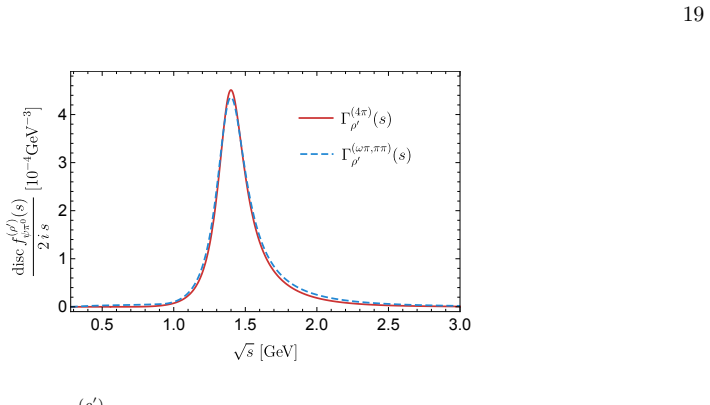
Motivated by the discrepancies noted recently between the theoretical predictions of the electromagnetic $J/\psi \to \pi^0 \gamma^*$ transition form factor and the BESIII data, we reanalyze this transition form factor using the dispersive Khuri-Treiman equations, with final-state interactions in both the direct channel and the crossed channels properly considered. This improved framework incorporates $\rho$-$\omega$ mixing effects. The effect of four-pion states is evaluated through a dispersively improved vector-meson-dominance model. From this information, we propose a two-parameter fit that provides an excellent description of the BESIII data over the broad energy range from 0 to 2.8GeV. We demonstrate that the $\rho\pi^0$ decay mode of the $J/\psi$ is dominated by strong interaction, while the $\omega\pi^0$ mode is dominated by one-photon exchange. From this, we extract the relative phase between the strong and the one-virtual-photon (electromagnetic) modes in hadronic decays of $J/\psi$ as $(62 \pm 21)^{\circ}$. This could provide useful information in understanding the long-standing $\rho \pi$ puzzle in $J/\psi$ decays.
Editorial analysis
A structured set of objections, weighed in public.
Referee Report
Summary. The manuscript reanalyzes the J/ψ → π⁰ γ* transition form factor via dispersive Khuri-Treiman equations that incorporate final-state interactions in both direct and crossed channels together with ρ-ω mixing. Four-pion intermediate states are included through a dispersively improved vector-meson-dominance ansatz. A two-parameter fit to BESIII data is shown to describe the form factor from threshold to 2.8 GeV; from the fit the authors conclude that the ρπ⁰ mode is strong-dominated while the ωπ⁰ mode is electromagnetic-dominated and extract a relative phase of (62 ± 21)° between the strong and one-virtual-photon amplitudes.
Significance. If the framework is shown to be complete, the work supplies a theoretically constrained parametrization of the transition form factor over a wide kinematic range and yields a quantitative estimate of the relative phase that bears directly on the long-standing ρπ puzzle in J/ψ decays. The use of Khuri-Treiman dispersion relations with crossed-channel constraints and ρ-ω mixing constitutes a non-trivial improvement over simple vector-meson-dominance models.
major comments (2)
- [Abstract and fit-procedure section] The assertion that the two-parameter fit 'provides an excellent description' of the BESIII data (Abstract) is not supported by reported fit-quality diagnostics such as χ²/dof, residual plots, or covariance information for the extracted phase; without these the central claim that the phase is determined to ±21° rests on moderate evidence.
- [Section on four-pion states and dispersion integrals] The treatment of four-pion states via the dispersively improved VMD ansatz (section describing the dispersion integrals) does not include an explicit estimate or cross-check of possible KK or higher-resonance (φ, ψ(2S)) contributions above ~1.5 GeV; if such channels contribute at the 10–20 % level they would be absorbed into the two fit parameters and could shift the inferred strong/EM phase by an amount comparable to the quoted uncertainty.
minor comments (2)
- [Dispersion-relation section] Clarify the precise definition and numerical implementation of the ρ-ω mixing parameter in the dispersion relation (Eq. for the mixing term).
- [Results section] Add a brief comparison of the present two-parameter results with earlier single-channel or pure-VMD calculations to highlight the quantitative impact of the crossed-channel and mixing improvements.
Simulated Author's Rebuttal
We thank the referee for the thorough review and insightful comments on our manuscript. We have addressed each major comment in detail below and made revisions to the manuscript where necessary to improve clarity and support for our claims.
read point-by-point responses
-
Referee: [Abstract and fit-procedure section] The assertion that the two-parameter fit 'provides an excellent description' of the BESIII data (Abstract) is not supported by reported fit-quality diagnostics such as χ²/dof, residual plots, or covariance information for the extracted phase; without these the central claim that the phase is determined to ±21° rests on moderate evidence.
Authors: We agree with the referee that including fit-quality diagnostics would provide stronger support for our claims. In the revised version of the manuscript, we have included the value of χ² per degree of freedom for the two-parameter fit, added residual plots as an inset or supplementary figure, and provided the covariance information or correlation coefficient for the fitted parameters, including the relative phase. These additions confirm that the fit quality is good and substantiate the reported uncertainty of ±21° on the phase. revision: yes
-
Referee: [Section on four-pion states and dispersion integrals] The treatment of four-pion states via the dispersively improved VMD ansatz (section describing the dispersion integrals) does not include an explicit estimate or cross-check of possible KK or higher-resonance (φ, ψ(2S)) contributions above ~1.5 GeV; if such channels contribute at the 10–20 % level they would be absorbed into the two fit parameters and could shift the inferred strong/EM phase by an amount comparable to the quoted uncertainty.
Authors: We thank the referee for pointing this out. While the dispersively improved VMD ansatz primarily accounts for four-pion states, we acknowledge the potential contributions from KK and higher resonances. In the revised manuscript, we have added a paragraph discussing possible contributions from these channels based on existing experimental data and theoretical estimates. We argue that their impact is expected to be at the few percent level in the relevant energy range and would not shift the extracted phase beyond the quoted uncertainty, as the fit parameters can accommodate small adjustments without altering the central conclusions. A more detailed cross-check would require extending the dispersion relations to include these channels explicitly, which is planned for future work. revision: partial
Circularity Check
Dispersive Khuri-Treiman framework supplies independent scattering constraints; two-parameter fit to BESIII data does not reduce to self-definition
full rationale
The derivation begins from the dispersive Khuri-Treiman equations incorporating direct and crossed-channel final-state interactions plus ρ-ω mixing, which rest on general principles of analyticity and unitarity from ππ scattering rather than on the J/ψ transition data itself. The four-pion contribution is handled via a dispersively improved VMD ansatz that is fixed by external inputs. A two-parameter fit is then performed to the BESIII form-factor data over 0–2.8 GeV, yielding the quoted phase. This fit is a standard parameter adjustment inside an externally motivated representation; the representation itself is not constructed from the fit parameters or from the extracted phase. No equation is shown to equal its own input by construction, and no load-bearing uniqueness theorem is imported solely via self-citation. The central result therefore retains independent content from the dispersion relations.
Axiom & Free-Parameter Ledger
free parameters (1)
- two fit parameters
axioms (1)
- domain assumption Applicability of Khuri-Treiman dispersive equations including final-state interactions in direct and crossed channels to the J/ψ→π⁰γ* transition
Lean theorems connected to this paper
-
IndisputableMonolith/Cost/FunctionalEquation.leanwashburn_uniqueness_aczel unclear?
unclearRelation between the paper passage and the cited Recognition theorem.
We reanalyze this transition form factor using the dispersive Khuri–Treiman equations, with final-state interactions in both the direct channel and the crossed channels properly considered. This improved framework incorporates ρ–ω mixing effects. The effect of four-pion states is evaluated through a dispersively improved vector-meson-dominance model.
-
IndisputableMonolith/Foundation/RealityFromDistinction.leanreality_from_one_distinction unclear?
unclearRelation between the paper passage and the cited Recognition theorem.
From this information, we propose a two-parameter fit that provides an excellent description of the BESIII data over the broad energy range from 0 to 2.8 GeV.
What do these tags mean?
- matches
- The paper's claim is directly supported by a theorem in the formal canon.
- supports
- The theorem supports part of the paper's argument, but the paper may add assumptions or extra steps.
- extends
- The paper goes beyond the formal theorem; the theorem is a base layer rather than the whole result.
- uses
- The paper appears to rely on the theorem as machinery.
- contradicts
- The paper's claim conflicts with a theorem or certificate in the canon.
- unclear
- Pith found a possible connection, but the passage is too broad, indirect, or ambiguous to say the theorem truly supports the claim.
Reference graph
Works this paper leans on
-
[1]
(cf. Eq. (3)) σ e+e− →J/ψπ 0 = πα2 6s3 λ 3 2 s, M2 ψ, M2 π |fψπ(s)|2 ∝ 1 s4 ,whens→ ∞.(18) In particular, the 1/s 4 scaling arises from the necessity of a helicity flip since the vector meson can only be transversely polarized. Note that our analysis is confined to low-energy and excludes high-energy effective VMD-type diagrams due to one more virtual-pho...
-
[2]
Navaset al.(Particle Data Group), Review of particle physics, Phys
S. Navaset al.(Particle Data Group), Review of particle physics, Phys. Rev. D110, 030001 (2024). 31
work page 2024
-
[3]
Inclusive Radiative $J/\psi$ Decays
D. Bessonet al.(CLEO), Inclusive RadiativeJ/ψDecays, Phys. Rev. D78, 032012 (2008), arXiv:0806.0315 [hep-ex]
work page internal anchor Pith review Pith/arXiv arXiv 2008
-
[4]
Observation of Electromagnetic Dalitz decays J/\psi \to P e^+e^-
M. Ablikimet al.(BESIII), Observation of electromagnetic Dalitz decaysJ/ψ→P e +e−, Phys. Rev. D89, 092008 (2014), arXiv:1403.7042 [hep-ex]
work page internal anchor Pith review Pith/arXiv arXiv 2014
-
[5]
J. J. Sakurai, Theory of strong interactions, Annals Phys.11, 1 (1960)
work page 1960
-
[6]
Study of the electromagnetic transitions $J/\psi \rightarrow P l^+l^-$ and probe dark photon
J. Fu, H.-B. Li, X. Qin, and M.-Z. Yang, Study of the Electromagnetic TransitionsJ/ψ→P l +l− and Probe Dark Photon, Mod. Phys. Lett. A27, 1250223 (2012), arXiv:1111.4055 [hep-ph]
work page internal anchor Pith review Pith/arXiv arXiv 2012
-
[7]
Understanding the radiative decays of vector charmonia to light pseudoscalar mesons
Q. Zhao, Understanding the radiative decays of vector charmonia to light pseudoscalar mesons, Phys. Lett. B697, 52 (2011), arXiv:1012.1165 [hep-ph]
work page internal anchor Pith review Pith/arXiv arXiv 2011
-
[8]
Unified study of $J/\psi \to PV$, $P\gamma^{(*)}$ and light hadron radiative processes
Y.-H. Chen, Z.-H. Guo, and B.-S. Zou, Unified study ofJ/ψ→P V,P γ (∗) and light hadron radiative processes, Phys. Rev. D91, 014010 (2015), arXiv:1411.1159 [hep-ph]
work page internal anchor Pith review Pith/arXiv arXiv 2015
- [9]
- [10]
- [11]
-
[12]
M. Batelaan, J. J. Dudek, and R. G. Edwards,ηandη ′ meson production inJ/ψradiative decays from lattice QCD, Phys. Rev. D112, 074505 (2025), arXiv:2506.09305 [hep-lat]
-
[13]
M. Batelaan, J. J. Dudek, and R. G. Edwards,ηandη ′ production inJ/ψradiative decays from quantum chromodynamics, Phys. Rev. Lett.135, 161904 (2025), arXiv:2506.09306 [hep-lat]
- [14]
-
[15]
The anomalous magnetic moment of the muon in the Standard Model: an update
R. Alibertiet al., The anomalous magnetic moment of the muon in the Standard Model: an update, Phys. Rept.1143, 1 (2025), arXiv:2505.21476 [hep-ph]
work page internal anchor Pith review Pith/arXiv arXiv 2025
-
[16]
Ablikimet al.(BESIII), Study of the electromagnetic Dalitz decayJ/ψ→e +e−π0, Phys
M. Ablikimet al.(BESIII), Study of the electromagnetic Dalitz decayJ/ψ→e +e−π0, Phys. Rev. D 112, L011101 (2025), arXiv:2501.04344 [hep-ex]
-
[17]
Analysis of the J/psi --> pi^0 gamma^* transition form factor
B. Kubis and F. Niecknig, Analysis of theJ/ψ→π 0γ∗ transition form factor, Phys. Rev. D91, 036004 (2015), arXiv:1412.5385 [hep-ph]
work page internal anchor Pith review Pith/arXiv arXiv 2015
-
[18]
N. N. Khuri and S. B. Treiman, Pion-Pion Scattering andK ± →3πDecay, Phys. Rev.119, 1115 (1960)
work page 1960
-
[19]
L. G. Landsberg, Electromagnetic Decays of Light Mesons, Phys. Rept.128, 301 (1985)
work page 1985
-
[20]
T. W. B. Kibble, Kinematics of General Scattering Processes and the Mandelstam Representation, Phys. Rev.117, 1159 (1960)
work page 1960
-
[21]
M. Jacob and G. C. Wick, On the General Theory of Collisions for Particles with Spin, Annals Phys. 32 7, 404 (1959)
work page 1959
-
[22]
J. A. Oller,A Brief Introduction to Dispersion Relations, Springer Briefs in Physics (2019)
work page 2019
- [23]
-
[24]
K¨ opp, Dispersion calculation of the transition form-factorF πωγ (t) with cut contributions, Phys
G. K¨ opp, Dispersion calculation of the transition form-factorF πωγ (t) with cut contributions, Phys. Rev. D10, 932 (1974)
work page 1974
-
[25]
V. A. Matveev, R. M. Muradian, and A. N. Tavkhelidze, Automodellism in the large - angle elastic scattering and structure of hadrons, Lett. Nuovo Cim.7, 719 (1973)
work page 1973
-
[26]
S. J. Brodsky and G. R. Farrar, Scaling Laws at Large Transverse Momentum, Phys. Rev. Lett.31, 1153 (1973)
work page 1973
-
[27]
S. J. Brodsky and G. R. Farrar, Scaling Laws for Large Momentum Transfer Processes, Phys. Rev. D 11, 1309 (1975)
work page 1975
-
[28]
G. P. Lepage and S. J. Brodsky, Exclusive Processes in Quantum Chromodynamics: Evolution Equa- tions for Hadronic Wave Functions and the Form-Factors of Mesons, Phys. Lett. B87, 359 (1979)
work page 1979
-
[29]
G. P. Lepage and S. J. Brodsky, Exclusive Processes in Perturbative Quantum Chromodynamics, Phys. Rev. D22, 2157 (1980)
work page 1980
- [30]
-
[31]
On the constituent counting rules for hard exclusive processes involving multiquark states
F.-K. Guo, U.-G. Meißner, and W. Wang, On the constituent counting rule for hard exclusive processes involving multi-quark states, Chin. Phys. C41, 053108 (2017), arXiv:1607.04020 [hep-ph]
work page internal anchor Pith review Pith/arXiv arXiv 2017
-
[32]
P. Guo, R. Mitchell, and A. P. Szczepaniak, The Role of P-wave inelasticity inJ/ψ→π +π−π0, Phys. Rev. D82, 094002 (2010), arXiv:1006.4371 [hep-ph]
work page internal anchor Pith review Pith/arXiv arXiv 2010
-
[33]
Omn` es, On the Solution of certain singular integral equations of quantum field theory, Nuovo Cim
R. Omn` es, On the Solution of certain singular integral equations of quantum field theory, Nuovo Cim. 8, 316 (1958)
work page 1958
-
[34]
H. Leutwyler, Electromagnetic form-factor of the pion, inContinuous Advances in QCD 2002 / ARKADYFEST (honoring the 60th birthday of Prof. Arkady Vainshtein)(2002) pp. 23–40, arXiv:hep- ph/0212324
-
[35]
B. Ananthanarayan, I. Caprini, and I. S. Imsong, Implications of the recent high statistics determina- tion of the pion electromagnetic form factor in the timelike region, Phys. Rev. D83, 096002 (2011), arXiv:1102.3299 [hep-ph]
work page internal anchor Pith review Pith/arXiv arXiv 2011
-
[36]
S. P. Schneider, B. Kubis, and F. Niecknig, Theω→π 0γ∗ andϕ→π 0γ∗ transition form factors in dispersion theory, Phys. Rev. D86, 054013 (2012), arXiv:1206.3098 [hep-ph]
work page internal anchor Pith review Pith/arXiv arXiv 2012
- [37]
-
[38]
Hadronic currents for $\tau^-\to\pi^-\pi^0\nu_\tau$ and other decays of interest in TAUOLA
P. Roig, Hadronic Currents forτ − →π −π0ντ and Other Decays of Interest in TAUOLA, Nucl. Phys. B Proc. Suppl.225-227, 161 (2012), arXiv:1112.0962 [hep-ph]. 33
work page internal anchor Pith review Pith/arXiv arXiv 2012
-
[39]
A dispersive analysis of the pion vector form factor and $\tau^{-}\to K^{-}K_{S}\nu_{\tau}$ decay
S. Gonz` alez-Sol´ ıs and P. Roig, A dispersive analysis of the pion vector form factor andτ− →K −KSντ decay, Eur. Phys. J. C79, 436 (2019), arXiv:1902.02273 [hep-ph]
work page internal anchor Pith review Pith/arXiv arXiv 2019
-
[40]
E. Ruiz Arriola and P. S´ anchez-Puertas, Phase of the electromagnetic form factor of the pion, Phys. Rev. D110, 054003 (2024), arXiv:2403.07121 [hep-ph]
-
[41]
N_f Dependence of the Quark Condensate from a Chiral Sum Rule
B. Moussallam,N f dependence of the quark condensate from a chiral sum rule, Eur. Phys. J. C14, 111 (2000), arXiv:hep-ph/9909292
work page internal anchor Pith review Pith/arXiv arXiv 2000
-
[42]
F.-K. Guo, C. Hanhart, F. J. Llanes-Estrada, and U.-G. Meißner, Quark mass dependence of the pion vector form factor, Phys. Lett. B678, 90 (2009), arXiv:0812.3270 [hep-ph]
work page internal anchor Pith review Pith/arXiv arXiv 2009
-
[43]
Two-pion contribution to hadronic vacuum polarization
G. Colangelo, M. Hoferichter, and P. Stoffer, Two-pion contribution to hadronic vacuum polarization, JHEP02, 006, arXiv:1810.00007 [hep-ph]
work page internal anchor Pith review Pith/arXiv arXiv
-
[44]
A. P. Szczepaniak and M. R. Pennington, Application of the Veneziano Model in Charmonium Dalitz Plot Analysis, Phys. Lett. B737, 283 (2014), arXiv:1403.5782 [hep-ph]
work page internal anchor Pith review Pith/arXiv arXiv 2014
-
[45]
Albaladejoet al.(JPAC), Khuri-Treiman analysis ofJ/ψ→π +π−π0, Phys
M. Albaladejoet al.(JPAC), Khuri-Treiman analysis ofJ/ψ→π +π−π0, Phys. Rev. D108, 014035 (2023), arXiv:2304.09736 [hep-ph]
-
[46]
S. M. Roy, Exact integral equation for pion pion scattering involving only physical region partial waves, Phys. Lett. B36, 353 (1971)
work page 1971
- [47]
- [48]
- [49]
- [50]
-
[51]
Khuri-Treiman equations for $\pi\pi$ scattering
M. Albaladejo, N. Sherrill, C. Fern´ andez-Ram´ ırez, A. Jackura, V. Mathieu, M. Mikhasenko, J. Nys, A. Pilloni, and A. P. Szczepaniak (JPAC), Khuri–Treiman equations forππscattering, Eur. Phys. J. C78, 574 (2018), arXiv:1803.06027 [hep-ph]
work page internal anchor Pith review Pith/arXiv arXiv 2018
-
[52]
Dispersive analysis of omega --> 3pi and phi --> 3pi decays
F. Niecknig, B. Kubis, and S. P. Schneider, Dispersive analysis ofω→3πandϕ→3πdecays, Eur. Phys. J. C72, 2014 (2012), arXiv:1203.2501 [hep-ph]
work page internal anchor Pith review Pith/arXiv arXiv 2014
-
[53]
Extracting the chiral anomaly from gamma pi --> pi pi
M. Hoferichter, B. Kubis, and D. Sakkas, Extracting the chiral anomaly fromγπ→ππ, Phys. Rev. D86, 116009 (2012), arXiv:1210.6793 [hep-ph]
work page internal anchor Pith review Pith/arXiv arXiv 2012
-
[54]
I. V. Danilkin, C. Fern´ andez-Ram´ ırez, P. Guo, V. Mathieu, D. Schott, M. Shi, and A. P. Szczepaniak, Dispersive analysis ofω/ϕ→3π,πγ*, Phys. Rev. D91, 094029 (2015), arXiv:1409.7708 [hep-ph]
work page internal anchor Pith review Pith/arXiv arXiv 2015
-
[55]
What $\pi-\pi$ Scattering Tells Us About Chiral Perturbation Theory
J. Stern, H. Sazdjian, and N. H. Fuchs, Whatπ−πscattering tells us about chiral perturbation theory, Phys. Rev. D47, 3814 (1993), arXiv:hep-ph/9301244
work page internal anchor Pith review Pith/arXiv arXiv 1993
-
[56]
The Low Energy $\pi\,\pi$ Amplitude to One and Two Loops
M. Knecht, B. Moussallam, J. Stern, and N. H. Fuchs, The Low-energyππamplitude to one and two 34 loops, Nucl. Phys. B457, 513 (1995), arXiv:hep-ph/9507319
work page internal anchor Pith review Pith/arXiv arXiv 1995
-
[57]
$\eta \to 3 \pi$ at Two Loops In Chiral Perturbation Theory
J. Bijnens and K. Ghorbani,η→3πat Two Loops In Chiral Perturbation Theory, JHEP11, 030, arXiv:0709.0230 [hep-ph]
work page internal anchor Pith review Pith/arXiv arXiv
-
[58]
Dispersive Approach to Chiral Perturbation Theory
M. Zdr´ ahal and J. Novotn´ y, Dispersive Approach to Chiral Perturbation Theory, Phys. Rev. D78, 116016 (2008), arXiv:0806.4529 [hep-ph]
work page internal anchor Pith review Pith/arXiv arXiv 2008
- [59]
-
[60]
O. Babelon, J. L. Basdevant, D. Caillerie, and G. Mennessier, Unitarity and Inelastic Final State Interactions, Nucl. Phys. B113, 445 (1976)
work page 1976
-
[61]
M. Albaladejo, I. Danilkin, S. Gonz` alez-Sol´ ıs, D. Winney, C. Fern´ andez-Ram´ ırez, A. N. H. Blin, V. Mathieu, M. Mikhasenko, A. Pilloni, and A. Szczepaniak (JPAC),ω→3πandωπ 0 transition form factor revisited, Eur. Phys. J. C80, 1107 (2020), arXiv:2006.01058 [hep-ph]
-
[62]
A. Garc´ ıa-Lorenzo, M. Albaladejo, S. Gonz` alez-Sol´ ıs, N. Hammoud, V. Mathieu, G. Monta˜ na, A. Pil- loni, D. Winney, and A. P. Szczepaniak (JPAC),ϕ→3πandϕπ 0 transition form factor from Khuri- Treiman equations (2025), arXiv:2505.15309 [hep-ph]
-
[63]
Final State Interactions and Khuri-Treiman Equations in $\eta\to 3\pi$ decays
J. Kambor, C. Wiesendanger, and D. Wyler, Final state interactions and Khuri-Treiman equations in η→3πdecays, Nucl. Phys. B465, 215 (1996), arXiv:hep-ph/9509374
work page internal anchor Pith review Pith/arXiv arXiv 1996
-
[64]
J. B. Bronzan and C. Kacser, Khuri-Treiman Representation and Perturbation Theory, Phys. Rev. 132, 2703 (1963)
work page 1963
-
[65]
I. J. R. Aitchison and R. Pasquier, Three-Body Unitarity and Khuri-Treiman Amplitudes, Phys. Rev. 152, 1274 (1966)
work page 1966
-
[66]
Solving integral equations in $\eta\to 3\pi$
J. Gasser and A. Rusetsky, Solving integral equations inη→3π, Eur. Phys. J. C78, 906 (2018), arXiv:1809.06399 [hep-ph]
work page internal anchor Pith review Pith/arXiv arXiv 2018
- [67]
-
[68]
S. P. Schneider,Analysis tools for precision studies of hadronic three-body decays and transition form factors, Ph.D. thesis, Bonn U., HISKP (2012)
work page 2012
-
[69]
Dispersion-theoretical analysis of the D^+ --> K^- pi^+ pi^+ Dalitz plot
F. Niecknig and B. Kubis, Dispersion-theoretical analysis of theD + →K −π+π+ Dalitz plot, JHEP 10, 142, arXiv:1509.03188 [hep-ph]
work page internal anchor Pith review Pith/arXiv arXiv
-
[70]
Niecknig,Dispersive analysis of charmed meson decays, Ph.D
F. Niecknig,Dispersive analysis of charmed meson decays, Ph.D. thesis, Bonn U., HISKP (2016)
work page 2016
-
[71]
M. Albaladejo, D. Winney, I. V. Danilkin, C. Fern´ andez-Ram´ ırez, V. Mathieu, M. Mikhasenko, A. Pil- loni, J. A. Silva-Castro, and A. P. Szczepaniak (JPAC), Khuri-Treiman equations for 3πdecays of particles with spin, Phys. Rev. D101, 054018 (2020), arXiv:1910.03107 [hep-ph]
- [72]
- [73]
-
[74]
Nucleon electroweak form factors: Analysis of their spectral functions
V. Bernard, N. Kaiser, and U.-G. Meißner, Nucleon electroweak form-factors: Analysis of their spectral functions, Nucl. Phys. A611, 429 (1996), arXiv:hep-ph/9607428
work page internal anchor Pith review Pith/arXiv arXiv 1996
-
[75]
Spectral functions of nucleon form factors: Three-pion continua at low energies
N. Kaiser and E. Passemar, Spectral functions of nucleon form factors: Three-pion continua at low energies, Eur. Phys. J. A55, 16 (2019), arXiv:1901.02865 [nucl-th]
work page internal anchor Pith review Pith/arXiv arXiv 2019
- [76]
-
[77]
M. Hoferichter, B.-L. Hoid, B. Kubis, and D. Schuh, Isospin-breaking effects in the three-pion contri- bution to hadronic vacuum polarization, JHEP08, 208, arXiv:2307.02546 [hep-ph]
-
[78]
On the pi pi continuum in the nucleon form factors and the proton radius puzzle
M. Hoferichter, B. Kubis, J. Ruiz de Elvira, H.-W. Hammer, and U.-G. Meißner, On theππcon- tinuum in the nucleon form factors and the proton radius puzzle, Eur. Phys. J. A52, 331 (2016), arXiv:1609.06722 [hep-ph]
work page internal anchor Pith review Pith/arXiv arXiv 2016
-
[79]
Nakano, Two potential formalisms and the coulomb-nuclear interfrerence, Phys
K. Nakano, Two potential formalisms and the coulomb-nuclear interfrerence, Phys. Rev. C26, 1123 (1982)
work page 1982
-
[80]
A new Parameterization for the Pion Vector Form Factor
C. Hanhart, A New Parameterization for the Pion Vector Form Factor, Phys. Lett. B715, 170 (2012), arXiv:1203.6839 [hep-ph]
work page internal anchor Pith review Pith/arXiv arXiv 2012
discussion (0)
Sign in with ORCID, Apple, or X to comment. Anyone can read and Pith papers without signing in.