Does Head Pose Correction Improve Biometric Facial Recognition?
Pith reviewed 2026-05-17 02:00 UTC · model grok-4.3
The pith
Selective head-pose correction improves biometric facial recognition while naive use degrades it.
A machine-rendered reading of the paper's core claim, the machinery that carries it, and where it could break.
Core claim
The authors establish that naive application of 3D reconstruction, 2D frontalization, or feature enhancement substantially degrades facial recognition accuracy. Selective application of CFR-GAN combined with CodeFormer, however, yields meaningful improvements on difficult images.
What carries the argument
The model-agnostic forensic-evaluation pipeline that measures how each restoration approach affects recognition accuracy when applied either universally or selectively.
Load-bearing premise
That criteria for deciding when to apply the corrections can be set without introducing selection bias or overfitting to the test images.
What would settle it
Applying the selective CFR-GAN plus CodeFormer rule to a fresh, independent collection of non-frontal facial images and checking whether recognition accuracy rises relative to the uncorrected baseline.
Figures


read the original abstract
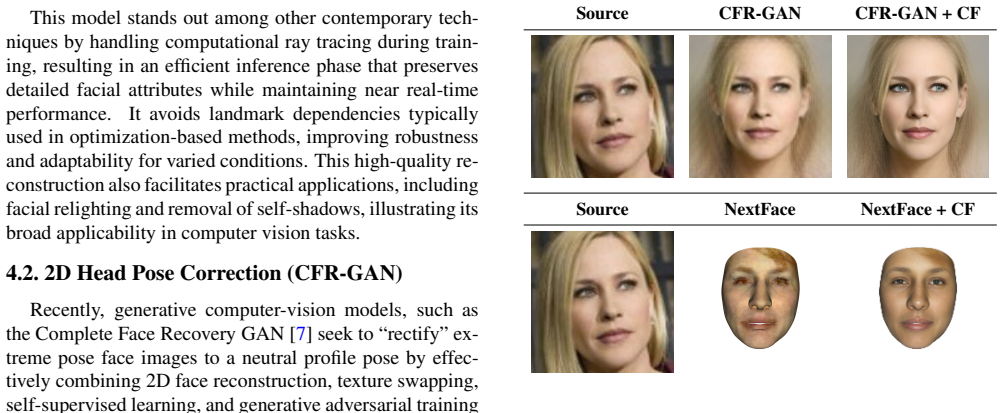
Biometric facial recognition models often demonstrate significant decreases in accuracy when processing real-world images, often characterized by poor quality, non-frontal subject poses, and subject occlusions. We investigate whether targeted, AI-driven, head-pose correction and image restoration can improve recognition accuracy. Using a model-agnostic, large-scale, forensic-evaluation pipeline, we assess the impact of three restoration approaches: 3D reconstruction (NextFace), 2D frontalization (CFR-GAN), and feature enhancement (CodeFormer). We find that naive application of these techniques substantially degrades facial recognition accuracy. However, we also find that selective application of CFR-GAN combined with CodeFormer yields meaningful improvements.
Editorial analysis
A structured set of objections, weighed in public.
Referee Report
Summary. The paper evaluates whether AI-driven head-pose correction and image restoration improve biometric facial recognition on real-world, low-quality images. Using a model-agnostic forensic-evaluation pipeline, it tests three techniques—3D reconstruction (NextFace), 2D frontalization (CFR-GAN), and feature enhancement (CodeFormer)—and reports that naive application degrades accuracy while selective application of CFR-GAN combined with CodeFormer produces meaningful gains.
Significance. If the selective criterion can be shown to be fixed, a priori, and free of test-set contamination, the result would be practically useful for forensic and surveillance pipelines that must decide when to restore images. The model-agnostic, large-scale evaluation design is a positive feature that supports broader applicability.
major comments (2)
- [Results section (selective-application experiments)] The operational definition of the 'selective' application rule for CFR-GAN + CodeFormer is not provided with sufficient detail (e.g., exact thresholds, features used for the decision, or whether the rule was fixed before seeing recognition scores on the evaluation partition). Because the central positive claim rests on this selectivity, the absence of an explicit, reproducible selection procedure leaves open the possibility of post-hoc bias or overfitting.
- [Experimental setup and evaluation pipeline] No information is given on how the test set was partitioned or whether any hyper-parameters or selection thresholds were tuned on the same data used to measure the reported accuracy gains. This directly affects the validity of the headline improvement.
minor comments (2)
- [Abstract] The abstract states that selective application 'yields meaningful improvements' but supplies no numeric deltas or confidence intervals; adding these quantities would make the claim easier to assess.
- [Figures and tables] Figure captions and table legends should explicitly state the exact selection criterion used for the 'selective' rows so that readers can reproduce the condition without consulting the main text.
Simulated Author's Rebuttal
We thank the referee for the constructive comments, which help strengthen the reproducibility and clarity of our experimental claims. We address each major point below and will incorporate the requested details into the revised manuscript.
read point-by-point responses
-
Referee: [Results section (selective-application experiments)] The operational definition of the 'selective' application rule for CFR-GAN + CodeFormer is not provided with sufficient detail (e.g., exact thresholds, features used for the decision, or whether the rule was fixed before seeing recognition scores on the evaluation partition). Because the central positive claim rests on this selectivity, the absence of an explicit, reproducible selection procedure leaves open the possibility of post-hoc bias or overfitting.
Authors: We agree that an explicit, reproducible definition of the selective rule is essential. The rule combines two pre-defined criteria: (1) yaw-angle deviation exceeding 30 degrees as estimated by the 3D reconstruction pipeline, and (2) an input-image quality score below a fixed threshold derived from a separate validation partition. Both thresholds were locked prior to any evaluation on the test partition. We will add a new subsection under Results that states the exact thresholds, the features involved, and the a-priori decision procedure. revision: yes
-
Referee: [Experimental setup and evaluation pipeline] No information is given on how the test set was partitioned or whether any hyper-parameters or selection thresholds were tuned on the same data used to measure the reported accuracy gains. This directly affects the validity of the headline improvement.
Authors: The dataset follows the standard subject-disjoint train/validation/test split provided by the source collection. All hyper-parameters of the restoration models and the two thresholds of the selective rule were determined exclusively on the validation partition; the test partition was held out until final reporting. We will expand the Experimental Setup section to document the exact partitioning protocol and to confirm that no tuning or threshold adjustment occurred on the evaluation data. revision: yes
Circularity Check
No circularity: purely empirical measurements against external models and datasets
full rationale
The paper conducts an empirical evaluation of image restoration techniques (NextFace, CFR-GAN, CodeFormer) on facial recognition accuracy using a model-agnostic forensic pipeline and independent datasets. All reported outcomes, including the selective CFR-GAN+CodeFormer result, are direct measurements of accuracy deltas on held-out test data rather than any derivation, equation, or fitted parameter that reduces to the input by construction. No self-citations, ansatzes, or uniqueness theorems are invoked as load-bearing premises. The work contains no mathematical derivation chain to inspect for tautology.
Axiom & Free-Parameter Ledger
axioms (1)
- domain assumption Head pose and image quality are primary causes of accuracy drops in real-world facial recognition.
Lean theorems connected to this paper
-
IndisputableMonolith/Cost/FunctionalEquation.leanwashburn_uniqueness_aczel unclear?
unclearRelation between the paper passage and the cited Recognition theorem.
selective application of CFR-GAN combined with CodeFormer yields meaningful improvements
What do these tags mean?
- matches
- The paper's claim is directly supported by a theorem in the formal canon.
- supports
- The theorem supports part of the paper's argument, but the paper may add assumptions or extra steps.
- extends
- The paper goes beyond the formal theorem; the theorem is a base layer rather than the whole result.
- uses
- The paper appears to rely on the theorem as machinery.
- contradicts
- The paper's claim conflicts with a theorem or certificate in the canon.
- unclear
- Pith found a possible connection, but the passage is too broad, indirect, or ambiguous to say the theorem truly supports the claim.
Reference graph
Works this paper leans on
-
[1]
Gender shades: Intersectional accuracy disparities in commercial gen- der classification
Joy Buolamwini and Timnit Gebru. Gender shades: Intersectional accuracy disparities in commercial gen- der classification. InConference on Fairness, Ac- countability and Transparency, pages 77–91. PMLR,
-
[2]
Low- resolution face recognition
Zhiyi Cheng, Xiatian Zhu, and Shaogang Gong. Low- resolution face recognition. In14th Asian Conference on Computer Vision, pages 605–621. Springer, 2019. 1
work page 2019
-
[3]
Arcface: Additive angular margin loss for deep face recognition
Jiankang Deng, Jia Guo, Niannan Xue, and Stefanos Zafeiriou. Arcface: Additive angular margin loss for deep face recognition. InInternational Conference on Computer Vision and Pattern Recognition, pages 4690–4699, 2019. 1
work page 2019
-
[4]
Practical face reconstruction via differen- tiable ray tracing
Abdallah Dib, Gaurav Bharaj, Junghyun Ahn, C ´edric Th´ebault, Philippe Gosselin, Marco Romeo, and Louis Chevallier. Practical face reconstruction via differen- tiable ray tracing. InComputer Graphics Forum, vol- ume 40, pages 153–164. Wiley Online Library, 2021. 1
work page 2021
-
[5]
Abdallah Dib, C ´edric Th ´ebault, Junghyun Ahn, Philippe-Henri Gosselin, Christian Theobalt, and Louis Chevallier. Towards high fidelity monocular face reconstruction with rich reflectance using self- supervised learning and ray tracing. InProceedings of the IEEE/CVF International Conference on Computer Vision (ICCV), pages 12819–12829, October 2021. 1, 4
work page 2021
-
[6]
Matthijs Douze, Alexandr Guzhva, Chengqi Deng, Jeff Johnson, Gergely Szilvasy, Pierre-Emmanuel Mazar´e, Maria Lomeli, Lucas Hosseini, and Herv ´e J´egou. The faiss library.arXiv preprint arXiv:2401.08281, 2024. 3
work page internal anchor Pith review Pith/arXiv arXiv 2024
-
[7]
Yeong-Joon Ju, Gun-Hee Lee, Jung-Ho Hong, and Seong-Whan Lee. Complete face recovery gan: Un- supervised joint face rotation and de-occlusion from a single-view image. InProceedings of the IEEE/CVF Winter Conference on Applications of Computer Vi- sion (WACV), pages 3711–3721, January 2022. 1, 5
work page 2022
-
[8]
Dlib-ml: A machine learning toolkit
Davis E King. Dlib-ml: A machine learning toolkit. The Journal of Machine Learning Research, 10:1755– 1758, 2009. 6
work page 2009
-
[9]
Analyzing and reducing the damage of dataset bias to face recognition with synthetic data
Adam Kortylewski, Bernhard Egger, Andreas Schnei- der, Thomas Gerig, Andreas Morel-Forster, and Thomas Vetter. Analyzing and reducing the damage of dataset bias to face recognition with synthetic data. InInternational Conference on Computer Vision and Pattern Recognition Workshop, 2019. 1
work page 2019
-
[10]
Blind deconvolution using a normalized sparsity measure
Dilip Krishnan, Terence Tay, and Rob Fergus. Blind deconvolution using a normalized sparsity measure. In CVPR 2011, pages 233–240. IEEE, 2011. 4
work page 2011
-
[11]
MediaPipe: A framework for perceiving and processing reality
Camillo Lugaresi, Jiuqiang Tang, Hadon Nash, Chris McClanahan, Esha Uboweja, Michael Hays, Fan Zhang, Chuo-Ling Chang, Ming Yong, Juhyun Lee, Wan-Teh Chang, Wei Hua, Manfred Georg, and Matthias Grundmann. MediaPipe: A framework for perceiving and processing reality. InThird Workshop on Computer Vision for AR/VR at IEEE Computer Vi- sion and Pattern Recogn...
work page 2019
-
[12]
Controversial US facial recogni- tion technology likely illegal, EU body says.Politico,
Vincent Manancourt. Controversial US facial recogni- tion technology likely illegal, EU body says.Politico,
-
[13]
An evaluation of forensic facial recognition, 2023
Justin Norman, Shruti Agarwal, and Hany Farid. An evaluation of forensic facial recognition, 2023. 1, 2
work page 2023
-
[14]
An investigation into the impact of ai-powered image enhancement on forensic facial recognition
Justin Norman and Hany Farid. An investigation into the impact of ai-powered image enhancement on forensic facial recognition. InProceedings of the IEEE/CVF Conference on Computer Vision and Pat- tern Recognition (CVPR) Workshops, pages 4306– 4314, June 2024. 1, 2, 4, 9
work page 2024
-
[15]
Alice J O’Toole and Carlos D Castillo. Face recogni- tion by humans and machines: Three fundamental ad- vances from deep learning.Annual Review of Vision Science, 7:543–570, 2021. 1
work page 2021
-
[16]
Scikit-learn: Machine Learning in Python.Journal of Machine Learning Re- search, 12:2825–2830, 2011
Fabian Pedregosa, Ga ¨el Varoquaux, Alexandre Gram- fort, Vincent Michel, Bertrand Thirion, Olivier Grisel, Mathieu Blondel, Peter Prettenhofer, Ron Weiss, Vin- cent Dubourg, Jake Vanderplas, Alexandre Passos, David Cournapeau, Matthieu Brucher, Matthieu Per- rot, and ´Edouard Duchesnay. Scikit-learn: Machine Learning in Python.Journal of Machine Learning...
work page 2011
-
[17]
P Jonathon Phillips, Amy N Yates, Ying Hu, Carina A Hahn, Eilidh Noyes, Kelsey Jackson, Jacqueline G Cavazos, G ´eraldine Jeckeln, Rajeev Ranjan, Swami Sankaranarayanan, et al. Face recognition accu- racy of forensic examiners, superrecognizers, and face recognition algorithms.Proceedings of the National Academy of Sciences, 115(24):6171–6176, 2018. 1
work page 2018
-
[18]
Saving face: Investigating the ethical con- cerns of facial recognition auditing
Inioluwa Deborah Raji, Timnit Gebru, Margaret Mitchell, Joy Buolamwini, Joonseok Lee, and Emily Denton. Saving face: Investigating the ethical con- cerns of facial recognition auditing. InAAAI/ACM Conference on AI, Ethics, and Society, pages 145–151,
-
[19]
Marcus Smith and Seumas Miller. The ethical appli- cation of biometric facial recognition technology.AI & Society, 37(1):167–175, 2022. 1
work page 2022
-
[20]
Diverse types of expertise in facial recognition.Scientific Reports, 13(1):11396, 2023
Alice Towler, James D Dunn, Sergio Castro Mart´ınez, Reuben Moreton, Fredrick Ekl ¨of, Arnout Ruifrok, Richard I Kemp, and David White. Diverse types of expertise in facial recognition.Scientific Reports, 13(1):11396, 2023. 1
work page 2023
-
[21]
Deep face recognition: A survey.Neurocomputing, 429:215–244, 2021
Mei Wang and Weihong Deng. Deep face recognition: A survey.Neurocomputing, 429:215–244, 2021. 1
work page 2021
-
[22]
Real risks of fake data: Synthetic data, diversity-washing and consent circumvention
Cedric Deslandes Whitney and Justin Norman. Real risks of fake data: Synthetic data, diversity-washing and consent circumvention. InThe 2024 ACM Confer- ence on Fairness, Accountability, and Transparency, pages 1733–1744, 2024. 2
work page 2024
-
[23]
Learning Face Representation from Scratch
Dong Yi, Zhen Lei, Shengcai Liao, and Stan Z Li. Learning face representation from scratch. arXiv:1411.7923, 2014. 2
work page internal anchor Pith review Pith/arXiv arXiv 2014
-
[24]
Towards large-pose face frontalization in the wild
Xi Yin, Xiang Yu, Kihyuk Sohn, Xiaoming Liu, and Manmohan Chandraker. Towards large-pose face frontalization in the wild. InProceedings of the IEEE International Conference on Computer Vision, pages 3990–3999, 2017. 1
work page 2017
-
[25]
Restormer: Efficient transformer for high- resolution image restoration
Syed Waqas Zamir, Aditya Arora, Salman Khan, Mu- nawar Hayat, Fahad Shahbaz Khan, and Ming-Hsuan Yang. Restormer: Efficient transformer for high- resolution image restoration. InInternational Con- ference on Computer Vision and Pattern Recognition, pages 5728–5739, 2022. 4
work page 2022
-
[26]
Towards robust blind face restora- tion with codebook lookup transformer
Shangchen Zhou, Kelvin Chan, Chongyi Li, and Chen Change Loy. Towards robust blind face restora- tion with codebook lookup transformer. InAdvances in Neural Information Processing Systems, volume 35, pages 30599–30611, 2022. 1, 5
work page 2022
discussion (0)
Sign in with ORCID, Apple, or X to comment. Anyone can read and Pith papers without signing in.