Approximations and modifications of celestial dynamics tested on the three-body system
Pith reviewed 2026-05-17 02:21 UTC · model grok-4.3
The pith
Particle-mesh approximations and MOND modifications fail to conserve momentum exactly and destabilize three-body dynamics
A machine-rendered reading of the paper's core claim, the machinery that carries it, and where it could break.
Core claim
The PM approximation and the MOND modification of classical dynamics do not preserve the momentum and angular momentum of a conservative system exactly, and PM does not obey Newton's third law. Although the errors and shortcomings of these PM approximations and MOND modifications are small, they cause the instability of the regular dynamics. In contrast, the MOGA modification of gravity by replacing Newton's inverse square attraction with an inverse attraction for far-away interactions stabilizes the system.
What carries the argument
The three-body system as the minimal testbed that exposes violations of momentum conservation and Newton's third law under PM and MOND approximations.
Where Pith is reading between the lines
- If the conservation violations scale with system size, they could introduce systematic artifacts into galaxy and cluster simulations that rely on PM or MOND.
- Exact adherence to Newton's laws may prove necessary for reliable long-term stability in any N-body celestial model.
- Alternative long-range force modifications like MOGA could be explored as a route to stable dynamics without the same conservation shortfalls.
Load-bearing premise
The instabilities seen in the three-body system will similarly dominate the behavior of large-scale simulations without being offset by numerical or scale-dependent effects.
What would settle it
A controlled three-body simulation that enforces exact momentum and angular momentum conservation at every step and checks whether the observed instability vanishes.
Figures


read the original abstract
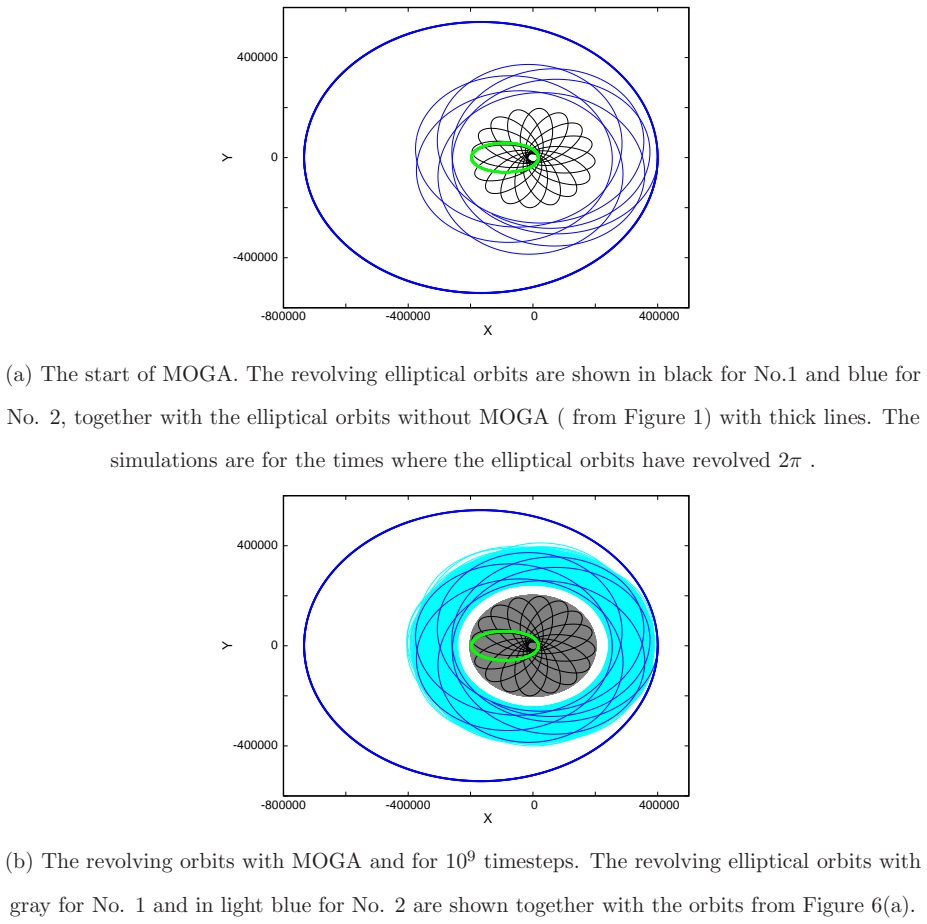
Large-scale simulations of celestial systems are based on approximations or modifications of classical dynamics. The approximations are with ``particle-mesh'' (PM) substitutions of the attractions from objects far away, or one modify the Newtonian accelerations (MOND) or the gravities (MOGA). The PM approximation and MOND modification of classical dynamics break the invariances of classical dynamics. The simple three-body system (TBS) is the simplest system to test the approximations and modifications of celestial dynamics, and it is easy to implement on a computer. Simulations of the TBS show that the PM approximation and MOND destabilize TBS. In contrast, the MOGA modification of gravity by replacing Newton's inverse square attraction with an inverse attraction for far-away interactions stabilizes the system. The PM approximation and the MOND modification of classical dynamics do not preserve the momentum and angular momentum of a conservative system exactly, and PM does not obey Newton's third law. Although the errors and shortcomings of these PM approximations and MOND modifications are small, they cause the instability of the regular dynamics.
Editorial analysis
A structured set of objections, weighed in public.
Referee Report
Summary. The manuscript claims that particle-mesh (PM) approximations for far-field attractions and MOND modifications to Newtonian accelerations violate exact conservation of linear and angular momentum (and Newton's third law for PM), while the MOGA modification (inverse-square to inverse attraction for distant interactions) does not. Simulations of the three-body system are presented as evidence that these small violations destabilize regular orbits, whereas MOGA stabilizes them. The work positions the three-body system as a minimal testbed for assessing the suitability of such approximations in large-scale celestial simulations.
Significance. If the instabilities can be shown to arise specifically from the broken invariances rather than integrator or discretization effects, the result would flag a potential systematic limitation in PM and MOND implementations used for galactic and cluster dynamics. The contrast with MOGA would then provide a concrete example of how far-field modifications can be constructed to preserve conservation properties. However, the three-body system is known to be exponentially sensitive, so any such finding would still require scaling tests before it can be taken as diagnostic for high-N simulations.
major comments (3)
- [§4] §4 (Numerical experiments): No time series or integrated measures of total linear momentum drift, angular momentum drift, or pairwise force imbalance are reported for the PM and MOND runs. Without these quantities plotted against the growth of orbital deviations, the attribution of instability to conservation violation remains qualitative.
- [§3.2] §3.2 (PM implementation): The cutoff radius separating near-field direct summation from far-field mesh interpolation is not specified, nor is any test shown that the observed instability persists when the cutoff is varied while keeping the same far-field approximation. This leaves open the possibility that the instability is driven by the abrupt transition rather than the invariance violation itself.
- [§5] §5 (Discussion): The manuscript asserts that the three-body results imply problems for galaxy-scale simulations, yet no auxiliary runs or scaling arguments are supplied to show that the same conservation errors dominate over other numerical factors (e.g., tree-code opening angle or softening length) once N ≫ 3.
minor comments (2)
- [Abstract] The abstract states that MOGA uses an 'inverse attraction' for far-away interactions but does not give the explicit functional form or the transition function between near- and far-field regimes.
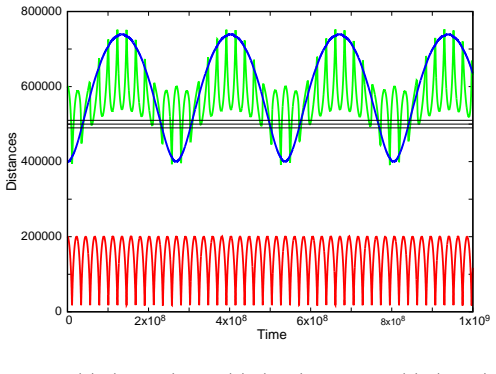
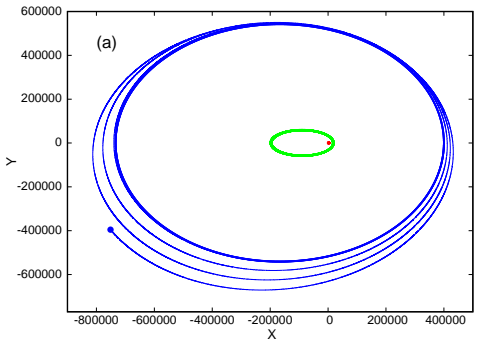
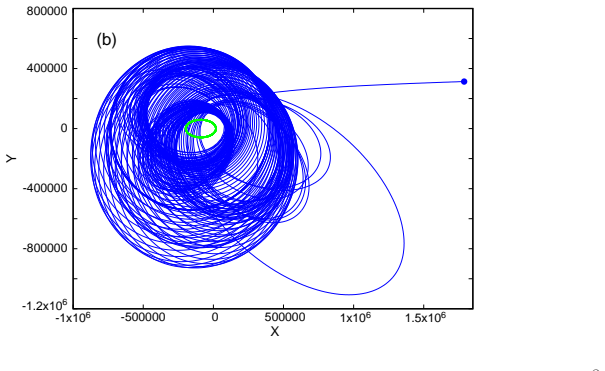
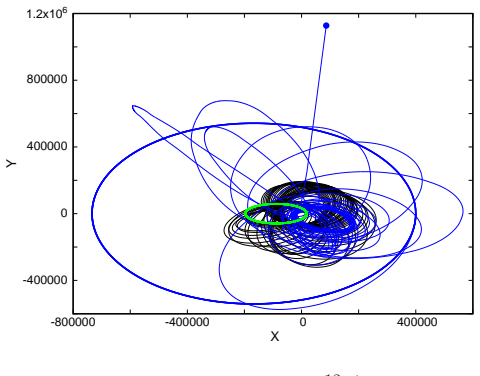
- Figure captions do not indicate which curves correspond to which approximation (PM, MOND, MOGA, Newtonian reference), making it difficult to interpret the plotted trajectories without cross-referencing the text.
Simulated Author's Rebuttal
We thank the referee for the constructive and detailed comments. We address each major comment below, indicating where revisions will be made to strengthen the manuscript while preserving its focus on the three-body system as a minimal testbed.
read point-by-point responses
-
Referee: [§4] §4 (Numerical experiments): No time series or integrated measures of total linear momentum drift, angular momentum drift, or pairwise force imbalance are reported for the PM and MOND runs. Without these quantities plotted against the growth of orbital deviations, the attribution of instability to conservation violation remains qualitative.
Authors: We agree that explicit time series of the conservation errors would make the attribution more quantitative. In the revised manuscript we will add plots of linear momentum drift, angular momentum drift, and pairwise force imbalance versus time for the PM and MOND cases, shown together with the orbital deviation measures to demonstrate their correlation with the onset of instability. revision: yes
-
Referee: [§3.2] §3.2 (PM implementation): The cutoff radius separating near-field direct summation from far-field mesh interpolation is not specified, nor is any test shown that the observed instability persists when the cutoff is varied while keeping the same far-field approximation. This leaves open the possibility that the instability is driven by the abrupt transition rather than the invariance violation itself.
Authors: The cutoff radius, set by mesh resolution and particle separation, will be explicitly stated in the revised §3.2. We maintain that the invariance violations originate in the far-field mesh treatment itself rather than the transition; however, to address the concern we will add a short sensitivity test confirming that the instability persists across a range of cutoffs when the far-field approximation remains active. revision: partial
-
Referee: [§5] §5 (Discussion): The manuscript asserts that the three-body results imply problems for galaxy-scale simulations, yet no auxiliary runs or scaling arguments are supplied to show that the same conservation errors dominate over other numerical factors (e.g., tree-code opening angle or softening length) once N ≫ 3.
Authors: The three-body system is used as the simplest setting in which the broken invariances can be isolated. In the revised discussion we will include a qualitative scaling argument showing how small per-interaction errors accumulate over the large number of far-field pairs present at high N. Full high-N runs lie outside the present scope, which is limited to establishing the minimal testbed. revision: partial
Circularity Check
No circularity: claims rest on direct simulation comparisons to conservation laws
full rationale
The paper's argument proceeds by stating the definitional properties of the PM approximation and MOND modification (broken exact momentum/angular-momentum conservation and Newton's third law for PM), then reporting outcomes from explicit numerical integrations of the three-body system under each scheme. Instability is observed in the PM and MOND runs while MOGA runs remain stable; this is presented as an empirical result rather than a derived prediction. No equation reduces a claimed output to a fitted input by construction, no uniqueness theorem is imported via self-citation, and no ansatz is smuggled through prior work. The chain is therefore self-contained against the classical invariants and the reported simulation trajectories.
Axiom & Free-Parameter Ledger
axioms (1)
- domain assumption Newtonian gravity and its conservation laws hold exactly for the three-body system
Lean theorems connected to this paper
-
IndisputableMonolith/Foundation/ArithmeticFromLogic.leanembed_injective, toNat_add unclear?
unclearRelation between the paper passage and the cited Recognition theorem.
The PM approximation and the MOND modification of classical dynamics do not preserve the momentum and angular momentum of a conservative system exactly, and PM does not obey Newton's third law.
-
IndisputableMonolith/Foundation/Atomicity.leanatomic_tick unclear?
unclearRelation between the paper passage and the cited Recognition theorem.
Simulations of the TBS show that the PM approximation and MOND destabilize TBS. In contrast, the MOGA modification ... stabilizes the system.
What do these tags mean?
- matches
- The paper's claim is directly supported by a theorem in the formal canon.
- supports
- The theorem supports part of the paper's argument, but the paper may add assumptions or extra steps.
- extends
- The paper goes beyond the formal theorem; the theorem is a base layer rather than the whole result.
- uses
- The paper appears to rely on the theorem as machinery.
- contradicts
- The paper's claim conflicts with a theorem or certificate in the canon.
- unclear
- Pith found a possible connection, but the passage is too broad, indirect, or ambiguous to say the theorem truly supports the claim.
Reference graph
Works this paper leans on
-
[1]
Springel, V.:, High Performance Computing and Numerica l Modelling, Star Formation in Galaxy Evolution: Connecting Numerical Models to Reality, Springer, New York, (2016) 251
work page 2016
-
[2]
Vogelsberger, M., Marinacci, F., Torrey, P., Puchwein, E.: Cosmological Simulations of Galaxy Formation, Nat. Rev. Phys. 2, 42-66 (2020)
work page 2020
-
[3]
Hockney, R. W., Goel, S. P., Eastwood, J. W.: Quit High-Re solution Computer Models of a Plasma, J. Comput. Phys. 14, 148-158 (1974) 13
work page 1974
-
[4]
Efstathiou, G., Davis, M., Frenk, C. S., White, D. M.: Num erical Techniques for Large Cosmological N -Body Simulations, ApjS 57, 241-260 (1985)
work page 1985
-
[5]
S.: TreePM: A Code for Cosmological N-Body Simu lations, J
Bagla, J. S.: TreePM: A Code for Cosmological N-Body Simu lations, J. Astrophys. Astr. 23, 185-196 (2002)
work page 2002
-
[6]
Toxvaerd, S.: Testing the approximations in large-scal e simulations of systems with gravita- tional forces, J. Chem. Phys. 163, 084101 (2025)
work page 2025
-
[7]
Newton, PHILOSOPHIÆ NATURALIS PRINCIPIA MATHEMATIC A
I. Newton, PHILOSOPHIÆ NATURALIS PRINCIPIA MATHEMATIC A. LONDINI, Anno MDCLXXXVII
-
[8]
˘Suvakov, M., Dmitra˘ sinovi´ c, V.: Three Classes of Newtoni an Three-Body Planar Periodic Orbits, Phys. Rev. Lett. 110, 114301 (2013)
work page 2013
-
[9]
Dmitra˘ sinovi´ c, V., Hudomal, A., Shibayama, M., Sugita, A.: Linear stability of periodic three- body orbits with zero angular momentum and topological depe ndence of Kepler’s third law: a numerical test, J. Phys. A: Math. Theor. 51, 315101 (2018)
work page 2018
-
[10]
Li, X., Tao, Y., Li, X., Liao, S.: A numerical scheme to ob tain periodic three-body orbits with finite angular momentum, New Astronomy 119, 102407 (2025)
work page 2025
-
[11]
Krishnaswami, G., Senapati, H.: An Introduction to Cla ssical Three-Body Problem, Reso- nance 24, 87-114 (2019)
work page 2019
-
[12]
Toxvaerd, S.: Discrete Molecular Dynamics, Comprehen sive Computational Chemistry 3, Elsevier, 2023, 329-343
work page 2023
-
[13]
Toxvaerd, S.: Energy, temperature, and heat capacity i n discrete classical dynamics, Phys. Rev E 109, 015306 (2024)
work page 2024
-
[14]
Toxvaerd, S.: Newton’s algorithm for discrete classic al dynamics, J. Chem. Phys. 162, 024107 (2025)
work page 2025
-
[15]
Toxvaerd, S.: Newton’s discrete dynamics, Eur. Phys. J . Plus, 135:267 (2020)
work page 2020
-
[16]
Milgrom, M.: A Modification of the Newtonian Dynamics: I mpications for Galaxies, The Astrophysical J. 270, 371-383 (1983)
work page 1983
-
[17]
Gentile, G., Famaey, B., de Blok, W. J. G: Things about MO ND, A&A, 527 A76 (2011)
work page 2011
-
[18]
Toxvaerd, S.: Simulations of galaxies in an expanding U niverse with modified Newtonian dynamics (MOND) and with modified gravitational attraction s (MOGA), Eur. Phys. J. Plus 139, 395 (2024)
work page 2024
-
[19]
Toxvaerd, S.: Planetary systems with forces other than gravitational forces, Celest. Mech. 14 Dyn. 134 :40 (2022)
work page 2022
-
[20]
Capozziello, S., De Laurentis, M.: Extended Theories o f Gravity, Phys. Rep. 509, 167-321 (2011)
work page 2011
-
[21]
G., Padilla, A.,Skordis, C.: Modified gravity and cosmology, Phys
Clifton, T., Ferreira, P. G., Padilla, A.,Skordis, C.: Modified gravity and cosmology, Phys. Rep. 513, 1-189 (2012)
work page 2012
-
[22]
Capozziello, S., Capriolo, M., Nojiri, S.: Gravitatio nal waves in f (Q) non-metric gravity via geodesic deviation, Phys. Lett. B 850, 138510 (2024)
work page 2024
-
[23]
A., et al: Modified gravity N -body code comparison project, MNRAS 454, 4208-4234 (2015)
Winther, H. A., et al: Modified gravity N -body code comparison project, MNRAS 454, 4208-4234 (2015)
work page 2015
-
[24]
Koyama, K.: Cosmological tests of modified gravity, R ep
K. Koyama, K.: Cosmological tests of modified gravity, R ep. Prog. Phys. 79, 046902 (2016) 15
work page 2016
discussion (0)
Sign in with ORCID, Apple, or X to comment. Anyone can read and Pith papers without signing in.