ELGtimesLRG distribution through dark matter halo dynamics
Pith reviewed 2026-05-17 02:23 UTC · model grok-4.3
The pith
A halo occupation model samples satellites from dark matter particles to match ELG and LRG clustering down to 200 kpc scales.
A machine-rendered reading of the paper's core claim, the machinery that carries it, and where it could break.
Core claim
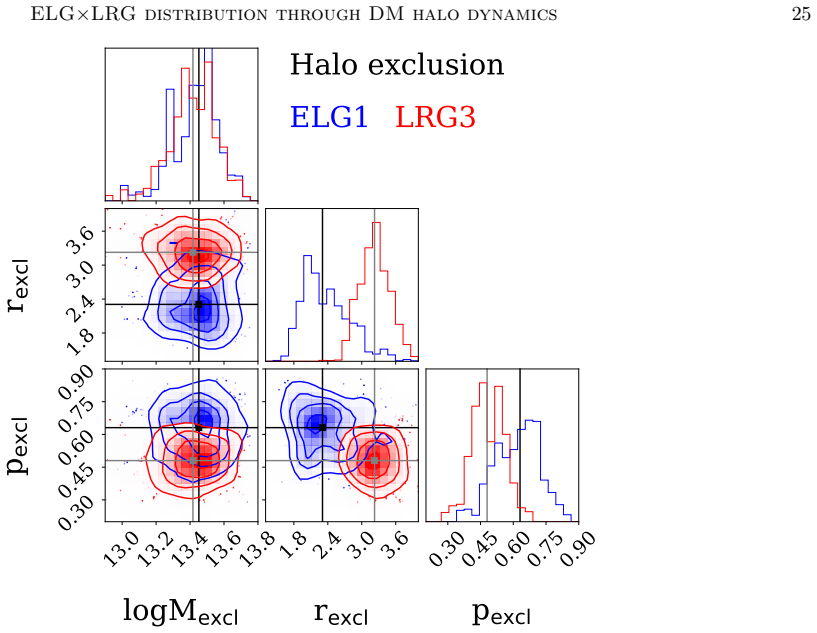
HOMe reproduces the anisotropic clustering down to s=200 h^{-1}kpc with unprecedented accuracy. Model parameters are inferred solely from two-point statistics using a two-level Bayesian framework, yielding high-fidelity ELG, LRG and cross-reference catalogs. Satellite ELGs behave as incoherent flows within their parent halos, dominating the clustering below 4 h^{-1}Mpc. The best-fit HOD indicates that 90.5 percent of ELGs and 85.91 percent of LRGs are central galaxies without satellites, residing in halos of virial mass around 6.6 times 10 to the 11 and 1.2 times 10 to the 13 solar masses per h, respectively. The ELG by LRG cross-correlation is governed by central-central pairs shaped byhalo
What carries the argument
HOMe, a halo occupation model that integrates intra-halo dynamics, halo exclusion, and quenching by sampling satellite galaxies from dark-matter particle positions via physically motivated prescriptions.
If this is right
- Satellite ELGs act as incoherent flows inside halos and dominate the clustering signal below 4 h^{-1} Mpc.
- Roughly 90 percent of ELGs and 86 percent of LRGs reside as isolated central galaxies in halos of specific characteristic masses.
- The ELG by LRG cross-correlation arises mainly from central-central pairs and is shaped by halo exclusion on scales of 2 to 5 h^{-1} Mpc.
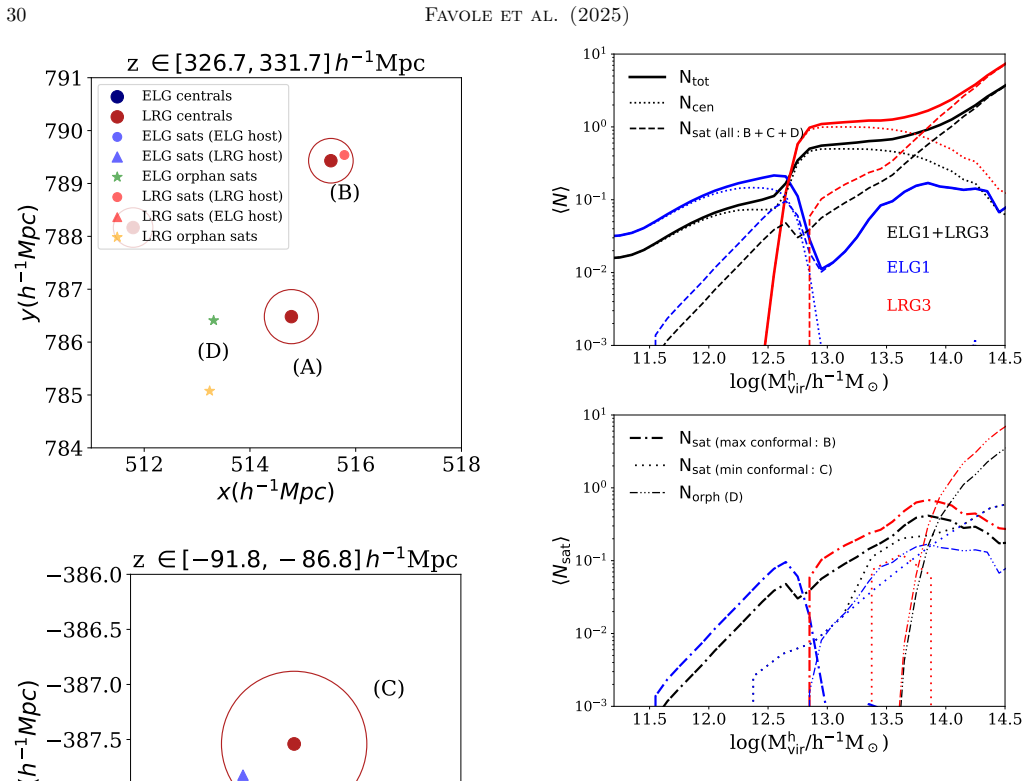
- Small percentages of satellites occupy same-species hosts, complementary hosts, or exist as orphans, with distinct fractions for ELGs versus LRGs.
- The model captures the sensitivity of satellite dynamics to different host environments.
Where Pith is reading between the lines
- The framework could be used to test for inconsistencies between observed small-scale clustering and predictions from different dark-matter models.
- Extending the same satellite-sampling approach to hydrodynamical simulations would check whether the fitted parameters remain consistent across modeling methods.
- The high-fidelity catalogs produced by HOMe could serve as input for forecasting systematic errors in future large-scale structure analyses.
Load-bearing premise
The prescriptions used to sample satellite galaxies from dark-matter particle positions accurately capture the real intra-halo dynamics and quenching processes for both ELGs and LRGs.
What would settle it
A new measurement of the small-scale anisotropic clustering or satellite velocity dispersion in an independent ELG or LRG sample that deviates significantly from the predictions of the best-fit HOMe model.
Figures


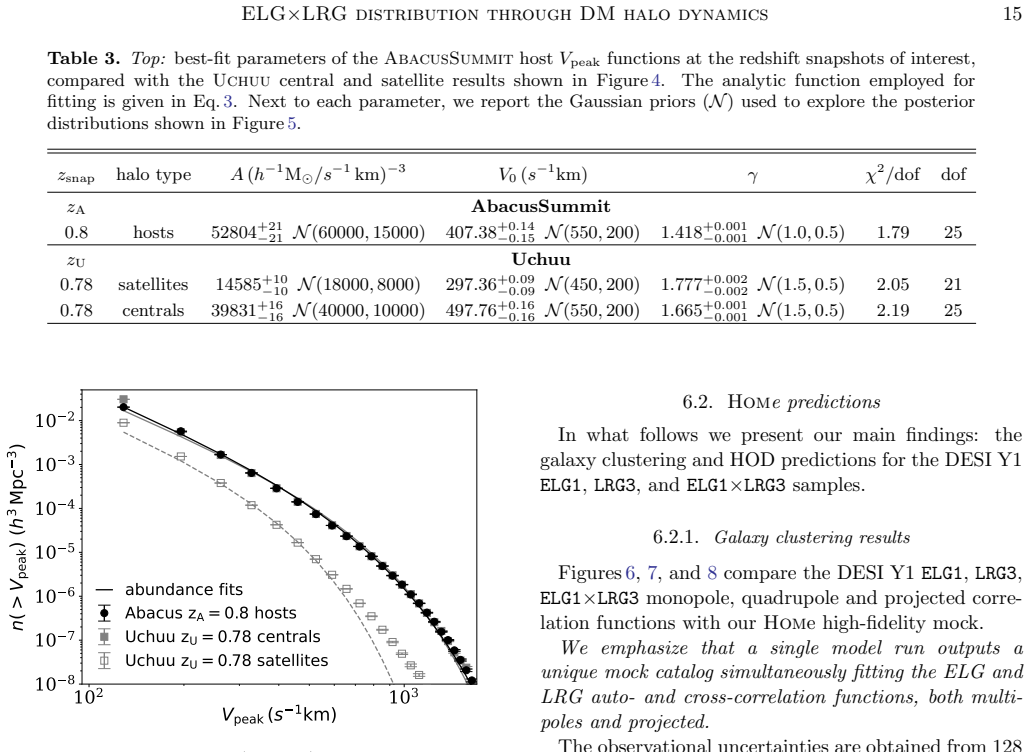
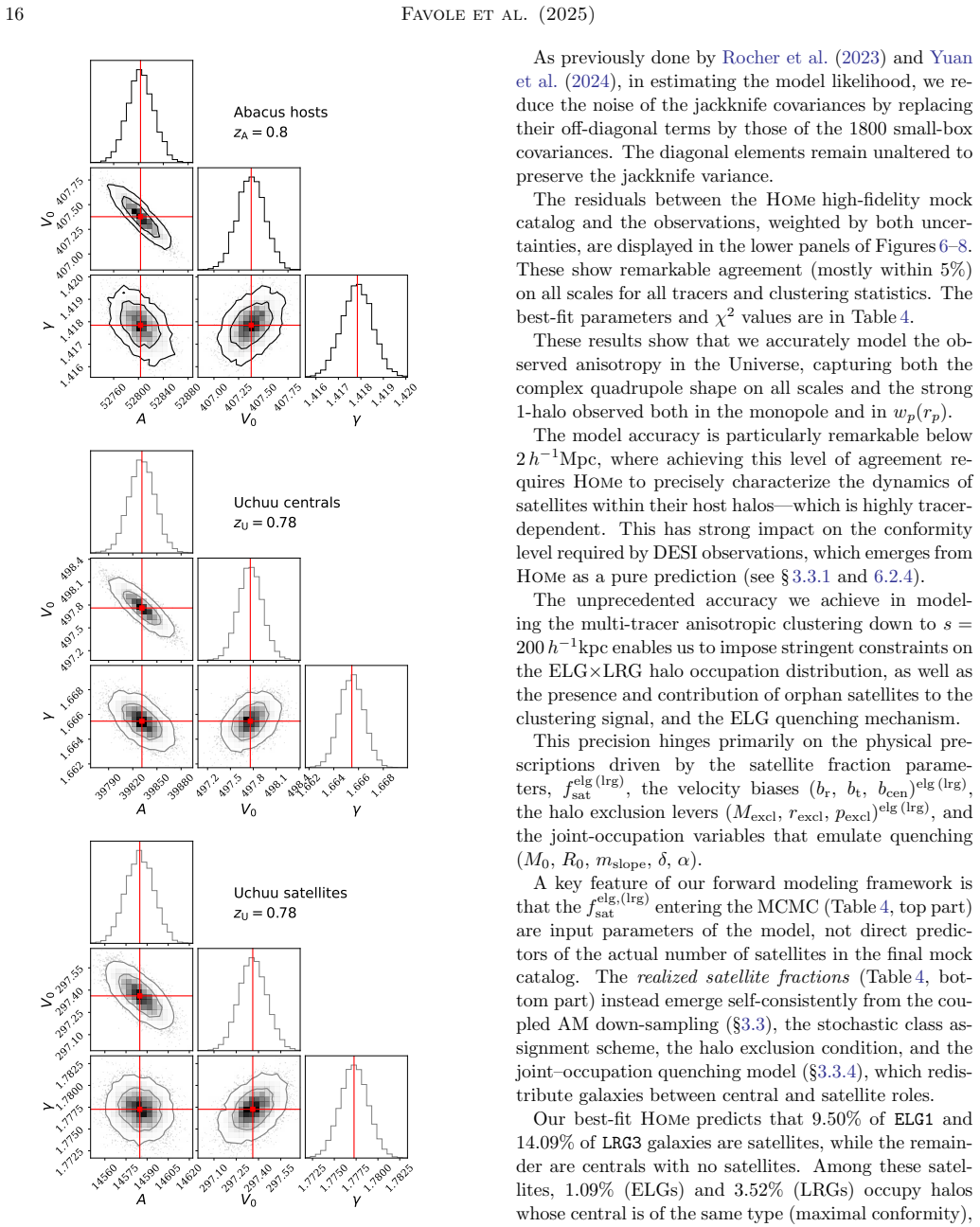
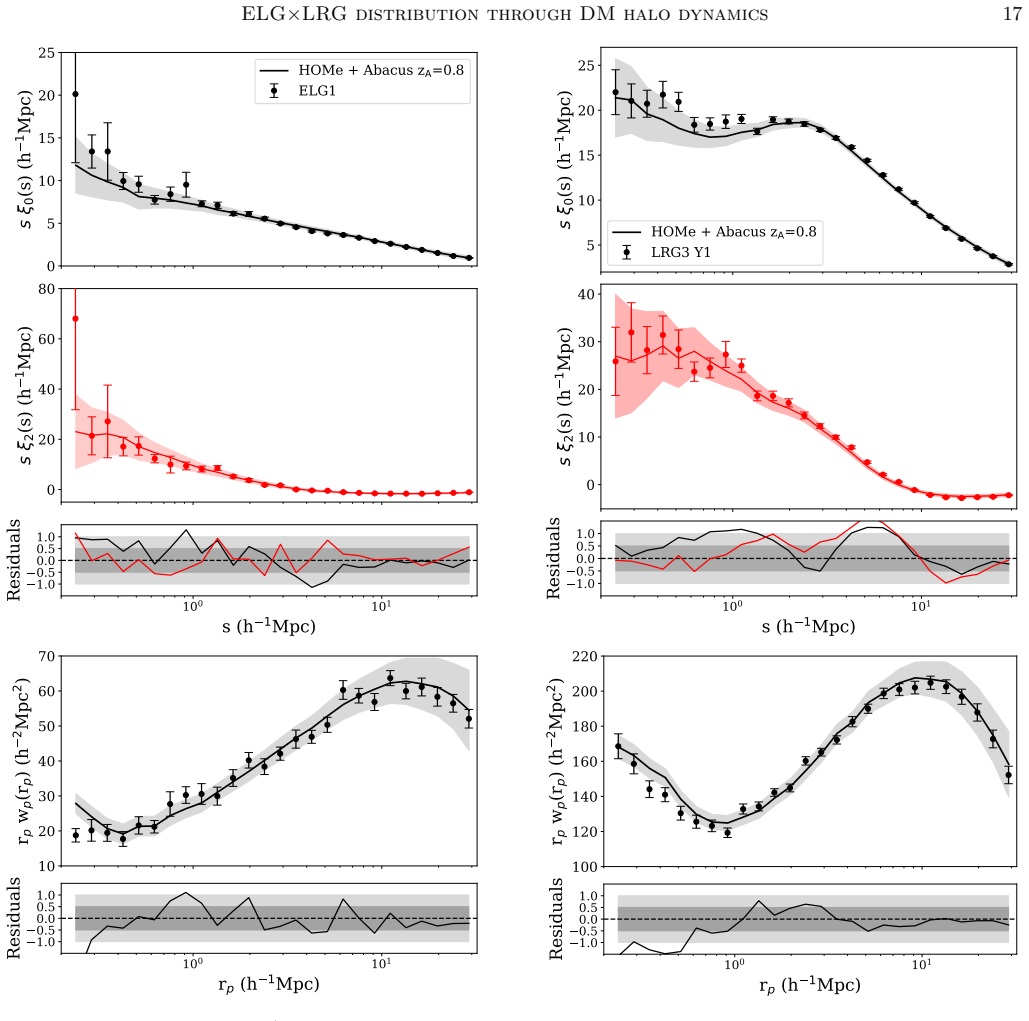


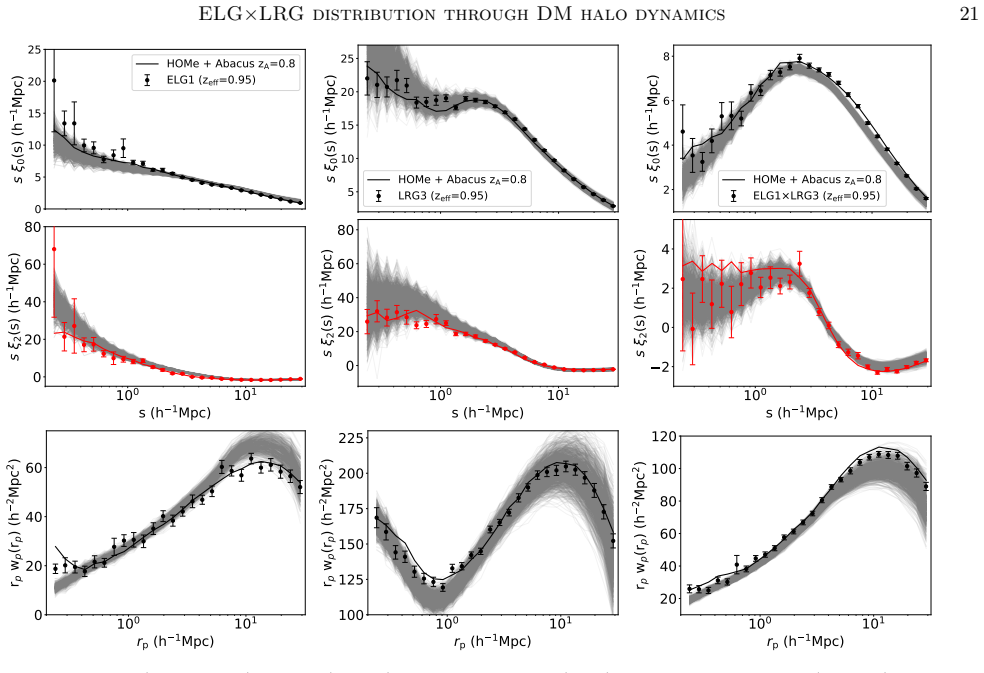







read the original abstract
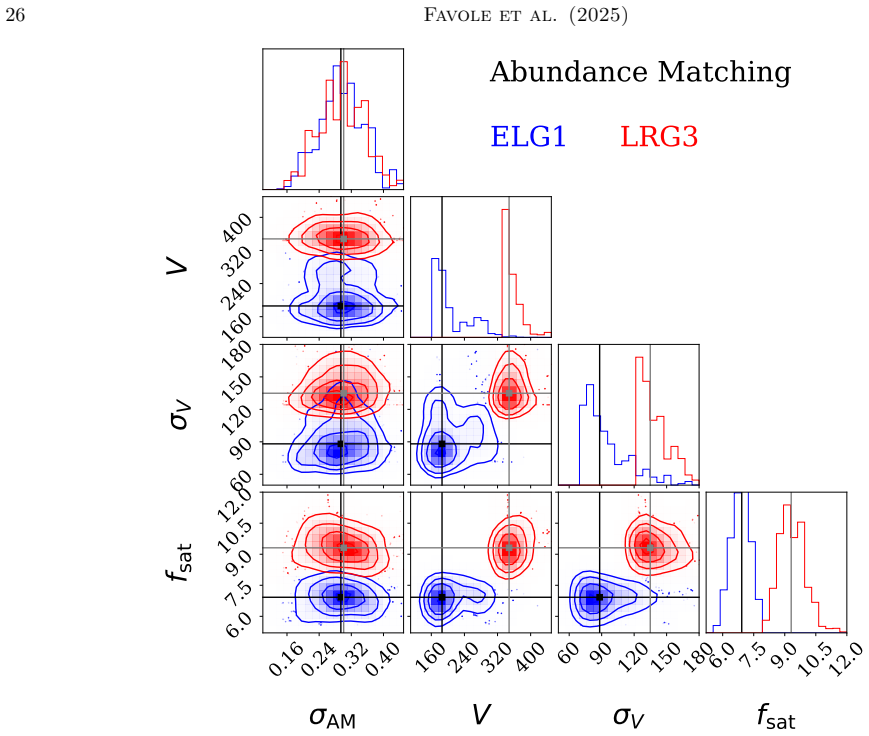
We investigate the clustering and halo occupation distribution (HOD) of DESI Y1 emission-line (ELGs) and luminous red (LRGs) galaxies at $0.8<z<1.1$, including their cross-correlation (ELG$\times$LRG), using the AbacusSummit suite and a new Halo Occupation Model (HOMe) for galaxy multi-tracers. This integrates intra-halo dynamics, halo exclusion, and quenching, bridging insights from hydrodynamical, HOD, abundance-matching, and semi-analytic studies. Leveraging full phase-space information from the Uchuu N-body simulation, and sampling satellites from dark-matter particle positions via physically motivated prescriptions, HOMe reproduces the anisotropic clustering down to $s=200\,h^{-1}$kpc with unprecedented accuracy. Model parameters are inferred solely from two-point statistics using a two-level Bayesian framework, yielding high-fidelity ELG, LRG and cross-reference catalogs. We find that satellite ELGs behave as incoherent flows within their parent halos, dominating the clustering below $4\,h^{-1}$Mpc. The HOD from the best-fit HOMe has the following properties: (i) 90.50% (85.91%) of ELGs (LRGs) are central galaxies without satellites, residing in halos of $M_{\rm vir}\sim6.6\times10^{11}\,(1.2\times10^{13})\,h^{-1}{\rm M}_\odot$; (ii) the ELG$\times$LRG cross-correlation is governed by central-central pairs and shaped by halo exclusion on $2-5\,h^{-1}$Mpc scales; (iii) 9.50% (14.09%) of ELGs (LRGs) are satellites, of which 1.09% (3.52%) inhabit halos with a central galaxy of the same species in a maximally conformal configuration, 7.02% (0.005%) orbit complementary hosts in a minimally conformal state, and 0.58% (10.57%) are orphans. The high sensitivity of HOMe precisely captures the dynamics of satellites in different host environments, opening a promising avenue for understanding systematics, the dynamical nature of dark matter, potentially distinguishing gravity models.
Editorial analysis
A structured set of objections, weighed in public.
Referee Report
Summary. The paper introduces a new Halo Occupation Model (HOMe) that incorporates intra-halo dynamics, halo exclusion, and quenching prescriptions to model the auto- and cross-clustering of DESI Y1 ELGs and LRGs at 0.8<z<1.1. Using full phase-space information from the Uchuu N-body simulation and sampling satellites from dark-matter particles, the model parameters are inferred via a two-level Bayesian framework applied solely to two-point statistics; the resulting catalogs are claimed to reproduce anisotropic clustering down to s=200 h^{-1}kpc with high fidelity, yielding specific HOD fractions (e.g., 90.5% central ELGs, 9.5% satellites) and dynamical insights such as incoherent satellite flows below 4 h^{-1}Mpc.
Significance. If the central claims hold, the work provides a multi-tracer framework that bridges hydrodynamical, HOD, and semi-analytic insights while leveraging simulation phase-space data to produce high-fidelity catalogs; this could strengthen cosmological analyses of DESI data and offer tests of intra-halo physics or gravity models. The explicit reporting of conformal/orphan satellite fractions and the use of a two-level Bayesian approach are notable strengths.
major comments (1)
- [Abstract and §3 (model)] Abstract and model description: the claim that satellite sampling prescriptions 'accurately capture' real ELG/LRGs intra-halo dynamics rests on prescriptions that integrate insights from hydro/HOD/SAM studies yet are not shown to reproduce independent measurements (e.g., satellite radial profiles or pairwise velocities from TNG/EAGLE at z~1 for M_vir~10^{12-14} h^{-1}M_⊙); because parameters are fit directly to the same two-point statistics (including small-scale anisotropy) that the model then reproduces, the reported HOD fractions and 'unprecedented accuracy' risk being artifacts of fitting flexibility rather than dynamical validation.
minor comments (2)
- [§4 (results)] The two-level Bayesian framework is mentioned but its exact likelihood construction, prior choices, and convergence diagnostics are not detailed enough to assess robustness.
- Figure captions and text should explicitly state the scale cuts used in the fit versus those shown in the clustering comparisons to avoid ambiguity about the 'down to s=200 h^{-1}kpc' claim.
Simulated Author's Rebuttal
We thank the referee for their constructive comments on our manuscript. We address the major comment below, clarifying the scope of our validation and revising the manuscript to better distinguish between physically motivated prescriptions and direct dynamical tests against hydrodynamical simulations.
read point-by-point responses
-
Referee: Abstract and §3 (model)] Abstract and model description: the claim that satellite sampling prescriptions 'accurately capture' real ELG/LRGs intra-halo dynamics rests on prescriptions that integrate insights from hydro/HOD/SAM studies yet are not shown to reproduce independent measurements (e.g., satellite radial profiles or pairwise velocities from TNG/EAGLE at z~1 for M_vir~10^{12-14} h^{-1}M_⊙); because parameters are fit directly to the same two-point statistics (including small-scale anisotropy) that the model then reproduces, the reported HOD fractions and 'unprecedented accuracy' risk being artifacts of fitting flexibility rather than dynamical validation.
Authors: We agree that our satellite sampling prescriptions are constructed by integrating insights from hydrodynamical, HOD, and semi-analytic studies rather than being directly calibrated or validated against independent measurements such as satellite radial profiles or pairwise velocities from TNG or EAGLE at z~1. The parameters are indeed inferred from two-point statistics (auto- and cross-correlations), and the reproduction of anisotropic clustering down to 200 h^{-1} kpc is therefore a consistency test within the fitted data rather than an independent dynamical validation. We will revise the abstract and Section 3 to replace phrases such as 'accurately capture' with 'physically motivated sampling' and to qualify 'unprecedented accuracy' as 'high fidelity reproduction of the observed two-point statistics'. We will also add explicit discussion of this limitation and the distinction between clustering-based inference and direct hydrodynamical tests. The two-level Bayesian framework and use of multiple statistics provide some protection against pure overfitting, but we acknowledge the referee's concern that reported HOD fractions should be interpreted as best-fit values under the model assumptions. revision: partial
- Direct reproduction of independent measurements such as satellite radial profiles or pairwise velocities from TNG/EAGLE at z~1 for the relevant halo masses is not currently available in the manuscript and would require new simulation analysis beyond the scope of the present work.
Circularity Check
Parameters fitted to two-point statistics then used to reproduce the same statistics
specific steps
-
fitted input called prediction
[Abstract]
"HOMe reproduces the anisotropic clustering down to s=200 h^{-1}kpc with unprecedented accuracy. Model parameters are inferred solely from two-point statistics using a two-level Bayesian framework, yielding high-fidelity ELG, LRG and cross-reference catalogs."
Parameters are obtained by fitting directly to the two-point statistics; the reported reproduction of those same statistics (down to the smallest scales) is therefore enforced by construction of the Bayesian inference rather than emerging as a genuine out-of-sample prediction.
full rationale
The central modeling step infers HOMe parameters exclusively via Bayesian fit to the observed two-point (including anisotropic) clustering; the subsequent claim that the model reproduces that clustering down to 200 h^{-1} kpc is therefore a direct consequence of the fit rather than an independent test. External N-body input (Uchuu/AbacusSummit) supplies the dark-matter skeleton, but the satellite-sampling prescriptions and derived HOD fractions remain tied to the same data used for calibration. This constitutes a moderate fitted-input issue without reducing the entire derivation to pure self-definition or self-citation.
Axiom & Free-Parameter Ledger
free parameters (2)
- HOD parameters for ELGs and LRGs
- Satellite sampling prescriptions
axioms (2)
- domain assumption Satellite ELGs behave as incoherent flows within their parent halos
- domain assumption Two-point statistics alone are sufficient to constrain the full phase-space model
Lean theorems connected to this paper
-
IndisputableMonolith/Cost/FunctionalEquation.leanwashburn_uniqueness_aczel unclear?
unclearRelation between the paper passage and the cited Recognition theorem.
HOMe reproduces the anisotropic clustering down to s=200 h^{-1}kpc... Model parameters are inferred solely from two-point statistics using a two-level Bayesian framework... 37 parameters grouped in the vector ϕ
-
IndisputableMonolith/Foundation/AbsoluteFloorClosure.leanreality_from_one_distinction unclear?
unclearRelation between the paper passage and the cited Recognition theorem.
sampling satellites from dark-matter particle positions via physically motivated prescriptions... halo exclusion... environmental quenching through the joint halo occupation
What do these tags mean?
- matches
- The paper's claim is directly supported by a theorem in the formal canon.
- supports
- The theorem supports part of the paper's argument, but the paper may add assumptions or extra steps.
- extends
- The paper goes beyond the formal theorem; the theorem is a base layer rather than the whole result.
- uses
- The paper appears to rely on the theorem as machinery.
- contradicts
- The paper's claim conflicts with a theorem or certificate in the canon.
- unclear
- Pith found a possible connection, but the passage is too broad, indirect, or ambiguous to say the theorem truly supports the claim.
Reference graph
Works this paper leans on
-
[1]
G., Aguilar, J., Ahlen, S., et al
Adame, A. G., Aguilar, J., Ahlen, S., et al. 2025a, JCAP, 2025, 017, doi: 10.1088/1475-7516/2025/07/017 —. 2025b, JCAP, 2025, 012, doi: 10.1088/1475-7516/2025/04/012
-
[2]
2020, MNRAS, 497, 581, doi: 10.1093/mnras/staa1956
Comparat, J. 2020, MNRAS, 497, 581, doi: 10.1093/mnras/staa1956
-
[3]
2021, MNRAS, 504, 4667, doi: 10.1093/mnras/stab1150
Alam, S., de Mattia, A., Tamone, A., et al. 2021, MNRAS, 504, 4667, doi: 10.1093/mnras/stab1150
-
[4]
Anbajagane, D., Aung, H., Evrard, A. E., et al. 2022, MNRAS, 510, 2980, doi: 10.1093/mnras/stab3587
-
[5]
C., Zehavi, I., Contreras, S., & Norberg, P
Artale, M. C., Zehavi, I., Contreras, S., & Norberg, P. 2018, MNRAS, 480, 3978, doi: 10.1093/mnras/sty2110
-
[6]
Asgari, M., Mead, A. J., & Heymans, C. 2023, The Open Journal of Astrophysics, 6, 39, doi: 10.21105/astro.2303.08752
-
[7]
Avila, S., Gonzalez-Perez, V., Mohammad, F. G., et al. 2020, MNRAS, 499, 5486, doi: 10.1093/mnras/staa2951
-
[8]
2013, PhRvD, 88, 083507, doi: 10.1103/PhysRevD.88.083507
Desjacques, V. 2013, PhRvD, 88, 083507, doi: 10.1103/PhysRevD.88.083507
-
[9]
Baxter, D. C., Cooper, M. C., Balogh, M. L., et al. 2023, MNRAS, 526, 3716, doi: 10.1093/mnras/stad2995
-
[10]
Behroozi, P., Wechsler, R. H., Hearin, A. P., & Conroy, C. 2019, MNRAS, 488, 3143, doi: 10.1093/mnras/stz1182
-
[11]
Behroozi, P. S., Conroy, C., & Wechsler, R. H. 2010, ApJ, 717, 379, doi: 10.1088/0004-637X/717/1/379 44F avole et al. (2025)
-
[12]
Behroozi, P. S., Wechsler, R. H., & Conroy, C. 2013a, ApJ, 770, 57, doi: 10.1088/0004-637X/770/1/57
work page internal anchor Pith review doi:10.1088/0004-637x/770/1/57
-
[13]
Behroozi, P. S., Wechsler, R. H., & Wu, H.-Y. 2013b, ApJ, 762, 109, doi: 10.1088/0004-637X/762/2/109
-
[14]
Berlind, A. A., & Weinberg, D. H. 2002, ApJ, 575, 587, doi: 10.1086/341469
-
[15]
Blanton, M. R., & Berlind, A. A. 2007, ApJ, 664, 791, doi: 10.1086/512478
-
[16]
Bluck, A. F. L., Piotrowska, J. M., & Maiolino, R. 2023, ApJ, 944, 108, doi: 10.3847/1538-4357/acac7c
-
[17]
Chaves-Montero, J., Angulo, R. E., Schaye, J., et al. 2016, MNRAS, 460, 3100, doi: 10.1093/mnras/stw1225
-
[18]
2017, MNRAS, 466, 1880, doi: 10.1093/mnras/stw3127
Chen, Y.-C., Ho, S., Mandelbaum, R., et al. 2017, MNRAS, 466, 1880, doi: 10.1093/mnras/stw3127
-
[19]
2013, MNRAS, 431, 2634, doi: 10.1093/mnras/stt357
Chuang, C.-H., & Wang, Y. 2013, MNRAS, 431, 2634, doi: 10.1093/mnras/stt357
-
[20]
Conroy, C., Wechsler, R. H., & Kravtsov, A. V. 2006, ApJ, 647, 201, doi: 10.1086/503602
-
[21]
E., Chaves-Montero, J., White, S
Contreras, S., Angulo, R. E., Chaves-Montero, J., White, S. D. M., & Aric` o, G. 2023, MNRAS, 520, 489, doi: 10.1093/mnras/stad122
-
[22]
Contreras, S., Angulo, R. E., & Zennaro, M. 2021, MNRAS, 504, 5205, doi: 10.1093/mnras/stab1170
-
[23]
Davis, M., & Peebles, P. J. E. 1983, ApJ, 267, 465, doi: 10.1086/160884 DESI Collaboration, Aghamousa, A., Aguilar, J., et al. 2016, arXiv e-prints, arXiv:1611.00037, doi: 10.48550/arXiv.1611.00037 DESI Collaboration, Abareshi, B., Aguilar, J., et al. 2022, AJ, 164, 207, doi: 10.3847/1538-3881/ac882b DESI Collaboration, Abdul-Karim, M., Adame, A. G., et a...
work page internal anchor Pith review Pith/arXiv arXiv doi:10.1086/160884 1983
-
[24]
Donnari, M., Pillepich, A., Joshi, G. D., et al. 2021, MNRAS, 500, 4004, doi: 10.1093/mnras/staa3006
-
[25]
2024, A&A, 691, A236, doi: 10.1051/0004-6361/202450733
Dutta, R., Fumagalli, M., Fossati, M., et al. 2024, A&A, 691, A236, doi: 10.1051/0004-6361/202450733
-
[26]
R., Silva Lafaurie, J., & Sapone, D
Favole, G., Granett, B. R., Silva Lafaurie, J., & Sapone, D. 2021, MNRAS, 505, 5833, doi: 10.1093/mnras/stab1720
-
[27]
Favole, G., McBride, C. K., Eisenstein, D. J., et al. 2016a, MNRAS, 462, 2218, doi: 10.1093/mnras/stw1801
-
[28]
Favole, G., Montero-Dorta, A. D., Artale, M. C., et al. 2022, MNRAS, 509, 1614, doi: 10.1093/mnras/stab3006
-
[29]
Favole, G., Rodr´ ıguez-Torres, S. A., Comparat, J., et al. 2017, MNRAS, 472, 550, doi: 10.1093/mnras/stx1980
-
[30]
2016b, MNRAS, 461, 3421, doi: 10.1093/mnras/stw1483
Favole, G., Comparat, J., Prada, F., et al. 2016b, MNRAS, 461, 3421, doi: 10.1093/mnras/stw1483
-
[31]
Foreman-Mackey, D., Hogg, D. W., Lang, D., & Goodman, J. 2013, PASP, 125, 306, doi: 10.1086/670067
-
[32]
Gao, H., Jing, Y. P., Xu, K., et al. 2024, ApJ, 961, 74, doi: 10.3847/1538-4357/ad09d6
-
[33]
H., Guo Y., Hertzberg J., Katz N., Mo H
Gao, L., Navarro, J. F., Cole, S., et al. 2008, MNRAS, 387, 536, doi: 10.1111/j.1365-2966.2008.13277.x
-
[34]
Garrison, L. H., Eisenstein, D. J., Ferrer, D., Maksimova, N. A., & Pinto, P. A. 2021, MNRAS, 508, 575, doi: 10.1093/mnras/stab2482
-
[35]
2018, MNRAS, 474, 4024, doi: 10.1093/mnras/stx2807
Gonzalez-Perez, V., Comparat, J., Norberg, P., et al. 2018, MNRAS, 474, 4024, doi: 10.1093/mnras/stx2807
-
[36]
Guo, H., Jones, M. G., Wang, J., & Lin, L. 2021, ApJ, 918, 53, doi: 10.3847/1538-4357/ac062e
-
[37]
Guo, H., Zheng, Z., Behroozi, P. S., et al. 2016, MNRAS, 459, 3040, doi: 10.1093/mnras/stw845
-
[38]
2021a, MNRAS, 501, 1603, doi: 10.1093/mnras/staa3776
Hadzhiyska, B., Bose, S., Eisenstein, D., & Hernquist, L. 2021a, MNRAS, 501, 1603, doi: 10.1093/mnras/staa3776
-
[39]
2022, MNRAS, 509, 501, doi: 10.1093/mnras/stab2980
Maksimova, N. 2022, MNRAS, 509, 501, doi: 10.1093/mnras/stab2980
-
[40]
Hadzhiyska, B., Tacchella, S., Bose, S., & Eisenstein, D. J. 2021b, MNRAS, 502, 3599, doi: 10.1093/mnras/stab243
-
[41]
Haines, C. P., Pereira, M. J., Smith, G. P., et al. 2015, ApJ, 806, 101, doi: 10.1088/0004-637X/806/1/101
-
[42]
2007, A&A, 464, 399, doi: 10.1051/0004-6361:20066170
Hartlap, J., Simon, P., & Schneider, P. 2007, A&A, 464, 399, doi: 10.1051/0004-6361:20066170
-
[43]
2014, MNRAS, 444, 2938, doi: 10.1093/mnras/stu1609
Hirschmann, M., De Lucia, G., Wilman, D., et al. 2014, MNRAS, 444, 2938, doi: 10.1093/mnras/stu1609
-
[44]
2015, MNRAS, 452, 998, doi: 10.1093/mnras/stv1271
Hoshino, H., Leauthaud, A., Lackner, C., et al. 2015, MNRAS, 452, 998, doi: 10.1093/mnras/stv1271
-
[45]
Ishiyama, T., Prada, F., Klypin, A. A., et al. 2021, MNRAS, 506, 4210, doi: 10.1093/mnras/stab1755
-
[46]
L., Theuns, T., Moriwaki, K., & Bose, S
Jun, R. L., Theuns, T., Moriwaki, K., & Bose, S. 2025, arXiv e-prints, arXiv:2506.03015, doi: 10.48550/arXiv.2506.03015
-
[47]
1987, MNRAS, 227, 1, doi: 10.1093/mnras/227.1.1
Kaiser, N. 1987, MNRAS, 227, 1, doi: 10.1093/mnras/227.1.1
-
[48]
2016, MNRAS, 456, 4156, doi: 10.1093/mnras/stv2826
Kitaura, F.-S., Rodr´ ıguez-Torres, S., Chuang, C.-H., et al. 2016, MNRAS, 456, 4156, doi: 10.1093/mnras/stv2826
-
[49]
A., Trujillo-Gomez, S., & Primack, J
Klypin, A. A., Trujillo-Gomez, S., & Primack, J. 2011, ApJ, 740, 102, doi: 10.1088/0004-637X/740/2/102
-
[50]
Knebe, A., Knollmann, S. R., Muldrew, S. I., et al. 2011, MNRAS, 415, 2293, doi: 10.1111/j.1365-2966.2011.18858.x
-
[51]
2018, MNRAS, 474, 547, doi: 10.1093/mnras/stx2638
Kraljic, K., Arnouts, S., Pichon, C., et al. 2018, MNRAS, 474, 547, doi: 10.1093/mnras/stx2638
-
[52]
Kravtsov, A. V., Berlind, A. A., Wechsler, R. H., et al. 2004, ApJ, 609, 35, doi: 10.1086/420959
-
[53]
Lamman, C., Eisenstein, D., Forero-Romero, J. E., et al. 2024, MNRAS, 534, 3540, doi: 10.1093/mnras/stae2290
-
[54]
Euclid Definition Study Report
Laureijs, R., Amiaux, J., Arduini, S., et al. 2011, arXiv e-prints, arXiv:1110.3193, doi: 10.48550/arXiv.1110.3193 ELG×LRG distribution through DM halo dynamics45
work page internal anchor Pith review Pith/arXiv arXiv doi:10.48550/arxiv.1110.3193 2011
-
[55]
2017, MNRAS, 467, 3024, doi: 10.1093/mnras/stx258
Leauthaud, A., Saito, S., Hilbert, S., et al. 2017, MNRAS, 467, 3024, doi: 10.1093/mnras/stx258
-
[56]
The DESI Experiment, a whitepaper for Snowmass 2013
Levi, M., Bebek, C., Beers, T., et al. 2013, arXiv e-prints, arXiv:1308.0847, doi: 10.48550/arXiv.1308.0847
work page internal anchor Pith review Pith/arXiv arXiv doi:10.48550/arxiv.1308.0847 2013
-
[57]
Maksimova, N. A., Garrison, L. H., Eisenstein, D. J., et al. 2021, MNRAS, 508, 4017, doi: 10.1093/mnras/stab2484
-
[58]
McGee, S. L., Bower, R. G., & Balogh, M. L. 2014, MNRAS, 442, L105, doi: 10.1093/mnrasl/slu066
-
[59]
V., Dalal, N., & Gottl¨ ober, S
More, S., Kravtsov, A. V., Dalal, N., & Gottl¨ ober, S. 2011a, ApJS, 195, 4, doi: 10.1088/0067-0049/195/1/4
-
[60]
More, S., van den Bosch, F. C., Cacciato, M., et al. 2011b, MNRAS, 410, 210, doi: 10.1111/j.1365-2966.2010.17436.x
-
[61]
Nagai, D., & Kravtsov, A. V. 2005, ApJ, 618, 557, doi: 10.1086/426016
-
[62]
Navarro, J. F., Frenk, C. S., & White, S. D. M. 1997, ApJ, 490, 493, doi: 10.1086/304888 Orsi, ´A. A., & Angulo, R. E. 2018, MNRAS, 475, 2530, doi: 10.1093/mnras/stx3349
-
[63]
2024, A&A, 689, A66, doi: 10.1051/0004-6361/202449597
Ortega-Martinez, S., Contreras, S., & Angulo, R. 2024, A&A, 689, A66, doi: 10.1051/0004-6361/202449597
-
[64]
Paranjape, A., Kovaˇ c, K., Hartley, W. G., & Pahwa, I. 2015, MNRAS, 454, 3030, doi: 10.1093/mnras/stv2137
-
[65]
2015, Nature, 521, 192, doi: 10.1038/nature14439
Peng, Y., Maiolino, R., & Cochrane, R. 2015, Nature, 521, 192, doi: 10.1038/nature14439
-
[66]
Piotrowska, J. M., Bluck, A. F. L., Maiolino, R., & Peng, Y. 2022, MNRAS, 512, 1052, doi: 10.1093/mnras/stab3673 Planck Collaboration, Aghanim, N., Akrami, Y., et al. 2020, A&A, 641, A6, doi: 10.1051/0004-6361/201833910
-
[67]
2025, A&A, 698, A170, doi: 10.1051/0004-6361/202451022
Prada, F., Ereza, J., Smith, A., et al. 2025, A&A, 698, A170, doi: 10.1051/0004-6361/202451022
-
[68]
Pujol, A., Skibba, R. A., Gazta˜ naga, E., et al. 2017, MNRAS, 469, 749, doi: 10.1093/mnras/stx913
-
[69]
Raichoor, A., Moustakas, J., Newman, J. A., et al. 2023, AJ, 165, 126, doi: 10.3847/1538-3881/acb213
-
[70]
Reddick, R. M., Wechsler, R. H., Tinker, J. L., & Behroozi, P. S. 2013, ApJ, 771, 30, doi: 10.1088/0004-637X/771/1/30
-
[71]
Reid, B. A., & Spergel, D. N. 2009, ApJ, 698, 143, doi: 10.1088/0004-637X/698/1/143
-
[72]
Rhee, J., Yi, S. K., Ko, J., et al. 2024, ApJ, 971, 111, doi: 10.3847/1538-4357/ad5a83
-
[73]
2023, JCAP, 2023, 016, doi: 10.1088/1475-7516/2023/10/016 Rodr´ ıguez-Torres, S
Rocher, A., Ruhlmann-Kleider, V., Burtin, E., et al. 2023, JCAP, 2023, 016, doi: 10.1088/1475-7516/2023/10/016 Rodr´ ıguez-Torres, S. A., Chuang, C.-H., Prada, F., et al. 2016, MNRAS, 460, 1173, doi: 10.1093/mnras/stw1014
-
[74]
Ross, A. J., Aguilar, J., Ahlen, S., et al. 2025, JCAP, 2025, 125, doi: 10.1088/1475-7516/2025/01/125
-
[75]
2016, A&A, 591, A51, doi: 10.1051/0004-6361/201527705
Steinhauser, D., Schindler, S., & Springel, V. 2016, A&A, 591, A51, doi: 10.1051/0004-6361/201527705
-
[76]
Tal, T., Wake, D. A., & van Dokkum, P. G. 2012, ApJL, 751, L5, doi: 10.1088/2041-8205/751/1/L5
-
[77]
Tinker, J. L., Sheldon, E. S., Wechsler, R. H., et al. 2012, ApJ, 745, 16, doi: 10.1088/0004-637X/745/1/16
-
[78]
Romanowsky, A. J. 2011, ApJ, 742, 16, doi: 10.1088/0004-637X/742/1/16 van den Bosch, F. C., More, S., Cacciato, M., Mo, H., &
-
[79]
2013, MNRAS, 430, 725, doi: 10.1093/mnras/sts006 van den Bosch, F
Yang, X. 2013, MNRAS, 430, 725, doi: 10.1093/mnras/sts006 van den Bosch, F. C., Tormen, G., & Giocoli, C. 2005, MNRAS, 359, 1029, doi: 10.1111/j.1365-2966.2005.08964.x
-
[80]
Vaughan, S. P., Tiley, A. L., Davies, R. L., et al. 2020, MNRAS, 496, 3841, doi: 10.1093/mnras/staa1837
discussion (0)
Sign in with ORCID, Apple, or X to comment. Anyone can read and Pith papers without signing in.