Recognition: no theorem link
Probing chiral topological states with permutation defects
Pith reviewed 2026-05-17 01:57 UTC · model grok-4.3
The pith
Permutation defects between wavefunction replicas extract the chiral central charge directly from the bulk.
A machine-rendered reading of the paper's core claim, the machinery that carries it, and where it could break.
Core claim
Applying different permutations to replicas of the ground state in adjacent spatial regions creates permutation defects whose entanglement measures equal the chiral CFT partition function on high-genus Riemann surfaces. This correctly captures the chiral anomaly missed by standard topological field theory prescriptions.
What carries the argument
permutation defects at boundaries between regions with different replica permutations, which introduce gapless boundary modes whose contribution is the chiral CFT partition function
If this is right
- The chiral central charge becomes extractable from a finite number of wavefunction replicas.
- The Hall conductance follows from the same finite-replica construction.
- The measures apply equally to free-fermion and strongly interacting chiral states.
- Monte Carlo techniques can now compute these chiral quantities.
- Noisy intermediate-scale quantum devices can implement the extraction.
Where Pith is reading between the lines
- The replica-permutation construction may generalize to probe other bulk anomalies or higher-dimensional topological invariants.
- Time-dependent or Floquet versions of the same defects could diagnose dynamical chiral properties.
- The approach offers an entanglement-based diagnostic that could be implemented on quantum simulators without requiring full tomography.
Load-bearing premise
Any regularization at the permutation defects introduces gapless boundary modes whose contribution yields the chiral CFT partition function on high-genus surfaces.
What would settle it
A numerical evaluation of the proposed entanglement measure on the ground state of a chiral p+ip superconductor that yields a value different from the known chiral central charge of 1/2.
Figures







read the original abstract
The hallmark of two-dimensional chiral topological phases is the existence of anomalous gapless modes at the spatial boundary. Yet, the manifestation of this edge anomaly within the bulk ground-state wavefunction itself remains only partially understood. In this work, we introduce a family of multipartite entanglement measures that probe chirality directly from the bulk wavefunction. Our construction involves applying different permutations between replicas of the ground state wavefunction in neighboring spatial regions, creating "permutation defects" at the boundaries between these regions. We provide general arguments for the robustness of these measures and develop a field-theoretical framework to compute them systematically. While the standard topological field theory prescription misses the chiral contribution, our method correctly identifies it as the chiral conformal field theory partition function on high-genus Riemann surfaces. This feature is a consequence of the bulk-edge correspondence, which dictates that any regularization of the theory at the permutation defects must introduce gapless boundary modes. We numerically verify our results with both free-fermion and strongly-interacting chiral topological states and find excellent agreement. Our results enable the extraction of the chiral central charge and the Hall conductance using a finite number of wavefunction replicas, making these quantities accessible to Monte-Carlo numerical techniques and noisy intermediate-scale quantum devices.
Editorial analysis
A structured set of objections, weighed in public.
Referee Report
Summary. The paper introduces multipartite entanglement measures constructed by applying permutations between replicas of the ground-state wavefunction in neighboring spatial regions, thereby creating permutation defects. It develops general arguments and a field-theoretic framework to show that these measures capture the chiral CFT partition function on high-genus Riemann surfaces (via bulk-edge correspondence forcing gapless modes at the defects), even though standard TFT misses the chiral contribution. Numerical checks on free-fermion and strongly interacting chiral topological states are reported to agree with the predictions, enabling extraction of the chiral central charge and Hall conductance from a finite number of replicas.
Significance. If the central identification holds, the work supplies a concrete route to extract chiral invariants directly from bulk wavefunctions, making them accessible to Monte Carlo sampling and NISQ devices. The numerical agreement across both free-fermion and interacting models is a positive feature, and the permutation-defect construction offers a new probe of chirality that standard entanglement measures do not isolate.
major comments (1)
- [Field-theoretical framework] The central claim that the permutation-defect measure equals the chiral CFT partition function on high-genus surfaces rests on the assertion that any regularization at the defects introduces gapless boundary modes whose contribution is precisely chiral. The construction applies permutations between replicas in neighboring bulk spatial regions rather than at a physical edge; an explicit derivation showing how this regularization enforces the chiral (as opposed to full) CFT contribution, without extra terms or additional tuning, is required to substantiate the identification.
minor comments (1)
- [Numerical results] The abstract and numerical section state 'excellent agreement' but do not report quantitative error bars, system sizes, or the precise lattice regularizations used for the interacting case; adding these details would strengthen the numerical support.
Simulated Author's Rebuttal
We thank the referee for their careful reading of the manuscript and for the positive assessment of its significance. We address the single major comment below and have revised the manuscript to strengthen the presentation of the field-theoretic framework.
read point-by-point responses
-
Referee: The central claim that the permutation-defect measure equals the chiral CFT partition function on high-genus surfaces rests on the assertion that any regularization at the defects introduces gapless boundary modes whose contribution is precisely chiral. The construction applies permutations between replicas in neighboring bulk spatial regions rather than at a physical edge; an explicit derivation showing how this regularization enforces the chiral (as opposed to full) CFT contribution, without extra terms or additional tuning, is required to substantiate the identification.
Authors: We agree that a more explicit derivation of the regularization procedure would improve clarity. In the field-theoretic treatment (Section III), the permutation defects are introduced as interfaces where the replica wavefunctions are glued according to a permutation operator. Because the underlying bulk theory is chiral, the bulk-edge correspondence requires that any regularization of these interfaces (implemented via a short-distance cutoff or infinitesimal gap) must host gapless chiral modes whose anomaly cancels that of the bulk. The permutation gluing projects the boundary theory onto the chiral sector; anti-chiral modes are absent from the start and do not appear. We have added a new subsection (III.C) and Appendix B that explicitly compute the regularized partition function on the high-genus surface obtained by the defect network, confirming that it reduces to the chiral CFT partition function with no additional non-chiral terms or parameter tuning. The numerical results already reported remain unchanged. revision: yes
Circularity Check
No significant circularity; derivation relies on external bulk-edge principle
full rationale
The paper defines permutation defects via replica permutations in the bulk wavefunction and invokes the standard bulk-edge correspondence (an established external principle in topological phases) to argue that regularization at defects introduces gapless modes yielding the chiral CFT partition function on high-genus surfaces. This is not a self-definitional reduction, fitted input renamed as prediction, or load-bearing self-citation chain; the abstract explicitly attributes the chiral identification to bulk-edge correspondence rather than deriving it from the paper's own equations or prior self-work. Numerical verification on free-fermion and interacting states provides independent external benchmarks. No quoted step reduces the central claim to its inputs by construction.
Axiom & Free-Parameter Ledger
axioms (1)
- domain assumption Bulk-edge correspondence requires that regularization at permutation defects introduces gapless boundary modes.
Forward citations
Cited by 1 Pith paper
-
Testing the robustness of topological quantities evaluated from the modular Hamiltonian for a given wavefunction
Numerical tests on bosonic Laughlin and Moore-Read states show that modular Hamiltonian methods recover expected topological quantities only when system sizes are large enough relative to the correlation length.
Reference graph
Works this paper leans on
-
[1]
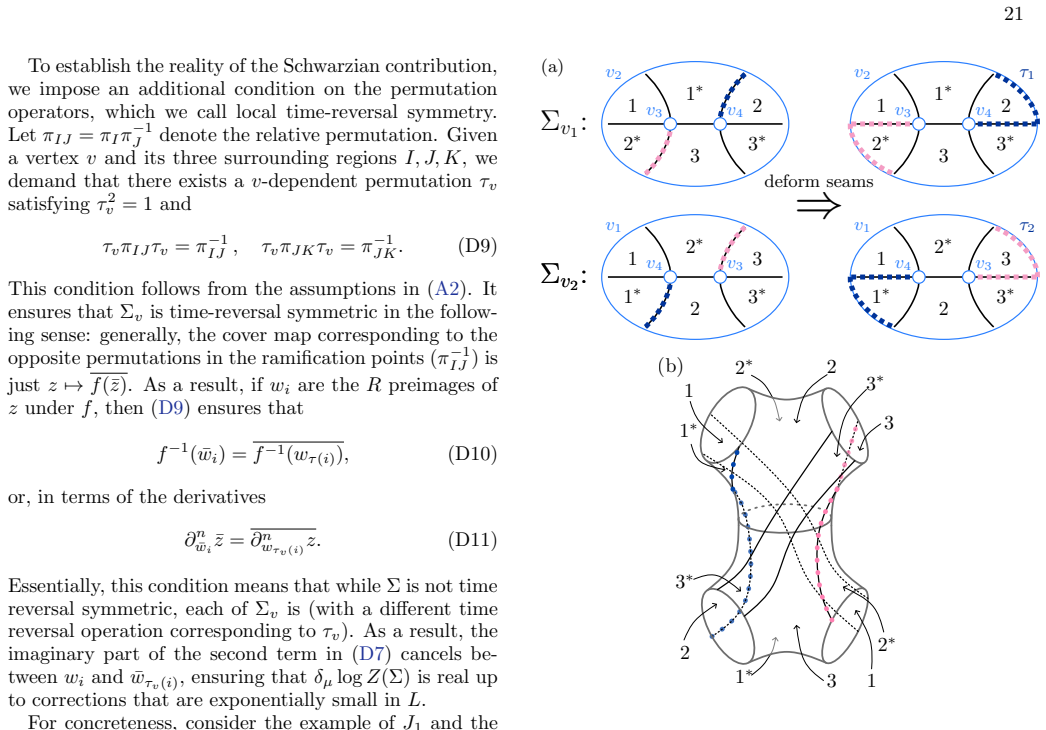
Invariance ofM Here we follow Ref. [12] to argue that the phase ofM, as defined in (1), is topologically invariant for “generic” perturbations. The argument is similar to the original argument on the invariance of the topological entangle- ment entropy by [3]. Throughout this section, we will find it useful to sep- arate between the abstract permutations,...
-
[2]
Invariance of the charged modular commutator Here we show that the phase of the charged modular commutator (14) is invariant under deformations of the region boundaries. The analogous relation to Eq. (A4) holds when some permutation operators are replaced by eµQ. It remains to show that, for any two regions, the action of the operators acting on only two ...
-
[3]
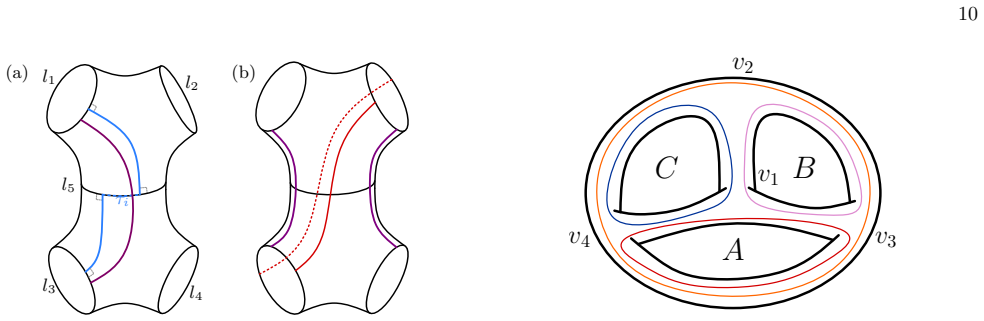
To obtainMfor a R´ enyi-Rquantity, we takeRcopies of such balls, one for each replica, and glue their faces according to the specified permutations. For example, the faceAof thei-th ball is glued to the faceA ∗ of theπ A(i)-th ball. The edges and vertices from different replicas are identified accordingly. By construction,Mis a simplicial complex: a space...
-
[4]
Review of the Kitaev model The model is defined on the hexagonal lattice, with a spin-1/2 degree of freedom at each vertex. The Hamilto- nian is given by H=−J x X x−link σx i σx j −J y X y−link σy i σy j −J z X z−link σz i σz j (H1) where thex, y, zlinks correspond to the three different directions of edges on the Honeycomb lattice. The model can be solve...
-
[5]
Implementation of the multi-entropy measures We want to measure operators of the form (1) on the ground state of the Kitaev model. This can be achieved by representing the wavefunction as a sum over gauge configurations using (H6) and by implementing the per- mutation operators as fermionic operators. To do so, we first consider the operator that exchange...
-
[6]
This immediately reduces the number of summands to evaluate to 2 3R
SinceG AGBGCGΛ |ψ⟩=|ψ⟩, we can ignore sum- mands whereG Λ,r are applied, since any such con- figuration is equivalent to one whereG Λ,r are not applied. This immediately reduces the number of summands to evaluate to 2 3R
-
[7]
A less trivial property is that the summand van- ishes under the following condition: denotingπ IJ = πI π−1 J for the “boundary permutation” between the regionsI, J, and considering the orbitso πIJ (r) to be the orbit of replicarunderπ IJ . If, for any orbits, we have X r′∈oπIJ (r) δGI,r ′ is applied +δ GJ,r′ is applied ̸= 0 mod 2, (H13) then the summand ...
-
[8]
Evaluation of fermionic gaussian operators To evaluate the summands in (H12), we use two proper- ties of fermionic states. The first is that the product of a fermionic gaussian operator satisfies e 1 4 cT Ace 1 4 cT Bc =e 1 4 cT M c , e AeB =e M .(H14) To show this, we use the fact that, for any anti-symmetric matricesA,B, 1 4 cT Ac, 1 4 cT Bc = 1 4 cT [A...
-
[9]
Vanishing of summands satisfying(H13) We finish by proving that summands in (H12) satis- fying (H13). We simplify the problem by assuming that πJ = id, this is because we can multiply the wavefunction byπ −1 J acting on all regions. We can further assume that no gauge transformations are applied on regionJ, using the fact thatG AGBGCGΛ |ψ0⟩=|ψ 0⟩. Finally...
-
[10]
To do so, we must consider how paths onCthat surround the defects lift underf −1 to paths onC/Λ
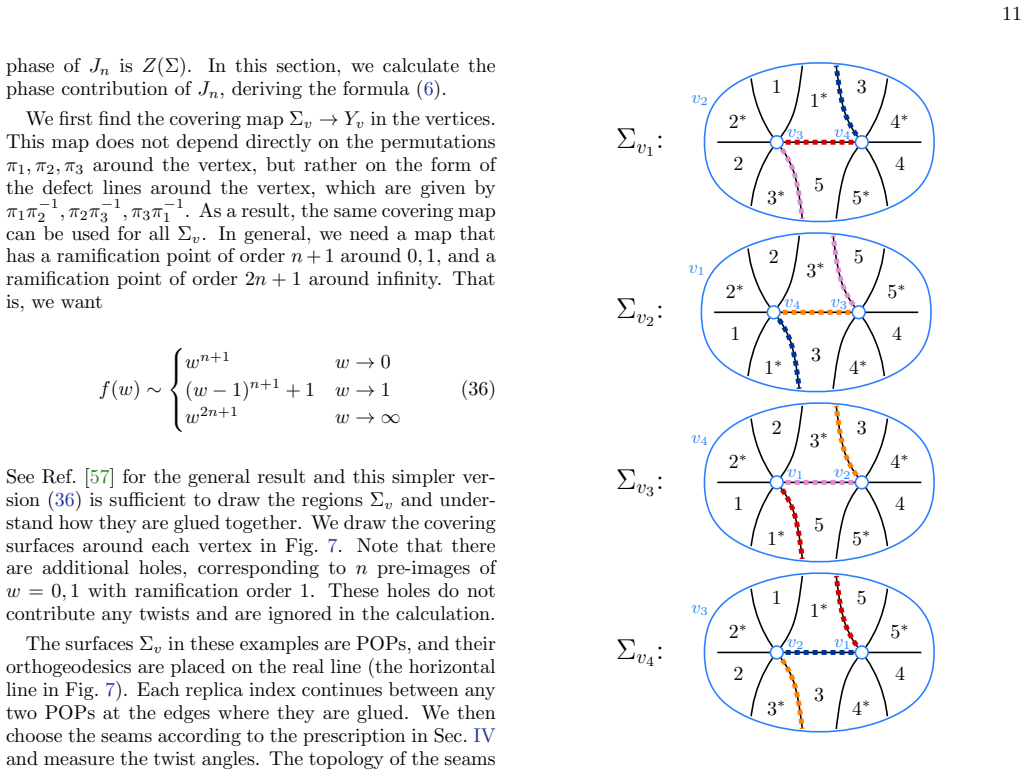
Determining the modulus As the next step, we need to obtain the lattice Λ in (J11). To do so, we must consider how paths onCthat surround the defects lift underf −1 to paths onC/Λ. For smallϵ ′ >0, we have f −1(−ϵ′)≈ω 2/2±iϵ+nω 1 +kω 2, n, k∈Z,(J12) whereϵ∝ √ ϵ′. The permutationsπ (i) act on the points in (J12) as follows: We consider a path Γ that starts...
-
[11]
Final result Following [57] (see also [85]), the final result is obtained by combining the partition function on the torus with modulusτand the terms arising from the Weyl anomaly. Since the torus with modulusτ 0 is coveredrtimes, we get Or,l(η) = 28η η−1 rc 12 Z τ0 r − l r ,(J17) whereZ(τ) is the partition function of the CFT on the torus with modulusτ, ...
-
[12]
Zoo of quantum-topological phases of matter
X.-G. Wen, Colloquium: Zoo of quantum-topological phases of matter, Reviews of Modern Physics89, 041004 (2017), arXiv:1610.03911 [cond-mat.str-el]
work page internal anchor Pith review Pith/arXiv arXiv 2017
-
[13]
B. Zeng, X. Chen, D.-L. Zhou, and X.-G. Wen,Quan- tum Information Meets Quantum Matter: From Quan- tum Entanglement to Topological Phases of Many-Body Systems, Quantum Science and Technology (Springer,
-
[14]
arXiv:1508.02595 [cond-mat.str-el]
work page internal anchor Pith review Pith/arXiv arXiv
-
[15]
A. Kitaev and J. Preskill, Topological entanglement en- tropy, Phys. Rev. Lett.96, 110404 (2006)
work page 2006
- [16]
-
[17]
X.-L. Qi, H. Katsura, and A. W. W. Ludwig, General Relationship between the Entanglement Spectrum and the Edge State Spectrum of Topological Quantum States, Phys. Rev. Lett.108, 196402 (2012), arXiv:1103.5437 [cond-mat.mes-hall]
work page internal anchor Pith review Pith/arXiv arXiv 2012
- [18]
-
[19]
Detecting topological order in a ground state wave function
M. Levin and X.-G. Wen, Detecting topological order in a ground state wave function, Phys. Rev. Lett.96, 110405 (2006), arXiv:cond-mat/0510613
work page internal anchor Pith review Pith/arXiv arXiv 2006
- [20]
-
[21]
X. Wen, S. Matsuura, and S. Ryu, Edge theory approach to topological entanglement entropy, mutual information and entanglement negativity in Chern-Simons theories, Phys. Rev. B93, 245140 (2016), arXiv:1603.08534 [cond- mat.mes-hall]
work page internal anchor Pith review Pith/arXiv arXiv 2016
- [22]
-
[23]
S. Liu, Anyon quantum dimensions from an arbitrary ground state wave function, Nat Commun15, 5134 (2024)
work page 2024
-
[24]
Y. Sheffer, A. Stern, and E. Berg, Extracting the topo- logical spins from bulk multipartite entanglement, arXiv preprint arXiv:2502.12259 (2025)
-
[26]
R. Fan, R. Sahay, and A. Vishwanath, Extracting the quantum hall conductance from a single bulk wave func- tion, Phys. Rev. Lett.131, 186301 (2023)
work page 2023
-
[27]
M. B. Hastings, I. Gonz´ alez, A. B. Kallin, and R. G. Melko, Measuring Renyi entanglement entropy in quan- tum Monte Carlo simulations, Physical review letters 104, 157201 (2010)
work page 2010
-
[28]
K. Satzinger, Y.-J. Liu, A. Smith, C. Knapp, M. New- man, C. Jones, Z. Chen, C. Quintana, X. Mi, A. Dunsworth,et al., Realizing topologically ordered states on a quantum processor, Science374, 1237 (2021)
work page 2021
-
[29]
T. Nishioka, Entanglement entropy: holography and renormalization group, Reviews of Modern Physics90, 035007 (2018)
work page 2018
-
[30]
Notes on Some Entanglement Properties of Quantum Field Theory
E. Witten, Notes on some entanglement properties of quantum field theory, Rev. Mod. Phys.90, 045003 (2018), arXiv:1803.04993 [hep-th]
work page internal anchor Pith review Pith/arXiv arXiv 2018
-
[31]
H. Casini and M. Huerta, Lectures on entanglement in quantum field theory (2023), arXiv:2201.13310 [hep-th]
-
[32]
R. E. Prange and S. M. Girvin,The quantum Hall effect (Springer, 1987)
work page 1987
- [33]
-
[34]
Kitaev, Anyons in an exactly solved model and be- yond, Annals of Physics321, 2 (2006)
A. Kitaev, Anyons in an exactly solved model and be- yond, Annals of Physics321, 2 (2006)
work page 2006
-
[35]
C. Broholm, R. J. Cava, S. Kivelson, D. Nocera, M. Nor- man, and T. Senthil, Quantum spin liquids, Science367, eaay0668 (2020)
work page 2020
-
[36]
L. Savary and L. Balents, Quantum spin liquids: a re- view, Reports on Progress in Physics80, 016502 (2016)
work page 2016
-
[37]
A. Kapustin and L. Spodyneiko, Thermal hall conduc- tance and a relative topological invariant of gapped two- dimensional systems, Physical Review B101, 045137 (2020)
work page 2020
-
[38]
S. T. Flammia, A. Hamma, T. L. Hughes, and X.-G. Wen, Topological Entanglement Renyi Entropy and Reduced Density Matrix Structure, Phys. Rev. Lett.103, 261601 (2009), arXiv:0909.3305 [cond-mat, physics:quant-ph]
work page internal anchor Pith review Pith/arXiv arXiv 2009
-
[39]
L. Alvarez-Gaume and E. Witten, Gravitational anoma- lies, Nuclear Physics B234, 269 (1984)
work page 1984
-
[40]
S. Hellerman, D. Orlando, and M. Watanabe, Quantum information theory of the gravitational anomaly, arXiv preprint arXiv:2101.03320 (2021)
-
[41]
R. Fan, From entanglement generated dynamics to the gravitational anomaly and chiral central charge, Phys. Rev. Lett.129, 260403 (2022)
work page 2022
-
[42]
S. Dong, E. Fradkin, R. G. Leigh, and S. Nowling, Topo- logical Entanglement Entropy in Chern-Simons Theories and Quantum Hall Fluids, J. High Energy Phys.2008 (05), 016, arXiv:0802.3231 [cond-mat, physics:hep-th]
work page internal anchor Pith review Pith/arXiv arXiv 2008
- [43]
-
[44]
G. Penington, M. Walter, and F. Witteveen, Fun with replicas: tripartitions in tensor networks and gravity, J. High Energ. Phys.2023(5), 8, arXiv:2211.16045 [hep-th, physics:quant-ph]
- [45]
-
[46]
M. B. Plenio and S. Virmani, An introduction to en- tanglement measures, arXiv preprint quant-ph/0504163 (2005)
work page internal anchor Pith review Pith/arXiv arXiv 2005
-
[47]
Y. Zou, B. Shi, J. Sorce, I. T. Lim, and I. H. Kim, Mod- ular commutators in conformal field theory, Phys. Rev. Lett.129, 260402 (2022)
work page 2022
-
[48]
R. Fan, P. Zhang, and Y. Gu, Generalized real-space chern number formula and entanglement hamiltonian, SciPost Physics15, 249 (2023)
work page 2023
- [49]
-
[50]
X. Chen, Z.-C. Gu, Z.-X. Liu, and X.-G. Wen, Symmetry protected topological orders and the group cohomology of their symmetry group, Physical Review B—Condensed Matter and Materials Physics87, 155114 (2013)
work page 2013
-
[51]
M. Barkeshli, P. Bonderson, M. Cheng, and Z. Wang, Symmetry fractionalization, defects, and gauging of topological phases, Physical Review B100, 115147 (2019), publisher: American Physical Society
work page 2019
-
[52]
Physics at the entangling surface
K. Ohmori and Y. Tachikawa, Physics at the entan- gling surface, J. Stat. Mech.1504, P04010 (2015), arXiv:1406.4167 [hep-th]
work page internal anchor Pith review Pith/arXiv arXiv 2015
-
[53]
A note on entanglement edge modes in Chern Simons theory
G. Wong, A note on entanglement edge modes in Chern Simons theory, Journal of High En- ergy Physics2018, 10.1007/JHEP08(2018)020 (2018), arXiv:1706.04666 [hep-th]
work page internal anchor Pith review Pith/arXiv arXiv doi:10.1007/jhep08(2018)020 2018
- [54]
- [55]
-
[56]
Y. Liu, Y. Kusuki, J. Kudler-Flam, R. Sohal, and S. Ryu, Multipartite entanglement in two-dimensional chiral topological liquids, Phys. Rev. B109, 085108 (2024)
work page 2024
-
[57]
A. Kitaev and L. Kong, Models for gapped bound- aries and domain walls, Communications in Mathemati- cal Physics313, 351 (2012)
work page 2012
-
[58]
B. Farb and D. Margalit,A primer on mapping class groups, Vol. 49 (Princeton university press, 2011)
work page 2011
-
[59]
Y. Imayoshi and M. Taniguchi,An introduction to Te- ichm¨ uller spaces(Springer Science & Business Media, 2012)
work page 2012
-
[60]
J. H. Hubbard,Teichm¨ uller theory and applications to geometry, topology, and dynamics, Vol. 1 (Matrix Edi- tions, 2006)
work page 2006
-
[61]
P. Di Francesco, P. Mathieu, and D. S´ en´ echal,Conformal Field Theory, Graduate Texts in Contemporary Physics (Springer New York, New York, NY, 1997)
work page 1997
-
[62]
H.-H. Tu, Y. Zhang, and X.-L. Qi, Momentum polariza- tion: An entanglement measure of topological spin and chiral central charge, Physical Review B—Condensed Matter and Materials Physics88, 195412 (2013)
work page 2013
-
[63]
E. Witten, Quantum field theory and the jones polyno- mial, Communications in Mathematical Physics121, 351 (1989)
work page 1989
-
[64]
E. Witten, The chiral central charge in three dimensions, inPhysics and Mathematics of Strings(WORLD SCI- ENTIFIC, 1990) p. 530–559
work page 1990
-
[65]
A. E. Nielsen, J. I. Cirac, and G. Sierra, Laughlin spin- liquid states on lattices obtained from conformal field theory, Physical review letters108, 257206 (2012)
work page 2012
-
[66]
J. R. Fliss, X. Wen, O. Parrikar, C.-T. Hsieh, B. Han, T. L. Hughes, and R. G. Leigh, Interface Contributions to Topological Entanglement in Abelian Chern-Simons Theory, JHEP09, 056, arXiv:1705.09611 [cond-mat.str- el]
work page internal anchor Pith review Pith/arXiv arXiv
-
[67]
S. Elitzur, G. Moore, A. Schwimmer, and N. Seiberg, Re- marks on the canonical quantization of the chern-simons- witten theory, Nuclear Physics B326, 108 (1989)
work page 1989
-
[68]
Polchinski,String theory, volume 1: An introduction to the bosonic string, Vol
J. Polchinski,String theory, volume 1: An introduction to the bosonic string, Vol. 1 (Cambridge university press Cambridge, 2005)
work page 2005
-
[69]
Correlation functions for M^N/S_N orbifolds
O. Lunin and S. D. Mathur, Correlation functions for MˆN/S n orbifolds, Communications in Mathematical Physics219, 399 (2001), arXiv:hep-th/0006196
work page internal anchor Pith review Pith/arXiv arXiv 2001
-
[70]
H. Yao and X.-L. Qi, Entanglement entropy and entan- glement spectrum of the kitaev model, Physical review letters105, 080501 (2010)
work page 2010
- [71]
-
[72]
F. D. M. Haldane, Model for a quantum hall effect with- out landau levels: Condensed-matter realization of the” parity anomaly”, Physical review letters61, 2015 (1988)
work page 2015
- [73]
-
[74]
I. H. Kim, B. Shi, K. Kato, and V. V. Albert, Modu- lar commutator in gapped quantum many-body systems, Phys. Rev. B106, 075147 (2022)
work page 2022
- [75]
-
[76]
G. Carleo, K. Choo, D. Hofmann, J. E. T. Smith, T. Westerhout, F. Alet, E. J. Davis, S. Efthymiou, I. Glasser, S.-H. Lin, M. Mauri, G. Mazzola, C. B. Mendl, E. van Nieuwenburg, O. O’Reilly, H. Th´ eveniaut, G. Tor- lai, F. Vicentini, and A. Wietek, Netket: A machine learning toolkit for many-body quantum systems, Soft- wareX , 100311 (2019)
work page 2019
-
[77]
F. Vicentini, D. Hofmann, A. Szab´ o, D. Wu, C. Roth, C. Giuliani, G. Pescia, J. Nys, V. Vargas-Calder´ on, N. Astrakhantsev, and G. Carleo, NetKet 3: Machine Learning Toolbox for Many-Body Quantum Systems, Sci- Post Phys. Codebases , 7 (2022)
work page 2022
-
[78]
Atiyah, On framings of 3-manifolds, Topology29, 1 (1990)
M. Atiyah, On framings of 3-manifolds, Topology29, 1 (1990)
work page 1990
-
[79]
D. S. Freed and R. E. Gompf, Computer calculation of witten’s 3-manifold invariant, Communications in math- ematical physics141, 79 (1991)
work page 1991
-
[80]
R. Kirby and P. Melvin, Canonical framings for 3- manifolds, Turkish Journal of Mathematics23, 89 (1999)
work page 1999
-
[81]
E. D’Hoker and D. H. Phong, The geometry of string perturbation theory, Reviews of Modern Physics60, 917 (1988)
work page 1988
discussion (0)
Sign in with ORCID, Apple, or X to comment. Anyone can read and Pith papers without signing in.