Recognition: 2 theorem links
· Lean TheoremDetector-Empowered Video Large Language Model for Efficient Spatio-Temporal Grounding
Pith reviewed 2026-05-17 00:50 UTC · model grok-4.3
The pith
DEViL distills queries into detector tokens to ground video objects efficiently in one pass.
A machine-rendered reading of the paper's core claim, the machinery that carries it, and where it could break.
Core claim
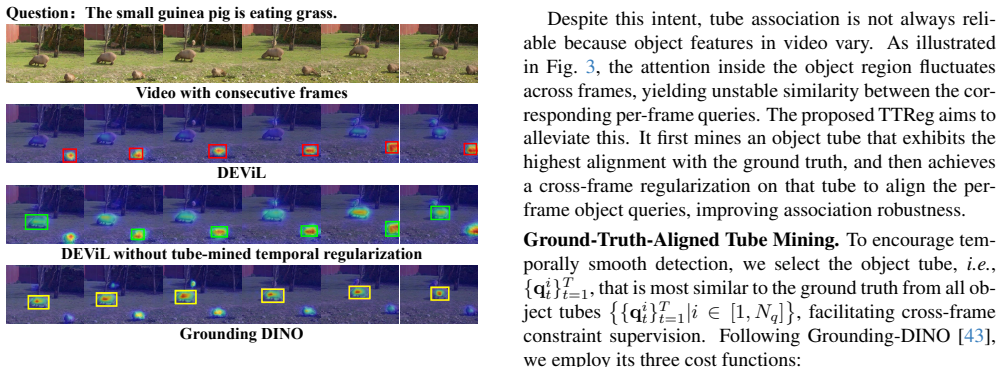
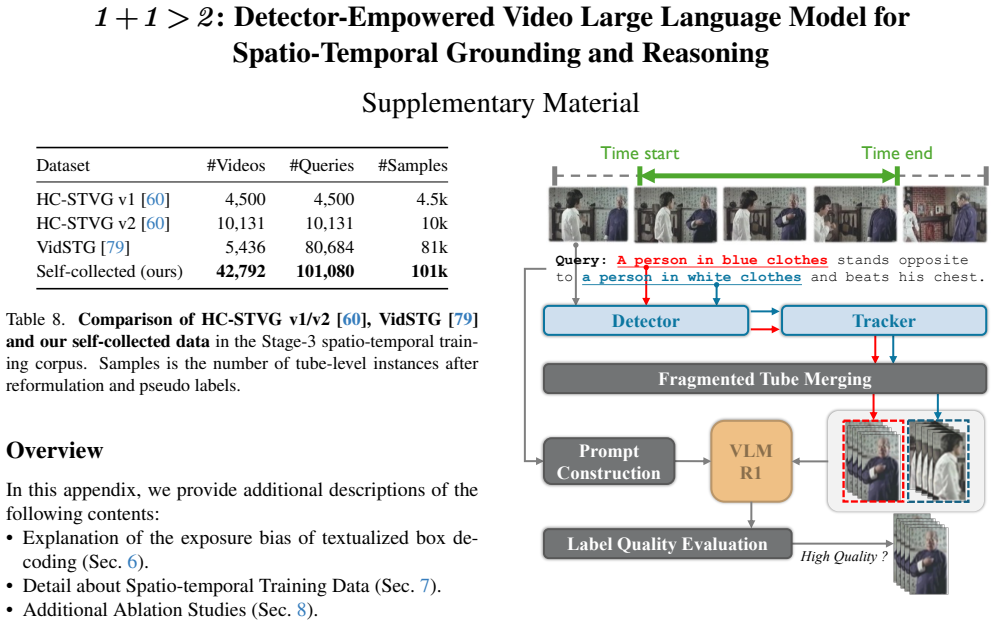
DEViL distills the query into a detector-compatible reference-semantic token that replaces the detector's text embedding, enabling spatial grounding in a single forward pass, and adds temporal consistency regularization to match and maintain object coherence across frames.
What carries the argument
The reference-semantic token that replaces the detector's text embedding to drive query-specific spatial localization in one parallel pass.
If this is right
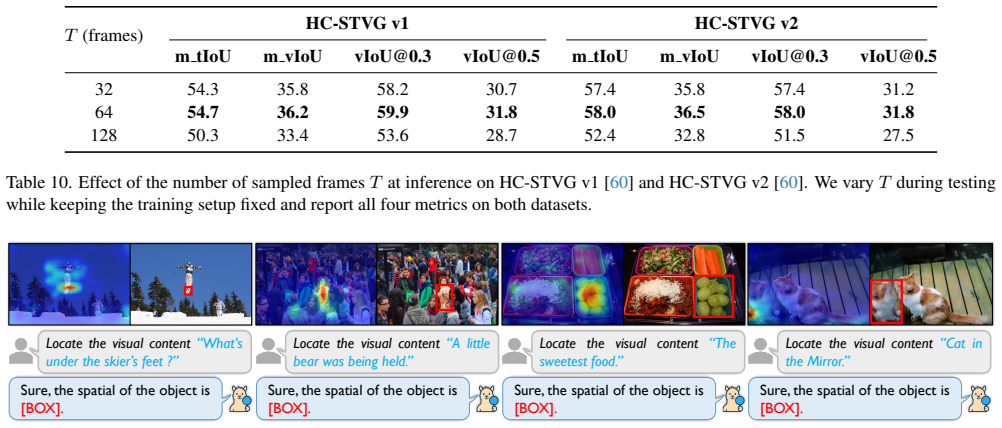
- Strong performance of 43.1 percent m_vIoU on the HC-STVG benchmark.
- Superior efficiency reaching 14.33 frames per second.
- Preservation of the underlying MLLM backbone's general reasoning capacity.
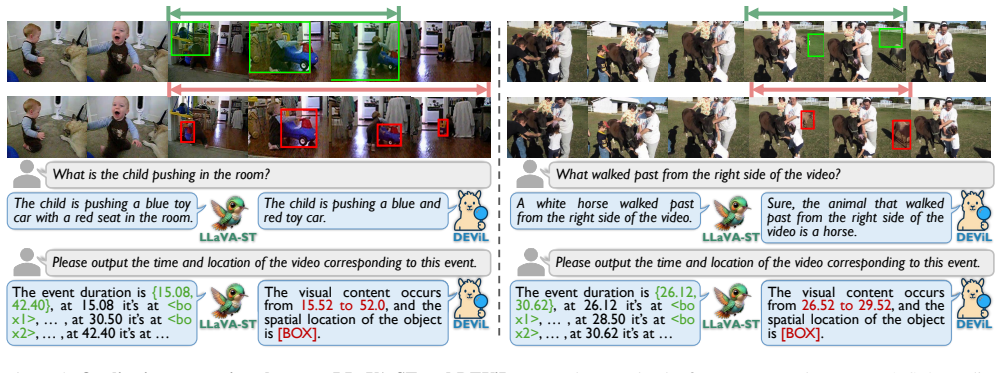
- Avoidance of linear growth in decoding cost as temporal span increases and avoidance of heavy candidate construction pipelines.
Where Pith is reading between the lines
- The same query-distillation step could be tested on image-based referring localization tasks to see if the detector offload improves speed there too.
- Hybrid systems like this may allow video models to run on lower-power hardware by limiting the LLM to high-level steps.
- Extending the approach to multi-object queries would require checking whether multiple reference tokens can be handled without interference.
Load-bearing premise
That distilling the query into a detector-compatible reference-semantic token enables accurate spatial grounding in a single forward pass and that temporal consistency regularization maintains object coherence across frames without further tuning.
What would settle it
Measuring whether object identity remains consistent across frames in videos with fast motion or frequent occlusions would directly test if the regularization alone suffices.
Figures




read the original abstract
Multimodal large language models (MLLMs) are rapidly expanding from general video understanding to finer-grained understanding such as spatio-temporal video grounding (STVG) and reasoning. In these tasks, an MLLM must localize the user-queried target in time and space and take the results as evidence for reasoning. Existing MLLM methods mainly follow two paradigms: (1) Direct Localization, which outputs STVG results with extra alignment modules or specialized decoders; and (2) Candidate-based Selection, which first constructs tube-level candidates and then selects the relevant one by an MLLM. However, both suffer from a serious efficiency bottleneck: the former incurs linearly growing decoding cost as the queried temporal span increases, while the latter relies on costly candidate construction. To break this bottleneck, we propose DEViL, a detector-empowered Video-LLM with a simple key idea: offloading dense spatial grounding from the MLLM to a fully parallelizable, well-trained detector. Specifically, DEViL distills the query into a detector-compatible reference-semantic token, which replaces the detector's text embedding to enable spatial grounding in a single pass. Then, we design temporal consistency regularization to match objects across frames and enforce their coherence over time. In this way, DEViL avoids long coordinate decoding and heavy candidate pipelines. Extensive experiments show that DEViL achieves strong performance (43.1% m_vIoU on HC-STVG) with superior efficiency (14.33 FPS), while preserving the general reasoning capacity of the MLLM backbone.
Editorial analysis
A structured set of objections, weighed in public.
Referee Report
Summary. The paper proposes DEViL, a detector-empowered Video-LLM for efficient spatio-temporal video grounding (STVG). It offloads dense spatial grounding from the MLLM to a pre-trained detector by distilling the user query into a single reference-semantic token that replaces the detector's text embedding, enabling spatial localization in one forward pass; temporal consistency regularization is added to enforce object coherence across frames. The method claims to avoid the linear decoding cost of direct localization and the heavy candidate construction of selection-based approaches, reporting 43.1% m_vIoU on HC-STVG at 14.33 FPS while preserving the backbone MLLM's general reasoning capacity.
Significance. If the distillation and regularization mechanisms prove robust, the work could meaningfully advance efficient fine-grained video understanding by showing how fixed, parallelizable detectors can be integrated with MLLMs without sacrificing accuracy or generality. The reported FPS gain and single-pass design address a clear practical bottleneck; reproducible code or parameter-free derivations would further strengthen its contribution.
major comments (3)
- [Abstract and §3] Abstract and §3 (method): the central claim that replacing the detector's text embedding with a distilled reference-semantic token enables accurate single-pass spatial grounding lacks any loss formulation, derivation, or ablation isolating this substitution; without these, it is impossible to verify whether the token faithfully encodes complex or ambiguous queries for the fixed detector.
- [§4] §4 (experiments): the headline 43.1% m_vIoU and 14.33 FPS are reported without baselines, ablations, error bars, or analysis of how temporal consistency regularization affects the final metric; this leaves the efficiency advantage and the sufficiency of regularization for cross-frame coherence difficult to evaluate.
- [§3.2] §3.2 (temporal regularization): the assumption that matching objects across frames via the proposed regularization alone maintains coherence without further tuning or additional losses is load-bearing for the overall efficiency claim, yet no quantitative isolation of its contribution is provided.
minor comments (2)
- [§3] Clarify the precise architecture of the reference-semantic token (e.g., dimension, injection point into the detector) and any modifications to the detector backbone.
- [§4] Add a short table comparing DEViL against recent STVG methods on both accuracy and speed metrics for direct context.
Simulated Author's Rebuttal
We thank the referee for the thoughtful and constructive comments on our work. We address each of the major comments below and outline the revisions we plan to make to strengthen the manuscript.
read point-by-point responses
-
Referee: [Abstract and §3] Abstract and §3 (method): the central claim that replacing the detector's text embedding with a distilled reference-semantic token enables accurate single-pass spatial grounding lacks any loss formulation, derivation, or ablation isolating this substitution; without these, it is impossible to verify whether the token faithfully encodes complex or ambiguous queries for the fixed detector.
Authors: We appreciate this observation. Section 3.1 details the distillation of the query into the reference-semantic token by aligning the MLLM's output with the detector's text embedding space through a learned projection. While the manuscript describes the overall architecture, we acknowledge that an explicit loss formulation and a dedicated ablation were not included. In the revised manuscript, we will add the mathematical formulation of the distillation loss and provide an ablation study that isolates the contribution of the reference-semantic token substitution, including tests on complex and ambiguous queries. revision: yes
-
Referee: [§4] §4 (experiments): the headline 43.1% m_vIoU and 14.33 FPS are reported without baselines, ablations, error bars, or analysis of how temporal consistency regularization affects the final metric; this leaves the efficiency advantage and the sufficiency of regularization for cross-frame coherence difficult to evaluate.
Authors: We note that the experimental section includes comparisons to existing methods and reports the efficiency metrics. However, to fully address the referee's concern, we will expand Section 4 with additional baseline comparisons, more comprehensive ablations, error bars from multiple runs, and a specific analysis quantifying the impact of the temporal consistency regularization on the m_vIoU and coherence metrics. revision: yes
-
Referee: [§3.2] §3.2 (temporal regularization): the assumption that matching objects across frames via the proposed regularization alone maintains coherence without further tuning or additional losses is load-bearing for the overall efficiency claim, yet no quantitative isolation of its contribution is provided.
Authors: We agree that isolating the contribution of the temporal consistency regularization is important for validating the efficiency claim. In the current manuscript, Section 3.2 describes the regularization term designed to enforce object coherence by matching features across frames. We will add quantitative results in the revised experiments section that ablate the regularization term, showing its effect on cross-frame coherence and overall performance without requiring additional losses or extensive tuning. revision: yes
Circularity Check
No circularity: novel architecture evaluated on external benchmarks
full rationale
The paper introduces DEViL as a new method that distills queries into reference-semantic tokens for a fixed detector and adds temporal consistency regularization. These are presented as engineering contributions rather than derived predictions. Performance metrics such as 43.1% m_vIoU on HC-STVG are measured on an external benchmark, not obtained by fitting parameters to the target quantity and then re-predicting it. No equations, uniqueness theorems, or load-bearing claims reduce by construction to self-citations or prior results from the same authors. The derivation chain consists of standard components (MLLM backbone, off-the-shelf detector) plus explicitly new modules whose validity is assessed empirically outside the paper's own fitted values.
Axiom & Free-Parameter Ledger
axioms (2)
- domain assumption A well-trained object detector can perform accurate spatial grounding when its text embedding is replaced by an MLLM-derived reference-semantic token
- domain assumption Temporal consistency regularization can enforce object coherence across frames without introducing new errors or requiring per-video tuning
invented entities (1)
-
reference-semantic token
no independent evidence
Lean theorems connected to this paper
-
IndisputableMonolith/Cost/FunctionalEquation.leanwashburn_uniqueness_aczel unclear?
unclearRelation between the paper passage and the cited Recognition theorem.
DEViL distills the query into a detector-compatible reference-semantic token, which replaces the detector's text embedding to enable spatial grounding in a single pass. Then, we design temporal consistency regularization to match objects across frames
-
IndisputableMonolith/Foundation/RealityFromDistinction.leanreality_from_one_distinction unclear?
unclearRelation between the paper passage and the cited Recognition theorem.
Tube-mined Temporal Regularization (TTReg) ... memory-based tube association
What do these tags mean?
- matches
- The paper's claim is directly supported by a theorem in the formal canon.
- supports
- The theorem supports part of the paper's argument, but the paper may add assumptions or extra steps.
- extends
- The paper goes beyond the formal theorem; the theorem is a base layer rather than the whole result.
- uses
- The paper appears to rely on the theorem as machinery.
- contradicts
- The paper's claim conflicts with a theorem or certificate in the canon.
- unclear
- Pith found a possible connection, but the passage is too broad, indirect, or ambiguous to say the theorem truly supports the claim.
Reference graph
Works this paper leans on
-
[1]
Localizing mo- ments in video with natural language
Lisa Anne Hendricks, Oliver Wang, Eli Shechtman, Josef Sivic, Trevor Darrell, and Bryan Russell. Localizing mo- ments in video with natural language. InIEEE/CVF Interna- tional Conference on Computer Vision (ICCV), pages 5803– 5812, 2017. 2
work page 2017
-
[2]
Lawrence Zitnick, and Devi Parikh
Stanislaw Antol, Aishwarya Agrawal, Jiasen Lu, Margaret Mitchell, Dhruv Batra, C. Lawrence Zitnick, and Devi Parikh. Vqa: Visual question answering. InIEEE Inter- national Conference on Computer Vision (ICCV), 2015. 1
work page 2015
-
[3]
Shuai Bai, Keqin Chen, Xuejing Liu, Jialin Wang, Wenbin Ge, Sibo Song, Kai Dang, Peng Wang, Shijie Wang, Jun Tang, et al. Qwen2. 5-vl technical report.arXiv preprint arXiv:2502.13923, 2025. 5
work page internal anchor Pith review Pith/arXiv arXiv 2025
-
[4]
Zechen Bai, Tong He, Haiyang Mei, Pichao Wang, Ziteng Gao, Joya Chen, Zheng Zhang, and Mike Zheng Shou. One token to seg them all: Language instructed reasoning seg- mentation in videos.Advances in Neural Information Pro- cessing Systems (NeurIPS), 37:6833–6859, 2024. 2
work page 2024
-
[5]
End-to- end object detection with transformers
Nicolas Carion, Francisco Massa, Gabriel Synnaeve, Nicolas Usunier, Alexander Kirillov, and Sergey Zagoruyko. End-to- end object detection with transformers. InEuropean confer- ence on computer vision (ECCV), 2020. 6
work page 2020
-
[6]
David L. Chen and William B. Dolan. Collecting highly par- allel data for paraphrase evaluation. InAnnual Meeting of the Association for Computational Linguistics (ACL), 2011. 1
work page 2011
-
[7]
Shimin Chen, Xiaohan Lan, Yitian Yuan, Zequn Jie, and Lin Ma. Timemarker: A versatile video-llm for long and short video understanding with superior temporal localiza- tion ability.arXiv preprint arXiv:2411.18211, 2024. 7
-
[8]
Sutrack: Towards simple and unified single object tracking
Xin Chen, Ben Kang, Wanting Geng, Jiawen Zhu, Yi Liu, Dong Wang, and Huchuan Lu. Sutrack: Towards simple and unified single object tracking. InAAAI Conference on Artifi- cial Intelligence (AAAI), 2025. 5, 3
work page 2025
-
[9]
Zhe Chen, Weiyun Wang, Yue Cao, Yangzhou Liu, Zhang- wei Gao, Erfei Cui, Jinguo Zhu, Shenglong Ye, Hao Tian, Zhaoyang Liu, et al. Expanding performance boundaries of open-source multimodal models with model, data, and test- time scaling.arXiv preprint arXiv:2412.05271, 2024. 5
work page internal anchor Pith review Pith/arXiv arXiv 2024
-
[10]
VideoLLaMA 2: Advancing Spatial-Temporal Modeling and Audio Understanding in Video-LLMs
Zesen Cheng, Sicong Leng, Hang Zhang, Yifei Xin, Xin Li, Guanzheng Chen, Yongxin Zhu, Wenqi Zhang, Ziyang Luo, Deli Zhao, et al. Videollama 2: Advancing spatial- temporal modeling and audio understanding in video-llms. arXiv preprint arXiv:2406.07476, 2024. 7
work page internal anchor Pith review Pith/arXiv arXiv 2024
-
[11]
V-star: Bench- marking video-llms on video spatio-temporal reasoning
Zixu Cheng, Jian Hu, Ziquan Liu, Chenyang Si, Wei Li, and Shaogang Gong. V-star: Benchmarking video- llms on video spatio-temporal reasoning.arXiv preprint arXiv:2503.11495, 2025. 5, 6
-
[12]
Gheorghe Comanici, Eric Bieber, Mike Schaekermann, Ice Pasupat, Noveen Sachdeva, Inderjit Dhillon, Marcel Blis- tein, Ori Ram, Dan Zhang, Evan Rosen, et al. Gemini 2.5: Pushing the frontier with advanced reasoning, multimodality, long context, and next generation agentic capabilities.arXiv preprint arXiv:2507.06261, 2025. 5
work page internal anchor Pith review Pith/arXiv arXiv 2025
-
[13]
Video-mme: The first-ever comprehensive evaluation benchmark of multi-modal llms in video analysis
Chaoyou Fu, Yuhan Dai, Yongdong Luo, Lei Li, Shuhuai Ren, Renrui Zhang, Zihan Wang, Chenyu Zhou, Yunhang Shen, Mengdan Zhang, et al. Video-mme: The first-ever comprehensive evaluation benchmark of multi-modal llms in video analysis. InIEEE/CVF Conference on Computer Vi- sion and Pattern Recognition (CVPR), 2025. 7
work page 2025
-
[14]
arXiv preprint arXiv:2111.12681 , year=
Tsu-Jui Fu, Linjie Li, Zhe Gan, Kevin Lin, William Yang Wang, Lijuan Wang, and Zicheng Liu. Violet: End-to-end video-language transformers with masked visual-token mod- eling.arXiv preprint arXiv:2111.12681, 2021. 7
-
[15]
Tall: Temporal activity localization via language query
Jiyang Gao, Chen Sun, Zhenheng Yang, and Ram Neva- tia. Tall: Temporal activity localization via language query. InIEEE/CVF International Conference on Computer Vision (ICCV), pages 5267–5275, 2017. 7
work page 2017
-
[16]
Making the v in vqa matter: Elevating the role of image understanding in visual question answer- ing
Yash Goyal, Tejas Khot, Douglas Summers-Stay, Dhruv Ba- tra, and Devi Parikh. Making the v in vqa matter: Elevating the role of image understanding in visual question answer- ing. InIEEE Conference on Computer Vision and Pattern Recognition (CVPR), 2017. 1
work page 2017
-
[17]
Ego4d: Around the world in 3,000 hours of egocentric video
Kristen Grauman, Andrew Westbury, Eugene Byrne, Zachary Chavis, Antonino Furnari, Rohit Girdhar, Jack- son Hamburger, Hao Jiang, Miao Liu, Xingyu Liu, et al. Ego4d: Around the world in 3,000 hours of egocentric video. InIEEE/CVF Conference on Computer Vision and Pattern Recognition (CVPR), pages 18995–19012, 2022. 2
work page 2022
-
[18]
Agqa: A benchmark for compositional spatio-temporal reasoning
Madeleine Grunde-McLaughlin, Ranjay Krishna, and Ma- neesh Agrawala. Agqa: A benchmark for compositional spatio-temporal reasoning. InIEEE/CVF Conference on Computer Vision and Pattern Recognition (CVPR), 2021. 2
work page 2021
-
[19]
Context-guided spatio-temporal video grounding
Xin Gu, Heng Fan, Yan Huang, Tiejian Luo, and Libo Zhang. Context-guided spatio-temporal video grounding. InIEEE/CVF Conference on Computer Vision and Pattern Recognition (CVPR), 2024. 6, 7
work page 2024
-
[20]
Xin Gu, Yaojie Shen, Chenxi Luo, Tiejian Luo, Yan Huang, Yuewei Lin, Heng Fan, and Libo Zhang. Knowing your tar- get: Target-aware transformer makes better spatio-temporal video grounding.arXiv preprint arXiv:2502.11168, 2025. 6, 7
-
[21]
Trace: Temporal grounding video llm via causal event modeling
Yongxin Guo, Jingyu Liu, Mingda Li, Qingbin Liu, Xi Chen, and Xiaoying Tang. Trace: Temporal grounding video llm via causal event modeling.arXiv preprint arXiv:2410.05643,
-
[22]
Vtg-llm: Integrating timestamp knowledge into video llms for enhanced video temporal grounding
Yongxin Guo, Jingyu Liu, Mingda Li, Dingxin Cheng, Xi- aoying Tang, Dianbo Sui, Qingbin Liu, Xi Chen, and Kevin Zhao. Vtg-llm: Integrating timestamp knowledge into video llms for enhanced video temporal grounding. InAAAI Con- ference on Artificial Intelligence (AAAI), 2025. 2, 7
work page 2025
-
[23]
Creating summaries from user videos
Michael Gygli, Helmut Grabner, Hayko Riemenschneider, and Luc Van Gool. Creating summaries from user videos. In European Conference on Computer Vision (ECCV), 2014. 1
work page 2014
-
[24]
Edward J Hu, Yelong Shen, Phillip Wallis, Zeyuan Allen- Zhu, Yuanzhi Li, Shean Wang, Lu Wang, Weizhu Chen, et al. Lora: Low-rank adaptation of large language models.Inter- national Conference on Learning Representations (ICLR), 1 (2):3, 2022. 4, 6
work page 2022
-
[25]
Vtimellm: Empower llm to grasp video moments
Bin Huang, Xin Wang, Hong Chen, Zihan Song, and Wenwu Zhu. Vtimellm: Empower llm to grasp video moments. InIEEE/CVF Conference on Computer Vision and Pattern Recognition (CVPR), pages 14271–14280, 2024. 2, 5, 7
work page 2024
-
[26]
Lita: Language instructed temporal-localization assistant
De-An Huang, Shijia Liao, Subhashree Radhakrishnan, Hongxu Yin, Pavlo Molchanov, Zhiding Yu, and Jan Kautz. Lita: Language instructed temporal-localization assistant. InEuropean conference on computer vision (ECCV), pages 202–218. Springer, 2024. 2
work page 2024
-
[27]
Aaron Hurst, Adam Lerer, Adam P Goucher, Adam Perel- man, Aditya Ramesh, Aidan Clark, AJ Ostrow, Akila Weli- hinda, Alan Hayes, Alec Radford, et al. Gpt-4o system card. arXiv preprint arXiv:2410.21276, 2024. 5
work page internal anchor Pith review Pith/arXiv arXiv 2024
-
[28]
Yang Jin, Zehuan Yuan, Yadong Mu, et al. Embracing con- sistency: A one-stage approach for spatio-temporal video grounding.Advances in Neural Information Processing Sys- tems (NeurIPS), 35, 2022. 6, 7
work page 2022
-
[29]
Language repository for long video understanding
Kumara Kahatapitiya, Kanchana Ranasinghe, Jongwoo Park, and Michael S Ryoo. Language repository for long video understanding. InFindings of the Association for Computa- tional Linguistics: ACL, pages 5627–5646, 2025. 7
work page 2025
-
[30]
Referitgame: Referring to objects in pho- tographs of natural scenes
Sahar Kazemzadeh, Vicente Ordonez, Mark Matten, and Tamara Berg. Referitgame: Referring to objects in pho- tographs of natural scenes. InProceedings of the 2014 con- ference on empirical methods in natural language processing (EMNLP), pages 787–798, 2014. 5
work page 2014
-
[31]
Dense-captioning events in videos
Ranjay Krishna, Kenji Hata, Frederic Ren, Li Fei-Fei, and Juan Carlos Niebles. Dense-captioning events in videos. InIEEE/CVF International Conference on Computer Vision (ICCV), pages 706–715, 2017. 5, 3
work page 2017
-
[32]
Jie Lei, Licheng Yu, Tamara L. Berg, and Mohit Bansal. TVQA+: Spatio-temporal grounding for video question an- swering. InAnnual Meeting of the Association for Compu- tational Linguistics (ACL), 2020. 1
work page 2020
-
[33]
Jie Lei, Tamara L Berg, and Mohit Bansal. Detecting moments and highlights in videos via natural language queries.Advances in Neural Information Processing Systems (NeurIPS), 34:11846–11858, 2021. 5, 3
work page 2021
-
[34]
LLaVA-NeXT-Interleave: Tackling Multi-image, Video, and 3D in Large Multimodal Models
Feng Li, Renrui Zhang, Hao Zhang, Yuanhan Zhang, Bo Li, Wei Li, Zejun Ma, and Chunyuan Li. Llava-next-interleave: Tackling multi-image, video, and 3d in large multimodal models.arXiv preprint arXiv:2407.07895, 2024. 7
work page internal anchor Pith review Pith/arXiv arXiv 2024
-
[35]
Llava-ST: A multimodal large language model for fine-grained spatial- temporal understanding
Hongyu Li, Jinyu Chen, Ziyu Wei, Shaofei Huang, Tian- rui Hui, Jialin Gao, Xiaoming Wei, and Si Liu. Llava-ST: A multimodal large language model for fine-grained spatial- temporal understanding. InIEEE/CVF Conference on Com- puter Vision and Pattern Recognition (CVPR), pages 8592– 8603, 2025. 5, 7
work page 2025
-
[36]
Llava-st: A multimodal large language model for fine-grained spatial- temporal understanding
Hongyu Li, Jinyu Chen, Ziyu Wei, Shaofei Huang, Tian- rui Hui, Jialin Gao, Xiaoming Wei, and Si Liu. Llava-st: A multimodal large language model for fine-grained spatial- temporal understanding. InIEEE/CVF Conference on Com- puter Vision and Pattern Recognition (CVPR), 2025. 1, 2, 5, 6, 7, 3, 4
work page 2025
-
[37]
VideoChat: Chat-Centric Video Understanding
KunChang Li, Yinan He, Yi Wang, Yizhuo Li, Wenhai Wang, Ping Luo, Yali Wang, Limin Wang, and Yu Qiao. Videochat: Chat-centric video understanding.arXiv preprint arXiv:2305.06355, 2023. 2, 7
work page internal anchor Pith review Pith/arXiv arXiv 2023
-
[38]
Mvbench: A comprehensive multi-modal video understand- ing benchmark
Kunchang Li, Yali Wang, Yinan He, Yizhuo Li, Yi Wang, Yi Liu, Zun Wang, Jilan Xu, Guo Chen, Ping Luo, et al. Mvbench: A comprehensive multi-modal video understand- ing benchmark. InIEEE/CVF Conference on Computer Vi- sion and Pattern Recognition (CVPR), pages 22195–22206,
-
[39]
Referdino: Referring video object segmentation with visual grounding founda- tions
Tianming Liang, Kun-Yu Lin, Chaolei Tan, Jianguo Zhang, Wei-Shi Zheng, and Jian-Fang Hu. Referdino: Referring video object segmentation with visual grounding founda- tions. InIEEE/CVF International Conference on Computer Vision (ICCV), 2025. 3, 4
work page 2025
-
[40]
Video-llava: Learning united visual repre- sentation by alignment before projection
Bin Lin, Yang Ye, Bin Zhu, Jiaxi Cui, Munan Ning, Peng Jin, and Li Yuan. Video-llava: Learning united visual repre- sentation by alignment before projection. InProceedings of the 2024 Conference on Empirical Methods in Natural Lan- guage Processing (EMNLP), pages 5971–5984, 2024. 7
work page 2024
-
[41]
Glus: Global-local reasoning unified into a single large lan- guage model for video segmentation
Lang Lin, Xueyang Yu, Ziqi Pang, and Yu-Xiong Wang. Glus: Global-local reasoning unified into a single large lan- guage model for video segmentation. InIEEE/CVF Confer- ence on Computer Vision and Pattern Recognition (CVPR), pages 8658–8667, 2025. 2
work page 2025
-
[42]
Collaborative static and dynamic vision-language streams for spatio-temporal video ground- ing
Zihang Lin, Chaolei Tan, Jian-Fang Hu, Zhi Jin, Tiancai Ye, and Wei-Shi Zheng. Collaborative static and dynamic vision-language streams for spatio-temporal video ground- ing. InIEEE/CVF Conference on Computer Vision and Pat- tern Recognition (CVPR), 2023. 6, 7
work page 2023
-
[43]
Grounding DINO: Marrying dino with grounded pre-training for open-set object detection
Shilong Liu, Zhaoyang Zeng, Tianhe Ren, Feng Li, Hao Zhang, Jie Yang, Qing Jiang, Chunyuan Li, Jianwei Yang, Hang Su, et al. Grounding DINO: Marrying dino with grounded pre-training for open-set object detection. InEu- ropean Conference on Computer Vision (ECCV). Springer,
-
[44]
TempCompass: Do Video LLMs Really Understand Videos?
Yuanxin Liu, Shicheng Li, Yi Liu, Yuxiang Wang, Shuhuai Ren, Lei Li, Sishuo Chen, Xu Sun, and Lu Hou. Tempcom- pass: Do video llms really understand videos?arXiv preprint arXiv:2403.00476, 2024. 7
work page internal anchor Pith review arXiv 2024
-
[45]
Swin transformer: Hierarchical vision transformer using shifted windows
Ze Liu, Yutong Lin, Yue Cao, Han Hu, Yixuan Wei, Zheng Zhang, Stephen Lin, and Baining Guo. Swin transformer: Hierarchical vision transformer using shifted windows. In IEEE/CVF Conference on Computer Vision and Pattern Recognition (CVPR), 2021. 6
work page 2021
-
[46]
Zuyan Liu, Yuhao Dong, Ziwei Liu, Winston Hu, Ji- wen Lu, and Yongming Rao. Oryx mllm: On-demand spatial-temporal understanding at arbitrary resolution.arXiv preprint arXiv:2409.12961, 2024. 5
-
[47]
Valley: Video assistant with large language model enhanced ability
Ruipu Luo, Ziwang Zhao, Min Yang, Junwei Dong, Da Li, Pengcheng Lu, Tao Wang, Linmei Hu, Minghui Qiu, and Zhongyu Wei. Valley: Video assistant with large language model enhanced ability.arXiv preprint arXiv:2306.07207,
-
[48]
Video-chatgpt: Towards detailed video un- derstanding via large vision and language models
Muhammad Maaz, Hanoona Rasheed, Salman Khan, and Fahad Khan. Video-chatgpt: Towards detailed video un- derstanding via large vision and language models. InPro- ceedings of the 62nd Annual Meeting of the Association for Computational Linguistics (Volume 1: Long Papers), pages 12585–12602, 2024. 2, 7
work page 2024
-
[49]
Genera- tion and comprehension of unambiguous object descriptions
Junhua Mao, Jonathan Huang, Alexander Toshev, Oana Camburu, Alan L Yuille, and Kevin Murphy. Genera- tion and comprehension of unambiguous object descriptions. InIEEE/CVF Conference on Computer Vision and Pattern Recognition (CVPR), pages 11–20, 2016. 5
work page 2016
-
[50]
Jiahao Meng, Xiangtai Li, Haochen Wang, Yue Tan, Tao Zhang, Lingdong Kong, Yunhai Tong, Anran Wang, Zhiyang Teng, Yujing Wang, et al. Open-o3 video: Grounded video reasoning with explicit spatio-temporal evidence.arXiv preprint arXiv:2510.20579, 2025. 2
-
[51]
Long Qian, Juncheng Li, Yu Wu, Yaobo Ye, Hao Fei, Tat- Seng Chua, Yueting Zhuang, and Siliang Tang. Momen- tor: Advancing video large language model with fine-grained temporal reasoning.arXiv preprint arXiv:2402.11435, 2024. 2, 7
-
[52]
Rui Qian, Xiaoyi Dong, Pan Zhang, Yuhang Zang, Shuan- grui Ding, Dahua Lin, and Jiaqi Wang. Streaming long video understanding with large language models.Advances in Neu- ral Information Processing Systems (NeurIPS), 37:119336– 119360, 2024. 7
work page 2024
-
[53]
SAM 2: Segment Anything in Images and Videos
Nikhila Ravi, Valentin Gabeur, Yuan-Ting Hu, Ronghang Hu, Chaitanya Ryali, Tengyu Ma, Haitham Khedr, Roman R¨adle, Chloe Rolland, Laura Gustafson, et al. Sam 2: Segment anything in images and videos.arXiv preprint arXiv:2408.00714, 2024. 5, 3
work page internal anchor Pith review Pith/arXiv arXiv 2024
-
[54]
Michaela Regneri, Marcus Rohrbach, Dominikus Wetzel, Stefan Thater, Bernt Schiele, and Manfred Pinkal. Ground- ing action descriptions in videos.Transactions of the Associ- ation for Computational Linguistics (TACL), 1:25–36, 2013. 5, 3
work page 2013
-
[55]
Timechat: A time-sensitive multimodal large language model for long video understanding
Shuhuai Ren, Linli Yao, Shicheng Li, Xu Sun, and Lu Hou. Timechat: A time-sensitive multimodal large language model for long video understanding. InIEEE/CVF Confer- ence on Computer Vision and Pattern Recognition (CVPR), pages 14313–14323, 2024. 2, 5, 7
work page 2024
-
[56]
VLM-R1: A Stable and Generalizable R1-style Large Vision-Language Model
Haozhan Shen, Peng Liu, Jingcheng Li, Chunxin Fang, Yibo Ma, Jiajia Liao, Qiaoli Shen, Zilun Zhang, Kangjia Zhao, Qianqian Zhang, et al. Vlm-r1: A stable and generaliz- able r1-style large vision-language model.arXiv preprint arXiv:2504.07615, 2025. 5, 3
work page internal anchor Pith review Pith/arXiv arXiv 2025
-
[57]
Moviechat: From dense token to sparse memory for long video understanding
Enxin Song, Wenhao Chai, Guanhong Wang, Yucheng Zhang, Haoyang Zhou, Feiyang Wu, Haozhe Chi, Xun Guo, Tian Ye, Yanting Zhang, et al. Moviechat: From dense token to sparse memory for long video understanding. InIEEE/CVF Conference on Computer Vision and Pattern Recognition (CVPR), 2024. 2
work page 2024
-
[58]
Tvsum: Summarizing web videos using titles
Yale Song, Jordi Vallmitjana, Amanda Stent, and Alejandro Jaimes. Tvsum: Summarizing web videos using titles. In IEEE Conference on Computer Vision and Pattern Recogni- tion (CVPR), 2015. 1
work page 2015
-
[59]
STVGBERT: A visual- linguistic transformer based framework for spatio-temporal video grounding
Rui Su, Qian Yu, and Dong Xu. STVGBERT: A visual- linguistic transformer based framework for spatio-temporal video grounding. InIEEE/CVF Conference on Computer Vision and Pattern Recognition (CVPR), 2021. 6
work page 2021
-
[60]
Human-centric spatio-temporal video grounding with visual transformers
Zongheng Tang, Yue Liao, Si Liu, Guanbin Li, Xiaojie Jin, Hongxu Jiang, Qian Yu, and Dong Xu. Human-centric spatio-temporal video grounding with visual transformers. IEEE Transactions on Circuits and Systems for Video Tech- nology (TCSVT), 32(12):8238–8249, 2021. 5, 6, 7, 2, 3, 4
work page 2021
-
[61]
Grounded-videollm: Sharpening fine-grained temporal grounding in video large language models
Haibo Wang, Zhiyang Xu, Yu Cheng, Shizhe Diao, Yu- fan Zhou, Yixin Cao, Qifan Wang, Weifeng Ge, and Lifu Huang. Grounded-videollm: Sharpening fine-grained tem- poral grounding in video large language models.arXiv preprint arXiv:2410.03290, 2024. 2, 7
-
[62]
Jiankang Wang, Zhihan Zhang, Zhihang Liu, Yang Li, Jian- nan Ge, Hongtao Xie, and Yongdong Zhang. Spacevllm: Endowing multimodal large language model with spatio- temporal video grounding capability.arXiv preprint arXiv:2503.13983, 2025. 2
-
[63]
Internvideo2: Scaling video foundation models for multimodal video understanding
Yueqian Wang, Xiaojun Meng, Jianxin Liang, Yuxuan Wang, Qun Liu, and Dongyan Zhao. Hawkeye: Training video- text llms for grounding text in videos.arXiv preprint arXiv:2403.10228, 2024. 2, 7
-
[64]
Can i trust your answer? video question answering
Junbin Xiao, Angela Yao, Yicong Li, and Tat-Seng Chua. Can i trust your answer? video question answering. In IEEE/CVF Conference on Computer Vision and Pattern Recognition (CVPR), 2024. 1, 7
work page 2024
-
[65]
Msr-vtt: A large video description dataset for bridging video and language
Jun Xu, Tao Mei, Ting Yao, and Yong Rui. Msr-vtt: A large video description dataset for bridging video and language. In IEEE Conference on Computer Vision and Pattern Recogni- tion (CVPR), 2016. 1
work page 2016
-
[66]
Visa: Reasoning video object segmentation via large lan- guage models
Cilin Yan, Haochen Wang, Shilin Yan, Xiaolong Jiang, Yao Hu, Guoliang Kang, Weidi Xie, and Efstratios Gavves. Visa: Reasoning video object segmentation via large lan- guage models. InEuropean conference on computer vision (ECCV), pages 98–115. Springer, 2024. 2
work page 2024
-
[67]
Ziang Yan, Zhilin Li, Yinan He, Chenting Wang, Kunchang Li, Xinhao Li, Xiangyu Zeng, Zilei Wang, Yali Wang, Yu Qiao, et al. Task preference optimization: Improving mul- timodal large language models with vision task alignment. InIEEE/CVF Conference on Computer Vision and Pattern Recognition (CVPR), 2025. 7
work page 2025
-
[68]
Tubedetr: Spatio-temporal video ground- ing with transformers
Antoine Yang, Antoine Miech, Josef Sivic, Ivan Laptev, and Cordelia Schmid. Tubedetr: Spatio-temporal video ground- ing with transformers. InIEEE/CVF Conference on Com- puter Vision and Pattern Recognition (CVPR), 2022. 6, 7
work page 2022
-
[69]
Antoine Yang, Antoine Miech, Josef Sivic, Ivan Laptev, and Cordelia Schmid. Zero-shot video question answering via frozen bidirectional language models.Advances in Neural Information Processing Systems (NeurIPS), 2022. 7
work page 2022
-
[70]
An Yang, Anfeng Li, Baosong Yang, Beichen Zhang, Binyuan Hui, Bo Zheng, Bowen Yu, Chang Gao, Chengen Huang, Chenxu Lv, et al. Qwen3 technical report.arXiv preprint arXiv:2505.09388, 2025. 6
work page internal anchor Pith review Pith/arXiv arXiv 2025
- [71]
-
[72]
Self-chained image-language model for video localization and question answering
Shoubin Yu, Jaemin Cho, Prateek Yadav, and Mohit Bansal. Self-chained image-language model for video localization and question answering. InAdvances in Neural Information Processing Systems (NeurIPS), 2023. 7
work page 2023
-
[73]
Sa2VA: Marrying SAM2 with LLaVA for Dense Grounded Understanding of Images and Videos
Haobo Yuan, Xiangtai Li, Tao Zhang, Zilong Huang, Shilin Xu, Shunping Ji, Yunhai Tong, Lu Qi, Jiashi Feng, and Ming-Hsuan Yang. Sa2va: Marrying sam2 with llava for dense grounded understanding of images and videos.arXiv preprint arXiv:2501.04001, 2025. 2, 5, 3
work page internal anchor Pith review Pith/arXiv arXiv 2025
-
[74]
Sigmoid loss for language image pre-training
Xiaohua Zhai, Basil Mustafa, Alexander Kolesnikov, and Lucas Beyer. Sigmoid loss for language image pre-training. InIEEE/CVF International Conference on Computer Vision (ICCV), 2023. 6
work page 2023
-
[75]
VideoLLaMA 3: Frontier Multimodal Foundation Models for Image and Video Understanding
Boqiang Zhang, Kehan Li, Zesen Cheng, Zhiqiang Hu, Yuqian Yuan, Guanzheng Chen, Sicong Leng, Yuming Jiang, Hang Zhang, Xin Li, et al. Videollama 3: Frontier multi- modal foundation models for image and video understand- ing.arXiv preprint arXiv:2501.13106, 2025. 5, 6
work page internal anchor Pith review Pith/arXiv arXiv 2025
-
[76]
A simple llm framework for long-range video question-answering
Ce Zhang, Taixi Lu, Md Mohaiminul Islam, Ziyang Wang, Shoubin Yu, Mohit Bansal, and Gedas Bertasius. A simple llm framework for long-range video question-answering. In Conference on Empirical Methods in Natural Language Pro- cessing (EMNLP), pages 21715–21737, 2024. 7
work page 2024
-
[77]
Video-LLaMA: An Instruction-tuned Audio-Visual Language Model for Video Understanding
Hang Zhang, Xin Li, and Lidong Bing. Video-llama: An instruction-tuned audio-visual language model for video un- derstanding.arXiv preprint arXiv:2306.02858, 2023. 2, 7
work page internal anchor Pith review Pith/arXiv arXiv 2023
-
[78]
LLaVA-Video: Video Instruction Tuning With Synthetic Data
Yuanhan Zhang, Jinming Wu, Wei Li, Bo Li, Zejun Ma, Zi- wei Liu, and Chunyuan Li. Video instruction tuning with synthetic data.arXiv preprint arXiv:2410.02713, 2024. 5
work page internal anchor Pith review Pith/arXiv arXiv 2024
-
[79]
Where does it exist: Spatio-temporal video grounding for multi-form sentences
Zhu Zhang, Zhou Zhao, Yang Zhao, Qi Wang, Huasheng Liu, and Lianli Gao. Where does it exist: Spatio-temporal video grounding for multi-form sentences. InIEEE/CVF Conference on Computer Vision and Pattern Recognition (CVPR), 2020. 1, 5, 6, 2, 3, 4
work page 2020
-
[80]
Xiangyu Zhao, Yicheng Chen, Shilin Xu, Xiangtai Li, Xin- jiang Wang, Yining Li, and Haian Huang. An open and com- prehensive pipeline for unified object grounding and detec- tion.arXiv preprint arXiv:2401.02361, 2024. 5, 3 1+1>2: Detector-Empowered Video Large Language Model for Spatio-Temporal Grounding and Reasoning Supplementary Material Dataset #Video...
discussion (0)
Sign in with ORCID, Apple, or X to comment. Anyone can read and Pith papers without signing in.