A Texture-Generalizable Deep Material Network via Orientation-Aware Interaction Learning for Polycrystal Modeling and Texture Evolution
Pith reviewed 2026-05-17 01:18 UTC · model grok-4.3
The pith
A graph neural network allows deep material networks to work on any new crystal texture without retraining.
A machine-rendered reading of the paper's core claim, the machinery that carries it, and where it could break.
Core claim
The TACS--GNN--ODMN framework reformulates ODMN generalization as a microstructure-to-parameter inference problem. Combining a Texture-Adaptive Clustering and Sampling (TACS) scheme for texture representation with a Graph Neural Network (GNN) for inferring micromechanical equilibrium parameters enables fully parameterized ODMNs for previously unseen microstructures without retraining. Numerical results show accurate predictions of nonlinear mechanical responses and texture evolution that agree with direct numerical simulations.
What carries the argument
The combination of the Texture-Adaptive Clustering and Sampling (TACS) scheme and a Graph Neural Network that infers the micromechanical equilibrium parameters of the ODMN from a given texture representation.
Load-bearing premise
The GNN trained on a finite set of textures can accurately infer equilibrium parameters for any arbitrary unseen texture distribution while preserving the physical consistency of the original ODMN.
What would settle it
Perform a direct numerical simulation and the framework prediction for a specific texture distribution held out from the GNN training data, and check if the stress-strain curves and texture evolution match closely; disagreement would disprove the generalization claim.
Figures




read the original abstract
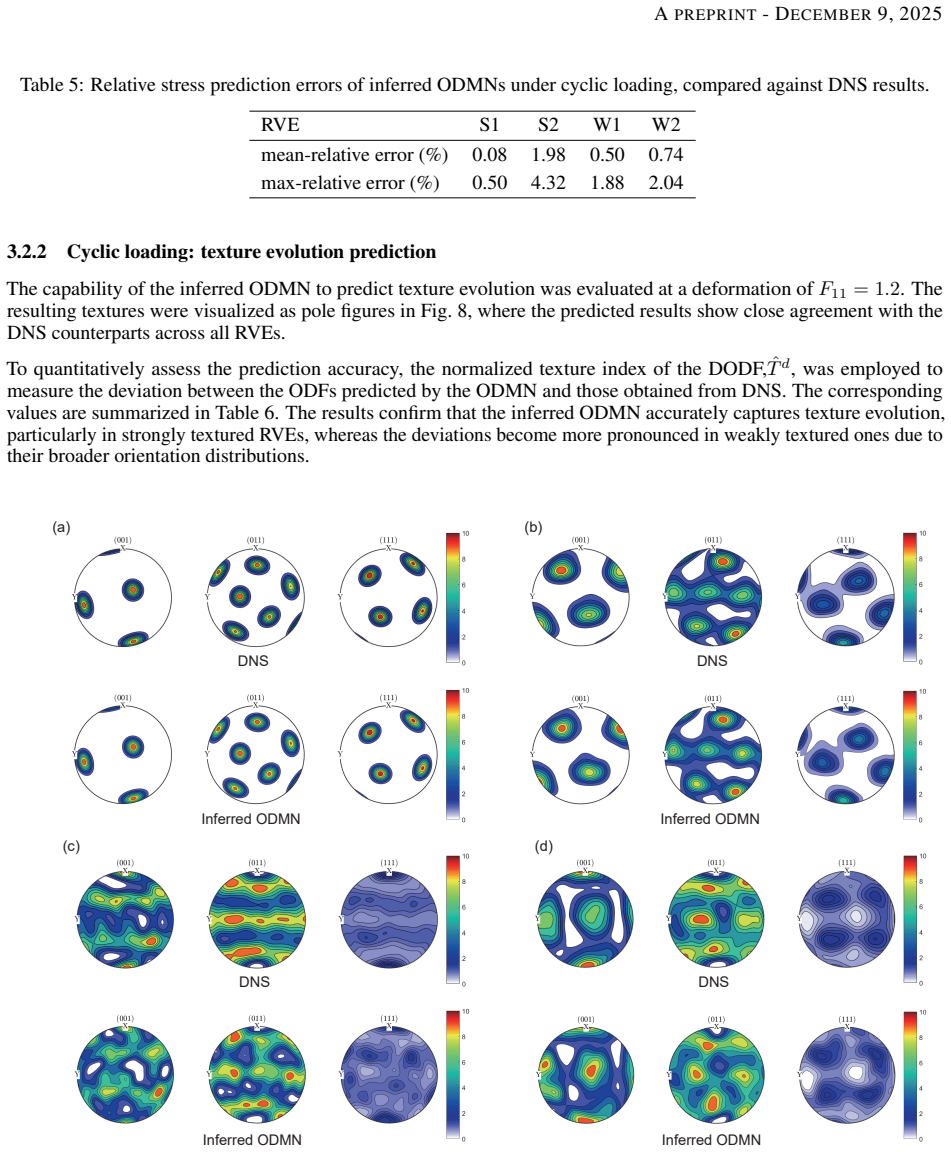
Machine learning surrogate models have emerged as a promising approach for accelerating multiscale materials simulations while preserving predictive fidelity. Among them, the Orientation-aware Interaction-based Deep Material Network (ODMN) provides a hierarchical homogenization framework in which material nodes encode crystallographic texture and interaction nodes enforce stress equilibrium under the Hill--Mandel condition. Trained solely on linear-elastic stiffness data, ODMN captures intrinsic microstructure--mechanics relationships, enabling accurate prediction of nonlinear mechanical responses and texture evolution. However, its applicability remains fundamentally limited by the absence of a parametric mapping from arbitrary microstructures to the ODMN parameter space. This limitation necessitates retraining for each new microstructure. To address this challenge, we reformulate ODMN generalization as a microstructure-to-parameter inference problem and propose the TACS--GNN--ODMN framework. The proposed framework combines a Texture-Adaptive Clustering and Sampling (TACS) scheme for texture representation with a Graph Neural Network (GNN) for inferring micromechanical equilibrium parameters. This strategy enables the construction of fully parameterized ODMNs for previously unseen microstructures without retraining. Numerical results demonstrate that the proposed framework accurately predicts nonlinear mechanical responses and texture evolution across diverse texture distributions. The predicted responses show close agreement with direct numerical simulations (DNS), highlighting the framework as a generalizable and physically interpretable surrogate model for microstructure-informed multiscale materials simulations.
Editorial analysis
A structured set of objections, weighed in public.
Referee Report
Summary. The manuscript proposes the TACS-GNN-ODMN framework to overcome the retraining requirement of the Orientation-aware Interaction-based Deep Material Network (ODMN). It combines Texture-Adaptive Clustering and Sampling (TACS) for microstructure representation with a Graph Neural Network (GNN) that infers micromechanical equilibrium parameters, enabling fully parameterized ODMNs for unseen textures. The central claim is that this yields accurate predictions of nonlinear mechanical responses and texture evolution that agree closely with direct numerical simulations (DNS), while preserving physical interpretability from the original ODMN trained only on linear-elastic data.
Significance. If the numerical evidence holds under rigorous validation, the work would represent a meaningful step toward generalizable, microstructure-aware surrogate models in polycrystal mechanics. It directly addresses the per-microstructure retraining bottleneck in deep material networks and could accelerate multiscale simulations while retaining the Hill-Mandel equilibrium enforcement that makes ODMN physically interpretable.
major comments (2)
- [Abstract / Numerical Results] Abstract and Numerical Results section: the repeated claim of 'close agreement with DNS' and 'accurate prediction' across diverse textures is unsupported by any quantitative error metrics (e.g., relative L2 errors on stress-strain curves, pole-figure intensity differences, or texture evolution RMSE). No training/validation split ratios, cross-validation procedure, or propagation analysis of GNN inference errors into the nonlinear regime are provided, leaving the central generalization claim without load-bearing numerical substantiation.
- [Methodology] Methodology (TACS-GNN-ODMN pipeline): the GNN is trained solely on equilibrium parameters extracted by TACS from a finite texture collection. No architectural constraint, auxiliary loss, or post-inference projection is described that would enforce satisfaction of the stress-equilibrium and Hill-Mandel conditions at interaction nodes for textures lying outside the training distribution. This leaves open the possibility that inferred parameters produce non-zero residuals, violating the physical consistency that the original ODMN relies upon.
minor comments (2)
- [Introduction] Clarify in the introduction or methods whether the GNN training data include only linear-elastic stiffness tensors or also sample nonlinear constitutive responses; the current description leaves this ambiguous.
- [Figures / Results] Figure captions and results tables should report explicit quantitative comparison metrics (error norms, R² values) rather than relying solely on visual overlay of curves.
Simulated Author's Rebuttal
We thank the referee for the thorough and constructive review. The comments highlight important aspects of quantitative validation and physical consistency that we will address to strengthen the manuscript. Below we respond point-by-point to the major comments.
read point-by-point responses
-
Referee: [Abstract / Numerical Results] Abstract and Numerical Results section: the repeated claim of 'close agreement with DNS' and 'accurate prediction' across diverse textures is unsupported by any quantitative error metrics (e.g., relative L2 errors on stress-strain curves, pole-figure intensity differences, or texture evolution RMSE). No training/validation split ratios, cross-validation procedure, or propagation analysis of GNN inference errors into the nonlinear regime are provided, leaving the central generalization claim without load-bearing numerical substantiation.
Authors: We agree that the current presentation relies primarily on visual comparisons in the figures without accompanying quantitative error metrics. In the revised manuscript we will add explicit quantitative measures, including mean relative L2 errors on stress-strain responses, average pole-figure intensity differences, and texture evolution RMSE across the test textures. We will also report the training/validation split (80/20 with 5-fold cross-validation) and include a short analysis of how GNN parameter inference errors propagate into the nonlinear regime. These additions will be placed in a new subsection of the Numerical Results section. revision: yes
-
Referee: [Methodology] Methodology (TACS-GNN-ODMN pipeline): the GNN is trained solely on equilibrium parameters extracted by TACS from a finite texture collection. No architectural constraint, auxiliary loss, or post-inference projection is described that would enforce satisfaction of the stress-equilibrium and Hill-Mandel conditions at interaction nodes for textures lying outside the training distribution. This leaves open the possibility that inferred parameters produce non-zero residuals, violating the physical consistency that the original ODMN relies upon.
Authors: The GNN learns a mapping from TACS-derived texture descriptors to the equilibrium parameters that were originally obtained by enforcing Hill-Mandel conditions on the training textures. For unseen textures the inference is therefore approximate. We acknowledge that the manuscript does not currently describe an explicit enforcement mechanism (auxiliary loss or projection) for out-of-distribution cases. In revision we will add a verification subsection that computes the residual of the stress-equilibrium and Hill-Mandel conditions on the inferred parameters for the held-out textures and report the magnitude of any violations. If residuals are non-negligible we will introduce a lightweight post-inference projection step onto the admissible parameter manifold; otherwise we will clarify that the physical consistency is inherited from the original ODMN training and preserved to within the observed residual tolerance. revision: partial
Circularity Check
Minor self-citation on ODMN base; GNN generalization validated against independent DNS benchmarks
full rationale
The paper builds ODMN on prior interaction-based homogenization (likely self-cited) but introduces new TACS-GNN mapping from texture to equilibrium parameters. The central claim of accurate nonlinear prediction and texture evolution for unseen microstructures is supported by direct numerical simulation (DNS) comparisons on diverse distributions, which serve as external falsifiable benchmarks. No load-bearing step reduces by construction to fitted inputs or self-citation chains; the GNN acts as a learned surrogate tested for out-of-distribution performance. This qualifies as standard surrogate modeling with independent validation rather than circular derivation.
Axiom & Free-Parameter Ledger
free parameters (2)
- GNN architecture hyperparameters
- TACS clustering parameters
axioms (1)
- domain assumption Hill-Mandel condition holds for the homogenized response
Reference graph
Works this paper leans on
-
[2]
Jain, Peidong Wu, Yichuan Shao, Dayong Li, and Yinghong Peng
Guowei Zhou, Mukesh K. Jain, Peidong Wu, Yichuan Shao, Dayong Li, and Yinghong Peng. Experiment and crystal plasticity analysis on plastic deformation of az31b mg alloy sheet under intermediate temperatures: How deformation mechanisms evolve.International Journal of Plasticity, 79:19–47, 2016
work page 2016
-
[3]
P.S. Bate and Y .G. An. Plastic anisotropy in aa5005 al–1mg: predictions using crystal plasticity finite element analysis.Scripta Materialia, 51(10):973–977, 2004
work page 2004
-
[4]
L. Delannay, M.A. Melchior, J.W. Signorelli, J.-F. Remacle, and T. Kuwabara. Influence of grain shape on the planar anisotropy of rolled steel sheets – evaluation of three models.Computational Materials Science, 45(3):739–743, 2009. Proceedings of the 17th International Workshop on Computational Mechanics of Materials
work page 2009
-
[5]
R.A. Lebensohn and C.N. Tomé. A self-consistent anisotropic approach for the simulation of plastic deformation and texture development of polycrystals: Application to zirconium alloys.Acta Metallurgica et Materialia, 41(9):2611–2624, 1993
work page 1993
-
[6]
P.A. Turner and C.N. Tomé. A study of residual stresses in zircaloy-2 with rod texture.Acta Metallurgica et Materialia, 42(12):4143–4153, 1994
work page 1994
- [7]
-
[8]
D D Tjahjanto, P Eisenlohr, and F Roters. A novel grain cluster-based homogenization scheme.Modelling and Simulation in Materials Science and Engineering, 18(1):015006, dec 2009
work page 2009
-
[9]
D D Tjahjanto, P Eisenlohr, and F Roters. Multiscale deep drawing analysis of dual-phase steels using grain cluster-based rgc scheme.Modelling and Simulation in Materials Science and Engineering, 23(4):045005, apr 2015
work page 2015
-
[10]
F. Roters, M. Diehl, P. Shanthraj, P. Eisenlohr, C. Reuber, S.L. Wong, T. Maiti, A. Ebrahimi, T. Hochrainer, H.-O. Fabritius, S. Nikolov, M. Friák, N. Fujita, N. Grilli, K.G.F. Janssens, N. Jia, P.J.J. Kok, D. Ma, F. Meier, E. Werner, M. Stricker, D. Weygand, and D. Raabe. Damask – the düsseldorf advanced material simulation kit for modeling multi-physics...
work page 2019
-
[11]
I. Temizer and P. Wriggers. An adaptive multiscale resolution strategy for the finite deformation analysis of microheterogeneous structures.Computer Methods in Applied Mechanics and Engineering, 200(37):2639–2661,
-
[12]
Special Issue on Modeling Error Estimation and Adaptive Modeling
-
[13]
P. Eisenlohr, M. Diehl, R.A. Lebensohn, and F. Roters. A spectral method solution to crystal elasto-viscoplasticity at finite strains.International Journal of Plasticity, 46:37–53, 2013. Microstructure-based Models of Plastic Deformation
work page 2013
-
[14]
P. Shanthraj, P. Eisenlohr, M. Diehl, and F. Roters. Numerically robust spectral methods for crystal plasticity simulations of heterogeneous materials.International Journal of Plasticity, 66(SI):31–45, MAR 2015
work page 2015
-
[15]
A. Vidyasagar, Abbas D. Tutcuoglu, and Dennis M. Kochmann. Deformation patterning in finite-strain crystal plasticity by spectral homogenization with application to magnesium.Computer Methods in Applied Mechanics and Engineering, 335:584–609, JUN 15 2018
work page 2018
-
[16]
Ricardo A. Lebensohn and Anthony D. Rollett. Spectral methods for full-field micromechanical modelling of polycrystalline materials.Computational materials science, 173, FEB 15 2020. 20 APREPRINT- DECEMBER9, 2025
work page 2020
-
[17]
Lallit Anand. Single-crystal elasto-viscoplasticity: application to texture evolution in polycrystalline metals at large strains.Computer Methods in Applied Mechanics and Engineering, 193(48):5359–5383, 2004. Advances in Computational Plasticity
work page 2004
-
[18]
Milan Ardeljan, Irene J. Beyerlein, and Marko Knezevic. A dislocation density based crystal plasticity finite element model: Application to a two-phase polycrystalline hcp/bcc composites.Journal of the Mechanics and Physics of Solids, 66:16–31, 2014
work page 2014
-
[19]
Milan Ardeljan, Irene J. Beyerlein, and Marko Knezevic. Effect of dislocation density-twin interactions on twin growth in az31 as revealed by explicit crystal plasticity finite element modeling.International Journal of Plasticity, 99:81–101, 2017
work page 2017
-
[20]
S.R. Kalidindi, C.A. Bronkhorst, and L. Anand. Crystallographic texture evolution in bulk deformation processing of fcc metals.Journal of the Mechanics and Physics of Solids, 40(3):537–569, 1992
work page 1992
-
[21]
Marko Knezevic, Amanda Levinson, Ryan Harris, Raja K. Mishra, Roger D. Doherty, and Surya R. Kalidindi. Deformation twinning in az31: Influence on strain hardening and texture evolution.Acta Materialia, 58(19):6230– 6242, 2010
work page 2010
-
[22]
Marko Knezevic, Mark R. Daymond, and Irene J. Beyerlein. Modeling discrete twin lamellae in a microstructural framework.Scripta Materialia, 121:84–88, 2016
work page 2016
-
[23]
Franz Roters, Philip Eisenlohr, Thomas R Bieler, and Dierk Raabe.Crystal Plasticity Finite Element Methods: In Materials Science and Engineering. John Wiley & Sons, Ltd, 2010
work page 2010
-
[24]
Cross-scale prediction from rve to component.International Journal of Plasticity, 140:102973, 2021
Xinxin Sun, Hongwei Li, Mei Zhan, Junyuan Zhou, Jian Zhang, and Jia Gao. Cross-scale prediction from rve to component.International Journal of Plasticity, 140:102973, 2021
work page 2021
-
[25]
Olga Ibragimova, Abhijit Brahme, Waqas Muhammad, Julie Lévesque, and Kaan Inal. A new ann based crystal plasticity model for fcc materials and its application to non-monotonic strain paths.International Journal of Plasticity, 144:103059, 2021
work page 2021
-
[26]
Guowei Zhou, Yuanzhe Hu, Zizheng Cao, Myoung Gyu Lee, and Dayong Li. A physics-constrained neural network for crystal plasticity modelling of fcc materials.Scripta Materialia, 241:115861, 2024
work page 2024
-
[27]
Colin Bonatti and Dirk Mohr. On the importance of self-consistency in recurrent neural network models representing elasto-plastic solids.Journal of the Mechanics and Physics of Solids, 158:104697, 2022
work page 2022
-
[28]
Colin Bonatti, Bekim Berisha, and Dirk Mohr. From cp-fft to cp-rnn: Recurrent neural network surrogate model of crystal plasticity.International Journal of Plasticity, 158:103430, 2022
work page 2022
-
[29]
Yuanzhe Hu, Guowei Zhou, Myoung-Gyu Lee, Peidong Wu, and Dayong Li. A temporal graph neural network for cross-scale modelling of polycrystals considering microstructure interaction.International Journal of Plasticity, 179:104017, 2024
work page 2024
-
[30]
Zeliang Liu and C.T. Wu. Exploring the 3d architectures of deep material network in data-driven multiscale mechanics.Journal of the Mechanics and Physics of Solids, 127:20–46, 2019
work page 2019
-
[31]
On the micromechanics of deep material networks
Sebastian Gajek, Matti Schneider, and Thomas Böhlke. On the micromechanics of deep material networks. Journal of the Mechanics and Physics of Solids, 142:103984, 2020
work page 2020
-
[32]
Van Dung Nguyen and Ludovic Noels. Micromechanics-based material networks revisited from the interaction viewpoint; robust and efficient implementation for multi-phase composites.European Journal of Mechanics - A/Solids, 91:104384, 2022
work page 2022
-
[33]
Ludovic Noels et al. Interaction-based material network: A general framework for (porous) microstructured materials.Computer Methods in Applied Mechanics and Engineering, 389:114300, 2022
work page 2022
-
[34]
Dongil Shin, Peter Jefferson Creveling, Scott Alan Roberts, and Rémi Dingreville. Deep material network for thermal conductivity problems: Application to woven composites.Computer Methods in Applied Mechanics and Engineering, 431:117279, 2024
work page 2024
-
[35]
Benedikt Sterr, Sebastian Gajek, Andrew Hrymak, Matti Schneider, and Thomas Böhlke. Deep material networks for fiber suspensions with infinite material contrast.International Journal for Numerical Methods in Engineering, 126(7):e70014, 2025
work page 2025
-
[36]
Jimmy Gaspard Jean, Tung Huan Su, Szu Jui Huang, Cheng-Tang Wu, and Chuin Shan Chen. Graph-enhanced deep material network: multiscale materials modeling with microstructural informatics.Computational Mechanics, 75:113–136, 2025
work page 2025
-
[37]
Wen-Ning Wan, Ting-Ju Wei, Tung-Huan Su, and Chuin-Shan Chen. Decoding material networks: exploring performance of deep material network and interaction-based material networks.Journal of Mechanics, 40:796–807, 2024. 21 APREPRINT- DECEMBER9, 2025
work page 2024
-
[38]
Ting-Ju Wei and Chuin-Shan Chen. Foundation model for composite microstructures: Reconstruction, stiffness, and nonlinear behavior prediction.Materials & Design, 257:114397, 2025
work page 2025
-
[39]
Ting-Ju Wei, Tung-Huan Su, and Chuin-Shan Chen. Orientation-aware interaction-based deep material network in polycrystalline materials modeling.Computer Methods in Applied Mechanics and Engineering, 441:117977, 2025
work page 2025
-
[40]
J Wanni, CA Bronkhorst, and DJ Thoma. Machine learning enhanced analysis of ebsd data for texture representa- tion.npj Computational Materials, 10(1):133, 2024
work page 2024
-
[41]
How Attentive are Graph Attention Networks?
Shaked Brody, Uri Alon, and Eran Yahav. How attentive are graph attention networks?arXiv preprint arXiv:2105.14491, 2021
work page internal anchor Pith review arXiv 2021
-
[42]
Michael A Groeber and Michael A Jackson. Dream. 3d: a digital representation environment for the analysis of microstructure in 3d.Integrating materials and manufacturing innovation, 3(1):56–72, 2014
work page 2014
-
[43]
Wei Dai, Huamiao Wang, Qiang Guan, Dayong Li, Yinghong Peng, and Carlos N Tomé. Studying the mi- cromechanical behaviors of a polycrystalline metal by artificial neural networks.Acta Materialia, 214:117006, 2021
work page 2021
-
[44]
Saiyi Li, Irene J. Beyerlein, David J. Alexander, and Sven C. V ogel. Texture evolution during multi-pass equal channel angular extrusion of copper: Neutron diffraction characterization and polycrystal modeling.Acta Materialia, 53(7):2111–2125, 2005
work page 2005
-
[45]
Timothy J. Barrett and Marko Knezevic. Deep drawing simulations using the finite element method embedding a multi-level crystal plasticity constitutive law: Experimental verification and sensitivity analysis.Computer Methods in Applied Mechanics and Engineering, 354:245–270, 2019
work page 2019
-
[46]
Damask documentation: Phenopowerlaw aa6022-t4, 2024
Max-Planck-Institut für Eisenforschung GmbH. Damask documentation: Phenopowerlaw aa6022-t4, 2024. Accessed: 21st June 2024
work page 2024
-
[47]
Tianyu Huang, Zeliang Liu, CT Wu, and Wei Chen. Microstructure-guided deep material network for rapid nonlinear material modeling and uncertainty quantification.Computer Methods in Applied Mechanics and Engineering, 398:115197, 2022
work page 2022
-
[48]
Dongil Shin, Ryan Alberdi, Ricardo A Lebensohn, and Rémi Dingreville. Deep material network via a quilting strategy: visualization for explainability and recursive training for improved accuracy.npj Computational Materials, 9(1):128, 2023. Appendix A Phenomenological Crystal Plasticity Model In this work, the phenomenological crystal plasticity framework ...
work page 2023
discussion (0)
Sign in with ORCID, Apple, or X to comment. Anyone can read and Pith papers without signing in.