Recognition: 2 theorem links
· Lean TheoremUniversality in quasinormal modes of a magnetized black hole
Pith reviewed 2026-05-16 23:48 UTC · model grok-4.3
The pith
A critical charge value makes the quasinormal modes of a magnetized black hole follow universal power-law scaling with exponent near 1/2.
A machine-rendered reading of the paper's core claim, the machinery that carries it, and where it could break.
Core claim
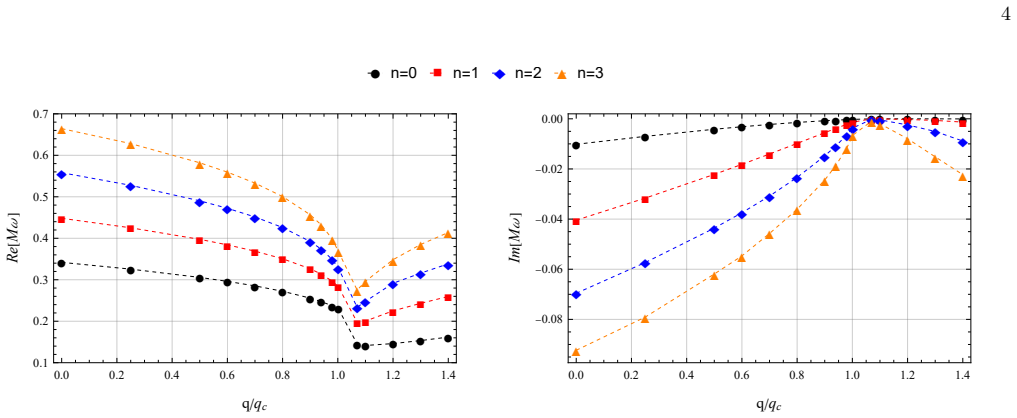
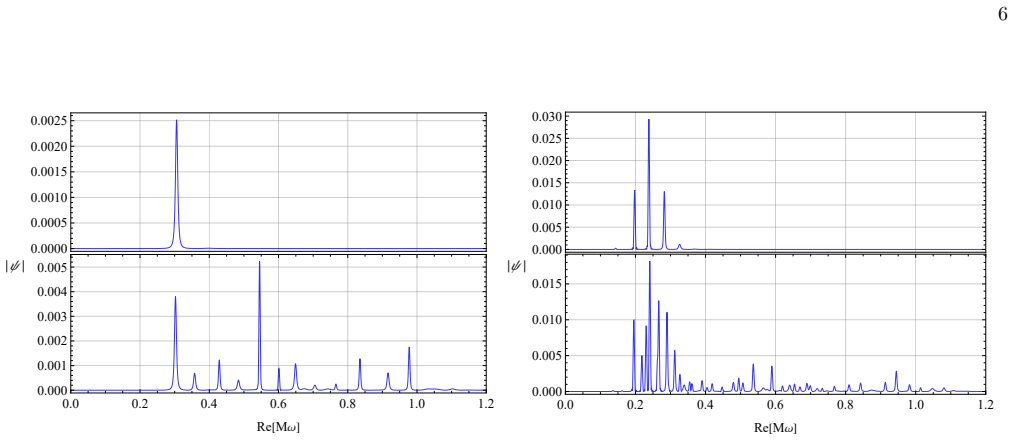
We find a critical value of the field charge at which the QNM spectrum exhibits universal power-law scaling with an exponent of approximately 1/2. This critical behavior admits a simple interpretation in terms of a transition between a confined regime, where waves remain effectively trapped within a region of characteristic size ~1/B, and a deconfined regime, where the field reaches distances >>1/B and the damping rate becomes parametrically small. These results provide qualitative and quantitative insights that may inform more realistic scenarios involving highly magnetized compact objects.
What carries the argument
Quasinormal modes of the charged scalar field in the static axially symmetric magnetized Einstein-Maxwell black hole background, computed with both frequency-domain and time-domain methods.
If this is right
- Damping rates become parametrically small once the waves enter the deconfined regime.
- The power-law scaling holds universally at the critical charge value.
- The confined-to-deconfined shift organizes wave propagation around the black hole in a simple way.
- The transition supplies a model for how strong magnetic fields affect the stability and ringing of compact objects.
Where Pith is reading between the lines
- The same scaling could appear in other magnetized spacetimes, such as slowly rotating black holes with external fields.
- Full nonlinear simulations near the critical charge would test whether the linear transition survives.
- The critical charge might leave imprints in electromagnetic or gravitational-wave signals from magnetized mergers.
Load-bearing premise
The spacetime is exactly the static axially symmetric magnetized Einstein-Maxwell solution and linear perturbation theory for the charged scalar field remains valid across the confined-deconfined transition.
What would settle it
Numerical computation of the quasinormal frequencies for several field-charge values straddling the reported critical point, followed by a power-law fit, would show whether the exponent is close to 1/2 or deviates.
Figures


read the original abstract
In this work, we investigate the linear stability of a magnetized Einstein-Maxwell solution describing a static, axially symmetric black hole (BH) immersed in a uniform magnetic field $B$. We probe the dynamics of an external charged scalar field through its quasinormal modes (QNMs), combining frequency- and time-domain analyses. We find a critical value of the field charge at which the QNM spectrum exhibits universal power-law scaling with an exponent of approximately $1/2$. This critical behavior admits a simple interpretation in terms of a transition between a confined regime, where waves remain effectively trapped within a region of characteristic size $\sim 1/B$, and a deconfined regime, where the field reaches distances $\gg 1/B$ and the damping rate becomes parametrically small. These results provide qualitative and quantitative insights that may inform more realistic scenarios involving highly magnetized compact objects.
Editorial analysis
A structured set of objections, weighed in public.
Referee Report
Summary. The manuscript investigates the linear stability of a static, axially symmetric magnetized Einstein-Maxwell black hole by computing quasinormal modes of an external charged scalar field. Frequency- and time-domain analyses are combined to identify a critical value of the field charge at which the QNM spectrum exhibits universal power-law scaling with an exponent of approximately 1/2. This behavior is interpreted as a transition between a confined regime (waves trapped within a region of size ~1/B) and a deconfined regime (damping rate parametrically small).
Significance. If the central numerical observation holds under closer scrutiny, the result offers a concrete example of universal scaling in QNMs that admits a simple physical interpretation in terms of confinement. The dual-method approach is a methodological strength. However, the current significance is limited by the absence of quantitative error analysis and by the unverified regime of validity of the linear test-field approximation.
major comments (2)
- [Abstract] Abstract and results sections: the reported critical charge value and the exponent ~1/2 are presented without error bars, convergence tests with respect to grid resolution or overtone number, or an explicit description of the fitting procedure used to extract the scaling from the numerical spectrum.
- [Linear perturbation analysis] Setup and linear perturbation analysis: the claim that the scaling persists into the deconfined regime rests on the assumption that linear charged-scalar perturbations on the fixed background remain accurate when Im(ω) becomes parametrically small. No bound on perturbation amplitude, comparison of linear versus nonlinear timescales, or check for scalar-induced corrections to the electromagnetic field is provided near the transition.
minor comments (2)
- [Notation] The notation for the magnetic field strength B and the charge parameter should be made fully consistent between the text, equations, and figure captions.
- [Figures] Figures displaying the QNM spectrum or the extracted scaling should include resolution or fitting-error indicators to allow readers to assess the robustness of the reported exponent.
Simulated Author's Rebuttal
We thank the referee for the careful reading and constructive comments on our manuscript. The points raised regarding quantitative error analysis and the regime of validity of the linear approximation are well taken. We address each major comment below and will prepare a revised manuscript incorporating the suggested improvements.
read point-by-point responses
-
Referee: [Abstract] Abstract and results sections: the reported critical charge value and the exponent ~1/2 are presented without error bars, convergence tests with respect to grid resolution or overtone number, or an explicit description of the fitting procedure used to extract the scaling from the numerical spectrum.
Authors: We agree that the presentation of the numerical results can be strengthened by including quantitative uncertainties. In the revised manuscript we will report error bars on the critical charge value and the fitted exponent, describe the fitting procedure in detail (including the range of frequencies used and the functional form assumed), and present convergence tests with respect to both grid resolution in the frequency-domain solver and the number of overtones retained in the time-domain analysis. revision: yes
-
Referee: [Linear perturbation analysis] Setup and linear perturbation analysis: the claim that the scaling persists into the deconfined regime rests on the assumption that linear charged-scalar perturbations on the fixed background remain accurate when Im(ω) becomes parametrically small. No bound on perturbation amplitude, comparison of linear versus nonlinear timescales, or check for scalar-induced corrections to the electromagnetic field is provided near the transition.
Authors: The analysis throughout the paper is performed strictly within the linear test-field approximation on a fixed background, which is the conventional framework for QNM studies. We recognize that the parametrically small damping rates near the transition warrant additional discussion of the approximation's domain of validity. In the revision we will add a dedicated paragraph providing order-of-magnitude estimates for the perturbation amplitude at which nonlinear effects would become comparable to the linear damping, together with a comparison of the linear evolution timescale to the expected nonlinear timescale. A full nonlinear evolution or explicit computation of scalar back-reaction on the electromagnetic field lies outside the scope of the present work. revision: partial
Circularity Check
No circularity: scaling is numerically observed on external background
full rationale
The central claim (critical charge value with ~1/2 power-law QNM scaling) is obtained by direct numerical computation in frequency- and time-domain on a fixed magnetized Einstein-Maxwell background taken from prior literature. No equation reduces the scaling to a fitted parameter by construction, no self-citation chain justifies the uniqueness of the result, and the transition interpretation follows from the computed damping rates rather than being presupposed. The derivation is self-contained against external benchmarks.
Axiom & Free-Parameter Ledger
free parameters (1)
- critical charge value
axioms (2)
- domain assumption Linear perturbation theory applies to the charged scalar field on the fixed magnetized background
- standard math The background is the exact static axially symmetric solution of the Einstein-Maxwell equations in a uniform magnetic field
Lean theorems connected to this paper
-
IndisputableMonolith/Cost/FunctionalEquation.leanwashburn_uniqueness_aczel unclear?
unclearRelation between the paper passage and the cited Recognition theorem.
We find a critical value of the field charge at which the QNM spectrum exhibits universal power-law scaling with an exponent of approximately 1/2. ... d∼|q−qc|−γ ... Re[ω]∼|q−qc|1/2
-
IndisputableMonolith/Foundation/AbsoluteFloorClosure.leanreality_from_one_distinction unclear?
unclearRelation between the paper passage and the cited Recognition theorem.
the effective potential ... lim r→∞ Veff ∼ r^6 ... at the critical charge qc = mB ... quadratic growth similar to the AdS case
What do these tags mean?
- matches
- The paper's claim is directly supported by a theorem in the formal canon.
- supports
- The theorem supports part of the paper's argument, but the paper may add assumptions or extra steps.
- extends
- The paper goes beyond the formal theorem; the theorem is a base layer rather than the whole result.
- uses
- The paper appears to rely on the theorem as machinery.
- contradicts
- The paper's claim conflicts with a theorem or certificate in the canon.
- unclear
- Pith found a possible connection, but the passage is too broad, indirect, or ambiguous to say the theorem truly supports the claim.
Reference graph
Works this paper leans on
-
[1]
On the gravitational field of a mass point according to Einstein's theory
K. Schwarzschild, On the gravitational field of a mass point according to einstein’s theory (1999), arXiv:physics/9905030. 8
work page internal anchor Pith review Pith/arXiv arXiv 1999
-
[2]
H. Stephani, D. Kramer, M. MacCallum, C. Hoenselaers, and E. Herlt,Exact solutions of Einstein’s field equations (Cambridge university press, 2009)
work page 2009
-
[3]
J. B. Griffiths and J. Podolsk` y,Exact space-times in Einstein’s general relativity(Cambridge University Press, 2009)
work page 2009
-
[4]
Observation of Gravitational Waves from a Binary Black Hole Merger
B. Abbott, R. Abbott, T. Abbott,et al., Phys. Rev. Lett. 116, 061102 (2016), arXiv:1602.03837
work page internal anchor Pith review Pith/arXiv arXiv 2016
-
[5]
M. C. Guzzetti, N. Bartolo, M. Liguori,et al., Riv. Nuovo Cim.39, 399 (2016), arXiv:1605.01615
work page internal anchor Pith review Pith/arXiv arXiv 2016
- [6]
-
[7]
A Radio Counterpart to a Neutron Star Merger
G. Hallinan, A. Corsi, K. Mooley,et al., Science358, 1579 (2017), arXiv:1710.05435
work page internal anchor Pith review Pith/arXiv arXiv 2017
-
[8]
E. Abdalla, E. G. Ferreira, R. G. Landim,et al., A&A 664, A14 (2022), arXiv:2107.01633
-
[10]
R. D. Blandford and D. Payne, Mon. Not. Roy. Astron. Soc.199, 883 (1982)
work page 1982
-
[11]
Zhang, Nature587, 45 (2020), arXiv:2011.03500
B. Zhang, Nature587, 45 (2020), arXiv:2011.03500
- [12]
-
[13]
Stability of general-relativistic accretion disks
O. Korobkin, E. B. Abdikamalov, E. Schnetter,et al., Phys. Rev. D83, 043007 (2011), arXiv:1011.3010
work page internal anchor Pith review Pith/arXiv arXiv 2011
-
[14]
S. A. Balbus and J. F. Hawley, Rev. Mod. Phys.70, 1 (1998)
work page 1998
-
[15]
Stability and quasinormal modes of the massive scalar field around Kerr black holes
R. Konoplya and A. Zhidenko, Phys. Rev. D73, 124040 (2006), arXiv:gr-qc/0605013
work page internal anchor Pith review Pith/arXiv arXiv 2006
-
[16]
Superradiant instability of black holes immersed in a magnetic field
R. Brito, V. Cardoso, and P. Pani, Phys. Rev. D89 (2014), arXiv:1405.2098
work page internal anchor Pith review Pith/arXiv arXiv 2014
- [17]
- [18]
-
[19]
Z. Zhu, S. J. Zhang, C. Pellicer,et al., Phys. Rev. D90 (2014), arXiv:1405.4931
work page internal anchor Pith review Pith/arXiv arXiv 2014
- [20]
-
[21]
V. P. de Freitas and A. Saa, Phys. Rev. D95(2017), arXiv:1703.10883
work page internal anchor Pith review Pith/arXiv arXiv 2017
-
[22]
F. J. Ernst, J.Math.Phys.17, 54 (1976)
work page 1976
-
[23]
S. Shaymatov, M. Jamil, K. Jusufi,et al., Eur. Phys. J. C82, 636 (2022), arXiv:2205.00270
-
[24]
K. R. Nayak and C. Vishveshwara, Gen. Relativ. Gravit. 29, 291 (1997)
work page 1997
-
[25]
Quasinormal modes of black holes immersed in a strong magnetic field
R. Konoplya and R. Fontana, Phys. Lett B659, 375 (2008), arXiv:0707.1156
work page internal anchor Pith review Pith/arXiv arXiv 2008
-
[26]
G. T. Horowitz and H. J. Sheinblatt, Phys. Rev. D55, 650 (1997), arXiv:gr-qc/9607027
work page internal anchor Pith review Pith/arXiv arXiv 1997
-
[27]
M. W. Choptuik, Phys. Rev. Lett.70, 9 (1993)
work page 1993
- [28]
-
[29]
S. E. Gralla and P. Zimmerman, JHEP2018(6), 1, arXiv:1804.04753
work page internal anchor Pith review Pith/arXiv arXiv
-
[30]
R. B´ ecar, P. Gonz´ alez, and Y. V´ asquez, Eur. Phys. J. C 83, 75 (2023), arXiv:2211.02931
-
[31]
M. A. Melvin, Phys. Lett.8, 65 (1964)
work page 1964
-
[32]
K. S. Thorne, Phys. Rev.139, B244 (1965)
work page 1965
-
[33]
W. J. Wild and R. M. Kerns, Phys. Rev. D21, 332 (1980)
work page 1980
-
[34]
N. Dadhich, C. Hoenselaers, and C. Vishveshwara, J. Phys. A Gen. Phys.12, 215 (1979)
work page 1979
-
[35]
Photon capture cones and embedding diagrams of the Ernst spacetime
Z. Stuchl´ ık and S. Hled´ ık, Class. Quant. Grav.16, 1377 (1999), arXiv:0803.2536
work page internal anchor Pith review Pith/arXiv arXiv 1999
-
[36]
Magnetically Arrested Disk: An Energetically Efficient Accretion Flow
R. Narayan, I. V. Igumenshchev, and M. A. Abramowicz, Astron. Soc. Jap.55, L69 (2003), arXiv:astro-ph/0305029
work page internal anchor Pith review Pith/arXiv arXiv 2003
-
[37]
M. Romanova, G. Ustyugova, A. Koldoba,et al., Astro- phys. J.500, 703 (1998)
work page 1998
-
[38]
M. A. Abramowicz, M. Bejger, and M. Wielgus, Astrophys. J.868, 17 (2018), arXiv:1704.05931
work page internal anchor Pith review Pith/arXiv arXiv 2018
-
[39]
Auffinger,Primordial black hole constraints with Hawking radiation—A review,Prog
J. Auffinger, Prog. Part. Nucl. Phys131, 104040 (2023), arXiv:2206.02672
- [40]
- [41]
discussion (0)
Sign in with ORCID, Apple, or X to comment. Anyone can read and Pith papers without signing in.