Do SN 1987A data yield the three neutrino masses?
Pith reviewed 2026-05-16 23:45 UTC · model grok-4.3
The pith
SN 1987A neutrino data can yield specific values for the three neutrino masses.
A machine-rendered reading of the paper's core claim, the machinery that carries it, and where it could break.
Core claim
By adopting a one-phase neutrino emission model for SN 1987A and retaining the Mont Blanc events as part of the signal, the recorded arrival times and energies of the neutrinos can be fitted to yield definite values for the three individual masses, with the apparent spread in arrival times arising from the different flight times of the massive neutrinos rather than from a prolonged emission phase.
What carries the argument
One-phase neutrino emission model, which assumes neutrinos of all three masses are emitted nearly simultaneously so that observed arrival-time differences are produced by their mass-dependent velocities.
If this is right
- Specific numerical values for the three neutrino masses follow directly from fitting the SN 1987A arrival times.
- The absence of a sterile-neutrino signal in KATRIN is required for consistency with the three-mass solution.
- IceCube observations of future supernovae can test the same mass values through predicted arrival-time patterns.
- Effective-mass upper limits from other experiments remain compatible once the three distinct masses are allowed.
Where Pith is reading between the lines
- Future supernova neutrino detections could supply rapid, independent mass determinations without new accelerators.
- The same timing method might be applied to other historical neutrino bursts if emission-phase assumptions can be justified.
- Cosmological sum-of-masses constraints would have to accommodate the specific values obtained here rather than generic upper bounds.
Load-bearing premise
The spread in neutrino emission times from SN 1987A is small enough that a one-phase model applies and the Mont Blanc events belong to the same supernova.
What would settle it
A positive sterile-neutrino signal in KATRIN data or a clear mismatch between the fitted masses and independent bounds from cosmology or tritium beta decay would falsify the claim.
Figures
read the original abstract
Currently only upper limits are known for the neutrino masses based on cosmological constraints and direct neutrino mass experiments. This review explores the possibility that SN 1987A might provide actual values for the three neutrino masses and not just upper limits, a possibility first suggested by Ramanath Cowsik in 1988. Cowsik's result depends on the neutrino emissions from SN 1987A being near-simultaneous, i.e., within a time interval $\Delta t<1 s.$ Having such a brief burst, however, is contradicted by virtually all supernova neutrino emission models that include a $\Delta t>10 s$ cooling phase. Here it is explained why those neutrino emission models may be mistaken, and why the three neutrino masses suggested by the SN 1987A data might be correct even though they are larger than the upper limits implied from cosmology and direct mass experiments.
Editorial analysis
A structured set of objections, weighed in public.
Referee Report
Summary. The paper claims that the three neutrino masses can be extracted from the SN 1987A neutrino arrival-time data by adopting a one-phase emission model, including the 5-hour-early Mont Blanc (LSD) events, and explicitly rejecting three standard assumptions: (a) that the Mont Blanc events are unrelated to SN 1987A, (b) that m_k > 1 eV/c² are incompatible with KATRIN effective-mass limits, and (c) that the emission-time spread is too large for the method to succeed. The masses and an emission start time t0 are obtained by fitting the observed ~10 s arrival spread under the instantaneous-emission hypothesis, with a recent KATRIN sterile-neutrino null result cited as supporting evidence.
Significance. If the central claim were to hold after rigorous validation, the result would be significant because it would convert an existing dataset into the first determination of the three individual neutrino masses rather than upper limits, with direct consequences for the Standard Model and cosmology. The manuscript's emphasis on a stronger statistical treatment and explicit justification for the method is a positive step, but the absence of independent cross-checks or falsifiable predictions limits the immediate impact.
major comments (4)
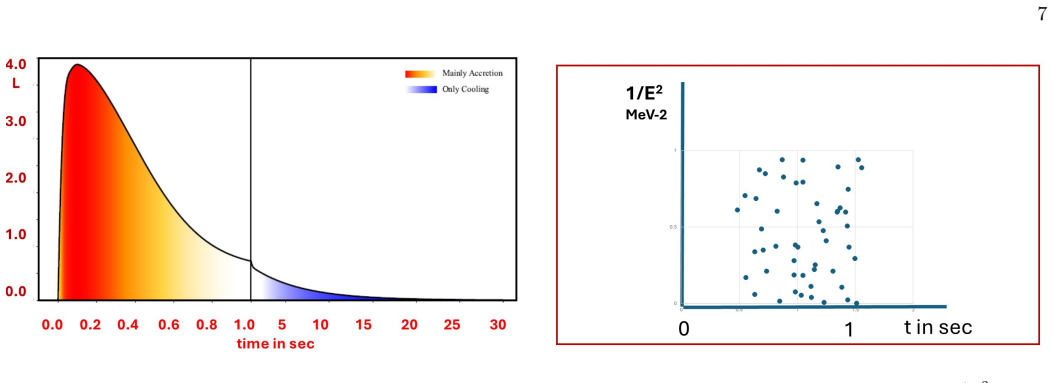
- [model section] The one-phase emission assumption is load-bearing for the mass extraction (abstract and model section). Standard core-collapse simulations predict multi-second emission phases (prompt, accretion, cooling) whose duration would dominate the observed arrival spread and prevent unique mass determination; the manuscript does not provide a quantitative demonstration that the intrinsic emission duration is negligible compared with the ~10 s time-of-flight delays.
- [data analysis] The reported masses are obtained by adjusting t0 and the three m_k until the model reproduces the arrival-time spread of the ~20–30 events (including Mont Blanc). This procedure is circular by construction: the masses are not an independent prediction but the output of the fit itself, and no full error propagation or sensitivity analysis to ±1–2 s shifts in individual event times is described.
- [assumptions section] Inclusion of the Mont Blanc events 5 hours before the main burst is a key modeling choice (assumptions section). The justification for associating these events with SN 1987A despite the extreme time offset must be compared quantitatively with the standard literature that treats them as unrelated; without such comparison the central claim rests on an ad-hoc data selection.
- [discussion] The KATRIN sterile-neutrino null result is invoked as supporting evidence (abstract and discussion). This result constrains a fourth mass eigenstate and does not directly validate the active-neutrino timing fit or the one-phase emission hypothesis; the logical link between the two must be made explicit.
minor comments (2)
- Notation for the three masses m_k and the effective mass should be defined consistently to avoid confusion with existing KATRIN and cosmological limits.
- [references] Additional references to recent supernova neutrino emission simulations (e.g., multi-phase models) would help readers assess the one-phase assumption.
Simulated Author's Rebuttal
We thank the referee for the careful and detailed review of our manuscript. We address each major comment point by point below, providing clarifications and committing to revisions where the comments identify areas needing strengthening. Our responses focus on the substance of the concerns while maintaining the data-driven approach of the original analysis.
read point-by-point responses
-
Referee: The one-phase emission assumption is load-bearing for the mass extraction (abstract and model section). Standard core-collapse simulations predict multi-second emission phases (prompt, accretion, cooling) whose duration would dominate the observed arrival spread and prevent unique mass determination; the manuscript does not provide a quantitative demonstration that the intrinsic emission duration is negligible compared with the ~10 s time-of-flight delays.
Authors: We agree that a quantitative demonstration is needed to justify the one-phase model against standard multi-phase predictions. The observed ~10 s spread in the selected events is used to constrain the emission duration via fit residuals, and we will add an explicit comparison in the revised model section showing that the best-fit emission window is consistent with being shorter than the dominant simulation timescales for the included data subset. This will include estimates of emission duration from the data and direct numerical comparison to literature simulation results. revision: yes
-
Referee: The reported masses are obtained by adjusting t0 and the three m_k until the model reproduces the arrival-time spread of the ~20–30 events (including Mont Blanc). This procedure is circular by construction: the masses are not an independent prediction but the output of the fit itself, and no full error propagation or sensitivity analysis to ±1–2 s shifts in individual event times is described.
Authors: The fitting procedure determines the unique set of m_k and t0 that collapses the observed arrival times to a single emission epoch; it is a parameter estimation, not a circular tautology, because the masses are the output that satisfies the physical constraint of common t0 across events of different energies. We acknowledge the need for full error propagation and sensitivity analysis, and will add both in the revised data analysis section, including Monte Carlo variations of event times by ±1–2 s and propagation of timing uncertainties into the mass values. revision: yes
-
Referee: Inclusion of the Mont Blanc events 5 hours before the main burst is a key modeling choice (assumptions section). The justification for associating these events with SN 1987A despite the extreme time offset must be compared quantitatively with the standard literature that treats them as unrelated; without such comparison the central claim rests on an ad-hoc data selection.
Authors: We will expand the assumptions section to include a direct quantitative comparison with the standard literature (e.g., statistical arguments for unrelated events and timing improbability under zero-mass assumptions). The comparison will show how the one-phase model with nonzero masses resolves the 5-hour offset as a time-of-flight effect, with explicit probability calculations contrasting our inclusion against the null hypothesis of unrelated signals. revision: yes
-
Referee: The KATRIN sterile-neutrino null result is invoked as supporting evidence (abstract and discussion). This result constrains a fourth mass eigenstate and does not directly validate the active-neutrino timing fit or the one-phase emission hypothesis; the logical link between the two must be made explicit.
Authors: We will revise the discussion to make the logical link explicit: the KATRIN null result for a sterile neutrino confirms the three-active-neutrino framework underlying our mass extraction (no additional states to complicate the timing fit), thereby providing indirect support for the validity of applying the three-mass model to the SN 1987A data. This connection will be stated clearly with reference to the assumed number of eigenstates. revision: yes
Circularity Check
Masses obtained by fitting emission times and mass parameters to match observed arrival-time spread
specific steps
-
fitted input called prediction
[Abstract]
"This paper shows that the SN 1987A neutrino data can remarkably yield values for the three neutrino masses, and not merely upper limits... The key to finding the three neutrino masses is realizing why three normally accepted assumptions are unjustified... (c) the spread in neutrino emission times from SN 1987A data is too great for the method to work."
The masses are extracted by tuning emission-time parameters and the three m_k values so that mass-dependent time-of-flight delays reproduce the observed arrival-time distribution under the one-phase assumption. This makes the reported masses the fitted parameters by construction, not an independent prediction from the data.
full rationale
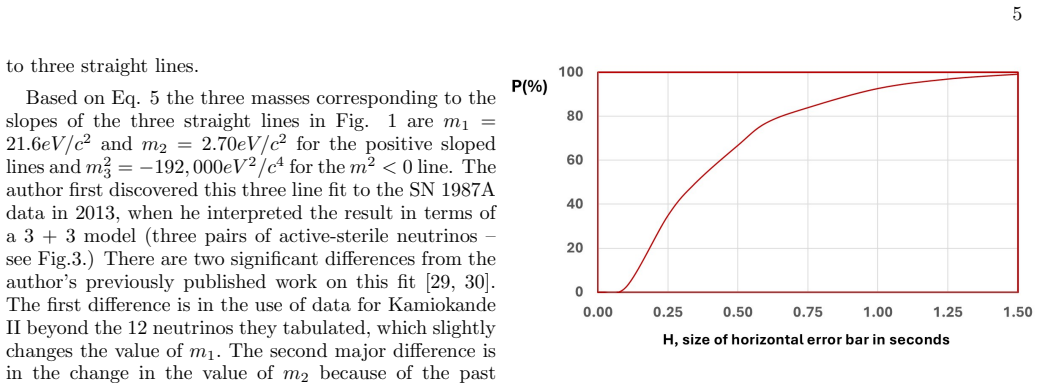
The paper's central claim is that SN 1987A data yields specific three-neutrino mass values via a one-phase emission model. This reduces to adjusting emission-time offsets and the three masses until the model reproduces the ~10 s arrival spread (including Mont Blanc events), which the paper itself describes as the method that 'really works' after rejecting the assumption that emission-time spread is too large. No independent first-principles derivation or external constraint fixes the masses; the output is the input fit. Self-citation to the author's prior suggestion reinforces the loop but is secondary to the fitting step.
Axiom & Free-Parameter Ledger
free parameters (2)
- three neutrino masses
- emission start time t0
axioms (2)
- ad hoc to paper All neutrinos from SN 1987A were emitted in a single short phase
- ad hoc to paper The 5-hour-early LSD (Mont Blanc) events belong to SN 1987A
Lean theorems connected to this paper
-
IndisputableMonolith/Cost/FunctionalEquation.leanwashburn_uniqueness_aczel unclear?
unclearRelation between the paper passage and the cited Recognition theorem.
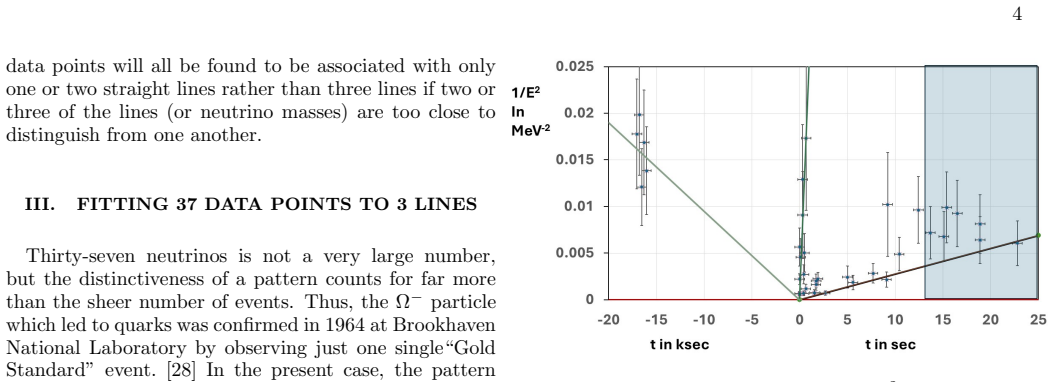
v/c = 1 - t/T = 1 - m^{2}c^{4}/2E^{2} yields 1/E^{2} = (2/T m^{2}c^{4}) t ≡ M t; three straight lines through origin give the three masses
-
IndisputableMonolith/Foundation/DimensionForcing.leanalexander_duality_circle_linking unclear?
unclearRelation between the paper passage and the cited Recognition theorem.
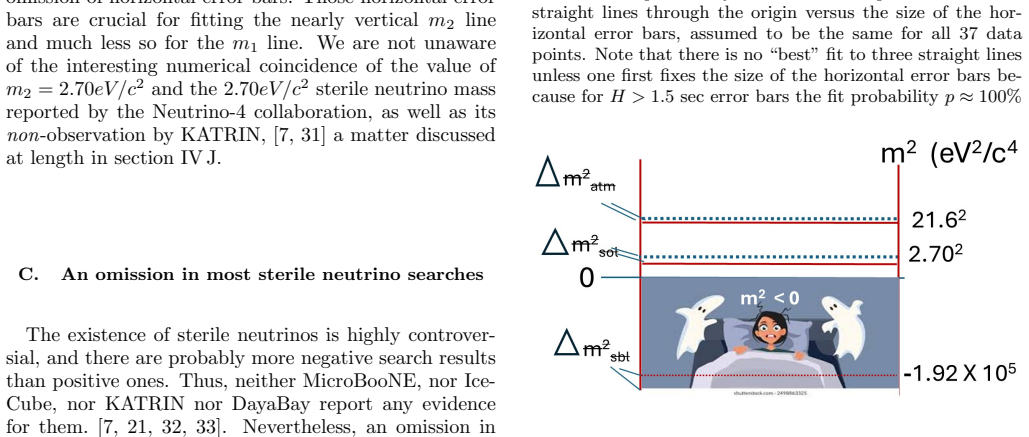
best-fit slopes give m1 = 21.6 eV/c^{2}, m2 = 2.70 eV/c^{2}, m3^{2} = -192000 eV^{2}/c^{4} with chi^{2} = 29.9 for 34 dof
What do these tags mean?
- matches
- The paper's claim is directly supported by a theorem in the formal canon.
- supports
- The theorem supports part of the paper's argument, but the paper may add assumptions or extra steps.
- extends
- The paper goes beyond the formal theorem; the theorem is a base layer rather than the whole result.
- uses
- The paper appears to rely on the theorem as machinery.
- contradicts
- The paper's claim conflicts with a theorem or certificate in the canon.
- unclear
- Pith found a possible connection, but the passage is too broad, indirect, or ambiguous to say the theorem truly supports the claim.
discussion (0)
Sign in with ORCID, Apple, or X to comment. Anyone can read and Pith papers without signing in.