Recovering long-range cumulative response to geometric frustration in quasi-1d systems, mediated by constitutive softness
Pith reviewed 2026-05-16 22:42 UTC · model grok-4.3
The pith
Introducing a soft shear response mode recovers long-range cumulative geometric frustration in quasi-one-dimensional systems by tuning the longitudinal to transverse moduli ratio.
A machine-rendered reading of the paper's core claim, the machinery that carries it, and where it could break.
Core claim
Cumulative geometric frustration in quasi-one-dimensional systems is suppressed by the inability to form long-range longitudinal gradients due to slenderness. By introducing a soft response mode that reduces the transverse shear modulus relative to the longitudinal one, the cumulative effects are recovered, enabling the frustration to influence assembly and morphology across the entire system length.
What carries the argument
A tunable soft shear response mode that permits independent control over the ratio of longitudinal and transverse moduli.
If this is right
- Size-dependent energetic costs from frustration become effective in driving self-limited growth in quasi-1D geometries.
- Different mechanisms of geometric frustration all exhibit recovered cumulative responses once the soft shear mode is added.
- Material design can control morphology selection by adjusting the longitudinal-to-shear modulus ratio rather than changing geometry alone.
Where Pith is reading between the lines
- Engineered metamaterials could use tunable shear softness to create structures whose final shape depends on total length.
- The same modulus-ratio tuning might restore cumulative effects in other geometries where gradient formation is normally suppressed.
- Biological filaments that incorporate compliant shear elements may already exploit this route to achieve length-sensitive assembly.
Load-bearing premise
The soft shear mode can be introduced without causing additional instabilities or interfering with the primary geometric frustration.
What would settle it
Simulating a quasi-1D chain of frustrated elements while lowering the shear modulus and checking whether the total elastic energy begins to scale quadratically with system length rather than remaining linear.
Figures


read the original abstract
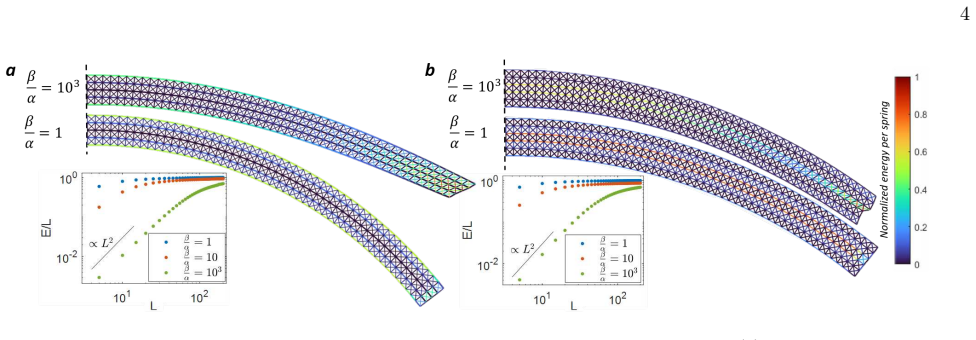
Cumulative geometric frustration can drive self-limited assembly and morphology selection through size-dependent energetic costs. However, the slenderness of quasi-one-dimensional systems generally suppresses the formation of long-range longitudinal gradients. We show that the suppression of longitudinal gradients can be overcome by tuning the ratio between the longitudinal and transverse (shear) moduli. We demonstrate the recovery of cumulative frustration across distinct quasi-one-dimensional systems, each frustrated through a different mechanism, by the introduction of a soft response mode.
Editorial analysis
A structured set of objections, weighed in public.
Referee Report
Summary. The manuscript claims that slenderness in quasi-1D elastic systems suppresses long-range longitudinal gradients and thus cumulative geometric frustration, but that this suppression can be overcome by tuning the longitudinal-to-shear modulus ratio to activate a soft transverse response mode. The recovery is demonstrated across multiple distinct quasi-1D systems, each with a different geometric frustration mechanism.
Significance. If the central claim is substantiated, the result would be significant for the mechanics of geometrically frustrated soft matter. It supplies a constitutive route (modulus anisotropy) to restore long-range cumulative effects in slender geometries without altering the geometric sources of frustration, which could inform models of self-limited assembly and morphology selection in filaments, fibers, and metamaterials. The cross-mechanism demonstration is a strength.
major comments (1)
- [Demonstration sections (mechanism-specific results)] The central claim requires that the soft shear mode can be introduced by lowering the shear modulus without inducing instabilities (e.g., Euler buckling or shear banding) or altering the original frustration mechanisms. No stability analysis or critical-modulus threshold is supplied for the slenderness ratios and boundary conditions used in the demonstrations; this is load-bearing because the recovered cumulative response would be inaccessible or contaminated if instabilities appear inside the relevant parameter window.
minor comments (1)
- [Abstract] The abstract states the result but supplies no equations, specific modulus-ratio values, or validation checks; adding one concrete numerical example would improve accessibility.
Simulated Author's Rebuttal
We are grateful to the referee for their positive assessment of the significance of our work and for the constructive major comment. We address the point below.
read point-by-point responses
-
Referee: [Demonstration sections (mechanism-specific results)] The central claim requires that the soft shear mode can be introduced by lowering the shear modulus without inducing instabilities (e.g., Euler buckling or shear banding) or altering the original frustration mechanisms. No stability analysis or critical-modulus threshold is supplied for the slenderness ratios and boundary conditions used in the demonstrations; this is load-bearing because the recovered cumulative response would be inaccessible or contaminated if instabilities appear inside the relevant parameter window.
Authors: We thank the referee for highlighting this important point. The geometric sources of frustration in each demonstration are fixed by the system geometry and are independent of the constitutive moduli, so lowering the shear modulus does not alter the frustration mechanisms themselves. Regarding stability, the parameter regimes in our demonstrations were selected such that the computed responses remain smooth and continuous, with no evidence of discontinuous jumps or bifurcations that would indicate Euler buckling or shear banding. To strengthen the manuscript, we will add an explicit stability analysis (in the main text or an appendix) that derives the critical shear-to-longitudinal modulus thresholds for the onset of these instabilities under the specific slenderness ratios and boundary conditions employed. This will confirm that our chosen modulus ratios lie safely in the stable regime while still activating the soft transverse mode. We anticipate that this addition will support rather than alter the central claims. revision: yes
Circularity Check
No circularity in derivation chain
full rationale
The paper claims that suppression of longitudinal gradients in quasi-1D systems is overcome by tuning the longitudinal-to-shear modulus ratio, thereby recovering cumulative geometric frustration via a soft response mode. No equations, definitions, or steps in the abstract or described claims reduce a prediction to a fitted input, self-definition, or self-citation chain. The mechanism is framed as a direct consequence of standard linear elasticity constitutive relations, with the modulus ratio serving as an independent tunable parameter rather than a quantity derived from the target frustration response. The derivation remains self-contained against external elastic benchmarks and does not invoke uniqueness theorems or ansatzes from prior self-work that would collapse the result to its inputs.
Axiom & Free-Parameter Ledger
free parameters (1)
- longitudinal to shear modulus ratio
axioms (1)
- domain assumption Quasi-1D systems obey linear continuum elasticity with distinct longitudinal and transverse shear moduli
invented entities (1)
-
soft response mode
no independent evidence
Lean theorems connected to this paper
-
IndisputableMonolith/Cost/FunctionalEquation.leanwashburn_uniqueness_aczel unclear?
unclearRelation between the paper passage and the cited Recognition theorem.
We show that the suppression of longitudinal gradients can be overcome by tuning the ratio between the longitudinal and transverse (shear) moduli... by the introduction of a soft response mode.
-
IndisputableMonolith/Foundation/AbsoluteFloorClosure.leanreality_from_one_distinction unclear?
unclearRelation between the paper passage and the cited Recognition theorem.
The compatibility condition becomes δ = η′ + ξ... energy of the optimal cumulative response scales as α(l0−l1)²L³/24l̄³
What do these tags mean?
- matches
- The paper's claim is directly supported by a theorem in the formal canon.
- supports
- The theorem supports part of the paper's argument, but the paper may add assumptions or extra steps.
- extends
- The paper goes beyond the formal theorem; the theorem is a base layer rather than the whole result.
- uses
- The paper appears to rely on the theorem as machinery.
- contradicts
- The paper's claim conflicts with a theorem or certificate in the canon.
- unclear
- Pith found a possible connection, but the passage is too broad, indirect, or ambiguous to say the theorem truly supports the claim.
Reference graph
Works this paper leans on
-
[1]
Cumulative geometric frustration in phy sical assemblies
Snir Meiri and Efi Efrati. Cumulative geometric frustration in phy sical assemblies. Physical Review E , 104(5):054601, November 2021
work page 2021
- [2]
discussion (0)
Sign in with ORCID, Apple, or X to comment. Anyone can read and Pith papers without signing in.