Single-layer framework of variational tensor network states
Pith reviewed 2026-05-16 21:55 UTC · model grok-4.3
The pith
A single-layer tensor network method with automatic differentiation reduces computational cost by three orders of magnitude for variational ground states of two-dimensional quantum lattice models.
A machine-rendered reading of the paper's core claim, the machinery that carries it, and where it could break.
Core claim
The authors establish that a single-layer nested tensor network combined with automatic differentiation yields a three-order-of-magnitude reduction in computational cost with respect to bond dimension. This enables variational ground-state calculations at bond dimension nine on standard two-dimensional spin models, producing accurate energies and order parameters that match prior studies. In the Shastry-Sutherland model the method identifies an intermediate empty-plaquette valence bond solid ground state between the plaquette valence bond solid and the antiferromagnetic phases.
What carries the argument
The single-layer nested tensor network state optimized via automatic differentiation, which performs efficient contraction and gradient computation for the variational energy.
If this is right
- Accurate ground-state energies are obtained for the square-lattice Heisenberg antiferromagnet at bond dimension nine without GPU acceleration.
- Order parameters remain consistent with previous tensor-network and other numerical studies.
- An intermediate empty-plaquette valence bond solid phase is confirmed in the Shastry-Sutherland model.
- The algorithm exhibits reliable convergence, indicating that further refinements can increase accessible system sizes.
Where Pith is reading between the lines
- The efficiency improvement may allow systematic exploration of phase diagrams in other frustrated two-dimensional models where cost has been prohibitive.
- Adding symmetry projections could push bond dimensions higher while retaining the single-layer structure.
- The approach offers a route to benchmark against larger-scale methods such as quantum Monte Carlo on systems where sign problems are absent.
Load-bearing premise
The single-layer nested tensor network plus automatic differentiation combination accurately converges to the true ground state without hidden biases or optimization failures for the tested models and bond dimensions.
What would settle it
A higher-bond-dimension calculation on the Shastry-Sutherland model that yields a ground-state energy or order parameter differing substantially from the reported values, or that fails to locate the empty-plaquette valence bond solid region.
Figures



read the original abstract
We propose a single-layer tensor network framework for the variational determination of ground states in two-dimensional quantum lattice models. By combining the nested tensor network method [Phys. Rev. B 96, 045128 (2017)] with the automatic differentiation technique, our approach can reduce the computational cost by three orders of magnitude in bond dimension, and therefore enables highly efficient variational ground-state calculations. We demonstrate the capability of this framework through two quantum spin models: the antiferromagnetic Heisenberg model on a square lattice and the frustrated Shastry-Sutherland model. Even without GPU acceleration or symmetry implementation, we have achieved a bond dimension of nine and obtained accurate ground-state energy and consistent order parameters compared to prior studies. In particular, we confirm the existence of an intermediate empty-plaquette valence bond solid ground state in the Shastry-Sutherland model. We have further discussed the convergence of the algorithm and its potential improvements. Our work provides a promising route for large-scale tensor network calculations of two-dimensional quantum systems.
Editorial analysis
A structured set of objections, weighed in public.
Referee Report
Summary. The paper proposes a single-layer tensor network framework that combines the nested tensor network method with automatic differentiation for variational ground-state calculations in 2D quantum spin models. It claims this reduces computational cost by three orders of magnitude in bond dimension, enabling D=9 calculations on standard hardware without GPU or symmetry. Demonstrations on the square-lattice Heisenberg antiferromagnet and Shastry-Sutherland model yield energies and order parameters matching prior work, with confirmation of an intermediate empty-plaquette valence bond solid phase in the latter.
Significance. If the efficiency gains and phase identification are robust, the approach could lower the barrier for tensor-network studies of frustrated 2D systems, allowing routine access to moderate bond dimensions on conventional resources and potentially clarifying ground states in models like the Shastry-Sutherland lattice.
major comments (2)
- [Shastry-Sutherland model results] Shastry-Sutherland results: the empty-plaquette VBS identification at D=9 lacks D-scaling of the order parameter or energy comparison against a dimer-product reference state at identical D; in frustrated models this leaves open the possibility that the reported phase is an artifact of limited entanglement capacity rather than the true ground state.
- [Computational cost and convergence discussion] Efficiency claim: the three-order-of-magnitude reduction in computational cost is stated without explicit timing benchmarks, error bars on energies, or convergence data versus bond dimension, making the central performance advantage unverifiable from the presented material.
minor comments (2)
- [Abstract] Abstract: the phrase 'consistent order parameters compared to prior studies' should be accompanied by quantitative differences or tabled reference values for transparency.
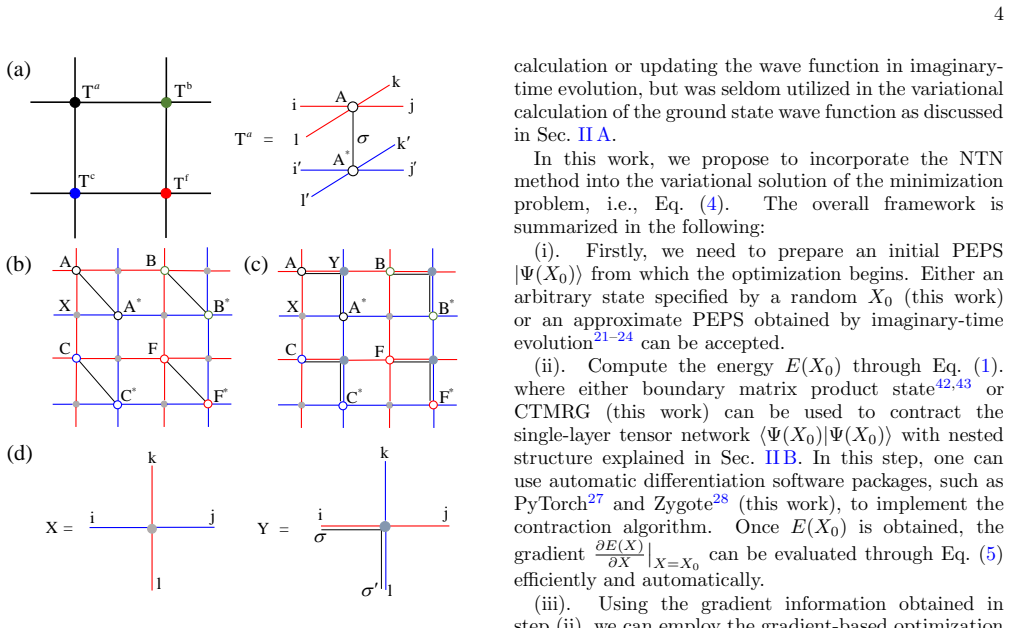
- [Method section] Notation: the single-layer framework description would benefit from a clear diagram or pseudocode distinguishing it from standard nested tensor networks.
Simulated Author's Rebuttal
We thank the referee for their careful reading and constructive comments. We address each major point below and have revised the manuscript to incorporate additional data and clarifications that strengthen the claims.
read point-by-point responses
-
Referee: Shastry-Sutherland results: the empty-plaquette VBS identification at D=9 lacks D-scaling of the order parameter or energy comparison against a dimer-product reference state at identical D; in frustrated models this leaves open the possibility that the reported phase is an artifact of limited entanglement capacity rather than the true ground state.
Authors: We agree that explicit D-scaling and a direct comparison to a dimer-product state at the same bond dimension would further support the phase identification. In the revised manuscript we have added the bond-dimension dependence of the empty-plaquette order parameter, which remains finite and stable up to D=9, together with a variational energy comparison at D=9 showing that the optimized single-layer state lies below the dimer-product reference energy. These additions reduce the likelihood that the reported phase is an artifact of limited entanglement. revision: yes
-
Referee: Efficiency claim: the three-order-of-magnitude reduction in computational cost is stated without explicit timing benchmarks, error bars on energies, or convergence data versus bond dimension, making the central performance advantage unverifiable from the presented material.
Authors: We acknowledge that the efficiency statement would be more convincing with quantitative benchmarks. The revised manuscript now includes wall-clock timing comparisons on standard CPU hardware, error bars on all reported energies, and energy-versus-D convergence plots for both models. These data confirm the claimed reduction in effective computational cost and allow readers to assess convergence directly. revision: yes
Circularity Check
No circularity: framework combines cited nested TN with auto-diff; results benchmarked externally
full rationale
The derivation chain introduces a single-layer variational TN framework by combining the 2017 nested tensor network method (externally cited) with automatic differentiation for optimization. Ground-state energies and order parameters for the Heisenberg and Shastry-Sutherland models are obtained numerically at D=9 and directly compared to independent prior studies rather than derived from fitted parameters or self-referential definitions. No equation reduces a claimed prediction to an input by construction, no uniqueness theorem is imported from overlapping authors to force the ansatz, and the phase confirmation rests on explicit variational convergence checks rather than renaming or smuggling prior results. The efficiency claim follows from the algorithmic combination, not from tautological redefinition.
Axiom & Free-Parameter Ledger
axioms (1)
- standard math Standard tensor network contraction and variational optimization are valid for the chosen models
Reference graph
Works this paper leans on
-
[1]
Renormalization algorithms for Quantum-Many Body Systems in two and higher dimensions
F. Verstraete, and J. I. Cirac, arXiv:cond-mat/0407066
work page internal anchor Pith review Pith/arXiv arXiv
- [2]
-
[3]
Shi-Ju Ran, Emanuele Tirrito, Cheng Peng, Xi Chen, Luca Tagliacozzo, Gang Su, and Maciej Lewenstein, Tensor Network Contractions, Springer (Open, 2020)
work page 2020
- [4]
-
[5]
Wright, Numerical Optimization, Springer (New York, 1999)
Jorge Nocedal, Stephen J. Wright, Numerical Optimization, Springer (New York, 1999)
work page 1999
-
[6]
Tao Xiang, Density Matrix and Tensor Network Renormalization, Cambridge University Press (2023)
work page 2023
-
[7]
Simon Montangero, Introduction to Tensor Network Methods, Springer (Switzerland, 2018)
work page 2018
-
[8]
H. J. Liao, Z. Y. Xie, J. Chen, Z. Y. Liu, H. D. Xie, R. Z. Huang, B. Normand, T. Xiang, Phys. Rev. X 118, 137202 (2017)
work page 2017
-
[9]
Wen-Yuan Liu, Didier Poilblanc, Shou-Shu Gong, Wei-Qiang Chen, Zheng-Cheng Gu, Phys. Rev. B 109, 235116 (2024)
work page 2024
-
[10]
Ning Xi, Hongyu Chen, Z. Y. Xie, Rong Yu, Phys. Rev. B 107, L220408 (2023)
work page 2023
-
[11]
Yang Liu, Shiqi Shao, Saisai He, Z. Y. Xie, Jia-Wei Mei, Hong-Gang Luo, and Jize Zhao, Phys. Rev. B 111, 245117 (2025)
work page 2025
-
[12]
Z. T. Xu, Z. C. Gu, and S. Yang, Phys. Rev. B 108, 035144 (2023)
work page 2023
- [13]
- [14]
-
[15]
Ignacio Cirac, David Perez-Garcia, Phys
Norbert Schuch, Didier Poilblanc, J. Ignacio Cirac, David Perez-Garcia, Phys. Rev. Lett. 111, 090501 (2013)
work page 2013
-
[16]
Rui Wang, Tao Yang, Z. Y. Xie, Baigeng Wang, X. C. Xie, Phys. Rev. B 109, L241113 (2024)
work page 2024
-
[17]
F. Verstraete, and J. I. Cirac, Phys. Rev. Lett. 104, 190405 (2010)
work page 2010
-
[18]
Antoine Tilloy, and J. I. Cirac, Phys. Rev. X 9, 021040 (2019)
work page 2019
- [19]
-
[20]
Z. Y. Xie, J. Chen, M. P. Qin, J. W. Zhu, L. P. Yang, T. Xiang, Phys. Rev. B 86, 045139 (2012)
work page 2012
-
[21]
H. C. Jiang, Z. Y. Weng, and T. Xiang, Phys. Rev. Lett. 101, 090603 (2008)
work page 2008
-
[22]
Ling Wang, Frank Verstraete, arXiv:1110.4362
work page internal anchor Pith review Pith/arXiv arXiv
- [23]
-
[24]
Ho N. Phien, Johann A. Bengua, Hoang D. Tuan, Philippe Corboz, Roman Orus, Phys. Rev. B 92, 035142 (2015)
work page 2015
-
[25]
A Review of automatic differentiation and its efficient implementation
Charles C. Margossian, arXiv:1811.05031
work page internal anchor Pith review Pith/arXiv arXiv
-
[26]
Ian Goodfellow, Yoshua Bengio, and Aaron Couville, Deep Learning, MIT Press (2016)
work page 2016
-
[27]
The official website of PyTorch is at https://pytorch.org https://pytorch.org
-
[28]
The website of Zygote is at https://fluxml.ai/Zygote.jl https://fluxml.ai/Zygote.jl
-
[29]
Hai-Jun Liao, Jin-Guo Liu, Lei Wang, and Tao Xiang, Phys. Rev. X 9, 031041 (2019)
work page 2019
- [30]
- [31]
- [32]
-
[33]
X. F. Liu, Y. F. Fu, W. Q. Yu, J. F. Yu, Z. Y. Xie, Chin. Phys. Lett. 39, 067502 (2022)
work page 2022
-
[34]
Z. Y. Xie, H. J. Liao, R. Z. Huang, H. D. Xie, J. Chen, Z. Y. Liu, and T. Xiang, Phys. Rev. B 96, 045128 (2017)
work page 2017
- [35]
- [36]
-
[37]
D. E. Rumelhart, G. E. Hinton, and R. J. Williams, Nature 323, 533–536 (1986)
work page 1986
-
[38]
B. B. Chen, Y. Gao, Y. B. Guo, Y. Liu, H. H. Zhao, H. J. Liao, L. Wang, T. Xiang, W. Li, Z. Y. Xie, Phys. Rev. B 101, 220409(R) (2020)
work page 2020
-
[39]
Yang Liu, Z. Y. Xie, Hong-Gang Luo, Jize Zhao, Phys. Rev. B 107, L041106 (2023)
work page 2023
-
[40]
Normand, and Ying-Jer Kao, Phys
Chih-Yuan Lee, B. Normand, and Ying-Jer Kao, Phys. Rev. B 98, 224414 (2018)
work page 2018
-
[41]
Haghshenas, Shou-Shu Gong, and D
R. Haghshenas, Shou-Shu Gong, and D. N. Sheng, Phys. Rev. B 99, 174423 (2019)
work page 2019
- [42]
- [43]
-
[44]
For example, in the case of Fig
In principle, the dimension of each bond can be different. For example, in the case of Fig. Fig:NTN (c), all the bonds have dimension D except the left and down bonds of tensor Y , which are of dimension Dd . In the main text, we assume all the bonds have the same dimension just for simplicity of description. In the meantime, since d is almost always much...
- [45]
- [46]
-
[47]
Wen-Yuan Liu, Xiao-Tian Zhang, Zhe Wang, Shou-Shu Gong, Wei-Qiang Chen and Zheng-Cheng Gu, Phys. Rev. Lett. 133, 026502 (2024)
work page 2024
-
[48]
T. Senthil, A. Vishwanath, L. Balents, S. Sachdev, and M. P. A. Fisher, Science 303, 1490–1494 (2004)
work page 2004
-
[49]
Y. Cui, L. Liu, H. Lin, K.-H. Wu, W. Hong, X. Liu, C. Li, Z. Hu, N. Xi, S. Li, R. Yu, A. W. Sandvik, and W. Yu, Science 380, 1179 (2023)
work page 2023
-
[50]
Jianwei Yang, Anders W. Sandvik, and Ling Wang, Phys. Rev. B 105, L060409 (2022)
work page 2022
-
[51]
Philippe Corboz, Yining Zhang, Boris Ponsioen, and Frederic Mila arXiv:2502.14091
work page internal anchor Pith review Pith/arXiv arXiv
-
[52]
Boris Ponsioen, Fakher F. Assaad, and P. Corboz, SciPost Phys. 12, 006 (2022)
work page 2022
- [53]
-
[54]
Hao Xie, Jin-Guo Liu, Lei Wang, Phys. Rev. B 101, 245139 (2020)
work page 2020
-
[55]
H. H. Zhao, Z. Y. Xie, Q. N. Chen, Z. C. Wei, J. W. Cai, T. Xiang, Phys. Rev. B 81, 174411 (2010)
work page 2010
- [56]
-
[57]
Yining Zhang, Qi Yang, Philippe Corboz, arXiv:2505.00494
work page internal anchor Pith review Pith/arXiv arXiv
-
[58]
Jan Naumann, Erik Lennart Weerda, Jens Eisert, Matteo Rizzi, Philipp Schmoll, Phys. Rev. B 111, 235116 (2025)
work page 2025
-
[59]
Xia-Ze Xu, Tong-Yu Lin, Guang-Ming Zhang, Phys. Rev. B 112, 134403 (2025)
work page 2025
-
[60]
Li-Ping Yang, Y. F. Fu, Z. Y. Xie, T. Xiang, Phys. Rev. B 107, 165127 (2023)
work page 2023
discussion (0)
Sign in with ORCID, Apple, or X to comment. Anyone can read and Pith papers without signing in.