A flexible class of latent variable models for the analysis of antibody response data
Pith reviewed 2026-05-16 21:47 UTC · model grok-4.3
The pith
A latent variable model places each individual's immune status on a continuous scale of seroreactivity instead of splitting people into seronegative and seropositive groups.
A machine-rendered reading of the paper's core claim, the machinery that carries it, and where it could break.
Core claim
The central claim is that immune status can be represented by a continuous latent seroreactivity variable linked to observed antibody concentrations, yielding a flexible class of models that capture age-related changes, preserve quantitative data, and include finite mixture models as a limiting case.
What carries the argument
The single continuous latent seroreactivity variable that indexes immune activation and is linked to measured concentrations through a suitable function.
If this is right
- Antibody data from all ages can be analyzed jointly without separate models or arbitrary age cutoffs.
- Changes in transmission intensity can be incorporated directly into the model for the latent variable.
- The full quantitative measurements are used rather than reduced to binary serostatus.
- Existing finite mixture models arise automatically as a special case of the new class.
- An L2-based estimator provides consistent inference at substantially lower computational cost than maximum likelihood.
Where Pith is reading between the lines
- Replacing binary cutoffs with a continuous latent scale may reduce bias in estimated seroprevalence when antibody distributions are not cleanly bimodal.
- The same modeling structure could be applied to other continuous biomarker measurements in omics data where binary thresholds are currently imposed.
- The latent variable can be given a dynamic interpretation as cumulative exposure, opening a direct route to coupling the framework with transmission models.
Load-bearing premise
A single continuous latent seroreactivity variable together with an appropriate link to the observed concentrations is sufficient to represent the biological process across ages and transmission settings.
What would settle it
Application to a dataset whose age-specific antibody distributions remain multimodal after conditioning on the fitted latent variable, or whose predictive intervals systematically miss the observed tails.
Figures



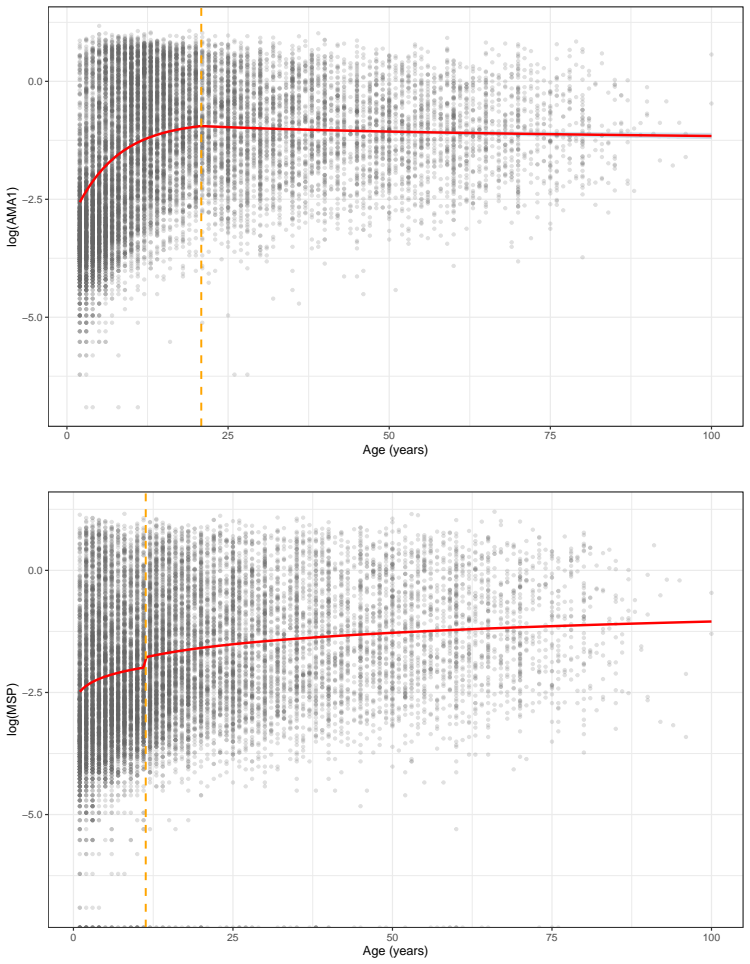


read the original abstract
Existing approaches to modelling antibody concentration data are mostly based on finite mixture models that rely on the assumption that individuals can be divided into two distinct groups: seronegative and seropositive. Here, we challenge this dichotomous modelling assumption and propose a latent variable modelling framework in which the immune status of each individual is represented along a continuum of latent seroreactivity, ranging from minimal to strong immune activation. This formulation provides greater flexibility in capturing age-related changes in antibody distributions while preserving the full information content of quantitative measurements. We show that the proposed class of models can accommodate a large variety of model formulations, both mechanistic and regression-based, and also includes finite mixture models as a special case. We also propose a computationally efficient $L_2$-based estimator as an alternative to maximum likelihood estimation, which substantially reduces computational cost, and we establish its consistency. Through a case study on malaria serology, we demonstrate how the flexibility of the novel framework enables joint analyses across all ages while accounting for changes in transmission patterns. We conclude by outlining extensions of the proposed modelling framework and its relevance to other omics applications.
Editorial analysis
A structured set of objections, weighed in public.
Referee Report
Summary. The manuscript proposes a latent variable framework for antibody concentration data that represents each individual's immune status along a continuous latent seroreactivity continuum (from minimal to strong activation) rather than a binary seronegative/seropositive classification. This class subsumes finite mixture models as a special case, accommodates mechanistic and regression formulations, and supports joint age-stratified analyses. The authors introduce a computationally efficient L2-based estimator, establish its consistency, and illustrate the approach via a malaria serology case study that accounts for transmission changes across ages.
Significance. If the consistency result and empirical performance hold, the framework offers a principled way to retain quantitative antibody information while flexibly modeling age-dependent shifts in seroreactivity distributions. This could improve inference in seroepidemiology and extend to other omics settings. The explicit inclusion of mixtures as a limiting case and the computational advantage of the L2 estimator are practical strengths.
major comments (3)
- [§3] §3 (L2 estimator): the consistency claim for the L2 estimator is stated without the key regularity conditions or proof outline; the abstract and methods must supply the steps showing that the estimator converges to the true parameter under the continuous latent variable model, including any assumptions on the link function and latent distribution.
- [§4] §4 (case study): the malaria analysis claims joint modeling across all ages while accounting for transmission changes, but provides no quantitative comparison (e.g., AIC, cross-validated predictive performance, or parameter stability) against the standard two-component mixture model on the same data; this weakens the flexibility claim.
- [§2.2] §2.2 (model class): the statement that finite mixtures arise as a special case requires an explicit limiting argument (e.g., variance of the latent seroreactivity distribution approaching zero or a point-mass construction); without it the subsumption claim remains informal.
minor comments (3)
- Notation for the latent seroreactivity variable and its link to observed concentrations should be introduced once and used consistently; current usage mixes Greek and Latin symbols across equations.
- Figure 2 (age-stratified distributions) lacks axis labels on the latent scale and error bars on the fitted curves; add these for clarity.
- The abstract mentions 'extensions to other omics applications' but the discussion provides only a one-sentence outline; expand or remove the claim.
Simulated Author's Rebuttal
We thank the referee for the constructive comments on our manuscript. We address each major point below and will revise the paper accordingly to strengthen the presentation.
read point-by-point responses
-
Referee: [§3] §3 (L2 estimator): the consistency claim for the L2 estimator is stated without the key regularity conditions or proof outline; the abstract and methods must supply the steps showing that the estimator converges to the true parameter under the continuous latent variable model, including any assumptions on the link function and latent distribution.
Authors: We agree that the consistency result for the L2 estimator requires additional detail. In the revised manuscript we will expand the Methods section (and update the abstract) to state the key regularity conditions, including that the link function is Lipschitz continuous and the latent seroreactivity distribution has finite second moments. We will also include a concise proof outline showing that the estimator converges in probability to the true parameter values under the continuous latent variable model. revision: yes
-
Referee: [§4] §4 (case study): the malaria analysis claims joint modeling across all ages while accounting for transmission changes, but provides no quantitative comparison (e.g., AIC, cross-validated predictive performance, or parameter stability) against the standard two-component mixture model on the same data; this weakens the flexibility claim.
Authors: We acknowledge that a direct quantitative comparison on the malaria data would better support the flexibility claim. In the revision we will add AIC values, cross-validated predictive performance metrics, and a brief assessment of parameter stability comparing the continuous latent model to the standard two-component mixture model fitted to the same serology data. revision: yes
-
Referee: [§2.2] §2.2 (model class): the statement that finite mixtures arise as a special case requires an explicit limiting argument (e.g., variance of the latent seroreactivity distribution approaching zero or a point-mass construction); without it the subsumption claim remains informal.
Authors: We agree that an explicit limiting argument is needed. In the revised §2.2 we will add a formal construction showing that finite mixture models arise as the variance of the latent seroreactivity distribution approaches zero, yielding point masses at the seronegative and seropositive extremes. revision: yes
Circularity Check
No significant circularity detected
full rationale
The paper introduces a latent-variable framework for antibody concentrations that treats seroreactivity as a continuous latent trait rather than a binary seropositive/seronegative split. It states that this class subsumes finite mixtures as a special case and can host both mechanistic and regression formulations. The L2 estimator is proposed separately and its consistency is asserted as an independent result. No equation in the provided material defines a quantity in terms of itself, renames a fitted parameter as a prediction, or relies on a self-citation whose content is itself unverified. The modeling choice is an explicit ansatz for flexibility; the consistency claim is presented as a separate mathematical property rather than a re-expression of the fitted values. The derivation chain therefore remains self-contained against external benchmarks.
Axiom & Free-Parameter Ledger
free parameters (1)
- latent seroreactivity distribution parameters
axioms (1)
- domain assumption Antibody concentration data can be generated from a continuous latent seroreactivity variable linked to observed measurements
invented entities (1)
-
continuous latent seroreactivity variable
no independent evidence
Reference graph
Works this paper leans on
-
[1]
doi: 10.1214/aos/1176343842. C. Bottomley, M. Otiende, S. Uyoga, K. Gallagher, E. W. Kagucia, A. O. Etyang, D. Mugo, J. Gitonga, H. Karanja, J. Nyagwandhi, R. Aman, L. I. Ochola-Oyier, K. Kasera, P. Amoth, M. Mwangangi, E. Otieno, C. Agoti, G. Githinji, I. K. Kombe, P. K. Munywoki, D. J. Nokes, E. Barasa, B. Tsofa, P. Bejon, G. M. Warimwe, J. A. G. Scott,...
-
[2]
doi: 10.1017/S0950268808000393. E. Hartman, A. M. Scott, C. Karlsson, T. Mohanty, S. T. Vaara, A. Linder, L. Malmstr¨ om, and J. Malm- str¨ om. Interpreting biologically informed neural networks for enhanced proteomic biomarker discovery and pathway analysis.Nature Communications, 14(1):5359, 2023. doi: 10.1038/s41467-023-41146-4. URL https://doi.org/10.1...
-
[3]
doi: 10.1371/journal.pntd.0012375. I. Kyomuhangi and E. Giorgi. A unified and flexible modelling framework for the analysis of malaria serology data.Epidemiology and Infection, 149:e99, 2021. doi: 10.1017/S0950268821000753. Gertraud Malsiner-Walli, Sylvia Fr¨ uhwirth-Schnatter, and Bettina Gr¨ un. Model-based clustering based on sparse finite Gaussian mix...
-
[4]
Thus, supϑ∈ϑ |Mn(ϑ)−M(ϑ)| p − →0
Thus under AssumptionA5., sup ϑ∈ϑ ∥f ′(·;ϑ)∥ 2 <∞: sup ϑ∈ϑ ∥fϑ,n −f(·;ϑ)∥ 2 ≤Ch n sup ϑ∈ϑ ∥f ′(·;ϑ)∥ 2 − →0. Thus, supϑ∈ϑ |Mn(ϑ)−M(ϑ)| p − →0. B Verification of regularity conditions for the latent variable model To apply the consistency result of Theorem 4.1 to our proposed latent variable model, we must verify that the model defined in (2) satisfies Ass...
-
[5]
Furthermore, assumeσ 0, σ1 ≥cfor some constantc >0to ensure the density is bounded
Assume the parameter spaceϑis compact (A1) and satisfies the ordering constraintµ 0 < µ 1 to avoid label switching. Furthermore, assumeσ 0, σ1 ≥cfor some constantc >0to ensure the density is bounded. Letg T be identifiable and continous with respectψ. a If the histogram discretization satisfiesA4, then the estimator satisfies AssumptionsA1–A5. Proof.We ve...
work page 1966
discussion (0)
Sign in with ORCID, Apple, or X to comment. Anyone can read and Pith papers without signing in.