Recognition: 2 theorem links
· Lean TheoremMatter-free gravitational collapse and the equivalence principle
Pith reviewed 2026-05-16 23:33 UTC · model grok-4.3
The pith
An extended equivalence principle shows that any bound traversable Klinkhamer wormhole collapses into a nontraversable Einstein-Rosen wormhole.
A machine-rendered reading of the paper's core claim, the machinery that carries it, and where it could break.
Core claim
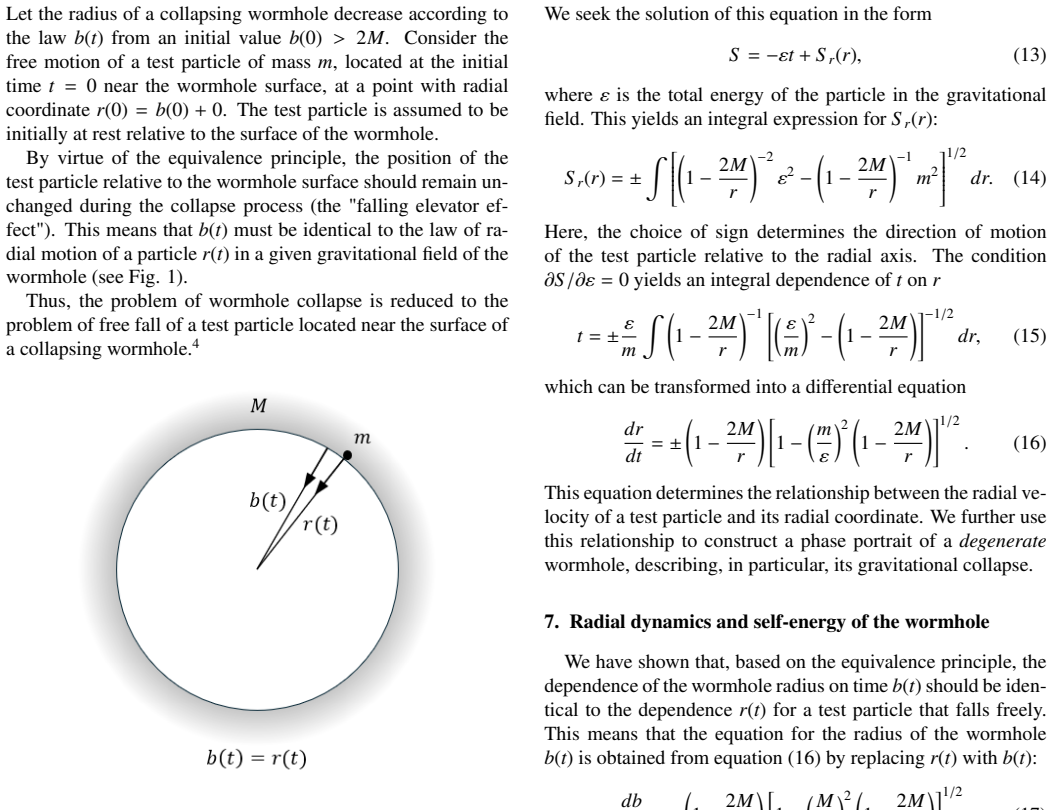
By extending the equivalence principle to matter-free gravitational sources, the radial dynamics of the Klinkhamer wormhole are reduced to those of a test particle falling radially in a Schwarzschild gravitational field. As a result, any bound state of the traversable Klinkhamer wormhole eventually collapses into a nontraversable Einstein-Rosen wormhole. An estimate shows that this traversable state, although nonstationary, persists for a long time.
What carries the argument
The proposed extension of the equivalence principle to the Klinkhamer metric, which equates the wormhole's radial evolution to geodesic free fall in Schwarzschild geometry.
Load-bearing premise
The equivalence principle extends to matter-free objects that source a gravitational field, as applied to the Klinkhamer wormhole.
What would settle it
A numerical integration or exact solution of the Klinkhamer metric's radial evolution that deviates from the Schwarzschild geodesic equation for free fall would falsify the collapse result.
Figures

read the original abstract
The dynamics of a degenerate spherically symmetric wormhole in a vacuum is considered. An extension of the equivalence principle to matter free objects that are the source of a gravitational field is proposed. Using the Klinkhamer metric as an example, it is shown that a degenerate wormhole is precisely such an object. Application of the extended equivalence principle reduces the radial dynamics of the Klinkhamer wormhole to the dynamics of the radial fall of a test particle in a Schwarzschild gravitational field. It is proven that any bound state of the traversable Klinkhamer wormhole eventually collapses into a nontraversable Einstein-Rosen wormhole. An estimate is presented showing that the traversable Klinkhamer wormhole, although nonstationary, is a longlived state.
Editorial analysis
A structured set of objections, weighed in public.
Referee Report
Summary. The paper proposes an extension of the equivalence principle to matter-free objects that source a gravitational field. Taking the Klinkhamer metric as an example of a degenerate spherically symmetric wormhole, it applies this extension to reduce the wormhole's radial dynamics to the radial geodesic motion of a test particle in Schwarzschild spacetime. This reduction is then used to prove that any bound state of the traversable Klinkhamer wormhole collapses into a nontraversable Einstein-Rosen bridge, accompanied by an estimate indicating that the traversable configuration is long-lived despite being nonstationary.
Significance. If the proposed extension of the equivalence principle can be rigorously justified and the reduction to Schwarzschild dynamics holds without hidden assumptions, the result would supply a concrete dynamical mechanism for the collapse of vacuum wormhole solutions into black-hole-like structures. The lifetime estimate could inform discussions of transient traversable wormholes, though the work's impact depends on whether the extended principle is accepted as a natural generalization rather than an ad-hoc postulate.
major comments (3)
- [Abstract and section proposing the extended equivalence principle] The extension of the equivalence principle to matter-free objects that source gravity (introduced in the abstract and developed in the section proposing the extension) is presented without a derivation from the vacuum Einstein equations or a demonstration of consistency with standard local applications of the principle. This extension is load-bearing for the entire claim, as it directly enables the reduction of the wormhole throat dynamics to test-particle geodesics; a limiting-case check (e.g., recovery of known vacuum solutions) is needed to establish that the extension does not introduce inconsistencies.
- [Dynamics reduction section] The reduction of the Klinkhamer wormhole radial dynamics to Schwarzschild test-particle infall (claimed in the abstract and executed in the dynamics section) is asserted but not accompanied by the explicit intermediate steps or effective equation of motion. Without showing how the Klinkhamer line element, under the extended principle, maps onto the Schwarzschild radial geodesic equation (including any coordinate or parameter identifications), it remains unclear whether the collapse proof follows directly or relies on additional choices.
- [Collapse proof and final section] The proof that bound states collapse to an Einstein-Rosen wormhole (stated in the abstract and concluded in the collapse analysis) depends on the analogy to Schwarzschild bound orbits reaching the horizon. The manuscript should specify the precise definition of a 'bound state' for the wormhole (e.g., in terms of throat radius or redshift parameter) and confirm that topological features of the Klinkhamer metric do not alter the infall trajectory before the nontraversable regime is reached.
minor comments (2)
- [Abstract] The abstract asserts both a proof and a numerical estimate without referencing the relevant equations or sections; adding such pointers would improve readability.
- The Klinkhamer metric should be written out explicitly in an early section to make the subsequent application of the extended principle self-contained.
Simulated Author's Rebuttal
We thank the referee for the thorough review and constructive suggestions. We agree that the manuscript requires additional explicit derivations and clarifications to strengthen the presentation of the extended equivalence principle and the dynamical reduction. We will implement the revisions outlined below.
read point-by-point responses
-
Referee: [Abstract and section proposing the extended equivalence principle] The extension of the equivalence principle to matter-free objects that source gravity (introduced in the abstract and developed in the section proposing the extension) is presented without a derivation from the vacuum Einstein equations or a demonstration of consistency with standard local applications of the principle. This extension is load-bearing for the entire claim, as it directly enables the reduction of the wormhole throat dynamics to test-particle geodesics; a limiting-case check (e.g., recovery of known vacuum solutions) is needed to establish that the extension does not introduce inconsistencies.
Authors: We agree that the extended equivalence principle requires a more explicit justification. In the revised manuscript we will insert a new subsection that derives the extension from the vacuum Einstein equations for matter-free sources and performs the requested limiting-case check, recovering the standard Schwarzschild geodesic equation for test particles and confirming consistency with local applications of the principle. revision: yes
-
Referee: [Dynamics reduction section] The reduction of the Klinkhamer wormhole radial dynamics to Schwarzschild test-particle infall (claimed in the abstract and executed in the dynamics section) is asserted but not accompanied by the explicit intermediate steps or effective equation of motion. Without showing how the Klinkhamer line element, under the extended principle, maps onto the Schwarzschild radial geodesic equation (including any coordinate or parameter identifications), it remains unclear whether the collapse proof follows directly or relies on additional choices.
Authors: We accept that the intermediate steps were insufficiently detailed. The revised dynamics section will contain a complete, step-by-step derivation that maps the Klinkhamer line element under the extended principle onto the Schwarzschild radial geodesic equation, including all coordinate and parameter identifications and the resulting effective equation of motion. revision: yes
-
Referee: [Collapse proof and final section] The proof that bound states collapse to an Einstein-Rosen wormhole (stated in the abstract and concluded in the collapse analysis) depends on the analogy to Schwarzschild bound orbits reaching the horizon. The manuscript should specify the precise definition of a 'bound state' for the wormhole (e.g., in terms of throat radius or redshift parameter) and confirm that topological features of the Klinkhamer metric do not alter the infall trajectory before the nontraversable regime is reached.
Authors: We will add an explicit definition of a bound state in terms of the throat radius lying below the critical value corresponding to bound motion in the effective Schwarzschild potential. We will also show that the topological features of the Klinkhamer metric do not modify the radial infall trajectory in the exterior region before the nontraversable regime is reached, because the dynamics are reduced to the Schwarzschild geodesic equation outside the throat. revision: yes
Circularity Check
No significant circularity: derivation applies a proposed extension without reducing to self-definition or fitted inputs
full rationale
The paper proposes an extension of the equivalence principle to matter-free objects sourcing gravity, demonstrates that the Klinkhamer wormhole satisfies this definition, and then applies the extension to equate its radial dynamics with Schwarzschild test-particle geodesics. The collapse result follows from this application plus the standard GR result for bound geodesics, without any parameter fitting, renaming of known results, or load-bearing self-citation. The extension itself is introduced as a new assumption rather than derived tautologically from the target metric or prior author work, so the chain does not reduce by construction to its inputs. The derivation remains self-contained once the extension is accepted.
Axiom & Free-Parameter Ledger
axioms (1)
- ad hoc to paper Extension of the equivalence principle to matter-free objects that source a gravitational field
Lean theorems connected to this paper
-
IndisputableMonolith/Foundation/AlexanderDuality.leanalexander_duality_circle_linking unclear?
unclearRelation between the paper passage and the cited Recognition theorem.
An extension of the equivalence principle to matter free objects that are the source of a gravitational field is proposed... reduces the radial dynamics of the Klinkhamer wormhole to the dynamics of the radial fall of a test particle in a Schwarzschild gravitational field.
-
IndisputableMonolith/Foundation/RealityFromDistinction.leanreality_from_one_distinction unclear?
unclearRelation between the paper passage and the cited Recognition theorem.
It is proven that any bound state of the traversable Klinkhamer wormhole eventually collapses into a nontraversable Einstein-Rosen wormhole.
What do these tags mean?
- matches
- The paper's claim is directly supported by a theorem in the formal canon.
- supports
- The theorem supports part of the paper's argument, but the paper may add assumptions or extra steps.
- extends
- The paper goes beyond the formal theorem; the theorem is a base layer rather than the whole result.
- uses
- The paper appears to rely on the theorem as machinery.
- contradicts
- The paper's claim conflicts with a theorem or certificate in the canon.
- unclear
- Pith found a possible connection, but the passage is too broad, indirect, or ambiguous to say the theorem truly supports the claim.
Reference graph
Works this paper leans on
-
[1]
" write newline "" before.all 'output.state := FUNCTION n.dashify 't := "" t empty not t #1 #1 substring "-" = t #1 #2 substring "--" = not "--" * t #2 global.max substring 't := t #1 #1 substring "-" = "-" * t #2 global.max substring 't := while if t #1 #1 substring * t #2 global.max substring 't := if while FUNCTION word.in bbl.in ":" * " " * FUNCTION f...
-
[2]
author Atiyah, M.F. , year 1989 . title Topological quantum field theories . journal Publications Mathématiques de l’IHÉS volume 68 , pages 175--186
work page 1989
-
[3]
Topology Change in Classical General Relativity
author de Borde, A.H. , year 1994 . title Topology change in classical general relativity . journal arxiv.org/abs/gr-qc/9406053
work page internal anchor Pith review Pith/arXiv arXiv 1994
-
[4]
author Borissova, J. , author Magueijo, J. , year 2025 . title Quantum dynamics and thermodynamics of a minkowski-minkowski wormhole . journal arxiv.org/pdf/2510.13944
-
[5]
author Dimaschko, J. , year 2024 . title Topological dressing method for the einstein-maxwell equations . journal Gen. Relativ. Gravit. volume 56 , pages 103
work page 2024
-
[6]
author Einstein, A. , author Rosen, N. , year 1935 . title The particle problem in the general theory of relativity . journal Phys. Rev. volume 48 , pages 73--77
work page 1935
-
[7]
author Feng, J.C. , year 2023 . title Smooth metrics can hide thin shells . journal Class. Quantum Grav. volume 40 , pages 197002
work page 2023
-
[8]
author Geroch, R.P. , year 1967 . title Topology in general relativity . journal J. Math. Phys. volume 8 , pages 782--786
work page 1967
-
[9]
author Hawking, S.W. , year 1990 . title Wormholes in spacetime . journal Phys. Rev. D volume 37 , pages 904–910
work page 1990
-
[10]
author Hochberg, D. , author Visser, M. , year 1998 . title Dynamic wormholes, antitrapped surfaces, and energy conditions . journal Phys. Rev. volume D58 , pages 044021
work page 1998
-
[11]
author Horowitz, G.T. , year 1991 . title Topology change in classical and quantum gravity . journal Class. and Quant. Gravit. volume 8 , pages 587–602
work page 1991
-
[12]
author Katanaev, M.O. , year 2006 . title Polynomial hamiltonian form of general relativity . journal Theoret. and Math. Phys. volume 148 , pages 1264--12947
work page 2006
-
[13]
author Klinkhamer, F.R. , year 2022 . title Defect wormhole: A traversable wormhole without exotic matter . journal Acta Phys. Pol. volume B54 , pages 5--A3
work page 2022
-
[14]
author Klinkhamer, F.R. , year 2023 . title Vacuum-defect wormholes and a mirror world . journal Acta Phys. Pol. volume B54 , pages 7--22
work page 2023
-
[15]
author Klinkhamer, F.R. , year 2025 . title Big bang as spacetime defect . journal Mod. Phys. Lett. A volume 40 , pages 2530010
work page 2025
-
[16]
author Koga, R. , year 2023 . title Topology change and wormhole formation in modified gravity . journal Class. and Quant. Gravit. volume 40 , pages 155010
work page 2023
-
[17]
author Landau, L.D. , author Lifshitz, E.M. , year 1982 . title Mechanics . publisher Elsevier , address Amsterdam
work page 1982
-
[18]
author Misner, C.W. , author Thorne, K.S. , author Wheeler, J.A. , year 1973 . title Gravitation . publisher Princeton University Press , address Princeton
work page 1973
-
[19]
author Morris, M.S. , author Thorne, K.S. , year 1988 . title Wormholes in spacetime and their use for interstellar travel: A tool for teaching general relativity . journal Am. J. Rev. volume 56 , pages 395--412
work page 1988
-
[20]
author Oppenheimer, J.R. , author Snyder, H. , year 1939 . title On continued gravitational contraction . journal Phys. Rev. volume 56 , pages 455--459
work page 1939
-
[21]
author Peres, A. , year 1963 . title Polynomial expansion of gravitational lagrangian . journal Nuovo Cimento volume 28 , pages 865--867
work page 1963
-
[22]
author Rezzolla, L. , author Zanotti, O. , year 2013 . title Relativistic Hydrodynamics . publisher Oxford University Press , address Oxford
work page 2013
-
[23]
author Shapiro, L. , author Teukolsky, S.A. , year 1983 . title Black Holes, White Dwarfs, and Neutron Stars: The Physics of Compact Objects . publisher John Wiley and Sons
work page 1983
-
[24]
author Sorkin, R.D. , year 1986 . title On topology change and monopole creation . journal Phys. Rev. D volume 33 , pages 978--982
work page 1986
-
[25]
author Tolman, R.C. , year 1934 . title Effect of inhomogeneity on cosmological models . journal Proc. Nat. Acad. Sci. volume 20 , pages 169--176
work page 1934
-
[26]
author Visser, M. , year 1989 . title Traversable wormholes from surgically modified schwarzschild spacetimes . journal Nucl. Phys. B volume 238 , pages 203--212
work page 1989
-
[27]
author Visser, M. , year 1996 . title Lorentzian Wormholes: from Einstein to Hawking . publisher AIP Melville , address New York
work page 1996
-
[28]
author Wang, Z.L. , year 2023 . title On a schwarzschild-type defect wormhole . journal arxiv.org/abs/2307.01678
-
[29]
author Witten, E. , year 1988 . title Topological quantum field theory . journal Commun. in Math. Phys. volume 117 , pages 353--386
work page 1988
-
[30]
author Özel, F. , author Freire, P. , year 2016 . title Masses, radii, and the equation of state of neutron stars . journal Annual Review of Astronomy and Astrophysics volume 54 , pages 402--440
work page 2016
- [31]
discussion (0)
Sign in with ORCID, Apple, or X to comment. Anyone can read and Pith papers without signing in.