The Ensemble Schr{\"o}dinger Bridge filter for Nonlinear Data Assimilation
Pith reviewed 2026-05-16 20:37 UTC · model grok-4.3
The pith
The Ensemble Schrödinger Bridge filter combines a standard prediction step with a diffusion-generative-modeling analysis step to perform nonlinear data assimilation without structural model error.
A machine-rendered reading of the paper's core claim, the machinery that carries it, and where it could break.
Core claim
The paper claims that the analysis step can be realized through diffusion generative modeling to approximate the Schrödinger Bridge, thereby completing a full nonlinear filtering update when combined with the prediction step, introducing no structural model error, and yielding effective results on nonlinear observation processes and chaotic dynamics.
What carries the argument
The diffusion-generative-modeling-based analysis step that approximates the Schrödinger Bridge to compute the ensemble filter update.
If this is right
- The filter performs effectively for highly nonlinear dynamics and nonlinear observation processes.
- It outperforms the ensemble Kalman filter and particle filter across tests with varying degrees of nonlinearity.
- The method is derivative-free, training-free, and highly parallelizable.
- It handles chaotic systems with dimension up to 40 and beyond.
Where Pith is reading between the lines
- Extension to meteorological applications could follow if the method scales as claimed in future work.
- The reliance on generative modeling techniques opens possible integration with other machine learning tools for scientific simulation.
- Development of the mentioned rigorous convergence theory would provide a clearer bound on approximation quality.
Load-bearing premise
The diffusion-generative-modeling-based analysis step is assumed to deliver an accurate approximation to the optimal nonlinear filter update without introducing structural model error.
What would settle it
A test on a low-dimensional nonlinear system with a known exact posterior where the filter's output distribution shows large deviations from the true posterior would disprove the no-structural-error claim.
Figures






read the original abstract
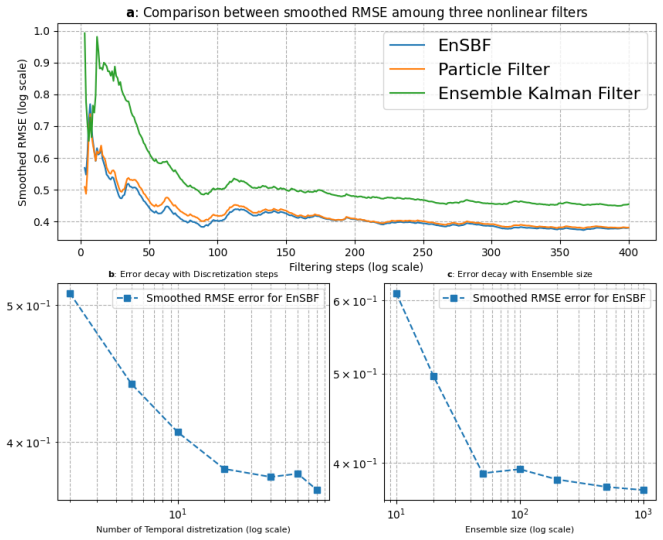
This work introduces a novel nonlinear optimal filtering method, termed the Ensemble Schr{\"o}dinger Bridge nonlinear filter. The proposed filter combines the standard prediction step with a diffusion-generative-modeling-based analysis step, thereby completing one full filtering update. The resulting approach introduces no structural model error, and is derivative-free, training-free, and highly parallelizable. Numerical experiments demonstrate that the proposed algorithm performs effectively for highly nonlinear dynamics and nonlinear observation processes, including chaotic systems with dimension up to 40 and beyond. The results also show that the method outperforms classical approaches such as the ensemble Kalman filter and particle filter across a range of tests with varying degrees of nonlinearity. Future work will focus on extending the proposed method to practical meteorological applications and developing a rigorous convergence theory.
Editorial analysis
A structured set of objections, weighed in public.
Referee Report
Summary. The paper introduces the Ensemble Schrödinger Bridge nonlinear filter for data assimilation. It combines a standard prediction step with a diffusion-generative-modeling-based analysis step using the Schrödinger Bridge to perform the nonlinear filter update. The method is claimed to be derivative-free, training-free, highly parallelizable, and to introduce no structural model error. Numerical experiments show effective performance on highly nonlinear dynamics and observations, including chaotic systems up to dimension 40 and beyond, outperforming the ensemble Kalman filter and particle filter.
Significance. If the central claims hold, particularly the absence of structural model error and the ability to handle high-dimensional nonlinear systems accurately, this could represent a significant advance in nonlinear data assimilation methods. The parallelizability and lack of training requirements would make it practical for large-scale applications like meteorology, addressing limitations of existing ensemble methods.
major comments (2)
- The claim that the analysis step 'introduces no structural model error' and approximates the optimal nonlinear filter update requires a supporting derivation or error analysis; the abstract asserts this but provides no equations, bounds, or proof sketch showing why the Schrödinger Bridge diffusion model yields an exact update beyond sampling error.
- The reported outperformance on chaotic systems with dimension up to 40 lacks details on experimental setup, such as ensemble sizes, specific error metrics, number of runs, or how the Schrödinger Bridge step is implemented numerically; without these, the results cannot be evaluated for statistical significance or reproducibility.
minor comments (1)
- The statement on future work developing a rigorous convergence theory indicates that the current version may lack theoretical guarantees, which should be clarified in the introduction or conclusion.
Simulated Author's Rebuttal
We thank the referee for their constructive and insightful comments, which have helped us identify areas where the manuscript can be strengthened. We address each major comment below and commit to incorporating the necessary revisions.
read point-by-point responses
-
Referee: The claim that the analysis step 'introduces no structural model error' and approximates the optimal nonlinear filter update requires a supporting derivation or error analysis; the abstract asserts this but provides no equations, bounds, or proof sketch showing why the Schrödinger Bridge diffusion model yields an exact update beyond sampling error.
Authors: We agree that the current manuscript would benefit from a more explicit theoretical justification. In the revised version, we will add a new subsection (likely in Section 3) that provides a derivation showing how the Schrödinger Bridge diffusion model yields the optimal nonlinear filter update in the continuous-time limit, along with error bounds that separate the approximation error from sampling error. This will include the relevant Fokker-Planck and Schrödinger Bridge equations to support the claim of no structural model error. revision: yes
-
Referee: The reported outperformance on chaotic systems with dimension up to 40 lacks details on experimental setup, such as ensemble sizes, specific error metrics, number of runs, or how the Schrödinger Bridge step is implemented numerically; without these, the results cannot be evaluated for statistical significance or reproducibility.
Authors: We fully acknowledge that additional experimental details are required for reproducibility and statistical evaluation. In the revised manuscript, we will expand the numerical experiments section (Section 4) to specify the ensemble sizes employed in each test case, the precise error metrics (including RMSE and other diagnostics), the number of independent Monte Carlo runs, and a detailed description of the numerical implementation of the Schrödinger Bridge analysis step, including the discretization scheme, solver tolerances, and hyperparameter choices. revision: yes
Circularity Check
No significant circularity; method is a novel combination of standard prediction and diffusion-based analysis
full rationale
The paper proposes the Ensemble Schrödinger Bridge nonlinear filter by combining a standard ensemble prediction step with a new diffusion-generative-modeling analysis step based on the Schrödinger Bridge. The abstract states that this completes a full filtering update and introduces no structural model error, but this is presented as a property of the proposed construction rather than a self-referential definition or tautology. No equations reduce claimed performance or optimality to fitted parameters renamed as predictions, no load-bearing self-citations justify the central premise, and no uniqueness theorems or ansatzes are imported from prior author work. Numerical experiments are described as validation on nonlinear systems, not as the source of the method's definition. The derivation chain is therefore self-contained and does not reduce to its inputs by construction.
Axiom & Free-Parameter Ledger
Lean theorems connected to this paper
-
IndisputableMonolith/Cost/FunctionalEquation.leanwashburn_uniqueness_aczel unclear?
unclearRelation between the paper passage and the cited Recognition theorem.
The designed approach finds no structural model error... only errors introduced at the particle generation step comes from the Euler approximation of the solution of SDE and the Monte Carlo (ensemble) approximation of integrals.
-
IndisputableMonolith/Foundation/AlphaCoordinateFixation.leancostAlphaLog_high_calibrated_iff unclear?
unclearRelation between the paper passage and the cited Recognition theorem.
we draw theoretically the direct connection between the SDE related to the solution of the SBP and the reverse SDE in the score-based diffusion model
What do these tags mean?
- matches
- The paper's claim is directly supported by a theorem in the formal canon.
- supports
- The theorem supports part of the paper's argument, but the paper may add assumptions or extra steps.
- extends
- The paper goes beyond the formal theorem; the theorem is a base layer rather than the whole result.
- uses
- The paper appears to rely on the theorem as machinery.
- contradicts
- The paper's claim conflicts with a theorem or certificate in the canon.
- unclear
- Pith found a possible connection, but the passage is too broad, indirect, or ambiguous to say the theorem truly supports the claim.
Forward citations
Cited by 2 Pith papers
-
SURGE: Approximation-free Training Free Particle Filter for Diffusion Surrogate
URGE performs unbiased path-wise importance reweighting via Girsanov estimation for derivative-free inference-time scaling in diffusion models, proving equivalence to particle-wise SMC and outperforming baselines empirically.
-
Pathwise Learning of Stochastic Dynamical Systems with Partial Observations
A neural path estimation approach learns the filtering posterior path measure for stochastic dynamical systems from noisy partial observations by solving a variational stochastic control problem based on the pathwise ...
Reference graph
Works this paper leans on
-
[1]
F. Bao, Z. Zhang, and G. Zhang,A Score-based Filter for Nonlinear Data Assimilation, Journal of Compu- tational Physics, 514, 113207, 2024
work page 2024
-
[2]
F. Bao, Y. Cao, and P. Maksymovych,Backward sde filter for jump diffusion processes and its applications in material sciences, Communications in Computational Physics, 27 (2020), pp. 589–618
work page 2020
-
[3]
F. Bao, N. Cogan, A. Dobreva, and R. Paus,Data assimilation of synthetic data as a novel strategy for predicting disease progression in alopecia areata, Mathematical Medicine and Biology: A Journal of the IMA, (2021)
work page 2021
-
[4]
S. Liang, H.Tran, F. Bao, H. G. Chipilski, P.J.V. Leeuwen, G. Zhang.Ensemble score filter with image inpainting for data assimilation in tracking surface quasi-geostrophic dynamics with partial observations. https://arxiv.org/pdf/2501.12419?
-
[5]
H.G. Chipilski, F. Bao, S. Liang, G. Zhang, J.S.WhitakerNonlinear Ensemble Filtering with Diffusion Models: Application to the Surface Quasi-Geostrophic Dynamics, 105th AMS Annual Meeting, 2025
work page 2025
-
[6]
Volume 432, Part B, 1 December 2024, 117447
F.Bao, Z.Zhang, G.Zhang.An ensemble score filter for tracking high-dimensional nonlinear dynamical sys- tems.Computer Methods in Applied Mechanics and Engineering. Volume 432, Part B, 1 December 2024, 117447
work page 2024
-
[7]
G. Evensen,The ensemble Kalman filter for combined state and parameter estimation: Monte Carlo tech- niques for data assimilation in large systems, IEEE Control Syst. Mag., 29 (2009), pp. 83–104
work page 2009
-
[8]
Ramaprasad,Stochastic filtering with applications in finance, 2010
B. Ramaprasad,Stochastic filtering with applications in finance, 2010
work page 2010
-
[9]
Hamdouche, P.Henry-Labordere, and H
M. Hamdouche, P.Henry-Labordere, and H. Pham. (2023).Generative modeling for time series via schr¨ odinger bridge. arXiv:2304.05093
-
[10]
Yang Song, Sahaj Garg*, Jiaxin Shi, and Stefano Ermon Sliced Score Matching: A Scalable Approach to Density and Score Estimation.In the 35th Conference on Uncertainty in Artificial Intelligence, 2019
work page 2019
-
[11]
Yang Song.Generative Modeling by Estimating Gradients of the Data Distribution.Blog Post,https: //yang-song.net/blog/2021/score/
work page 2021
-
[12]
Y. Song, S. Ermon. Generative Modeling by Estimating Gradients of the Data DistributionAdvances in Neural Information Processing Systems, pp. 11895–11907. 2019
work page 2019
-
[13]
Kingma, Abhishek Kumar, Stefano Ermon, and Ben Poole
Yang Song, Jascha Sohl-Dickstein, Diederik P. Kingma, Abhishek Kumar, Stefano Ermon, and Ben Poole. Score-based generative modeling through stochastic differential equations.International Conference on Learning Representations (ICLR), 2021.https://openreview.net/forum?id=PxTIG12RRHS
work page 2021
-
[14]
Jascha Sohl-Dickstein, Eric Weiss, Niru Maheswaranathan, and Surya Ganguli. Deep unsupervised learning using nonequilibrium thermodynamics.In International Conference on Machine Learning, pages 2256–2265, 2015 22
work page 2015
-
[15]
Denoising Diffusion Probabilistic Models
Jonathan Ho, Ajay Jain, and Pieter Abbeel. Denoising diffusion probabilistic models. InAdvances in Neural Information Processing Systems (NeurIPS), 2020. https://arxiv.org/abs/2006.11239
work page internal anchor Pith review Pith/arXiv arXiv 2020
-
[16]
A connection between score matching and denoising autoencoders
Pascal Vincent. A connection between score matching and denoising autoencoders. Neural Computation, 23(7):1661–1674, 2011.https://www.iro.umontreal.ca/ ~vincentp/Publications/smdae_techreport. pdf
work page 2011
-
[17]
E. Bernton, J. Heng, A. Doucet, and P. E.Jacob, (2019).Schr¨ odinger bridge samplers.https://arxiv. org/abs/1912.13170
- [18]
-
[19]
Likelihood training of schr \” odinger bridge using forward-backward sdes theory
T. Chen, G.-H. Liu, and E. A. Theodorou, (2023a).Likelihood training of Schr¨ odinger bridge using forward- backward sdes theory.https://arxiv.org/abs/2110.11291
- [20]
-
[21]
Z. Chen, G.He, K. Zheng, X.Tan, and J.Zhu (2023c).Schr¨ odinger bridges beat diffusion models on text-to- speech synthesis.https://arxiv.org/abs/2312.03491
- [22]
-
[23]
Stromme, A. (2023).Sampling from a Schr¨ odinger bridge.Proceedings of The 26th International Conference on Artificial Intelligence and Statistics, volume 206 of Proceedings of Machine Learning Research, pages 4058–4067. PMLR
work page 2023
-
[24]
P. Dai Pra,A stochastic control approach to reciprocal diffusion processes.(1991).Applied Mathematics and Optimization, 23(1):313–329
work page 1991
-
[25]
G. Wang, Y.Jiao, Q.Xu, Y. Wang, C.Yang.Deep Generative Learning via Schr¨ odinger Bridge, PMLR 139, 2021.https://proceedings.mlr.press/v139/wang21l/wang21l.pdf
work page 2021
- [26]
-
[27]
Y. Chen, T. T. Georgiou, and M. Pavon (2021).Optimal transport in systems and control. Annual Review of Control, Robotics, and Autonomous Systems, 4(Volume 4, 2021):89–113
work page 2021
-
[28]
I.Goodfellow; J. Pouget-Abadie; M. Mirza;B. Xu; D. Warde-Farley; S. Ozair; A. Courville; Y. Bengio (2014).Generative Adversarial Nets. Proceedings of the International Conference on Neural Information Processing Systems (NIPS 2014). pp. 2672–2680
work page 2014
-
[29]
Arjovsky, S.Chintala, L.Bottou,Wasserstein Generative Adversarial Networks
M. Arjovsky, S.Chintala, L.Bottou,Wasserstein Generative Adversarial Networks. International Conference on Machine Learning. PMLR: 214–223
-
[30]
Variational Inference with Normalizing Flows
Danilo Jimenez Rezende and Shakir Mohamed. Variational inference with normalizing flows.https:// arxiv.org/abs/1505.05770
work page internal anchor Pith review Pith/arXiv arXiv
-
[31]
Laurent Dinh, Jascha Sohl-Dickstein, Samy Bengio.Density estimation using real NVP.2016.https: //arxiv.org/abs/1605.08803
work page internal anchor Pith review Pith/arXiv arXiv 2016
-
[32]
K.Law, A.Stuart, K.Zygalakis.Data Assimilation, A Mathematical Introduction2016. Texts in Applied Mathemtatics, Vol 62, ISSN 2196-9949, Springer International Publishing Switzerland 2015. 23
work page 2015
-
[33]
C. L´ eonard.A survey of the Schr¨ odinger bridge problem and some of its connections with optimal transport. DYNAMICAL SYSTEMS, 34(4):1533–1574, 2014
work page 2014
- [34]
- [35]
- [36]
discussion (0)
Sign in with ORCID, Apple, or X to comment. Anyone can read and Pith papers without signing in.