REVIEW 4 major objections 7 minor 1 cited by
This paper claims that the Dominant-vs-Dominated (DvD) imbalance in text-to-image diffusion models is caused by visual diversity disparity in training data: low-diversity concepts form rigid priors that suppress high-diversity concepts when
Reviewed by Pith at T0; open to challenge. T0 means a machine referee read the full paper against a public rubric. the ladder, T0–T4 →
T0 review · deepseek-v4-flash
2026-08-03 15:19 UTC pith:3SO3T4NA
load-bearing objection Useful framing and a genuinely helpful benchmark, but the diversity experiment is confounded by memorization and the attention story is partly selected on the same data; still worth refereeing. the 4 major comments →
Dominant vs. Dominated: Concept-Level Generative Collapse in Diffusion Models
The pith
A machine-rendered reading of the paper's core claim, the machinery that carries it, and where it could break.
Core claim
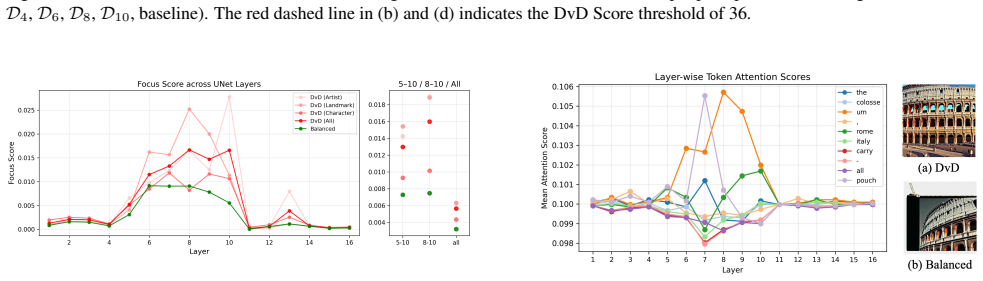
The central discovery, on the paper's own terms, is that Dominant-vs-Dominated imbalance is a systematic concept-level failure caused by visual diversity disparity. Low-diversity concepts form overfit, rigid visual priors that dominate high-diversity, flexible concepts in multi-concept generation. Mechanistically, in the first denoising step, dominant tokens receive abnormally high cross-attention in lower-resolution semantic layers (layers 8–10), dominated tokens lose attention sharply in the earliest timesteps, and the behavior emerges from distributed cooperation across multiple attention heads rather than localized in specific heads — in contrast to diffusion memorization, which concentr
What carries the argument
The argument rests on three instruments: (1) a DvD Score that measures presence imbalance from vision-language-model yes/no answers (C1 yes for one concept, C2 for the other); (2) a controlled fine-tuning setup that varies only the visual diversity of a newly learned concept token, from one dog breed to ten, to isolate the cause; and (3) cross-attention analysis with a focus score (peak attention minus mean, normalized by entropy) plus temporal attention-change tracking and multi-head ablation, which locates when, where, and how dominance arises.
Load-bearing premise
The entire argument depends on the DvD Score — five yes/no questions per concept asked to a vision-language model, with hand-set thresholds — correctly measuring visual presence; if that machine judge mislabels a concept as present or absent, the root-cause and mechanism conclusions inherit the error.
What would settle it
A human annotator study over generated images from DominanceBench prompts, comparing human presence judgments to the machine DvD Score; if human ratings disagree strongly with the score, the root-cause claim loses its foundation. Alternatively, rerun the dog-breed diversity sweep with humans judging presence; if dominance does not increase monotonically as breed diversity is reduced, the central claim is refuted.
If this is right
- If visual diversity disparity is the root cause, then increasing the visual variety of low-diversity concepts in training data should reduce DvD.
- Because DvD is distributed across many attention heads, simple head pruning will not fix it; architectural or training-level interventions are needed.
- The early attention signature (high focus in low-resolution layers at the first denoising step) can serve as a diagnostic for predicting whether a prompt will produce DvD.
- DominanceBench provides a reusable benchmark of 300 prompts with which future mitigation methods can be measured against a fixed threshold.
- DvD is a distinct failure mode from memorization: memorization localizes to specific heads and specific prompts, while DvD is concept-level and distributed.
Where Pith is reading between the lines
- This suggests a data-curation principle for personalized fine-tuning: users who train a custom concept from homogeneous reference images should expect that concept to overpower other objects in multi-concept prompts.
- A testable extension would be to see whether the same dominance signature appears in newer transformer-based text-to-image models; if the mechanism is tied to cross-attention layers, newer architectures may behave differently.
- The paper's detection experiment implies a cheap intervention — replacing the dominant token with a generic category word — but the authors themselves note this sacrifices the user's intent; this points toward hidden-concept or embedding-level interventions as a more practical direction.
- One could also turn the dominance signature into a training objective: penalize early focus concentration on a single token to preempt DvD.
Editorial analysis
A structured set of objections, weighed in public.
Referee Report
Summary. The paper introduces the Dominant-vs-Dominated (DvD) imbalance in multi-concept text-to-image diffusion generation, where one concept visually overwhelms the output and the other is suppressed. The authors propose DominanceBench, a benchmark of 300 prompts pairing low-diversity categories (artists, landmarks, characters) with everyday objects, and a DvD Score computed from Qwen2.5-VL yes/no questions. Using a DreamBooth fine-tuning experiment that varies the number of dog breeds (D1–D10) while holding dataset size fixed, they argue that lower visual diversity in training data is the root cause of DvD. Cross-attention analysis of DominanceBench prompts is used to claim that DvD manifests as early attention concentration on the dominant token in lower-resolution layers (8–10), rapid attention decline of the dominated token in layer 7, and that DvD is distributed across attention heads rather than localized as in memorization. The paper also proposes a focus-score-based DvD detection method and validates it in Appendix G.
Significance. If substantiated, the paper's central claim is significant: it identifies a training-data property—visual diversity disparity—as a causal driver of compositional failure, and distinguishes DvD from memorization both behaviorally and mechanistically. The controlled fine-tuning design (varying the number of breeds while holding dataset size) is a reasonable way to manipulate diversity, and the aggregate monotonic trend in Fig. S4 is suggestive. The attention and head-ablation analyses are extensive and would provide useful mechanistic insight if the comparison sets were properly matched. However, the current evidence has load-bearing gaps: the DreamBooth experiment may confound low diversity with memorization/overfitting; the DvD metric is unvalidated; and the key attention comparison confounds DvD with concept category. These need to be resolved before the causal and mechanistic claims can be accepted.
major comments (4)
- [Sec. 4.1 / DreamBooth experiment] Section 4.1 confounds visual diversity with memorization/overfitting. All six variants train for 50 epochs on 120 images, and no prior-preservation loss or regularization is reported. In this regime D1 (120 single-breed images) is likely to memorize its training set; the high DvD scores for prompts such as 'a dvddog and a cat' could arise from prompt-level reproduction of a memorized dog image rather than from a rigid prior caused by low diversity. The paper explicitly distinguishes DvD from memorization in Sec. 4.3, but no memorization metric is reported for the D1–D10 variants. Please report per-variant memorization measures (e.g., cross-seed SSCD/LPIPS similarity, or the first-step noise-prediction norm used in Appendix C), add regularization/early stopping, or otherwise rule out this alternative explanation. This is load-bearing because Sec. 4.1 is the only controlled evidence for th
- [Sec. 3.2 / Eq. (1)] The DvD Score is built on five hand-written VQA yes/no questions per concept with hand-set thresholds C1≥3, C2<3, N=5, and a score threshold of 36 for DvD. No human agreement, cross-VLM agreement, or threshold sensitivity analysis is reported. The questions in Table S2 are leading and category-specific, and the questions used for balanced prompts (Table S3) differ from those used for DominanceBench, making score comparisons across the two sets potentially incomparable. Because DominanceBench construction, the Sec. 4.1 experiment, the head-ablation outcome classification, and Appendix G detection all rely on this score, the metric needs validation before the benchmark and downstream conclusions can be accepted.
- [Sec. 4.2.1 / Fig. 5] The comparison between DominanceBench and balanced prompts is confounded by concept category and prompt structure. DominanceBench pairs low-diversity categories (artist/landmark/character) with objects, whereas the balanced prompts are two everyday-object prompts (Appendix B). Higher focus scores in layers 8–10 may reflect attention to named entities/proper nouns or category-specific syntax rather than DvD. The 83% peak-token finding is also not sufficient to identify a DvD-specific mechanism without a matched control—for example, the same low-diversity categories in prompts that generate both concepts successfully, or object-object prompts that exhibit DvD.
- [Sec. 4.2.2 / Appendix G] Several analytical settings are selected on the same data used for validation. Dominating tokens are tracked in layers 8–10 and dominated tokens in layer 7 because these are the observed peaks (Figs. 5 and 7); the detection threshold and layer configuration in Table S7 are chosen to maximize the gap on DominanceBench vs. balanced prompts and then validated on the same sets. This post-selection makes the reported numbers (e.g., 70.67% vs. 33.67%) optimistic. Please validate with held-out prompts or pre-specified settings and report confidence intervals for the main proportions (48%, 83%, etc.). No statistical tests are reported for any of the main comparisons.
minor comments (7)
- [Title] The arXiv title is 'Dominant vs. Dominated: Concept-Level Generative Collapse in Diffusion Models', but the paper text uses 'Dominating vs. Dominated: Generative Collapse in Diffusion Models'. Please make the title consistent.
- [Eq. (2)] The focus-score formula uses N, epsilon, and normalization by log2 N without fully defining the token set and the base of the logarithm before first use. Clarify the averaging over spatial positions and heads.
- [Fig. 9] The panel labels in the figure are inconsistent with the caption: '(b)' appears twice and '(d)' is missing. Please fix the panel lettering.
- [Introduction] Reference [26] is duplicated in the sentence 'memorization [3, 5, 11, 12, 15, 26, 26, 28, ...]'.
- [Appendix G / Table S7] The 'max' and 'mean' layer-aggregation methods in Table S7 are not defined. Please specify how these aggregate over layers.
- [Appendix B] Appendix B mentions using 'GPT-5' to identify the number of concepts in prompts. Please clarify which model/version was actually used.
- [Data availability] The full list of 300 DominanceBench prompts and generation seeds is not included in the supplement. For a benchmark paper, this should be provided at submission time or via a stable repository link, not only 'upon publication'.
Circularity Check
Central diversity claim has independent controlled support, but the directional DvD metric and in-sample layer/threshold selection make several 'confirmations' and the detection validation circular.
specific steps
-
self definitional
[Sec. 3.2–3.3 (Eq. (1), Algorithm 1); Sec. 4.1 setup]
"We set N=5 with concept-type-specific questions (e.g., for artists: “Is this image painted in the artistic style of Van Gogh?”) and consider a prompt as DvD when C1 ≥3 and C2 <3 (DvD Score ≥36). ... We focus on prompts containing two concepts: one from low-diversity groups (artist, landmark, character) and one from a high-diversity group (object, ...)."
The DvD Score is asymmetric: it is large only when C1 is present and C2 is absent, and near zero when the roles are reversed. In DominanceBench, prompts are collected as p(c,o) with c in the low-diversity set (A∪C∪L) and o the high-diversity object, and in Sec. 4.1 the paper says 'treating “dvddog” as C1.' Thus the inclusion rule DvD Score ≥36 selects exactly the pattern 'low-diversity concept dominates.' The conclusion that the dominant concept is the low-diversity one is therefore an input to the benchmark selection, not a finding of the benchmark. The genuinely independent support must come from the D1–D10 diversity manipulation, which is a separate test.
-
fitted input called prediction
[Appendix G.2–G.3 (Table S7, Fig. S5)]
"Among all settings, a threshold of 0.010 with layer combination 9&10 achieves the optimal balance with the maximum discrimination gap of 37.00 percentage points (70.67% on DominanceBench vs. 33.67% on Balanced). ... The dramatic reduction validates accurate detection of dominant concept tokens."
The threshold and layer pair are selected by maximizing the gap on the same 300 DominanceBench and 300 Balanced prompts that are then used to report the detection rate. The reported 37-point gap is a selected maximum, not an independent prediction. The token-replacement validation in Fig. S5 is also run on the same in-sample flagged prompts, so it does not provide out-of-sample confirmation of detection accuracy.
-
other
[Sec. 4.2.1–4.2.2 (Fig. 5, Fig. 7)]
"DominanceBench prompts exhibit significantly higher focus scores than balanced prompts across layers 5–10, with lower-resolution layers (layers 8–10) showing the most pronounced difference. ... To verify that this attention concentration indeed targets the dominating concept’s token, we analyze which token receives the peak attention in lower-resolution layers (layers 8–10). We find that in 249 out of 300 DominanceBench prompts (83%), the dominating concept’s token receives the maximum attention in these semantic layers. This confirms that DvD manifests through excessive early attention concen"
Layers 8–10 are selected post hoc because they show the largest DvD-vs-balanced focus-score gap on the same dataset; the 83% token-identification rate is then computed on those selected layers and presented as confirmation. Likewise, Sec. 4.2.2 tracks dominating tokens in layers 8–10 and dominated tokens in layer 7 because those are the layers with the highest observed focus scores. The 'where' claims are therefore in-sample descriptions, not a priori predictions.
full rationale
The paper's core causal claim is not circular: the D1–D10 DreamBooth experiment independently varies the visual diversity of a single novel concept while holding data size and training epochs fixed, and the monotonic DvD-score increase is a real comparison, not an identity. The cross-attention and head-ablation analyses are descriptive correlations on DominanceBench; they would have been falsifiable if attention patterns had not separated DvD from balanced prompts. There is no load-bearing self-citation: the only same-author reference ([15]) is background on memorization and is not used to justify the DvD claims. However, several 'confirmations' are in-sample. First, the DvD Score is directional (C1×(N−C2)/N²), and the benchmark and the dvddog experiment always place the low-diversity / hypothesized-dominant concept in C1; hence DominanceBench is selected to contain exactly the low-diversity-dominates pattern, making that particular 'finding' an input to selection rather than an output. Second, Appendix G selects the detection threshold and layer pair by maximizing the gap on the same 600 prompts it then uses to report detection accuracy; the reported 37-point gap is a fitted maximum, not a prediction. Third, the Sec. 4.2 layer choices (layers 8–10, then layer 7 for dominated tokens) are made on the same data and then used as the basis for the mechanistic 'where' claims. These issues do not destroy the independent diversity experiment, but they mean several claimed validations overstate their evidential value. The reliance on Qwen2.5-VL judgments is a measurement-validity risk, not a circularity.
Axiom & Free-Parameter Ledger
free parameters (5)
- DvD Score threshold =
36 (equiv. C1>=3, C2<3)
- DominanceBench inclusion rate =
at least 7 of 10 images above threshold
- Number of VQA questions N =
5
- Detection threshold and layer configuration =
0.010, layers 9&10
- Head ablation outcome thresholds =
LPIPS>0.5, DvD Score<36; SSCD<0.5, LPIPS>0.6
axioms (5)
- domain assumption Qwen2.5-VL yes/no answers reliably indicate visual presence of a concept.
- domain assumption Cross-attention weights averaged over positions and heads reflect concept-level influence in generation.
- domain assumption DreamBooth fine-tuning of a novel token from 120 images approximates real concept learning during diffusion training.
- domain assumption Balanced prompts from Ren et al. are an appropriate control for attention comparison.
- domain assumption CLIP cosine distance on LAION images measures visual diversity as it affects generation.
read the original abstract
Text-to-image diffusion models have attracted significant attention for their ability to generate diverse, high-fidelity images. However, in multi-concept generation, one concept token often dominates the output while others are suppressed-a phenomenon we term the Dominant-vs-Dominated (DvD) imbalance. To systematically study this failure mode, we introduce DominanceBench and examine its underlying causes from both data and internal-mechanistic perspectives. Our controlled fine-tuning study, which mimics concept learning during diffusion-model training, shows that concepts learned from visually homogeneous (low-variation) concept-specific training images exhibit stronger dominance when composed with others. Cross-attention analysis indicates that dominant tokens concentrate attention in early denoising steps, followed by reduced representation of competing concepts. Head-ablation analysis further shows that this dominance is distributed across attention heads rather than localized. Overall, these findings characterize DvD as a systematic concept-level failure mode and provide a basis for more reliable and controllable multi-concept generation. DominanceBench will be released upon publication.
Figures




Forward citations
Cited by 1 Pith paper
-
Mosaic: Compositional Multi-Concept Erasure via Vector Field Blending
Mosaic is a framework for compositional multi-concept erasure in flow-based T2I models via spatial vector field blending without extra optimization, evaluated on the new CoME-Bench benchmark covering intra- and cross-...
Reference graph
Works this paper leans on
-
[1]
Shuai Bai, Keqin Chen, Xuejing Liu, Jialin Wang, Wenbin Ge, Sibo Song, Kai Dang, Peng Wang, Shijie Wang, Jun Tang, et al. Qwen2. 5-vl technical report.arXiv preprint arXiv:2502.13923, 2025. 3
Pith/arXiv arXiv 2025
-
[2]
In- structpix2pix: Learning to follow image editing instructions
Tim Brooks, Aleksander Holynski, and Alexei A Efros. In- structpix2pix: Learning to follow image editing instructions. InProceedings of the IEEE/CVF conference on computer vi- sion and pattern recognition, pages 18392–18402, 2023. 1, 2
2023
-
[3]
Carlini, J
N. Carlini, J. Hayes, M. Nasr, M. Jagielski, V . Sehwag, F. Tram`er, B. Balle, D. Ippolito, and E. Wallace. Extracting training data from diffusion models. InUSENIX Security Symposium, 2023. 1, 2, 6, 12
2023
-
[4]
Chefer, Y
H. Chefer, Y . Alaluf, Y . Vinker, L. Wolf, and D. Cohen- Or. Attend-and-excite: Attention-based semantic guidance for text-to-image diffusion models. InProceedings of the Special Interest Group on Computer Graphics and Interac- tive Techniques Conference Conference Papers, 2023. 2
2023
-
[5]
C. Chen, D. Liu, M. Shah, and C. Xu. Exploring local memorization in diffusion models via bright ending atten- tion. InInternational Conference on Learning Representa- tions, 2025. 1, 2
2025
-
[6]
Diffedit: Diffusion-based semantic image editing with mask guidance
Guillaume Couairon, Jakob Verbeek, Holger Schwenk, and Matthieu Cord. Diffedit: Diffusion-based semantic image editing with mask guidance. InThe Eleventh International Conference on Learning Representations, 2023. 2
2023
-
[7]
D. Dat, H. Nam, P. Mao, and T. Oh. Vsc: Visual search com- positional text-to-image diffusion model. InProceedings of the IEEE/CVF International Conference on Computer Vi- sion, 2025. 2
2025
-
[8]
G. Ding, C. Zhao, W. Wang, Z. Yang, Z. Liu, H. Chen, and C. Shen. Freecustom: Tuning-free customized image gen- eration for multi-concept composition. InProceedings of the IEEE/CVF Conference on Computer Vision and Pattern Recognition, 2024. 1, 2
2024
-
[9]
Esser, S
P. Esser, S. Kulal, A. Blattmann, R. Entezari, J. M ¨uller, H. Saini, Y . Levi, D. Lorenz, A. Sauer, F. Boesel, D. Podell, T. Dockhorn, Z. English, K. Lacey, A. Goodwin, Y . Marek, and R. Rombach. Scaling rectified flow transformers for high- resolution image synthesis. InInternational Conference on Machine Learning, 2024. 1
2024
-
[10]
Prompt-to-prompt image editing with cross-attention control
Amir Hertz, Ron Mokady, Jay Tenenbaum, Kfir Aberman, Yael Pritch, and Daniel Cohen-or. Prompt-to-prompt image editing with cross-attention control. InThe Eleventh Inter- national Conference on Learning Representations, 2023. 1, 2
2023
-
[11]
Hintersdorf, L
D. Hintersdorf, L. Struppek, K. Kersting, A. Dziedzic, and F. Boenisch. Finding nemo: Localizing neurons responsible for memorization in diffusion models. InAdvances in Neural Information Processing Systems, 2024. 1, 2, 8
2024
-
[12]
D. Jeon, D. Kim, and A. No. Understanding memorization in generative models via sharpness in probability landscapes. InInternational Conference on Machine Learning, 2025. 1
2025
-
[13]
Jeong, S
J. Jeong, S. Han, J. Kim, and S. Kim. Latent space super- resolution for higher-resolution image generation with diffu- sion models. InProceedings of the IEEE/CVF Conference on Computer Vision and Pattern Recognition, 2025. 1
2025
-
[14]
Jiang, Y
J. Jiang, Y . Zhang, K. Feng, X. Wu, W. Li, R. Pei, F. Li, and W. Zuo. Mcˆ2: Multi-concept guidance for customized multi-concept generation. InProceedings of the IEEE/CVF Conference on Computer Vision and Pattern Recognition,
-
[15]
J. Kim, S. Kim, and J.-S. Lee. How diffusion models mem- orize.arXiv preprint arXiv:2509.25705, 2025. 1, 2
arXiv 2025
-
[16]
Z. Kong, Y . Zhang, T. Yang, T. Wang, K. Zhang, B. Wu, G. Chen, W. Liu, and W. Luo. Compositional generation with energy-based diffusion models. InInternational Conference on Machine Learning, 2023. 2
2023
-
[17]
Z. Kong, Y . Zhang, T. Yang, T. Wang, K. Zhang, B. Wu, G. Chen, W. Liu, and W. Luo. Omg: Occlusion-friendly personalized multi-concept generation in diffusion models. InEuropean Conference on Computer Vision, 2024. 2
2024
-
[18]
Kumari, B
N. Kumari, B. Zhang, R. Zhang, E. Shechtman, and J. Y . Zhu. Multi-concept customization of text-to-image diffu- sion. InProceedings of the IEEE/CVF Conference on Com- puter Vision and Pattern Recognition, 2023. 2
2023
-
[19]
N. Liu, S. Li, Y . Du, A. Torralba, and J. B. Tenenbaum. Com- positional visual generation with composable diffusion mod- els. InEuropean Conference on Computer Vision, 2022. 2
2022
-
[20]
Z. Liu, Y . Zhang, Y . Shen, K. Zheng, K. Zhu, R. Feng, Y . Liu, D. Zhao, J. Zhou, and Y . Cao. Customizable image synthesis with multiple subjects. InAdvances in Neural Information Processing Systems, 2023. 2
2023
-
[21]
Nichol, P
A. Nichol, P. Dhariwal, A. Ramesh, P. Shyam, P. Mishkin, B. McGrew, I. Sutskever, and M. Chen. Glide: Towards photorealistic image generation and editing with text-guided diffusion models. InInternational Conference on Machine Learning, 2022. 1
2022
-
[22]
Patashnik, R
O. Patashnik, R. Gal, D. Ostashev, S. Tulyakov, K. Aberman, and D. Cohen-Or. Nested attention: Semantic-aware atten- tion values for concept personalization. InProceedings of the Special Interest Group on Computer Graphics and Inter- active Techniques Conference Conference Papers, 2025. 1, 2
2025
-
[23]
A self-supervised descriptor for image copy detection, 2022
Ed Pizzi, Sreya Dutta Roy, Sugosh Nagavara Ravindra, Priya Goyal, and Matthijs Douze. A self-supervised descriptor for image copy detection, 2022. 6
2022
-
[24]
Podell, Z
D. Podell, Z. English, K. Lacey, A. Blattmann, T. Dockhorn, J. M¨uller, J. Penna, and R. Rombach. Sdxl: Improving latent diffusion models for high-resolution image synthesis. InIn- ternational Conference on Learning Representations, 2024. 1
2024
-
[25]
Ramesh, M
A. Ramesh, M. Pavlov, G. Goh, S. Gray, C. V oss, A. Rad- ford, M. Chen, and I. Sutskever. Zero-shot text-to-image generation. InInternational Conference on Machine Learn- ing, 2021. 1
2021
-
[26]
J. Ren, Y . Li, S. Zeng, H. Xu, L. Lyu, Y . Xing, and J. Tang. Unveiling and mitigating memorization in text-to-image dif- fusion models through cross attention. InEuropean Confer- ence on Computer Vision, 2024. 1, 2, 12
2024
-
[27]
High-resolution image syn- thesis with latent diffusion models, 2022
Robin Rombach, Andreas Blattmann, Dominik Lorenz, Patrick Esser, and Bj¨orn Ommer. High-resolution image syn- thesis with latent diffusion models, 2022. 1 9
2022
-
[28]
B. Ross, H. Kamkari, T. Wu, R. Hosseinzadeh, Z. Liu, G. Stein, J. Cresswell, and G. Loaiza-Ganem. A geomet- ric framework for understanding memorization in generative models. InInternational Conference on Learning Represen- tations, 2025. 1, 2
2025
-
[29]
Dreambooth: Fine tuning text-to-image diffusion models for subject-driven generation
Nataniel Ruiz, Yuanzhen Li, Varun Jampani, Yael Pritch, Michael Rubinstein, and Kfir Aberman. Dreambooth: Fine tuning text-to-image diffusion models for subject-driven generation. InProceedings of the IEEE/CVF conference on computer vision and pattern recognition, pages 22500– 22510, 2023. 1, 4
2023
-
[30]
Russakovsky, J
O. Russakovsky, J. Deng, H. Su, J. Krause, S. Satheesh, S. Ma, Z. Huang, A. Karpathy, A. Khosla, M. Bernstein, A. C. Berg, and L. Fei-Fei. Imagenet large scale visual recognition challenge.International Journal of Computer Vision, 115 (3):211–252, 2015. 4
2015
-
[31]
Laion-5b: An open large-scale dataset for training next generation image-text models.Advances in neural in- formation processing systems, 35:25278–25294, 2022
Christoph Schuhmann, Romain Beaumont, Richard Vencu, Cade Gordon, Ross Wightman, Mehdi Cherti, Theo Coombes, Aarush Katta, Clayton Mullis, Mitchell Worts- man, et al. Laion-5b: An open large-scale dataset for training next generation image-text models.Advances in neural in- formation processing systems, 35:25278–25294, 2022. 2, 3
2022
-
[32]
Somepalli, V
G. Somepalli, V . Singla, M. Goldblum, J. Geiping, and T. Goldstein. Diffusion art or digital forgery? investigat- ing data replication in diffusion models. InProceedings of the IEEE/CVF conference on computer vision and pattern recognition, 2023. 1
2023
-
[33]
Somepalli, V
G. Somepalli, V . Singla, M. Goldblum, J. Geiping, and T. Goldstein. Understanding and mitigating copying in diffu- sion models. InAdvances in Neural Information Processing Systems, 2023. 1, 2
2023
-
[34]
Z. Tang, Z. Yang, C. Zhu, M. Zeng, and M. Bansal. Any- to-any generation via composable diffusion. InAdvances in Neural Information Processing Systems, 2023. 2
2023
-
[35]
Y . Wan and K.-W. Chang. Compalign: Improving compositional text-to-image generation with a complex benchmark and fine-grained feedback.arXiv preprint arXiv:2505.11178, 2025. 2
Pith/arXiv arXiv 2025
-
[36]
S. Wen, G. Fang, R. Zhang, P. Gao, H. Dong, and D. Metaxas. Improving compositional text-to-image gener- ation with large vision-language models.arXiv preprint arXiv:2310.06311, 2023. 2
Pith/arXiv arXiv 2023
-
[37]
Y . Wen, X. Zhang, Y . Li, Y . Wang, Z. Chen, Y . Chen, X. Zhang, and H. Wang. Detecting, explaining, and mitigating memorization in diffusion models. InInternational Confer- ence on Learning Representations, 2024. 1, 2, 12
2024
-
[38]
C. Zhang, C. Zhang, M. Zhang, and I. S. Kweon. Text-to- image diffusion models in generative ai: A survey.arXiv preprint arXiv:2303.07909, 2023. 1
Pith/arXiv arXiv 2023
-
[39]
Zhang, A
L. Zhang, A. Rao, and M. Agrawala. Adding conditional control to text-to-image diffusion models. InProceedings of the IEEE/CVF International Conference on Computer Vi- sion, 2023. 1
2023
-
[40]
dvddog” is present, while the second and third sets verify the paired concept depending on whether it is an ob- ject/scene or a style/material. Category Questions “dvddog
Richard Zhang, Phillip Isola, Alexei A. Efros, Eli Shecht- man, and Oliver Wang. The unreasonable effectiveness of deep features as a perceptual metric, 2018. 6 10 Dominating vs. Dominated: Generative Collapse in Diffusion Models Supplementary Material Contents A. DominanceBench. . . . . . . . . . . . . . . . . . . . . . . . . . . . . . . 11 A.1. Training...
2018
-
[41]
Main- tained
Since each layer has its own entropy value, any metric involving entropy cannot be directly compared across lay- ers. Attention deviationα (l,t) i =a (l,t) i −¯a(l,t) others isolates relative token importance within each layer, enabling con- sistent cross-layer comparison. Summary.By using only attention deviation, our Tem- poral Analysis (1) maintains di...
discussion (0)
Sign in with ORCID, Apple, or X to comment. Anyone can read and Pith papers without signing in.